SIMPLE MACHINES http://www.flixxy.com/best-rube-goldberg-machine.htm   \\Sv0002\stares$\Middle School\Science\Gr. 8\2006-2007\Quarter 4\Simple Machines\Videos (1) Video Clips:
MACHINES Work is …………………….…… What is a machine?........  Why use machines?.........
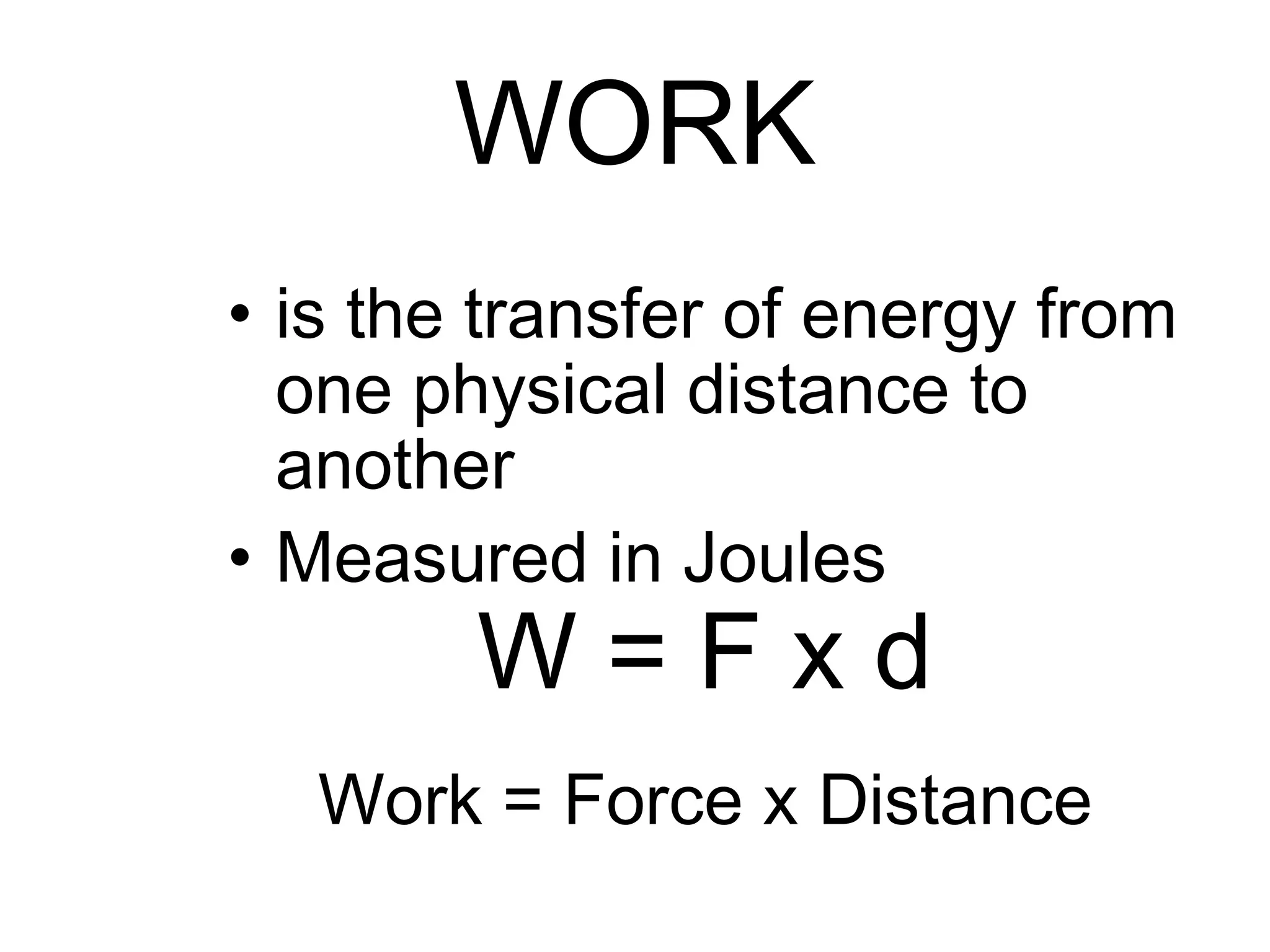
WORK is the transfer of energy from one physical distance to another Measured in Joules W = F x d Work = Force x Distance
MACHINES … ..any device or instrument that helps you do something
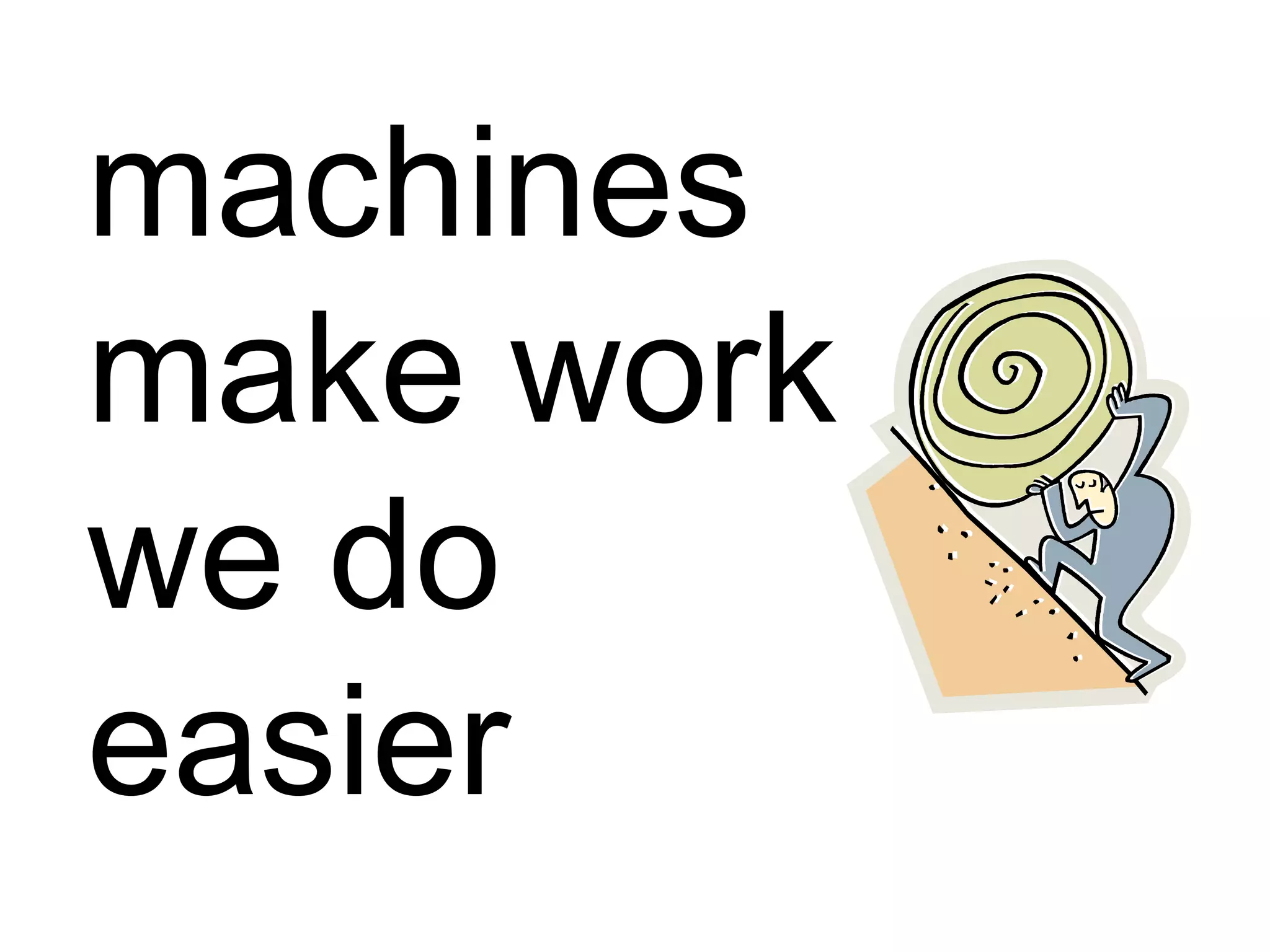
machines make work we do easier
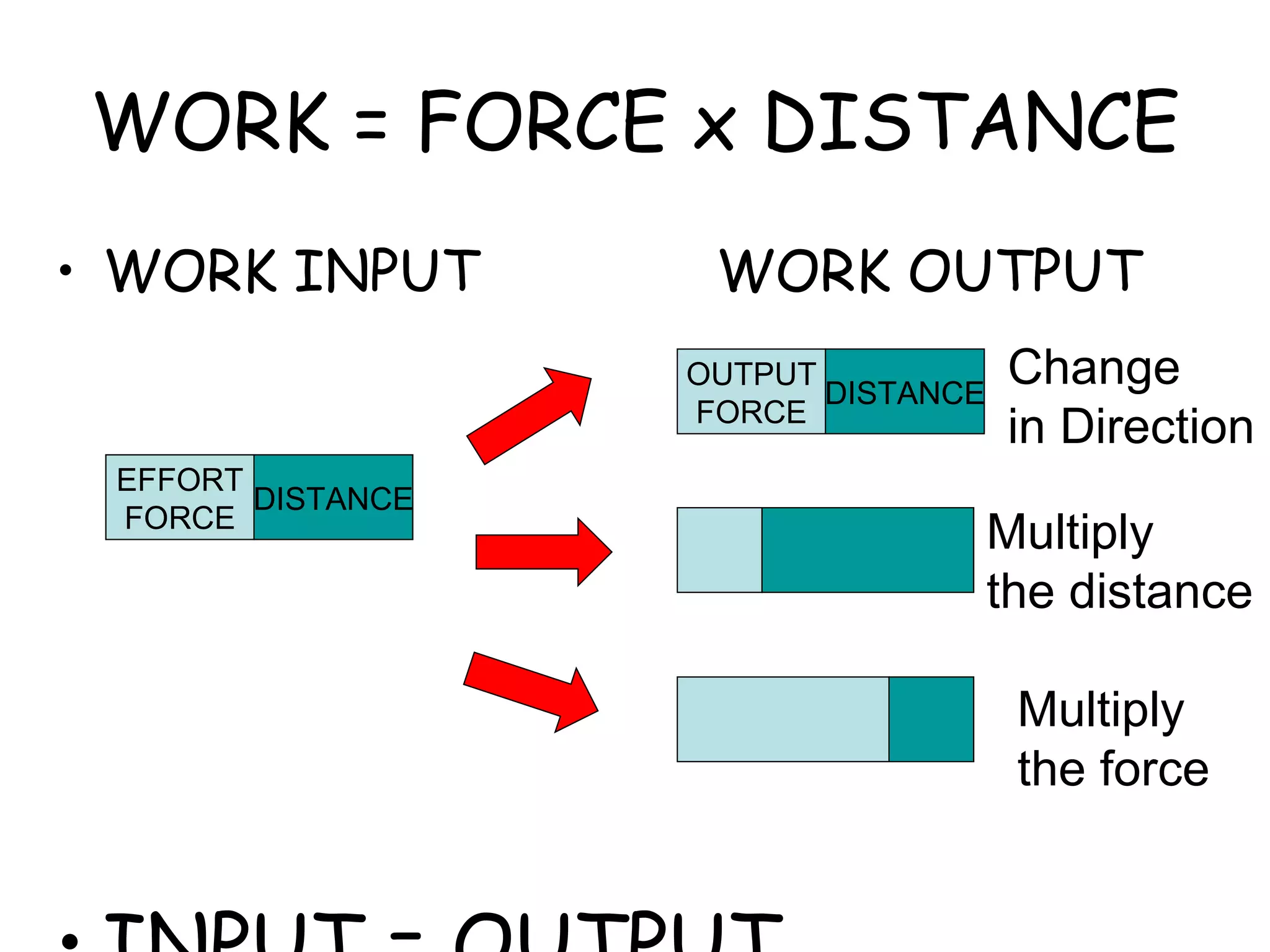
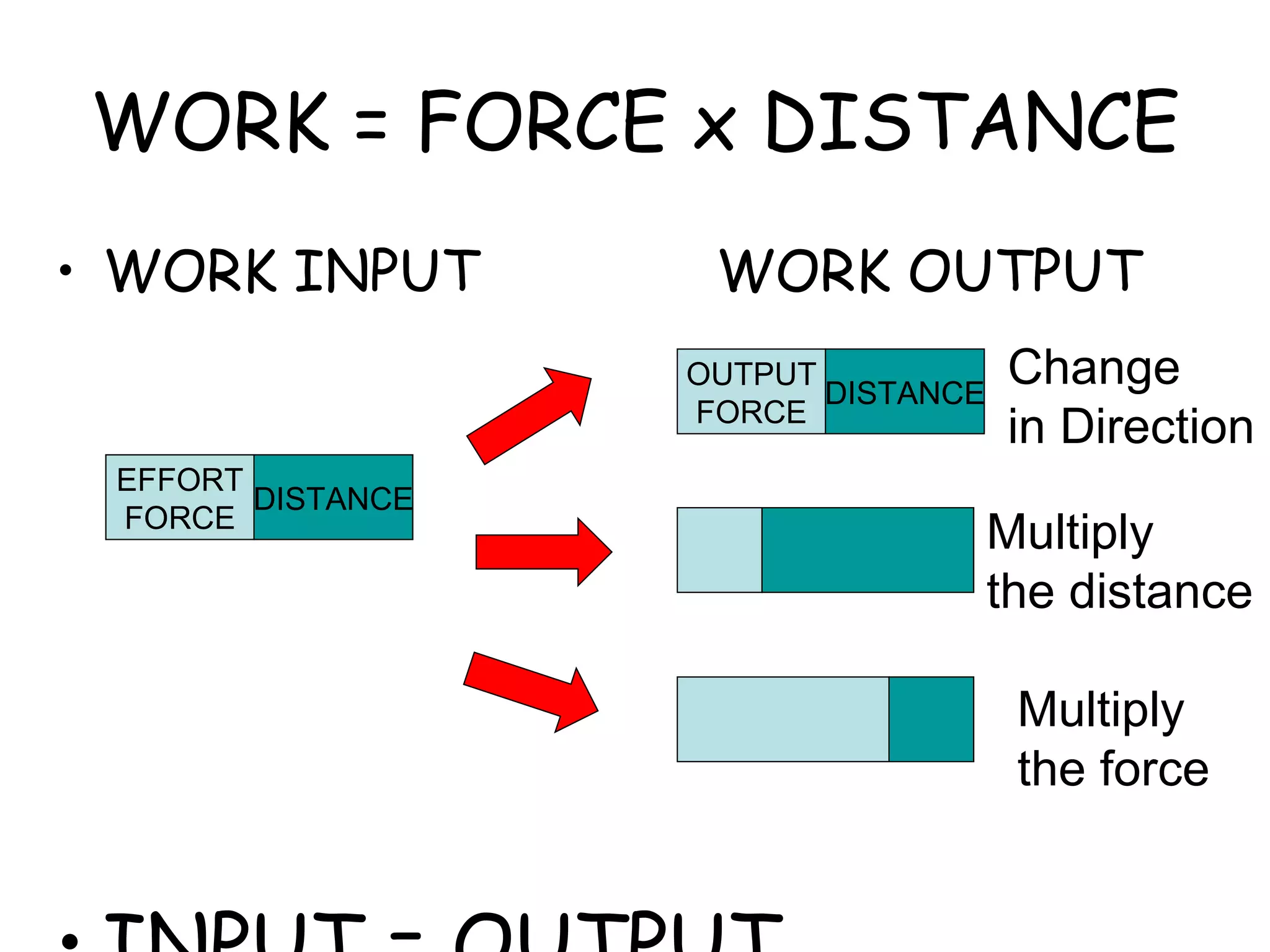
WORK = FORCE x DISTANCE WORK INPUT  WORK OUTPUT INPUT = OUTPUT EFFORT FORCE DISTANCE OUTPUT FORCE DISTANCE Multiply  the force Multiply  the distance Change  in Direction
TYPES OF WORK A.INPUT work that goes into the machine needs effort force
B.   OUTPUT Work done by the machine Resistance Force
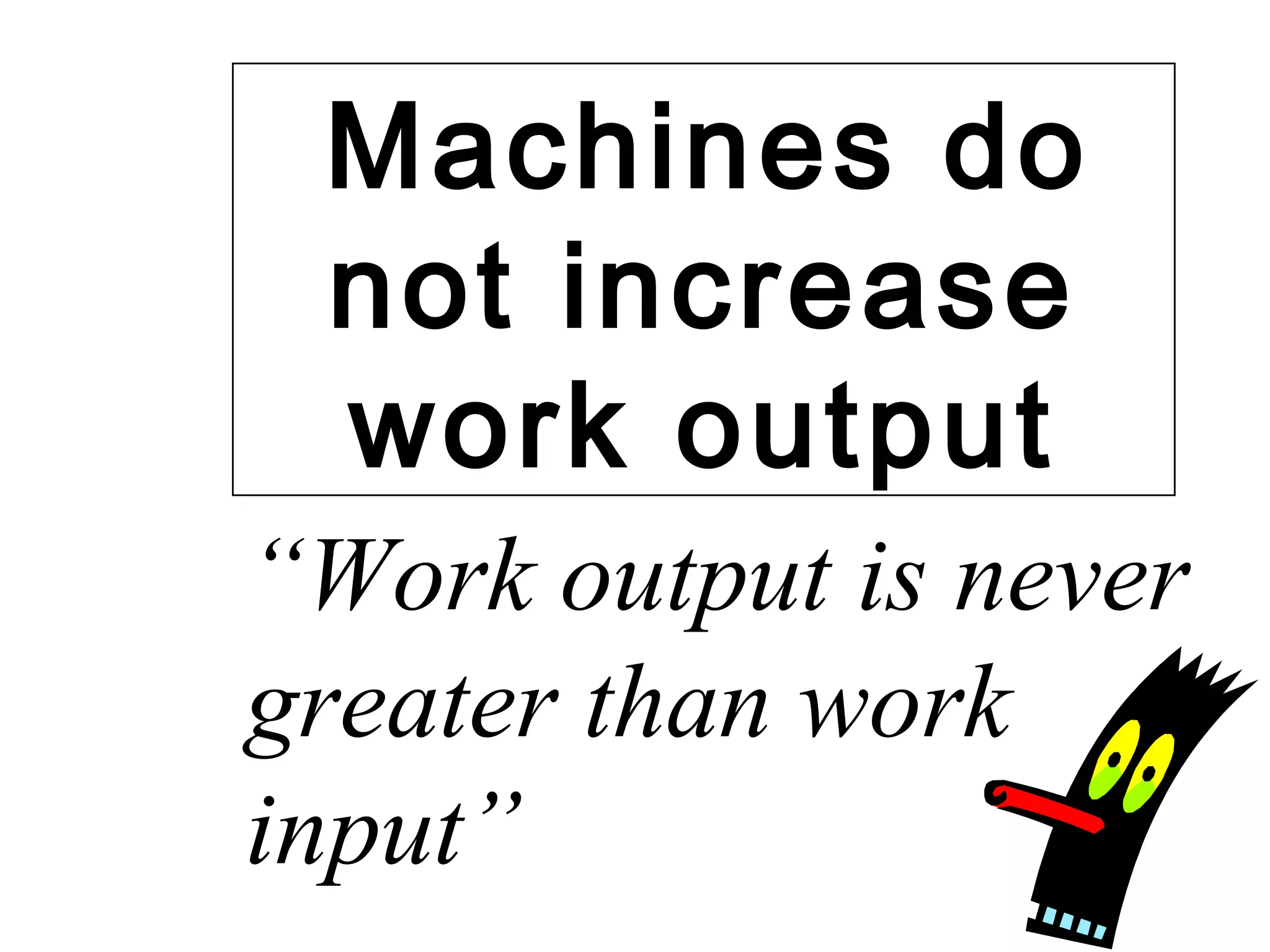
Machines do not increase work output “ Work output is never greater than work input”
WORK = FORCE x DISTANCE WORK INPUT  WORK OUTPUT INPUT = OUTPUT EFFORT FORCE DISTANCE OUTPUT FORCE DISTANCE Multiply  the force Multiply  the distance Change  in Direction
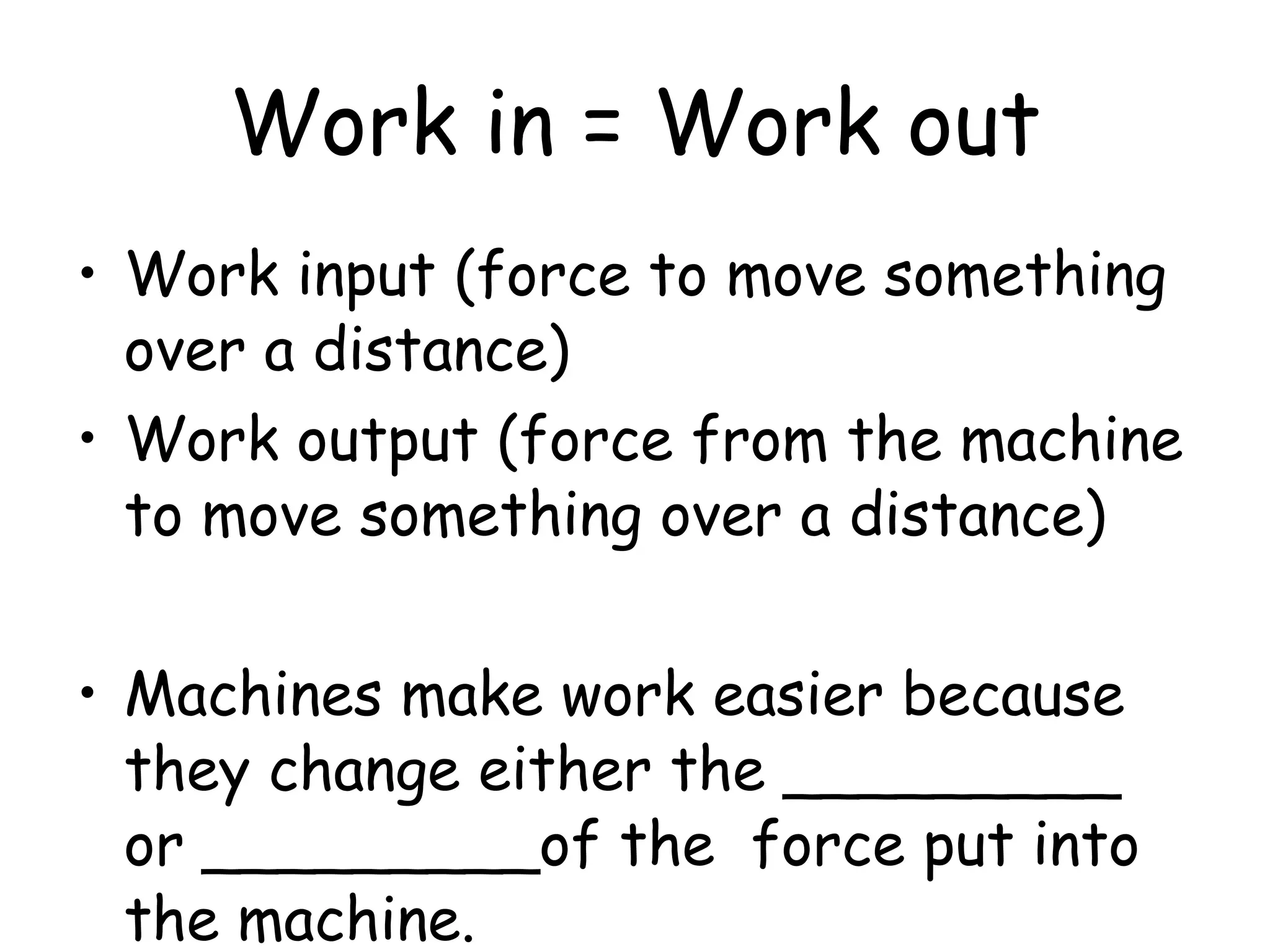
Work in = Work out Work input (force to move something over a distance)  Work output (force from the machine to move something over a distance)  Machines make work easier because they change either the _________ or _________of the  force put into the machine.
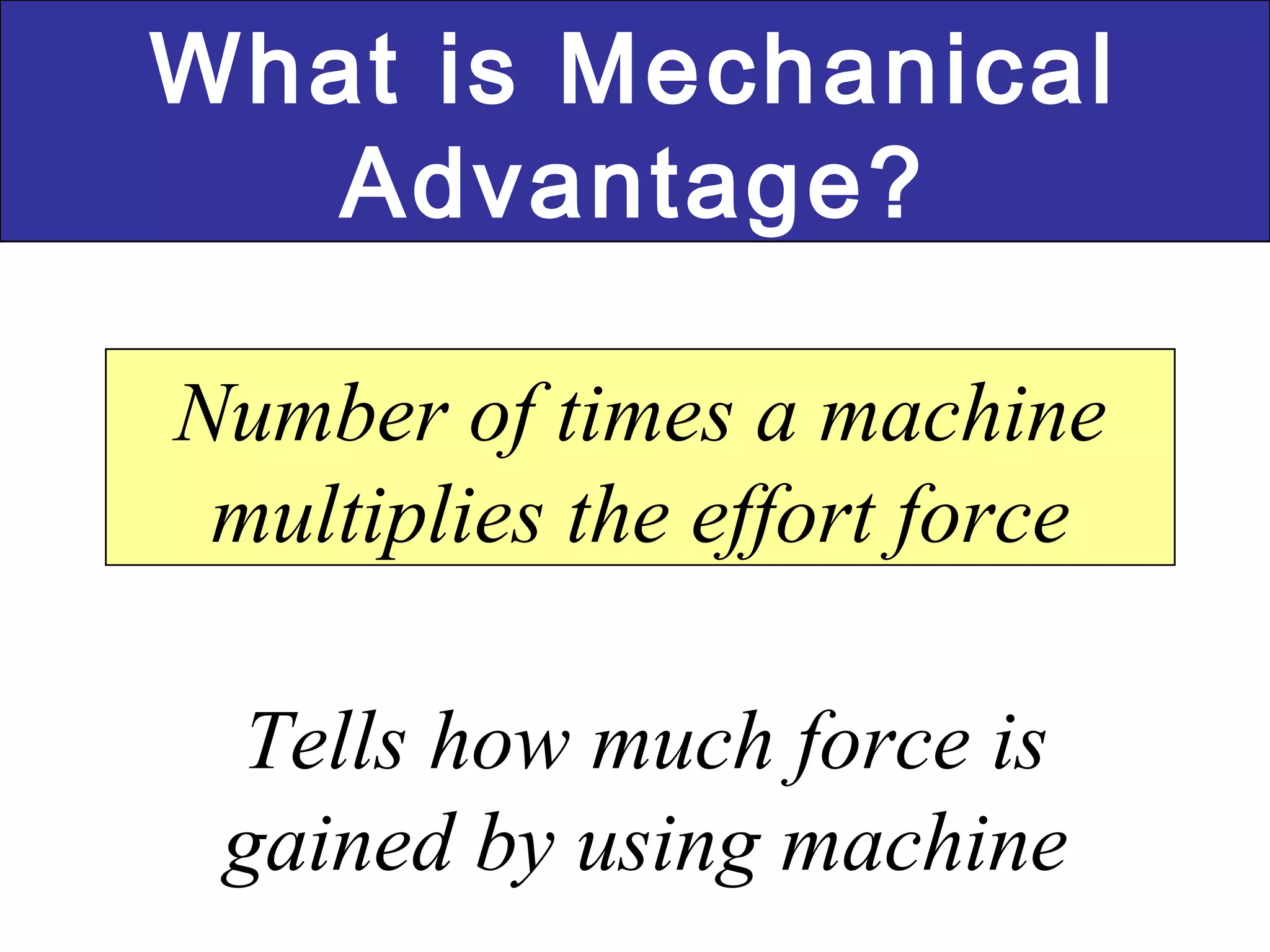
What is Mechanical Advantage? Number of times a machine multiplies the effort force Tells how much force is gained by using machine
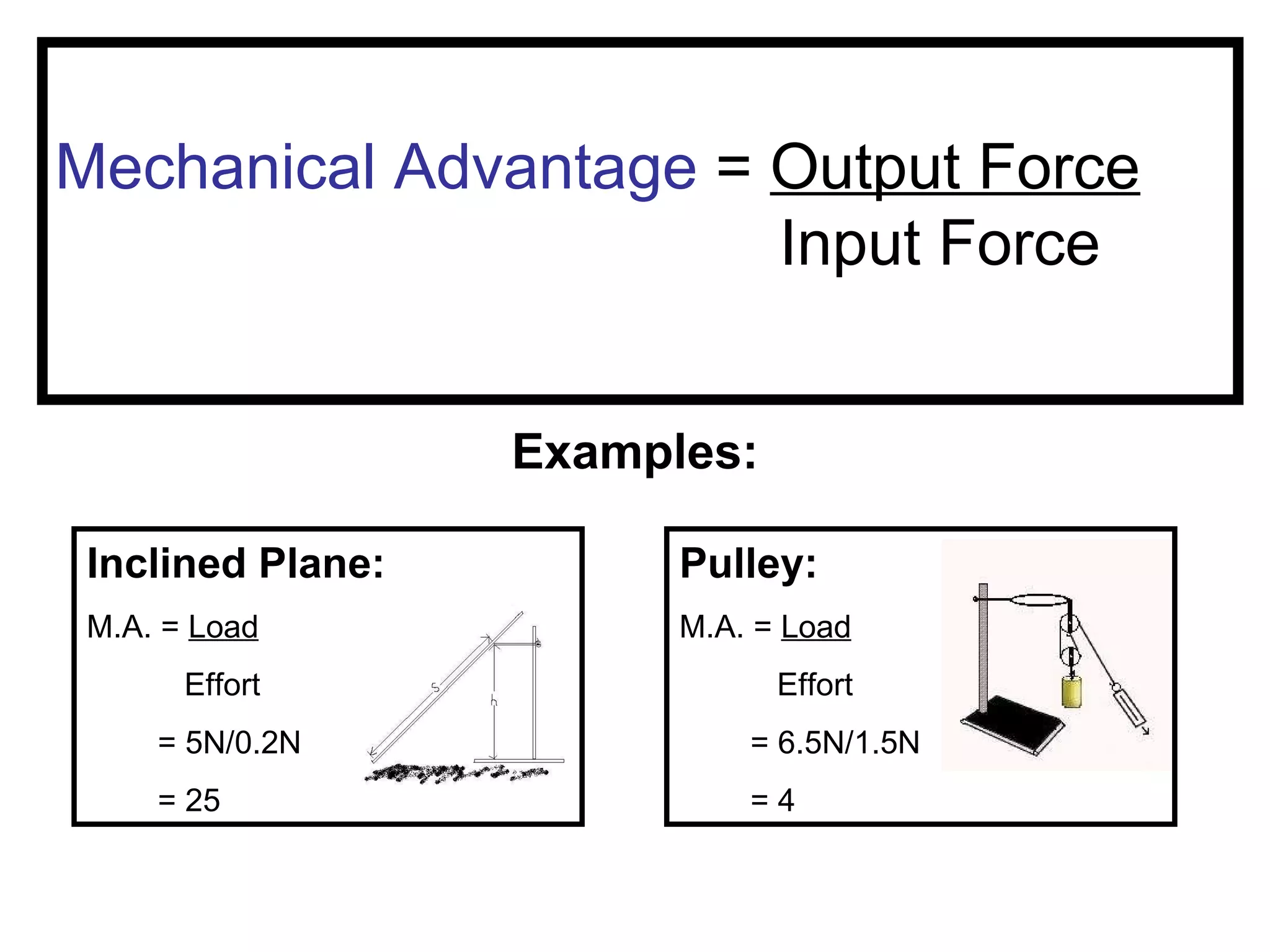
Mechanical Advantage  =  Output Force   Input Force  Examples: Inclined Plane:  M.A. =  Load Effort = 5N/0.2N = 25 Pulley:  M.A. =  Load Effort = 6.5N/1.5N = 4
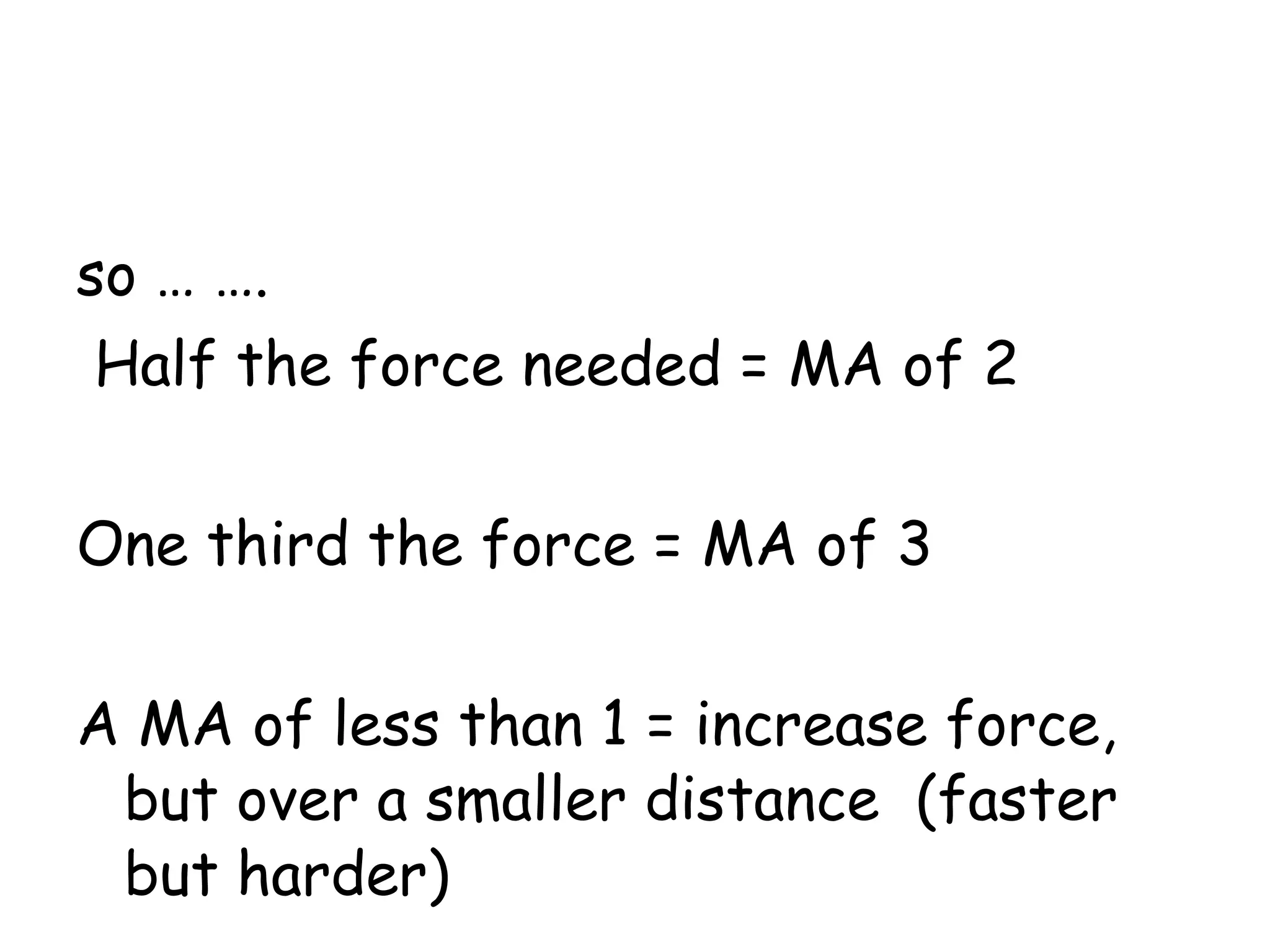
so … ….  Half the force needed = MA of 2 One third the force = MA of 3 A MA of less than 1 = increase force, but over a smaller distance  (faster but harder)
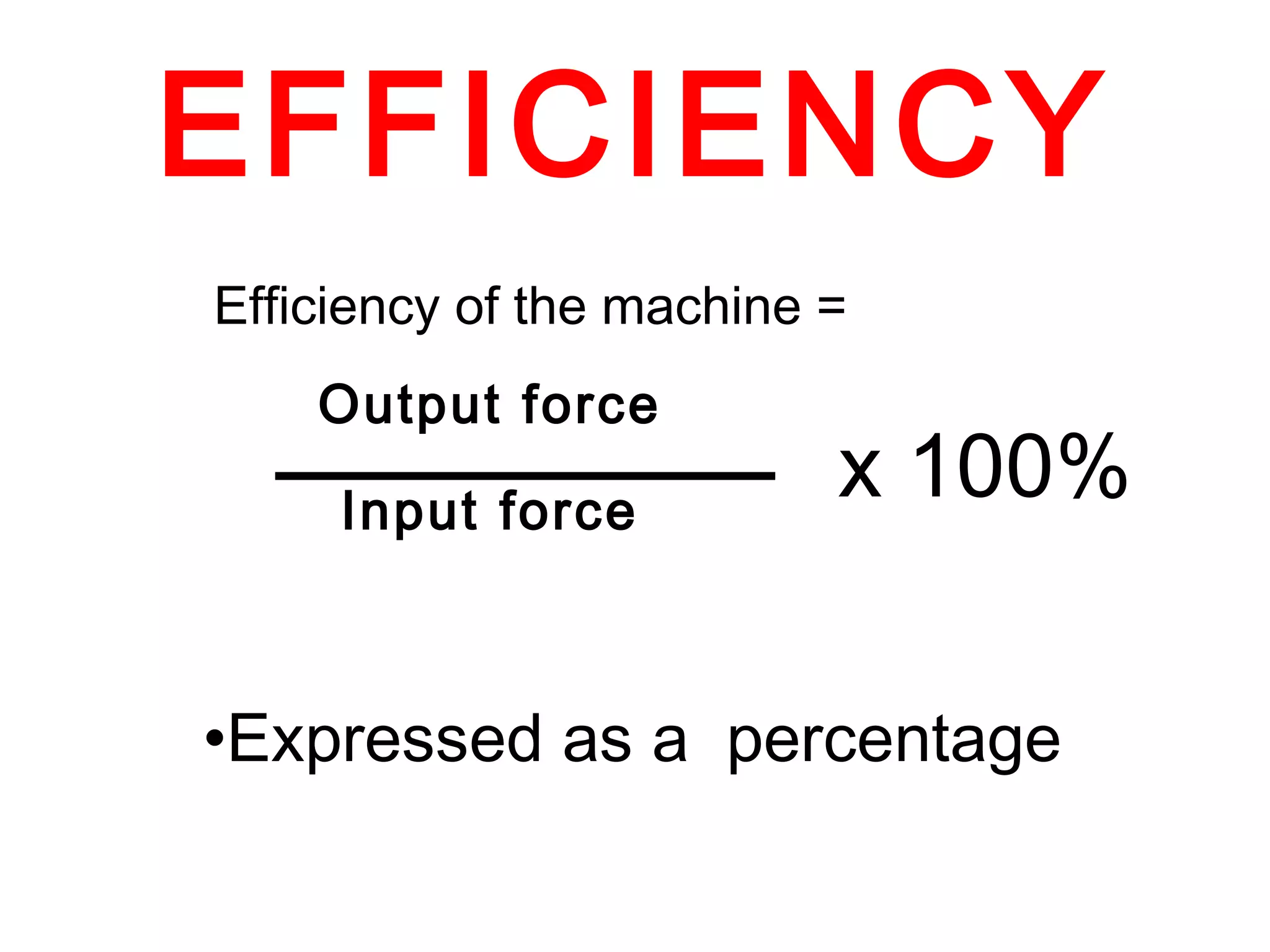
Output force Input force EFFICIENCY x 100% Efficiency of the machine =  Expressed as a  percentage
 
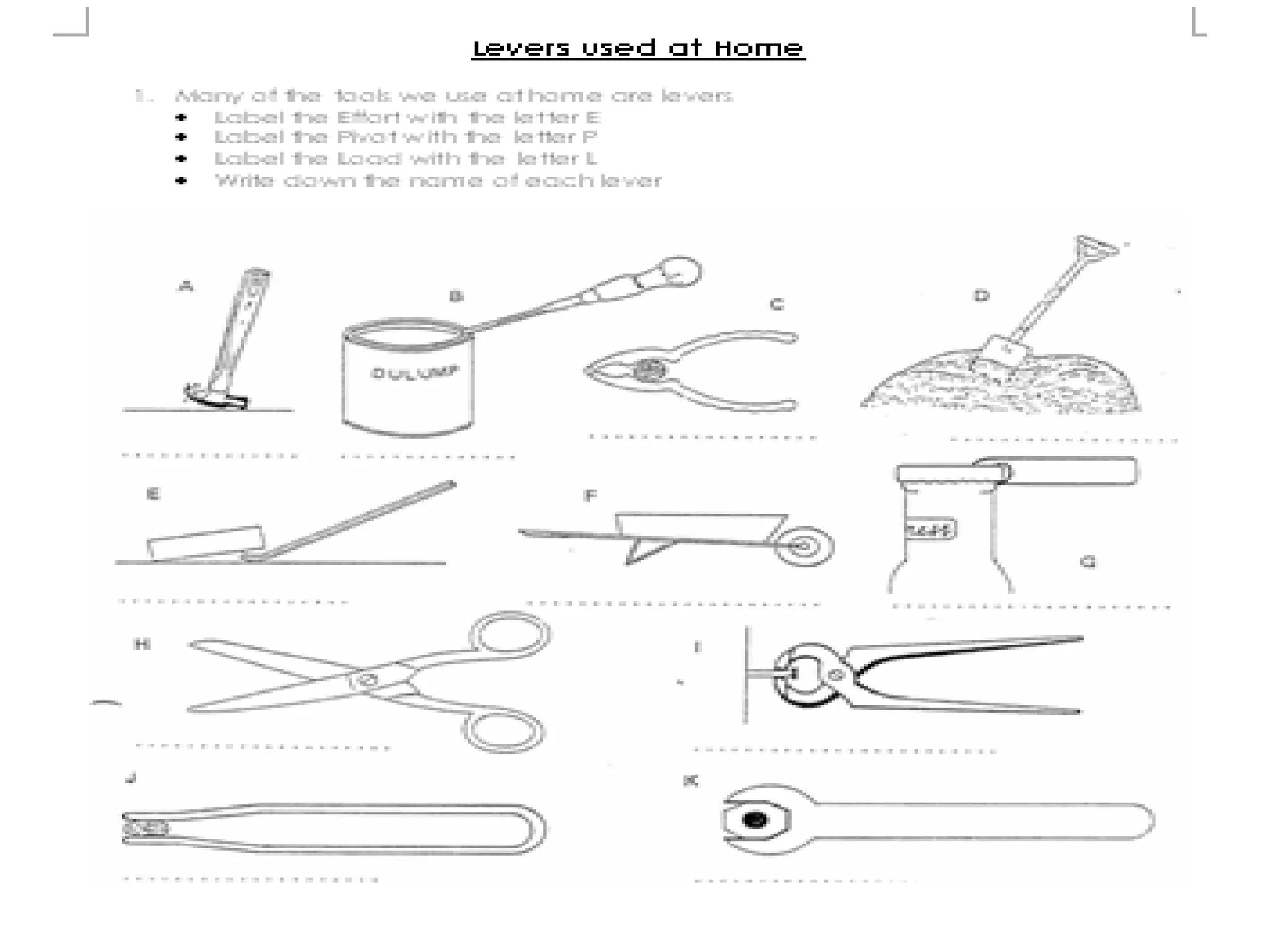
LEVERS Simple machines  used to lift weights
 
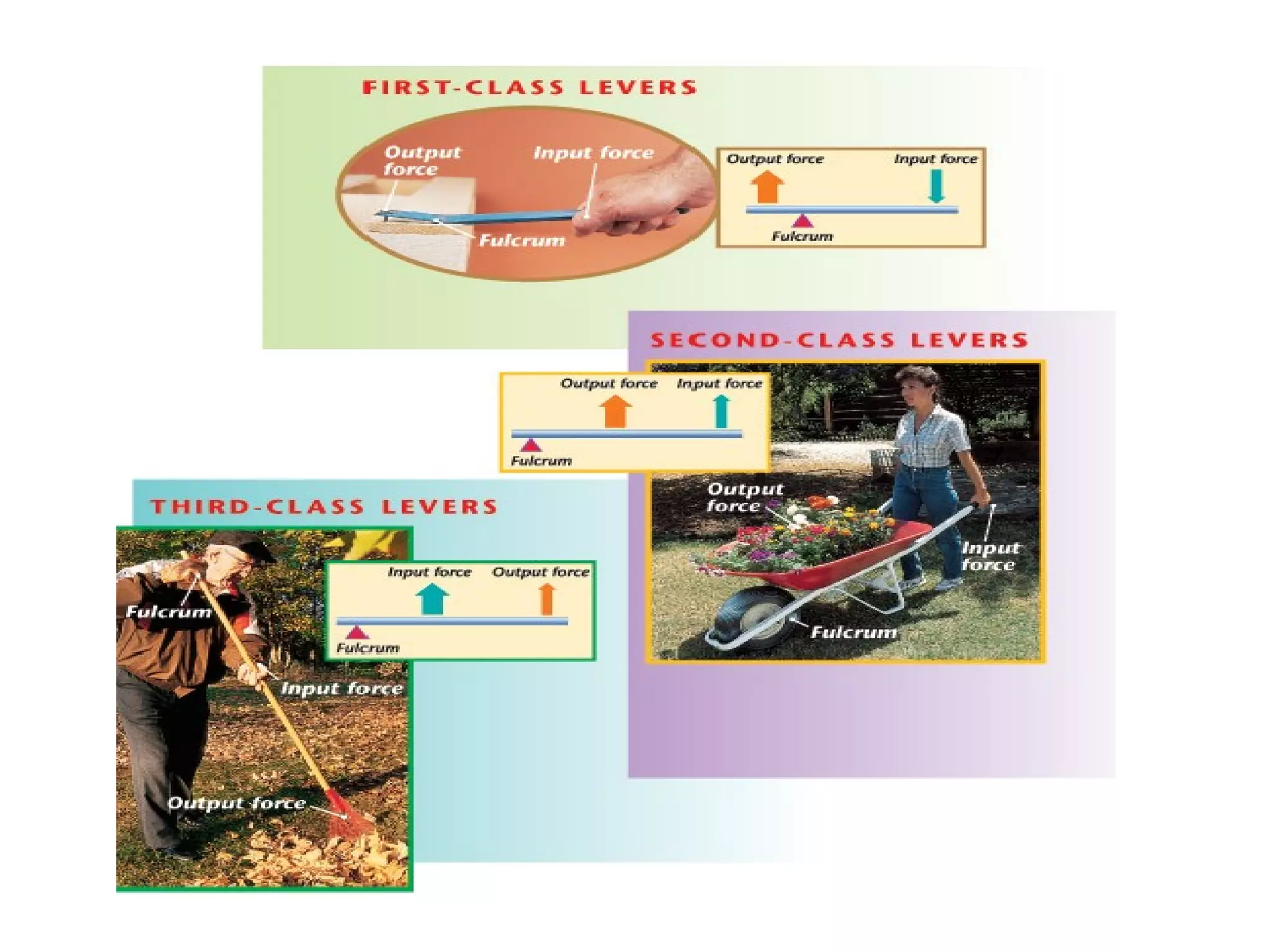
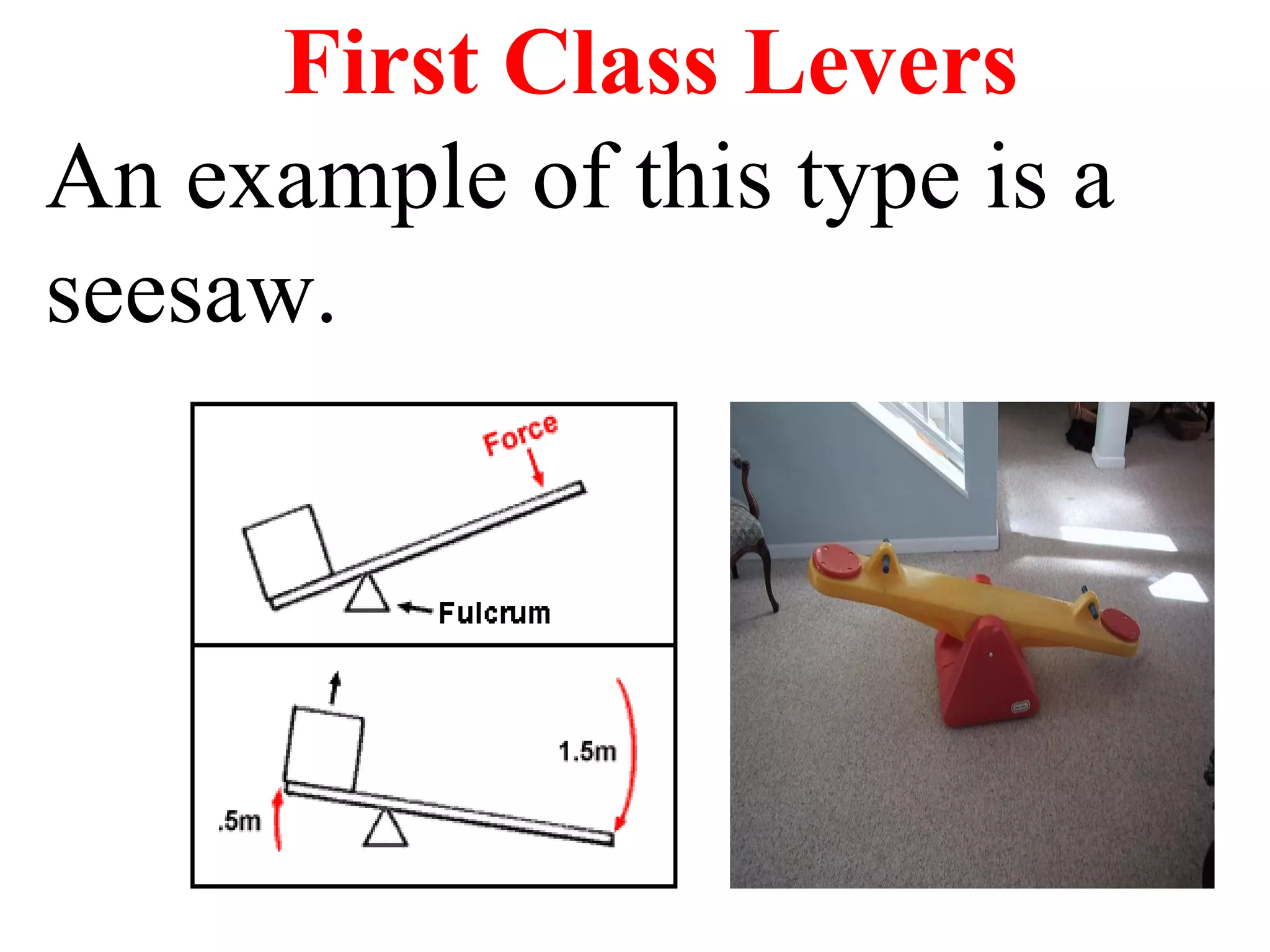
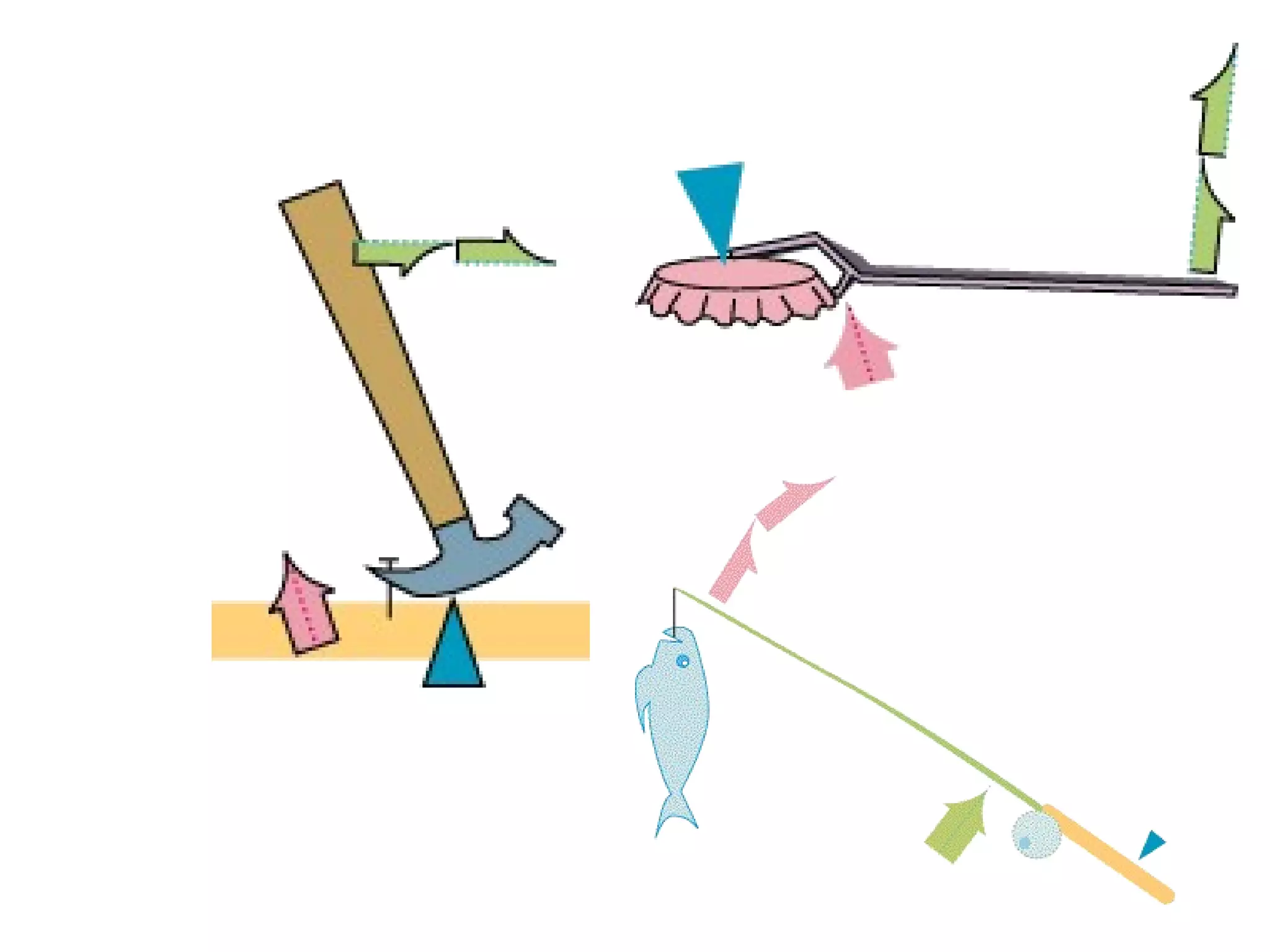
First Class Levers An example of this type is a seesaw.
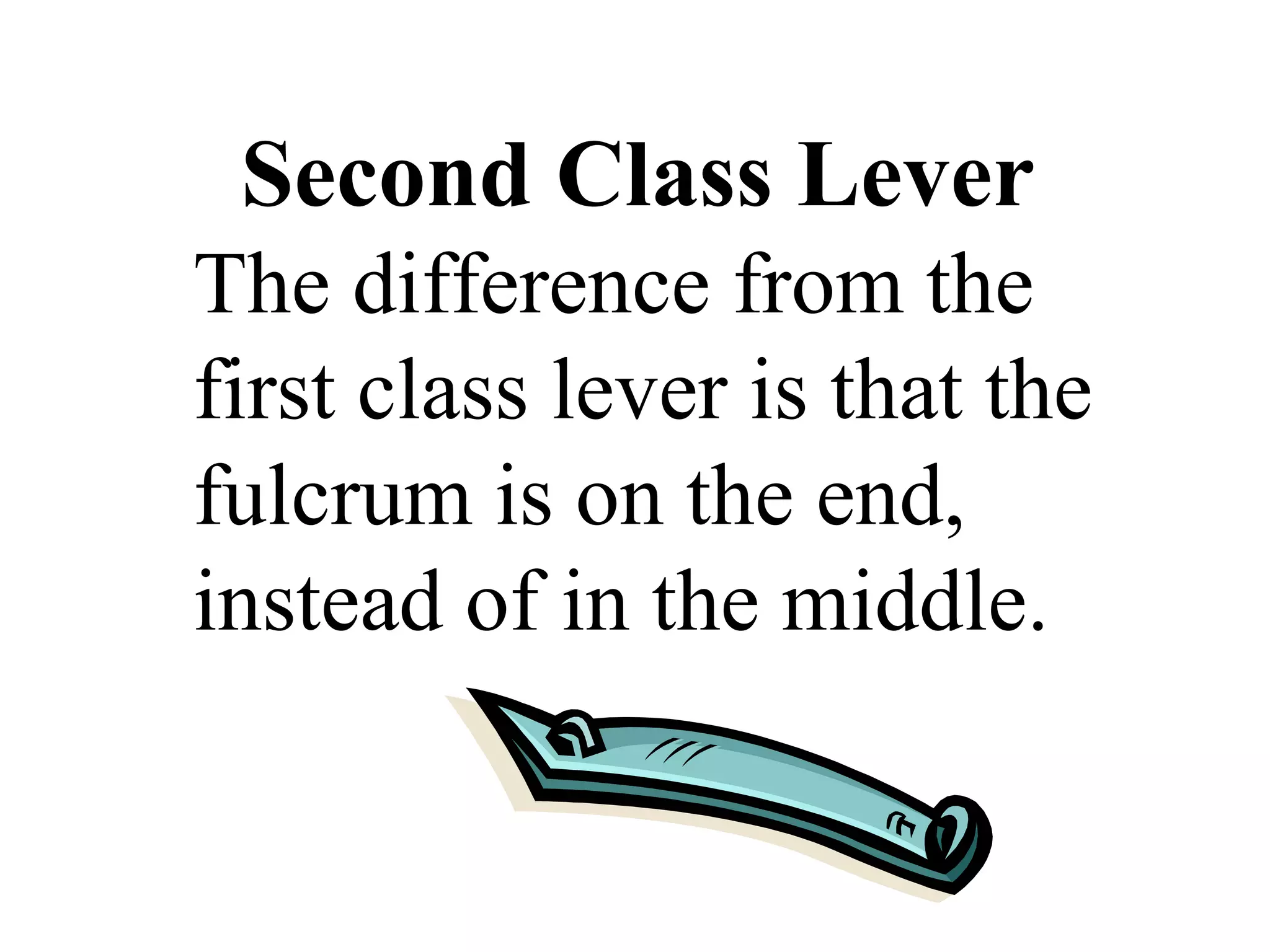
Second Class Lever  The difference from the first class lever is that the fulcrum is on the end, instead of in the middle.
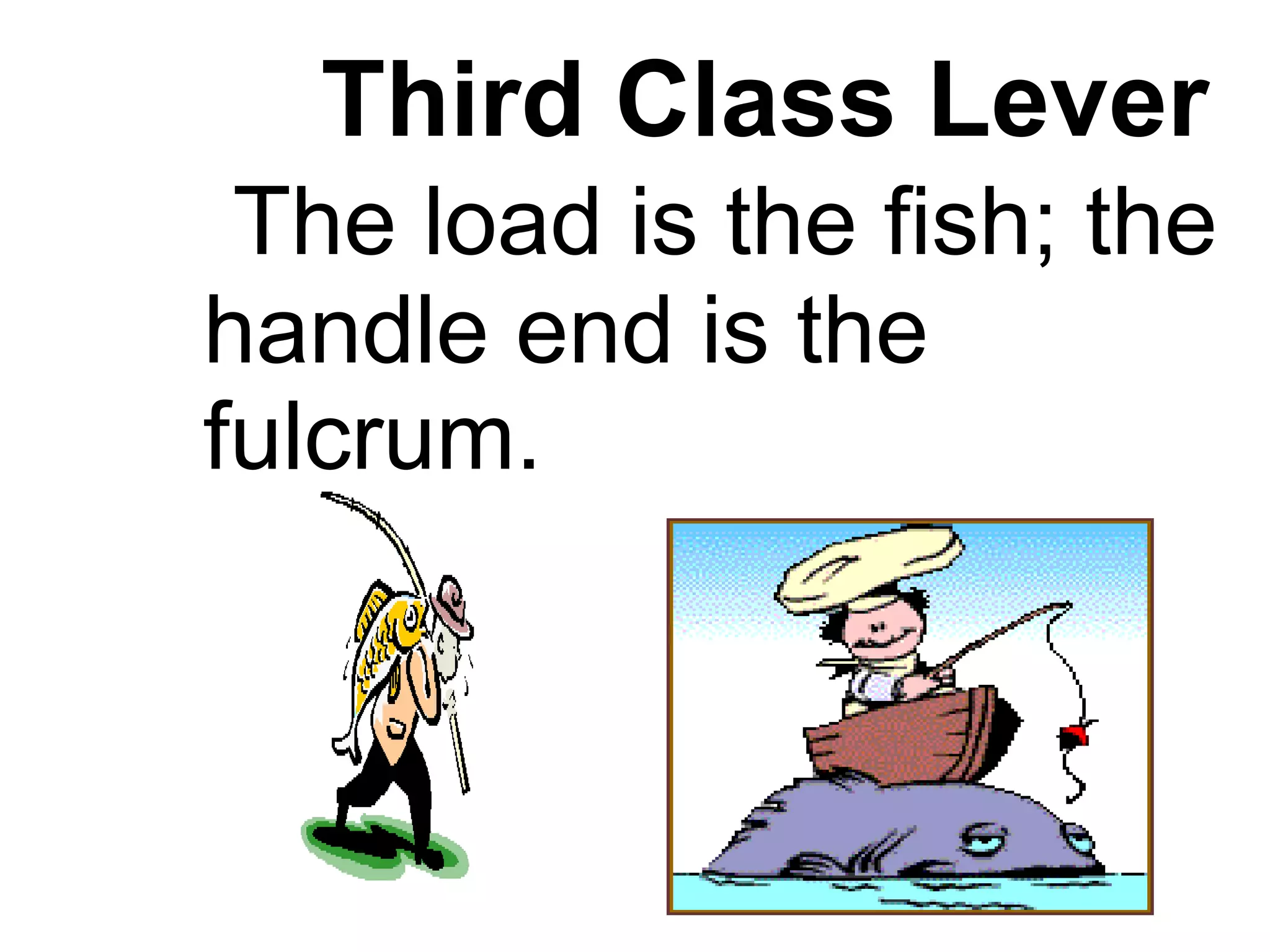
Third Class Lever    The load is the fish; the handle end is the fulcrum.


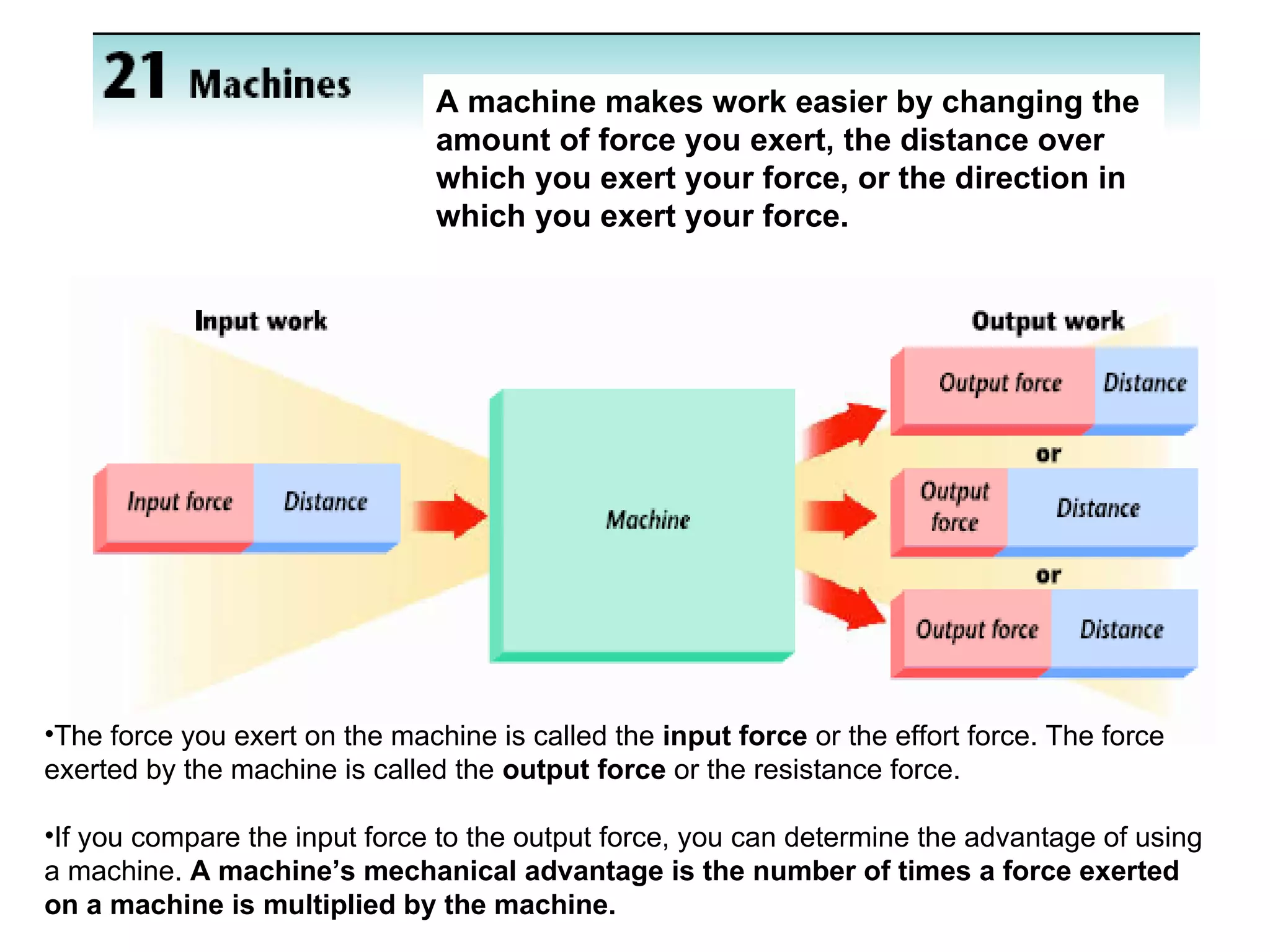
The force you exert on the machine is called the  input force  or the effort force. The force exerted by the machine is called the  output force  or the resistance force. If you compare the input force to the output force, you can determine the advantage of using a machine.  A machine’s mechanical advantage is the number of times a force exerted on a machine is multiplied by the machine. A machine makes work easier by changing the amount of force you exert, the distance over which you exert your force, or the direction in which you exert your force.
 
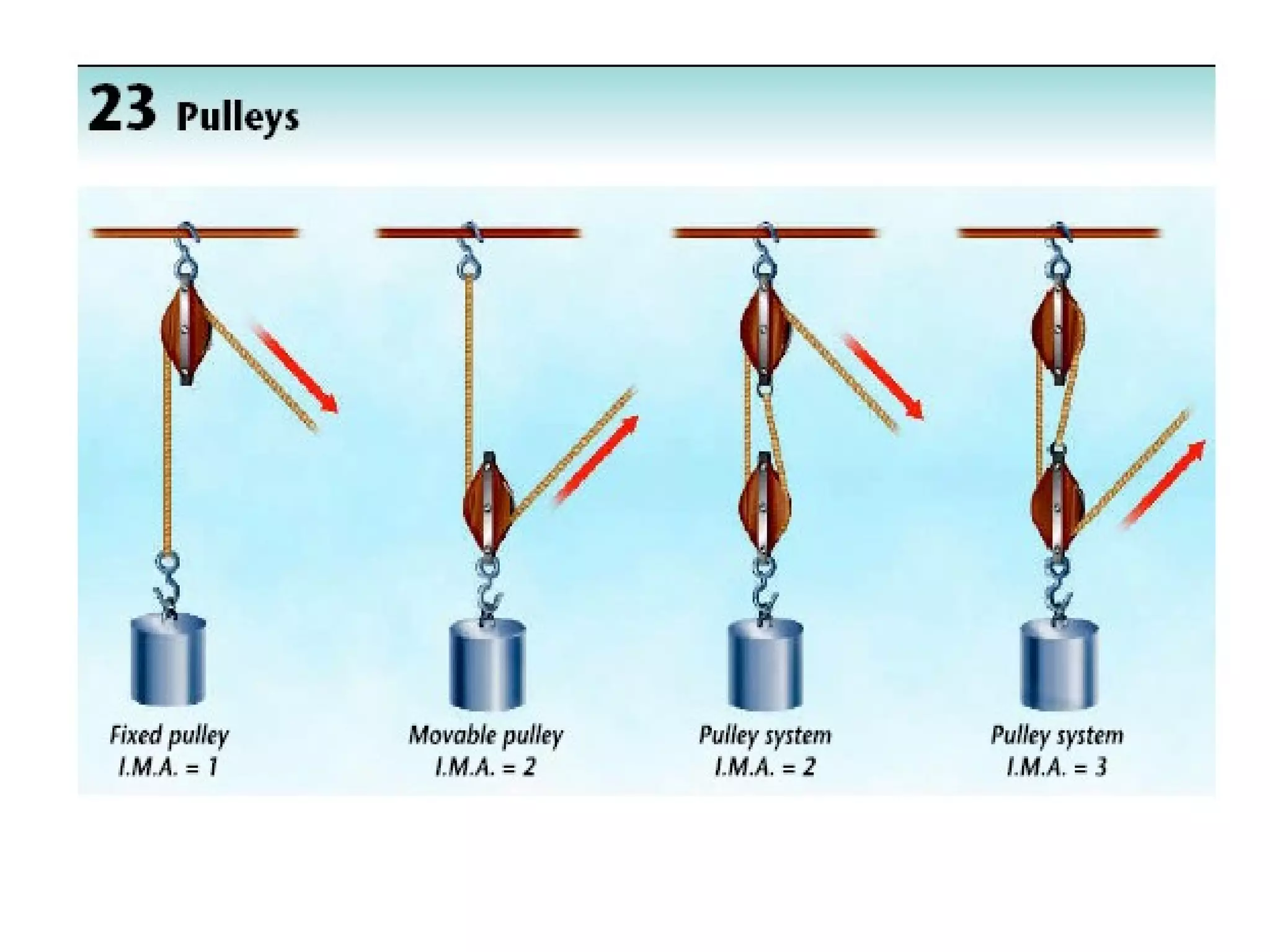
Pulley Changes the direction of the force and the amount of force.  Lever Increase input force and direction (eg prying open a can of paint)
INCLINED PLANE
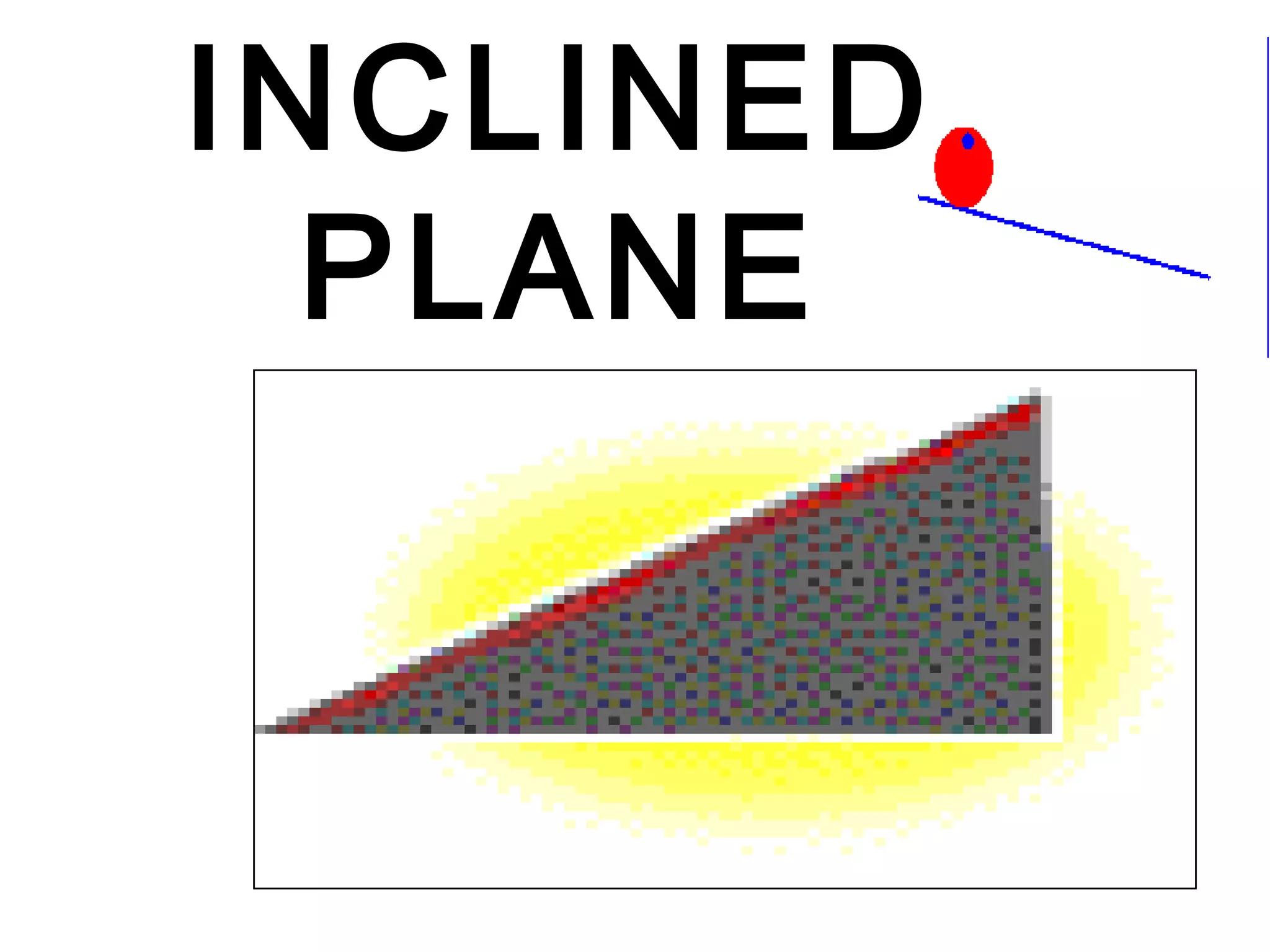
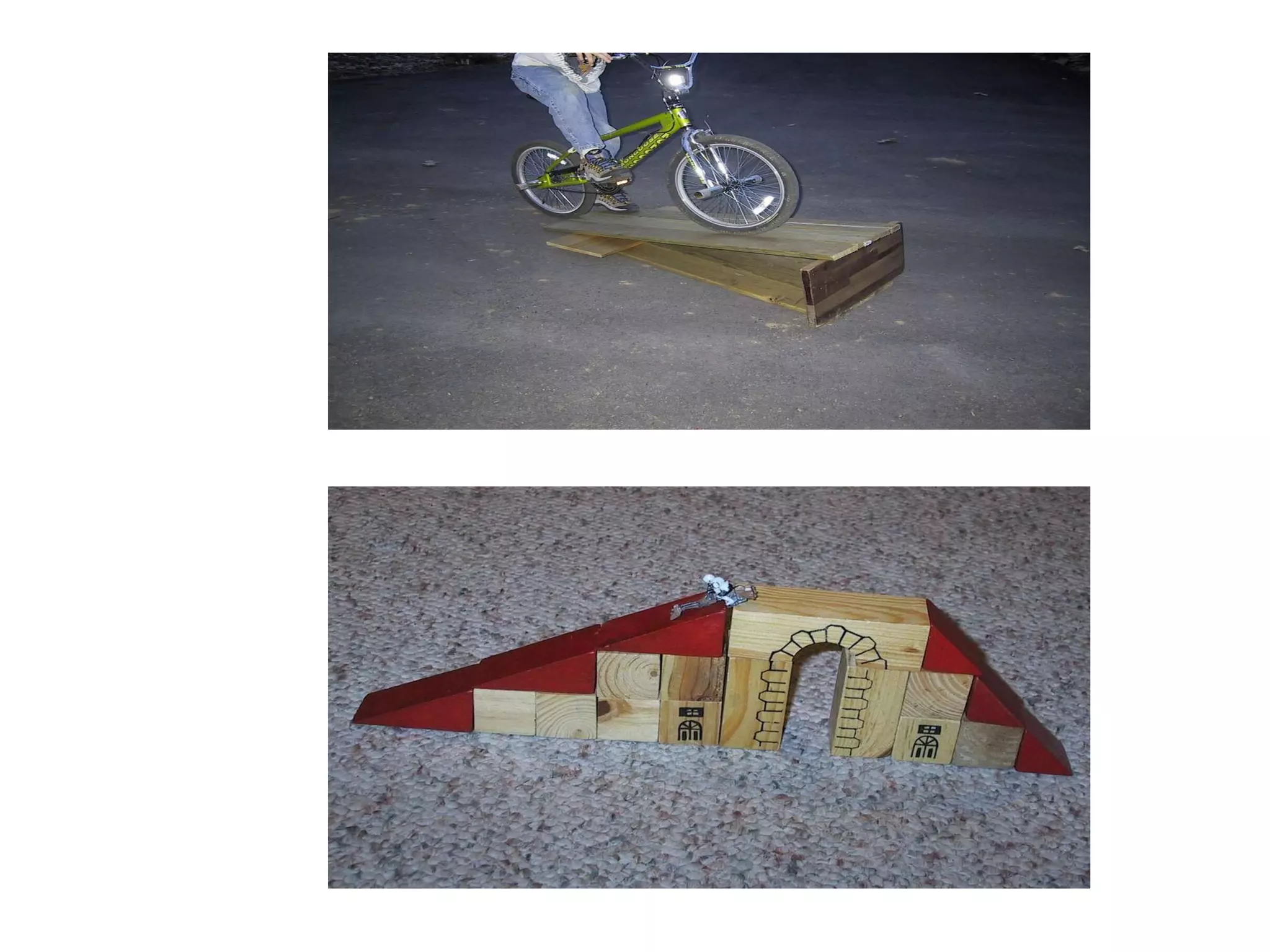
Inclined Plane A simple machine that makes it easier to  move a heavy object to a higher or lower elevation . It reduces the amount of force needed to lift the object by increasing the distance.
INCLINED PLANE Increases the distance so reduces the force Ideal MA =  Length Height
 
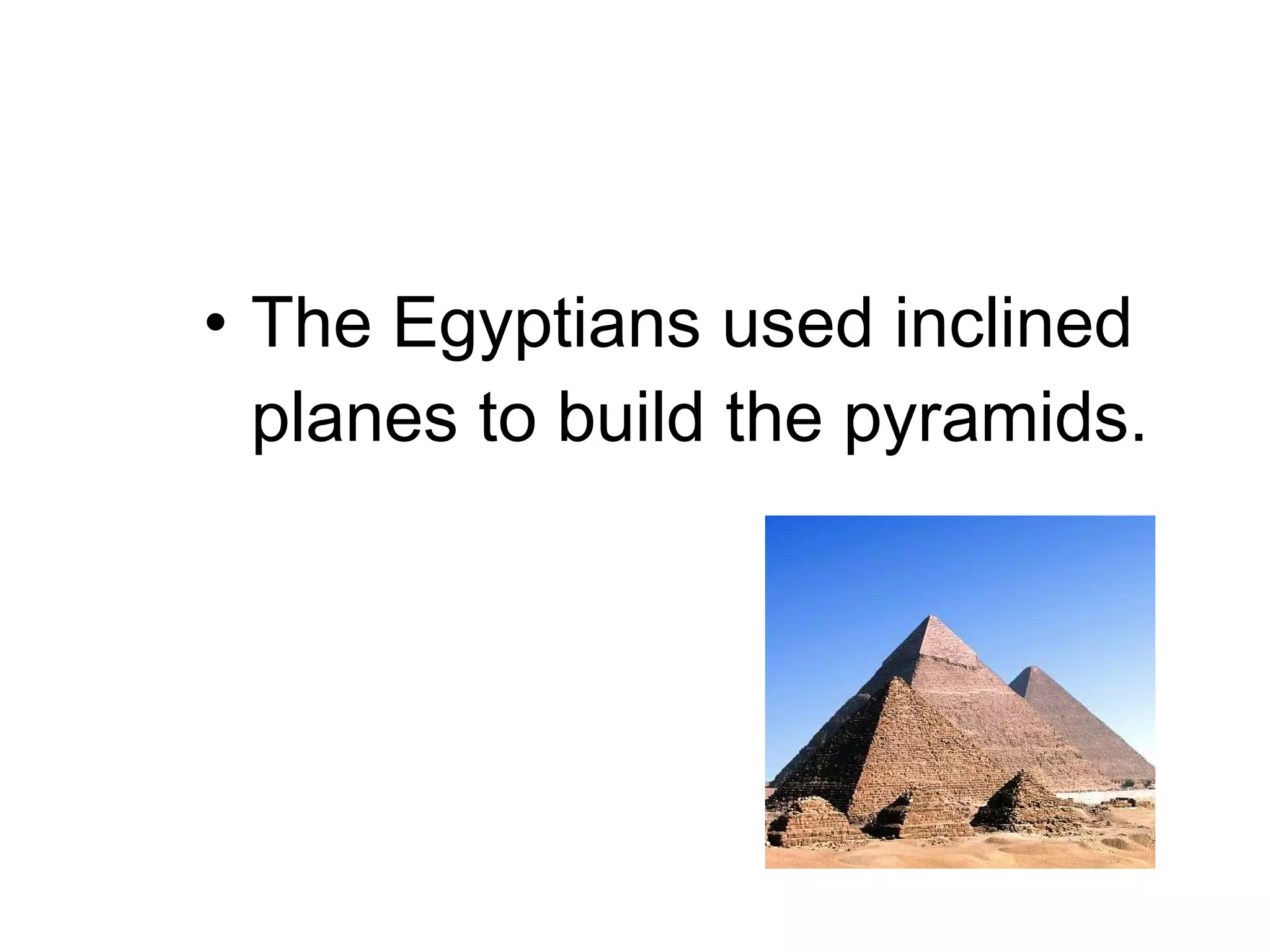
The Egyptians used inclined planes to build the pyramids.
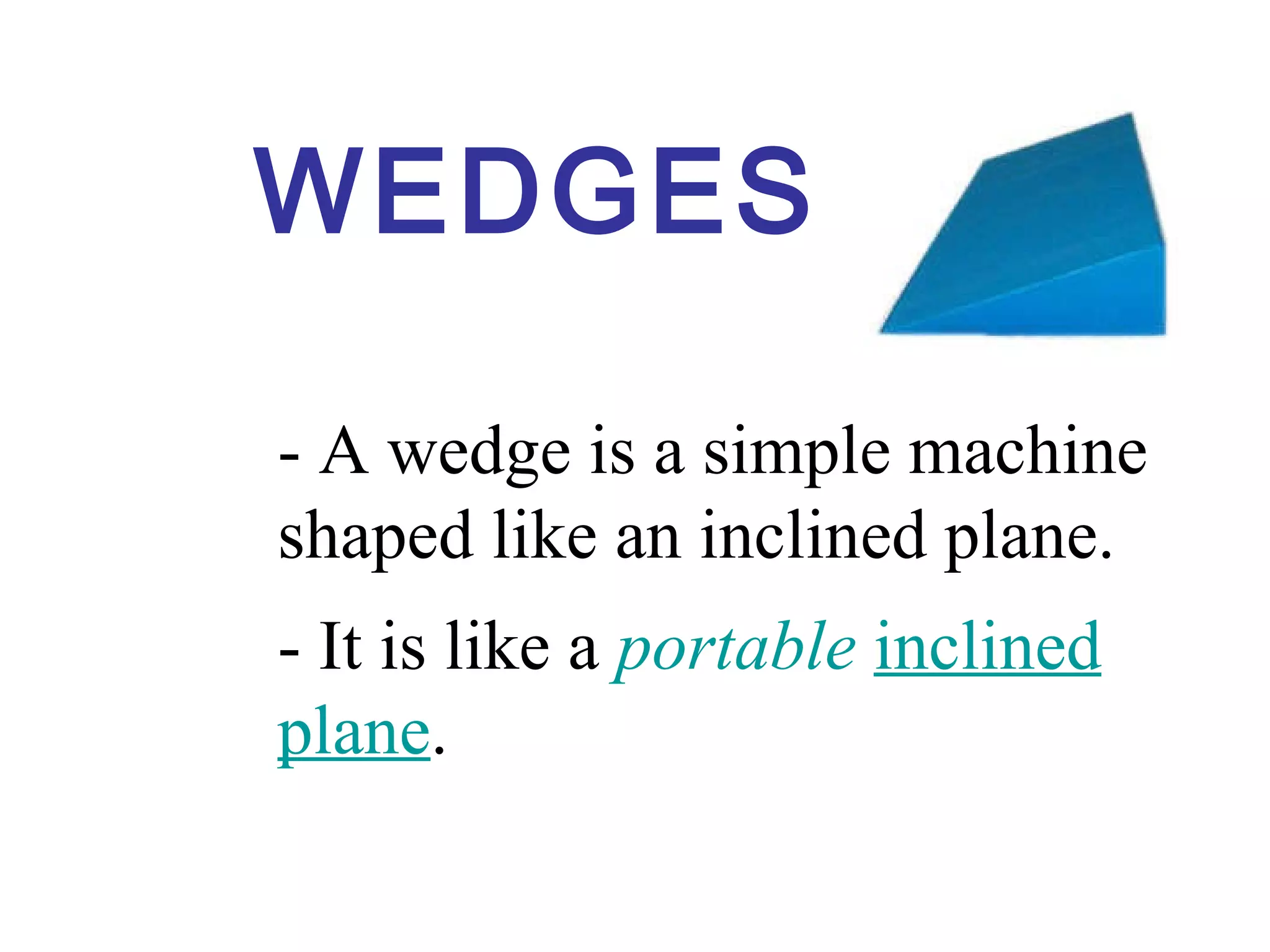
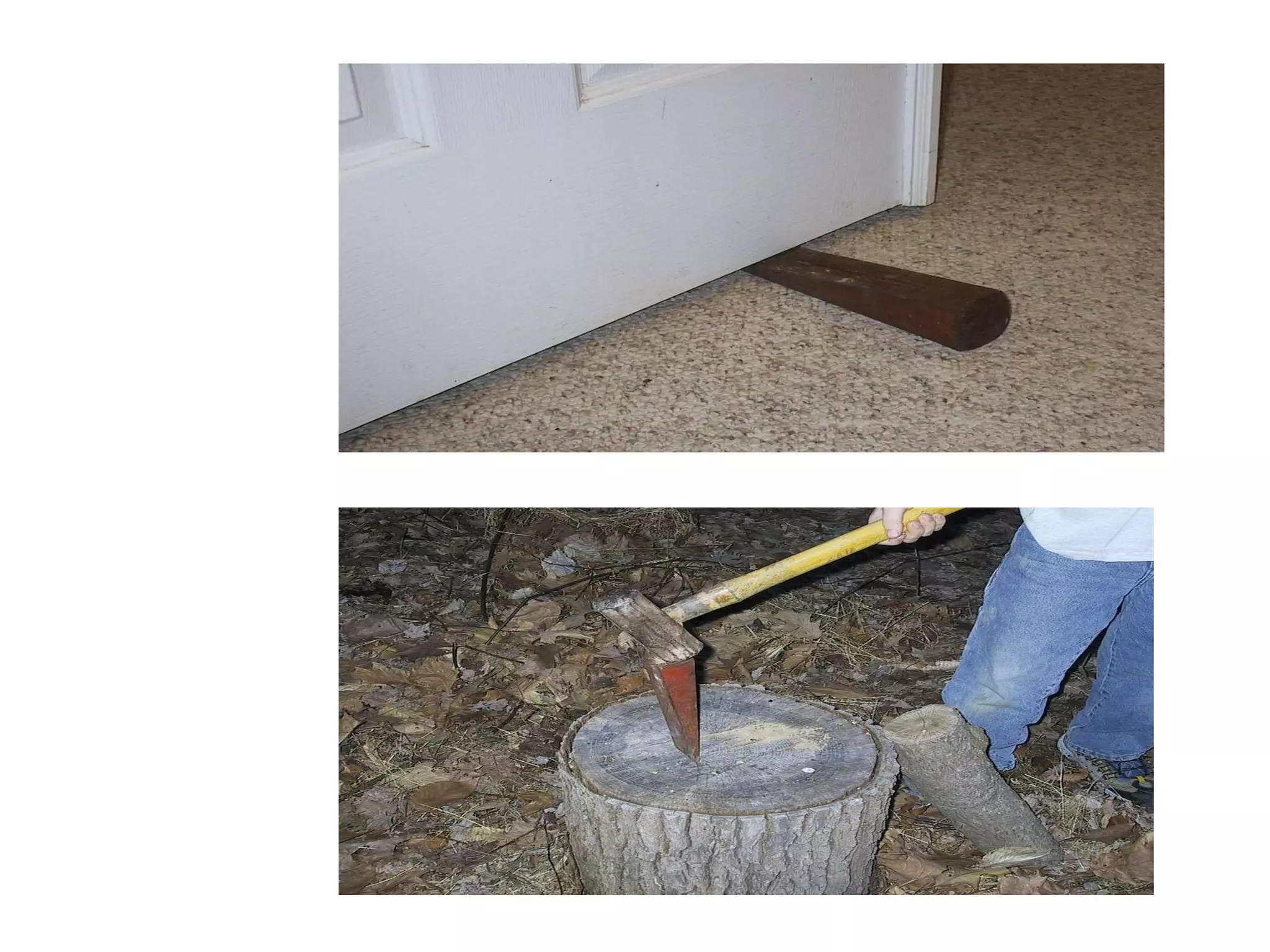
WEDGES - A wedge is a simple machine shaped like an  inclined plane . - It is like a  portable   inclined plane .
 
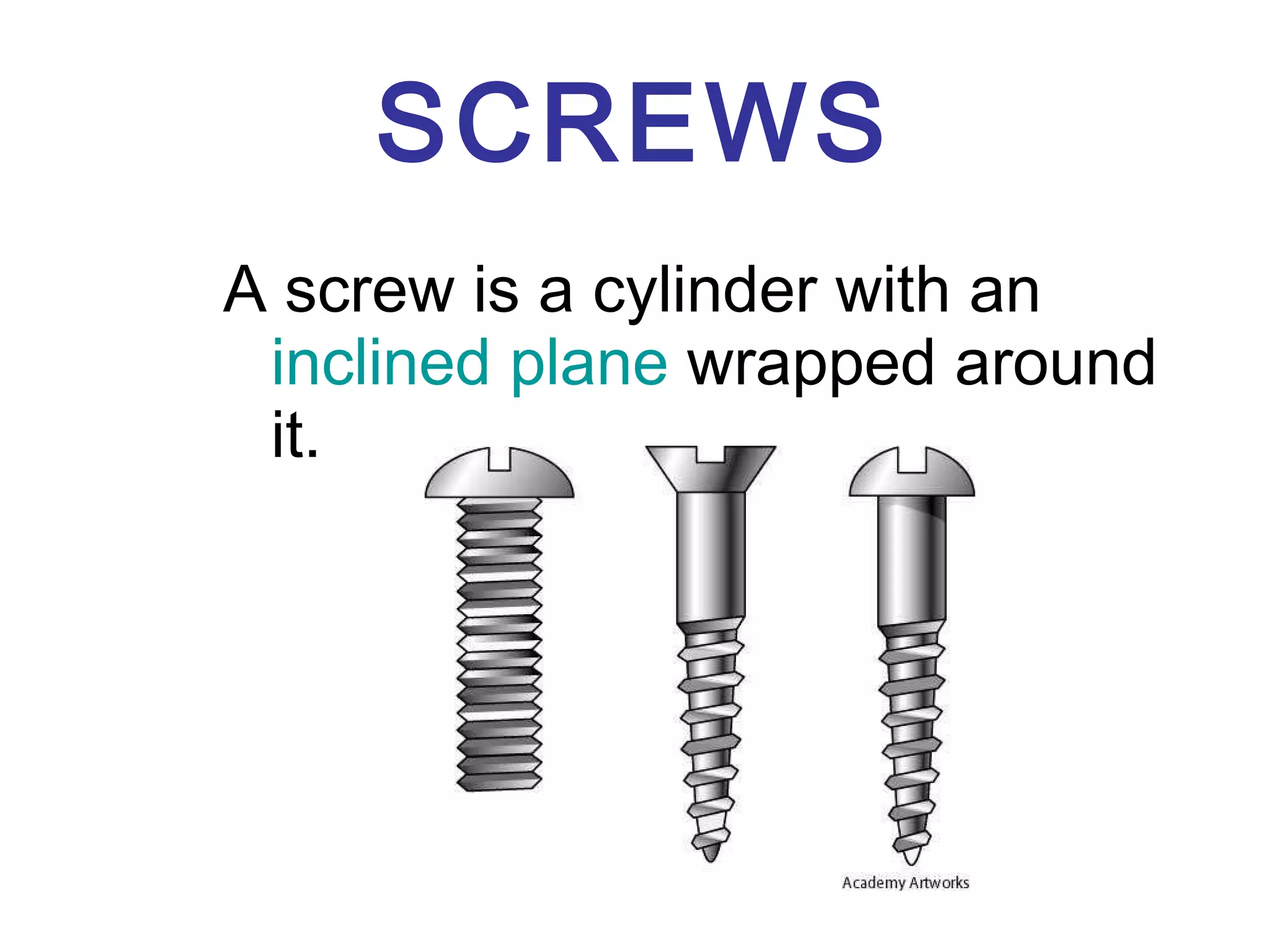
SCREWS A screw is a cylinder with an  inclined plane  wrapped around it.
 
Wedge and Screw Force is applied over a longer distance Think of the screw being a long inclined plane!!!
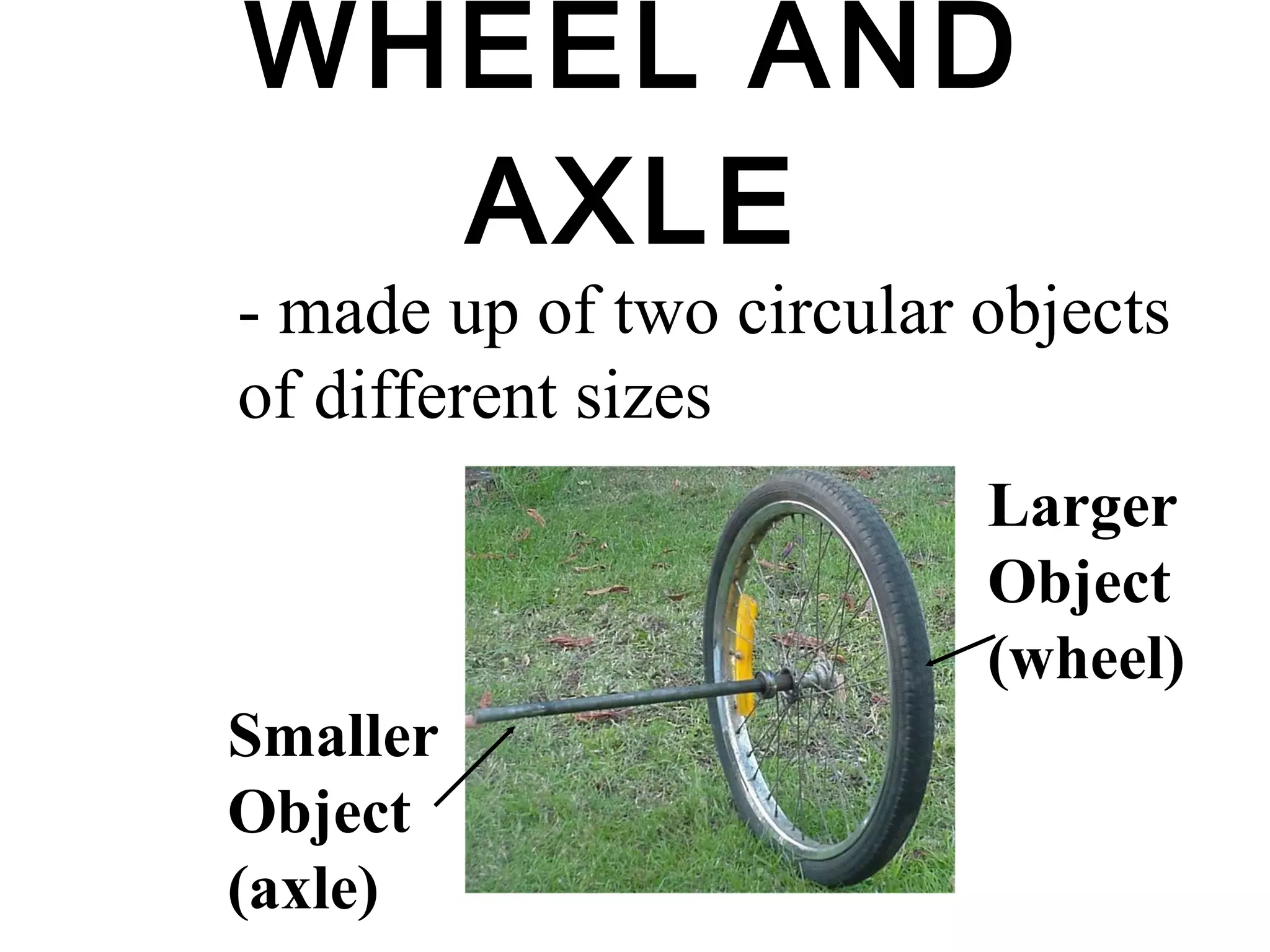
WHEEL AND AXLE - made up of two circular objects of different sizes Smaller Object (axle) Larger Object (wheel)
 
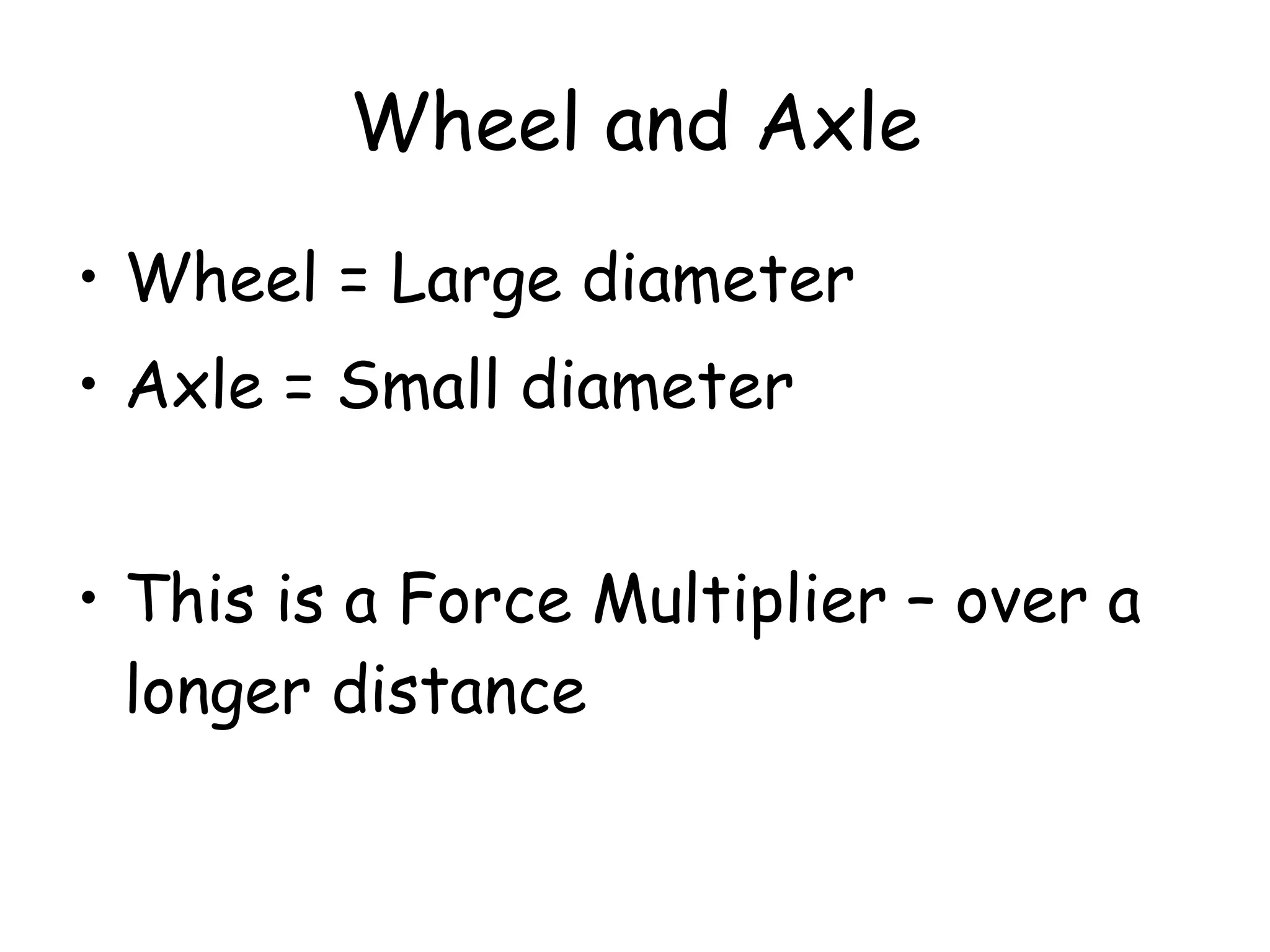
Wheel and Axle Wheel = Large diameter Axle = Small diameter  This is a Force Multiplier – over a longer distance
 

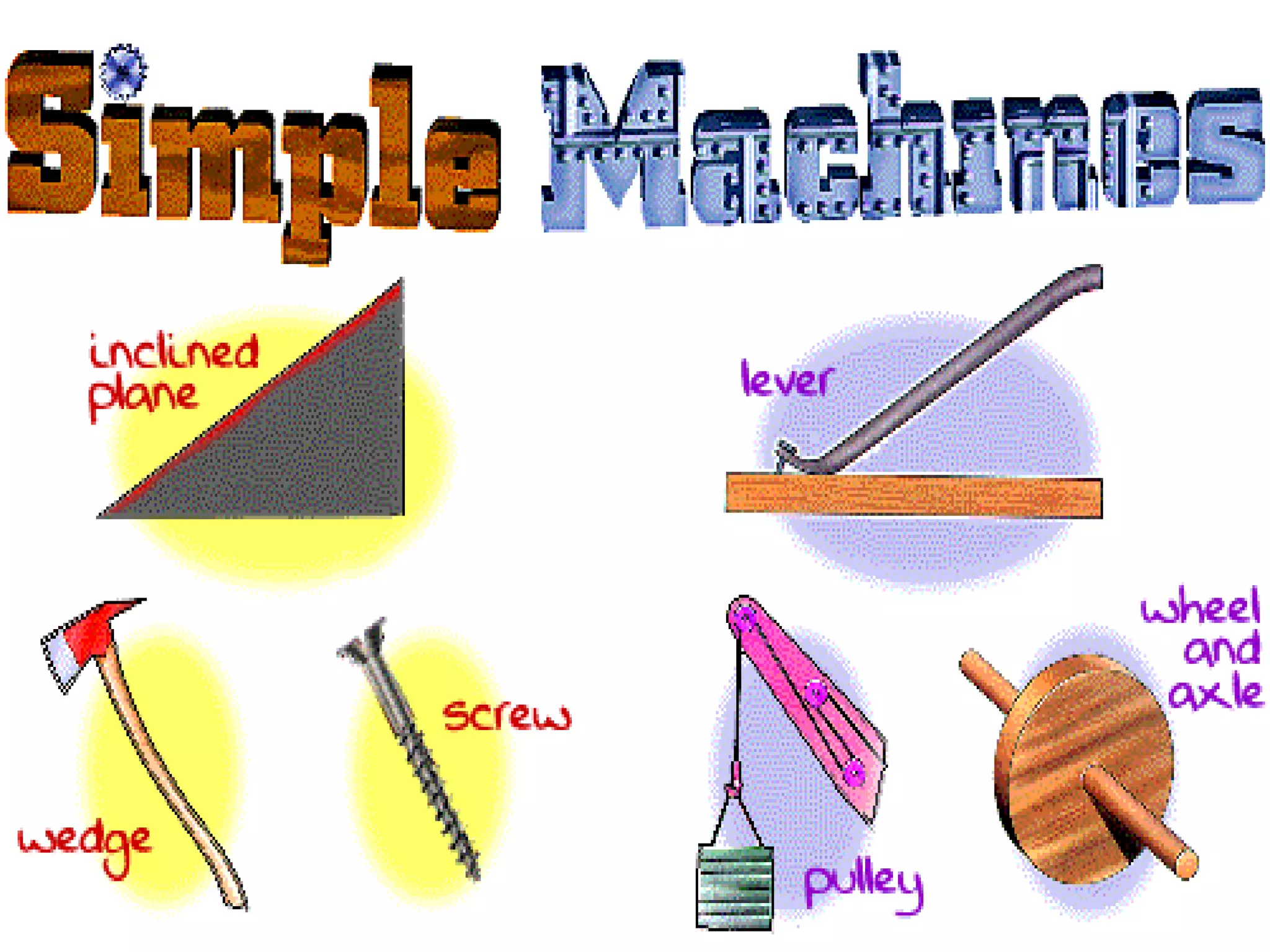
Simple Machines

  • 1.
    SIMPLE MACHINES http://www.flixxy.com/best-rube-goldberg-machine.htm \\Sv0002\stares$\Middle School\Science\Gr. 8\2006-2007\Quarter 4\Simple Machines\Videos (1) Video Clips:
  • 2.
    MACHINES Work is…………………….…… What is a machine?........ Why use machines?.........
  • 3.
    WORK is thetransfer of energy from one physical distance to another Measured in Joules W = F x d Work = Force x Distance
  • 4.
    MACHINES … ..anydevice or instrument that helps you do something
  • 5.
    machines make workwe do easier
  • 6.
    WORK = FORCEx DISTANCE WORK INPUT WORK OUTPUT INPUT = OUTPUT EFFORT FORCE DISTANCE OUTPUT FORCE DISTANCE Multiply the force Multiply the distance Change in Direction
  • 7.
    TYPES OF WORKA.INPUT work that goes into the machine needs effort force
  • 8.
    B. OUTPUT Work done by the machine Resistance Force
  • 9.
    Machines do notincrease work output “ Work output is never greater than work input”
  • 10.
    WORK = FORCEx DISTANCE WORK INPUT WORK OUTPUT INPUT = OUTPUT EFFORT FORCE DISTANCE OUTPUT FORCE DISTANCE Multiply the force Multiply the distance Change in Direction
  • 11.
    Work in =Work out Work input (force to move something over a distance) Work output (force from the machine to move something over a distance) Machines make work easier because they change either the _________ or _________of the force put into the machine.
  • 12.
    What is MechanicalAdvantage? Number of times a machine multiplies the effort force Tells how much force is gained by using machine
  • 13.
    Mechanical Advantage = Output Force Input Force Examples: Inclined Plane: M.A. = Load Effort = 5N/0.2N = 25 Pulley: M.A. = Load Effort = 6.5N/1.5N = 4
  • 14.
    so … …. Half the force needed = MA of 2 One third the force = MA of 3 A MA of less than 1 = increase force, but over a smaller distance (faster but harder)
  • 15.
    Output force Inputforce EFFICIENCY x 100% Efficiency of the machine = Expressed as a percentage
  • 16.
  • 17.
    LEVERS Simple machines used to lift weights
  • 18.
  • 19.
    First Class LeversAn example of this type is a seesaw.
  • 20.
    Second Class Lever The difference from the first class lever is that the fulcrum is on the end, instead of in the middle.
  • 21.
    Third Class Lever The load is the fish; the handle end is the fulcrum.
  • 22.
  • 23.
  • 24.
  • 25.
    The force youexert on the machine is called the input force or the effort force. The force exerted by the machine is called the output force or the resistance force. If you compare the input force to the output force, you can determine the advantage of using a machine. A machine’s mechanical advantage is the number of times a force exerted on a machine is multiplied by the machine. A machine makes work easier by changing the amount of force you exert, the distance over which you exert your force, or the direction in which you exert your force.
  • 26.
  • 27.
    Pulley Changes thedirection of the force and the amount of force. Lever Increase input force and direction (eg prying open a can of paint)
  • 28.
  • 29.
    Inclined Plane Asimple machine that makes it easier to move a heavy object to a higher or lower elevation . It reduces the amount of force needed to lift the object by increasing the distance.
  • 30.
    INCLINED PLANE Increasesthe distance so reduces the force Ideal MA = Length Height
  • 31.
  • 32.
    The Egyptians usedinclined planes to build the pyramids.
  • 33.
    WEDGES - Awedge is a simple machine shaped like an inclined plane . - It is like a portable inclined plane .
  • 34.
  • 35.
    SCREWS A screwis a cylinder with an inclined plane wrapped around it.
  • 36.
  • 37.
    Wedge and ScrewForce is applied over a longer distance Think of the screw being a long inclined plane!!!
  • 38.
    WHEEL AND AXLE- made up of two circular objects of different sizes Smaller Object (axle) Larger Object (wheel)
  • 39.
  • 40.
    Wheel and AxleWheel = Large diameter Axle = Small diameter This is a Force Multiplier – over a longer distance
  • 41.