Simple Machines
(Making work easier…phew!)
Simple Machines
Foldable
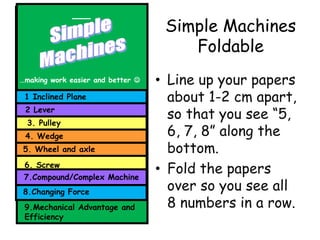
• Line up your papers
about 1-2 cm apart,
so that you see “5,
6, 7, 8” along the
bottom.
• Fold the papers
over so you see all
8 numbers in a row.
8.Changing Force
6. Screw
5. Wheel and axle
9.Mechanical Advantage and
Efficiency
3. Pulley
2 Lever
1 Inclined Plane
…making work easier and better 
7.Compound/Complex Machine
4. Wedge
Simple Machines
Foldable
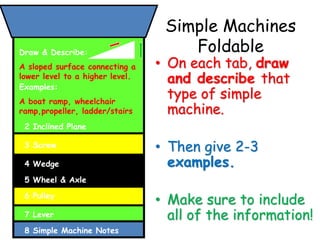
• On each tab, draw
and describe that
type of simple
machine.
• Then give 2-3
examples.
• Make sure to include
all of the information!
8 Simple Machine Notes
7 Lever
6 Pulley
5 Wheel & Axle
4 Wedge
3 Screw
2 Inclined Plane
Draw & Describe:
A sloped surface connecting a
lower level to a higher level.
Examples:
A boat ramp, wheelchair
ramp,propeller, ladder/stairs
What are MACHINES?
• Most people think of complex, technical,
or electronic gadgets with motors…, but
machines can be much SIMPLER.
• A machine is any device that lets you do
WORK in an EASIER or BETTER way.
• Basically:
Simple machines make work EASIER.
How do machines do work?
• Machines make work easier by changing
3 things about the FORCE you exert to
do work:
 AMOUNT OF FORCE you exert
 DISTANCE over which you exert
force
 DIRECTION in which you exert force
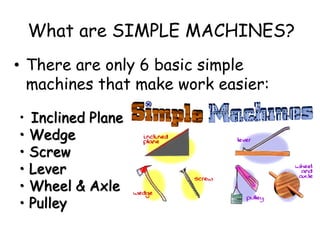
What are SIMPLE MACHINES?
• There are only 6 basic simple
machines that make work easier:
• Inclined Plane
• Wedge
• Screw
• Lever
• Wheel & Axle
• Pulley
WORK & SIMPLE MACHINES
• Simple machines DON’T change the
amount of WORK done!
(They change the size, distance or
direction of your FORCE!)
WORK IN = WORK OUT*
(*usually machines lose a bit of work
due to FRICTION…)
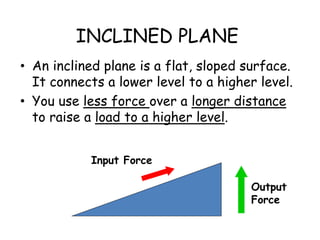
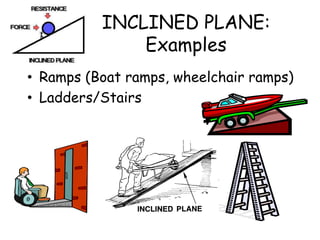
INCLINED PLANE
• An inclined plane is a flat, sloped surface.
It connects a lower level to a higher level.
• You use less force over a longer distance
to raise a load to a higher level.
Input Force
Output
Force
INCLINED PLANE:
Examples
• Ramps (Boat ramps, wheelchair ramps)
• Ladders/Stairs
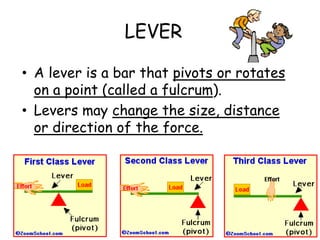
LEVER
• A lever is a bar that pivots or rotates
on a point (called a fulcrum).
• Levers may change the size, distance
or direction of the force.
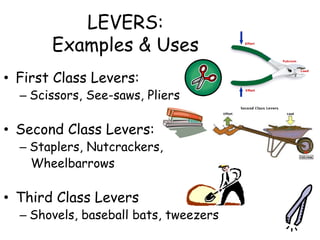
LEVERS:
Examples & Uses
• First Class Levers:
– Scissors, See-saws, Pliers
• Second Class Levers:
– Staplers, Nutcrackers,
Wheelbarrows
• Third Class Levers
– Shovels, baseball bats, tweezers
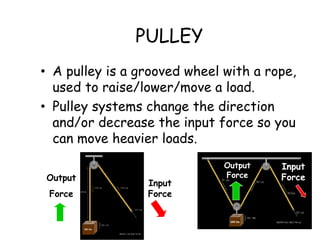
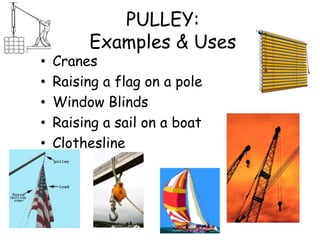
PULLEY
• A pulley is a grooved wheel with a rope,
used to raise/lower/move a load.
• Pulley systems change the direction
and/or decrease the input force so you
can move heavier loads.
Output
Force
Input
Force
Output
Force
Input
Force
PULLEY:
Examples & Uses
• Cranes
• Raising a flag on a pole
• Window Blinds
• Raising a sail on a boat
• Clothesline
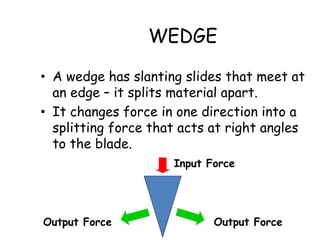
WEDGE
• A wedge has slanting slides that meet at
an edge – it splits material apart.
• It changes force in one direction into a
splitting force that acts at right angles
to the blade.
Input Force
Output Force
Output Force
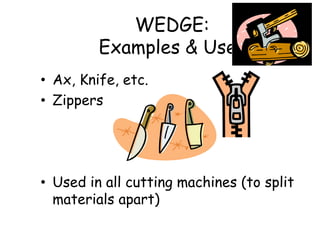
WEDGE:
Examples & Uses
• Ax, Knife, etc.
• Zippers
• Used in all cutting machines (to split
materials apart)
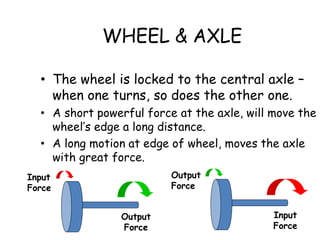
WHEEL & AXLE
• The wheel is locked to the central axle –
when one turns, so does the other one.
• A short powerful force at the axle, will move the
wheel’s edge a long distance.
• A long motion at edge of wheel, moves the axle
with great force.
Input
Force
Output
Force
Output
Force
Input
Force
WHEEL & AXLE:
Examples & Uses
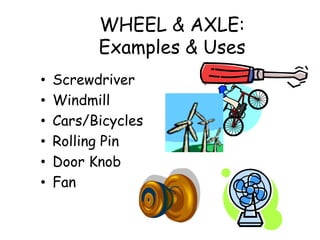
• Screwdriver
• Windmill
• Cars/Bicycles
• Rolling Pin
• Door Knob
• Fan
SCREW
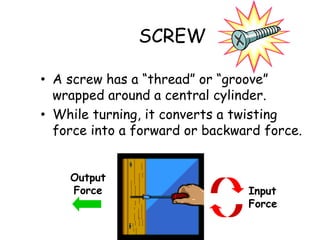
• A screw has a “thread” or “groove”
wrapped around a central cylinder.
• While turning, it converts a twisting
force into a forward or backward force.
Input
Force
Output
Force
SCREW:
Examples & Uses
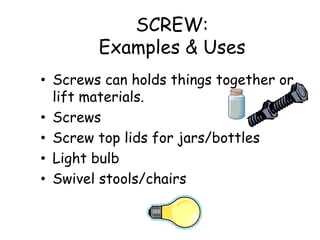
• Screws can holds things together or
lift materials.
• Screws
• Screw top lids for jars/bottles
• Light bulb
• Swivel stools/chairs
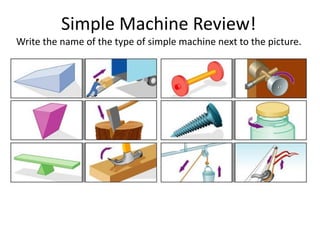
Simple Machine Review!
Write the name of the type of simple machine next to the picture.
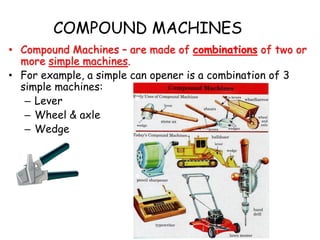
COMPOUND MACHINES
• Compound Machines – are made of combinations of two or
more simple machines.
• For example, a simple can opener is a combination of 3
simple machines:
– Lever
– Wheel & axle
– Wedge
Machines make work easier by
changing 3 things about the FORCE:
• The amount of force
• The distance of the force
• The direction of the force
Machines make work easier by
changing 3 things about the FORCE:
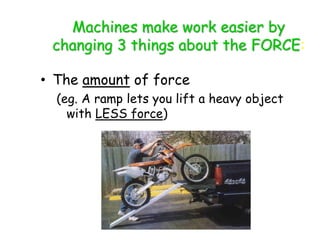
• The amount of force
(eg. A ramp lets you lift a heavy object
with LESS force)
Machines make work easier by
changing 3 things about the FORCE:
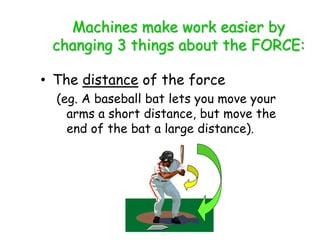
• The distance of the force
(eg. A baseball bat lets you move your
arms a short distance, but move the
end of the bat a large distance).
Machines make work easier by
changing 3 things about the FORCE:
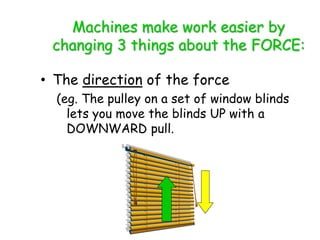
• The direction of the force
(eg. The pulley on a set of window blinds
lets you move the blinds UP with a
DOWNWARD pull.
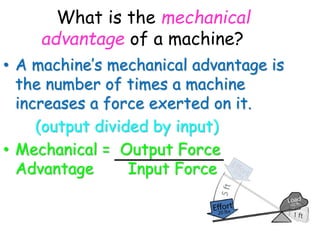
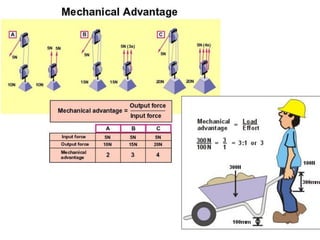
What is the mechanical
advantage of a machine?
• A machine’s mechanical advantage is
the number of times a machine
increases a force exerted on it.
(output divided by input)
• Mechanical = Output Force
Advantage Input Force
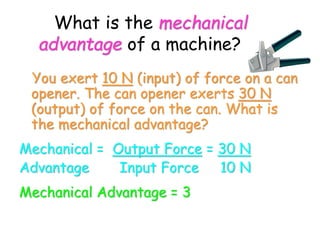
What is the mechanical
advantage of a machine?
You exert 10 N (input) of force on a can
opener. The can opener exerts 30 N
(output) of force on the can. What is
the mechanical advantage?
Mechanical = Output Force = 30 N
Advantage Input Force 10 N
Mechanical Advantage = 3
What is the efficiency of a
machine?
• The EFFICIENCY compares:
–the work you put IN to
–the work the machine puts OUT.
• An IDEAL machine is 100% efficient.
INPUT WORK = OUTPUT WORK
• In the real world, some input work is
always lost due to FRICTION between
the moving parts of the machine.
What is the efficiency of a
machine?
EFFICIENCY = Output Work x 100%
Input Work
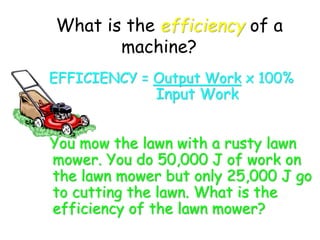
You mow the lawn with a rusty lawn
mower. You do 50,000 J of work on
the lawn mower but only 25,000 J go
to cutting the lawn. What is the
efficiency of the lawn mower?
What is the efficiency of a
machine?
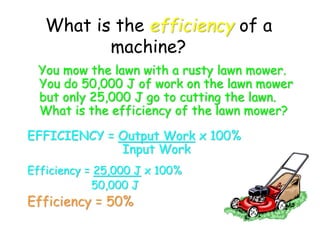
You mow the lawn with a rusty lawn mower.
You do 50,000 J of work on the lawn mower
but only 25,000 J go to cutting the lawn.
What is the efficiency of the lawn mower?
EFFICIENCY = Output Work x 100%
Input Work
Efficiency = 25,000 J x 100%
50,000 J
Efficiency = 50%
Try the rest of the practice
problems on your own…
Mechanical = Output Force
Advantage Input Force
EFFICIENCY = Output Work x 100%
Input Work
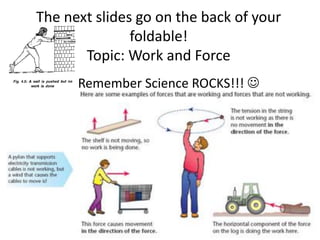
The next slides go on the back of your
foldable!
Topic: Work and Force
• Remember Science ROCKS!!! 
Evidence of Energy
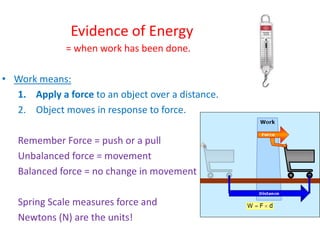
= when work has been done.
• Work means:
1. Apply a force to an object over a distance.
2. Object moves in response to force.
Remember Force = push or a pull
Unbalanced force = movement
Balanced force = no change in movement
Spring Scale measures force and
Newtons (N) are the units!
If something changes motion = it has
energy!
Cause Effect
1.Toy car at rest is pushed It moves = energy evidence =work
2.Fan is connect to a electric circuit It spins(moves)= energy evidence=work
3.Object is lifted It rises(moves) = energy evidence=work
4. A student pushes a wall The wall does NOT move = no work
5.A student stands wears a heavy bag The students continues to stand = no work
You try:
6. A rocket accelerates through space
7. A book falls off the table
8. A girl sits on the bench

19. simple-machines-foldable-ppt-10-24-12.pdf

  • 1.
  • 2.
    Simple Machines Foldable • Lineup your papers about 1-2 cm apart, so that you see “5, 6, 7, 8” along the bottom. • Fold the papers over so you see all 8 numbers in a row. 8.Changing Force 6. Screw 5. Wheel and axle 9.Mechanical Advantage and Efficiency 3. Pulley 2 Lever 1 Inclined Plane …making work easier and better  7.Compound/Complex Machine 4. Wedge
  • 3.
    Simple Machines Foldable • Oneach tab, draw and describe that type of simple machine. • Then give 2-3 examples. • Make sure to include all of the information! 8 Simple Machine Notes 7 Lever 6 Pulley 5 Wheel & Axle 4 Wedge 3 Screw 2 Inclined Plane Draw & Describe: A sloped surface connecting a lower level to a higher level. Examples: A boat ramp, wheelchair ramp,propeller, ladder/stairs
  • 4.
    What are MACHINES? •Most people think of complex, technical, or electronic gadgets with motors…, but machines can be much SIMPLER. • A machine is any device that lets you do WORK in an EASIER or BETTER way. • Basically: Simple machines make work EASIER.
  • 5.
    How do machinesdo work? • Machines make work easier by changing 3 things about the FORCE you exert to do work:  AMOUNT OF FORCE you exert  DISTANCE over which you exert force  DIRECTION in which you exert force
  • 6.
    What are SIMPLEMACHINES? • There are only 6 basic simple machines that make work easier: • Inclined Plane • Wedge • Screw • Lever • Wheel & Axle • Pulley
  • 7.
    WORK & SIMPLEMACHINES • Simple machines DON’T change the amount of WORK done! (They change the size, distance or direction of your FORCE!) WORK IN = WORK OUT* (*usually machines lose a bit of work due to FRICTION…)
  • 8.
    INCLINED PLANE • Aninclined plane is a flat, sloped surface. It connects a lower level to a higher level. • You use less force over a longer distance to raise a load to a higher level. Input Force Output Force
  • 9.
    INCLINED PLANE: Examples • Ramps(Boat ramps, wheelchair ramps) • Ladders/Stairs
  • 10.
    LEVER • A leveris a bar that pivots or rotates on a point (called a fulcrum). • Levers may change the size, distance or direction of the force.
  • 11.
    LEVERS: Examples & Uses •First Class Levers: – Scissors, See-saws, Pliers • Second Class Levers: – Staplers, Nutcrackers, Wheelbarrows • Third Class Levers – Shovels, baseball bats, tweezers
  • 12.
    PULLEY • A pulleyis a grooved wheel with a rope, used to raise/lower/move a load. • Pulley systems change the direction and/or decrease the input force so you can move heavier loads. Output Force Input Force Output Force Input Force
  • 13.
    PULLEY: Examples & Uses •Cranes • Raising a flag on a pole • Window Blinds • Raising a sail on a boat • Clothesline
  • 14.
    WEDGE • A wedgehas slanting slides that meet at an edge – it splits material apart. • It changes force in one direction into a splitting force that acts at right angles to the blade. Input Force Output Force Output Force
  • 15.
    WEDGE: Examples & Uses •Ax, Knife, etc. • Zippers • Used in all cutting machines (to split materials apart)
  • 16.
    WHEEL & AXLE •The wheel is locked to the central axle – when one turns, so does the other one. • A short powerful force at the axle, will move the wheel’s edge a long distance. • A long motion at edge of wheel, moves the axle with great force. Input Force Output Force Output Force Input Force
  • 17.
    WHEEL & AXLE: Examples& Uses • Screwdriver • Windmill • Cars/Bicycles • Rolling Pin • Door Knob • Fan
  • 18.
    SCREW • A screwhas a “thread” or “groove” wrapped around a central cylinder. • While turning, it converts a twisting force into a forward or backward force. Input Force Output Force
  • 19.
    SCREW: Examples & Uses •Screws can holds things together or lift materials. • Screws • Screw top lids for jars/bottles • Light bulb • Swivel stools/chairs
  • 20.
    Simple Machine Review! Writethe name of the type of simple machine next to the picture.
  • 21.
    COMPOUND MACHINES • CompoundMachines – are made of combinations of two or more simple machines. • For example, a simple can opener is a combination of 3 simple machines: – Lever – Wheel & axle – Wedge
  • 22.
    Machines make workeasier by changing 3 things about the FORCE: • The amount of force • The distance of the force • The direction of the force
  • 23.
    Machines make workeasier by changing 3 things about the FORCE: • The amount of force (eg. A ramp lets you lift a heavy object with LESS force)
  • 24.
    Machines make workeasier by changing 3 things about the FORCE: • The distance of the force (eg. A baseball bat lets you move your arms a short distance, but move the end of the bat a large distance).
  • 25.
    Machines make workeasier by changing 3 things about the FORCE: • The direction of the force (eg. The pulley on a set of window blinds lets you move the blinds UP with a DOWNWARD pull.
  • 26.
    What is themechanical advantage of a machine? • A machine’s mechanical advantage is the number of times a machine increases a force exerted on it. (output divided by input) • Mechanical = Output Force Advantage Input Force
  • 27.
    What is themechanical advantage of a machine? You exert 10 N (input) of force on a can opener. The can opener exerts 30 N (output) of force on the can. What is the mechanical advantage? Mechanical = Output Force = 30 N Advantage Input Force 10 N Mechanical Advantage = 3
  • 29.
    What is theefficiency of a machine? • The EFFICIENCY compares: –the work you put IN to –the work the machine puts OUT. • An IDEAL machine is 100% efficient. INPUT WORK = OUTPUT WORK • In the real world, some input work is always lost due to FRICTION between the moving parts of the machine.
  • 30.
    What is theefficiency of a machine? EFFICIENCY = Output Work x 100% Input Work You mow the lawn with a rusty lawn mower. You do 50,000 J of work on the lawn mower but only 25,000 J go to cutting the lawn. What is the efficiency of the lawn mower?
  • 31.
    What is theefficiency of a machine? You mow the lawn with a rusty lawn mower. You do 50,000 J of work on the lawn mower but only 25,000 J go to cutting the lawn. What is the efficiency of the lawn mower? EFFICIENCY = Output Work x 100% Input Work Efficiency = 25,000 J x 100% 50,000 J Efficiency = 50%
  • 32.
    Try the restof the practice problems on your own… Mechanical = Output Force Advantage Input Force EFFICIENCY = Output Work x 100% Input Work
  • 33.
    The next slidesgo on the back of your foldable! Topic: Work and Force • Remember Science ROCKS!!! 
  • 34.
    Evidence of Energy =when work has been done. • Work means: 1. Apply a force to an object over a distance. 2. Object moves in response to force. Remember Force = push or a pull Unbalanced force = movement Balanced force = no change in movement Spring Scale measures force and Newtons (N) are the units!
  • 35.
    If something changesmotion = it has energy! Cause Effect 1.Toy car at rest is pushed It moves = energy evidence =work 2.Fan is connect to a electric circuit It spins(moves)= energy evidence=work 3.Object is lifted It rises(moves) = energy evidence=work 4. A student pushes a wall The wall does NOT move = no work 5.A student stands wears a heavy bag The students continues to stand = no work You try: 6. A rocket accelerates through space 7. A book falls off the table 8. A girl sits on the bench