WELCOME TO MY CLASS
Mr. Souvik Chatterjee
M.Sc (Physics)&B.Ed
ENERGY
WORK
 When the force applied on a body moves it, work is said to be
done by the force on the body.
 Work is measured as,
Work = Force X Distance moved in the direction of force.
 The S.I unit of energy is joule(J).
 1 J work is said to be done when a force of 1 N moves a body
by a distance of 1m in the direction of force.
 When work is done on the body its energy increases. In other
words, the work done on the body is stored in it in the form of
energy. But if work is done by the body its energy decreases.
In other words, energy is spent when the body does work.
RELATIONSHIP BETWEEN
ENERGY AND WORK
 To do more amount of work, we need more amount of energy.
Hence, We can say that there is a direct relationship between
work and energy.
 Similarly, the work done on a body is changing its state is said
to be energy possessed by the body.
 e.g when a body is moved upwards work is done against the
force of gravity and the body at the height is said to possess
energy. Similarly, if a body initially at rest is made to move,
work is done on the body and the body in motion is said to
posses the amount of energy equal to the work done on the
body producing motion in it.
ENERGY
Energy is the capacity to do work
A body is said to possess an energy of one joule if
one joule work is done to bring the body in that
state i.e a force of 1 newton moves the body by a
distance of 1 metre in the direction of force.
Another unit of energy is calorie.
1 cal = 4.2 J
Bigger unit is kilo-calorie (kcal) where 1
kcal=1000 cal
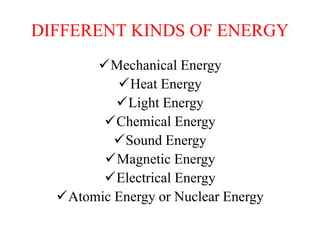
DIFFERENT KINDS OF ENERGY
Mechanical Energy
Heat Energy
Light Energy
Chemical Energy
Sound Energy
Magnetic Energy
Electrical Energy
Atomic Energy or Nuclear Energy
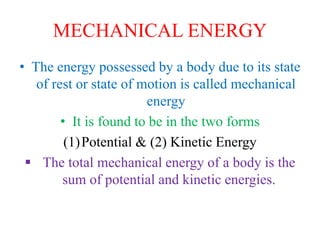
MECHANICAL ENERGY
• The energy possessed by a body due to its state
of rest or state of motion is called mechanical
energy
• It is found to be in the two forms
(1)Potential & (2) Kinetic Energy
 The total mechanical energy of a body is the
sum of potential and kinetic energies.
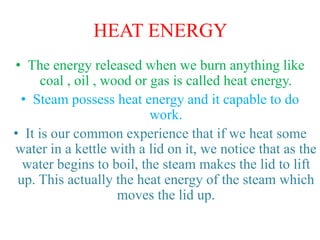
HEAT ENERGY
• The energy released when we burn anything like
coal , oil , wood or gas is called heat energy.
• Steam possess heat energy and it capable to do
work.
• It is our common experience that if we heat some
water in a kettle with a lid on it, we notice that as the
water begins to boil, the steam makes the lid to lift
up. This actually the heat energy of the steam which
moves the lid up.
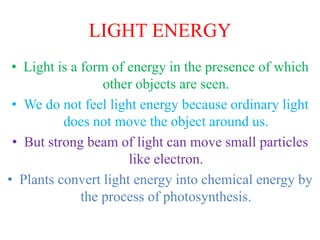
LIGHT ENERGY
• Light is a form of energy in the presence of which
other objects are seen.
• We do not feel light energy because ordinary light
does not move the object around us.
• But strong beam of light can move small particles
like electron.
• Plants convert light energy into chemical energy by
the process of photosynthesis.
CHEMICAL ENERGY
• The energy possessed by fuel such as coal, oil, gas
etc is called chemical energy.
• The chemical energy of petrol or diesel is capable to
move a car or truck.
SOUND ENERGY
• The energy responsible for the sensation of hearing
is called sound energy.
• A vibrating body is the source of sound energy
• We can hear sound when the frequency of sound is
in between 20 Hz and 20,000 Hz
MAGNETIC ENERGY
• The energy possessed by a magnet is called
magnetic energy.
• Magnets can attract an iron nail from a
distance and thus the force exerted by the
magnet makes the nail to move towards the
magnet.
ELECTRICAL ENERGY
• When two dry bodies are rubbed together they get
charged and gain electrical energy.
• A comb when rubbed on dry hair can attract small
bits of paper and cause them to move towards the
comb.
ATOMIC ENERGY
• The energy stored in atom is called atomic energy.
Atomic energy cam be used for destructive purposes.
• For peaceful purpose, atomic reactors are used to
produce electrical energy from atomic energy.
• For destructive purpose, atom bomb used for destroying
the enemy in a war.
• Actually atomic energy is the energy released due to
loss in mass when either a heavy nucleus splits into two
light nuclei or two light nuclei combine to form one
nucleus under certain circumstances. This is why
atomic energy is also called nuclear energy.
KEY POINTS
The sun is a major source of energy.
The energy which we receive on earth from the sun
is called the solar energy.
 Nowadays solar energy is used for making solar
cooker, solar cells etc.
Efforts are being made to obtain electricity by using
solar panels from solar energy.
 The Government of Indiais also promoting to
produce electricity for household purposes by using
solar cooker.
TWO FORMS OF MECHANICAL
ENERGY
• The energy possessed by a body due to its state
of rest or state of motion, is called mechanical
energy.
• Mechanical Energy is of two forms
1. Potential Energy
2. Kinetic Energy
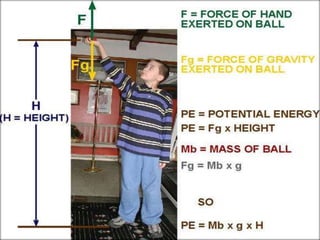
POTENTIAL ENERGY
• Potential energy of a body is the energy possessed
by it due to its state of rest or position. Actually it is
equal to the work done in bringing the body to that
state of rest or position.
• When a body is taken from earth’s surface to height,
work has to be done on the body against the force of
gravity on it. The work done in the body is stored in
the form of potential energy. This energy also called
gravitational potential energy.
EXAMPLES
1. A wound up watch spring has potential
energy because of the wound up state of its
coils. As the spring unwinds itself, it moves
the arms of the watch.
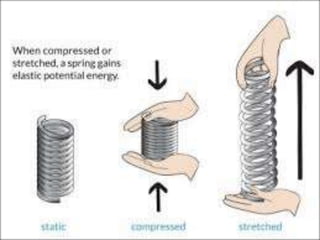
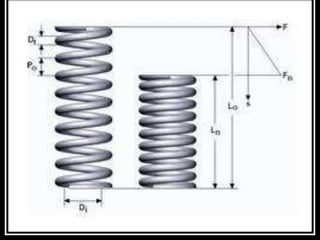
2. A compressed spring has potential energy
stored in it which equal to the work done on
the spring in bringing it to the compressed
state.
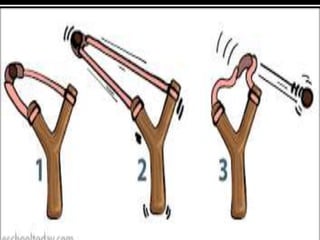
3. A stretch rubber band has potential energy. It does
not work restoring itself to its original state . A
pebble placed on the stretched rubber catapult, is
thrown away when it is released to restore its
original state.
In stretching a rubber band, work is done. This work
is stored in the rubber band in the form of potential
energy.
• 4. A hammer at a height has potential energy
stored in it. The hammer has this energy
because of its position at a height. In figure,
the hammer is dropped on a nail fixed on a
piece of wood. It drives the nail into the wood
as shown in figure.
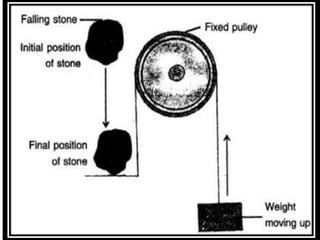
• 5.In figure a falling stone when reaches a pan,
attached at one end of a pulley, lifts up a
weight at its other end because of its potential
energy.
• 6. Water at a height has potential energy stored
in it. Falling water from a height can be used
to do work such as turning a wheel.
FACTORS AFFECTING THE
POTENTIAL ENERGY
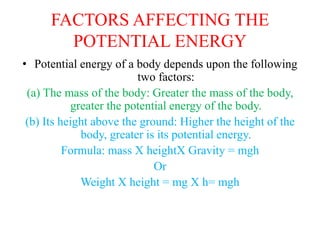
• Potential energy of a body depends upon the following
two factors:
(a) The mass of the body: Greater the mass of the body,
greater the potential energy of the body.
(b) Its height above the ground: Higher the height of the
body, greater is its potential energy.
Formula: mass X heightX Gravity = mgh
Or
Weight X height = mg X h= mgh
KINETIC ENERGY
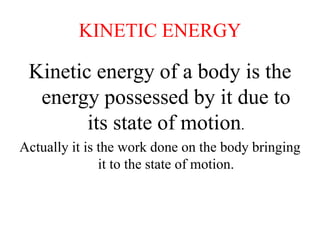
Kinetic energy of a body is the
energy possessed by it due to
its state of motion.
Actually it is the work done on the body bringing
it to the state of motion.
EXAMPLE
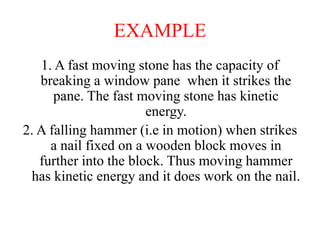
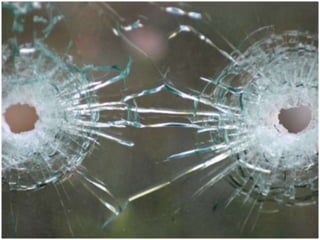
1. A fast moving stone has the capacity of
breaking a window pane when it strikes the
pane. The fast moving stone has kinetic
energy.
2. A falling hammer (i.e in motion) when strikes
a nail fixed on a wooden block moves in
further into the block. Thus moving hammer
has kinetic energy and it does work on the nail.
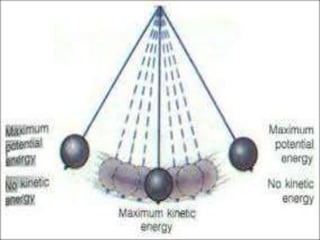
3. In a swinging pendulum, moving to and fro,
the bob has kinetic energy.
4. In a river or sea, the flowing water has kinetic
energy which makes wooden boat or a log of
wood to move in it.
5. A bullet fired from a gun, a rolling ball, an
apple falling from a tree etc all have kinetic
energy.
FACTORS ON WHICH KINETIC
ENERGY DEPENDS
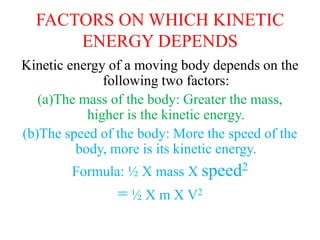
Kinetic energy of a moving body depends on the
following two factors:
(a)The mass of the body: Greater the mass,
higher is the kinetic energy.
(b)The speed of the body: More the speed of the
body, more is its kinetic energy.
Formula: ½ X mass X speed2
= ½ X m X V2
CONVERSION OF POTENTIAL
ENERGY INTO KINETIC ENERGY
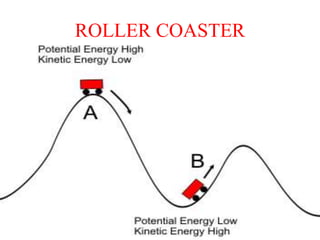
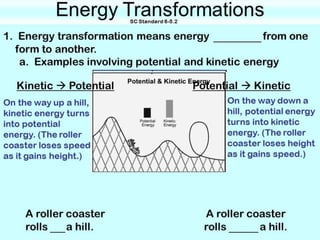
• Potential energy changes into kinetic energy when it is
put to use.
• Examples
(1)A hammer at a height has potential energy due to its
lifted or raised position. When a hammer is dropped
from that position, it begins to fall. The falling hammer
has kinetic energy. Thus the potential energy stored in
the hammer in its raised position changes into kinetic
energy when the hammer is falling. The kinetic energy
does work on the nail as the hammer strikes the nail and
causes the nail to move into the wood.
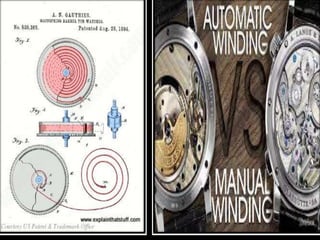
(2)The wound up watch spring has potential energy
because of its wound up state. As the spring unwinds
itself, the potential energy changes into kinetic
energy. The kinetic energy does work in moving the
arms of the watch.
(3)A stretch bow has potential energy because of its
stretch position. When the stretch bow is released,
the potential energy of the bow changes into its
kinetic energy. This kinetic energy does work on the
arrow and makes the arrow to move.
(4) A compressed spring has potential energy
in it due its compressed state, when the
compressed spring is released, the potential
energy changes into its kinetic energy which
does work on the ball placed on it and makes
the ball to fly away.
CONVERSION OF ENERGY
Energy can neither be created nor
destroyed but can be converted
from one form to the other
EXAMPLES
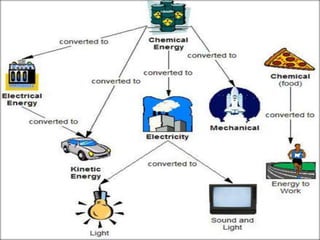
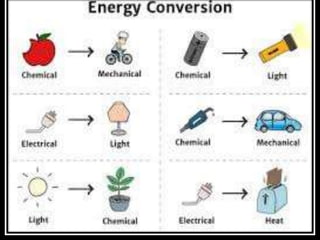
• (1) In a steam engine chemical energy of coal
first changes into heat of a steam. Then the
heat changes into mechanical energy which
causes train to move.
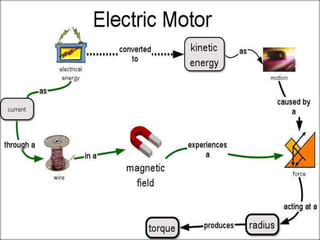
• (2) In electric motor or fan the electrical
energy changes into mechanical energy. The

energy rotates the axle of motor (or blades of a
fan).
(3) In electric heater, oven , toaster, geyser the
electrical energy changes into heat energy.
(4) The electric cell in use, the chemical energy
changes into electrical energy.
(5) In a glowing bulb electrical energy changes
into light and heat energy.
(6) An electric bell while ringing the electric
energy changes into sound energy.
• (7) Electric generator or dynamo mechanical
energy changes into electrical energy.
• (8) In microphone sound energy changes into
electrical energy.
• (9) In loudspeaker electrical energy changes into
sound energy.
• (10) Plants during photosynthesis light energy
received from sun changes into chemical energy
of food.
• (11) When fire crackers burst chemical energy
changes into heat sound and light energy.
CONSERVATION OF ENERGY
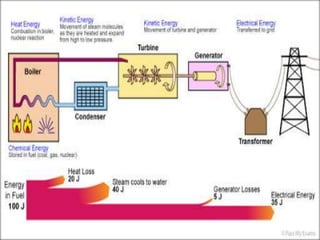
• Energy can neither be created or destroyed but can transform
one form to any other form.
• While transformation of energy takes place some energy is
wasted as a un-useful form of energy such as heat.
• The sum of useful and un-useful energy will be constant.
• If 100J of electrical energy is converted
70 J of mechanical energy, the remaining 30 J of energy is
converted to heat and sound energy.
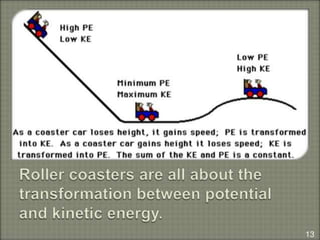
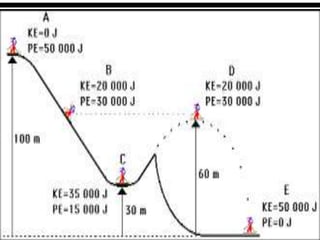
• In absence of friction the sum of potential and kinetic energy
always constant i.e Total mechanical energy always constant.
KEY POINTS
• In transformation of energy when one form of
energy changes into other form of energy, a
part of energy is converted into non-useful
form which is called dissipation of energy.
• e.g When a bulb is glowing electrical energy
gets converted to light energy. But a part of
energy is wasted as heat which is dissipation of
energy.
ROLLER COASTER
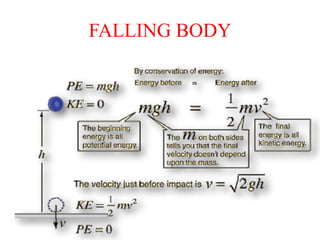
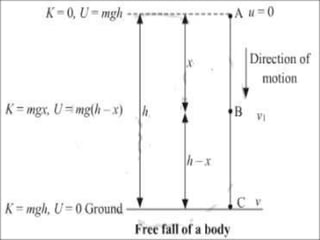
FALLING BODY
HYDROELECTRICITY
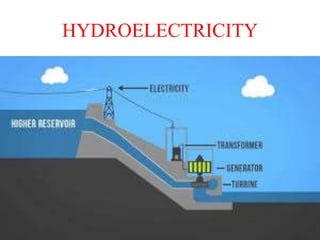
• The water collected in a dam at a height has
potential energy stored in it. When it is made
to fall on a turbine, the potential energy
changes to kinetic energy which is transferred
to the turbine to rotate it. By connecting the
turbine to the armature of a dynamo, electricity
(called the hydroelectricity) is produced.
• Two bodies having masses 50 kg and 100 kg
placed at a same height. Which one should
have more potential energy?
• Ans. Mass of 100 kg, more mass more
potential energy
• Two bodies having same mass are placed but
placed at 50m and 100m. Which one has
greater potential energy
• 2nd mass , as the height is more.
• Name the type of energy(Kinetic or potential)
possessed by the following
• Moving cricket ball- Kinetic energy
• A stone at rest at the top of a building-Potential
energy
• A compressed spring-Potential Energy
• A moving bus-Kinetic energy
• A bullet fired from a gun-Kinetic Energy
• Water flowing in a river-Kinetic Energy
• A stretched rubber band-Potential Energy
• State the energy change in the following:
• Unwinding of watch spring- Potential to
Kinetic Energy
• Burning coal while operating a steam engine-
Heat to mechanical/Kinetic Energy
• Lighting of torch bulb-Chemical Energy to
Light Energy
• A electric generator or dynamo-Mechanical
Energy to Electrical Energy
• Give one relevant example for each of the
following transformation
• Electrical to heat energy-Electric
Heater/Toster/Geyser
• Electrical to mechanical energy- Electric
Fan/Mixer-Grinder
• Electrical to light energy-Electric Bulb/Tube
light
• Chemical to heat energy- Burning Coal/
FireCraker
Questions from CONCISE PHYSICS
• A ball is made free to fall from a height. State
the kind/kinds of energy possessed by the ball
when it is
(i) at the highest point
(ii) just in the middle
(iii) At the ground
(i)Potential Energy
(ii)Potential +Kinetic energy
(iii)Kinetic Energy
• What do you by conservation of mechanical
energy? State the condition when it holds.
• In absence of friction the sum of potential and
kinetic energy always constant i.e Total mechanical
energy always constant.
• In absence of friction it holds.
• Two bodies having masses 500 g and 100 g having same
speed. Which of them having higher kinetic energy?
Why?
• First body having mass 500 g will have more kinetic
energy. More the mass more the kinetic energy if speed
is constant.
• Two bodies having same mass have speed 3 m/s and
4m/s. Which one should have more kinetic energy? Why?
• Second body will have more kinetic energy. More the
speed more kinetic energy if mass is constant.
• Can a body posses energy when it is not in
motion? Explain your answer with an example.
• Yes, A stone which is at rest placed in a height
will have potential energy .
• A bucket filled with water placed in first floor.
The same bucket with equal amount of water is
placed in second floor. Which one should have
more potential energy? Explain.
• The bucket placed at second floor will have more
potential energy because it has more height than
the bucket placed at first floor and mass is
constant for both the buckets..

CLASS 7 ENERGY

  • 1.
    WELCOME TO MYCLASS Mr. Souvik Chatterjee M.Sc (Physics)&B.Ed
  • 2.
  • 3.
    WORK  When theforce applied on a body moves it, work is said to be done by the force on the body.  Work is measured as, Work = Force X Distance moved in the direction of force.  The S.I unit of energy is joule(J).  1 J work is said to be done when a force of 1 N moves a body by a distance of 1m in the direction of force.  When work is done on the body its energy increases. In other words, the work done on the body is stored in it in the form of energy. But if work is done by the body its energy decreases. In other words, energy is spent when the body does work.
  • 4.
    RELATIONSHIP BETWEEN ENERGY ANDWORK  To do more amount of work, we need more amount of energy. Hence, We can say that there is a direct relationship between work and energy.  Similarly, the work done on a body is changing its state is said to be energy possessed by the body.  e.g when a body is moved upwards work is done against the force of gravity and the body at the height is said to possess energy. Similarly, if a body initially at rest is made to move, work is done on the body and the body in motion is said to posses the amount of energy equal to the work done on the body producing motion in it.
  • 5.
    ENERGY Energy is thecapacity to do work A body is said to possess an energy of one joule if one joule work is done to bring the body in that state i.e a force of 1 newton moves the body by a distance of 1 metre in the direction of force. Another unit of energy is calorie. 1 cal = 4.2 J Bigger unit is kilo-calorie (kcal) where 1 kcal=1000 cal
  • 6.
    DIFFERENT KINDS OFENERGY Mechanical Energy Heat Energy Light Energy Chemical Energy Sound Energy Magnetic Energy Electrical Energy Atomic Energy or Nuclear Energy
  • 7.
    MECHANICAL ENERGY • Theenergy possessed by a body due to its state of rest or state of motion is called mechanical energy • It is found to be in the two forms (1)Potential & (2) Kinetic Energy  The total mechanical energy of a body is the sum of potential and kinetic energies.
  • 8.
    HEAT ENERGY • Theenergy released when we burn anything like coal , oil , wood or gas is called heat energy. • Steam possess heat energy and it capable to do work. • It is our common experience that if we heat some water in a kettle with a lid on it, we notice that as the water begins to boil, the steam makes the lid to lift up. This actually the heat energy of the steam which moves the lid up.
  • 9.
    LIGHT ENERGY • Lightis a form of energy in the presence of which other objects are seen. • We do not feel light energy because ordinary light does not move the object around us. • But strong beam of light can move small particles like electron. • Plants convert light energy into chemical energy by the process of photosynthesis.
  • 10.
    CHEMICAL ENERGY • Theenergy possessed by fuel such as coal, oil, gas etc is called chemical energy. • The chemical energy of petrol or diesel is capable to move a car or truck.
  • 11.
    SOUND ENERGY • Theenergy responsible for the sensation of hearing is called sound energy. • A vibrating body is the source of sound energy • We can hear sound when the frequency of sound is in between 20 Hz and 20,000 Hz
  • 12.
    MAGNETIC ENERGY • Theenergy possessed by a magnet is called magnetic energy. • Magnets can attract an iron nail from a distance and thus the force exerted by the magnet makes the nail to move towards the magnet.
  • 13.
    ELECTRICAL ENERGY • Whentwo dry bodies are rubbed together they get charged and gain electrical energy. • A comb when rubbed on dry hair can attract small bits of paper and cause them to move towards the comb.
  • 14.
    ATOMIC ENERGY • Theenergy stored in atom is called atomic energy. Atomic energy cam be used for destructive purposes. • For peaceful purpose, atomic reactors are used to produce electrical energy from atomic energy. • For destructive purpose, atom bomb used for destroying the enemy in a war. • Actually atomic energy is the energy released due to loss in mass when either a heavy nucleus splits into two light nuclei or two light nuclei combine to form one nucleus under certain circumstances. This is why atomic energy is also called nuclear energy.
  • 15.
    KEY POINTS The sunis a major source of energy. The energy which we receive on earth from the sun is called the solar energy.  Nowadays solar energy is used for making solar cooker, solar cells etc. Efforts are being made to obtain electricity by using solar panels from solar energy.  The Government of Indiais also promoting to produce electricity for household purposes by using solar cooker.
  • 16.
    TWO FORMS OFMECHANICAL ENERGY • The energy possessed by a body due to its state of rest or state of motion, is called mechanical energy. • Mechanical Energy is of two forms 1. Potential Energy 2. Kinetic Energy
  • 17.
    POTENTIAL ENERGY • Potentialenergy of a body is the energy possessed by it due to its state of rest or position. Actually it is equal to the work done in bringing the body to that state of rest or position. • When a body is taken from earth’s surface to height, work has to be done on the body against the force of gravity on it. The work done in the body is stored in the form of potential energy. This energy also called gravitational potential energy.
  • 18.
    EXAMPLES 1. A woundup watch spring has potential energy because of the wound up state of its coils. As the spring unwinds itself, it moves the arms of the watch. 2. A compressed spring has potential energy stored in it which equal to the work done on the spring in bringing it to the compressed state.
  • 20.
    3. A stretchrubber band has potential energy. It does not work restoring itself to its original state . A pebble placed on the stretched rubber catapult, is thrown away when it is released to restore its original state. In stretching a rubber band, work is done. This work is stored in the rubber band in the form of potential energy.
  • 22.
    • 4. Ahammer at a height has potential energy stored in it. The hammer has this energy because of its position at a height. In figure, the hammer is dropped on a nail fixed on a piece of wood. It drives the nail into the wood as shown in figure.
  • 24.
    • 5.In figurea falling stone when reaches a pan, attached at one end of a pulley, lifts up a weight at its other end because of its potential energy. • 6. Water at a height has potential energy stored in it. Falling water from a height can be used to do work such as turning a wheel.
  • 26.
    FACTORS AFFECTING THE POTENTIALENERGY • Potential energy of a body depends upon the following two factors: (a) The mass of the body: Greater the mass of the body, greater the potential energy of the body. (b) Its height above the ground: Higher the height of the body, greater is its potential energy. Formula: mass X heightX Gravity = mgh Or Weight X height = mg X h= mgh
  • 27.
    KINETIC ENERGY Kinetic energyof a body is the energy possessed by it due to its state of motion. Actually it is the work done on the body bringing it to the state of motion.
  • 28.
    EXAMPLE 1. A fastmoving stone has the capacity of breaking a window pane when it strikes the pane. The fast moving stone has kinetic energy. 2. A falling hammer (i.e in motion) when strikes a nail fixed on a wooden block moves in further into the block. Thus moving hammer has kinetic energy and it does work on the nail.
  • 29.
    3. In aswinging pendulum, moving to and fro, the bob has kinetic energy. 4. In a river or sea, the flowing water has kinetic energy which makes wooden boat or a log of wood to move in it. 5. A bullet fired from a gun, a rolling ball, an apple falling from a tree etc all have kinetic energy.
  • 33.
    FACTORS ON WHICHKINETIC ENERGY DEPENDS Kinetic energy of a moving body depends on the following two factors: (a)The mass of the body: Greater the mass, higher is the kinetic energy. (b)The speed of the body: More the speed of the body, more is its kinetic energy. Formula: ½ X mass X speed2 = ½ X m X V2
  • 34.
    CONVERSION OF POTENTIAL ENERGYINTO KINETIC ENERGY • Potential energy changes into kinetic energy when it is put to use. • Examples (1)A hammer at a height has potential energy due to its lifted or raised position. When a hammer is dropped from that position, it begins to fall. The falling hammer has kinetic energy. Thus the potential energy stored in the hammer in its raised position changes into kinetic energy when the hammer is falling. The kinetic energy does work on the nail as the hammer strikes the nail and causes the nail to move into the wood.
  • 35.
    (2)The wound upwatch spring has potential energy because of its wound up state. As the spring unwinds itself, the potential energy changes into kinetic energy. The kinetic energy does work in moving the arms of the watch. (3)A stretch bow has potential energy because of its stretch position. When the stretch bow is released, the potential energy of the bow changes into its kinetic energy. This kinetic energy does work on the arrow and makes the arrow to move.
  • 37.
    (4) A compressedspring has potential energy in it due its compressed state, when the compressed spring is released, the potential energy changes into its kinetic energy which does work on the ball placed on it and makes the ball to fly away.
  • 39.
    CONVERSION OF ENERGY Energycan neither be created nor destroyed but can be converted from one form to the other
  • 40.
    EXAMPLES • (1) Ina steam engine chemical energy of coal first changes into heat of a steam. Then the heat changes into mechanical energy which causes train to move. • (2) In electric motor or fan the electrical energy changes into mechanical energy. The energy rotates the axle of motor (or blades of a fan).
  • 41.
    (3) In electricheater, oven , toaster, geyser the electrical energy changes into heat energy. (4) The electric cell in use, the chemical energy changes into electrical energy. (5) In a glowing bulb electrical energy changes into light and heat energy. (6) An electric bell while ringing the electric energy changes into sound energy.
  • 42.
    • (7) Electricgenerator or dynamo mechanical energy changes into electrical energy. • (8) In microphone sound energy changes into electrical energy. • (9) In loudspeaker electrical energy changes into sound energy. • (10) Plants during photosynthesis light energy received from sun changes into chemical energy of food. • (11) When fire crackers burst chemical energy changes into heat sound and light energy.
  • 47.
    CONSERVATION OF ENERGY •Energy can neither be created or destroyed but can transform one form to any other form. • While transformation of energy takes place some energy is wasted as a un-useful form of energy such as heat. • The sum of useful and un-useful energy will be constant. • If 100J of electrical energy is converted 70 J of mechanical energy, the remaining 30 J of energy is converted to heat and sound energy. • In absence of friction the sum of potential and kinetic energy always constant i.e Total mechanical energy always constant.
  • 48.
    KEY POINTS • Intransformation of energy when one form of energy changes into other form of energy, a part of energy is converted into non-useful form which is called dissipation of energy. • e.g When a bulb is glowing electrical energy gets converted to light energy. But a part of energy is wasted as heat which is dissipation of energy.
  • 49.
  • 52.
  • 56.
  • 57.
    • The watercollected in a dam at a height has potential energy stored in it. When it is made to fall on a turbine, the potential energy changes to kinetic energy which is transferred to the turbine to rotate it. By connecting the turbine to the armature of a dynamo, electricity (called the hydroelectricity) is produced.
  • 58.
    • Two bodieshaving masses 50 kg and 100 kg placed at a same height. Which one should have more potential energy? • Ans. Mass of 100 kg, more mass more potential energy • Two bodies having same mass are placed but placed at 50m and 100m. Which one has greater potential energy • 2nd mass , as the height is more.
  • 59.
    • Name thetype of energy(Kinetic or potential) possessed by the following • Moving cricket ball- Kinetic energy • A stone at rest at the top of a building-Potential energy • A compressed spring-Potential Energy • A moving bus-Kinetic energy • A bullet fired from a gun-Kinetic Energy • Water flowing in a river-Kinetic Energy • A stretched rubber band-Potential Energy
  • 60.
    • State theenergy change in the following: • Unwinding of watch spring- Potential to Kinetic Energy • Burning coal while operating a steam engine- Heat to mechanical/Kinetic Energy • Lighting of torch bulb-Chemical Energy to Light Energy • A electric generator or dynamo-Mechanical Energy to Electrical Energy
  • 61.
    • Give onerelevant example for each of the following transformation • Electrical to heat energy-Electric Heater/Toster/Geyser • Electrical to mechanical energy- Electric Fan/Mixer-Grinder • Electrical to light energy-Electric Bulb/Tube light • Chemical to heat energy- Burning Coal/ FireCraker
  • 62.
    Questions from CONCISEPHYSICS • A ball is made free to fall from a height. State the kind/kinds of energy possessed by the ball when it is (i) at the highest point (ii) just in the middle (iii) At the ground (i)Potential Energy (ii)Potential +Kinetic energy (iii)Kinetic Energy
  • 63.
    • What doyou by conservation of mechanical energy? State the condition when it holds. • In absence of friction the sum of potential and kinetic energy always constant i.e Total mechanical energy always constant. • In absence of friction it holds.
  • 64.
    • Two bodieshaving masses 500 g and 100 g having same speed. Which of them having higher kinetic energy? Why? • First body having mass 500 g will have more kinetic energy. More the mass more the kinetic energy if speed is constant. • Two bodies having same mass have speed 3 m/s and 4m/s. Which one should have more kinetic energy? Why? • Second body will have more kinetic energy. More the speed more kinetic energy if mass is constant.
  • 65.
    • Can abody posses energy when it is not in motion? Explain your answer with an example. • Yes, A stone which is at rest placed in a height will have potential energy . • A bucket filled with water placed in first floor. The same bucket with equal amount of water is placed in second floor. Which one should have more potential energy? Explain. • The bucket placed at second floor will have more potential energy because it has more height than the bucket placed at first floor and mass is constant for both the buckets..