Simple Machines
What is a Machine?
 A device that allows you to do work in
a way that is easier or more effective.
 A machine can do at least one of these
3 things:
1. Change the amount of force
2. Change the direction of the
force
3. Cut down the amount of
friction
Pulley
Wheel &
Axle
Lever
Screw
Wedge
Inclined
Plane
Simple
Machines
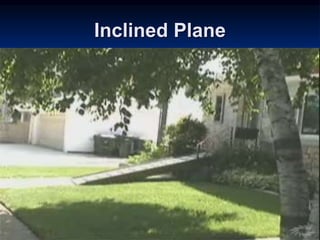
The Inclined Plane
 An inclined plane
is a flat, slanted
surface
 It allows you to
exert your force
over a longer
distance
Inclined Plane
 Inclined planes
make it easier to
get things up
higher or down
lower
 You can roll or
slide things on a
ramp
Types of Inclined Planes
Ramps
Stairs
Roads
The steeper the slant…the more
work it takes to go up the inclined
plane
Inclined Plane
The Wedge
 A wedge is a device that is thick at
one end and tapers to a thin edge
at the other end
 In a wedge, instead of an object
moving along the inclined plane,
the inclined plane itself moves.
Wedge Uses
 A wedge is used for cutting,
splitting, or prying things
apart.
 Zippers use wedges to push 2
sides together.
Types of Wedges
 Axe
 Zipper
 Chisel
 Razor Blade
 A wedge can change
the direction of the
force. When you use
a wedge to pry, not as
much force is needed.
The Wedge
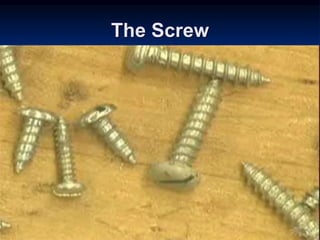
The Screw
 A screw can be thought
of as an inclined plane
wrapped around a
cylinder.
 A screw changes the
direction of the force,
meaning as you turn it,
it goes up or down.
The Screw
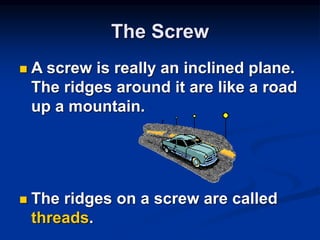
 A screw is really an inclined plane.
The ridges around it are like a road
up a mountain.
 The ridges on a screw are called
threads.
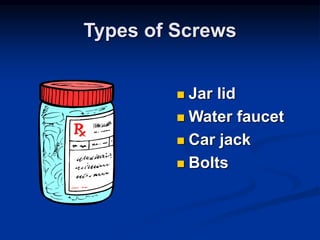
Types of Screws
 Jar lid
 Water faucet
 Car jack
 Bolts
The Screw
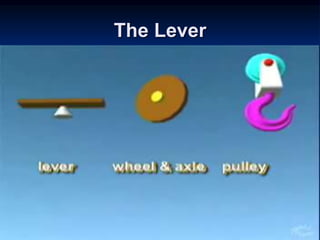
The Lever
 A lever is a rigid bar that is free to
pivot or rotate around a fixed point.
 The fixed point that the lever pivots
around is called the fulcrum.
3 Types of Levers
 1st Class Lever - the pivot (fulcrum) is
between the effort and the load.
Item
Number of Class 1
Levers Used
see-saw a single class 1 lever
hammer’
s claws
a single class 1 lever
scissors 2 class 1 levers
pliers 2 class 1 levers
3 Types of Levers
 2nd Class Lever - the load is between
the pivot (fulcrum) and the effort.
Item
Number of Class 2
Levers Used
bottle opener a single class 2 lever
wheelbarrow a single class 2 lever
nail clippers Two class 2 levers
nut cracker Two class 2 levers
3 Types of Levers
 3rd Class Lever - the effort is
between the pivot (fulcrum) and
the load.
Item
Number of
Class 3
Levers Used
fishing rod
a single class
3 lever
tweezers
Two class 3
levers
tongs
Two class 3
levers
Examples of Levers
 Seesaw
 Crowbar
 Chopsticks
 A lever increases the effect of your
input force and changes the
direction of your input force.
The Lever
3 classes of levers
The Wheel and Axle
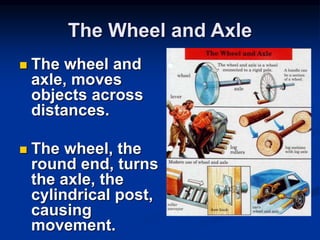
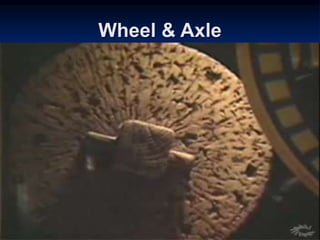
 A wheel and axle is a
modification of a pulley.
 A wheel is fixed to a shaft. The
wheel and shaft must move
together to be a simple
machine.
 Sometimes the wheel has a
crank or handle on it.
The Wheel and Axle
 The wheel and
axle, moves
objects across
distances.
 The wheel, the
round end, turns
the axle, the
cylindrical post,
causing
movement.
Wheel & Axle
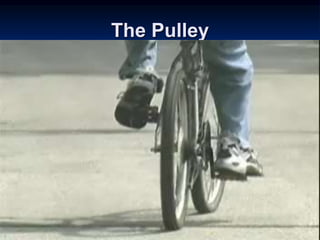
The Pulley
 Instead of an axle, the wheel
could also rotate a rope or cord.
 This variation of the wheel and
axle is the pulley.
 In a pulley, a cord wraps around a
wheel. As the wheel rotates, the
cord moves in either direction.
Types of Pulley
 Now, attach a hook to the cord, and you
can use the wheel's rotation to raise and
lower objects.
 On a flagpole, for example, a rope is
attached to a pulley. The cord rotates
around the pulley and lowers the hooks
where you can attach the flag. Then,
rotate the cord and the flag raises high
on the pole.
 A crane uses a simple machine called a
pulley to lift things. Our crane uses a
pulley to move the metal beams from
the ground to the air.
The Pulley
Mechanical Advantage
 MA = Is determined differently for each type
of simple machine
 Force Measured in Newtons
 Distance Measured in Meters
Mechanical advantage is the number of
times a force exerted on a machine is
multiplied by the machine. If this # is
greater than 1 the machine is extremely
useful
There are 2 types of Mechanical Advantage
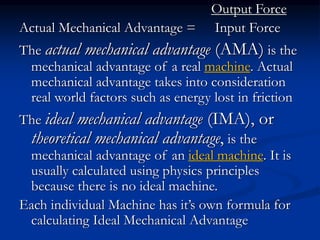
Output Force
Actual Mechanical Advantage = Input Force
The actual mechanical advantage (AMA) is the
mechanical advantage of a real machine. Actual
mechanical advantage takes into consideration
real world factors such as energy lost in friction
The ideal mechanical advantage (IMA), or
theoretical mechanical advantage, is the
mechanical advantage of an ideal machine. It is
usually calculated using physics principles
because there is no ideal machine.
Each individual Machine has it’s own formula for
calculating Ideal Mechanical Advantage
Mechanical Advantage
Go home and find 3 “real life”
examples of each simple
machine.
 3 Inclined Planes
 3 Wedges
 3 Screws
 Levers
1 1st Class Lever
1 2nd Class Lever
1 3rd Class Lever
 3 Wheels and Axels
 3 Pulleys
References
 http://www.cosi.org/onlineExhibits/simpMa
ch/sm2.html
 www.Unitedstreaming.com
 Microsoft clipart