


Simple Machines 
...continued 
Exploring Creation wwiitthh GGeenneerraall SScciieennccee 
Science is Organized Knowledge
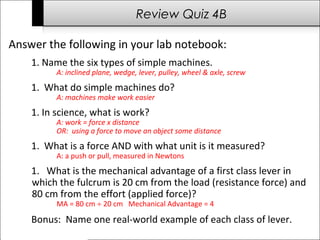
Review Quiz 4B 
Answer the following in your lab notebook: 
1. Name the six types of simple machines. 
A: inclined plane, wedge, lever, pulley, wheel & axle, screw 
1. What do simple machines do? 
A: machines make work easier 
1. In science, what is work? 
A: work = force x distance 
OR: using a force to move an object some distance 
1. What is a force AND with what unit is it measured? 
A: a push or pull, measured in Newtons 
1. What is the mechanical advantage of a first class lever in 
which the fulcrum is 20 cm from the load (resistance force) and 
80 cm from the effort (applied force)? 
MA = 80 cm ¸ 20 cm Mechanical Advantage = 4 
Bonus: Name one real-world example of each class of lever.
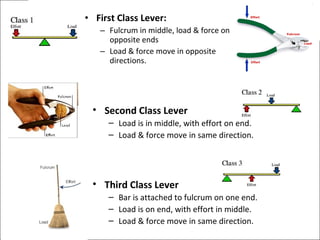
• First Class Lever: 
– Fulcrum in middle, load & force on 
opposite ends 
– Load & force move in opposite 
directions. 
– Fulcrum in middle, load & force on opposite ends 
– Load & force move in opposite directions. 
• Second Class Lever 
– Load is in middle, with effort on end. 
– Load & force move in same direction. 
• Third Class Lever 
– Bar is attached to fulcrum on one end. 
– Load is on end, with effort in middle. 
– Load & force move in same direction.
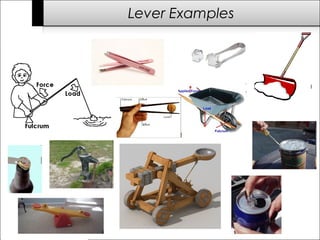
Lever Examples
Finish Experiment 4.1 
First and Second Class Levers
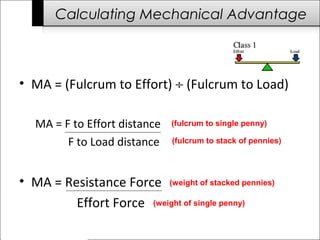
Calculating Mechanical Advantage 
• MA = (Fulcrum to Effort) ¸ (Fulcrum to Load) 
MA = F to Effort distance 
F to Load distance 
• MA = Resistance Force 
Effort Force 
(fulcrum to single penny) 
(fulcrum to stack of pennies) 
(weight of stacked pennies) 
(weight of single penny)
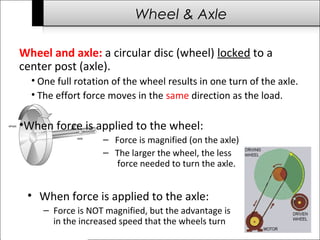
Wheel & Axle 
Wheel and axle: a circular disc (wheel) locked to a 
center post (axle). 
• One full rotation of the wheel results in one turn of the axle. 
• The effort force moves in the same direction as the load. 
•When force is applied to the wheel: 
– Force is magnified (on the axle) 
– The larger the wheel, the less 
force needed to turn the axle. 
• When force is applied to the axle: 
– Force is NOT magnified, but the advantage is 
in the increased speed that the wheels turn
Wheel & Axle 
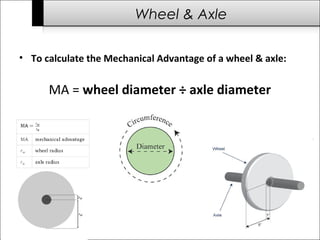
• To calculate the Mechanical Advantage of a wheel & axle: 
MA = wheel diameter ÷ axle diameter
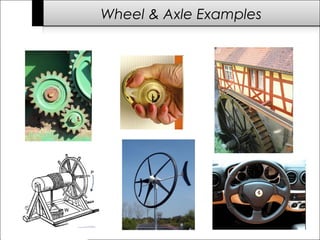
Wheel & Axle Examples
Pulley 
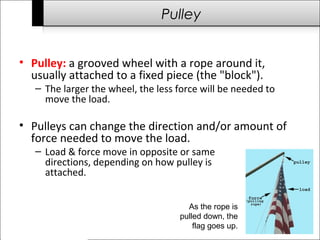
• Pulley: a grooved wheel with a rope around it, 
usually attached to a fixed piece (the "block"). 
– The larger the wheel, the less force will be needed to 
move the load. 
• Pulleys can change the direction and/or amount of 
force needed to move the load. 
– Load & force move in opposite or same 
directions, depending on how pulley is 
attached. 
As the rope is 
pulled down, the 
flag goes up.
Pulley Systems 
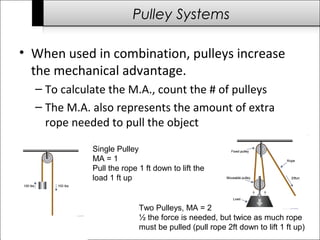
• When used in combination, pulleys increase 
the mechanical advantage. 
– To calculate the M.A., count the # of pulleys 
– The M.A. also represents the amount of extra 
rope needed to pull the object 
Single Pulley 
MA = 1 
Pull the rope 1 ft down to lift the 
load 1 ft up 
Two Pulleys, MA = 2 
½ the force is needed, but twice as much rope 
must be pulled (pull rope 2ft down to lift 1 ft up)
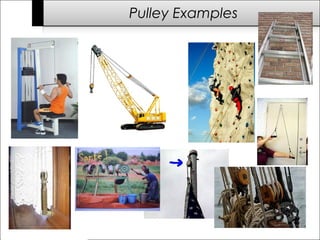
Pulley Examples
Inclined Plane 
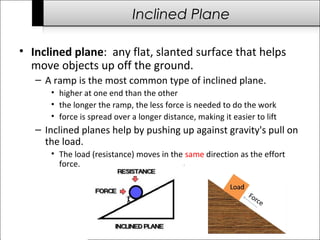
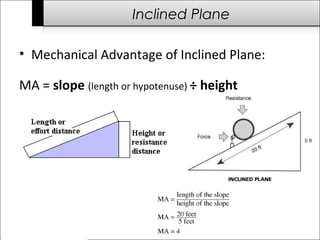
• Inclined plane: any flat, slanted surface that helps 
move objects up off the ground. 
– A ramp is the most common type of inclined plane. 
• higher at one end than the other 
• the longer the ramp, the less force is needed to do the work 
• force is spread over a longer distance, making it easier to lift 
– Inclined planes help by pushing up against gravity's pull on 
the load. 
• The load (resistance) moves in the same direction as the effort 
force.
Inclined Plane 
• Mechanical Advantage of Inclined Plane: 
MA = slope (length or hypotenuse) ÷ height
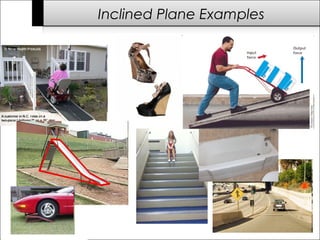
Inclined Plane Examples
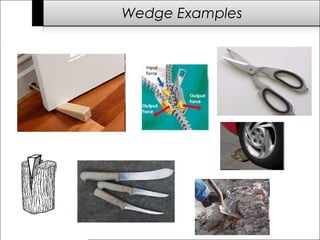
Wedge 
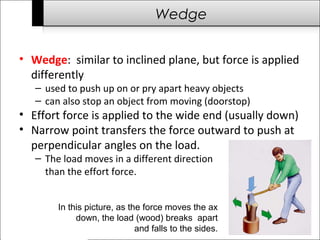
• Wedge: similar to inclined plane, but force is applied 
differently 
– used to push up on or pry apart heavy objects 
– can also stop an object from moving (doorstop) 
• Effort force is applied to the wide end (usually down) 
• Narrow point transfers the force outward to push at 
perpendicular angles on the load. 
– The load moves in a different direction 
than the effort force. 
In this picture, as the force moves the ax 
down, the load (wood) breaks apart 
and falls to the sides.
Wedge 
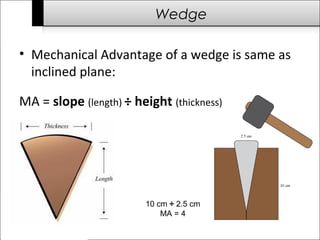
• Mechanical Advantage of a wedge is same as 
inclined plane: 
MA = slope (length) ÷ height (thickness) 
10 cm ÷ 2.5 cm 
MA = 4
Wedge Examples
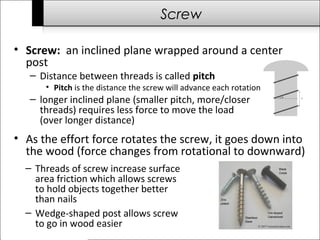
Screw 
• Screw: an inclined plane wrapped around a center 
post 
– Distance between threads is called pitch 
• Pitch is the distance the screw will advance each rotation 
– longer inclined plane (smaller pitch, more/closer 
threads) requires less force to move the load 
(over longer distance) 
• As the effort force rotates the screw, it goes down into 
the wood (force changes from rotational to downward) 
– Threads of screw increase surface 
area friction which allows screws 
to hold objects together better 
than nails 
– Wedge-shaped post allows screw 
to go in wood easier
Screw 
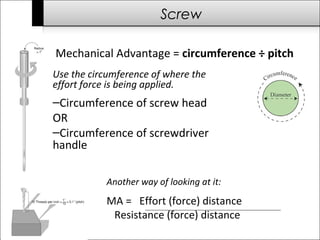
Mechanical Advantage = circumference ÷ pitch 
Use the circumference of where the 
effort force is being applied. 
–Circumference of screw head 
OR 
–Circumference of screwdriver 
handle 
Another way of looking at it: 
MA = Effort (force) distance 
Resistance (force) distance
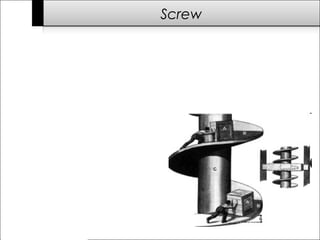
Screw
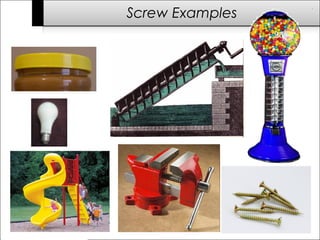
Screw Examples
Experiment 4.2 
Pulley Demo

ECGS Module 4B

  • 1.
    Simple Machines ...continued Exploring Creation wwiitthh GGeenneerraall SScciieennccee Science is Organized Knowledge
  • 2.
    Review Quiz 4B Answer the following in your lab notebook: 1. Name the six types of simple machines. A: inclined plane, wedge, lever, pulley, wheel & axle, screw 1. What do simple machines do? A: machines make work easier 1. In science, what is work? A: work = force x distance OR: using a force to move an object some distance 1. What is a force AND with what unit is it measured? A: a push or pull, measured in Newtons 1. What is the mechanical advantage of a first class lever in which the fulcrum is 20 cm from the load (resistance force) and 80 cm from the effort (applied force)? MA = 80 cm ¸ 20 cm Mechanical Advantage = 4 Bonus: Name one real-world example of each class of lever.
  • 3.
    • First ClassLever: • First Class Lever: – Fulcrum in middle, load & force on opposite ends – Load & force move in opposite directions. – Fulcrum in middle, load & force on opposite ends – Load & force move in opposite directions. • Second Class Lever – Load is in middle, with effort on end. – Load & force move in same direction. • Third Class Lever – Bar is attached to fulcrum on one end. – Load is on end, with effort in middle. – Load & force move in same direction.
  • 4.
  • 5.
    Finish Experiment 4.1 First and Second Class Levers
  • 6.
    Calculating Mechanical Advantage • MA = (Fulcrum to Effort) ¸ (Fulcrum to Load) MA = F to Effort distance F to Load distance • MA = Resistance Force Effort Force (fulcrum to single penny) (fulcrum to stack of pennies) (weight of stacked pennies) (weight of single penny)
  • 7.
    Wheel & Axle Wheel and axle: a circular disc (wheel) locked to a center post (axle). • One full rotation of the wheel results in one turn of the axle. • The effort force moves in the same direction as the load. •When force is applied to the wheel: – Force is magnified (on the axle) – The larger the wheel, the less force needed to turn the axle. • When force is applied to the axle: – Force is NOT magnified, but the advantage is in the increased speed that the wheels turn
  • 8.
    Wheel & Axle • To calculate the Mechanical Advantage of a wheel & axle: MA = wheel diameter ÷ axle diameter
  • 9.
    Wheel & AxleExamples
  • 10.
    Pulley • Pulley:a grooved wheel with a rope around it, usually attached to a fixed piece (the "block"). – The larger the wheel, the less force will be needed to move the load. • Pulleys can change the direction and/or amount of force needed to move the load. – Load & force move in opposite or same directions, depending on how pulley is attached. As the rope is pulled down, the flag goes up.
  • 11.
    Pulley Systems •When used in combination, pulleys increase the mechanical advantage. – To calculate the M.A., count the # of pulleys – The M.A. also represents the amount of extra rope needed to pull the object Single Pulley MA = 1 Pull the rope 1 ft down to lift the load 1 ft up Two Pulleys, MA = 2 ½ the force is needed, but twice as much rope must be pulled (pull rope 2ft down to lift 1 ft up)
  • 12.
  • 13.
    Inclined Plane •Inclined plane: any flat, slanted surface that helps move objects up off the ground. – A ramp is the most common type of inclined plane. • higher at one end than the other • the longer the ramp, the less force is needed to do the work • force is spread over a longer distance, making it easier to lift – Inclined planes help by pushing up against gravity's pull on the load. • The load (resistance) moves in the same direction as the effort force.
  • 14.
    Inclined Plane •Mechanical Advantage of Inclined Plane: MA = slope (length or hypotenuse) ÷ height
  • 15.
  • 16.
    Wedge • Wedge:similar to inclined plane, but force is applied differently – used to push up on or pry apart heavy objects – can also stop an object from moving (doorstop) • Effort force is applied to the wide end (usually down) • Narrow point transfers the force outward to push at perpendicular angles on the load. – The load moves in a different direction than the effort force. In this picture, as the force moves the ax down, the load (wood) breaks apart and falls to the sides.
  • 17.
    Wedge • MechanicalAdvantage of a wedge is same as inclined plane: MA = slope (length) ÷ height (thickness) 10 cm ÷ 2.5 cm MA = 4
  • 18.
  • 19.
    Screw • Screw:an inclined plane wrapped around a center post – Distance between threads is called pitch • Pitch is the distance the screw will advance each rotation – longer inclined plane (smaller pitch, more/closer threads) requires less force to move the load (over longer distance) • As the effort force rotates the screw, it goes down into the wood (force changes from rotational to downward) – Threads of screw increase surface area friction which allows screws to hold objects together better than nails – Wedge-shaped post allows screw to go in wood easier
  • 20.
    Screw Mechanical Advantage= circumference ÷ pitch Use the circumference of where the effort force is being applied. –Circumference of screw head OR –Circumference of screwdriver handle Another way of looking at it: MA = Effort (force) distance Resistance (force) distance
  • 21.
  • 22.
  • 23.

Editor's Notes

  • #5 First class levers: pop can, screw driver on lid, seesaw, catapult, pump handle Second Class: wheelbarrow, bottle cap, nut cracker Third Class: fishing pole, snow shovel, ice tongs/tweezers, chopsticks
  • #7 Knowing what you do about fractions, what happens to a number when the denominator gets smaller? (the number value increases)
  • #23 Use circumference of where the force is being applied.
  • #25 Archimede's water screw
  • #27 How is our current government and culture affecting scientific progress?