

Earth’s Protective Blanket
Atmosphere
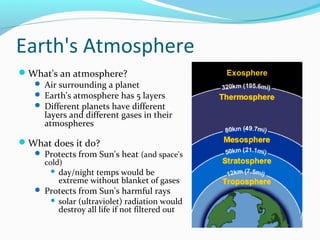
Earth's Atmosphere
What's an atmosphere?
 Air surrounding a planet
 Earth's atmosphere has 5 layers
 Different planets have different
layers and different gases in their
atmospheres
What does it do?
 Protects from Sun's heat (and space's
cold)
 day/night temps would be
extreme without blanket of gases
 Protects from Sun's harmful rays
 solar (ultraviolet) radiation would
destroy all life if not filtered out
Thermosphere
Mesosphere
Exosphere
Troposphere
Stratosphere
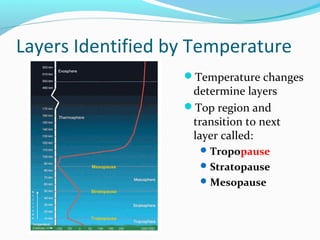
Layers Identified by Temperature
Temperature changes
determine layers
Top region and
transition to next
layer called:
Tropopause
Stratopause
Mesopause
Mesopause
Tropopause
Stratopause
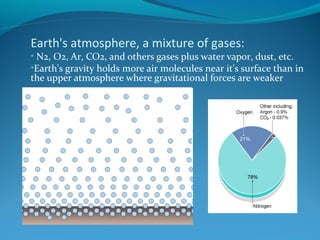
Earth's atmosphere, a mixture of gases:
• N2, O2, Ar, CO2, and others gases plus water vapor, dust, etc.
•Earth's gravity holds more air molecules near it's surface than in
the upper atmosphere where gravitational forces are weaker
Atmospheric
Pressure
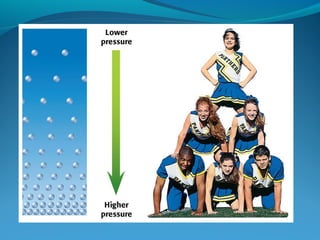
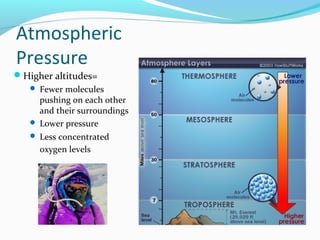
Higher altitudes=
 Fewer molecules
pushing on each other
and their surroundings
 Lower pressure
 Less concentrated
oxygen levels
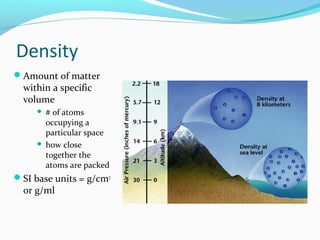
Density
Amount of matter
within a specific
volume
 # of atoms
occupying a
particular space
 how close
together the
atoms are packed
SI base units = g/cm3
or g/ml
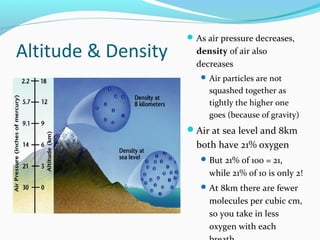
Altitude & Density
As air pressure decreases,
density of air also
decreases
 Air particles are not
squashed together as
tightly the higher one
goes (because of gravity)
Air at sea level and 8km
both have 21% oxygen
But 21% of 100 = 21,
while 21% of 10 is only 2!
At 8km there are fewer
molecules per cubic cm,
so you take in less
oxygen with each
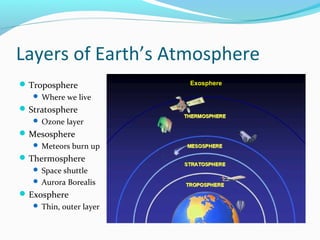
Layers of Earth’s Atmosphere
Troposphere
 Where we live
Stratosphere
 Ozone layer
Mesosphere
 Meteors burn up
Thermosphere
 Space shuttle
 Aurora Borealis
Exosphere
 Thin, outer layer
Exosphere
Troposphere
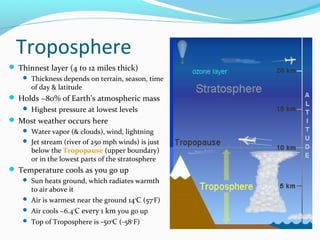
 Thinnest layer (4 to 12 miles thick)
 Thickness depends on terrain, season, time
of day & latitude
 Holds ~80% of Earth's atmospheric mass
 Highest pressure at lowest levels
 Most weather occurs here
 Water vapor (& clouds), wind, lightning
 Jet stream (river of 250 mph winds) is just
below the Tropopause (upper boundary)
or in the lowest parts of the stratosphere
 Temperature cools as you go up
 Sun heats ground, which radiates warmth
to air above it
 Air is warmest near the ground 14o
C (57o
F)
 Air cools ~6.4o
C every 1 km you go up
 Top of Troposphere is -50o
C (-58o
F)
Greenhouse Effect
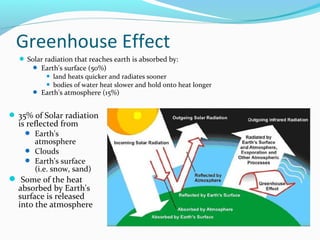
 Solar radiation that reaches earth is absorbed by:
 Earth's surface (50%)
 land heats quicker and radiates sooner
 bodies of water heat slower and hold onto heat longer
 Earth's atmosphere (15%)
 35% of Solar radiation
is reflected from
 Earth's
atmosphere
 Clouds
 Earth's surface
(i.e. snow, sand)
 Some of the heat
absorbed by Earth's
surface is released
into the atmosphere
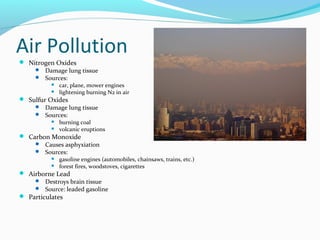
Air Pollution
 Nitrogen Oxides
 Damage lung tissue
 Sources:
 car, plane, mower engines
 lightening burning N2 in air
 Sulfur Oxides
 Damage lung tissue
 Sources:
 burning coal
 volcanic eruptions
 Carbon Monoxide
 Causes asphyxiation
 Sources:
 gasoline engines (automobiles, chainsaws, trains, etc.)
 forest fires, woodstoves, cigarettes
 Airborne Lead
 Destroys brain tissue
 Source: leaded gasoline
 Particulates
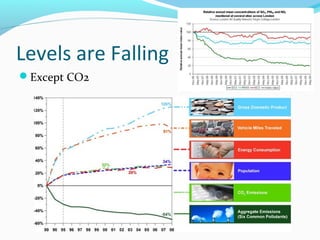
Levels are Falling
Except CO2
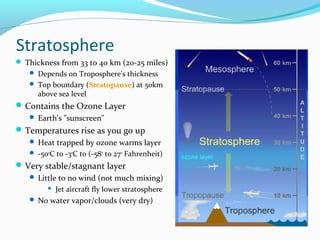
Stratosphere
 Thickness from 33 to 40 km (20-25 miles)
 Depends on Troposphere's thickness
 Top boundary (Stratopause) at 50km
above sea level
Contains the Ozone Layer
 Earth's "sunscreen"
Temperatures rise as you go up
 Heat trapped by ozone warms layer
 -50o
C to -3o
C to (-58o
to 27o
Fahrenheit)
Very stable/stagnant layer
 Little to no wind (not much mixing)
 Jet aircraft fly lower stratosphere
 No water vapor/clouds (very dry)
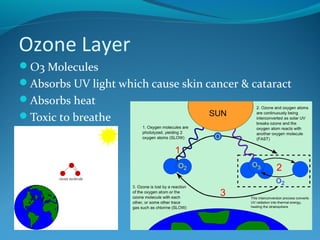
Ozone Layer
O3 Molecules
Absorbs UV light which cause skin cancer & cataract
Absorbs heat
Toxic to breathe
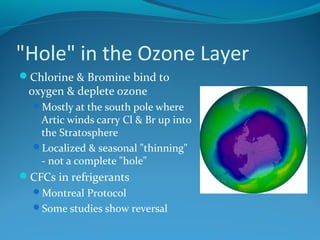
"Hole" in the Ozone Layer
Chlorine & Bromine bind to
oxygen & deplete ozone
Mostly at the south pole where
Artic winds carry Cl & Br up into
the Stratosphere
Localized & seasonal "thinning"
- not a complete "hole"
CFCs in refrigerants
Montreal Protocol
Some studies show reversal
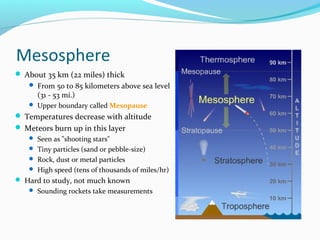
Mesosphere
 About 35 km (22 miles) thick
 From 50 to 85 kilometers above sea level
(31 - 53 mi.)
 Upper boundary called Mesopause
 Temperatures decrease with altitude
 Meteors burn up in this layer
 Seen as "shooting stars"
 Tiny particles (sand or pebble-size)
 Rock, dust or metal particles
 High speed (tens of thousands of miles/hr)
 Hard to study, not much known
 Sounding rockets take measurements
Thermosphere
 Thickest layer (250-560 miles)
 From 90 km (56 miles) to 1,000 km (621 mi) above sea level
 Upper boundary: Thermopause
 Predominant gases is Helium
 Temperatures rise with altitude
 Sun's activity (solar flares, day/night) affect the temperature
 Upper part ranges from 500°C - 2,000°C (3,632°F or higher)!
 "Ionosphere" - sublayer that contains plasmas (free p's & e's)
 ions aligned with Earth's magnetic fields collide with solar
flare ions, causing auroras
 Different gasses cause different colors
 Radio waves bounce off ionosphere to extend range
 Space shuttle, satellites & ISS orbit in this layer
 Considered "outer space" by most people
 Gas molecules very far apart & very excited
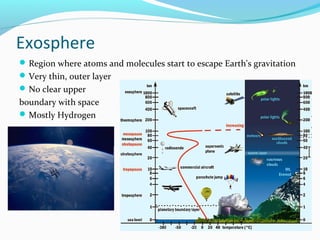
Exosphere
Region where atoms and molecules start to escape Earth's gravitation
Very thin, outer layer
No clear upper
boundary with space
Mostly Hydrogen
Homemade weather balloon experiment
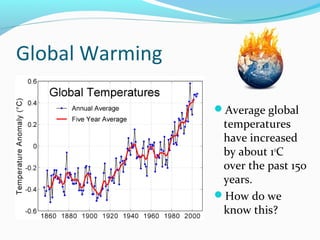
Global Warming
Average global
temperatures
have increased
by about 1o
C
over the past 150
years.
How do we
know this?
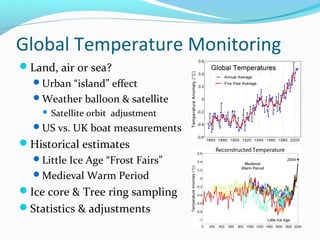
Global Temperature Monitoring
Land, air or sea?
Urban “island” effect
Weather balloon & satellite
 Satellite orbit adjustment
US vs. UK boat measurements
Historical estimates
Little Ice Age “Frost Fairs”
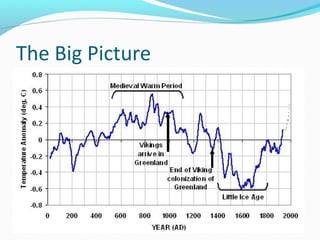
Medieval Warm Period
Ice core & Tree ring sampling
Statistics & adjustments
The Big Picture
Causes of Global Climate Change
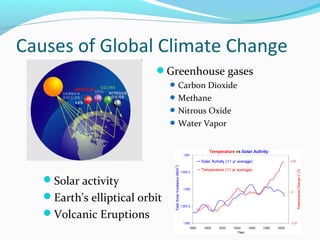
Solar activity
Earth's elliptical orbit
Volcanic Eruptions
Greenhouse gases
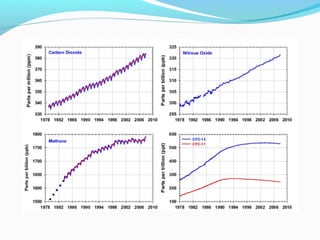
Carbon Dioxide
Methane
Nitrous Oxide
Water Vapor
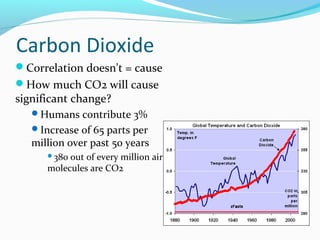
Carbon Dioxide
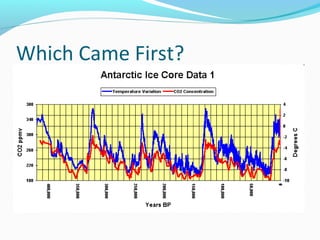
Correlation doesn't = cause
How much CO2 will cause
significant change?
Humans contribute 3%
Increase of 65 parts per
million over past 50 years
380 out of every million air
molecules are CO2
Which Came First?
Earth's Atmosphere

Earth's Atmosphere

  • 1.
  • 2.
    Earth's Atmosphere What's anatmosphere?  Air surrounding a planet  Earth's atmosphere has 5 layers  Different planets have different layers and different gases in their atmospheres What does it do?  Protects from Sun's heat (and space's cold)  day/night temps would be extreme without blanket of gases  Protects from Sun's harmful rays  solar (ultraviolet) radiation would destroy all life if not filtered out Thermosphere Mesosphere Exosphere Troposphere Stratosphere
  • 3.
    Layers Identified byTemperature Temperature changes determine layers Top region and transition to next layer called: Tropopause Stratopause Mesopause Mesopause Tropopause Stratopause
  • 4.
    Earth's atmosphere, amixture of gases: • N2, O2, Ar, CO2, and others gases plus water vapor, dust, etc. •Earth's gravity holds more air molecules near it's surface than in the upper atmosphere where gravitational forces are weaker
  • 6.
    Atmospheric Pressure Higher altitudes=  Fewermolecules pushing on each other and their surroundings  Lower pressure  Less concentrated oxygen levels
  • 7.
    Density Amount of matter withina specific volume  # of atoms occupying a particular space  how close together the atoms are packed SI base units = g/cm3 or g/ml
  • 8.
    Altitude & Density Asair pressure decreases, density of air also decreases  Air particles are not squashed together as tightly the higher one goes (because of gravity) Air at sea level and 8km both have 21% oxygen But 21% of 100 = 21, while 21% of 10 is only 2! At 8km there are fewer molecules per cubic cm, so you take in less oxygen with each
  • 10.
    Layers of Earth’sAtmosphere Troposphere  Where we live Stratosphere  Ozone layer Mesosphere  Meteors burn up Thermosphere  Space shuttle  Aurora Borealis Exosphere  Thin, outer layer Exosphere
  • 11.
    Troposphere  Thinnest layer(4 to 12 miles thick)  Thickness depends on terrain, season, time of day & latitude  Holds ~80% of Earth's atmospheric mass  Highest pressure at lowest levels  Most weather occurs here  Water vapor (& clouds), wind, lightning  Jet stream (river of 250 mph winds) is just below the Tropopause (upper boundary) or in the lowest parts of the stratosphere  Temperature cools as you go up  Sun heats ground, which radiates warmth to air above it  Air is warmest near the ground 14o C (57o F)  Air cools ~6.4o C every 1 km you go up  Top of Troposphere is -50o C (-58o F)
  • 12.
    Greenhouse Effect  Solarradiation that reaches earth is absorbed by:  Earth's surface (50%)  land heats quicker and radiates sooner  bodies of water heat slower and hold onto heat longer  Earth's atmosphere (15%)  35% of Solar radiation is reflected from  Earth's atmosphere  Clouds  Earth's surface (i.e. snow, sand)  Some of the heat absorbed by Earth's surface is released into the atmosphere
  • 13.
    Air Pollution  NitrogenOxides  Damage lung tissue  Sources:  car, plane, mower engines  lightening burning N2 in air  Sulfur Oxides  Damage lung tissue  Sources:  burning coal  volcanic eruptions  Carbon Monoxide  Causes asphyxiation  Sources:  gasoline engines (automobiles, chainsaws, trains, etc.)  forest fires, woodstoves, cigarettes  Airborne Lead  Destroys brain tissue  Source: leaded gasoline  Particulates
  • 14.
  • 15.
    Stratosphere  Thickness from33 to 40 km (20-25 miles)  Depends on Troposphere's thickness  Top boundary (Stratopause) at 50km above sea level Contains the Ozone Layer  Earth's "sunscreen" Temperatures rise as you go up  Heat trapped by ozone warms layer  -50o C to -3o C to (-58o to 27o Fahrenheit) Very stable/stagnant layer  Little to no wind (not much mixing)  Jet aircraft fly lower stratosphere  No water vapor/clouds (very dry)
  • 16.
    Ozone Layer O3 Molecules AbsorbsUV light which cause skin cancer & cataract Absorbs heat Toxic to breathe
  • 17.
    "Hole" in theOzone Layer Chlorine & Bromine bind to oxygen & deplete ozone Mostly at the south pole where Artic winds carry Cl & Br up into the Stratosphere Localized & seasonal "thinning" - not a complete "hole" CFCs in refrigerants Montreal Protocol Some studies show reversal
  • 18.
    Mesosphere  About 35km (22 miles) thick  From 50 to 85 kilometers above sea level (31 - 53 mi.)  Upper boundary called Mesopause  Temperatures decrease with altitude  Meteors burn up in this layer  Seen as "shooting stars"  Tiny particles (sand or pebble-size)  Rock, dust or metal particles  High speed (tens of thousands of miles/hr)  Hard to study, not much known  Sounding rockets take measurements
  • 19.
    Thermosphere  Thickest layer(250-560 miles)  From 90 km (56 miles) to 1,000 km (621 mi) above sea level  Upper boundary: Thermopause  Predominant gases is Helium  Temperatures rise with altitude  Sun's activity (solar flares, day/night) affect the temperature  Upper part ranges from 500°C - 2,000°C (3,632°F or higher)!  "Ionosphere" - sublayer that contains plasmas (free p's & e's)  ions aligned with Earth's magnetic fields collide with solar flare ions, causing auroras  Different gasses cause different colors  Radio waves bounce off ionosphere to extend range  Space shuttle, satellites & ISS orbit in this layer  Considered "outer space" by most people  Gas molecules very far apart & very excited
  • 20.
    Exosphere Region where atomsand molecules start to escape Earth's gravitation Very thin, outer layer No clear upper boundary with space Mostly Hydrogen
  • 21.
  • 22.
    Global Warming Average global temperatures haveincreased by about 1o C over the past 150 years. How do we know this?
  • 23.
    Global Temperature Monitoring Land,air or sea? Urban “island” effect Weather balloon & satellite  Satellite orbit adjustment US vs. UK boat measurements Historical estimates Little Ice Age “Frost Fairs” Medieval Warm Period Ice core & Tree ring sampling Statistics & adjustments
  • 24.
  • 26.
    Causes of GlobalClimate Change Solar activity Earth's elliptical orbit Volcanic Eruptions Greenhouse gases Carbon Dioxide Methane Nitrous Oxide Water Vapor
  • 28.
    Carbon Dioxide Correlation doesn't= cause How much CO2 will cause significant change? Humans contribute 3% Increase of 65 parts per million over past 50 years 380 out of every million air molecules are CO2
  • 29.

Editor's Notes

  • #8 Average lung capacity is 5,000 cm3
  • #9 Average lung capacity is 5,000 cm3
  • #14 At one time, automobiles were a huge source of carbon monoxide pollution. Automobiles require so much energy that they burn gasoline at a very fast rate. The gasoline is burned so quickly that there is just not enough time to supply it with plenty of oxygen. As a result, incomplete combustion occurs and carbon monoxide is produced. In 1977, however, the U.S. government required car manufacturers to install catalytic (kat' uh lih tik) converters in all new cars. These devices convert more than 95% of the carbon monoxide produced by automobiles into carbon dioxide. After the government mandated this change in automobile manufacturing, the concentration of carbon monoxide in the air began to decline rapidly.
  • #15 The air we breathe today is much "cleaner" than the air our grandparents lived in. Industrial revolution caused huge increase in pollution, but legislation, scientific research and changes in manufacturing practices have all helped reverse much of the damage.
  • #16 The stratosphere is very dry; air there contains little water vapor. Because of this, few clouds are found in this layer; almost all clouds occur in the lower, more humid troposphere. Polar stratospheric clouds (PSCs) are the exception. PSCs appear in the lower stratosphere near the poles in winter. They are found at altitudes of 15 to 25 km (9.3 to 15.5 miles) and form only when temperatures at those heights dip below -78° C. They appear to help cause the formation of the infamous holes in the ozone layer by "encouraging" certain chemical reactions that destroy ozone. PSCs are also called nacreous clouds. Due to the lack of vertical convection in the stratosphere, materials that get into the stratosphere can stay there for long times. Such is the case for the ozone-destroying chemicals called CFCs (chlorofluorocarbons). Large volcanic eruptions and major meteorite impacts can fling aerosol particles up into the stratosphere where they may linger for months or years, sometimes altering Earth's global climate. Rocket launches inject exhaust gases into the stratosphere, producing uncertain consequences.
  • #19 Scientists know less about the mesosphere than about other layers of the atmosphere. The mesosphere is hard to study. Weather balloons and jet planes cannot fly high enough to reach the mesosphere. The orbits of satellites are above the mesosphere. We don't have many ways to get scientific instruments to the mesosphere to take measurements there. We do get some measurements using sounding rockets. Sounding rockets make short flights that don't go into orbit. Overall, there's a lot we don't know about the mesosphere because it is hard to measure and study. What do we know about the mesosphere? Most meteors from space burn up in this layer. A special type of clouds, called "noctilucent clouds", sometimes forms in the mesosphere near the North and South Poles. These clouds are strange because they form much, much higher up than any other type of cloud. There are also odd types of lightning in the mesosphere. These types of lightning, called "sprites" and "ELVES", appear dozens of miles above thunderclouds in the troposphere below. In the mesosphere and below, different kinds of gases are all mixed together in the air. Above the mesosphere, the air is so thin that atoms and molecules of gases hardly ever run into each other. The gases get separated some, depending on the kinds of elements (like nitrogen or oxygen) that are in them.
  • #20 Solar activity strongly influences temperature in the thermosphere. The thermosphere is typically about 200° C (360° F) hotter in the daytime than at night, and roughly 500° C (900° F) hotter when the Sun is very active than at other times. Temperatures in the upper thermosphere can range from about 500° C (932° F) to 2,000° C (3,632° F) or higher. The aurora is formed when protons and electrons from the Sun travel along the Earth's magnetic field lines. These particles from the Sun are very energetic. We are talking major-league energy, much more than the power of lightning: 20 million amps at 50,000 volts is channeled into the auroral oval. It's no wonder that the gases of the atmosphere light up like the gases of a streetlamp! The aurora is also known as the northern and southern lights. From the ground, they can usually be seen where the northern and southern auroral ovals are on the Earth. The northern polar auroral oval usually spans Fairbanks, Alaska, Oslo, Norway, and the Northwest Territories. Sometimes, when the Sun is active, the northern auroral oval expands and the aurora can be seen much farther south. The lights of the aurora come in different colors. Oxygen atoms give off green light and sometimes red. Nitrogen molecules glow red, blue, and purple.
  • #24 The temperature record shows the fluctuations of the temperature of the atmosphere and the oceans through various spans of time. The most detailed information exists since 1850, when methodical thermometer-based records began. Satellites have been measuring the temperature of the troposphere since 1979. Balloon measurements begin to show an approximation of global coverage in the 1950s. Proxy measurements can be used to reconstruct the temperature record before the historical period. Quantities such as tree ring widths, coral growth, isotope variations in ice cores, ocean and lake sediments, cave deposits, fossils, ice cores, borehole temperatures, and glacier length records are correlated with climatic fluctuations. From these, proxy temperature reconstructions of the last 2000 years have been performed for the northern hemisphere, and over shorter time scales for the southern hemisphere and tropics. As well as natural, numerical proxies (tree-ring widths, for example) there exist records from the human historical period that can be used to infer climate variations, including: reports of frost fairs on the Thames; records of good and bad harvests; dates of spring blossom or lambing; extraordinary falls of rain and snow; and unusual floods or droughts. Such records can be used to infer historical temperatures, but generally in a more qualitative manner than natural proxies.
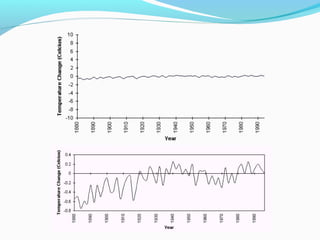
  • #26 Statistics, scale, adjustments for error