
Earth's Movement of Air Heat & Wind
Transfer of Heat Energy
Conduction Heat moving through molecules Molecules bumping into each other transfers heat  gases are poor conductors metals are good conductors Animation
Convection Heat moves with the molecules as they flow -  Warmer  molecules move faster and push each other apart - Less dense particle masses rise up, leaving space - As molecules lose heat, they sink back down, creating a circular flow Gas and liquids only Animation
Radiation Does not involve matter (atoms) Can travel through space (vacuum) Electromagnetic waves carry heat Different wavelengths visible light infrared light ultraviolet light Sun, flame, light bulb or other heat source
 
 
Solar Radiation  - Earth's Heat Source
Seasons Aphelion - Earth is farthest from the sun  Perihelion - Earth is closest to the sun  Solstices Summer solstice: longest Northern Hemisphere day  Winter solstice: shortest Northern Hemisphere day Equinox Vernal & Autumnal  Northern & Southern Hemisphere days are both 12 hours long
Atmospheric Convection Concentrated solar radiation at equator = hotter air (re-radiation) Rising heated air masses leave behind low pressure areas (L) Cold air from poles sinks down Denser (colder) air molecules results in high pressure areas (H) H L
Convection Cells Sinking polar air reaches warmer 60 o  latitudes and rises Rising equatorial air reaches cooler 30 o  latitudes and sinks In between (temperate latitudes)
 
Coriolis Effect The perceived curving of global winds due to Earth's rotation Marble Demo Video Illustration
Coriolis Effect Each cell curves (seemingly)  Northern hemisphere curves right (clockwise) S. hemisphere curves left (counter-clockwise)
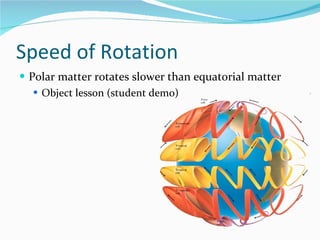
Speed of Rotation Polar matter rotates slower than equatorial matter Object lesson (student demo)
Global Winds Trade Winds North & South of the Equator Blow from East to West Prevailing Westerlies Latitudes 30 to 60  Named for the direction  from which  they blow Polar Easterlies North & South Poles Weak & irregular
 
Local Winds Smaller-scale convection Interact with global winds Influence by geography large bodies of water altitude (mountains, etc.)
 
Sea and Land Breezes Daytime : Land heats up faster than water  Hot air over land rises (L) Cool air over water pushes onto land (H) Nighttime : Land cools faster than water  Warm air over water rises (leaving a low pressure area) Cool air over land pushes into low pressure area over water Sea Breeze Land Breeze
Jet Streams High up in atmosphere Upper Troposphere Lower Stratosphere Form between cold & warm air masses bigger temperature difference = faster jet stream winds Flow west to east around the globe
 
Earth's Atmosphere Winds occur where? Troposphere & very lowest level Stratosphere What types of winds are there? Global Winds Trade Winds Prevailing Westerlies Polar Easterlies Local Winds Sea & Land Breezes Mountain & Valley Breezes Jet Streams Thermosphere Mesosphere Exosphere Troposphere Stratosphere

Heat & Wind

  • 1.
    Earth's Movement ofAir Heat & Wind
  • 2.
  • 3.
    Conduction Heat movingthrough molecules Molecules bumping into each other transfers heat gases are poor conductors metals are good conductors Animation
  • 4.
    Convection Heat moveswith the molecules as they flow - Warmer molecules move faster and push each other apart - Less dense particle masses rise up, leaving space - As molecules lose heat, they sink back down, creating a circular flow Gas and liquids only Animation
  • 5.
    Radiation Does notinvolve matter (atoms) Can travel through space (vacuum) Electromagnetic waves carry heat Different wavelengths visible light infrared light ultraviolet light Sun, flame, light bulb or other heat source
  • 6.
  • 7.
  • 8.
    Solar Radiation - Earth's Heat Source
  • 9.
    Seasons Aphelion -Earth is farthest from the sun Perihelion - Earth is closest to the sun Solstices Summer solstice: longest Northern Hemisphere day Winter solstice: shortest Northern Hemisphere day Equinox Vernal & Autumnal Northern & Southern Hemisphere days are both 12 hours long
  • 10.
    Atmospheric Convection Concentratedsolar radiation at equator = hotter air (re-radiation) Rising heated air masses leave behind low pressure areas (L) Cold air from poles sinks down Denser (colder) air molecules results in high pressure areas (H) H L
  • 11.
    Convection Cells Sinkingpolar air reaches warmer 60 o latitudes and rises Rising equatorial air reaches cooler 30 o latitudes and sinks In between (temperate latitudes)
  • 12.
  • 13.
    Coriolis Effect Theperceived curving of global winds due to Earth's rotation Marble Demo Video Illustration
  • 14.
    Coriolis Effect Eachcell curves (seemingly) Northern hemisphere curves right (clockwise) S. hemisphere curves left (counter-clockwise)
  • 15.
    Speed of RotationPolar matter rotates slower than equatorial matter Object lesson (student demo)
  • 16.
    Global Winds TradeWinds North & South of the Equator Blow from East to West Prevailing Westerlies Latitudes 30 to 60 Named for the direction from which they blow Polar Easterlies North & South Poles Weak & irregular
  • 17.
  • 18.
    Local Winds Smaller-scaleconvection Interact with global winds Influence by geography large bodies of water altitude (mountains, etc.)
  • 19.
  • 20.
    Sea and LandBreezes Daytime : Land heats up faster than water Hot air over land rises (L) Cool air over water pushes onto land (H) Nighttime : Land cools faster than water Warm air over water rises (leaving a low pressure area) Cool air over land pushes into low pressure area over water Sea Breeze Land Breeze
  • 21.
    Jet Streams Highup in atmosphere Upper Troposphere Lower Stratosphere Form between cold & warm air masses bigger temperature difference = faster jet stream winds Flow west to east around the globe
  • 22.
  • 23.
    Earth's Atmosphere Windsoccur where? Troposphere & very lowest level Stratosphere What types of winds are there? Global Winds Trade Winds Prevailing Westerlies Polar Easterlies Local Winds Sea & Land Breezes Mountain & Valley Breezes Jet Streams Thermosphere Mesosphere Exosphere Troposphere Stratosphere

Editor's Notes

  • #3 Game: 1 "Radiator" (the sun) throwing photons (balls) must stay in one spot, small group (4) of "Conductors" that can catch or pick up "photons" but only pass to others within reach and must stay planted in one spot, and large group (5+) of "Convectors" who cannot catch or throw (balls thrown must only bounce off) but can grab onto "photons" within reach and can move (as a group).
  • #4 Game: 1 "Radiator" (the sun) throwing photons (balls) must stay in one spot, small group (4) of "Conductors" that can catch or pick up "photons" but only pass to others within reach and must stay planted in one spot, and large group (5+) of "Convectors" who cannot catch or throw (balls thrown must only bounce off) but can grab onto "photons" within reach and can move (as a group).
  • #7 Game: 1 "Radiator" (the sun) throwing photons (balls) must stay in one spot, small group (4) of "Conductors" that can catch or pick up "photons" but only pass to others within reach and must stay planted in one spot, and large group (5+) of "Convectors" who cannot catch or throw (balls thrown must only bounce off) but can grab onto "photons" within reach and can move (as a group).
  • #23 Polar jet stream is strongest, often controls movement of storms