4 Main System of
the Earth
ATMOSPHERE
• From the Ancient Greek word "atmos"
meaning 'vapour' and "sphaira" meaning
'ball or sphere'
• Is any layer or set or mixture of gases
surrounding a planet or other material body
that is held in place by the gravity
Atmosphere of Earth
• Atmospheric Science(aerology) - the study of
Earth's atmosphere
• also known as sky
• The whole mass of air that surrounds our planet
• Helps protect and sustain life in Earth by:
1. Absorbing UV radiation
2. Creating pressure allowing for water to exist on the
Earth's surface
3. Warming the surface through heat retention
4. Gas composition that supports the need of every living
organism
Difference between Air and
Atmosphere
Atmosphere is any gaseous mixture that
surrounds the celestial body not necessarily
nitrogen and oxygen while
Air is the invisible mixture of human-breatheable
gas(oxygen & nitrogen) that surrounds Earth
What makes up the
Earth's Atmosphere?
1. Nitrogen (N2) - about 78%
2. Oxygen (O2) - about 21%
3. Argon (Ar) - about 0.9%
4. Carbon dioxide - about 0.4%
5. Traces gases: Neon(Ne), Helium(He),
Methane(CH4), Krypton(Kr)
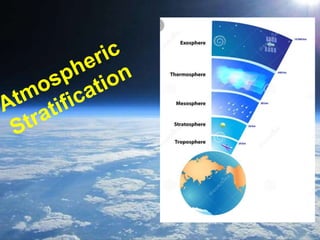
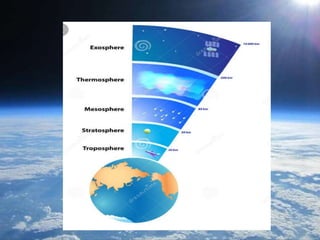
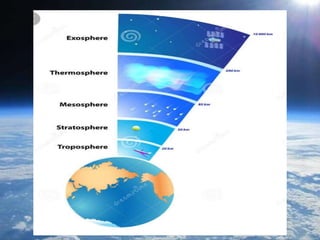
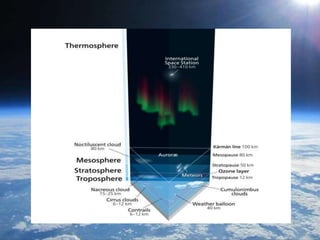
Earth's atmosphere is divided into five
main layer called Atmospheric
Stratification
1. Troposphere
2. Stratosphere
3. Mesosphere
4. Thermosphere
5. Exosphere
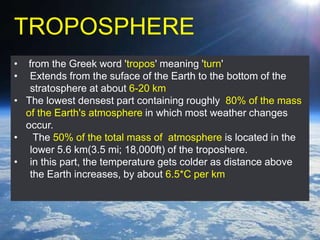
TROPOSPHERE
• from the Greek word 'tropos' meaning 'turn'
• Extends from the suface of the Earth to the bottom of the
stratosphere at about 6-20 km
• The lowest densest part containing roughly 80% of the mass
of the Earth's atmosphere in which most weather changes
occur.
• The 50% of the total mass of atmosphere is located in the
lower 5.6 km(3.5 mi; 18,000ft) of the troposhere.
• in this part, the temperature gets colder as distance above
the Earth increases, by about 6.5*C per km
• Contains about 75% of all of the air is found in the
atmosphere
• The lowest part ot the troposphere is called
boundary layer where the air is warm
• The top part of troposphere is the tropopause
• only layer that can be accessed by propoller-driven
aircraft
STRATOSPHERE
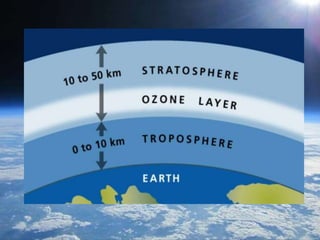
• Is the second-lowest layer of Earth's Atmosphere that lies above
the tropsphere and is separated from it by the tropopause
• extends about 20 - 50km from the top of the troposphere to the
stratopause- the interface between the stratosphere and
ionosphere
• temperature increases about 32*C as the height increases and
clouds rarely form called polar stratospheric or nacreous cloud.
• Atmospheric pressure is roughly 1/1000 the pressure at sea
level
• highest layer that can be accessed by jet-powered aircraft
Within the stratosphere, a secondary layer is contained called
the ozone layer or ozone shield ( protects us from skin cancer
other health damage by absorbing 97-99% of dangerous UV
Radiation)
Ozone layer
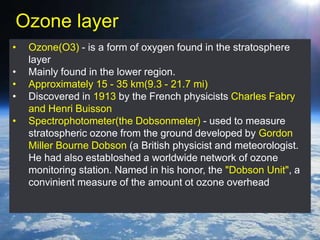
• Ozone(O3) - is a form of oxygen found in the stratosphere
layer
• Mainly found in the lower region.
• Approximately 15 - 35 km(9.3 - 21.7 mi)
• Discovered in 1913 by the French physicists Charles Fabry
and Henri Buisson
• Spectrophotometer(the Dobsonmeter) - used to measure
stratospheric ozone from the ground developed by Gordon
Miller Bourne Dobson (a British physicist and meteorologist.
He had also establoshed a worldwide network of ozone
monitoring station. Named in his honor, the "Dobson Unit", a
convinient measure of the amount ot ozone overhead
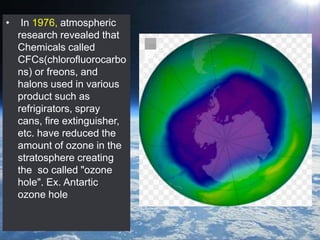
• In 1976, atmospheric
research revealed that
Chemicals called
CFCs(chlorofluorocarbo
ns) or freons, and
halons used in various
product such as
refrigirators, spray
cans, fire extinguisher,
etc. have reduced the
amount of ozone in the
stratosphere creating
the so called "ozone
hole". Ex. Antartic
ozone hole
MESOSPHERE
• Is the third lowest layer of Earth's atmosphere
about 50 - 85km bove sea level.
• Has an upper boundary called mesopause - the
coldest place on Earth as temperature drop on its
lowest point -85*C (-120*F; 190 K)
• Below mesopause, a very scarce water vapor
sublimate into polar mesospheric or noctilucent
cloud
• layer where meteors burn
• Mainly accessed by sounding rockets and
rocket-powered aircraft for it is too high to be
accessed by a jet-powered aircraft and
balloon but too low to permit orbital
spacecraft.
THERMOSPHERE
• Is the second-highest layer of Earth's Atmosphere that
extends from mesopause up to the thermopause about 85
-690km
• Thermopause - the upper boundary of thermosphere
• temperature increases with height as high as
1500*C(2700*F)
• Gas molecules are so far that individual molecule must
travel an average 1km of between collisions with other
molecule
• completely cloudless and water vapor free
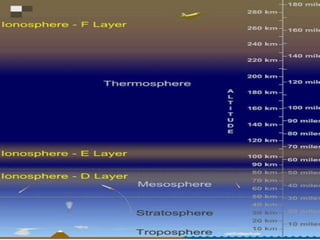
• where Ionosphere occuppies.
• accessed by the International Space System (ISS)
What is Ionosphere?
Ionosphere is not a separate layer but a part of the
thermosphere. In this region of atmosphere
the Sun's energy is so strong that it breaks apart
molecules and atoms in air, leaving ions(atoms with
missing electrons) and free-floating electrons.
Ionosphere is a special part of the atmosphere as
the different regions( D,E,F) of this make long
distance radio communication possible by reflecting
the radio waves back to Earth.
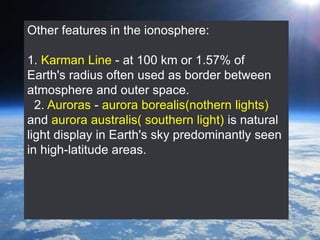
Other features in the ionosphere:
1. Karman Line - at 100 km or 1.57% of
Earth's radius often used as border between
atmosphere and outer space.
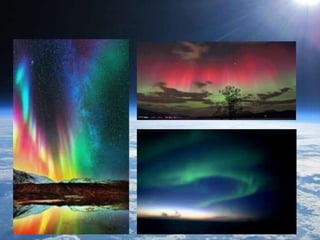
2. Auroras - aurora borealis(nothern lights)
and aurora australis( southern light) is natural
light display in Earth's sky predominantly seen
in high-latitude areas.
• Is the outermost layer of the Earth's atmosphere
• Exobase which is also referred to as the
thermopause for it lies in the lower boundary of the
exosphere.
• about 690 - 10,000 km
• Mainly composed of extremely low densities of
hydrogen, helium and several heavier molecules
including nitrogen, oxygen and carbon dioxide closer
to exobase.
• Molecules are so far apart that they can travel
hundreds of kilometer without colliding with one
another
EXOSPHER
E
Secondary Layers distinguished by other properties
1. Ozone Layer
2. Ionosphere
3. Homosphere (troposphere, stratosphere,
mesosphere & lowest part of the thermosphere) and
Heterosphere (thermosphere & exosphere)
4. Planetary boundary layer - part of troposphere
that is closest to Earth's suface
Atmosphere of the
other Planets
• PLUTO - thin atmosphere of methane and nitrogen
• MERCURY - contains no weather for its very thin
atmosphere
• VENUS - atmosphere contains thick clouds made up of
tiny droplets of sulphuric acid and carbon dioxide
• MARS - thin atmosphere of dust clouds, carbon dioxide
and thick clouds
• SATURN - atmosphere made of ammonia and
ammonium acids
• URANUS - has thick atmosphere of elements such as
hydrogen, helium and methane
• NEPTUNE - atmosphere that contains a gas called
methane which made it appear blue
• JUPITER - a gassy planet made up of hydrogen which
made it had a stormy atmosphere full of clouds

Atmosphere report

  • 1.
    4 Main Systemof the Earth
  • 2.
  • 3.
    • From theAncient Greek word "atmos" meaning 'vapour' and "sphaira" meaning 'ball or sphere' • Is any layer or set or mixture of gases surrounding a planet or other material body that is held in place by the gravity
  • 4.
    Atmosphere of Earth •Atmospheric Science(aerology) - the study of Earth's atmosphere • also known as sky • The whole mass of air that surrounds our planet • Helps protect and sustain life in Earth by: 1. Absorbing UV radiation 2. Creating pressure allowing for water to exist on the Earth's surface 3. Warming the surface through heat retention 4. Gas composition that supports the need of every living organism
  • 5.
    Difference between Airand Atmosphere Atmosphere is any gaseous mixture that surrounds the celestial body not necessarily nitrogen and oxygen while Air is the invisible mixture of human-breatheable gas(oxygen & nitrogen) that surrounds Earth
  • 6.
    What makes upthe Earth's Atmosphere? 1. Nitrogen (N2) - about 78% 2. Oxygen (O2) - about 21% 3. Argon (Ar) - about 0.9% 4. Carbon dioxide - about 0.4% 5. Traces gases: Neon(Ne), Helium(He), Methane(CH4), Krypton(Kr)
  • 7.
    Earth's atmosphere isdivided into five main layer called Atmospheric Stratification 1. Troposphere 2. Stratosphere 3. Mesosphere 4. Thermosphere 5. Exosphere
  • 9.
    TROPOSPHERE • from theGreek word 'tropos' meaning 'turn' • Extends from the suface of the Earth to the bottom of the stratosphere at about 6-20 km • The lowest densest part containing roughly 80% of the mass of the Earth's atmosphere in which most weather changes occur. • The 50% of the total mass of atmosphere is located in the lower 5.6 km(3.5 mi; 18,000ft) of the troposhere. • in this part, the temperature gets colder as distance above the Earth increases, by about 6.5*C per km
  • 10.
    • Contains about75% of all of the air is found in the atmosphere • The lowest part ot the troposphere is called boundary layer where the air is warm • The top part of troposphere is the tropopause • only layer that can be accessed by propoller-driven aircraft
  • 12.
    STRATOSPHERE • Is thesecond-lowest layer of Earth's Atmosphere that lies above the tropsphere and is separated from it by the tropopause • extends about 20 - 50km from the top of the troposphere to the stratopause- the interface between the stratosphere and ionosphere • temperature increases about 32*C as the height increases and clouds rarely form called polar stratospheric or nacreous cloud. • Atmospheric pressure is roughly 1/1000 the pressure at sea level • highest layer that can be accessed by jet-powered aircraft Within the stratosphere, a secondary layer is contained called the ozone layer or ozone shield ( protects us from skin cancer other health damage by absorbing 97-99% of dangerous UV Radiation)
  • 14.
    Ozone layer • Ozone(O3)- is a form of oxygen found in the stratosphere layer • Mainly found in the lower region. • Approximately 15 - 35 km(9.3 - 21.7 mi) • Discovered in 1913 by the French physicists Charles Fabry and Henri Buisson • Spectrophotometer(the Dobsonmeter) - used to measure stratospheric ozone from the ground developed by Gordon Miller Bourne Dobson (a British physicist and meteorologist. He had also establoshed a worldwide network of ozone monitoring station. Named in his honor, the "Dobson Unit", a convinient measure of the amount ot ozone overhead
  • 15.
    • In 1976,atmospheric research revealed that Chemicals called CFCs(chlorofluorocarbo ns) or freons, and halons used in various product such as refrigirators, spray cans, fire extinguisher, etc. have reduced the amount of ozone in the stratosphere creating the so called "ozone hole". Ex. Antartic ozone hole
  • 17.
    MESOSPHERE • Is thethird lowest layer of Earth's atmosphere about 50 - 85km bove sea level. • Has an upper boundary called mesopause - the coldest place on Earth as temperature drop on its lowest point -85*C (-120*F; 190 K) • Below mesopause, a very scarce water vapor sublimate into polar mesospheric or noctilucent cloud
  • 18.
    • layer wheremeteors burn • Mainly accessed by sounding rockets and rocket-powered aircraft for it is too high to be accessed by a jet-powered aircraft and balloon but too low to permit orbital spacecraft.
  • 20.
    THERMOSPHERE • Is thesecond-highest layer of Earth's Atmosphere that extends from mesopause up to the thermopause about 85 -690km • Thermopause - the upper boundary of thermosphere • temperature increases with height as high as 1500*C(2700*F) • Gas molecules are so far that individual molecule must travel an average 1km of between collisions with other molecule • completely cloudless and water vapor free • where Ionosphere occuppies. • accessed by the International Space System (ISS)
  • 21.
    What is Ionosphere? Ionosphereis not a separate layer but a part of the thermosphere. In this region of atmosphere the Sun's energy is so strong that it breaks apart molecules and atoms in air, leaving ions(atoms with missing electrons) and free-floating electrons. Ionosphere is a special part of the atmosphere as the different regions( D,E,F) of this make long distance radio communication possible by reflecting the radio waves back to Earth.
  • 23.
    Other features inthe ionosphere: 1. Karman Line - at 100 km or 1.57% of Earth's radius often used as border between atmosphere and outer space. 2. Auroras - aurora borealis(nothern lights) and aurora australis( southern light) is natural light display in Earth's sky predominantly seen in high-latitude areas.
  • 25.
    • Is theoutermost layer of the Earth's atmosphere • Exobase which is also referred to as the thermopause for it lies in the lower boundary of the exosphere. • about 690 - 10,000 km • Mainly composed of extremely low densities of hydrogen, helium and several heavier molecules including nitrogen, oxygen and carbon dioxide closer to exobase. • Molecules are so far apart that they can travel hundreds of kilometer without colliding with one another EXOSPHER E
  • 26.
    Secondary Layers distinguishedby other properties 1. Ozone Layer 2. Ionosphere 3. Homosphere (troposphere, stratosphere, mesosphere & lowest part of the thermosphere) and Heterosphere (thermosphere & exosphere) 4. Planetary boundary layer - part of troposphere that is closest to Earth's suface
  • 27.
  • 28.
    • PLUTO -thin atmosphere of methane and nitrogen • MERCURY - contains no weather for its very thin atmosphere • VENUS - atmosphere contains thick clouds made up of tiny droplets of sulphuric acid and carbon dioxide • MARS - thin atmosphere of dust clouds, carbon dioxide and thick clouds • SATURN - atmosphere made of ammonia and ammonium acids • URANUS - has thick atmosphere of elements such as hydrogen, helium and methane • NEPTUNE - atmosphere that contains a gas called methane which made it appear blue • JUPITER - a gassy planet made up of hydrogen which made it had a stormy atmosphere full of clouds