Clouds and Precipitation
Earth Science
Ms. Kurtzweil
Unit Objectives
 1. Describe what happens when the
temperature of air drops to or below the
dew point.
 2. Identify the conditions that must exist for
a cloud to form.
 3. Name the main types of the clouds and
the weather they predict.
 4. Describe the various types of liquid and
solid precipitation.
Basics
 Evaporation is the changing of water from a
liquid to a gas
 Liquid water on Earth entering the
atmosphere as water vapor (when energy is
added at the sunlight)
 Condensation is the changing of water from
gas to a liquid
 Water vapor in the atmosphere condensing
into liquid water droplets in a cloud (when
energy is released = cooled)
Water Cycle
* When water reaches the dew point, or saturation
point, it will begin to condense into water droplets
that form a cloud.
Four ways that air may cool enough below the dew point to begin
condensation:
1. Contacting a colder surface (blade of grass, cold glass)
2. Radiating heat
3. Mixing with colder air
4. Expanding when it rises
“Expanding when it rises” is KEY to cloud
formation!
Frost
 If the temperature is
below the freezing,
the dew point is called
the frost point.
 If the surface
temperature falls
below the frost point
water vapor is
deposited directly as
ice crystals
Before a true cloud can form, water vapor still
needs something to condense upon!
Condensation nuclei: tiny particles on which water
vapor condenses.
-The foundations of water droplets in a cloud
Examples of possible condensation nuclei in our
atmosphere:
1. Salt
2. Dust
3. Ice
4. Smoke
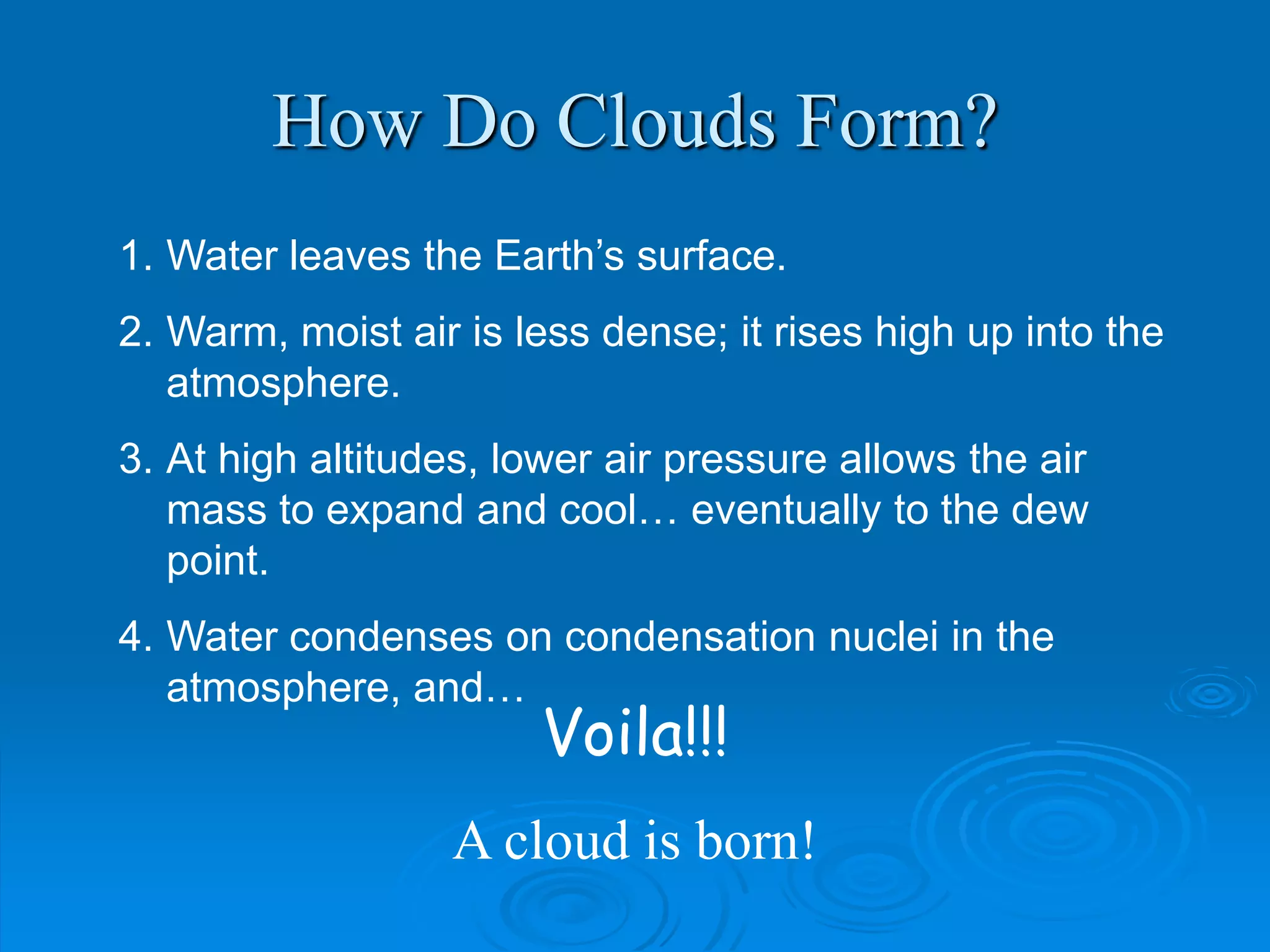
5. Sulfate/nitrate particles Cloud Seeding during droughts
How Do Clouds Form?
1. Water leaves the Earth’s surface.
2. Warm, moist air is less dense; it rises high up into the
atmosphere.
3. At high altitudes, lower air pressure allows the air
mass to expand and cool… eventually to the dew
point.
4. Water condenses on condensation nuclei in the
atmosphere, and…
Voila!!!
A cloud is born!
“Fog is just a cloud near to the ground.” Is
this true?
 There are different types of fogs, radiation or advection, but overall,
fog is formed nearer to the ground than a cloud. This occurs when
moist air close to the ground cools to its dew point.
 Fog can be considered a cloud at ground level. Like clouds, fog is made up
of condensed water droplets which are the result of the air being cooled to
the dewpoint, where it can no longer hold all of the water vapor it contains. For
instance, rain can cool and moisten the air near the surface until fog forms.
Radiation Fog
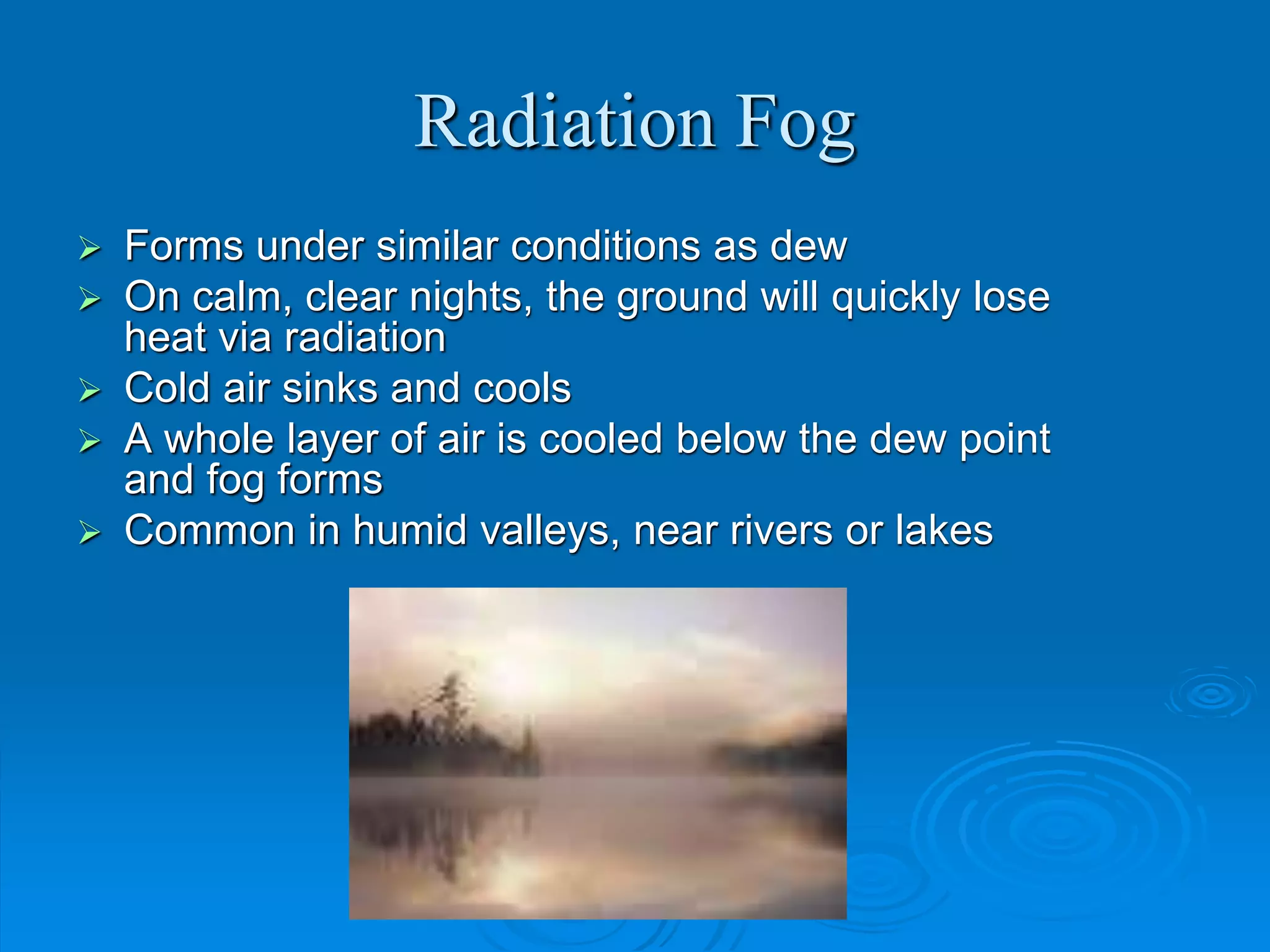
 Forms under similar conditions as dew
 On calm, clear nights, the ground will quickly lose
heat via radiation
 Cold air sinks and cools
 A whole layer of air is cooled below the dew point
and fog forms
 Common in humid valleys, near rivers or lakes
OK, back to clouds…
Cloud Types
 The shapes of clouds show how air is moving
through them.
 Rising? Horizontally? Stable?
 main cloud types, based on their location in the sky
 Cirrus “curly”
• Highest family of clouds in the sky
 Stratus “sheetlike” or “layered”
• Mid-level clouds
 Cumulus “piled” or “heaped”
• Lowest clouds, closest to Earth’s surface
Cloud Type Description
What kind of
weather?
Picture
Cirrus High-level
clouds.
Thin, feathery,
ice crystals
Just before
snowfall or rainfall
Stratus Low sheets or
layers
Little precipitation
to heavy rains or
snowfall
Cumulus Thick, puffy
masses,
“cotton balls”
Fair weather,
maybe leading to
abrupt storms
Nimbus Thick, grey
masses
Rain, snow and
thunderstorms
Nimbus and Stratus are the clouds
that bring rain, heavy rain or snow.
Thunderstorms are usually
associated to the cumulonimbus .
Precipitation
 The falling of any form of water from the
air to Earth’s surface
 When will water leave a cloud and fall to
the ground as precipitation?
 Basically, when gravity tells it to. Like thick
beads of condensation on a glass, when
cloud droplets grow into drops heavy enough
to fall to Earth, precipitation occurs.
4 major types of precipitation
 Rain
 Large droplets (up to
0.25 cm in diameter)
that are far apart and
fall rapidly
 Snow
 Clumps of 6-sided
crystals that grow by
collision
 The most common
type of solid ppt
4 major types of precipitation
 Sleet
 Ice pellets that form
when rain falls through
a layer of freezing air
 What about “black ice”
or “glare ice”?
Sometimes in an ice
storm, supercooled
rain drops will freeze
instantly as they come
in contact with a cold
surface such as roads,
roofs, and power lines
4 major types of precipitation
 Hail
 Solid ppt in the form of lumps
of ice
 Begins as raindrops falling
from a cumulonimbus cloud
 Convection currents toss the
droplet high up into the cloud
where it freezes. It then falls to
a lower level and water
condenses on it as a liquid.
The tossing and freezing
process repeats itself and the
hailstone keeps adding layers
and growing larger.
Cloud Type Description
What kind of
weather?
Picture
Cirrus High-level
clouds.
Thin, feathery,
ice crystals
Stratus Little precipitation
to heavy rains or
snowfall
Thick, puffy
masses,
“cotton balls”
Fair weather,
maybe leading to
abrupt storms
Nimbus Thick, grey
masses

Clouds and precipitation

  • 1.
    Clouds and Precipitation EarthScience Ms. Kurtzweil
  • 2.
    Unit Objectives  1.Describe what happens when the temperature of air drops to or below the dew point.  2. Identify the conditions that must exist for a cloud to form.  3. Name the main types of the clouds and the weather they predict.  4. Describe the various types of liquid and solid precipitation.
  • 3.
    Basics  Evaporation isthe changing of water from a liquid to a gas  Liquid water on Earth entering the atmosphere as water vapor (when energy is added at the sunlight)  Condensation is the changing of water from gas to a liquid  Water vapor in the atmosphere condensing into liquid water droplets in a cloud (when energy is released = cooled)
  • 4.
  • 5.
    * When waterreaches the dew point, or saturation point, it will begin to condense into water droplets that form a cloud. Four ways that air may cool enough below the dew point to begin condensation: 1. Contacting a colder surface (blade of grass, cold glass) 2. Radiating heat 3. Mixing with colder air 4. Expanding when it rises “Expanding when it rises” is KEY to cloud formation!
  • 6.
    Frost  If thetemperature is below the freezing, the dew point is called the frost point.  If the surface temperature falls below the frost point water vapor is deposited directly as ice crystals
  • 7.
    Before a truecloud can form, water vapor still needs something to condense upon! Condensation nuclei: tiny particles on which water vapor condenses. -The foundations of water droplets in a cloud Examples of possible condensation nuclei in our atmosphere: 1. Salt 2. Dust 3. Ice 4. Smoke 5. Sulfate/nitrate particles Cloud Seeding during droughts
  • 8.
    How Do CloudsForm? 1. Water leaves the Earth’s surface. 2. Warm, moist air is less dense; it rises high up into the atmosphere. 3. At high altitudes, lower air pressure allows the air mass to expand and cool… eventually to the dew point. 4. Water condenses on condensation nuclei in the atmosphere, and… Voila!!! A cloud is born!
  • 9.
    “Fog is justa cloud near to the ground.” Is this true?  There are different types of fogs, radiation or advection, but overall, fog is formed nearer to the ground than a cloud. This occurs when moist air close to the ground cools to its dew point.  Fog can be considered a cloud at ground level. Like clouds, fog is made up of condensed water droplets which are the result of the air being cooled to the dewpoint, where it can no longer hold all of the water vapor it contains. For instance, rain can cool and moisten the air near the surface until fog forms.
  • 10.
    Radiation Fog  Formsunder similar conditions as dew  On calm, clear nights, the ground will quickly lose heat via radiation  Cold air sinks and cools  A whole layer of air is cooled below the dew point and fog forms  Common in humid valleys, near rivers or lakes
  • 11.
    OK, back toclouds…
  • 12.
    Cloud Types  Theshapes of clouds show how air is moving through them.  Rising? Horizontally? Stable?  main cloud types, based on their location in the sky  Cirrus “curly” • Highest family of clouds in the sky  Stratus “sheetlike” or “layered” • Mid-level clouds  Cumulus “piled” or “heaped” • Lowest clouds, closest to Earth’s surface
  • 13.
    Cloud Type Description Whatkind of weather? Picture Cirrus High-level clouds. Thin, feathery, ice crystals Just before snowfall or rainfall Stratus Low sheets or layers Little precipitation to heavy rains or snowfall Cumulus Thick, puffy masses, “cotton balls” Fair weather, maybe leading to abrupt storms Nimbus Thick, grey masses Rain, snow and thunderstorms
  • 14.
    Nimbus and Stratusare the clouds that bring rain, heavy rain or snow. Thunderstorms are usually associated to the cumulonimbus .
  • 15.
    Precipitation  The fallingof any form of water from the air to Earth’s surface  When will water leave a cloud and fall to the ground as precipitation?  Basically, when gravity tells it to. Like thick beads of condensation on a glass, when cloud droplets grow into drops heavy enough to fall to Earth, precipitation occurs.
  • 16.
    4 major typesof precipitation  Rain  Large droplets (up to 0.25 cm in diameter) that are far apart and fall rapidly  Snow  Clumps of 6-sided crystals that grow by collision  The most common type of solid ppt
  • 17.
    4 major typesof precipitation  Sleet  Ice pellets that form when rain falls through a layer of freezing air  What about “black ice” or “glare ice”? Sometimes in an ice storm, supercooled rain drops will freeze instantly as they come in contact with a cold surface such as roads, roofs, and power lines
  • 18.
    4 major typesof precipitation  Hail  Solid ppt in the form of lumps of ice  Begins as raindrops falling from a cumulonimbus cloud  Convection currents toss the droplet high up into the cloud where it freezes. It then falls to a lower level and water condenses on it as a liquid. The tossing and freezing process repeats itself and the hailstone keeps adding layers and growing larger.
  • 20.
    Cloud Type Description Whatkind of weather? Picture Cirrus High-level clouds. Thin, feathery, ice crystals Stratus Little precipitation to heavy rains or snowfall Thick, puffy masses, “cotton balls” Fair weather, maybe leading to abrupt storms Nimbus Thick, grey masses