Layers of Atmosphere Slides for Earth Environmental.ppt
1.
LAYERS OF GASESSURROUNDING EARTH
LAYERS OF GASES SURROUNDING EARTH
Atmosphere
2.
% of gasesin the atmosphere
% of gases in the atmosphere
• 78% Nitrogen
• 21% Oxygen
• 0.04% Carbon dioxide, CO2
• 0.4% water vapor
3.
• Gravity pullsthe gases of atmosphere toward
earth’s surface & holds them
• Most gases are found within 32 km (20 miles)
• Air (atmospheric) pressure – pressure exerted
on a surface by the atmosphere
• Less air at higher altitudes means less weight
pushing down = Air pressure is HIGHER at
LOWER altitudes & Lower at Higher altitudes
4.
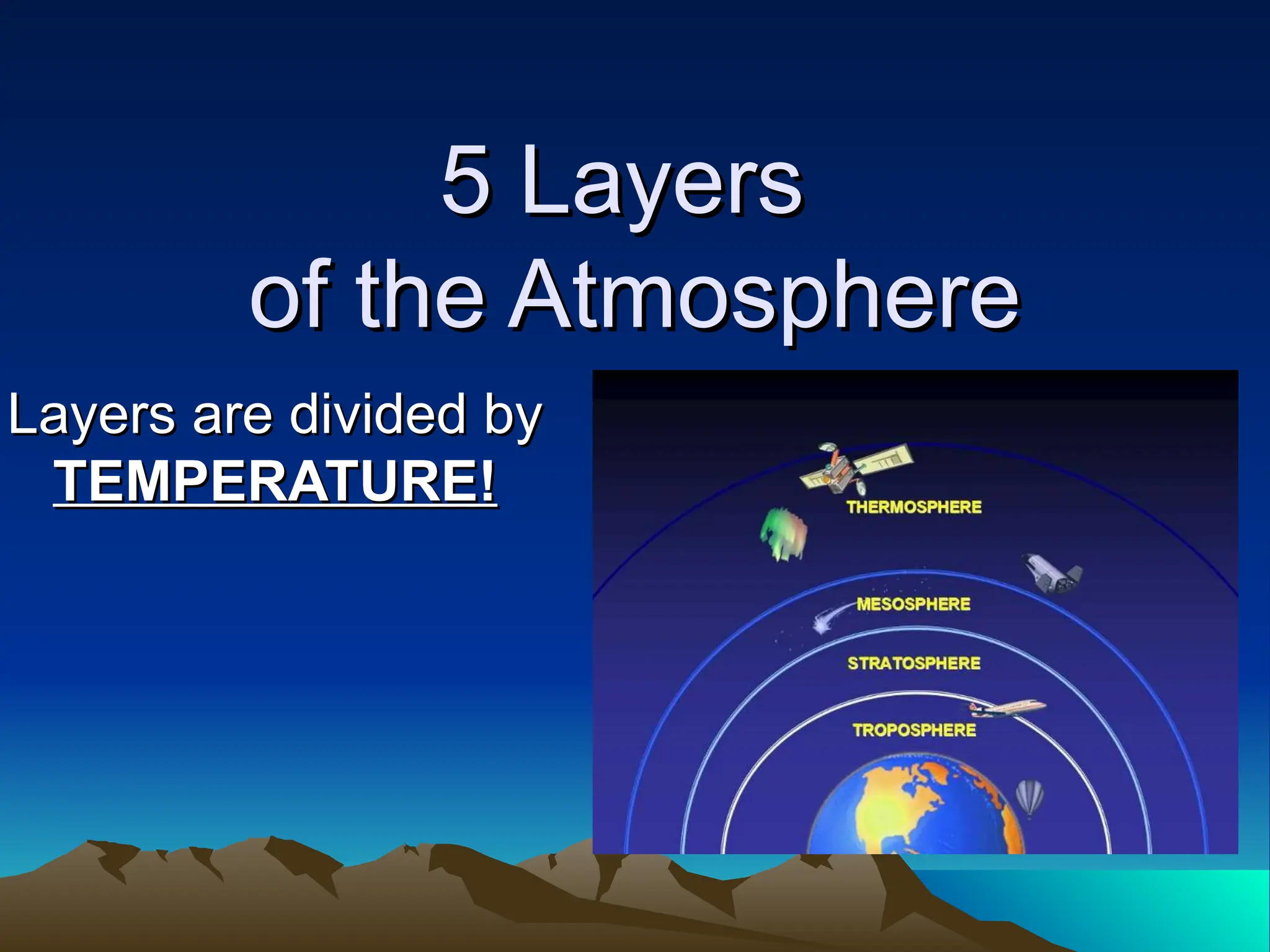
5 Layers
5 Layers
ofthe Atmosphere
of the Atmosphere
Layers are divided by
Layers are divided by
TEMPERATURE!
TEMPERATURE!
5.
1) Troposphere
1) Troposphere
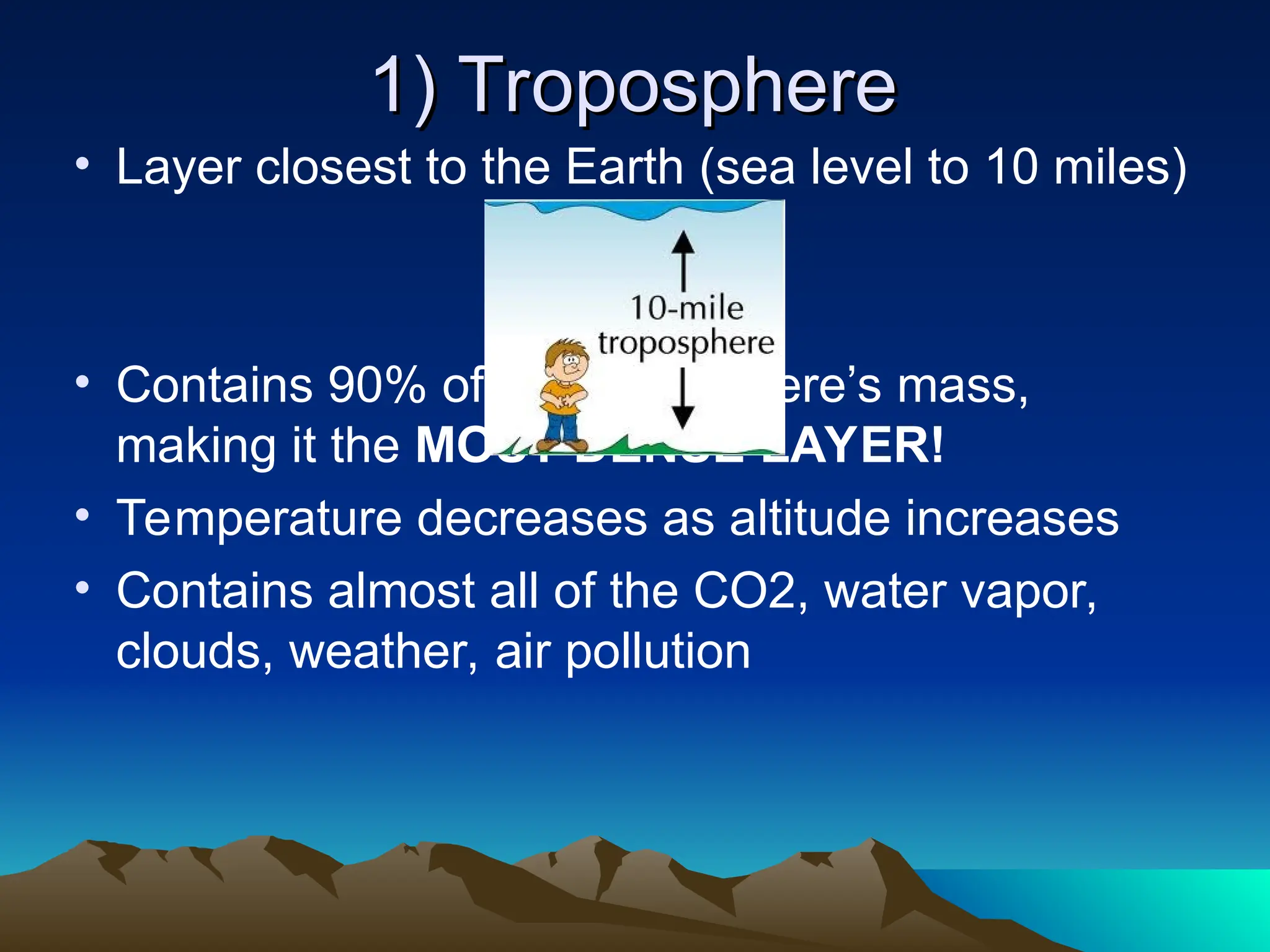
•Layer closest to the Earth (sea level to 10 miles)
• Contains 90% of the atmosphere’s mass,
making it the MOST DENSE LAYER!
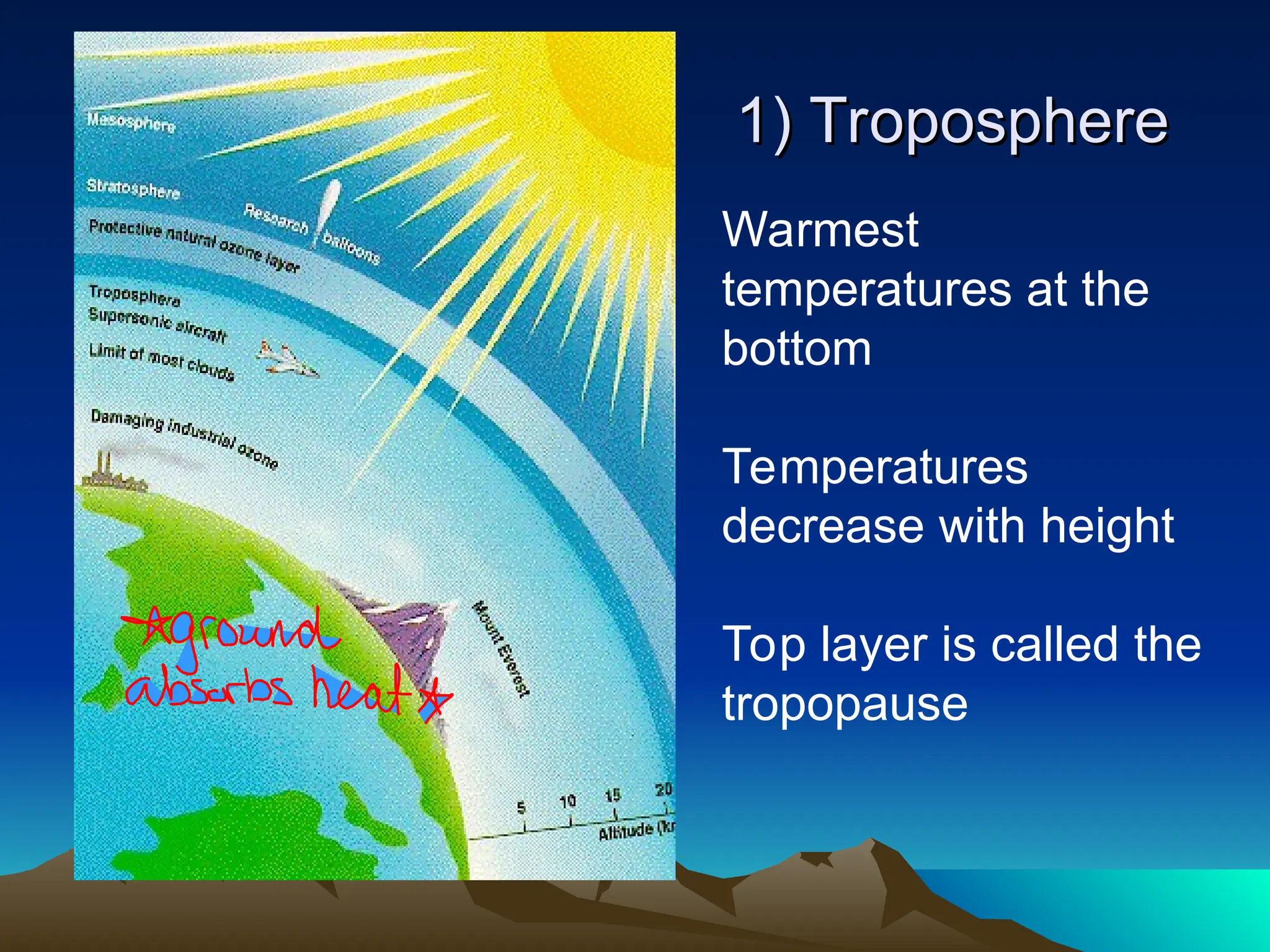
• Temperature decreases as altitude increases
• Contains almost all of the CO2, water vapor,
clouds, weather, air pollution
2) Stratosphere
2) Stratosphere
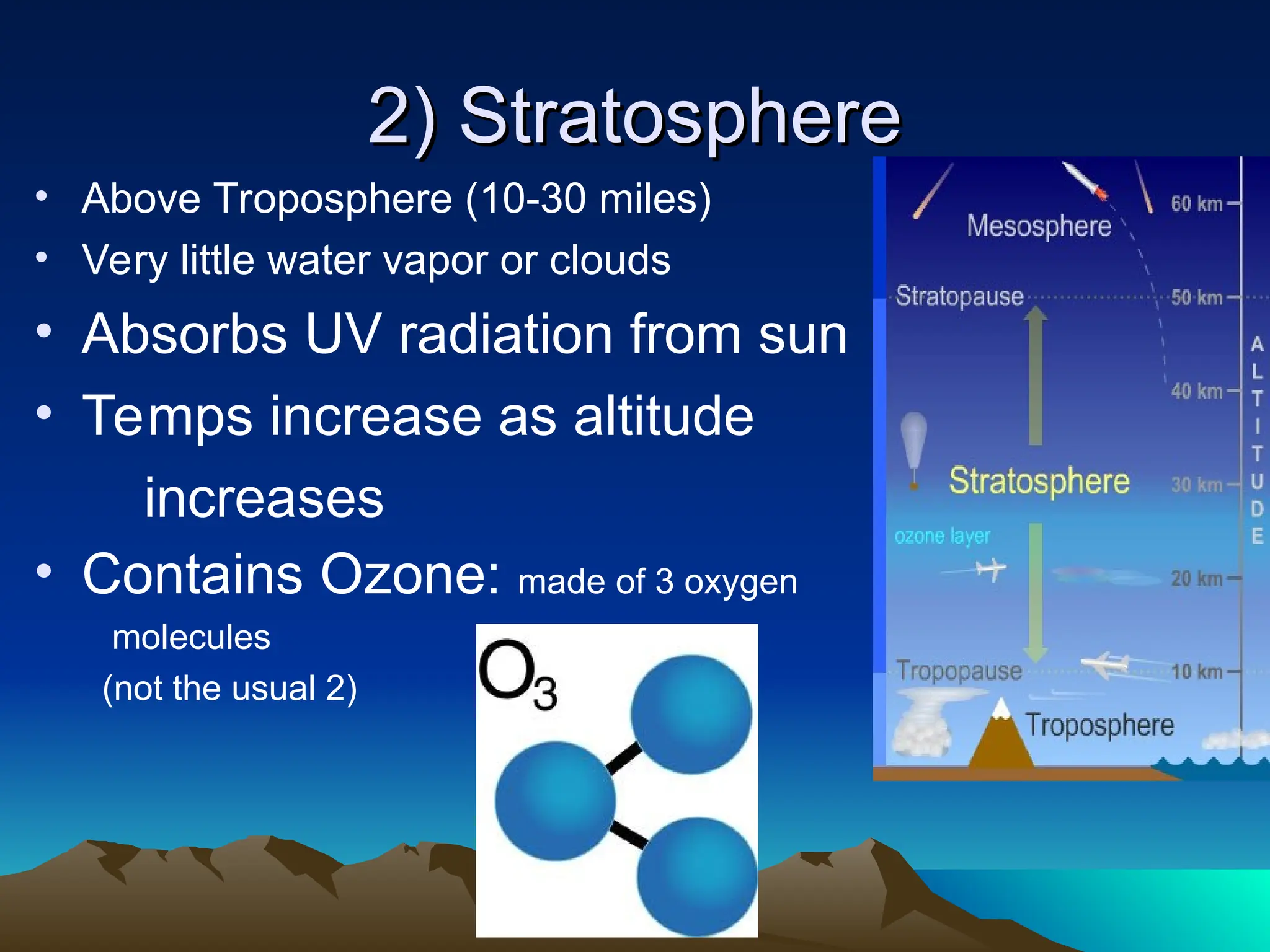
•Above Troposphere (10-30 miles)
• Very little water vapor or clouds
• Absorbs UV radiation from sun
• Temps increase as altitude
increases
• Contains Ozone: made of 3 oxygen
molecules
(not the usual 2)
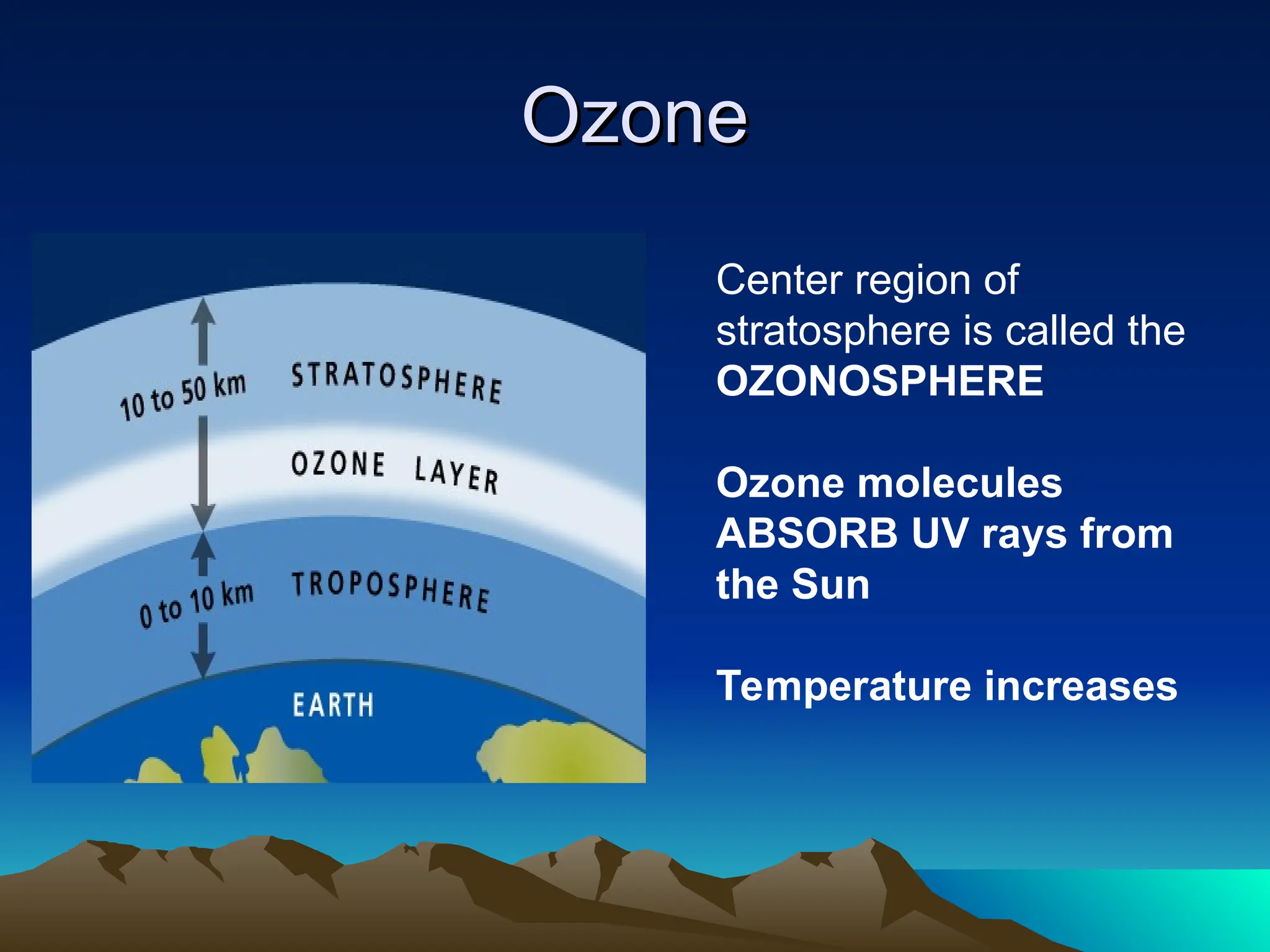
Ozone
Ozone
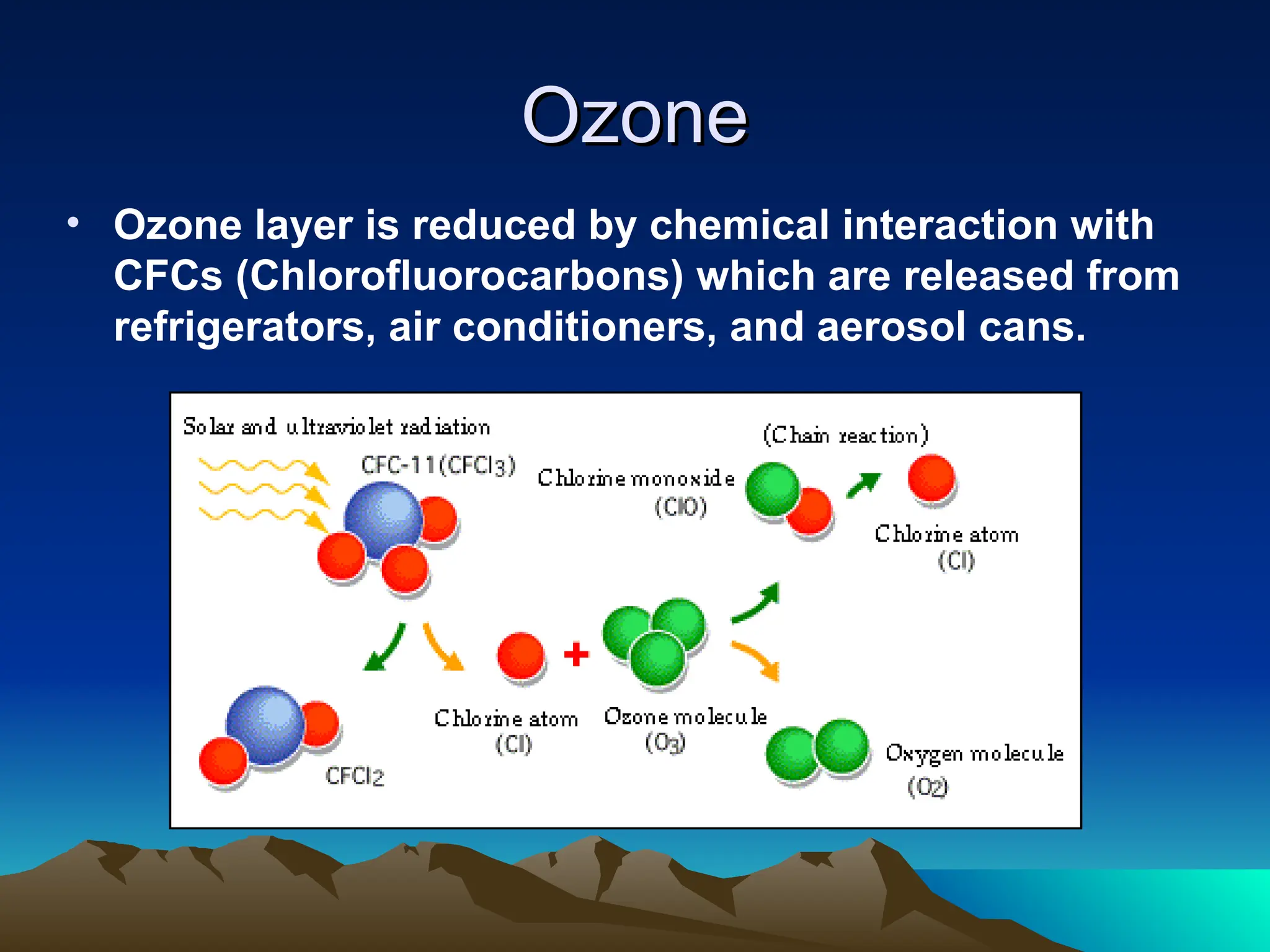
• Ozone layeris reduced by chemical interaction with
CFCs (Chlorofluorocarbons) which are released from
refrigerators, air conditioners, and aerosol cans.
10.
3) Mesosphere
3) Mesosphere
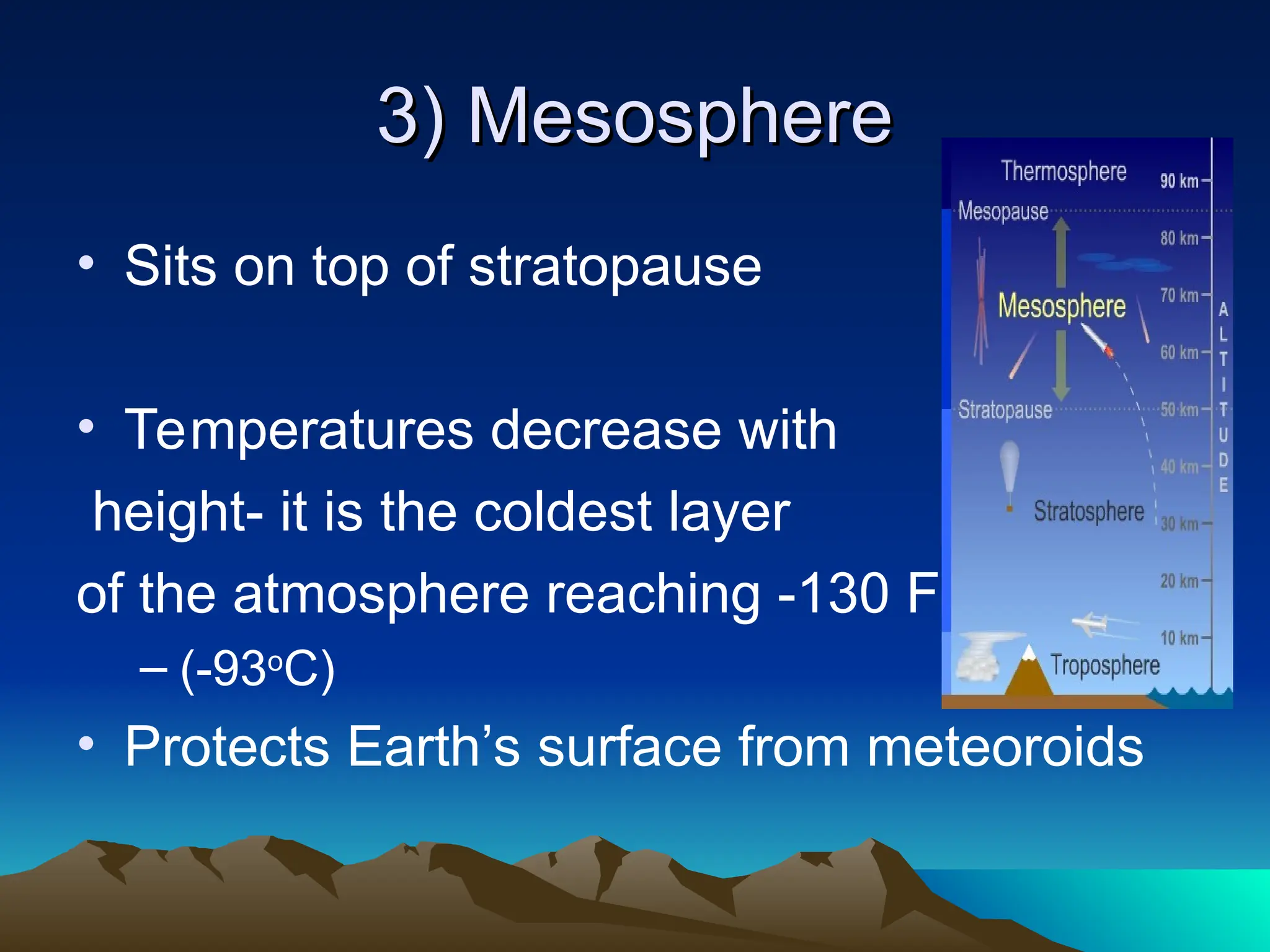
•Sits on top of stratopause
• Temperatures decrease with
height- it is the coldest layer
of the atmosphere reaching -130 F
– (-93o
C)
• Protects Earth’s surface from meteoroids
11.
4) Thermosphere
4) Thermosphere
•layer above Mesosphere
• Little atmosphere, very low density
• Temperatures increase with altitude
reaching 3,632o
F due to decreasing air
12.
4) Thermosphere
4) Thermosphere
•Contains Ionosphere- lower layer of
thermosphere, energy from Sun tears
gasses apart, electrically charging
particles
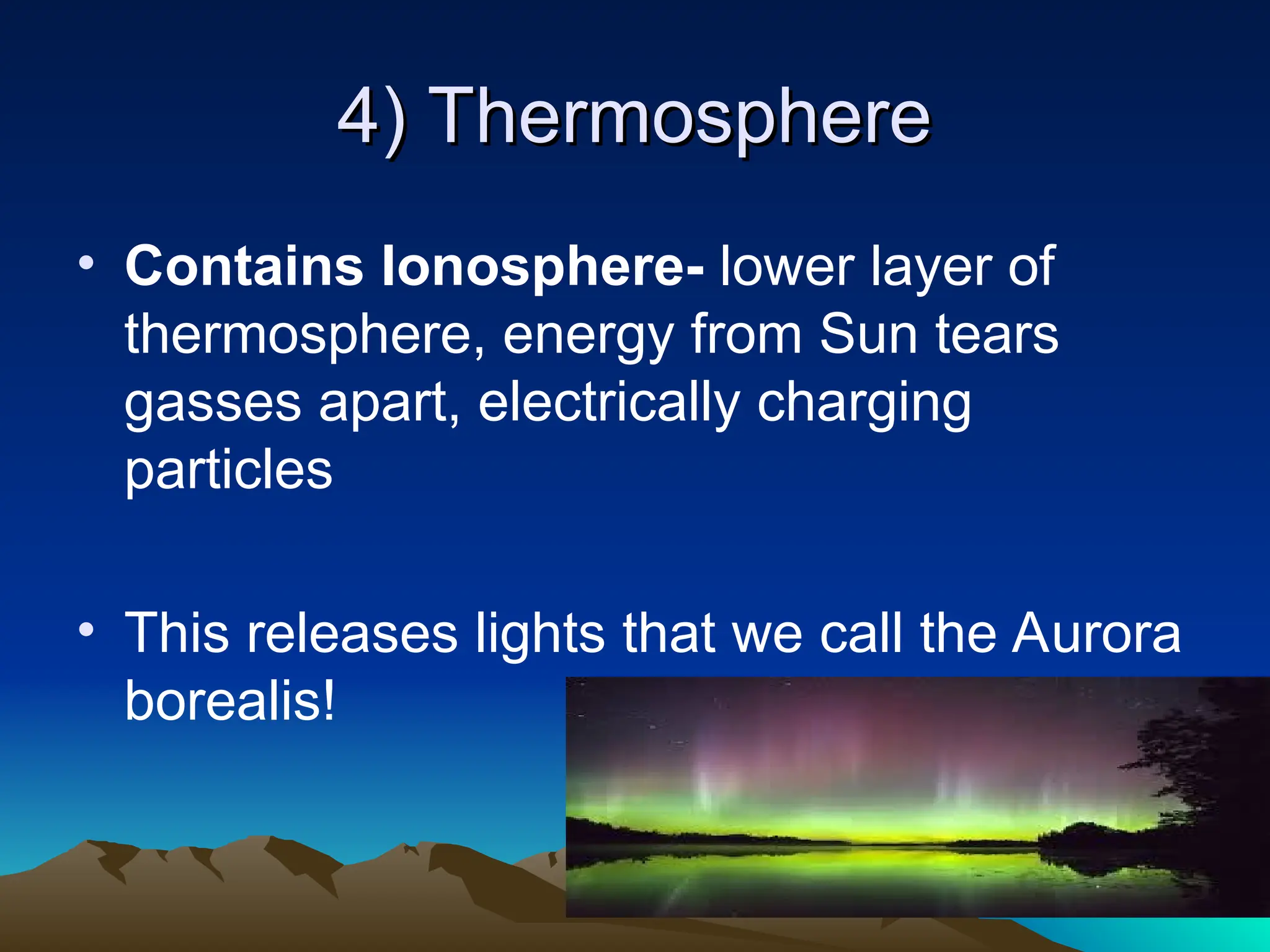
• This releases lights that we call the Aurora
borealis!
13.
5) Exosphere
5) Exosphere
•Exosphere - uppermost layer
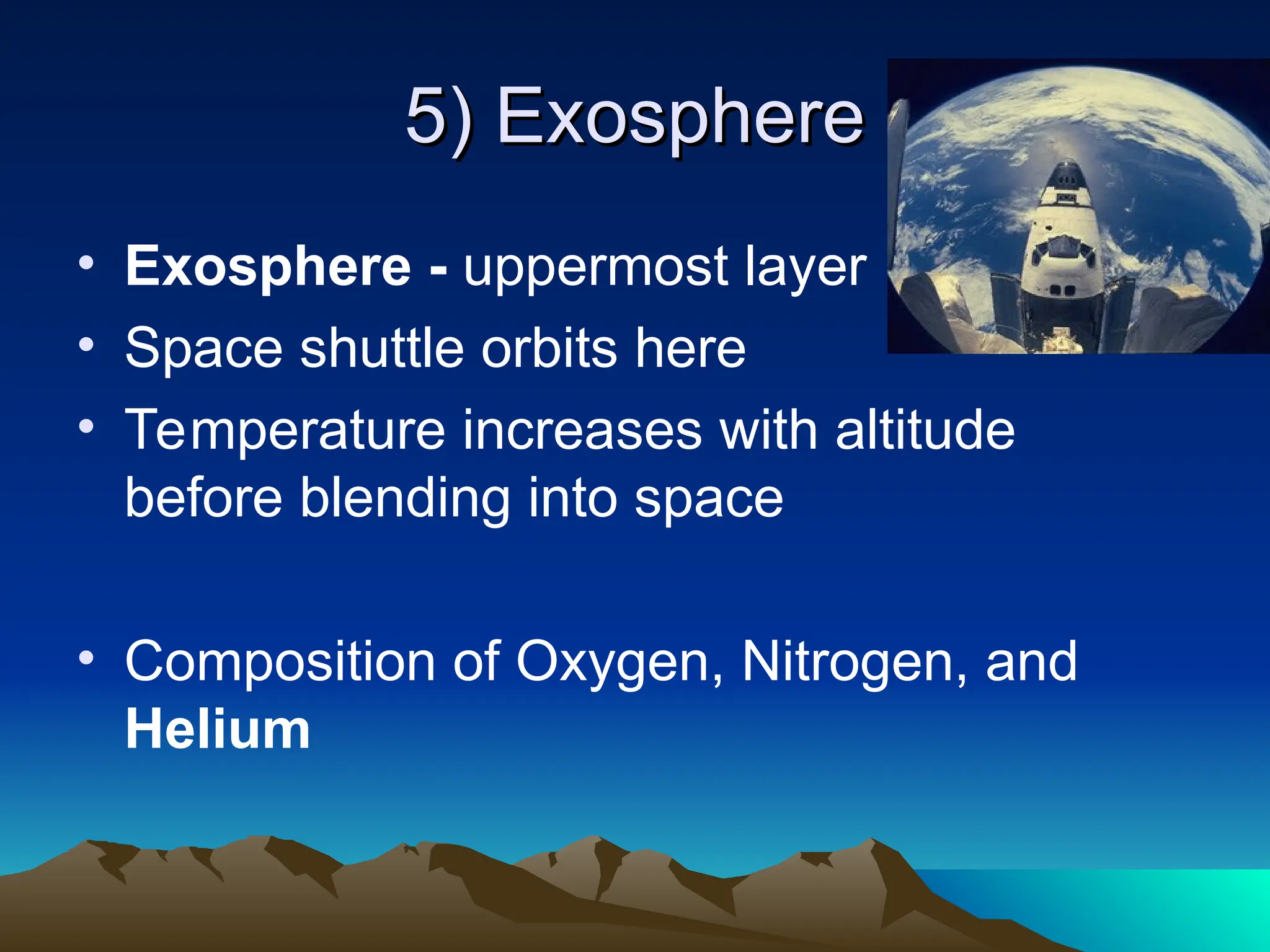
• Space shuttle orbits here
• Temperature increases with altitude
before blending into space
• Composition of Oxygen, Nitrogen, and
Helium
14.
Solar Energy
Solar Energy
•Our atmosphere is heated by the transfer of
energy from the sun in several ways:
• A) radiation – all forms of energy from waves
in space ex. radio, infrared, visible, ultraviolet
(UV), & X-rays
• B) conduction – when heat (E) is transferred
from 1 object to another by direct contact
• C) convection – the movement of GASES or
LIQUIDS when they are heated unevenly
15.
• Most solarenergy that reaches the Earth’s
atmosphere is ABSORBED by the surface
• Solar – energy from the sun is trapped in
the lower atmosphere by “greenhouse
gases” & prevented from escaping back
into space
• Greenhouse gases:
– CO – burning of wood & fossil fuels
– CO2 – use of coal, natural gas, & oil
– CH4 – farming and industrial activity
16.
Global Warming
Global Warming
•Energy trapped by gases in our
atmosphere has caused the overall global
temperature of Earth to rise over the past
100 years.
• Human activity such as burning fossil fuels
& deforestation, may be increasing the
levels of greenhouse gases in our
atmosphere
17.
Wind
Wind
• Wind- movementof air due to uneven
atmospheric pressure
• Coriolis Effect – rotation of Earth causes
surface winds in the Northern Hemisphere
to turn to the LEFT and surface winds in
the Southern Hemisphere to the RIGHT
18.
• When airgets warmer it becomes less
dense, as it rises it begins to move toward
the POLES.
• The longer it is high in the air, it becomes
More DENSE and SINKS down to the
Earth’s surface again where it is warmed.
• Air flowing from the equator completes
Continuous looping patterns of flow called
“wind cells.”


![Pollution.ppt [Autosaved].ppt yogesh kumbhar](https://cdn.slidesharecdn.com/ss_thumbnails/pollution-251205194856-d30cfee8-thumbnail.jpg?width=640&height=640&fit=bounds)


