Stars & Nuclear Power
The Sun’s AtmosphereThree layersPhotosphereMost of sun’s light comes from this layer400 km thick5,527oCChromosphereMore helium, redish2,500km thick29,727oCCoronaVisible during eclipseSeveral million km thick1-2 million degrees C
Sun’s Inner CompositionThree ZonesCoreHeat & light produced via fusionNear 15 million degrees Celsius (27 million F)Super dense, yet gaseous90% HydrogenRadiative ZonePhotons of light and heat 		emanate from coreConvection ZoneHeated gas circulates
Isotopes of HydrogenIn the Sun’s CoreEnormous pressure = blazing hot temperaturesHydrogen plasma“naked” nuclei (electrons stripped off)
Nuclear Fusion
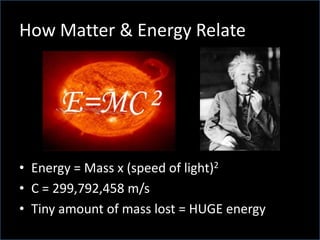
How Matter & Energy RelateEnergy = Mass x (speed of light)2C = 299,792,458 m/sTiny amount of mass lost = HUGE energy
Energy Released as Light
Sun FeaturesSunspotsDark, cool areasAlways in pairsIntense magnetic fieldsProminencesArches of gasOriented along sunspot magnetic fieldsCoronal Mass Ejections (600 mile/sec eruptions)Solar Flaresabrupt, violent explosions from the sun Sudden changes in sun’s magnetic field Cause auroras, disrupt communications satellites, navigation systems and can overload power grids
Nuclear FissionMass converted to energy by the splitting of atomsChain reaction from free neutronsMousetrap video
Types of StarsStars emit different colors & intensity of lightColor corresponds to temperatureMost stars fall into one of these categories:White DwarfsRed GiantsBlue GiantsSupergiantsMain Sequence 						Stars (most common)
Stars & Nuclear Power