Geodesy, GE 202
Kutubuddin ANSARI
kutubuddin.ansari@ikc.edu.tr
Lecture 3, Oct 11, 2016
Interior of the Earth
•The Earth's mass is about 5.98 x 1024
kg.
• Earth is the densest planet in our Solar
System (mass/volume).
•Earth is made of several layers with different
compositions and physical properties, like
temperature, density, and the ability to flow.
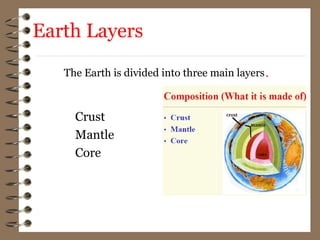
Earth
Crust
Mantle
Core
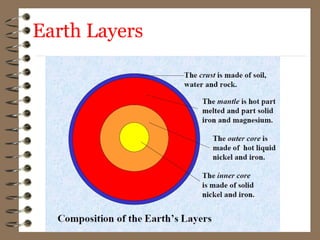
The Earth is divided into three main layers.
Earth Layers
Shell = crust
Egg white = mantle
Yolk = core
How are the earth’s
layers similar to an
egg?
Earth Layers
Earth Layers
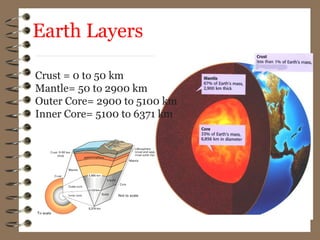
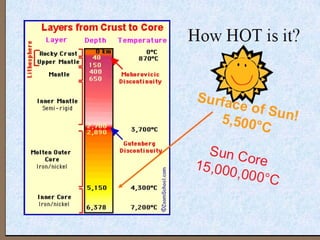
Crust = 0 to 50 km
Mantle= 50 to 2900 km
Outer Core= 2900 to 5100 km
Inner Core= 5100 to 6371 km
Earth Layers
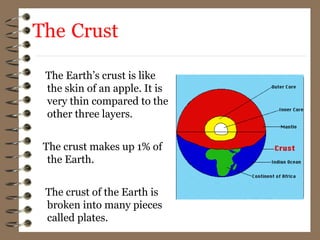
The Crust
The Earth’s crust is like
the skin of an apple. It is
very thin compared to the
other three layers.
The crust makes up 1% of
the Earth.
The crust of the Earth is
broken into many pieces
called plates.
CrustCrust
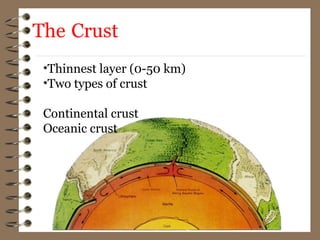
•Thinnest layer (0-50 km)
•Two types of crust
Continental crust
Oceanic crust
The Crust
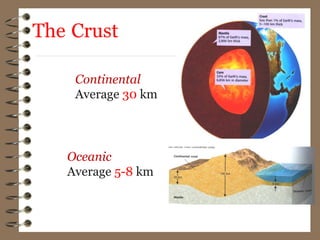
Continental
Average 30 km
Oceanic
Average 5-8 km
The Crust
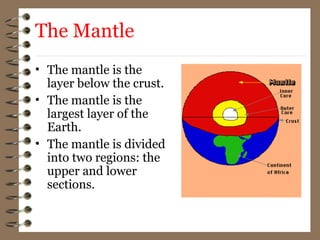
The Mantle
• The mantle is the
layer below the crust.
• The mantle is the
largest layer of the
Earth.
• The mantle is divided
into two regions: the
upper and lower
sections.
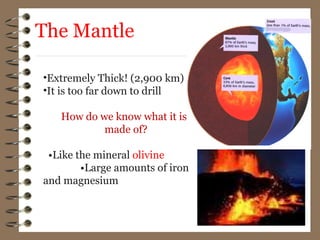
•Extremely Thick! (2,900 km)
•It is too far down to drill
How do we know what it is
made of?
•Like the mineral olivine
•Large amounts of iron
and magnesium
The Mantle
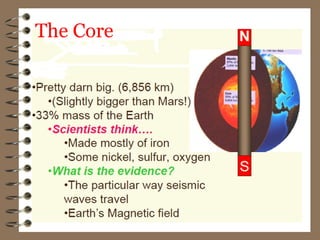
The Core
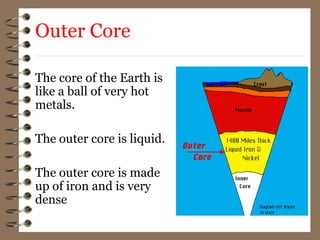
The core of the Earth is
like a ball of very hot
metals.
The outer core is liquid.
The outer core is made
up of iron and is very
dense
Outer Core
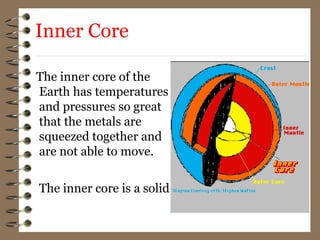
The inner core of the
Earth has temperatures
and pressures so great
that the metals are
squeezed together and
are not able to move.
The inner core is a solid
Inner Core
Plate Tectonics
Plate Tectonics
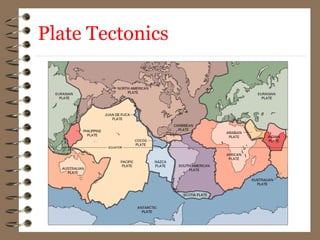
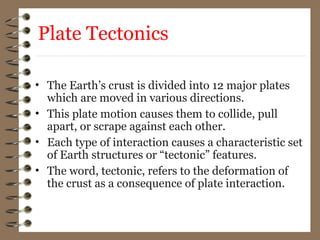
• The Earth’s crust is divided into 12 major plates
which are moved in various directions.
• This plate motion causes them to collide, pull
apart, or scrape against each other.
• Each type of interaction causes a characteristic set
of Earth structures or “tectonic” features.
• The word, tectonic, refers to the deformation of
the crust as a consequence of plate interaction.
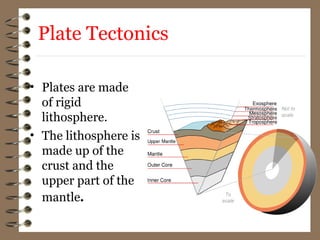
• Plates are made
of rigid
lithosphere.
• The lithosphere is
made up of the
crust and the
upper part of the
mantle.
Plate Tectonics
Plate Tectonics
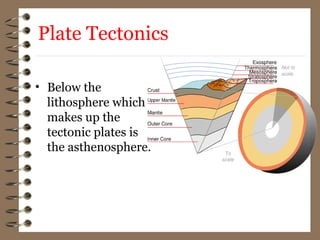
• Below the
lithosphere which
makes up the
tectonic plates is
the asthenosphere.
• “Plates” of lithosphere are moved around by
the underlying hot mantle convection cells
Plate Tectonics
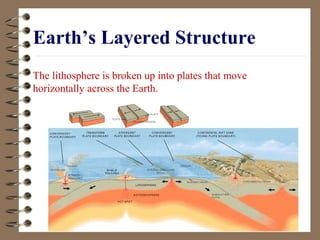
The lithosphere is broken up into plates that move
horizontally across the Earth.
Earth’s Layered Structure
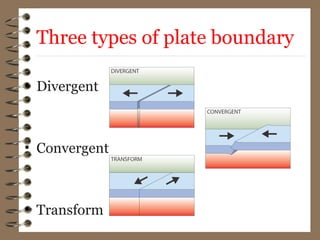
• Divergent
• Convergent
• Transform
Three types of plate boundary
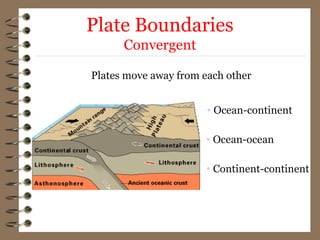
Plate Boundaries
Convergent
• Ocean-continent
• Ocean-ocean
• Continent-continent
Plates move away from each other
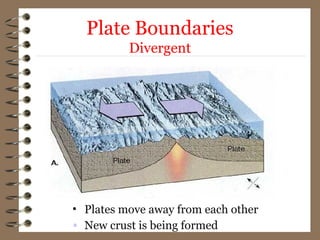
Plate Boundaries
Divergent
• Plates move away from each other
• New crust is being formed
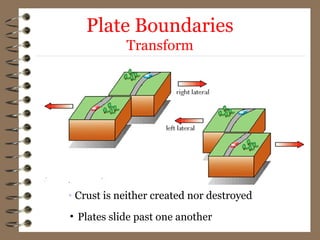
Plate Boundaries
Transform
• Plates slide past one another
• Crust is neither created nor destroyed
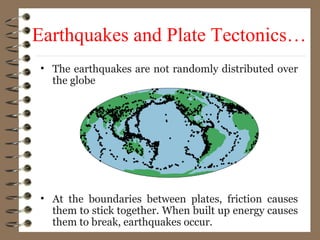
• The earthquakes are not randomly distributed over
the globe
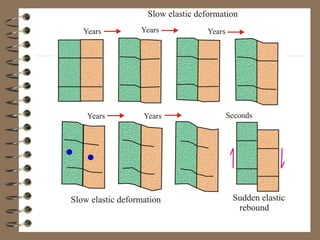
• At the boundaries between plates, friction causes
them to stick together. When built up energy causes
them to break, earthquakes occur.
Figure showing
the distribution of
earthquakes
around the globe
Earthquakes and Plate Tectonics…
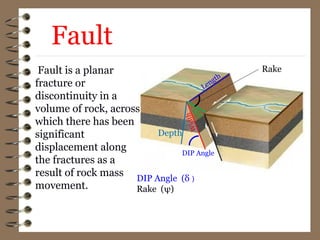
Length
Width
DIP Angle
Slip
Fault
RakeFault is a planar
fracture or
discontinuity in a
volume of rock, across
which there has been
significant
displacement along
the fractures as a
result of rock mass
movement.
DIP Angle (δ )
Rake (ψ)
Depth
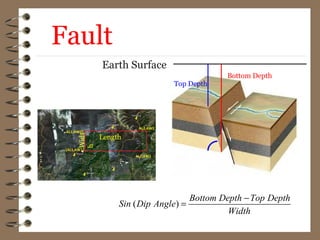
Top Depth
Length
Widt
h
Bottom Depth
Earth Surface
( )
Bottom Depth Top Depth
Sin Dip Angle
Width
−
=
Fault
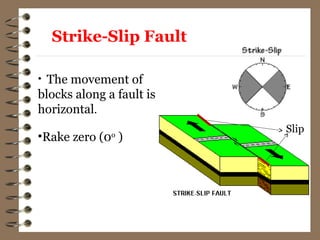
Strike-Slip Fault
• The movement of
blocks along a fault is
horizontal.
•Rake zero (0o
)
Slip
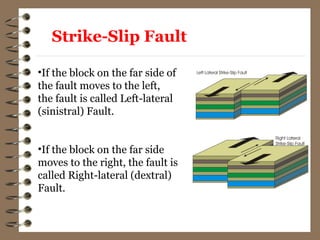
•If the block on the far side of
the fault moves to the left,
the fault is called Left-lateral
(sinistral) Fault.
•If the block on the far side
moves to the right, the fault is
called Right-lateral (dextral)
Fault.
Strike-Slip Fault
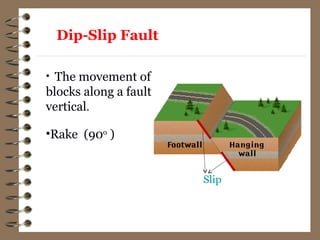
Dip-Slip Fault
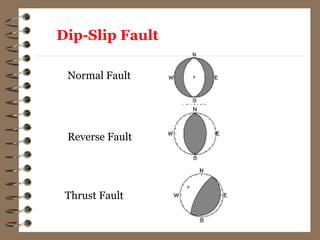
• The movement of
blocks along a fault is
vertical.
•Rake (90o
)
Slip
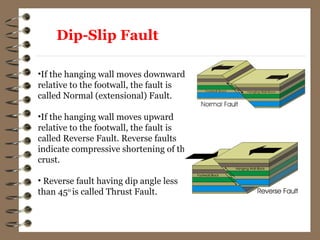
•If the hanging wall moves downward
relative to the footwall, the fault is
called Normal (extensional) Fault.
•If the hanging wall moves upward
relative to the footwall, the fault is
called Reverse Fault. Reverse faults
indicate compressive shortening of the
crust.
• Reverse fault having dip angle less
than 450
is called Thrust Fault.
Dip-Slip Fault
Normal Fault
Thrust Fault
Reverse Fault
Dip-Slip Fault
Oblique-Slip Fault
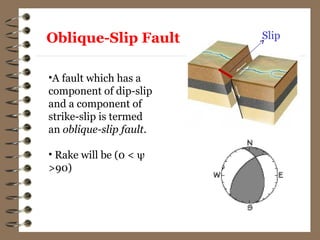
•A fault which has a
component of dip-slip
and a component of
strike-slip is termed
an oblique-slip fault.
• Rake will be (0 < ψ
>90)
Slip
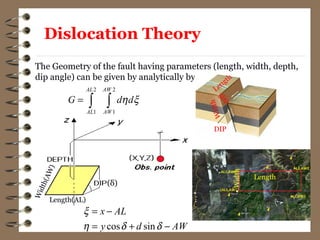
The Geometry of the fault having parameters (length, width, depth,
dip angle) can be given by analytically by Green function (G):
2 2
1 1
AL AW
AL AW
G d dη ξ= ∫ ∫
Length
Width
DIP
Slip
Length(AL)
Width(AW)
Length
Width
cos sin
x AL
y d AW
ξ
η δ δ
= −
= + −
(δ)
Dislocation Theory
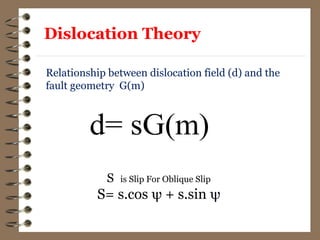
S is Slip For Oblique Slip
S= s.cos ψ + s.sin ψ
d= sG(m)
Relationship between dislocation field (d) and the
fault geometry G(m)
Dislocation Theory
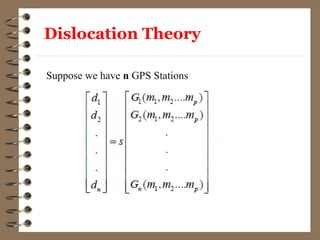
Consider the case we have observed data d1, d2, ……. dn
and the Green function of each observation data are G1, G2,
……. Gn respectively, Then:
Suppose we have n GPS Stations
Dislocation Theory
Richter magnitude scale
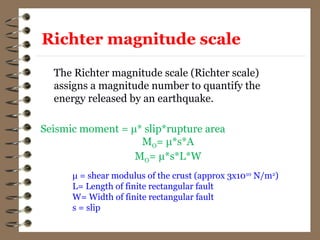
The Richter magnitude scale (Richter scale)
assigns a magnitude number to quantify the
energy released by an earthquake.
Seismic moment = μ* slip*rupture area
MO= μ*s*A
MO= μ*s*L*W
μ = shear modulus of the crust (approx 3x10¹⁰
N/m2
)
L= Length of finite rectangular fault
W= Width of finite rectangular fault
s = slip
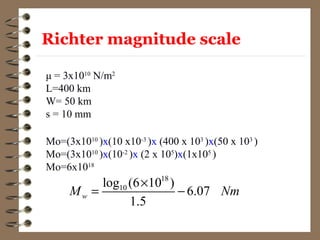
μ = 3x10¹⁰
N/m2
L=400 km
W= 50 km
s = 10 mm
MO= μsLW
Mo=(3x10¹⁰
)x(10 x10-3
)x (400 x 103
)x(50 x 103
)
Mo=(3x10¹⁰
)x(10-2
)x (2 x 10⁵
)x(1x10⁵
)
Mo=6x10¹⁸
18
10log (6 10 )
6.07
1.5
wM Nm
×
= −
Richter magnitude scale
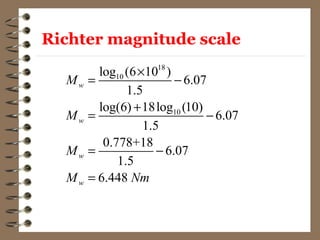
18
10
10
log (6 10 )
6.07
1.5
log(6) 18log (10)
6.07
1.5
0.778+18
6.07
1.5
6.448
w
w
w
w
M
M
M
M Nm
×
= −
+
= −
= −
=
Richter magnitude scale

Interior Structure of the Earth

  • 1.
    Geodesy, GE 202 KutubuddinANSARI kutubuddin.ansari@ikc.edu.tr Lecture 3, Oct 11, 2016 Interior of the Earth
  • 2.
    •The Earth's massis about 5.98 x 1024 kg. • Earth is the densest planet in our Solar System (mass/volume). •Earth is made of several layers with different compositions and physical properties, like temperature, density, and the ability to flow. Earth
  • 3.
    Crust Mantle Core The Earth isdivided into three main layers. Earth Layers
  • 4.
    Shell = crust Eggwhite = mantle Yolk = core How are the earth’s layers similar to an egg? Earth Layers
  • 5.
    Earth Layers Crust =0 to 50 km Mantle= 50 to 2900 km Outer Core= 2900 to 5100 km Inner Core= 5100 to 6371 km
  • 6.
  • 7.
    The Crust The Earth’scrust is like the skin of an apple. It is very thin compared to the other three layers. The crust makes up 1% of the Earth. The crust of the Earth is broken into many pieces called plates.
  • 8.
    CrustCrust •Thinnest layer (0-50km) •Two types of crust Continental crust Oceanic crust The Crust
  • 9.
  • 10.
    The Mantle • Themantle is the layer below the crust. • The mantle is the largest layer of the Earth. • The mantle is divided into two regions: the upper and lower sections.
  • 11.
    •Extremely Thick! (2,900km) •It is too far down to drill How do we know what it is made of? •Like the mineral olivine •Large amounts of iron and magnesium The Mantle
  • 12.
  • 13.
    The core ofthe Earth is like a ball of very hot metals. The outer core is liquid. The outer core is made up of iron and is very dense Outer Core
  • 14.
    The inner coreof the Earth has temperatures and pressures so great that the metals are squeezed together and are not able to move. The inner core is a solid Inner Core
  • 16.
  • 17.
    Plate Tectonics • TheEarth’s crust is divided into 12 major plates which are moved in various directions. • This plate motion causes them to collide, pull apart, or scrape against each other. • Each type of interaction causes a characteristic set of Earth structures or “tectonic” features. • The word, tectonic, refers to the deformation of the crust as a consequence of plate interaction.
  • 18.
    • Plates aremade of rigid lithosphere. • The lithosphere is made up of the crust and the upper part of the mantle. Plate Tectonics
  • 19.
    Plate Tectonics • Belowthe lithosphere which makes up the tectonic plates is the asthenosphere.
  • 20.
    • “Plates” oflithosphere are moved around by the underlying hot mantle convection cells Plate Tectonics
  • 21.
    The lithosphere isbroken up into plates that move horizontally across the Earth. Earth’s Layered Structure
  • 22.
    • Divergent • Convergent •Transform Three types of plate boundary
  • 23.
    Plate Boundaries Convergent • Ocean-continent •Ocean-ocean • Continent-continent Plates move away from each other
  • 24.
    Plate Boundaries Divergent • Platesmove away from each other • New crust is being formed
  • 25.
    Plate Boundaries Transform • Platesslide past one another • Crust is neither created nor destroyed
  • 26.
    • The earthquakesare not randomly distributed over the globe • At the boundaries between plates, friction causes them to stick together. When built up energy causes them to break, earthquakes occur. Figure showing the distribution of earthquakes around the globe Earthquakes and Plate Tectonics…
  • 28.
    Length Width DIP Angle Slip Fault RakeFault isa planar fracture or discontinuity in a volume of rock, across which there has been significant displacement along the fractures as a result of rock mass movement. DIP Angle (δ ) Rake (ψ) Depth
  • 29.
    Top Depth Length Widt h Bottom Depth EarthSurface ( ) Bottom Depth Top Depth Sin Dip Angle Width − = Fault
  • 30.
    Strike-Slip Fault • Themovement of blocks along a fault is horizontal. •Rake zero (0o ) Slip
  • 31.
    •If the blockon the far side of the fault moves to the left, the fault is called Left-lateral (sinistral) Fault. •If the block on the far side moves to the right, the fault is called Right-lateral (dextral) Fault. Strike-Slip Fault
  • 32.
    Dip-Slip Fault • Themovement of blocks along a fault is vertical. •Rake (90o ) Slip
  • 33.
    •If the hangingwall moves downward relative to the footwall, the fault is called Normal (extensional) Fault. •If the hanging wall moves upward relative to the footwall, the fault is called Reverse Fault. Reverse faults indicate compressive shortening of the crust. • Reverse fault having dip angle less than 450 is called Thrust Fault. Dip-Slip Fault
  • 34.
  • 35.
    Oblique-Slip Fault •A faultwhich has a component of dip-slip and a component of strike-slip is termed an oblique-slip fault. • Rake will be (0 < ψ >90) Slip
  • 36.
    The Geometry ofthe fault having parameters (length, width, depth, dip angle) can be given by analytically by Green function (G): 2 2 1 1 AL AW AL AW G d dη ξ= ∫ ∫ Length Width DIP Slip Length(AL) Width(AW) Length Width cos sin x AL y d AW ξ η δ δ = − = + − (δ) Dislocation Theory
  • 37.
    S is SlipFor Oblique Slip S= s.cos ψ + s.sin ψ d= sG(m) Relationship between dislocation field (d) and the fault geometry G(m) Dislocation Theory
  • 38.
    Consider the casewe have observed data d1, d2, ……. dn and the Green function of each observation data are G1, G2, ……. Gn respectively, Then: Suppose we have n GPS Stations Dislocation Theory
  • 39.
    Richter magnitude scale TheRichter magnitude scale (Richter scale) assigns a magnitude number to quantify the energy released by an earthquake. Seismic moment = μ* slip*rupture area MO= μ*s*A MO= μ*s*L*W μ = shear modulus of the crust (approx 3x10¹⁰ N/m2 ) L= Length of finite rectangular fault W= Width of finite rectangular fault s = slip
  • 40.
    μ = 3x10¹⁰ N/m2 L=400km W= 50 km s = 10 mm MO= μsLW Mo=(3x10¹⁰ )x(10 x10-3 )x (400 x 103 )x(50 x 103 ) Mo=(3x10¹⁰ )x(10-2 )x (2 x 10⁵ )x(1x10⁵ ) Mo=6x10¹⁸ 18 10log (6 10 ) 6.07 1.5 wM Nm × = − Richter magnitude scale
  • 41.
    18 10 10 log (6 10) 6.07 1.5 log(6) 18log (10) 6.07 1.5 0.778+18 6.07 1.5 6.448 w w w w M M M M Nm × = − + = − = − = Richter magnitude scale