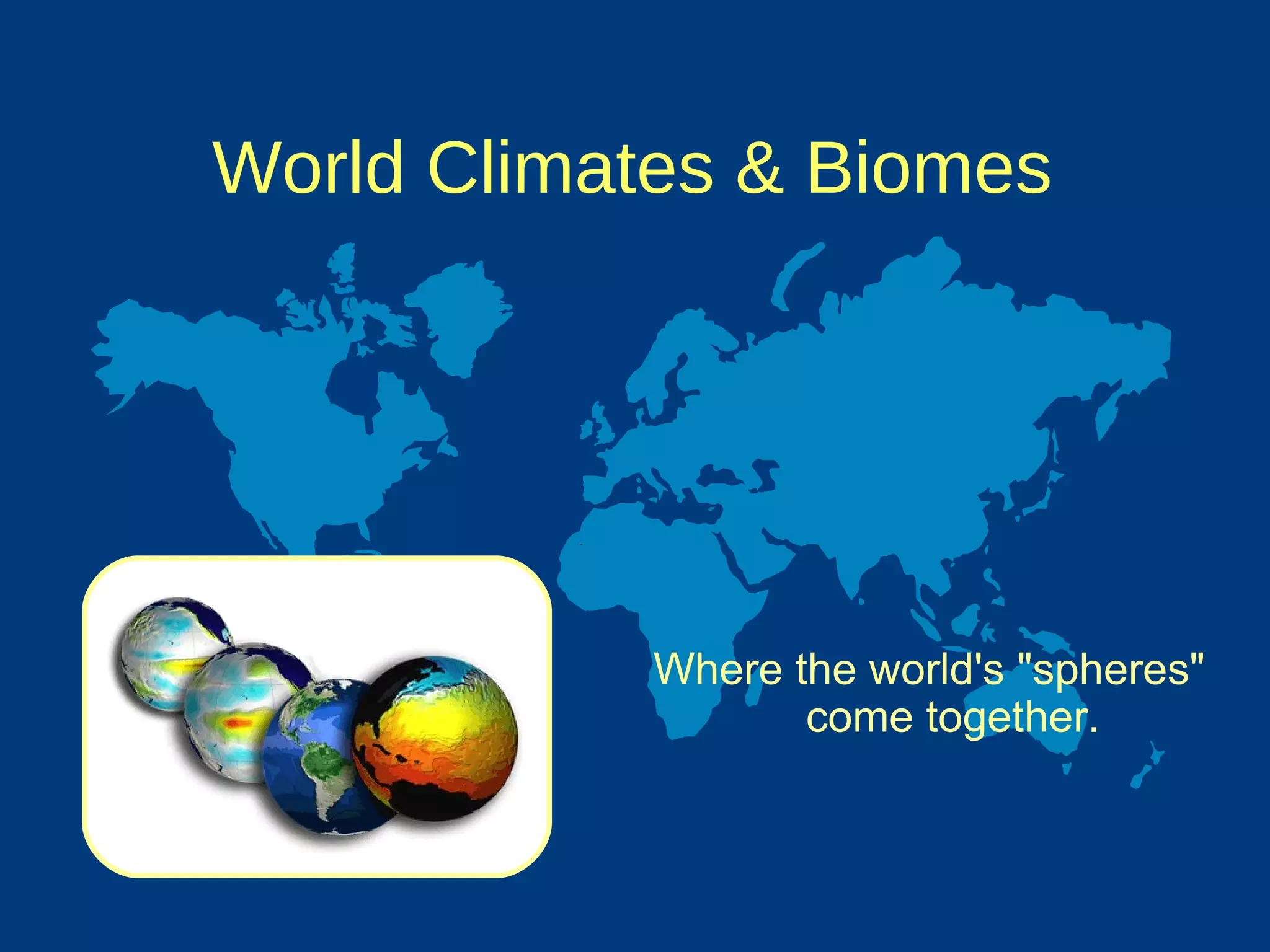
World Climates & Biomes Where the world's "spheres" come together.
Weather vs. Climate  Weather describes the condition of the atmosphere (temperature, precipitation, wind, etc.) covers a specific time and place  (i.e. Boston, MA) very short-term (changes daily/hourly) Climate describes the condition of the atmosphere (temperature, precipitation) covers large regions of the Earth  (i.e. Northern Africa) long-term weather patterns (over years of time)
Latitude Affects Climate Globe/Flashlight Demonstration
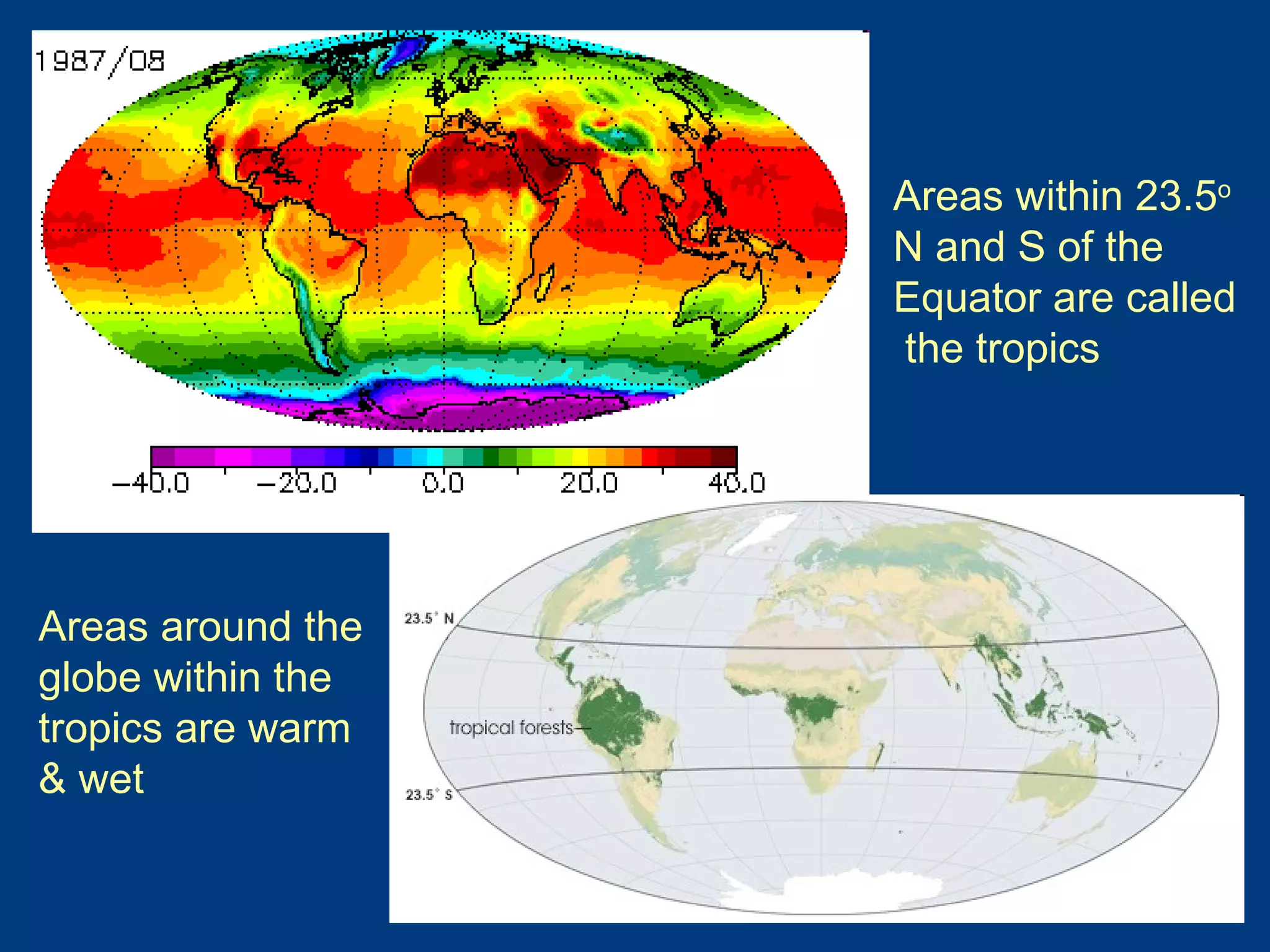
Areas around the globe within the tropics are warm & wet Areas within 23.5 o  N and S of the Equator are called  the tropics
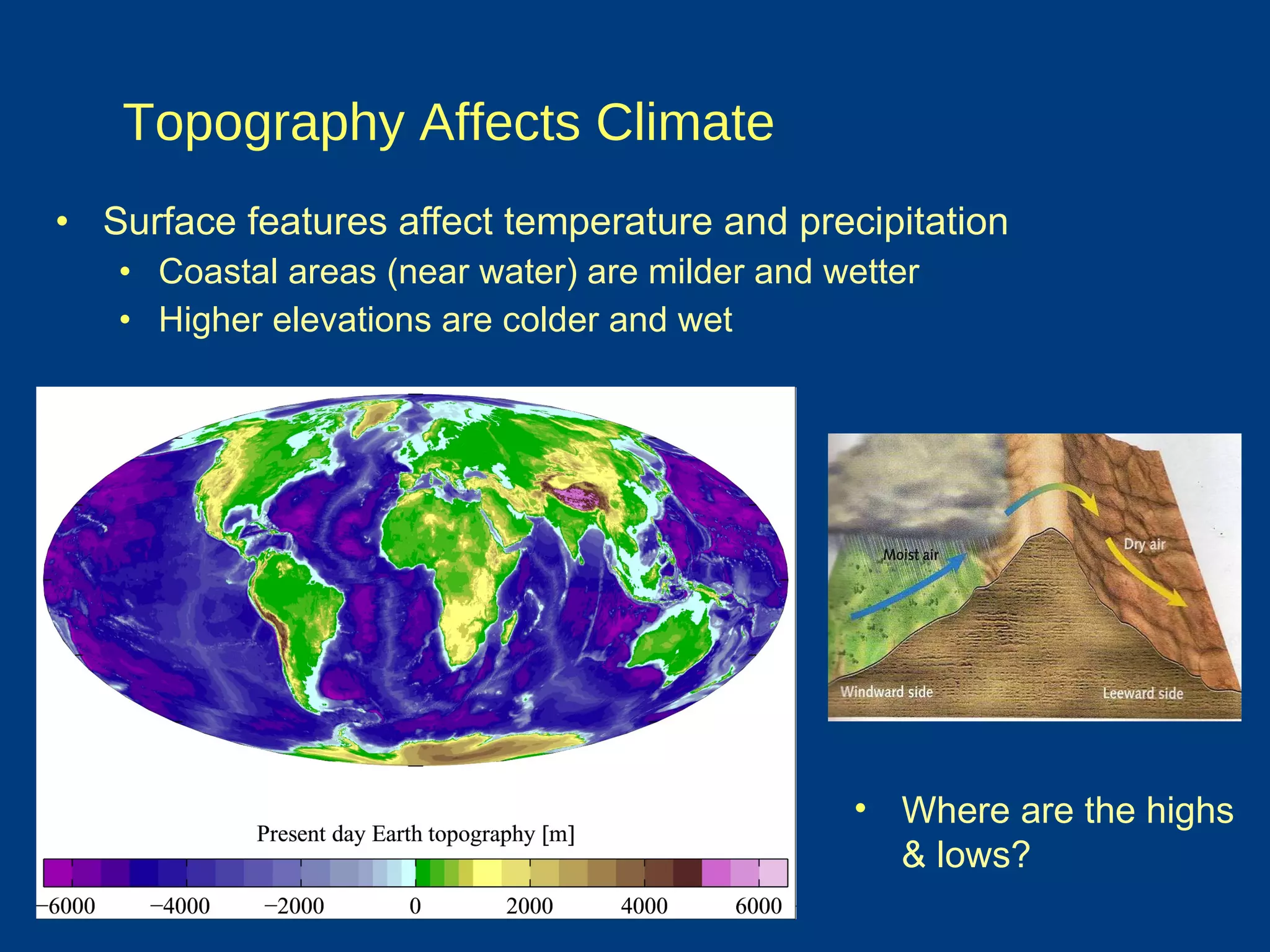
Surface features affect temperature and precipitation Coastal areas (near water) are milder and wetter  Higher elevations are colder and wet Topography Affects Climate Where are the highs & lows?
Other Factors Affecting Climate Ocean Currents warm & cold directional Prevailing Winds high pressure low pressure
World Climate - Overview
Climate vs. Biome Climate describes condition of the atmosphere  covers large regions of the Earth  long-term weather patterns  Biome describes a community of living (biotic) and non-living things includes plants, animals, soil, water and atmosphere regions contain distinctive living species adapted to the climate
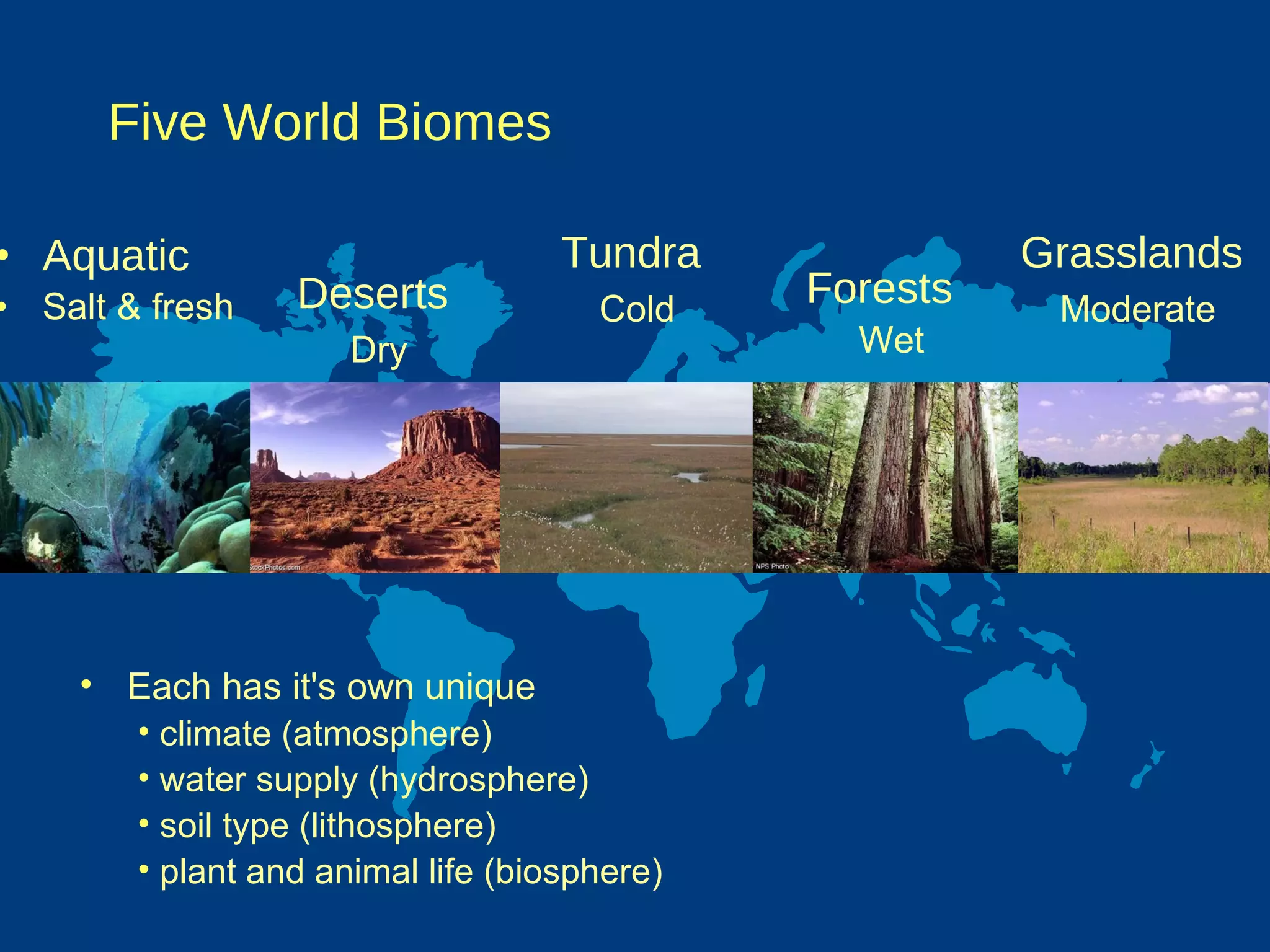
Five World Biomes Aquatic   Salt & fresh Forests    Wet Deserts   Dry Tundra   Cold Grasslands   Moderate Each has it's own unique climate (atmosphere) water supply (hydrosphere) soil type (lithosphere) plant and animal life (biosphere)
Aquatic Biomes - cover 75% of our planet
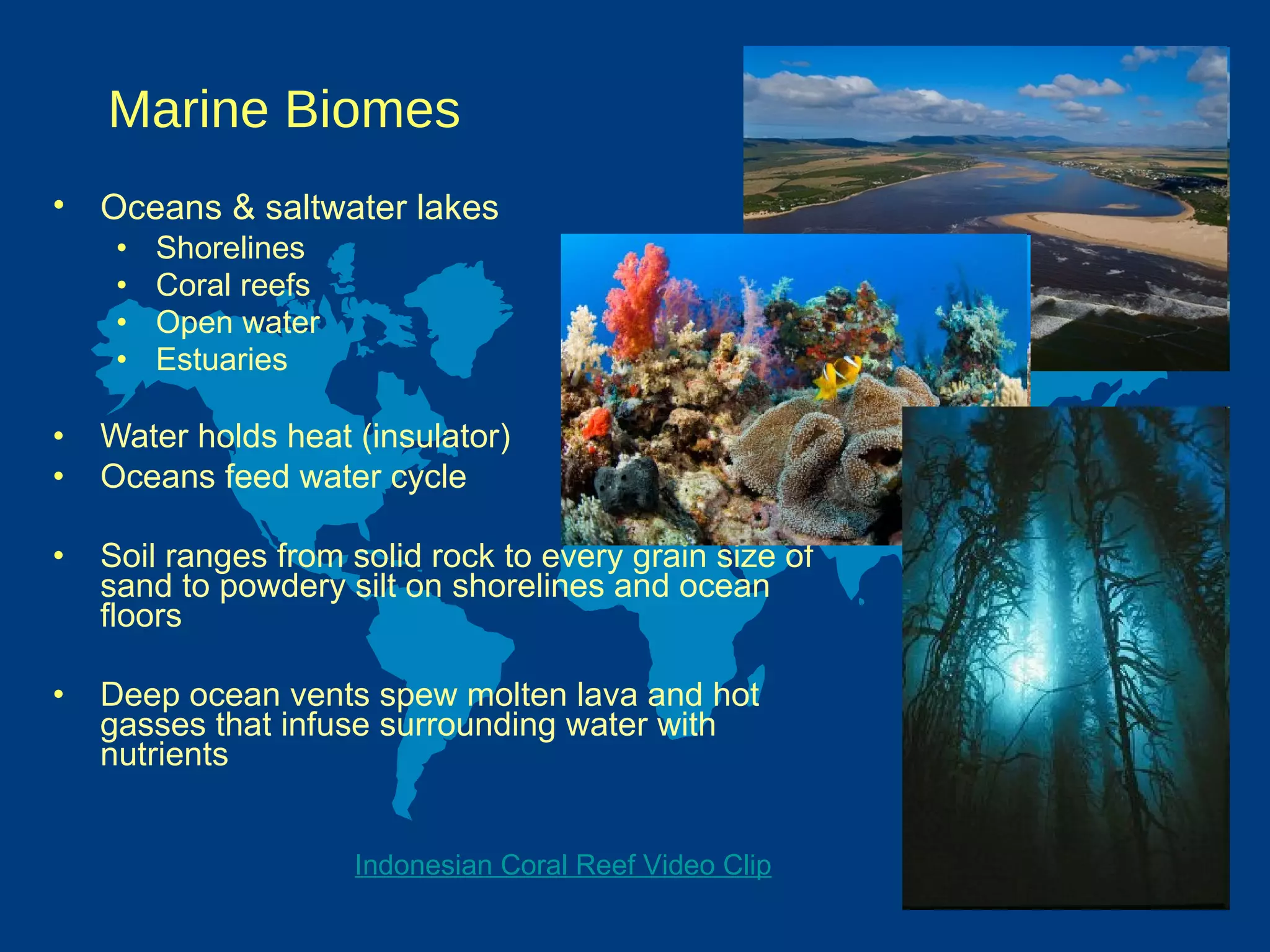
Marine Biomes  Oceans & saltwater lakes   Shorelines Coral reefs Open water Estuaries Water holds heat (insulator) Oceans feed water cycle Soil ranges from solid rock to every grain size of sand to powdery silt on shorelines and ocean floors Deep ocean vents spew molten lava and hot gasses that infuse surrounding water with nutrients Indonesian Coral Reef Video Clip
Marine Life Millions of plants & animal species Microscopic plankton to huge whales Algae provide most of Earth's O 2  absorb large amounts of CO 2 Coral (plantanimals) Polyps feed on zooplankton (microscopic animals) Algae (zooxanthellae) live within coral Living coral reefs take 100+ years to grow just 3 cm
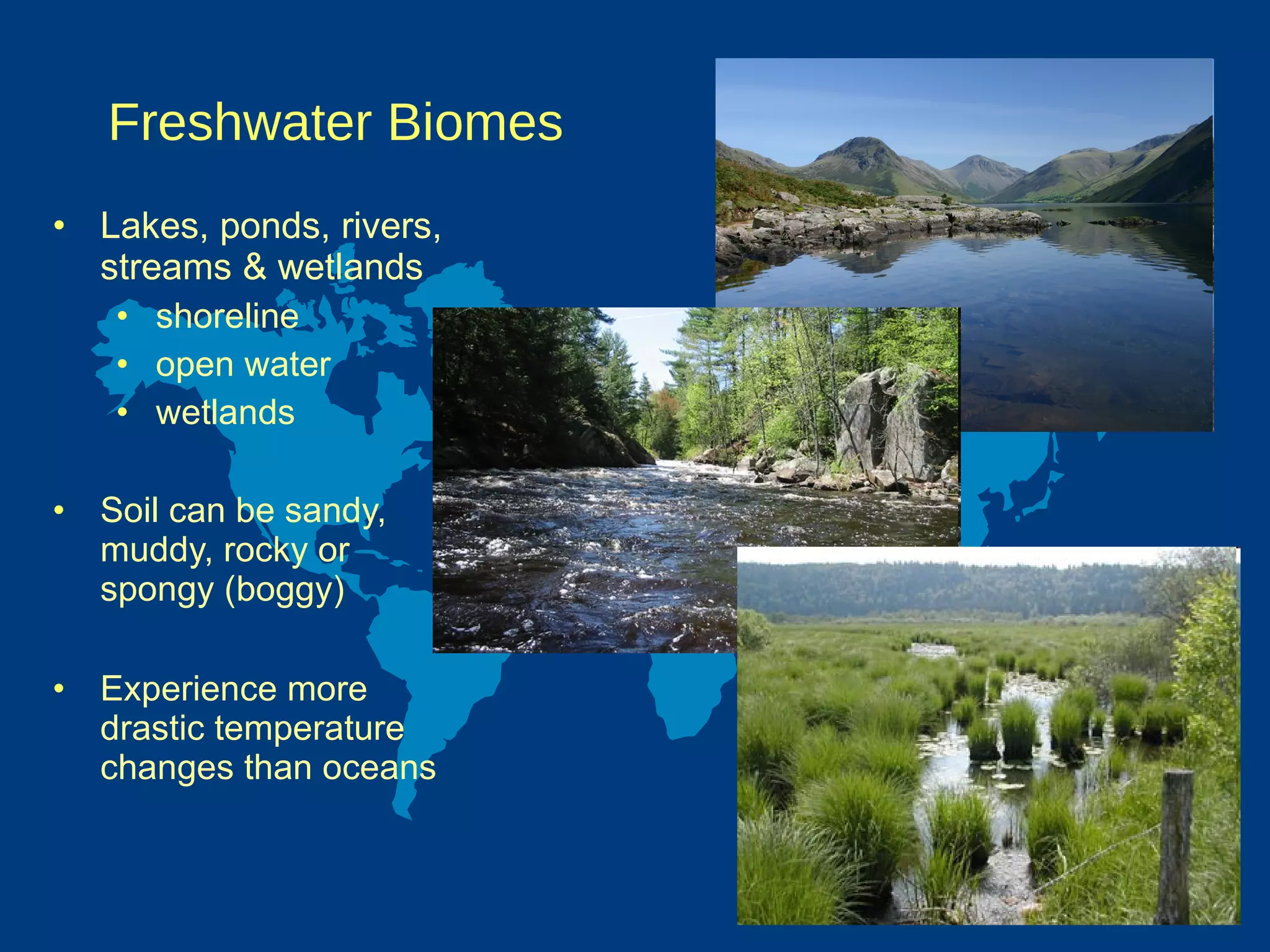
Freshwater Biomes  Lakes, ponds, rivers, streams & wetlands  shoreline open water wetlands Soil can be sandy, muddy, rocky or spongy (boggy) Experience more drastic temperature changes than oceans
Freshwater Organisms Shore Birds, reptiles, insects, crustaceans, amphibians Reeds/grasses, trees and shrubs  Open water Fish, insects, crayfish, mammals such as otters,  Algae, phytoplankton, floating weeds Wetlands Reeds/grass, sedges and pond lilies, trees reptiles, to mammals, to amphibians and birds, to hundreds of insects
Desert Biomes - cover 20% of land surfaces
Arid Deserts  Hot all year Dry (< 25 cm/yr rain) Extreme day/night temps. 100+ 0 F to 40 0 F in 24 hours Lower latitudes Sandy, course, rocky soil Examples Sahara (Northern Africa) Kalahari (S. Africa) Arabian (Middle East) Australian  Mohave (Southwestern US)
Temperate Deserts Hot Summers, cold winters Most precipitation falls as snow in the winter Inland (inner continental) soil is heavy & alkaline (salty) Examples Great Basin (Eastern OR/NV/UT) Patagonia (Argentina) Kara-Kum (Uzbekistan) Gobi (China/Mongolia)
Desert Wildlife -  adapted to conserve water Plants Sparse & widely dispersed Spines for protection Thick hair & waxy coatings Extra water storage in stem Roots  dive deep down  spread networks along surface  Animals Long bodies & slender limbs  Waxy skin, efficient kidneys  Most are nocturnal Burrow underground or hide beneath rocks  Eye protection (long lashes, deep-set eyes)
 
Grassland Biomes - cover 25% of land  Savannas Closer to equator Warm all year Seasonal fires Prairies Trees only near streams Cold winters Steppes  (in Eurasia) Pampas  (S. America) All have  rich, fertile soil  (black hummus)
Savanna Species Plants Grass, reeds & sedges Short, widely spaced trees Adaptations store water in trunks dormant periods Animals Mutualistic relationships Migratory patterns Congregate in communities Camouflage
Prairie Flora & Fauna Plants Tall grass  variety depends on location Trees few, if any for miles around near streams, at edges Broadleaf plants flowers, sedges Animals Small burrowing mammals Larger grazers Fast-running predators Insects, birds, snakes
Forests - cover 30% of Earth's surface
Taiga, Boreal or Coniferous Forest Largest of land biomes, mostly in far Northern Hemisphere  Short, moist summers and long, dark, cold winters Soil is thin and lacking in nutrients  decomposition is slow due to cold temperatures
Taiga Life  (Coniferous/Boreal Forest Plants & Animals) Plants Dense tree canopy  Thin forest floor vegetation  Mostly conifers  Evergreen, needle-leaves Cone-bearing Easily shed snow Animals Lots of insects Migration, hibernation, camouflage Birds & mammals
Temperate Deciduous Forest Four distinct seasons  (temperature & precipitation vary in each) Trees lose their leaves every fall Soil is rich (thick layers of dead leaves decay for nutrients)
Deciduous Forest Wildlife Plants Great variety Broadleaf trees Shrubs Wildflowers Trees have thick bark Animals Some still burrow, hibernate & migrate Warm enough for some cold-blooded animals
Tropical Rainforest Home to half the Earth's variety of plant & animal species! Very warm all year & lots of rainfall (with a &quot;dry&quot; season) Located near equator (12 hours of daylight all year long) between tropics of Cancer & Capricorn Soil is poor because constant rains wash away nutrients
Rainforest Plants Competition for light & nutrients Incredible diversity Trees  Tall with shallow roots Buttresses or prop & stilt roots  Thin, smooth bark Palms, evergreens, mangroves Vines (lianas) extend up to canopy for sunlight Orchids Ferns, mosses epiphytes  Bromeliads most live on tree branches leaves form tank to hold water organisms live within &quot;tanks&quot; Grasses Shrubs & other plants drip tips to shed rain quickly
Rainforest Animals Fierce competition for food Camouflage, interdependence  Incredible diversity Mammals Reptiles & amphibians Rodents, bats Birds Insects
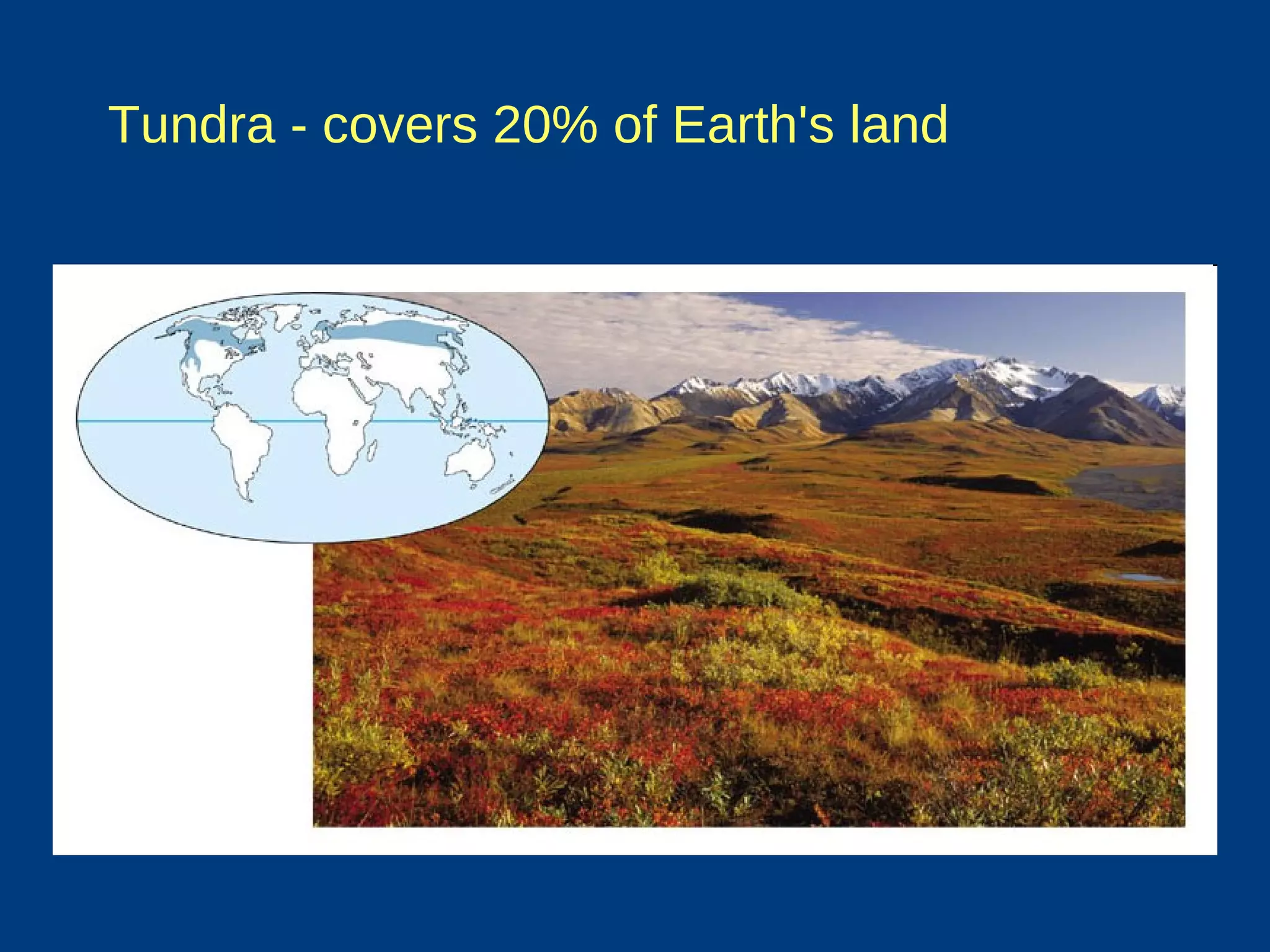
Tundra - covers 20% of Earth's land
Tundra - at the top of the world Arctic Tundra Far northern Hemisphere Very little rainfall Soil is poor in nutrients Permafrost  Very cold 50 0 F to -60 0 F in winter Icy rivers & temporary ponds   Alpine Tundra High elevation, any latitude Rocky mountaintops Otherwise same as above
Life in the Tundra Biome Plants short growing season shallow roots low-growing plants shrubs, grass, moss lichen (fungi & algae) Animals Fish, insects, birds Grazing mammals Adaptations: Thick fur, extra fat Hibernation Migration
 
Overview of World Biomes
Sources http://www.worldbiomes.com/default.htm http://old-packerpedia.wiki.packer.edu/Bio+Biome+Project http://www.mbgnet.net/index.html http://www.marietta.edu/~biol/biomes/biome_main.htm

World climate & biomes

  • 1.
    World Climates &Biomes Where the world's &quot;spheres&quot; come together.
  • 2.
    Weather vs. Climate Weather describes the condition of the atmosphere (temperature, precipitation, wind, etc.) covers a specific time and place (i.e. Boston, MA) very short-term (changes daily/hourly) Climate describes the condition of the atmosphere (temperature, precipitation) covers large regions of the Earth (i.e. Northern Africa) long-term weather patterns (over years of time)
  • 3.
    Latitude Affects ClimateGlobe/Flashlight Demonstration
  • 4.
    Areas around theglobe within the tropics are warm & wet Areas within 23.5 o N and S of the Equator are called the tropics
  • 5.
    Surface features affecttemperature and precipitation Coastal areas (near water) are milder and wetter Higher elevations are colder and wet Topography Affects Climate Where are the highs & lows?
  • 6.
    Other Factors AffectingClimate Ocean Currents warm & cold directional Prevailing Winds high pressure low pressure
  • 7.
  • 8.
    Climate vs. BiomeClimate describes condition of the atmosphere covers large regions of the Earth long-term weather patterns Biome describes a community of living (biotic) and non-living things includes plants, animals, soil, water and atmosphere regions contain distinctive living species adapted to the climate
  • 9.
    Five World BiomesAquatic Salt & fresh Forests   Wet Deserts Dry Tundra Cold Grasslands Moderate Each has it's own unique climate (atmosphere) water supply (hydrosphere) soil type (lithosphere) plant and animal life (biosphere)
  • 10.
    Aquatic Biomes -cover 75% of our planet
  • 11.
    Marine Biomes Oceans & saltwater lakes Shorelines Coral reefs Open water Estuaries Water holds heat (insulator) Oceans feed water cycle Soil ranges from solid rock to every grain size of sand to powdery silt on shorelines and ocean floors Deep ocean vents spew molten lava and hot gasses that infuse surrounding water with nutrients Indonesian Coral Reef Video Clip
  • 12.
    Marine Life Millionsof plants & animal species Microscopic plankton to huge whales Algae provide most of Earth's O 2 absorb large amounts of CO 2 Coral (plantanimals) Polyps feed on zooplankton (microscopic animals) Algae (zooxanthellae) live within coral Living coral reefs take 100+ years to grow just 3 cm
  • 14.
    Freshwater Biomes Lakes, ponds, rivers, streams & wetlands shoreline open water wetlands Soil can be sandy, muddy, rocky or spongy (boggy) Experience more drastic temperature changes than oceans
  • 15.
    Freshwater Organisms ShoreBirds, reptiles, insects, crustaceans, amphibians Reeds/grasses, trees and shrubs Open water Fish, insects, crayfish, mammals such as otters, Algae, phytoplankton, floating weeds Wetlands Reeds/grass, sedges and pond lilies, trees reptiles, to mammals, to amphibians and birds, to hundreds of insects
  • 17.
    Desert Biomes -cover 20% of land surfaces
  • 18.
    Arid Deserts Hot all year Dry (< 25 cm/yr rain) Extreme day/night temps. 100+ 0 F to 40 0 F in 24 hours Lower latitudes Sandy, course, rocky soil Examples Sahara (Northern Africa) Kalahari (S. Africa) Arabian (Middle East) Australian Mohave (Southwestern US)
  • 19.
    Temperate Deserts HotSummers, cold winters Most precipitation falls as snow in the winter Inland (inner continental) soil is heavy & alkaline (salty) Examples Great Basin (Eastern OR/NV/UT) Patagonia (Argentina) Kara-Kum (Uzbekistan) Gobi (China/Mongolia)
  • 20.
    Desert Wildlife - adapted to conserve water Plants Sparse & widely dispersed Spines for protection Thick hair & waxy coatings Extra water storage in stem Roots dive deep down spread networks along surface Animals Long bodies & slender limbs Waxy skin, efficient kidneys Most are nocturnal Burrow underground or hide beneath rocks Eye protection (long lashes, deep-set eyes)
  • 21.
  • 22.
    Grassland Biomes -cover 25% of land Savannas Closer to equator Warm all year Seasonal fires Prairies Trees only near streams Cold winters Steppes (in Eurasia) Pampas (S. America) All have rich, fertile soil (black hummus)
  • 23.
    Savanna Species PlantsGrass, reeds & sedges Short, widely spaced trees Adaptations store water in trunks dormant periods Animals Mutualistic relationships Migratory patterns Congregate in communities Camouflage
  • 24.
    Prairie Flora &Fauna Plants Tall grass variety depends on location Trees few, if any for miles around near streams, at edges Broadleaf plants flowers, sedges Animals Small burrowing mammals Larger grazers Fast-running predators Insects, birds, snakes
  • 25.
    Forests - cover30% of Earth's surface
  • 26.
    Taiga, Boreal orConiferous Forest Largest of land biomes, mostly in far Northern Hemisphere Short, moist summers and long, dark, cold winters Soil is thin and lacking in nutrients decomposition is slow due to cold temperatures
  • 27.
    Taiga Life (Coniferous/Boreal Forest Plants & Animals) Plants Dense tree canopy Thin forest floor vegetation Mostly conifers Evergreen, needle-leaves Cone-bearing Easily shed snow Animals Lots of insects Migration, hibernation, camouflage Birds & mammals
  • 28.
    Temperate Deciduous ForestFour distinct seasons (temperature & precipitation vary in each) Trees lose their leaves every fall Soil is rich (thick layers of dead leaves decay for nutrients)
  • 29.
    Deciduous Forest WildlifePlants Great variety Broadleaf trees Shrubs Wildflowers Trees have thick bark Animals Some still burrow, hibernate & migrate Warm enough for some cold-blooded animals
  • 30.
    Tropical Rainforest Hometo half the Earth's variety of plant & animal species! Very warm all year & lots of rainfall (with a &quot;dry&quot; season) Located near equator (12 hours of daylight all year long) between tropics of Cancer & Capricorn Soil is poor because constant rains wash away nutrients
  • 31.
    Rainforest Plants Competitionfor light & nutrients Incredible diversity Trees Tall with shallow roots Buttresses or prop & stilt roots Thin, smooth bark Palms, evergreens, mangroves Vines (lianas) extend up to canopy for sunlight Orchids Ferns, mosses epiphytes Bromeliads most live on tree branches leaves form tank to hold water organisms live within &quot;tanks&quot; Grasses Shrubs & other plants drip tips to shed rain quickly
  • 32.
    Rainforest Animals Fiercecompetition for food Camouflage, interdependence Incredible diversity Mammals Reptiles & amphibians Rodents, bats Birds Insects
  • 33.
    Tundra - covers20% of Earth's land
  • 34.
    Tundra - atthe top of the world Arctic Tundra Far northern Hemisphere Very little rainfall Soil is poor in nutrients Permafrost Very cold 50 0 F to -60 0 F in winter Icy rivers & temporary ponds  Alpine Tundra High elevation, any latitude Rocky mountaintops Otherwise same as above
  • 35.
    Life in theTundra Biome Plants short growing season shallow roots low-growing plants shrubs, grass, moss lichen (fungi & algae) Animals Fish, insects, birds Grazing mammals Adaptations: Thick fur, extra fat Hibernation Migration
  • 36.
  • 37.
  • 38.
    Sources http://www.worldbiomes.com/default.htm http://old-packerpedia.wiki.packer.edu/Bio+Biome+Projecthttp://www.mbgnet.net/index.html http://www.marietta.edu/~biol/biomes/biome_main.htm

Editor's Notes

  • #5 By far the biggest factor of global climate is latitude.
  • #6 - water absorbs a great amount of heat (it heats up and cools down slower than land) - water evaporates into the air, which blows inland and cools as it is pushed over mountain ranges, resulting in rain and snow
  • #7 - water absorbs a great amount of heat (it heats up and cools down slower than land) - water evaporates into the air, which blows inland and cools as it is pushed over mountain ranges, resulting in rain and snow
  • #11 Pacific Ocean, Dead Sea, Great Salt Lake Lake Erie, Amazon River
  • #12 Pacific Ocean, Dead Sea, Great Salt Lake Lake Erie, Amazon River
  • #13 Birds, fish, marine mammals, insects, mollusks, crustaceans, etc.
  • #14 Bull kelp, Barnacles, Puffin, frosted nudibranch, octipus, lionfish, rockweed, sea star (echinoderm), Albino manta ray, seal, shark, coelacanth, swimming sea cucumber, basket star, brine shrimp, blue whale, plankton
  • #15 Pacific Ocean, Dead Sea, Great Salt Lake Lake Erie, Amazon River
  • #16 lake Malawi fish (Africa)
  • #17 diatoms (algae), beaver, lily pads, crane, dragonfly, catfish, garter snake eating spotted frog, water strider, carnivorous pitcher plant
  • #18 20% or 1/5 of land surface Africa, Australia, Middle East, Southwestern US Polar Regions considered deserts because all moisture is trapped as ice. Few coastal deserts
  • #19 When it does rain, it is not uncommon for the rain to evaporate before hitting the ground Sahara Desert in western Libya (Middle East), Sonoran Desert in Arizona
  • #20 Gobi Desert (Bactrian camels), Utah Great Basin Desert
  • #21 camels store fat in humps that, when metabolized, provide some of the water they need (Bactrian, 2-humped camels in cold deserts) (Dromedary, 1-hump camels in subtropical deserts) Prickly pear, Old Man Cactus, White-Winged Dove on Saguro cactus, Sand Cat kitten, Zebratail lizard, Rock Hyrax
  • #22 Joshua Tree, Iguana, Barrel cactus, Pinyon Jay, Lichen (fungus) Coyote, Gila Monster, Diamondback rattlesnake, Bactrian Camel, fishhook cactus Lots of birds and insects, too
  • #23 Prairies a.k.a. Steppes in Europe &amp; Asia with shorter grass and less moisture
  • #25 Buffalo Grass, (prairie dogs, jack rabbits, ground squirrels, and gophers) and bison, pronghorn antelope, and elk badger, coyote, ferret, wolf, and cougar.
  • #28 Conifers = cone-bearing trees such as pine, fir and cedar, spruce. (Tamarack, Hemlock) Needles conserve water loss, allow for photosynthesis any time temperature rises above freezing. Moose, beaver, squirrel, lynx, bats, bears, hawks, bald eagle, deer (wolverine, snowshoe rabbit - brown in summer, pine marten, hairy woodpecker, Andean Condor, red fox)
  • #30 Canopy is thinner, allowing more light for photosynthesis and warmth for growth on the forest floor. Oak, maple, sycamore, beech, chestnut, walnut, and hickory. (Gingko, Sumac, Sweet Gum) (Spring peeper - frog the size of a paper clip, Eastern Newt, Box Turtle) (skunk - doesn&apos;t hibernate, but enters a state of torpor, Cardinal)
  • #31 However, constant warmth and moisture promote rapid decay of organic matter that is quickly utilized (often without it returning to the soil).
  • #32 Cacao &amp; Rubber - trees, Black pepper &amp; Rattan - vine, Vanilla - an orchid, Sugar cane &amp; bamboo - grasses, Cassava &amp; Banana - starchy fruits of plants, Nutmeg/Mace &amp; coffee- shrubs Rafflesia arnoldi - largest flower in the world. Its flowers may be eaten by rodents and small mammals. It is a parasite of the tetrastigma vine and since it lacks chlorophyll, leaves, and roots, it relies on the vine&apos;s nutrients to sustain it. It must be in the proximity of a flower of the opposite sex in order to reproduce. Pollinating insects aid this process. The rafflesia emits a pungent odor that smells of rotting flesh. This attracts insects and so helps the process of pollination. it can grow to up to 150 centimeters in diameter. Its large size increases the likelihood that more insects and other animals will find it and carry its seeds to another flower, enabling it to reproduce.
  • #33 2-toed Sloth, Kinkajou, Okapi, Spider monkeys, ocelot Blue Jeans Dart frog, Anaconda, Komodo Dragon - “After digestion, the Komodo Dragon regurgitates a mass of horns, hair, and teeth known as the gastric pellet, which is covered in malodorous mucus. After regurgitating the gastric pellet, it rubs its face in the dirt or on bushes to get rid of the mucus, suggesting that it, like humans, does not relish the scent of the mucus.” Capybara, tree shrew, bats blending in with bark Toucan, Macaw, Cockatoo Katydid, Caterpillar, Pleasing fungus beetles
  • #36 Mammals: reindeer, musk ox, bighorn sheep, lemmings, Birds: ptarmigan, snow bunting, grouse Insects: bumblebees (snowy owl, caribou, pika, polar bear, tundra swans)