Geography in the21st
Century
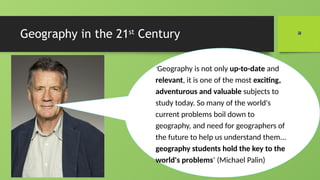
‘Geography is not only up-to-date and
relevant, it is one of the most exciting,
adventurous and valuable subjects to
study today. So many of the world's
current problems boil down to
geography, and need for geographers of
the future to help us understand them...
geography students hold the key to the
world's problems’ (Michael Palin)
3.
Why study GCSEGeography?
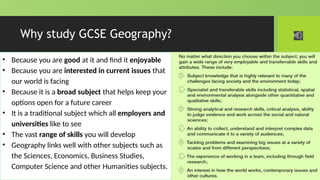
• Because you are good at it and find it enjoyable
• Because you are interested in current issues that
our world is facing
• Because it is a broad subject that helps keep your
options open for a future career
• It is a traditional subject which all employers and
universities like to see
• The vast range of skills you will develop
• Geography links well with other subjects such as
the Sciences, Economics, Business Studies,
Computer Science and other Humanities subjects.
4.
Why study GCSEGeography?
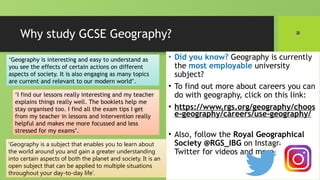
• Did you know? Geography is currently
the most employable university
subject?
• To find out more about careers you can
do with geography, click on this link:
• https://www.rgs.org/geography/choos
e-geography/careers/use-geography/
• Also, follow the Royal Geographical
Society @RGS_IBG on Instagram or
Twitter for videos and more
‘Geography is interesting and easy to understand as
you see the effects of certain actions on different
aspects of society. It is also engaging as many topics
are current and relevant to our modern world’.
‘Geography is a subject that enables you to learn about
the world around you and gain a greater understanding
into certain aspects of both the planet and society. It is an
open subject that can be applied to multiple situations
throughout your day-to-day life’.
‘I find our lessons really interesting and my teacher
explains things really well. The booklets help me
stay organised too. I find all the exam tips I get
from my teacher in lessons and intervention really
helpful and makes me more focussed and less
stressed for my exams’.
5.
The Geography Department
Thedepartment has a track
record of excellent results.
Our results are consistently
at or above national
average.
Our team of teachers are
experienced and dedicated
to helping you achieve!
• Experienced teachers & outstanding
teaching
• Supportive and caring teachers
• A course that addresses real, current issues
• Regular assessments, analysis and feedback
• Targeted intervention
• Two fieldwork trips
6.
What is thecourse like?
•The course is based on
understanding and interpreting
information rather than learning
facts, with the work completed in
topic booklets.
•The course has a focus on the
human, environmental and
physical geographies of the UK and
the rest of the world.
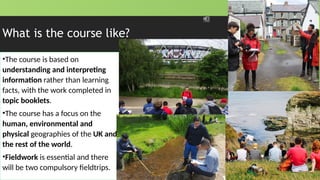
•Fieldwork is essential and there
will be two compulsory fieldtrips.
7.
What is classworkand homework like?
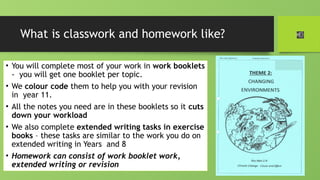
• You will complete most of your work in work booklets
- you will get one booklet per topic.
• We colour code them to help you with your revision
in year 11.
• All the notes you need are in these booklets so it cuts
down your workload
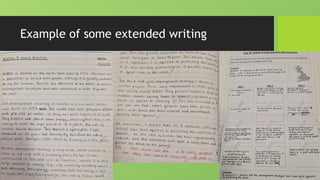
• We also complete extended writing tasks in exercise
books – these tasks are similar to the work you do on
extended writing in Years and 8
• Homework can consist of work booklet work,
extended writing or revision
How is GCSEGeography assessed?
Component 1: Changing Places – Changing Economies, Changing Environments,
Environmental Challenges (Paper 1—1hr 45mins)
•
You will learn about human, physical and environmental geographies through topics such as
development, global cities, flooding, climate change, weather, water security and ecosystems.
•
Component 2: Problem Solving Geography (Paper 2—1hr 30mins)
•
Students will use the topics and issues covered in component 1 for a synoptic view on problem
solving. Students will incorporate all of their knowledge from component 1 to learn a 3 phased
approach to solving problems. Students will learn how to use statistics, maps and photographs in
order to collect evidence and to determine appropriate management strategies for a given issue.
Students will also learn the importance of justifying and evaluating management strategies.
•
Component 3: Applied Fieldwork Enquiry (Paper 3—1hr 30mins)
•
Students will carry out field work in two contrasting environments (human and physical).
Students will play an active role in planning their fieldwork. They will learn how to collect, present
and then analyse the data that they have collected. Students will then evaluate limitations of their
fieldwork.
•
Please note there will be two compulsory fieldworks in the local area during the GCSE course.
•Here is a link to the specification we follow:
https://www.eduqas.co.uk/media/5ofdo23l/gcse-geog-b-spec.pdf