The Periodic Table of the Elements Basic Chemistry Heartlife Physical Science
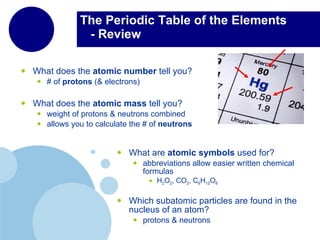
The Periodic Table of the Elements   - Review What does the  atomic number  tell you? # of  protons  (& electrons) What does the  atomic mass  tell you? weight of protons & neutrons combined allows you to calculate the # of  neutrons What are  atomic symbols  used for? abbreviations allow easier written chemical formulas H 2 O 2 , CO 2 ,  C 6 H 12 O 6 Which subatomic particles are found in the nucleus of an atom? protons & neutrons
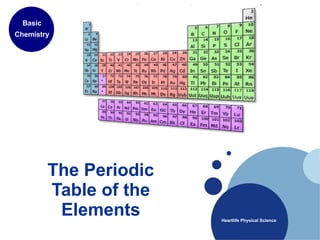
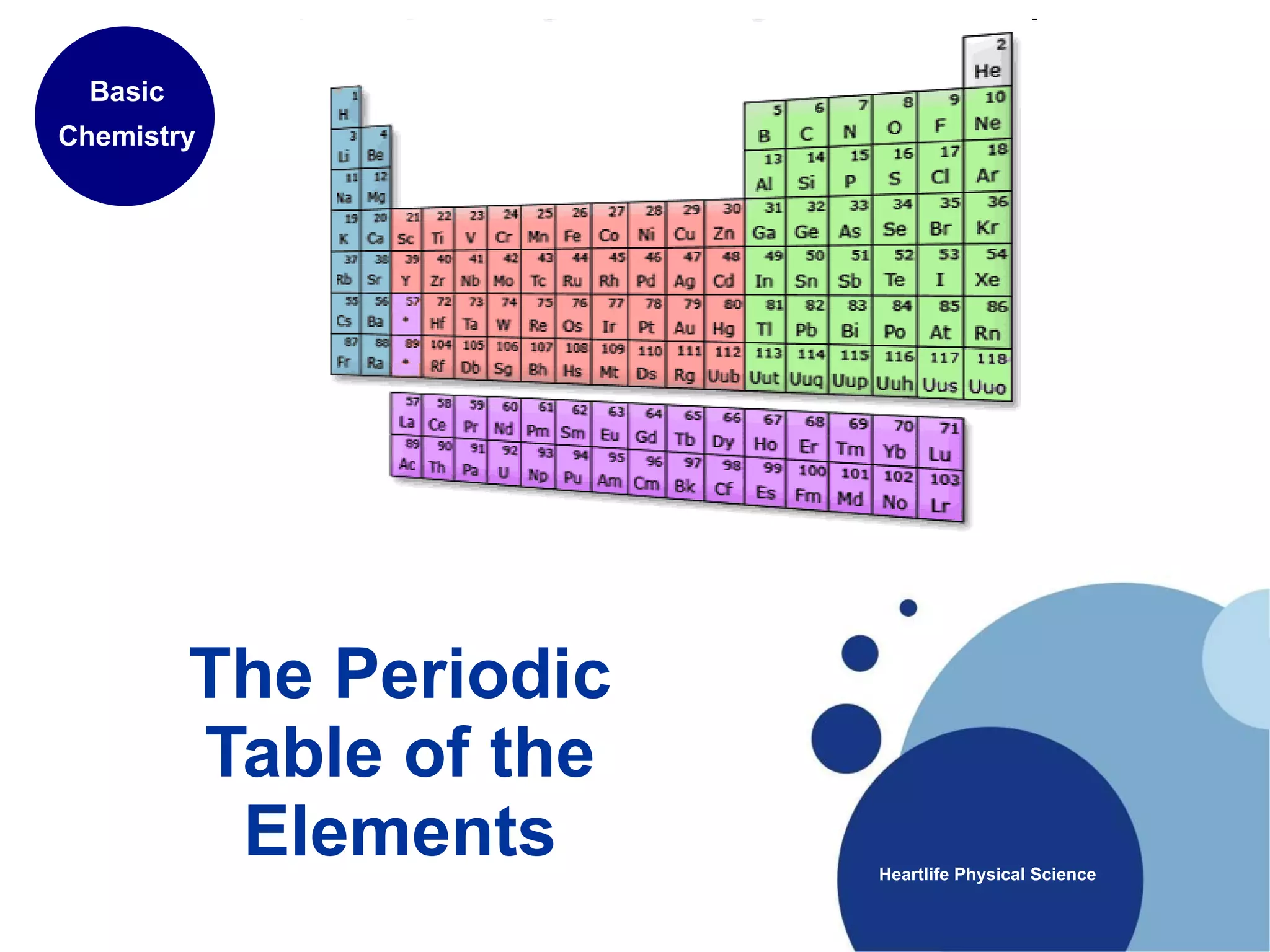
Columns (called  groups ) have similar chemical & physical properties share similar arrangement of electrons same # of  valence electrons  (electrons in outermost shell) Rows (called  periods ) highlight the repeating nature of elements displayed in order of increasing atomic number (no other similarities) atomic radius  decreases as you move left to right ionization energy  increases left to right  Periodic Table of the Elements   -  What patterns do you see?
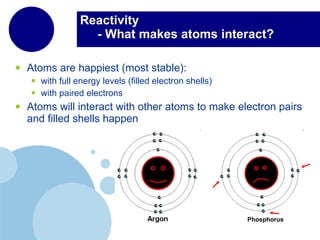
Reactivity   - What makes atoms interact? Atoms are happiest (most stable): with full energy levels (filled electron shells) with paired electrons  Atoms will interact with other atoms to make electron pairs and filled shells happen Phosphorus
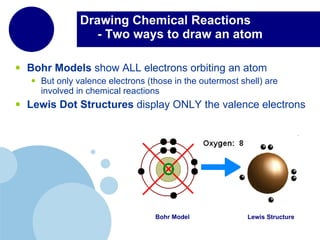
Drawing Chemical Reactions   - Two ways to draw an atom Bohr Models  show ALL electrons orbiting an atom But only valence electrons (those in the outermost shell) are involved in chemical reactions Lewis Dot Structures  display ONLY the valence electrons Lewis Structure Bohr Model
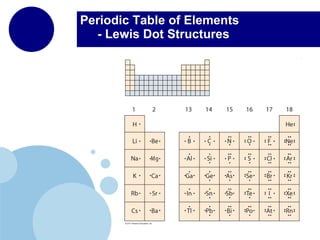
Periodic Table of Elements   - Lewis Dot Structures
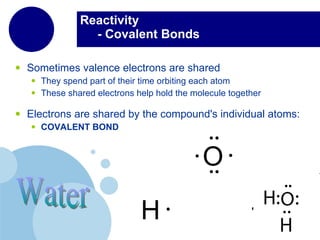
Reactivity   - Covalent Bonds Sometimes valence electrons are shared They spend part of their time orbiting each atom These shared electrons help hold the molecule together Electrons are shared by the compound's individual atoms: COVALENT BOND O Water H H
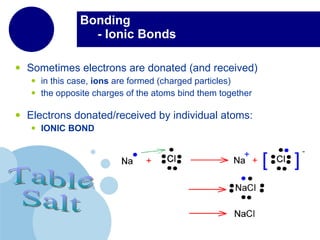
Bonding   - Ionic Bonds Sometimes electrons are donated (and received)  in this case,  ions  are formed (charged particles) the opposite charges of the atoms bind them together Electrons donated/received by individual atoms: IONIC BOND Table Salt
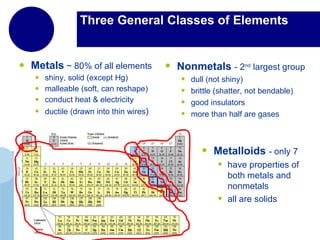
Three General Classes of Elements Metals  ~ 80% of all elements  shiny, solid (except Hg) malleable (soft, can reshape) conduct heat & electricity ductile (drawn into thin wires ) Metalloids  - only 7 have properties of both metals and nonmetals all are solids Nonmetals  - 2 nd  largest group dull (not shiny) brittle (shatter, not bendable) good insulators  more than half are gases
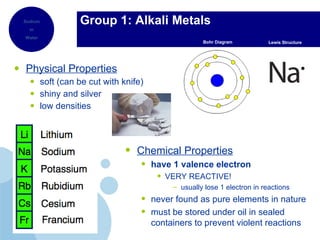
Group 1: Alkali Metals Physical Properties soft (can be cut with knife) shiny and silver low densities Bohr Diagram Lewis Structure Chemical Properties have 1 valence electron VERY REACTIVE! usually lose 1 electron in reactions never found as pure elements in nature must be stored under oil in sealed containers to prevent violent reactions Sodium in Water
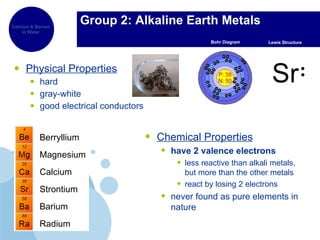
Group 2: Alkaline Earth Metals Physical Properties hard gray-white good electrical conductors Bohr Diagram Lewis Structure Chemical Properties have 2 valence electrons less reactive than alkali metals, but more than the other metals react by losing 2 electrons never found as pure elements in nature Berryllium Magnesium Calcium Strontium Barium Radium Sr Calcium & Barium in Water
Group 3-12: Transition Metals Physical Properties form colored compounds most are hard & shiny good electrical conductors Bohr Diagram Lewis Structure Chemical Properties have 1 or 2 valence electrons less reactive, but unpredictable reactions can speed up reactions lose different #'s of electrons Au * Lanthanides  **Actinides Copper & Zinc  Reactions
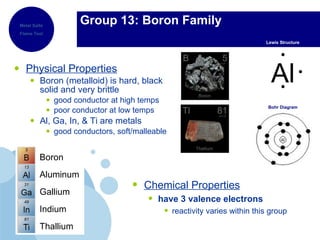
Group 13: Boron Family Physical Properties Boron (metalloid) is hard, black solid and very brittle good conductor at high temps poor conductor at low temps Al, Ga, In, & Ti are metals  good conductors, soft/malleable Bohr Diagram Chemical Properties have 3 valence electrons reactivity varies within this group Metal Salts Flame Test Boron Aluminum Gallium Indium Thallium Lewis Structure Al
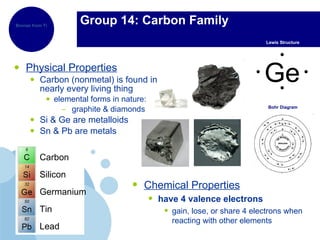
Physical Properties Carbon (nonmetal) is found in nearly every living thing elemental forms in nature: graphite & diamonds Si & Ge are metalloids Sn & Pb are metals Group 14: Carbon Family Bohr Diagram Chemical Properties have 4 valence electrons gain, lose, or share 4 electrons when reacting with other elements Carbon Silicon Germanium Tin Lead Lewis Structure Bronze from Tin & Copper Ge
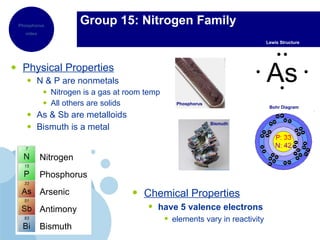
Physical Properties N & P are nonmetals  Nitrogen is a gas at room temp All others are solids As & Sb are metalloids Bismuth is a metal Group 15: Nitrogen Family Bohr Diagram Chemical Properties have 5 valence electrons elements vary in reactivity Nitrogen Phosphorus Arsenic Antimony Bismuth Lewis Structure Phosphorus video Phosphorus Bismuth As
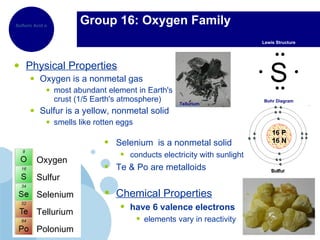
Physical Properties Oxygen is a nonmetal gas most abundant element in Earth's crust (1/5 Earth's atmosphere)  Sulfur is a yellow, nonmetal solid smells like rotten eggs Group 16: Oxygen Family Bohr Diagram Selenium  is a nonmetal solid conducts electricity with sunlight Te & Po are metalloids Chemical Properties have 6 valence electrons elements vary in reactivity Oxygen Sulfur Selenium Tellurium Polonium Lewis Structure Sulfuric Acid on Sugar Cubes Tellurium S
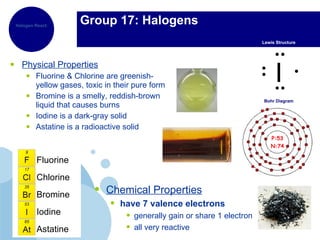
Physical Properties Fluorine & Chlorine are greenish-yellow gases, toxic in their pure form Bromine is a smelly, reddish-brown liquid that causes burns Iodine is a dark-gray solid Astatine is a radioactive solid Group 17: Halogens Chemical Properties have 7 valence electrons generally gain or share 1 electron all very reactive Fluorine Chlorine Bromine Iodine Astatine Lewis Structure Halogen Reactions I P:53 N:74 Bohr Diagram
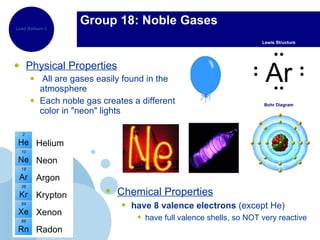
Physical Properties All are gases easily found in the atmosphere Each noble gas creates a different color in "neon" lights  Group 18: Noble Gases Bohr Diagram Chemical Properties have 8 valence electrons  (except He) have full valence shells, so NOT very reactive Lewis Structure Lead Balloon Demo   Ar Helium Neon Argon Krypton Xenon Radon
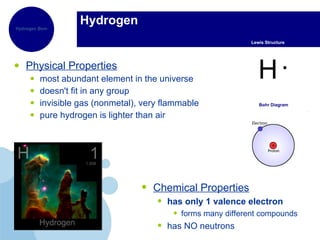
Physical Properties most abundant element in the universe doesn't fit in any group invisible gas (nonmetal), very flammable pure hydrogen is lighter than air Hydrogen Bohr Diagram Chemical Properties has only 1 valence electron forms many different compounds has NO neutrons Lewis Structure Hydrogen Bomb  H

The Periodic Table & Chemical Bonds

  • 1.
    The Periodic Tableof the Elements Basic Chemistry Heartlife Physical Science
  • 2.
    The Periodic Tableof the Elements - Review What does the atomic number tell you? # of protons (& electrons) What does the atomic mass tell you? weight of protons & neutrons combined allows you to calculate the # of neutrons What are atomic symbols used for? abbreviations allow easier written chemical formulas H 2 O 2 , CO 2 , C 6 H 12 O 6 Which subatomic particles are found in the nucleus of an atom? protons & neutrons
  • 3.
    Columns (called groups ) have similar chemical & physical properties share similar arrangement of electrons same # of valence electrons (electrons in outermost shell) Rows (called periods ) highlight the repeating nature of elements displayed in order of increasing atomic number (no other similarities) atomic radius decreases as you move left to right ionization energy increases left to right Periodic Table of the Elements - What patterns do you see?
  • 4.
    Reactivity - What makes atoms interact? Atoms are happiest (most stable): with full energy levels (filled electron shells) with paired electrons Atoms will interact with other atoms to make electron pairs and filled shells happen Phosphorus
  • 5.
    Drawing Chemical Reactions - Two ways to draw an atom Bohr Models show ALL electrons orbiting an atom But only valence electrons (those in the outermost shell) are involved in chemical reactions Lewis Dot Structures display ONLY the valence electrons Lewis Structure Bohr Model
  • 6.
    Periodic Table ofElements - Lewis Dot Structures
  • 7.
    Reactivity - Covalent Bonds Sometimes valence electrons are shared They spend part of their time orbiting each atom These shared electrons help hold the molecule together Electrons are shared by the compound's individual atoms: COVALENT BOND O Water H H
  • 8.
    Bonding - Ionic Bonds Sometimes electrons are donated (and received) in this case, ions are formed (charged particles) the opposite charges of the atoms bind them together Electrons donated/received by individual atoms: IONIC BOND Table Salt
  • 9.
    Three General Classesof Elements Metals ~ 80% of all elements shiny, solid (except Hg) malleable (soft, can reshape) conduct heat & electricity ductile (drawn into thin wires ) Metalloids - only 7 have properties of both metals and nonmetals all are solids Nonmetals - 2 nd largest group dull (not shiny) brittle (shatter, not bendable) good insulators more than half are gases
  • 10.
    Group 1: AlkaliMetals Physical Properties soft (can be cut with knife) shiny and silver low densities Bohr Diagram Lewis Structure Chemical Properties have 1 valence electron VERY REACTIVE! usually lose 1 electron in reactions never found as pure elements in nature must be stored under oil in sealed containers to prevent violent reactions Sodium in Water
  • 11.
    Group 2: AlkalineEarth Metals Physical Properties hard gray-white good electrical conductors Bohr Diagram Lewis Structure Chemical Properties have 2 valence electrons less reactive than alkali metals, but more than the other metals react by losing 2 electrons never found as pure elements in nature Berryllium Magnesium Calcium Strontium Barium Radium Sr Calcium & Barium in Water
  • 12.
    Group 3-12: TransitionMetals Physical Properties form colored compounds most are hard & shiny good electrical conductors Bohr Diagram Lewis Structure Chemical Properties have 1 or 2 valence electrons less reactive, but unpredictable reactions can speed up reactions lose different #'s of electrons Au * Lanthanides **Actinides Copper & Zinc Reactions
  • 13.
    Group 13: BoronFamily Physical Properties Boron (metalloid) is hard, black solid and very brittle good conductor at high temps poor conductor at low temps Al, Ga, In, & Ti are metals good conductors, soft/malleable Bohr Diagram Chemical Properties have 3 valence electrons reactivity varies within this group Metal Salts Flame Test Boron Aluminum Gallium Indium Thallium Lewis Structure Al
  • 14.
    Physical Properties Carbon(nonmetal) is found in nearly every living thing elemental forms in nature: graphite & diamonds Si & Ge are metalloids Sn & Pb are metals Group 14: Carbon Family Bohr Diagram Chemical Properties have 4 valence electrons gain, lose, or share 4 electrons when reacting with other elements Carbon Silicon Germanium Tin Lead Lewis Structure Bronze from Tin & Copper Ge
  • 15.
    Physical Properties N& P are nonmetals Nitrogen is a gas at room temp All others are solids As & Sb are metalloids Bismuth is a metal Group 15: Nitrogen Family Bohr Diagram Chemical Properties have 5 valence electrons elements vary in reactivity Nitrogen Phosphorus Arsenic Antimony Bismuth Lewis Structure Phosphorus video Phosphorus Bismuth As
  • 16.
    Physical Properties Oxygenis a nonmetal gas most abundant element in Earth's crust (1/5 Earth's atmosphere) Sulfur is a yellow, nonmetal solid smells like rotten eggs Group 16: Oxygen Family Bohr Diagram Selenium is a nonmetal solid conducts electricity with sunlight Te & Po are metalloids Chemical Properties have 6 valence electrons elements vary in reactivity Oxygen Sulfur Selenium Tellurium Polonium Lewis Structure Sulfuric Acid on Sugar Cubes Tellurium S
  • 17.
    Physical Properties Fluorine& Chlorine are greenish-yellow gases, toxic in their pure form Bromine is a smelly, reddish-brown liquid that causes burns Iodine is a dark-gray solid Astatine is a radioactive solid Group 17: Halogens Chemical Properties have 7 valence electrons generally gain or share 1 electron all very reactive Fluorine Chlorine Bromine Iodine Astatine Lewis Structure Halogen Reactions I P:53 N:74 Bohr Diagram
  • 18.
    Physical Properties Allare gases easily found in the atmosphere Each noble gas creates a different color in "neon" lights Group 18: Noble Gases Bohr Diagram Chemical Properties have 8 valence electrons (except He) have full valence shells, so NOT very reactive Lewis Structure Lead Balloon Demo Ar Helium Neon Argon Krypton Xenon Radon
  • 19.
    Physical Properties mostabundant element in the universe doesn't fit in any group invisible gas (nonmetal), very flammable pure hydrogen is lighter than air Hydrogen Bohr Diagram Chemical Properties has only 1 valence electron forms many different compounds has NO neutrons Lewis Structure Hydrogen Bomb H

Editor's Notes

  • #3 chalk = calcium carbonite (CaCH3) ammonia = NH3
  • #4 Like the days of the month, the chemical elements can be arranged in a way that shows a repeating, or PERIODIC pattern. DRY ERASE EXERCISE Patterns: atomic # increases as you move left to right Groups share same # of valence electron Energy levels increase as you move down a group
  • #10 luster is a measure of shinyness
  • #11 Common uses: Sodium chloride is table salt, lithium in batteries, Cesium in clocks, potassium in fireworks, liquid detergents, fertilizers and vitamins, rubidium in photocells (motion detectors) Pure sodium in water = flames
  • #12 Common uses: Beryllium in high-speed aircraft, missiles, spacecraft & satellites, Magnesium combined with other metals to form strong but lightweight alloys. Calcium in limestone & marble, essential for strong teeth & bones, Strontium gives fireworks their red color, barium in ceramics and some types of glass (and GI x-rays). Radium is radioactive (too many protons or too few neutrons causes unstable atom where particles are released) and used in cancer chemotherapy.
  • #13 Elements with atomic number greater than 92 are manufactured in laboratories and are highly unstable (radioactive)
  • #14 Common uses: Boron makes boric acid (mild antiseptic), borax (laundry water softener & ant killer) and a small component of silly putty - produces green flame when burned Aluminum (most abundant metal in Earth's crust) is soft and light - found in baseball bats, drink cans, bikes & cooking utensils. Gallium is solid at room temp but melts in your hand - used in electronic devices Indium also has a low melting point - used in alloys in thermometers and flat-screen TV's Thallium is poisonous - not many uses, but sometimes mixed with other compounds to form types of glass.
  • #15 Common uses: Graphite in pencils and powder lubricant, silicon comprises sand and used in semiconductors (computer chips), Tin lines steel food cans, mixed with copper makes bronze, Lead resists corrosion - used in ceramics, plumbing, glassmaking
  • #16 Common uses: Nitrogen (largest component of air), builds proteins in cells, DNA/RNA Phosphorus - highly reactive/corrosive solid, also found in human body, used in match heads (very flammable) Arsenic - pesticides, pyrotechnics Antimony - hardens & strengthens lead, semiconductors, batteries Bismuth - carrier for uranium fuel in nuclear reactors, fire extinguishing systems, cosmetics, medicine
  • #17 Common uses: Sulfur - food preservative, rubber product, bleaching & refrigeration Selenium - solar cells, light meters, photocopiers Tellurium - semiconductors, ceramics, tinting glass Polonium - rare radioactive element, named after Poland (discoverers Marie & Pierre Curie's native country)
  • #18 Common uses: Fluorine - fluoride toothpaste, teflon Chlorine - table salt, disinfectant, bleaching of paper product or clothing Bromine - dye, disinfectant, photographic chemicals Iodine - essential for thyroid function
  • #19 Common uses:
  • #20 The Eagle Nebula. ( External Sample ) By weight, 75 percent of the visible universe is hydrogen. Ordinarily it is a colorless gas, but vast quantities of it in space absorb starlight, creating spectacular sights such as the Eagle Nebula (seen by the Hubble Space telescope). Found in: water, sugar, ammonia, rocket fuel, stars & nebulae, and air