Periodic Table of Elements
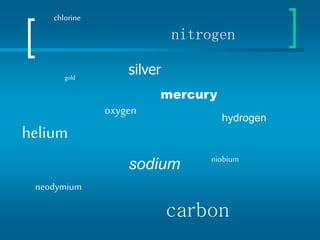
gold
silver
helium
oxygen
mercury
hydrogen
sodium
nitrogen
niobium
neodymium
chlorine
carbon
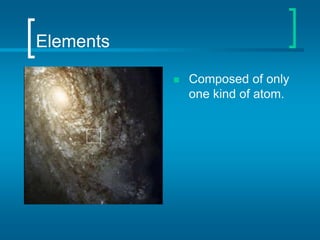
Elements
 Composed of only
one kind of atom.
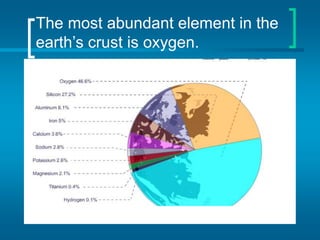
The most abundant element in the
earth’s crust is oxygen.
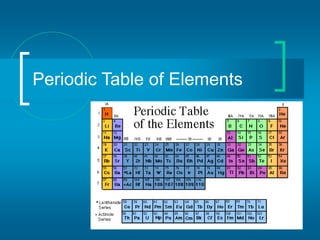
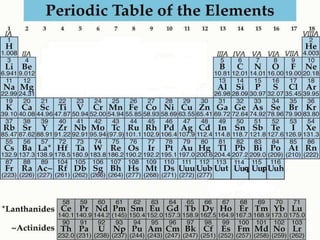
Periodic Table
 The periodic table organizes
the elements in a particular
way. A great deal of
information about an element
can be gathered from its
position in the period table.
Key to the Periodic Table
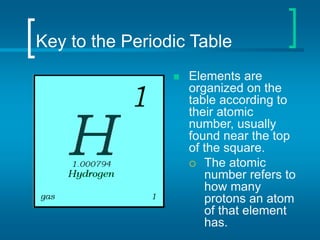
 Elements are
organized on the
table according to
their atomic
number, usually
found near the top
of the square.
 The atomic
number refers to
how many
protons an atom
of that element
has.
What’s in a square?
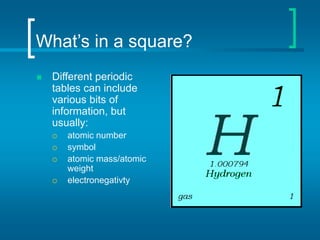
 Different periodic
tables can include
various bits of
information, but
usually:
 atomic number
 symbol
 atomic mass/atomic
weight
 electronegativty
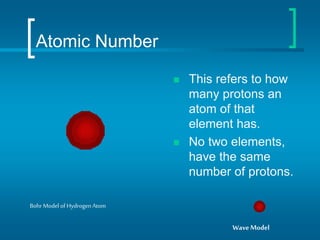
Atomic Number
 This refers to how
many protons an
atom of that
element has.
 No two elements,
have the same
number of protons.
Bohr Model of Hydrogen Atom
WaveModel
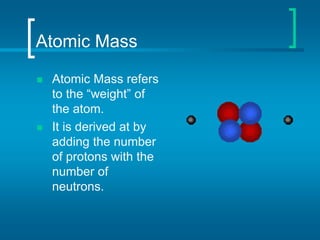
Atomic Mass
 Atomic Mass refers
to the “weight” of
the atom.
 It is derived at by
adding the number
of protons with the
number of
neutrons.
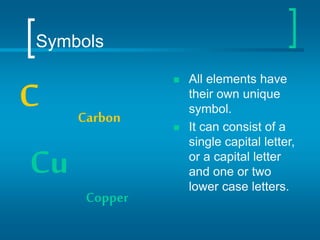
Symbols
 All elements have
their own unique
symbol.
 It can consist of a
single capital letter,
or a capital letter
and one or two
lower case letters.
C Carbon
Cu
Copper
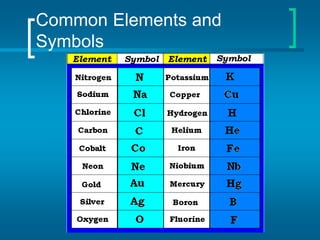
Common Elements and
Symbols
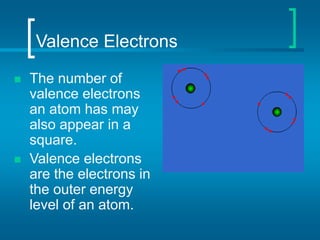
Valence Electrons
 The number of
valence electrons
an atom has may
also appear in a
square.
 Valence electrons
are the electrons in
the outer energy
level of an atom.
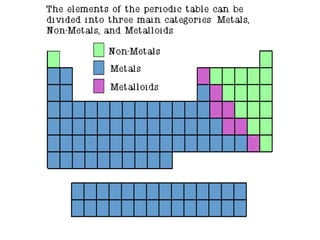
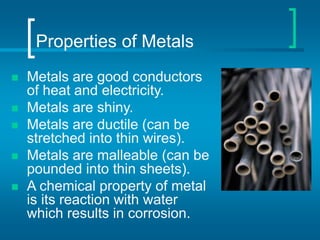
Properties of Metals
 Metals are good conductors
of heat and electricity.
 Metals are shiny.
 Metals are ductile (can be
stretched into thin wires).
 Metals are malleable (can be
pounded into thin sheets).
 A chemical property of metal
is its reaction with water
which results in corrosion.
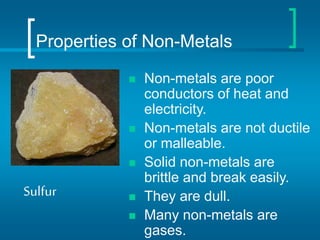
Properties of Non-Metals
 Non-metals are poor
conductors of heat and
electricity.
 Non-metals are not ductile
or malleable.
 Solid non-metals are
brittle and break easily.
 They are dull.
 Many non-metals are
gases.
Sulfur
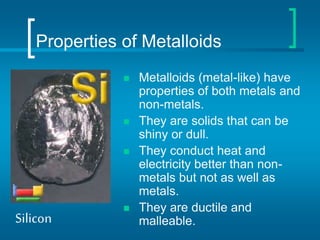
Properties of Metalloids
 Metalloids (metal-like) have
properties of both metals and
non-metals.
 They are solids that can be
shiny or dull.
 They conduct heat and
electricity better than non-
metals but not as well as
metals.
 They are ductile and
malleable.
Silicon
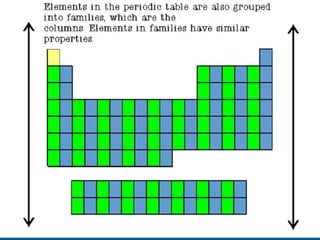
Families Periods
 Columns of
elements are
called groups or
families.
 Elements in each
family have
similar but not
identical
properties.
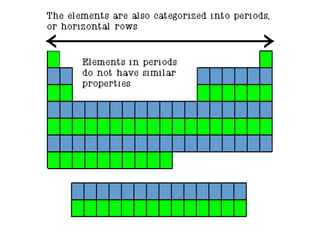
 Each horizontal row of
elements is called a
period.
 The elements in a
period are not alike in
properties.
 The first element in a
period is always an
extremely active solid.
The last element in a
period, is always an
inactive gas.
Hydrogen
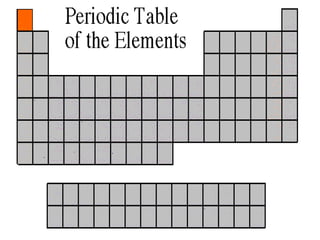
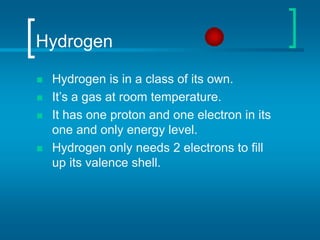
 Hydrogen is in a class of its own.
 It’s a gas at room temperature.
 It has one proton and one electron in its
one and only energy level.
 Hydrogen only needs 2 electrons to fill
up its valence shell.
Alkali Metals
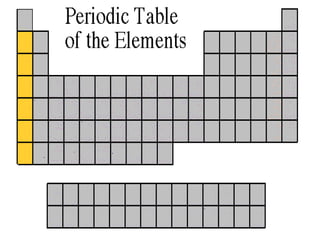
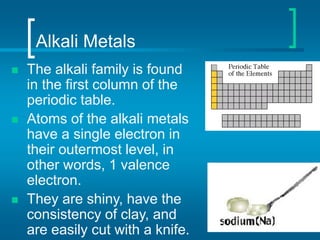
 The alkali family is found
in the first column of the
periodic table.
 Atoms of the alkali metals
have a single electron in
their outermost level, in
other words, 1 valence
electron.
 They are shiny, have the
consistency of clay, and
are easily cut with a knife.
Alkali Metals
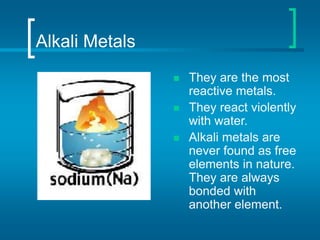
 They are the most
reactive metals.
 They react violently
with water.
 Alkali metals are
never found as free
elements in nature.
They are always
bonded with
another element.
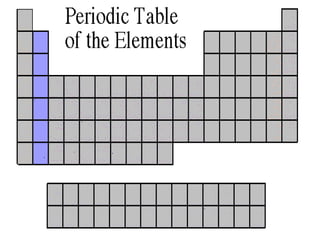
Alkaline Earth Metals
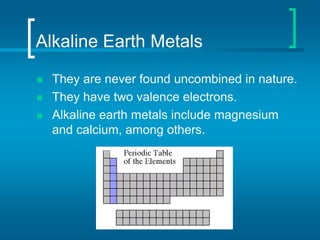
 They are never found uncombined in nature.
 They have two valence electrons.
 Alkaline earth metals include magnesium
and calcium, among others.
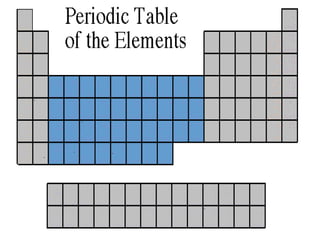
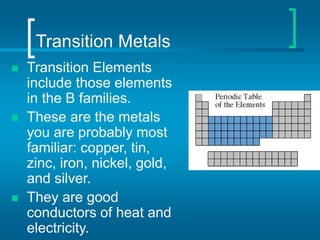
Transition Metals
 Transition Elements
include those elements
in the B families.
 These are the metals
you are probably most
familiar: copper, tin,
zinc, iron, nickel, gold,
and silver.
 They are good
conductors of heat and
electricity.
Transition Metals
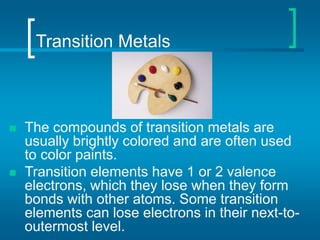
 The compounds of transition metals are
usually brightly colored and are often used
to color paints.
 Transition elements have 1 or 2 valence
electrons, which they lose when they form
bonds with other atoms. Some transition
elements can lose electrons in their next-to-
outermost level.
Transition Elements
 Transition elements have properties
similar to one another and to other
metals, but their properties do not fit in
with those of any other family.
 Many transition metals combine
chemically with oxygen to form
compounds called oxides.
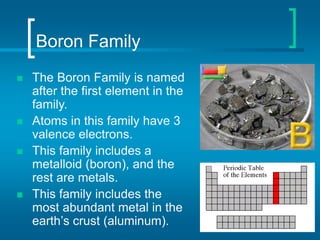
Boron Family
 The Boron Family is named
after the first element in the
family.
 Atoms in this family have 3
valence electrons.
 This family includes a
metalloid (boron), and the
rest are metals.
 This family includes the
most abundant metal in the
earth’s crust (aluminum).
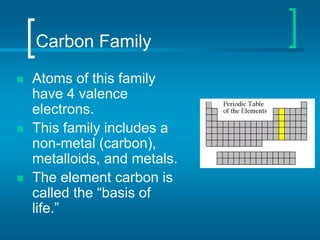
Carbon Family
 Atoms of this family
have 4 valence
electrons.
 This family includes a
non-metal (carbon),
metalloids, and metals.
 The element carbon is
called the “basis of
life.”
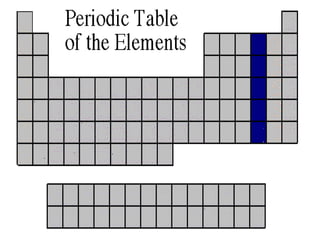
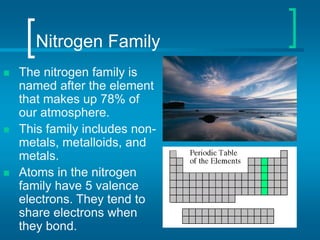
Nitrogen Family
 The nitrogen family is
named after the element
that makes up 78% of
our atmosphere.
 This family includes non-
metals, metalloids, and
metals.
 Atoms in the nitrogen
family have 5 valence
electrons. They tend to
share electrons when
they bond.
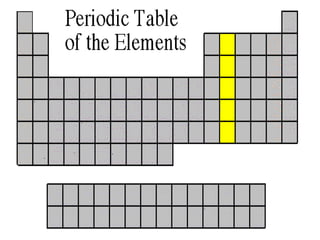
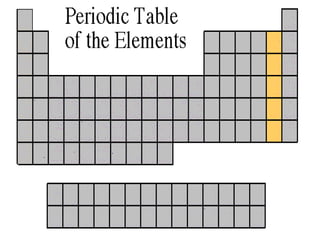
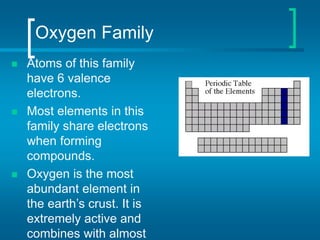
Oxygen Family
 Atoms of this family
have 6 valence
electrons.
 Most elements in this
family share electrons
when forming
compounds.
 Oxygen is the most
abundant element in
the earth’s crust. It is
extremely active and
combines with almost
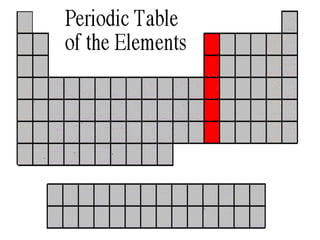
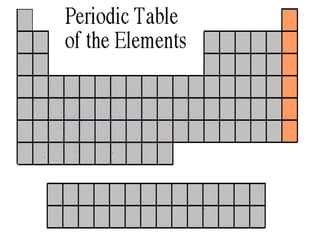
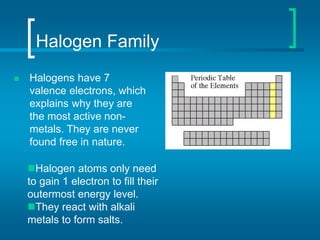
Halogen Family
 Halogens have 7
valence electrons, which
explains why they are
the most active non-
metals. They are never
found free in nature.
Halogen atoms only need
to gain 1 electron to fill their
outermost energy level.
They react with alkali
metals to form salts.
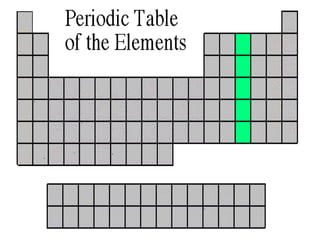
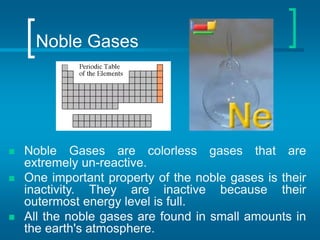
Noble Gases
 Noble Gases are colorless gases that are
extremely un-reactive.
 One important property of the noble gases is their
inactivity. They are inactive because their
outermost energy level is full.
 All the noble gases are found in small amounts in
the earth's atmosphere.
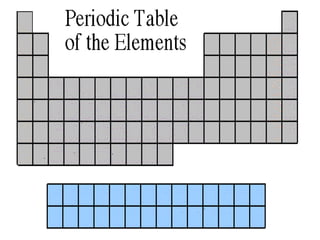
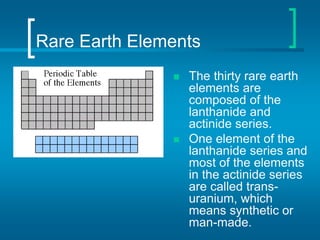
Rare Earth Elements
 The thirty rare earth
elements are
composed of the
lanthanide and
actinide series.
 One element of the
lanthanide series and
most of the elements
in the actinide series
are called trans-
uranium, which
means synthetic or
man-made.
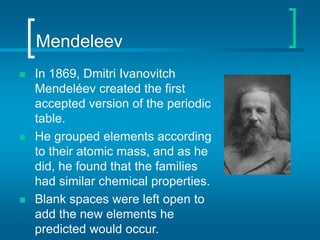
Mendeleev
 In 1869, Dmitri Ivanovitch
Mendeléev created the first
accepted version of the periodic
table.
 He grouped elements according
to their atomic mass, and as he
did, he found that the families
had similar chemical properties.
 Blank spaces were left open to
add the new elements he
predicted would occur.
Matter
 All matter is composed of atoms and groups
of atoms bonded together, called molecules.
 Substances that are made from one type of
atom only are called pure substances.
 Substances that are made from more than one
type of atom bonded together are called
compounds.
 Compounds that are combined physically, but
not chemically, are called mixtures.
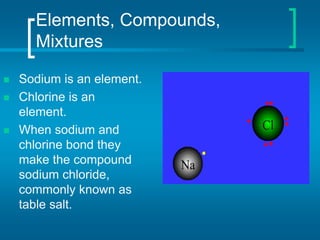
Elements, Compounds,
Mixtures
 Sodium is an element.
 Chlorine is an
element.
 When sodium and
chlorine bond they
make the compound
sodium chloride,
commonly known as
table salt.
Elements, compounds, and
mixtures
 Mixtures can be separated by physical
means.
 Compounds can only be separated by
chemical means.
 Elements are pure substances. When the
subatomic particles of an element are
separated from its atom, it no longer retains
the properties of that element.

Periodic table

  • 1.
  • 3.
  • 4.
    Elements  Composed ofonly one kind of atom.
  • 5.
    The most abundantelement in the earth’s crust is oxygen.
  • 6.
    Periodic Table  Theperiodic table organizes the elements in a particular way. A great deal of information about an element can be gathered from its position in the period table.
  • 7.
    Key to thePeriodic Table  Elements are organized on the table according to their atomic number, usually found near the top of the square.  The atomic number refers to how many protons an atom of that element has.
  • 8.
    What’s in asquare?  Different periodic tables can include various bits of information, but usually:  atomic number  symbol  atomic mass/atomic weight  electronegativty
  • 9.
    Atomic Number  Thisrefers to how many protons an atom of that element has.  No two elements, have the same number of protons. Bohr Model of Hydrogen Atom WaveModel
  • 10.
    Atomic Mass  AtomicMass refers to the “weight” of the atom.  It is derived at by adding the number of protons with the number of neutrons.
  • 11.
    Symbols  All elementshave their own unique symbol.  It can consist of a single capital letter, or a capital letter and one or two lower case letters. C Carbon Cu Copper
  • 12.
  • 13.
    Valence Electrons  Thenumber of valence electrons an atom has may also appear in a square.  Valence electrons are the electrons in the outer energy level of an atom.
  • 15.
    Properties of Metals Metals are good conductors of heat and electricity.  Metals are shiny.  Metals are ductile (can be stretched into thin wires).  Metals are malleable (can be pounded into thin sheets).  A chemical property of metal is its reaction with water which results in corrosion.
  • 16.
    Properties of Non-Metals Non-metals are poor conductors of heat and electricity.  Non-metals are not ductile or malleable.  Solid non-metals are brittle and break easily.  They are dull.  Many non-metals are gases. Sulfur
  • 17.
    Properties of Metalloids Metalloids (metal-like) have properties of both metals and non-metals.  They are solids that can be shiny or dull.  They conduct heat and electricity better than non- metals but not as well as metals.  They are ductile and malleable. Silicon
  • 20.
    Families Periods  Columnsof elements are called groups or families.  Elements in each family have similar but not identical properties.  Each horizontal row of elements is called a period.  The elements in a period are not alike in properties.  The first element in a period is always an extremely active solid. The last element in a period, is always an inactive gas.
  • 33.
    Hydrogen  Hydrogen isin a class of its own.  It’s a gas at room temperature.  It has one proton and one electron in its one and only energy level.  Hydrogen only needs 2 electrons to fill up its valence shell.
  • 34.
    Alkali Metals  Thealkali family is found in the first column of the periodic table.  Atoms of the alkali metals have a single electron in their outermost level, in other words, 1 valence electron.  They are shiny, have the consistency of clay, and are easily cut with a knife.
  • 35.
    Alkali Metals  Theyare the most reactive metals.  They react violently with water.  Alkali metals are never found as free elements in nature. They are always bonded with another element.
  • 36.
    Alkaline Earth Metals They are never found uncombined in nature.  They have two valence electrons.  Alkaline earth metals include magnesium and calcium, among others.
  • 37.
    Transition Metals  TransitionElements include those elements in the B families.  These are the metals you are probably most familiar: copper, tin, zinc, iron, nickel, gold, and silver.  They are good conductors of heat and electricity.
  • 38.
    Transition Metals  Thecompounds of transition metals are usually brightly colored and are often used to color paints.  Transition elements have 1 or 2 valence electrons, which they lose when they form bonds with other atoms. Some transition elements can lose electrons in their next-to- outermost level.
  • 39.
    Transition Elements  Transitionelements have properties similar to one another and to other metals, but their properties do not fit in with those of any other family.  Many transition metals combine chemically with oxygen to form compounds called oxides.
  • 40.
    Boron Family  TheBoron Family is named after the first element in the family.  Atoms in this family have 3 valence electrons.  This family includes a metalloid (boron), and the rest are metals.  This family includes the most abundant metal in the earth’s crust (aluminum).
  • 41.
    Carbon Family  Atomsof this family have 4 valence electrons.  This family includes a non-metal (carbon), metalloids, and metals.  The element carbon is called the “basis of life.”
  • 42.
    Nitrogen Family  Thenitrogen family is named after the element that makes up 78% of our atmosphere.  This family includes non- metals, metalloids, and metals.  Atoms in the nitrogen family have 5 valence electrons. They tend to share electrons when they bond.
  • 43.
    Oxygen Family  Atomsof this family have 6 valence electrons.  Most elements in this family share electrons when forming compounds.  Oxygen is the most abundant element in the earth’s crust. It is extremely active and combines with almost
  • 44.
    Halogen Family  Halogenshave 7 valence electrons, which explains why they are the most active non- metals. They are never found free in nature. Halogen atoms only need to gain 1 electron to fill their outermost energy level. They react with alkali metals to form salts.
  • 45.
    Noble Gases  NobleGases are colorless gases that are extremely un-reactive.  One important property of the noble gases is their inactivity. They are inactive because their outermost energy level is full.  All the noble gases are found in small amounts in the earth's atmosphere.
  • 46.
    Rare Earth Elements The thirty rare earth elements are composed of the lanthanide and actinide series.  One element of the lanthanide series and most of the elements in the actinide series are called trans- uranium, which means synthetic or man-made.
  • 47.
    Mendeleev  In 1869,Dmitri Ivanovitch Mendeléev created the first accepted version of the periodic table.  He grouped elements according to their atomic mass, and as he did, he found that the families had similar chemical properties.  Blank spaces were left open to add the new elements he predicted would occur.
  • 48.
    Matter  All matteris composed of atoms and groups of atoms bonded together, called molecules.  Substances that are made from one type of atom only are called pure substances.  Substances that are made from more than one type of atom bonded together are called compounds.  Compounds that are combined physically, but not chemically, are called mixtures.
  • 49.
    Elements, Compounds, Mixtures  Sodiumis an element.  Chlorine is an element.  When sodium and chlorine bond they make the compound sodium chloride, commonly known as table salt.
  • 50.
    Elements, compounds, and mixtures Mixtures can be separated by physical means.  Compounds can only be separated by chemical means.  Elements are pure substances. When the subatomic particles of an element are separated from its atom, it no longer retains the properties of that element.