The slide describe about the special senses such as eye, ear, nose, tongue. All the special senses shows different different functions along with the disorders.
PREPARED BY
Prof. ASHISHN. UMALE
M. PHARM IN PHARMACOLOGY
ASSISTANT PROFESSOR
SHRADDHA INSTITUTE OF PHARMACY, WASHIM-444505
HUMAN ANATOMY AND
PHYSIOLOGY - I
2.
The Human Eye(Vision
Structure (The Three Tunics)
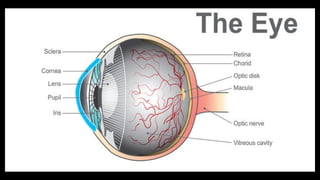
Fibrous Layer (Outer): Consists of the Sclera (white of the eye,
provides shape) and the Cornea (transparent window that refracts
light).
Vascular Layer (Middle/Uvea):
Choroid: Highly vascularized, prevents light reflection.
Ciliary Body: Secretes aqueous humor and controls lens shape.
Iris: Colored part; regulates pupil size.
Neural Layer (Inner): The Retina contains photoreceptors:
Rods: Responsible for twilight (scotopic) vision.
Cones: Responsible for daylight (photopic) and color vision.
4.
Functions
Refraction: Bending lightto focus on the retina.
Accommodation: Adjusting lens curvature for near/far objects.
Transduction: Converting light energy into electrical nerve impulses.
Disorders of the Eye
Myopia (Nearsightedness): Eyeball is too long; light focuses in front of the
retina.
Hypermetropia (Farsightedness): Eyeball is too short; light focuses behind
the retina.
Cataract: Clouding of the crystalline lens, often due to protein denaturation
(aging).
Glaucoma: Increased Intraocular Pressure (IOP) due to blockage of
Aqueous Humor drainage (Canal of Schlemm), leading to optic nerve damage.
Conjunctivitis: "Pink eye"; inflammation (viral, bacterial, or allergic).
5.
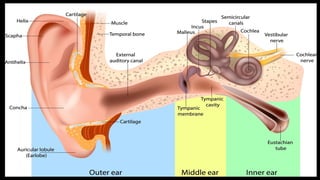
The Human Ear
Structure
ExternalEar: Pinna (Auricle) and External Auditory Canal;
ends at the Tympanic Membrane (eardrum).
Middle Ear: Air-filled cavity containing three ossicles:
Malleus (Hammer), Incus (Anvil), and Stapes (Stirrup).
Connected to the pharynx via the Eustachian tube.
Internal Ear (Labyrinth):
Cochlea: Contains the Organ of Corti (receptors for
hearing).
Semicircular Canals & Vestibule: Receptors for balance
and equilibrium.
7.
Functions
Hearing: Transmission ofsound vibrations to electrical signals.
Balance: Maintenance of static and dynamic equilibrium.
Disorders of the Ear
Otitis Media: Inflammation of the middle ear, common in children.
Tinnitus: Constant ringing or buzzing sensation in the ears.
Meniere’s Disease: Inner ear disorder affecting both hearing and
balance (vertigo).
Deafness:
Conductive: Blockage in outer/middle ear (e.g., wax, ossicle
damage).
Sensorineural: Damage to the cochlea or auditory nerve (CN
VIII).
8.
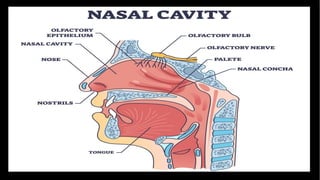
The Nose
Structure
Olfactory Epithelium:Located in the roof of the nasal cavity.
Olfactory Receptors: Bipolar neurons with "olfactory hairs" (cilia) that
detect dissolved chemicals (odorants).
Olfactory Bulb: Where signals are processed before traveling via the
Olfactory Nerve (CN I) to the brain.
Functions
Olfaction: Detection of smell.
Respiratory Support: Filtering, warming, and moistening inhaled air.
Disorders
Anosmia: Total loss of sense of smell (can be due to head injury or
infection).
Rhinitis: Inflammation of the nasal mucosa (allergies/colds).
Nasal Polyps: Non-cancerous growths blocking the airway.
10.
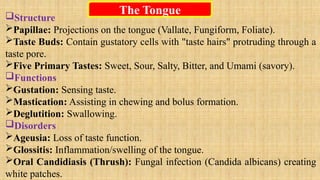
The Tongue
Structure
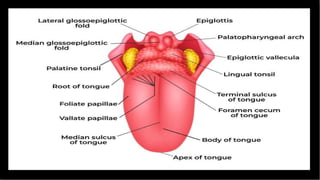
Papillae: Projectionson the tongue (Vallate, Fungiform, Foliate).
Taste Buds: Contain gustatory cells with "taste hairs" protruding through a
taste pore.
Five Primary Tastes: Sweet, Sour, Salty, Bitter, and Umami (savory).
Functions
Gustation: Sensing taste.
Mastication: Assisting in chewing and bolus formation.
Deglutition: Swallowing.
Disorders
Ageusia: Loss of taste function.
Glossitis: Inflammation/swelling of the tongue.
Oral Candidiasis (Thrush): Fungal infection (Candida albicans) creating
white patches.