1 
Writing & Naming 
Formulas 
of 
Ionic & Covalent 
Compounds
IIA III 
A 
IVA VA VI 
A 
VII 
A 
index 
2 
Review of the Periodic Table 
Periods = number of e- energy levels. 
Groups (families) = the number of 
valence electrons (A - groups) 
IA VIIIA 
1 
2 
3 Transition Metals 
4 
5 
6 
7 
6 
7
tight 1 
3 Transition Metals 
4 
5 
6 
7 
6 
2 
Atomic Radii decreases (more p+) 
3 
Metals have between 1 and 3 valence e-and 
have a loose hold on them. 
Nonmetals have between 5 and 7 valence e-and 
have a tight hold on them. 
Noble Gases 
Very 
IA VIIIA 
IIA IIIA IVA VA VIA VIIA hold on 
valence 
e-. 
Greater hold on valence electrons 
7 
index
IIA III 
A 
IVA VA VI 
A 
VII 
A 
4 
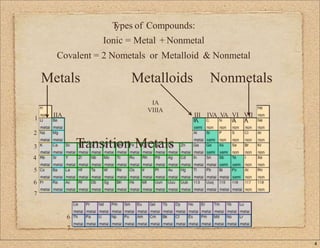
Types of Compounds: 
Ionic = Metal + Nonmetal 
Covalent = 2 Nometals or Metalloid & Nonmetal 
Metals Metalloids Nonmetals 
IA 
VIIIA 
1 
2 
3 Transition Metals 
4 
5 
6 
7 
6 
7
Very 
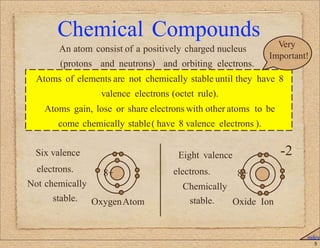
An atom consist of a positively charged nucleus 
(protons and neutrons) and orbiting electrons. 
Not chemically Chemically 
5 
Chemical Compounds 
Important! 
Atoms of elements are not chemically stable until they have 8 
valence electrons (octet rule). 
Atoms gain, lose or share electrons with other atoms to be 
come chemically stable( have 8 valence electrons ). 
Six valence Eight valence -2 
electrons. 8+ electrons. 8+ 
stable. OxygenAtom stable. Oxide Ion 
index
Atoms & Ions: 
Sodium 
Atom 11+ 
Nitrogen 
Atom 
7+ 
Aluminum 
Atom 
13+ 
+ 
1 
Sodium 
11+ 
Ion 
-3 
Nitride 
7+ Ion 
+3 
Aluminum 
13+ 
Ion 
6 
Not Stable Stable 
to become stable will: 
Lose 1 e- 
Gain 3 e- 
Lose 3 e-index
7 
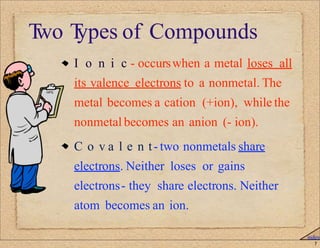
Two Types of Compounds 
I o n i c - occurswhen a metal loses all 
its valence electrons to a nonmetal. The 
metal becomes a cation (+ion), while the 
nonmetal becomes an anion (- ion). 
C o v a l e n t - two nonmetals share 
electrons. Neither loses or gains 
electrons- they share electrons. Neither 
atom becomes an ion. 
index
Compounds 
8 
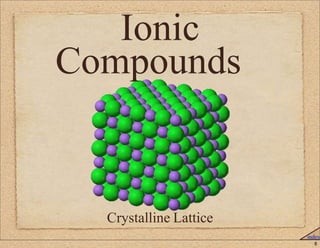
Ionic 
Crystalline Lattice 
index
2Mg +O2 → 2MgO 
12 + 12 
+ 
+ 
+ 
8+ 8+ 
9 
Oxidizing Magnesium 
Opposite 
charges 
hold the 
compound 
together. 
+2 -2 
Magnesium Atom +Oxygen Atom ➝ Magnesium Ion + Oxide Ion 
index
1 
-1 Cl 
+charges 
Crystalline 
+ + 17 
+ 
17 
+ 
11 
+ 
11 
+ 
10 
Formation of Sodium Chloride 
2Na + Cl2 → 2NaCl 
Na Opposite 
hold the 
compound 
together. 
Lattice 
+ 
- 
Sodium Atom + Chlorine Atom ➝ Sodium Ion + Chloride Ion index
s 
al. 
11 
Ionic Compound 
Contain a metal and a nonmet 
The Metal loses e- and becomes a cation (+). 
The Nonmetal gains e- and becomes an anion(-). 
Metal is listed first, followed by nonmetal. 
Change the name of the nonmetal to -ide. 
Examples: nitride, sulfide, fluoride, oxide, 
bromide, iodide, chloride, telluride, phosphide. 
index
onmetals gain 1,2 or 3 electrons and become - ions (an 
12 
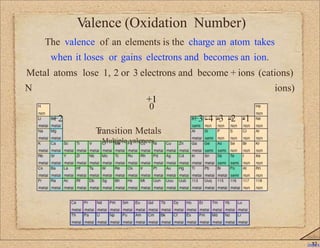
Valence (Oxidation Number) 
The valence of an elements is the charge an atom takes 
when it loses or gains electrons and becomes an ion. 
Metal atoms lose 1, 2 or 3 electrons and become + ions (cations) 
N ions) 
+1 
0 
+2 +3 -4 -3 -2 -1 
Transition Metals 
Multiple valences 
index
13 
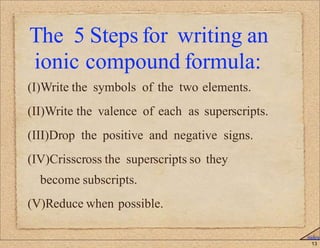
The 5 Steps for writing an 
ionic compound formula: 
(I)Write the symbols of the two elements. 
(II)Write the valence of each as superscripts. 
(III)Drop the positive and negative signs. 
(IV)Crisscross the superscripts so they 
become subscripts. 
(V)Reduce when possible. 
index
14 
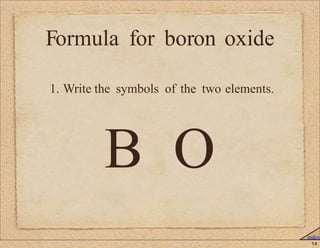
Formula for boron oxide 
1. Write the symbols of the two elements. 
B O 
index
B O 
15 
Formula for boron oxide 
2. Write the valence for each element. 
+3 -2 
index
B O 
16 
Formula for boron oxide 
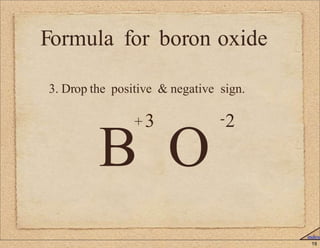
3. Drop the positive & negative sign. 
+ 3 -2 
index
B O 
17 
Formula for boron oxide 
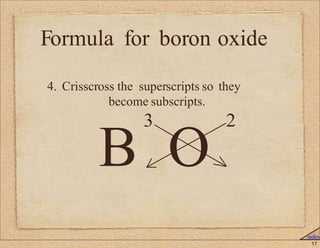
4. Crisscross the superscripts so they 
become subscripts. 
3 2 
index
18 
Formula for boron oxide 
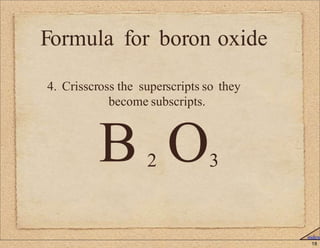
4. Crisscross the superscripts so they 
become subscripts. 
B 2 O3 
index
19 
Formula for boron oxide 
5. Reduce subscripts when possible. 
(not possible here) 
B 2 O3 
index
Ba3N2 Reduces to Reduce 
20 
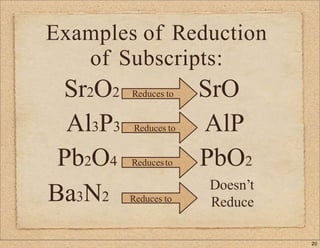
Examples of Reduction 
of Subscripts: 
Sr2O2 Reduces to SrO 
Al3P3 Reduces to AlP 
Pb2O4 Reduces to PbO2 
Doesn’t
21 
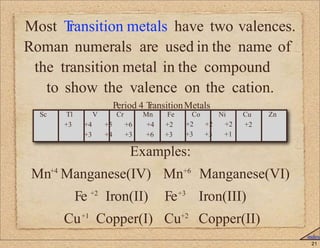
Most Transition metals have two valences. 
Roman numerals are used in the name of 
the transition metal in the compound 
to show the valence on the cation. 
Period 4 TransitionMetals 
Sc Tl V Cr Mn Fe Co Ni Cu Zn 
+3 +4 +5 +6 +4 +2 +2 +2 +2 +2 
+3 +4 +3 +6 +3 +3 +3 +1 
Examples: 
Mn+4 Manganese(IV) Mn+6 Manganese(VI) 
Fe +2 Iron(II) Fe+3 Iron(III) 
Cu+1 Copper(I) Cu+2 Copper(II) 
index
+3 Iron(III) Fe 
22 
Examples of Transition Metals 
Iron(II) Fe +2 
Copper(I)Cu +1 
Copper(II)Cu+2 
Manganese(II)Mn+2 
Manganese(IV)Mn+4 
index
23 
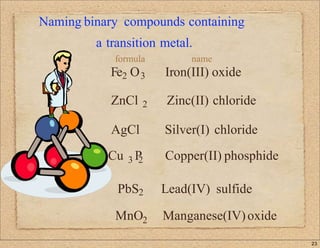
Naming binary compounds containing 
a transition metal. 
formula name 
Fe2 O3 Iron(III) oxide 
ZnCl 2 Zinc(II) chloride 
AgCl Silver(I) chloride 
Cu 3 P2 Copper(II) phosphide 
PbS2 Lead(IV) sulfide 
MnO2 Manganese(IV) oxide
In Writing Common names 
• The Latin root of the metal is followed by either 
Of two suffixes: 
-ous for the ion with the LOWER charge. 
-ic for the ion with the HIGHER charge.
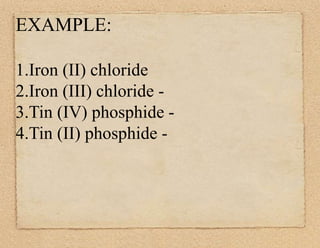
EXAMPLE: 
1.Iron (II) chloride 
2.Iron (III) chloride - 
3.Tin (IV) phosphide - 
4.Tin (II) phosphide -
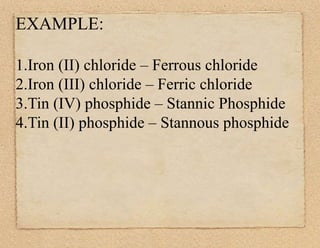
EXAMPLE: 
1.Iron (II) chloride – Ferrous chloride 
2.Iron (III) chloride – Ferric chloride 
3.Tin (IV) phosphide – Stannic Phosphide 
4.Tin (II) phosphide – Stannous phosphide
24 
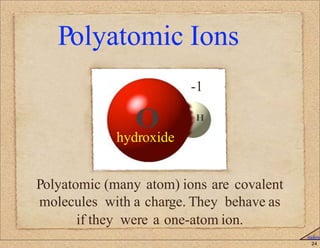
Polyatomic Ions 
-1 
hydroxide 
Polyatomic (many atom) ions are covalent 
molecules with a charge. They behave as 
if they were a one-atom ion. 
index
Ammonium 
Hydroxide 
Nitrite 
Nitrate 
SO3 
SO4 
CO3 
PO4 
Sulfite 
Sulfate 
Carbonate 
Phosphate 
4 
OH 
NO2 
NO3 
25 
Polyatomic Ions 
NH+1 -2 
-1 -2 
-1 -2 
-1 -3 
Note: ammonium is the only polyatomic ion with a + charge. 
Treat polyatomic ions as you would any ion - crisscross to 
determine the formula. The only difference is that when you 
have more than one of a specific polyatomic ion in a formula 
you must encase it in parenthesis. 
index
26 
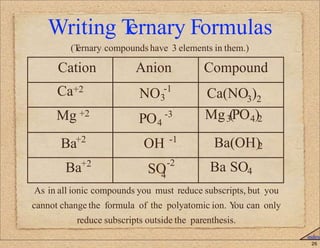
Writing Ternary Formulas 
(Ternary compounds have 3 elements in them.) 
Cation Anion Compound 
+2 -1 
Ca NO3 Ca(NO3)2 
Mg +2 PO4 
Mg3(PO4)2 
-3 
Ba+2 OH -1 Ba(OH)2 
Ba+2 SO-2 Ba SO4 
4 
As in all ionic compounds you must reduce subscripts, but you 
cannot change the formula of the polyatomic ion. You can only 
reduce subscripts outside the parenthesis. 
index
Carbonate CO3 
Phosphate PO4 
27 
Compounds with Polyatomic ions 
-2 
Sodium carbonate Na2CO3 
Calcium carbonate Ca CO3 
Aluminum carbonateAl 
(CO3)3 
2 
-3 
Sodium phosphateNa3PO4 
Calcium phosphate Ca3(PO3 )2 
Aluminum phosphateAlPO3 
index
Families of Oxoanions 
• Oxoanions are those in which an element 
(usually nonmetal) is bonded to one or more 
oxygen atoms. 
• There are several families of two or four 
oxoanions that differ only in the number of 
oxygen atoms.
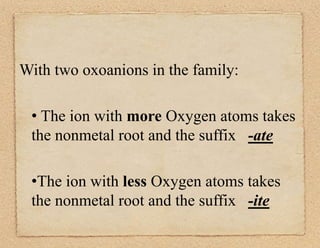
With two oxoanions in the family: 
• The ion with more Oxygen atoms takes 
the nonmetal root and the suffix -ate 
•The ion with less Oxygen atoms takes 
the nonmetal root and the suffix -ite
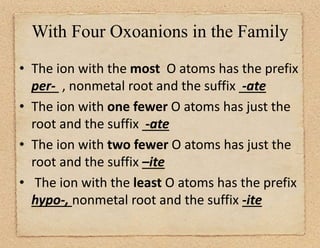
With Four Oxoanions in the Family 
• The ion with the most O atoms has the prefix 
per- , nonmetal root and the suffix -ate 
• The ion with one fewer O atoms has just the 
root and the suffix -ate 
• The ion with two fewer O atoms has just the 
root and the suffix –ite 
• The ion with the least O atoms has the prefix 
hypo-, nonmetal root and the suffix -ite
Example: 
1. ClO- 
2. ClO2 
- 
- 
3. NO2 
- 
4. NO3
ompounds 
28 
Covalent 
Water 
Molecule 
Hydrogen Oxygen Hydrogen 
Atom Atom Atom 
index
29 
Covalent Compounds 
Two nonmetals share electrons so both 
have 8 valence electrons. Exception: H 
Neither takes on a charge - no valence. 
Do not crisscross to determine formula. 
Must use prefixes in the name. 
Name tells you the formula. Example: 
N2O4 is dinitrogen tetroxide. 
You cannot reduce the formulas!!! 
index
1 1 
+ 8+ 
+ 
+ 
30 
Reaction between hydrogen + oxygen 
2H2 + O2 → 2H2O 
1+ 8+ 
2 Hydrogen Atoms Oxygen Atom Water Molecule 1+ 
index
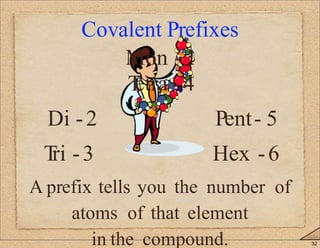
32 
Covalent Prefixes 
Mon - 1 
Tetra - 4 
Di - 2 Pent- 5 
Tri - 3 Hex - 6 
Aprefix tells you the number of 
atoms of that element 
in the compound.
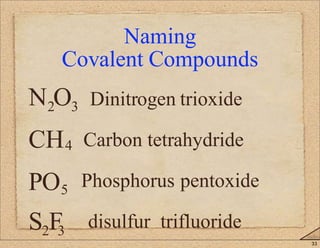
33 
Naming 
Covalent Compounds 
N2O3 Dinitrogen trioxide 
CH4 Carbon tetrahydride 
PO5 Phosphorus pentoxide 
S2F3 disulfur trifluoride
form a crystalline 
pattern of ions. 
34 
Ionic and Covalent Structure 
Ionic compounds Water 
H atoms 
lattice - a repeating O atom 
Covalent compounds 
B+3 ions form individual 
N-3 ions molecules that are 
not connected to 
Boron nitride each other. 
index
(Metal cation + Nonmetal anion) (Two Nonmetals) 
left on the periodic table first, then 
Numerals to tell Roman atoms in the compound 
the metal. 
iron(III) oxide 
pent(a)-5, hex-6 
Examples: 
magnesium nitride dinitrogen trioxide, nitrogen trichloride, 
manganese(IV) oxide carbon tetrachloride, dihydrogen oxide beryllium oxide 
35 
Naming Binary Compounds 
Does the compound have a metal? 
Yes No 
Ionic Covalent 
Place metal first followed by nonmetal ending in -ide 
Contain a Transition Metal? Place the nonmetal furthest to the 
Yes No the other nonmetal ending in -ide. 
Use Roman Do not use Use prefixes to tell the number of 
the valence of Numerals mon(o)-1, di-2, tri-3, tetr(a)-4, 
Examples: 
sodium chloride Examples: 
copper(II) chloride 
aluminum fluoride phosphorus pentoxide, sulfur dioxide 
silver(I) chloride 
index
36 
Name these compounds: 
CoF2 
cobalt(II) fluoride 
PCl 3 
Sr3N2 
KOH 
NH3
36 
Name these compounds: 
CoF2 
cobalt(II) fluoride 
PCl 3 phorphorus trichloride 
Sr3N2 strontium nitride 
KOH potassium hydroxide 
NH3 nitrogen trihydride
37 
Write formulas for these compounds: 
zinc(II) nitride 
lithium bromide dinitrogen pentoxide 
manganese(IV) sulfide 
dihydrogen oxide
37 
Write formulas for these compounds: 
Zn3N2 zinc(II) nitride 
LiBr lithium bromide 
N2O5 dinitrogen pentoxide 
MnS2 manganese(IV) sulfide 
H2O dihydrogen 
monoxide
38 
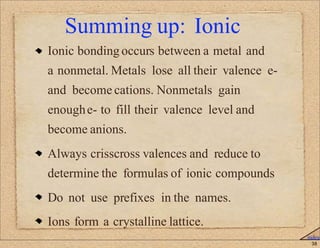
Summing up: Ionic 
Ionic bonding occurs between a metal and 
a nonmetal. Metals lose all their valence e-and 
become cations. Nonmetals gain 
enoughe- to fill their valence level and 
become anions. 
Always crisscross valences and reduce to 
determine the formulas of ionic compounds 
Do not use prefixes in the names. 
Ions form a crystalline lattice. 
index
39 
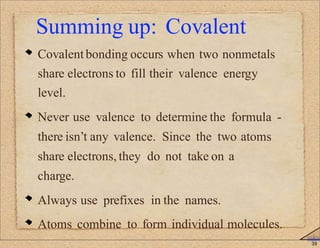
Summing up: Covalent 
Covalent bonding occurs when two nonmetals 
share electrons to fill their valence energy 
level. 
Never use valence to determine the formula - 
there isn’t any valence. Since the two atoms 
share electrons, they do not take on a 
charge. 
Always use prefixes in the names. 
Atoms combine to form individual molecules. 
index
40 
And now - 
A special type of 
Covalent Compound!
Polar covalent compounds have a partial charge at each end of the molecule. 
because the 8 molecule 
H H oxygen nucleus 
pull the 10 
charged partial 
positive. This is 
to the oxygen protons of the 
it a partial δ - charge that end of the 
index 
41 
Water:APolar Molecule 
Awater The hydrogen 
molecule is polar δ + charge end of the 
protons in the 1+ 1+ becomes 
electrons closer O8+ due to the 
end of the hydrogen atoms 
molecule, giving sticking out near 
negative charge. molecule.
index 
42 
Water: APolar Molecule 
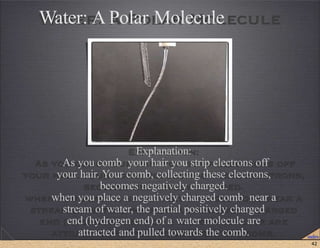
Explanation: 
As you comb your hair you strip electrons off 
your hair. Your comb, collecting these electrons, 
becomes negatively charged. 
when you place a negatively charged comb near a 
stream of water, the partial positively charged 
end (hydrogen end) of a water molecule are 
attracted and pulled towards the comb.
a δ+ 
l δ+ 
h 0 
e 
43 
δ+ δ - 
n 
e δ - 
g 
t 
i δ - 
v 
e 
y δ - 
c δ+ δ - 
a 
r 
g δ+ δ - 
d 
δ+ δ - 
Why does a 
comb attract 
a stream of 
water? 
δ + 
H 
H 
δ - 
index
- ∞- ∞- - ∞- ∞- - ∞- ∞- - - ∞- ∞- 
∞+ ∞+ ∞+ ∞+ ∞+ ∞+ ∞+ ∞+ ∞+ ∞+ ∞+ ∞+ ∞+ ∞+ 
44 
Surface Tension 
∞ ∞ ∞ ∞ ∞ ∞- 
The partially + charged hydrogen endof a water molecule is 
attracted to the partially - charged oxygen end of another 
molecule. At the surface this causes surface tension. To enter 
the water, one must break apart this attraction. 
What animal makes use of surface tension? index
a Formula Naming Flowchart 
45 
Chemical Formulas Index 
Types of Compounds 
Ionic Compounds Covalent Compounds 
Valence Covalent Prefixes 
Transition Metals 
Lattice & Molecules 
Steps in Writing 
Polyatomic Ions Polar Molecules 
Summing Up 
index

Naming Ionic and Covalent Compounds

  • 1.
    1 Writing &Naming Formulas of Ionic & Covalent Compounds
  • 2.
    IIA III A IVA VA VI A VII A index 2 Review of the Periodic Table Periods = number of e- energy levels. Groups (families) = the number of valence electrons (A - groups) IA VIIIA 1 2 3 Transition Metals 4 5 6 7 6 7
  • 3.
    tight 1 3Transition Metals 4 5 6 7 6 2 Atomic Radii decreases (more p+) 3 Metals have between 1 and 3 valence e-and have a loose hold on them. Nonmetals have between 5 and 7 valence e-and have a tight hold on them. Noble Gases Very IA VIIIA IIA IIIA IVA VA VIA VIIA hold on valence e-. Greater hold on valence electrons 7 index
  • 4.
    IIA III A IVA VA VI A VII A 4 Types of Compounds: Ionic = Metal + Nonmetal Covalent = 2 Nometals or Metalloid & Nonmetal Metals Metalloids Nonmetals IA VIIIA 1 2 3 Transition Metals 4 5 6 7 6 7
  • 5.
    Very An atomconsist of a positively charged nucleus (protons and neutrons) and orbiting electrons. Not chemically Chemically 5 Chemical Compounds Important! Atoms of elements are not chemically stable until they have 8 valence electrons (octet rule). Atoms gain, lose or share electrons with other atoms to be come chemically stable( have 8 valence electrons ). Six valence Eight valence -2 electrons. 8+ electrons. 8+ stable. OxygenAtom stable. Oxide Ion index
  • 6.
    Atoms & Ions: Sodium Atom 11+ Nitrogen Atom 7+ Aluminum Atom 13+ + 1 Sodium 11+ Ion -3 Nitride 7+ Ion +3 Aluminum 13+ Ion 6 Not Stable Stable to become stable will: Lose 1 e- Gain 3 e- Lose 3 e-index
  • 7.
    7 Two Typesof Compounds I o n i c - occurswhen a metal loses all its valence electrons to a nonmetal. The metal becomes a cation (+ion), while the nonmetal becomes an anion (- ion). C o v a l e n t - two nonmetals share electrons. Neither loses or gains electrons- they share electrons. Neither atom becomes an ion. index
  • 8.
    Compounds 8 Ionic Crystalline Lattice index
  • 9.
    2Mg +O2 →2MgO 12 + 12 + + + 8+ 8+ 9 Oxidizing Magnesium Opposite charges hold the compound together. +2 -2 Magnesium Atom +Oxygen Atom ➝ Magnesium Ion + Oxide Ion index
  • 10.
    1 -1 Cl +charges Crystalline + + 17 + 17 + 11 + 11 + 10 Formation of Sodium Chloride 2Na + Cl2 → 2NaCl Na Opposite hold the compound together. Lattice + - Sodium Atom + Chlorine Atom ➝ Sodium Ion + Chloride Ion index
  • 11.
    s al. 11 Ionic Compound Contain a metal and a nonmet The Metal loses e- and becomes a cation (+). The Nonmetal gains e- and becomes an anion(-). Metal is listed first, followed by nonmetal. Change the name of the nonmetal to -ide. Examples: nitride, sulfide, fluoride, oxide, bromide, iodide, chloride, telluride, phosphide. index
  • 12.
    onmetals gain 1,2or 3 electrons and become - ions (an 12 Valence (Oxidation Number) The valence of an elements is the charge an atom takes when it loses or gains electrons and becomes an ion. Metal atoms lose 1, 2 or 3 electrons and become + ions (cations) N ions) +1 0 +2 +3 -4 -3 -2 -1 Transition Metals Multiple valences index
  • 13.
    13 The 5Steps for writing an ionic compound formula: (I)Write the symbols of the two elements. (II)Write the valence of each as superscripts. (III)Drop the positive and negative signs. (IV)Crisscross the superscripts so they become subscripts. (V)Reduce when possible. index
  • 14.
    14 Formula forboron oxide 1. Write the symbols of the two elements. B O index
  • 15.
    B O 15 Formula for boron oxide 2. Write the valence for each element. +3 -2 index
  • 16.
    B O 16 Formula for boron oxide 3. Drop the positive & negative sign. + 3 -2 index
  • 17.
    B O 17 Formula for boron oxide 4. Crisscross the superscripts so they become subscripts. 3 2 index
  • 18.
    18 Formula forboron oxide 4. Crisscross the superscripts so they become subscripts. B 2 O3 index
  • 19.
    19 Formula forboron oxide 5. Reduce subscripts when possible. (not possible here) B 2 O3 index
  • 20.
    Ba3N2 Reduces toReduce 20 Examples of Reduction of Subscripts: Sr2O2 Reduces to SrO Al3P3 Reduces to AlP Pb2O4 Reduces to PbO2 Doesn’t
  • 21.
    21 Most Transitionmetals have two valences. Roman numerals are used in the name of the transition metal in the compound to show the valence on the cation. Period 4 TransitionMetals Sc Tl V Cr Mn Fe Co Ni Cu Zn +3 +4 +5 +6 +4 +2 +2 +2 +2 +2 +3 +4 +3 +6 +3 +3 +3 +1 Examples: Mn+4 Manganese(IV) Mn+6 Manganese(VI) Fe +2 Iron(II) Fe+3 Iron(III) Cu+1 Copper(I) Cu+2 Copper(II) index
  • 22.
    +3 Iron(III) Fe 22 Examples of Transition Metals Iron(II) Fe +2 Copper(I)Cu +1 Copper(II)Cu+2 Manganese(II)Mn+2 Manganese(IV)Mn+4 index
  • 23.
    23 Naming binarycompounds containing a transition metal. formula name Fe2 O3 Iron(III) oxide ZnCl 2 Zinc(II) chloride AgCl Silver(I) chloride Cu 3 P2 Copper(II) phosphide PbS2 Lead(IV) sulfide MnO2 Manganese(IV) oxide
  • 24.
    In Writing Commonnames • The Latin root of the metal is followed by either Of two suffixes: -ous for the ion with the LOWER charge. -ic for the ion with the HIGHER charge.
  • 25.
    EXAMPLE: 1.Iron (II)chloride 2.Iron (III) chloride - 3.Tin (IV) phosphide - 4.Tin (II) phosphide -
  • 26.
    EXAMPLE: 1.Iron (II)chloride – Ferrous chloride 2.Iron (III) chloride – Ferric chloride 3.Tin (IV) phosphide – Stannic Phosphide 4.Tin (II) phosphide – Stannous phosphide
  • 27.
    24 Polyatomic Ions -1 hydroxide Polyatomic (many atom) ions are covalent molecules with a charge. They behave as if they were a one-atom ion. index
  • 28.
    Ammonium Hydroxide Nitrite Nitrate SO3 SO4 CO3 PO4 Sulfite Sulfate Carbonate Phosphate 4 OH NO2 NO3 25 Polyatomic Ions NH+1 -2 -1 -2 -1 -2 -1 -3 Note: ammonium is the only polyatomic ion with a + charge. Treat polyatomic ions as you would any ion - crisscross to determine the formula. The only difference is that when you have more than one of a specific polyatomic ion in a formula you must encase it in parenthesis. index
  • 29.
    26 Writing TernaryFormulas (Ternary compounds have 3 elements in them.) Cation Anion Compound +2 -1 Ca NO3 Ca(NO3)2 Mg +2 PO4 Mg3(PO4)2 -3 Ba+2 OH -1 Ba(OH)2 Ba+2 SO-2 Ba SO4 4 As in all ionic compounds you must reduce subscripts, but you cannot change the formula of the polyatomic ion. You can only reduce subscripts outside the parenthesis. index
  • 30.
    Carbonate CO3 PhosphatePO4 27 Compounds with Polyatomic ions -2 Sodium carbonate Na2CO3 Calcium carbonate Ca CO3 Aluminum carbonateAl (CO3)3 2 -3 Sodium phosphateNa3PO4 Calcium phosphate Ca3(PO3 )2 Aluminum phosphateAlPO3 index
  • 31.
    Families of Oxoanions • Oxoanions are those in which an element (usually nonmetal) is bonded to one or more oxygen atoms. • There are several families of two or four oxoanions that differ only in the number of oxygen atoms.
  • 32.
    With two oxoanionsin the family: • The ion with more Oxygen atoms takes the nonmetal root and the suffix -ate •The ion with less Oxygen atoms takes the nonmetal root and the suffix -ite
  • 33.
    With Four Oxoanionsin the Family • The ion with the most O atoms has the prefix per- , nonmetal root and the suffix -ate • The ion with one fewer O atoms has just the root and the suffix -ate • The ion with two fewer O atoms has just the root and the suffix –ite • The ion with the least O atoms has the prefix hypo-, nonmetal root and the suffix -ite
  • 34.
    Example: 1. ClO- 2. ClO2 - - 3. NO2 - 4. NO3
  • 35.
    ompounds 28 Covalent Water Molecule Hydrogen Oxygen Hydrogen Atom Atom Atom index
  • 36.
    29 Covalent Compounds Two nonmetals share electrons so both have 8 valence electrons. Exception: H Neither takes on a charge - no valence. Do not crisscross to determine formula. Must use prefixes in the name. Name tells you the formula. Example: N2O4 is dinitrogen tetroxide. You cannot reduce the formulas!!! index
  • 37.
    1 1 +8+ + + 30 Reaction between hydrogen + oxygen 2H2 + O2 → 2H2O 1+ 8+ 2 Hydrogen Atoms Oxygen Atom Water Molecule 1+ index
  • 38.
    32 Covalent Prefixes Mon - 1 Tetra - 4 Di - 2 Pent- 5 Tri - 3 Hex - 6 Aprefix tells you the number of atoms of that element in the compound.
  • 39.
    33 Naming CovalentCompounds N2O3 Dinitrogen trioxide CH4 Carbon tetrahydride PO5 Phosphorus pentoxide S2F3 disulfur trifluoride
  • 40.
    form a crystalline pattern of ions. 34 Ionic and Covalent Structure Ionic compounds Water H atoms lattice - a repeating O atom Covalent compounds B+3 ions form individual N-3 ions molecules that are not connected to Boron nitride each other. index
  • 41.
    (Metal cation +Nonmetal anion) (Two Nonmetals) left on the periodic table first, then Numerals to tell Roman atoms in the compound the metal. iron(III) oxide pent(a)-5, hex-6 Examples: magnesium nitride dinitrogen trioxide, nitrogen trichloride, manganese(IV) oxide carbon tetrachloride, dihydrogen oxide beryllium oxide 35 Naming Binary Compounds Does the compound have a metal? Yes No Ionic Covalent Place metal first followed by nonmetal ending in -ide Contain a Transition Metal? Place the nonmetal furthest to the Yes No the other nonmetal ending in -ide. Use Roman Do not use Use prefixes to tell the number of the valence of Numerals mon(o)-1, di-2, tri-3, tetr(a)-4, Examples: sodium chloride Examples: copper(II) chloride aluminum fluoride phosphorus pentoxide, sulfur dioxide silver(I) chloride index
  • 42.
    36 Name thesecompounds: CoF2 cobalt(II) fluoride PCl 3 Sr3N2 KOH NH3
  • 43.
    36 Name thesecompounds: CoF2 cobalt(II) fluoride PCl 3 phorphorus trichloride Sr3N2 strontium nitride KOH potassium hydroxide NH3 nitrogen trihydride
  • 44.
    37 Write formulasfor these compounds: zinc(II) nitride lithium bromide dinitrogen pentoxide manganese(IV) sulfide dihydrogen oxide
  • 45.
    37 Write formulasfor these compounds: Zn3N2 zinc(II) nitride LiBr lithium bromide N2O5 dinitrogen pentoxide MnS2 manganese(IV) sulfide H2O dihydrogen monoxide
  • 46.
    38 Summing up:Ionic Ionic bonding occurs between a metal and a nonmetal. Metals lose all their valence e-and become cations. Nonmetals gain enoughe- to fill their valence level and become anions. Always crisscross valences and reduce to determine the formulas of ionic compounds Do not use prefixes in the names. Ions form a crystalline lattice. index
  • 47.
    39 Summing up:Covalent Covalent bonding occurs when two nonmetals share electrons to fill their valence energy level. Never use valence to determine the formula - there isn’t any valence. Since the two atoms share electrons, they do not take on a charge. Always use prefixes in the names. Atoms combine to form individual molecules. index
  • 48.
    40 And now- A special type of Covalent Compound!
  • 49.
    Polar covalent compoundshave a partial charge at each end of the molecule. because the 8 molecule H H oxygen nucleus pull the 10 charged partial positive. This is to the oxygen protons of the it a partial δ - charge that end of the index 41 Water:APolar Molecule Awater The hydrogen molecule is polar δ + charge end of the protons in the 1+ 1+ becomes electrons closer O8+ due to the end of the hydrogen atoms molecule, giving sticking out near negative charge. molecule.
  • 50.
    index 42 Water:APolar Molecule Explanation: As you comb your hair you strip electrons off your hair. Your comb, collecting these electrons, becomes negatively charged. when you place a negatively charged comb near a stream of water, the partial positively charged end (hydrogen end) of a water molecule are attracted and pulled towards the comb.
  • 51.
    a δ+ lδ+ h 0 e 43 δ+ δ - n e δ - g t i δ - v e y δ - c δ+ δ - a r g δ+ δ - d δ+ δ - Why does a comb attract a stream of water? δ + H H δ - index
  • 52.
    - ∞- ∞-- ∞- ∞- - ∞- ∞- - - ∞- ∞- ∞+ ∞+ ∞+ ∞+ ∞+ ∞+ ∞+ ∞+ ∞+ ∞+ ∞+ ∞+ ∞+ ∞+ 44 Surface Tension ∞ ∞ ∞ ∞ ∞ ∞- The partially + charged hydrogen endof a water molecule is attracted to the partially - charged oxygen end of another molecule. At the surface this causes surface tension. To enter the water, one must break apart this attraction. What animal makes use of surface tension? index
  • 53.
    a Formula NamingFlowchart 45 Chemical Formulas Index Types of Compounds Ionic Compounds Covalent Compounds Valence Covalent Prefixes Transition Metals Lattice & Molecules Steps in Writing Polyatomic Ions Polar Molecules Summing Up index