Electron
Configuration
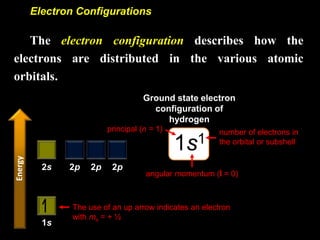
Electron Configurations
The electron configuration describes how the
electrons are distributed in the various atomic
orbitals.
1s1
principal (n = 1)
angular momentum (l = 0)
number of electrons in
the orbital or subshell
1s
2s 2p 2p 2p
Energy
The use of an up arrow indicates an electron
with ms = + ½
Ground state electron
configuration of
hydrogen
What do I mean by “electron
configuration?”
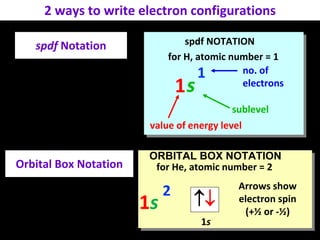
1
1s
value of energy level
sublevel
no. of
electrons
spdf NOTATION
for H, atomic number = 1
spdf Notation
Orbital Box Notation
Arrows show
electron spin
(+½ or -½)
ORBITAL BOX NOTATION
for He, atomic number = 2
1s
2
1s 
2 ways to write electron configurations
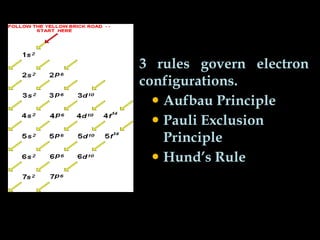
3 rules govern electron
configurations.
 Aufbau Principle
 Pauli Exclusion
Principle
 Hund’s Rule
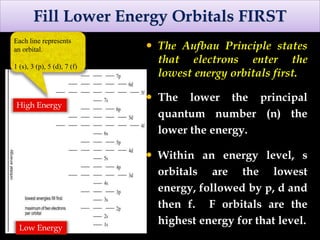
Fill Lower Energy Orbitals FIRST
 The Aufbau Principle states
that electrons enter the
lowest energy orbitals first.
 The lower the principal
quantum number (n) the
lower the energy.
 Within an energy level, s
orbitals are the lowest
energy, followed by p, d and
then f. F orbitals are the
highest energy for that level.
Each line represents
an orbital.
1 (s), 3 (p), 5 (d), 7 (f)
Low Energy
High Energy
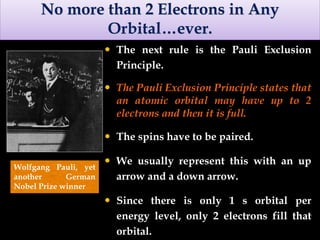
No more than 2 Electrons in Any
Orbital…ever.
 The next rule is the Pauli Exclusion
Principle.
 The Pauli Exclusion Principle states that
an atomic orbital may have up to 2
electrons and then it is full.
 The spins have to be paired.
 We usually represent this with an up
arrow and a down arrow.
 Since there is only 1 s orbital per
energy level, only 2 electrons fill that
orbital.
Wolfgang Pauli, yet
another German
Nobel Prize winner
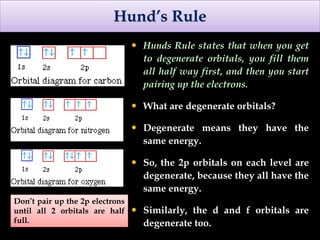
Hund’s Rule
 Hunds Rule states that when you get
to degenerate orbitals, you fill them
all half way first, and then you start
pairing up the electrons.
 What are degenerate orbitals?
 Degenerate means they have the
same energy.
 So, the 2p orbitals on each level are
degenerate, because they all have the
same energy.
 Similarly, the d and f orbitals are
degenerate too.
Don’t pair up the 2p electrons
until all 2 orbitals are half
full.
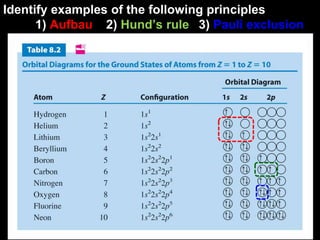
Identify examples of the following principles:
1) Aufbau 2) Hund’s rule 3) Pauli exclusion
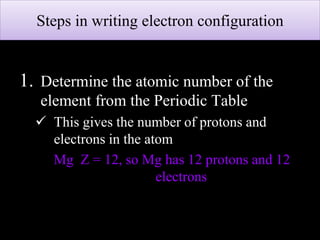
1. Determine the atomic number of the
element from the Periodic Table
 This gives the number of protons and
electrons in the atom
Mg Z = 12, so Mg has 12 protons and 12
electrons
Steps in writing electron configuration
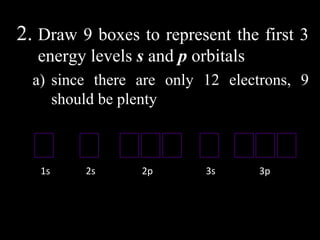
2. Draw 9 boxes to represent the first 3
energy levels s and p orbitals
a) since there are only 12 electrons, 9
should be plenty
1s 2s 2p 3s 3p
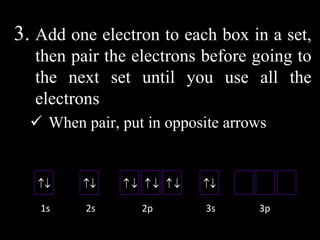
3. Add one electron to each box in a set,
then pair the electrons before going to
the next set until you use all the
electrons
 When pair, put in opposite arrows
1s 2s 2p 3s 3p
     
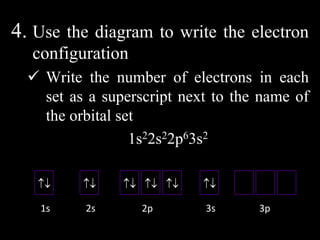
4. Use the diagram to write the electron
configuration
 Write the number of electrons in each
set as a superscript next to the name of
the orbital set
1s22s22p63s2
1s 2s 2p 3s 3p
     
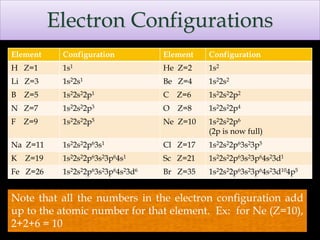
Electron Configurations
Element Configuration Element Configuration
H Z=1 1s1 He Z=2 1s2
Li Z=3 1s22s1 Be Z=4 1s22s2
B Z=5 1s22s22p1 C Z=6 1s22s22p2
N Z=7 1s22s22p3 O Z=8 1s22s22p4
F Z=9 1s22s22p5 Ne Z=10 1s22s22p6
(2p is now full)
Na Z=11 1s22s22p63s1 Cl Z=17 1s22s22p63s23p5
K Z=19 1s22s22p63s23p64s1 Sc Z=21 1s22s22p63s23p64s23d1
Fe Z=26 1s22s22p63s23p64s23d6 Br Z=35 1s22s22p63s23p64s23d104p5
Note that all the numbers in the electron configuration add
up to the atomic number for that element. Ex: for Ne (Z=10),
2+2+6 = 10
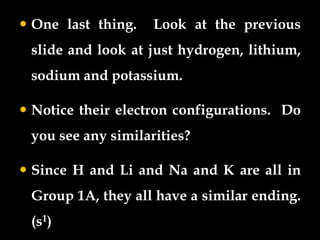
 One last thing. Look at the previous
slide and look at just hydrogen, lithium,
sodium and potassium.
 Notice their electron configurations. Do
you see any similarities?
 Since H and Li and Na and K are all in
Group 1A, they all have a similar ending.
(s1)
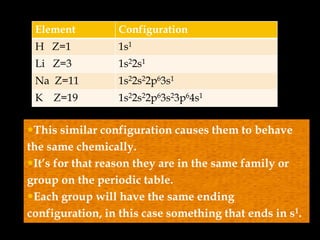
Element Configuration
H Z=1 1s1
Li Z=3 1s22s1
Na Z=11 1s22s22p63s1
K Z=19 1s22s22p63s23p64s1
This similar configuration causes them to behave
the same chemically.
It’s for that reason they are in the same family or
group on the periodic table.
Each group will have the same ending
configuration, in this case something that ends in s1.
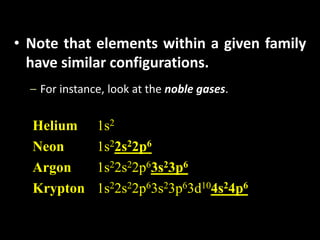
• Note that elements within a given family
have similar configurations.
– For instance, look at the noble gases.
Helium 1s2
Neon 1s22s22p6
Argon 1s22s22p63s23p6
Krypton 1s22s22p63s23p63d104s24p6
• Note that elements within a given
family have similar configurations.
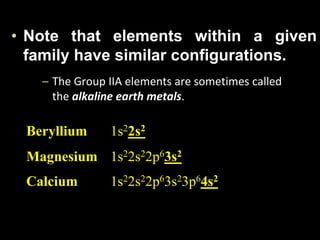
– The Group IIA elements are sometimes called
the alkaline earth metals.
Beryllium 1s22s2
Magnesium 1s22s22p63s2
Calcium 1s22s22p63s23p64s2
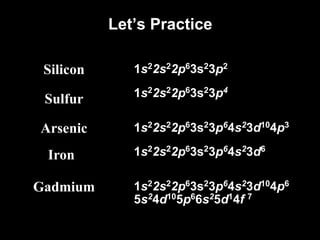
Let’s Practice
1s22s22p63s23p64s23d104p3
Arsenic
1s22s22p63s23p2
1s22s22p63s23p4
1s22s22p63s23p64s23d6
1s22s22p63s23p64s23d104p6
5s24d105p66s25d14f 7
Silicon
Iron
Sulfur
Gadmium
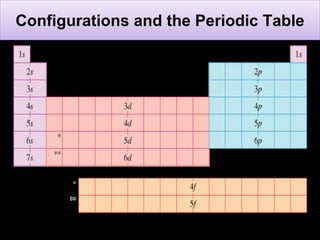
Configurations and the Periodic Table
Shorthand electron configurations
• We can write shorthand electron
configurations.
Shorthand electron configurations
• Because electrons fill orbitals in a regular
pattern, we can shorten the work of writing
electron configurations by using the preceding
noble gas as a template
• We write the highest shell last to indicate the
“valence electrons” - i.e. those furthest out
(involved in bonding and chemical reactions)
• We can represent shorthand electron
configurations of the noble gasses 2 ways: E.g.
Ar = 1s22s22p63s23p6 = [Ne]3s23p6 = [Ar]
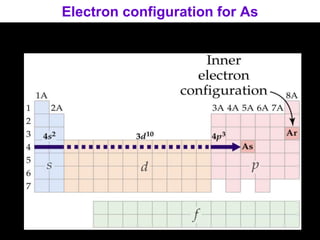
Electron configuration for As
• There are several notable exceptions to the order of
electron filling for some of the transition metals.
 Chromium (Z = 24) is [Ar]4s13d5 and not [Ar]4s23d4 as
expected.
• Copper (Z = 29) is [Ar]4s13d10 and not [Ar]4s23d9 as
expected.
The reason for these anomalies is the slightly greater
stability of d subshells that are either half-filled (d5) or
completely filled (d10).
4s 3d 3d 3d 3d 3d
[Ar]Cr
Greater stability with half-
filled 3d subshell
• There are several notable exceptions to the order of
electron filling for some of the transition metals.
 Chromium (Z = 24) is [Ar]4s13d5 and not [Ar]4s23d4 as
expected.
 Copper (Z = 29) is [Ar]4s13d10 and not [Ar]4s23d9 as
expected.
• The reason for these anomalies is the slightly greater
stability of d subshells that are either half-filled (d5) or
completely filled (d10).
4s 3d 3d 3d 3d 3d
[Ar]Cu
Greater stability with filled
3d subshell
Shorthand notation practice
Examples
Aluminum:
Calcium:
Nickel:
Iodine:
Astatine (At):
[Noble Gas Core] + higher energy electrons
Shorthand notation practice
Examples
● Aluminum: 1s22s22p63s23p1
[Ne]3s23p1
● Calcium: 1s22s22p63s23p64s2
[Ar]4s2
● Nickel: 1s22s22p63s23p64s23d8
[Ar]4s23d8 {or [Ar]3d84s2}
● Iodine: [Kr]5s24d105p5 {or [Kr]4d105s25p5}
● Astatine (At): [Xe]6s24f145d106p5
{or [Xe]4f145d106s26p5}
[Noble Gas Core] + higher energy electrons
Questions?
ASSESSMENT
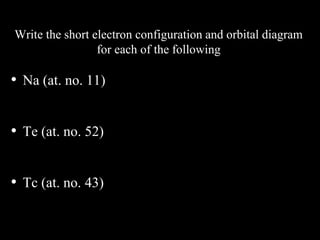
Write the short electron configuration and orbital diagram
for each of the following
• Na (at. no. 11)
• Te (at. no. 52)
• Tc (at. no. 43)
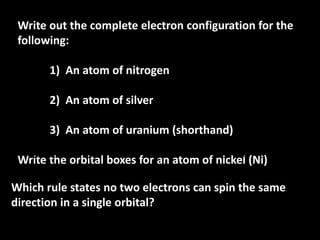
Write out the complete electron configuration for the
following:
1) An atom of nitrogen
2) An atom of silver
3) An atom of uranium (shorthand)
Write the orbital boxes for an atom of nickel (Ni)
2s 2p 3s 3p 4s 3d1s
Which rule states no two electrons can spin the same
direction in a single orbital?
Practice – Use the Periodic Table to write the short
electron configuration and orbital diagram for each of the
following
• Na (at. no. 11) [Ne]3s1
• Te (at. no. 52) [Kr]5s24d105p4
• Tc (at. no. 43) [Kr]5s24d5
3s
5s 5p4d
5s 4d
Write out the complete electron configuration for the following:
1) An atom of nitrogen
2) An atom of silver
3) An atom of uranium (shorthand)
Fill in the orbital boxes for an atom of nickel (Ni)
2s 2p 3s 3p 4s 3d1s
Which rule states no two electrons can spin the same direction in a single orbital?
1s22s22p3
1s22s22p63s23p64s23d104p65s24d9
[Rn]7s26d15f3
Pauli exclusion principle

Electronic configuration final

  • 1.
  • 2.
    Electron Configurations The electronconfiguration describes how the electrons are distributed in the various atomic orbitals. 1s1 principal (n = 1) angular momentum (l = 0) number of electrons in the orbital or subshell 1s 2s 2p 2p 2p Energy The use of an up arrow indicates an electron with ms = + ½ Ground state electron configuration of hydrogen
  • 3.
    What do Imean by “electron configuration?”
  • 4.
    1 1s value of energylevel sublevel no. of electrons spdf NOTATION for H, atomic number = 1 spdf Notation Orbital Box Notation Arrows show electron spin (+½ or -½) ORBITAL BOX NOTATION for He, atomic number = 2 1s 2 1s  2 ways to write electron configurations
  • 5.
    3 rules governelectron configurations.  Aufbau Principle  Pauli Exclusion Principle  Hund’s Rule
  • 6.
    Fill Lower EnergyOrbitals FIRST  The Aufbau Principle states that electrons enter the lowest energy orbitals first.  The lower the principal quantum number (n) the lower the energy.  Within an energy level, s orbitals are the lowest energy, followed by p, d and then f. F orbitals are the highest energy for that level. Each line represents an orbital. 1 (s), 3 (p), 5 (d), 7 (f) Low Energy High Energy
  • 7.
    No more than2 Electrons in Any Orbital…ever.  The next rule is the Pauli Exclusion Principle.  The Pauli Exclusion Principle states that an atomic orbital may have up to 2 electrons and then it is full.  The spins have to be paired.  We usually represent this with an up arrow and a down arrow.  Since there is only 1 s orbital per energy level, only 2 electrons fill that orbital. Wolfgang Pauli, yet another German Nobel Prize winner
  • 8.
    Hund’s Rule  HundsRule states that when you get to degenerate orbitals, you fill them all half way first, and then you start pairing up the electrons.  What are degenerate orbitals?  Degenerate means they have the same energy.  So, the 2p orbitals on each level are degenerate, because they all have the same energy.  Similarly, the d and f orbitals are degenerate too. Don’t pair up the 2p electrons until all 2 orbitals are half full.
  • 9.
    Identify examples ofthe following principles: 1) Aufbau 2) Hund’s rule 3) Pauli exclusion
  • 10.
    1. Determine theatomic number of the element from the Periodic Table  This gives the number of protons and electrons in the atom Mg Z = 12, so Mg has 12 protons and 12 electrons Steps in writing electron configuration
  • 11.
    2. Draw 9boxes to represent the first 3 energy levels s and p orbitals a) since there are only 12 electrons, 9 should be plenty 1s 2s 2p 3s 3p
  • 12.
    3. Add oneelectron to each box in a set, then pair the electrons before going to the next set until you use all the electrons  When pair, put in opposite arrows 1s 2s 2p 3s 3p      
  • 13.
    4. Use thediagram to write the electron configuration  Write the number of electrons in each set as a superscript next to the name of the orbital set 1s22s22p63s2 1s 2s 2p 3s 3p      
  • 14.
    Electron Configurations Element ConfigurationElement Configuration H Z=1 1s1 He Z=2 1s2 Li Z=3 1s22s1 Be Z=4 1s22s2 B Z=5 1s22s22p1 C Z=6 1s22s22p2 N Z=7 1s22s22p3 O Z=8 1s22s22p4 F Z=9 1s22s22p5 Ne Z=10 1s22s22p6 (2p is now full) Na Z=11 1s22s22p63s1 Cl Z=17 1s22s22p63s23p5 K Z=19 1s22s22p63s23p64s1 Sc Z=21 1s22s22p63s23p64s23d1 Fe Z=26 1s22s22p63s23p64s23d6 Br Z=35 1s22s22p63s23p64s23d104p5 Note that all the numbers in the electron configuration add up to the atomic number for that element. Ex: for Ne (Z=10), 2+2+6 = 10
  • 15.
     One lastthing. Look at the previous slide and look at just hydrogen, lithium, sodium and potassium.  Notice their electron configurations. Do you see any similarities?  Since H and Li and Na and K are all in Group 1A, they all have a similar ending. (s1)
  • 16.
    Element Configuration H Z=11s1 Li Z=3 1s22s1 Na Z=11 1s22s22p63s1 K Z=19 1s22s22p63s23p64s1 This similar configuration causes them to behave the same chemically. It’s for that reason they are in the same family or group on the periodic table. Each group will have the same ending configuration, in this case something that ends in s1.
  • 17.
    • Note thatelements within a given family have similar configurations. – For instance, look at the noble gases. Helium 1s2 Neon 1s22s22p6 Argon 1s22s22p63s23p6 Krypton 1s22s22p63s23p63d104s24p6
  • 18.
    • Note thatelements within a given family have similar configurations. – The Group IIA elements are sometimes called the alkaline earth metals. Beryllium 1s22s2 Magnesium 1s22s22p63s2 Calcium 1s22s22p63s23p64s2
  • 19.
  • 20.
    Configurations and thePeriodic Table
  • 21.
    Shorthand electron configurations •We can write shorthand electron configurations.
  • 22.
    Shorthand electron configurations •Because electrons fill orbitals in a regular pattern, we can shorten the work of writing electron configurations by using the preceding noble gas as a template • We write the highest shell last to indicate the “valence electrons” - i.e. those furthest out (involved in bonding and chemical reactions) • We can represent shorthand electron configurations of the noble gasses 2 ways: E.g. Ar = 1s22s22p63s23p6 = [Ne]3s23p6 = [Ar]
  • 23.
  • 24.
    • There areseveral notable exceptions to the order of electron filling for some of the transition metals.  Chromium (Z = 24) is [Ar]4s13d5 and not [Ar]4s23d4 as expected. • Copper (Z = 29) is [Ar]4s13d10 and not [Ar]4s23d9 as expected. The reason for these anomalies is the slightly greater stability of d subshells that are either half-filled (d5) or completely filled (d10). 4s 3d 3d 3d 3d 3d [Ar]Cr Greater stability with half- filled 3d subshell
  • 25.
    • There areseveral notable exceptions to the order of electron filling for some of the transition metals.  Chromium (Z = 24) is [Ar]4s13d5 and not [Ar]4s23d4 as expected.  Copper (Z = 29) is [Ar]4s13d10 and not [Ar]4s23d9 as expected. • The reason for these anomalies is the slightly greater stability of d subshells that are either half-filled (d5) or completely filled (d10). 4s 3d 3d 3d 3d 3d [Ar]Cu Greater stability with filled 3d subshell
  • 26.
  • 27.
    Shorthand notation practice Examples ●Aluminum: 1s22s22p63s23p1 [Ne]3s23p1 ● Calcium: 1s22s22p63s23p64s2 [Ar]4s2 ● Nickel: 1s22s22p63s23p64s23d8 [Ar]4s23d8 {or [Ar]3d84s2} ● Iodine: [Kr]5s24d105p5 {or [Kr]4d105s25p5} ● Astatine (At): [Xe]6s24f145d106p5 {or [Xe]4f145d106s26p5} [Noble Gas Core] + higher energy electrons
  • 28.
  • 30.
  • 31.
    Write the shortelectron configuration and orbital diagram for each of the following • Na (at. no. 11) • Te (at. no. 52) • Tc (at. no. 43)
  • 32.
    Write out thecomplete electron configuration for the following: 1) An atom of nitrogen 2) An atom of silver 3) An atom of uranium (shorthand) Write the orbital boxes for an atom of nickel (Ni) 2s 2p 3s 3p 4s 3d1s Which rule states no two electrons can spin the same direction in a single orbital?
  • 33.
    Practice – Usethe Periodic Table to write the short electron configuration and orbital diagram for each of the following • Na (at. no. 11) [Ne]3s1 • Te (at. no. 52) [Kr]5s24d105p4 • Tc (at. no. 43) [Kr]5s24d5 3s 5s 5p4d 5s 4d
  • 34.
    Write out thecomplete electron configuration for the following: 1) An atom of nitrogen 2) An atom of silver 3) An atom of uranium (shorthand) Fill in the orbital boxes for an atom of nickel (Ni) 2s 2p 3s 3p 4s 3d1s Which rule states no two electrons can spin the same direction in a single orbital? 1s22s22p3 1s22s22p63s23p64s23d104p65s24d9 [Rn]7s26d15f3 Pauli exclusion principle