Presented by
MS. Aneeta Sharma
M.Sc. Tutor(Child health nursing)
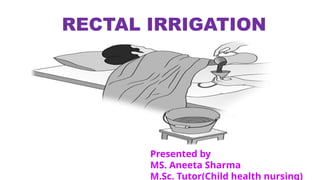
RECTAL IRRIGATION
OUTLINES
• Definition of rectal irrigation
• Indication of rectal irrigation
• Articles of rectal irrigation
• Procedure of rectal irrigation
DEFINITION
Rectal irrigation is a specialist treatment that involves using a
catheter to flush the rectum with a saline solution.
INDICATIONS-
• Hirschsprung's disease-Hirschsprung's disease is a birth defect that occurs when
nerve cells in the large intestine are missing or not developed properly
• Intestinal obstruction-Intestinal obstruction, also known as bowel obstruction,
is a blockage in the small or large intestine that prevents food, liquid, gas, and
stool from passing through normally.
• Meconium ileus-Newborn's first stool, or meconium, is abnormally thick and
sticky, blocking the small intestine
• Anorectal malformation-Anorectal malformations are birth defects link of a
child's anus or rectum that interfere with the normal passage of stool
• Severe Constipation-When other treatments for constipation fail to provide
adequate relief.
• Fecal incontinence-Involuntary leakage of stool, especially in individuals with
neurological conditions.
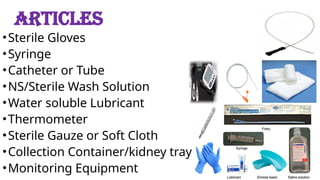
ARTICLES
•Sterile Gloves
•Syringe
•Catheter or Tube
•NS/Sterile Wash Solution
•Water soluble Lubricant
•Thermometer
•Sterile Gauze or Soft Cloth
•Collection Container/kidney tray
•Monitoring Equipment
PROCEDURE
1. Checks the physician order
2. Explains the procedure to the patient and take verbal conset
3. Keeps the articles ready for the procedure
4. Performs hand hygiene
5. Spreads the under pad/ mackintosh
6. Positions the patients left lateral position with the right leg
flexed over abdomen
7. Wears apron
8. Performs hand hygiene
9. Puts on gloves
10. Pours saline into the bowl
Continue…..
11. Draws 20 ml of saline into the syringe and attaches to the 12-16 Fr
Nelaton catheter / rectal catheter
12. Flushes the tube with saline
13. Lubricates the tip of the catheter with water-based lubricant
14. Inserts gently into the rectum via anus at about 15cm(6inch)length
15. Injects the saline into the rectum over 1-2 minutes
16. Does not use excessive force if resistance is felt
17. Injects fluid a maximum of 20 ml/kg or total of 250mL
18. Removes syringe and lets fluid/stool run into the kidney tray after
each 20ml of saline administration.
19. Manipulates the catheter in and out a few centimeters gently and
massages the abdomen if there is no return
Continue…..
20. Does not aspirate if there is no return
21. Stops the procedure when the return is clear
22. Removes catheter from the rectum
23. Cleans and dries anal region
24. Removes gloves
25. Places the child in comfortable position
26. Performs hand hygiene
27. Monitors vital signs
28. Replaces the articles
29. Documents the procedure/ findings
30. Helps the child to go to toilet if she wants to go
RECTAL IRRIGATION...................pptx

RECTAL IRRIGATION...................pptx

  • 1.
    Presented by MS. AneetaSharma M.Sc. Tutor(Child health nursing) RECTAL IRRIGATION
  • 2.
    OUTLINES • Definition ofrectal irrigation • Indication of rectal irrigation • Articles of rectal irrigation • Procedure of rectal irrigation
  • 3.
    DEFINITION Rectal irrigation isa specialist treatment that involves using a catheter to flush the rectum with a saline solution.
  • 4.
    INDICATIONS- • Hirschsprung's disease-Hirschsprung'sdisease is a birth defect that occurs when nerve cells in the large intestine are missing or not developed properly • Intestinal obstruction-Intestinal obstruction, also known as bowel obstruction, is a blockage in the small or large intestine that prevents food, liquid, gas, and stool from passing through normally. • Meconium ileus-Newborn's first stool, or meconium, is abnormally thick and sticky, blocking the small intestine • Anorectal malformation-Anorectal malformations are birth defects link of a child's anus or rectum that interfere with the normal passage of stool • Severe Constipation-When other treatments for constipation fail to provide adequate relief. • Fecal incontinence-Involuntary leakage of stool, especially in individuals with neurological conditions.
  • 5.
    ARTICLES •Sterile Gloves •Syringe •Catheter orTube •NS/Sterile Wash Solution •Water soluble Lubricant •Thermometer •Sterile Gauze or Soft Cloth •Collection Container/kidney tray •Monitoring Equipment
  • 6.
    PROCEDURE 1. Checks thephysician order 2. Explains the procedure to the patient and take verbal conset 3. Keeps the articles ready for the procedure 4. Performs hand hygiene 5. Spreads the under pad/ mackintosh 6. Positions the patients left lateral position with the right leg flexed over abdomen 7. Wears apron 8. Performs hand hygiene 9. Puts on gloves 10. Pours saline into the bowl
  • 7.
    Continue….. 11. Draws 20ml of saline into the syringe and attaches to the 12-16 Fr Nelaton catheter / rectal catheter 12. Flushes the tube with saline 13. Lubricates the tip of the catheter with water-based lubricant 14. Inserts gently into the rectum via anus at about 15cm(6inch)length 15. Injects the saline into the rectum over 1-2 minutes 16. Does not use excessive force if resistance is felt 17. Injects fluid a maximum of 20 ml/kg or total of 250mL 18. Removes syringe and lets fluid/stool run into the kidney tray after each 20ml of saline administration. 19. Manipulates the catheter in and out a few centimeters gently and massages the abdomen if there is no return
  • 8.
    Continue….. 20. Does notaspirate if there is no return 21. Stops the procedure when the return is clear 22. Removes catheter from the rectum 23. Cleans and dries anal region 24. Removes gloves 25. Places the child in comfortable position 26. Performs hand hygiene 27. Monitors vital signs 28. Replaces the articles 29. Documents the procedure/ findings 30. Helps the child to go to toilet if she wants to go