The Periodic Table
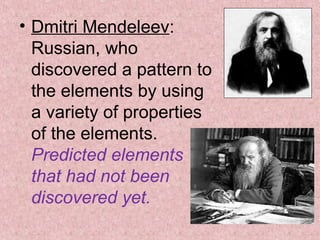
• Dmitri Mendeleev:
Russian, who
discovered a pattern to
the elements by using
a variety of properties
of the elements.
Predicted elements
that had not been
discovered yet.
• Periodic: describes something that occurs
or repeats at regular intervals (Days of a
week)
• Periodic Law: the law that states that the
repeating chemical and physical
properties of elements change periodically
with the atomic numbers of the elements
(Henry Moseley)
Categories of Elements:
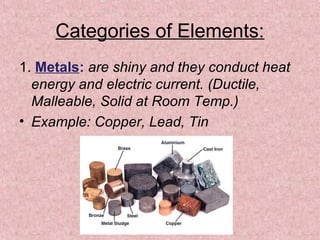
1. Metals: are shiny and they conduct heat
energy and electric current. (Ductile,
Malleable, Solid at Room Temp.)
• Example: Copper, Lead, Tin
Categories of Elements:
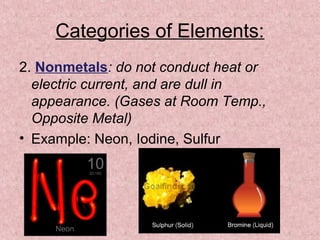
2. Nonmetals: do not conduct heat or
electric current, and are dull in
appearance. (Gases at Room Temp.,
Opposite Metal)
• Example: Neon, Iodine, Sulfur
Categories of Elements:
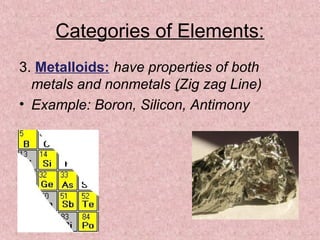
3. Metalloids: have properties of both
metals and nonmetals (Zig zag Line)
• Example: Boron, Silicon, Antimony
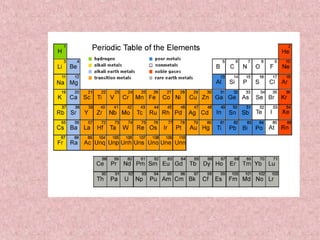
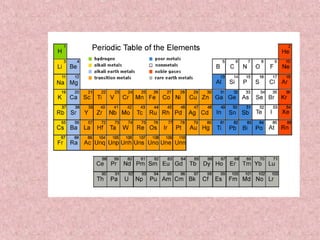
Parts of the Periodic Table:
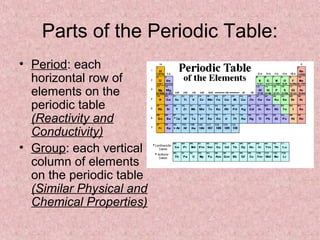
• Period: each
horizontal row of
elements on the
periodic table
(Reactivity and
Conductivity)
• Group: each vertical
column of elements
on the periodic table
(Similar Physical and
Chemical Properties)
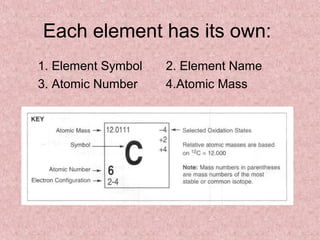
Each element has its own:
1. Element Symbol 2. Element Name
3. Atomic Number 4.Atomic Mass
Isotopes: atoms with same
number of protons but not neutrons
• How do Atoms of Different Elements
Differ? Neutrons
• Radioactive atoms spontaneously fall
apart after a certain amount of time.
• How do you tell isotopes apart? Mass
Number
• Naming an Isotope: Name of element with
hyphened mass number (Carbon-12)
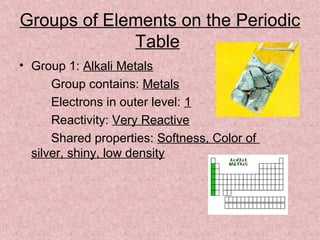
Groups of Elements on the Periodic
Table
• Group 1: Alkali Metals
Group contains: Metals
Electrons in outer level: 1
Reactivity: Very Reactive
Shared properties: Softness, Color of
silver, shiny, low density
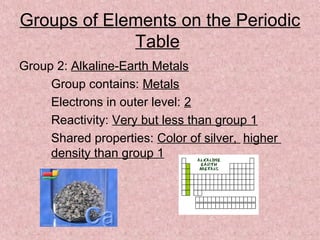
Groups of Elements on the Periodic
Table
Group 2: Alkaline-Earth Metals
Group contains: Metals
Electrons in outer level: 2
Reactivity: Very but less than group 1
Shared properties: Color of silver, higher
density than group 1
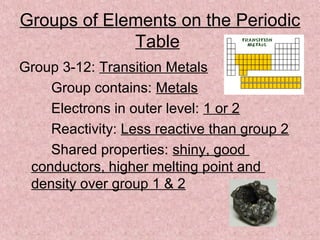
Groups of Elements on the Periodic
Table
Group 3-12: Transition Metals
Group contains: Metals
Electrons in outer level: 1 or 2
Reactivity: Less reactive than group 2
Shared properties: shiny, good
conductors, higher melting point and
density over group 1 & 2
Groups of Elements on the Periodic
Table
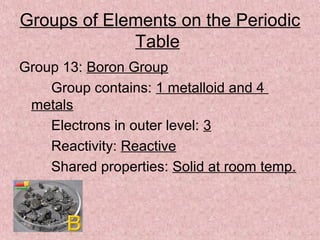
Group 13: Boron Group
Group contains: 1 metalloid and 4
metals
Electrons in outer level: 3
Reactivity: Reactive
Shared properties: Solid at room temp.
Groups of Elements on the Periodic
Table
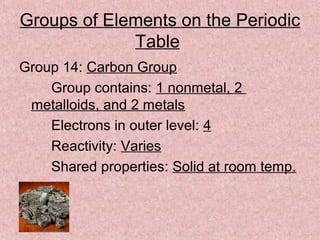
Group 14: Carbon Group
Group contains: 1 nonmetal, 2
metalloids, and 2 metals
Electrons in outer level: 4
Reactivity: Varies
Shared properties: Solid at room temp.
Groups of Elements on the Periodic
Table
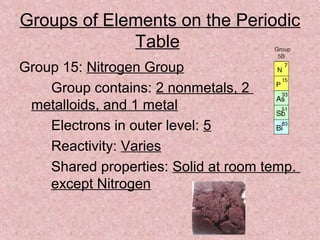
Group 15: Nitrogen Group
Group contains: 2 nonmetals, 2
metalloids, and 1 metal
Electrons in outer level: 5
Reactivity: Varies
Shared properties: Solid at room temp.
except Nitrogen
Groups of Elements on the Periodic
Table
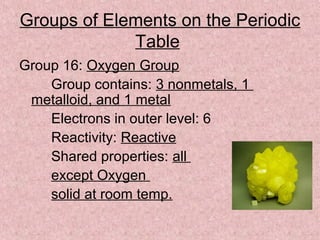
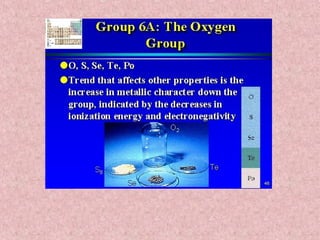
Group 16: Oxygen Group
Group contains: 3 nonmetals, 1
metalloid, and 1 metal
Electrons in outer level: 6
Reactivity: Reactive
Shared properties: all
except Oxygen
solid at room temp.
Groups of Elements on the Periodic
Table
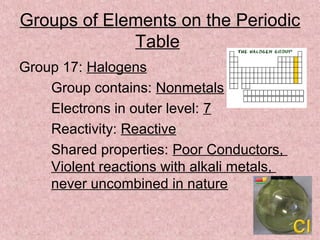
Group 17: Halogens
Group contains: Nonmetals
Electrons in outer level: 7
Reactivity: Reactive
Shared properties: Poor Conductors,
Violent reactions with alkali metals,
never uncombined in nature
Groups of Elements on the Periodic
Table
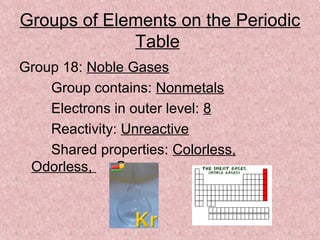
Group 18: Noble Gases
Group contains: Nonmetals
Electrons in outer level: 8
Reactivity: Unreactive
Shared properties: Colorless,
Odorless, Gases
Hydrogen
Electrons in outer level: 1
Reactivity: reactive
Shared properties: Colorless,
Odorless, Gases, low density,
explosive with oxygen

The periodic table

  • 1.
  • 2.
    • Dmitri Mendeleev: Russian,who discovered a pattern to the elements by using a variety of properties of the elements. Predicted elements that had not been discovered yet.
  • 3.
    • Periodic: describessomething that occurs or repeats at regular intervals (Days of a week) • Periodic Law: the law that states that the repeating chemical and physical properties of elements change periodically with the atomic numbers of the elements (Henry Moseley)
  • 4.
    Categories of Elements: 1.Metals: are shiny and they conduct heat energy and electric current. (Ductile, Malleable, Solid at Room Temp.) • Example: Copper, Lead, Tin
  • 5.
    Categories of Elements: 2.Nonmetals: do not conduct heat or electric current, and are dull in appearance. (Gases at Room Temp., Opposite Metal) • Example: Neon, Iodine, Sulfur
  • 6.
    Categories of Elements: 3.Metalloids: have properties of both metals and nonmetals (Zig zag Line) • Example: Boron, Silicon, Antimony
  • 7.
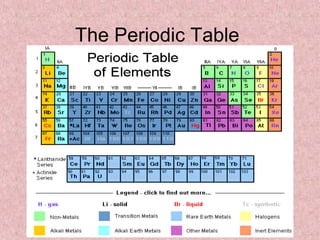
    Parts of thePeriodic Table: • Period: each horizontal row of elements on the periodic table (Reactivity and Conductivity) • Group: each vertical column of elements on the periodic table (Similar Physical and Chemical Properties)
  • 8.
    Each element hasits own: 1. Element Symbol 2. Element Name 3. Atomic Number 4.Atomic Mass
  • 9.
    Isotopes: atoms withsame number of protons but not neutrons • How do Atoms of Different Elements Differ? Neutrons • Radioactive atoms spontaneously fall apart after a certain amount of time. • How do you tell isotopes apart? Mass Number • Naming an Isotope: Name of element with hyphened mass number (Carbon-12)
  • 10.
    Groups of Elementson the Periodic Table • Group 1: Alkali Metals Group contains: Metals Electrons in outer level: 1 Reactivity: Very Reactive Shared properties: Softness, Color of silver, shiny, low density
  • 11.
    Groups of Elementson the Periodic Table Group 2: Alkaline-Earth Metals Group contains: Metals Electrons in outer level: 2 Reactivity: Very but less than group 1 Shared properties: Color of silver, higher density than group 1
  • 12.
    Groups of Elementson the Periodic Table Group 3-12: Transition Metals Group contains: Metals Electrons in outer level: 1 or 2 Reactivity: Less reactive than group 2 Shared properties: shiny, good conductors, higher melting point and density over group 1 & 2
  • 13.
    Groups of Elementson the Periodic Table Group 13: Boron Group Group contains: 1 metalloid and 4 metals Electrons in outer level: 3 Reactivity: Reactive Shared properties: Solid at room temp.
  • 15.
    Groups of Elementson the Periodic Table Group 14: Carbon Group Group contains: 1 nonmetal, 2 metalloids, and 2 metals Electrons in outer level: 4 Reactivity: Varies Shared properties: Solid at room temp.
  • 17.
    Groups of Elementson the Periodic Table Group 15: Nitrogen Group Group contains: 2 nonmetals, 2 metalloids, and 1 metal Electrons in outer level: 5 Reactivity: Varies Shared properties: Solid at room temp. except Nitrogen
  • 18.
    Groups of Elementson the Periodic Table Group 16: Oxygen Group Group contains: 3 nonmetals, 1 metalloid, and 1 metal Electrons in outer level: 6 Reactivity: Reactive Shared properties: all except Oxygen solid at room temp.
  • 20.
    Groups of Elementson the Periodic Table Group 17: Halogens Group contains: Nonmetals Electrons in outer level: 7 Reactivity: Reactive Shared properties: Poor Conductors, Violent reactions with alkali metals, never uncombined in nature
  • 21.
    Groups of Elementson the Periodic Table Group 18: Noble Gases Group contains: Nonmetals Electrons in outer level: 8 Reactivity: Unreactive Shared properties: Colorless, Odorless, Gases
  • 22.
    Hydrogen Electrons in outerlevel: 1 Reactivity: reactive Shared properties: Colorless, Odorless, Gases, low density, explosive with oxygen