REPLICATION
M.Prasad Naidu
MSc Medical Biochemistry, Ph.D,.
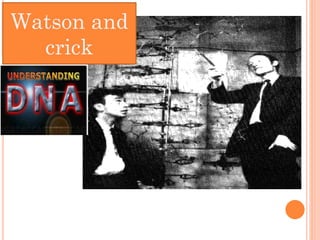
Watson and
crick
 Introduction
 Besides maintaining the integrity of DNA
sequences by DNA repair, all organisms must
duplicate their DNA accurately before every cell
division.
 DNA replication occurs at polymerization rates of
about 500 nucleotides per second in bacteria and
about 50 nucleotides per second in mammals.
 Clearly, the proteins that catalyze this process
must be both accurate and fast.
 Speed and accuracy are achieved by means of a
multienzyme complex that guides the process and
constitutes an elaborate "replication machine."
•Replication occurs in 5’ to 3’ direction only.
•Replication is simultaneous on both strands.
•Replication is bidirectional.
•Replication obeys base pair rule
•Replication results in 2 daughter DNA
strands.
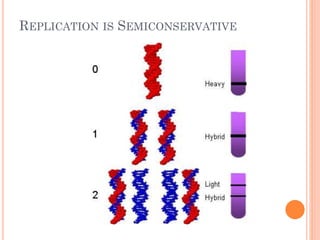
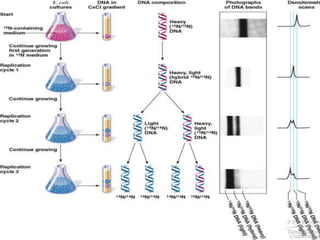
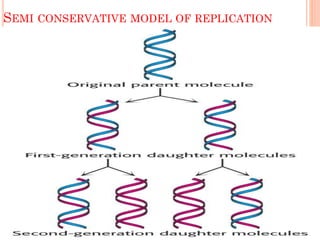
• Each daughter DNA strand has one
parent strand and one complementary
strand synthesized newly. Hence this
Replication is semi-conservative.
Held by phospho-di-ester bonds
and Hydrogen bonds
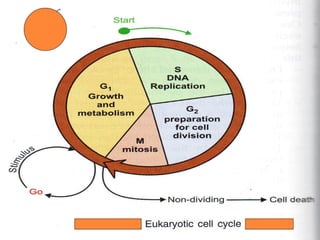
CELL - CYCLE
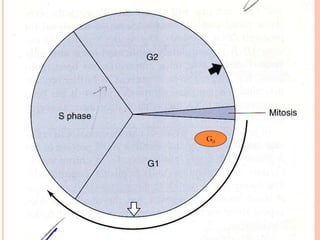
Cell cycle is a sequence of events that occur in
a cell during cell division.
It results in formation of 2 identical daughter
cells.
Duration of cell cycle varies from cell to cell.
It occurs in 4 phases
G1 PHASE [ gap-1]
S PHASE [synthetic]
G2 PHASE [gap-2]
M PHASE [ mitotic]
G0
CELL- CYCLE
 G1 phase ; Preparative phase for DNA synthesis. All
cellular components replicate except DNA . Cell size
increases. Any damage to DNA is detected.
 S phase ; DNA replication takes place.
 G2 phase ; Prepares for cell division and spindle
formation. Any damage to DNA is detected.
 M phase; Cell undergoes cell division . It includes prophase
,metaphase, anaphase ,and telophase.
After mitosis cell may continue cycle by re-entering into G1
or enter G0 and remain dormant or leads to cell
death
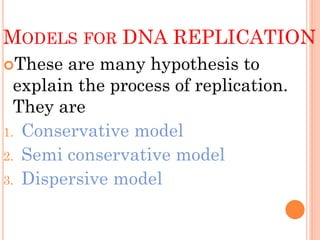
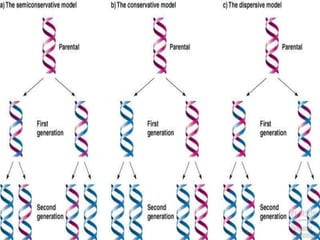
MODELS FOR DNA REPLICATION
These are many hypothesis to
explain the process of replication.
They are
1. Conservative model
2. Semi conservative model
3. Dispersive model
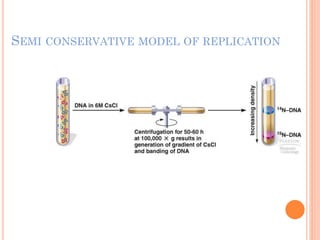
SEMI CONSERVATIVE MODEL OF REPLICATION
REPLICATION IS SEMICONSERVATIVE
SEMI CONSERVATIVE MODEL OF REPLICATION
DNA-REPLICATION
Requirements
1.Deoxyribonucleotides [ dATP, dGTP, dCTP, dTTP ]
2.Template DNA strand [parent strand]
3.RNA primer
4.Enzymes DNA polymerase
Primase
Helicase
DNA Ligase
Topo-isomerases
Single Strand Binding Proteins.
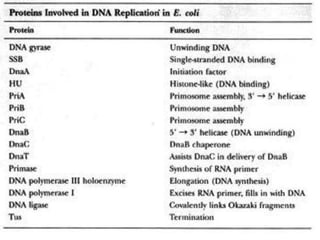
Single strand binding protein (SSBP )
Binds to ssDNA
Has two function
1. prevents reannealing , thus providing ss
template
required by polymerases
2. protects ssDNA from nuclease activity
Show cooperative binding
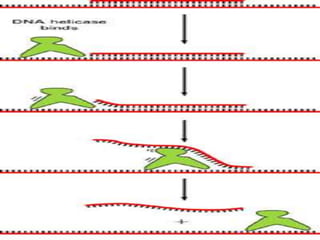
Helicases
 Separate the ds DNA to ss DNA by dissolving the
hydrogen bonds holding the two strands together
These separates dsDNA at physiological temperature
ATP dependent
At least 9 helicases have been described in E coli
Of which DNA binding protein A, B , C ( Dna A,
Dna B, Dna C ) are most important
Initial separation is by Dna A
Continued further by Dna B ( major strand
separating protein acts bidirectionally )
Dna C is required for loading Dna B at site of
replication
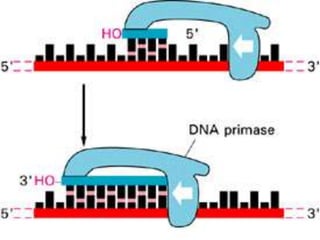
PRIMASE:
Primase is a specilised RNA polymerase
It synthesis a short strech of RNA in 5’ 3’
direction on a template running in 3’ 5’
direction.
An RNA primer, about 100-200 nucleotides
long, is synthesized by the RNA primase.
The RNA primer is removed by DANP, using
exonuclease activity and is replaced with
deoxyribo nucleotides by DNAP
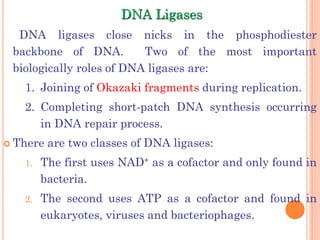
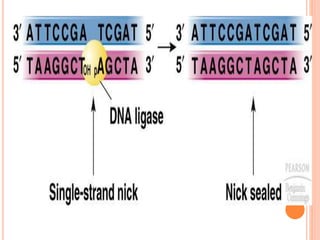
DNA Ligases
DNA ligases close nicks in the phosphodiester
backbone of DNA. Two of the most important
biologically roles of DNA ligases are:
1. Joining of Okazaki fragments during replication.
2. Completing short-patch DNA synthesis occurring
in DNA repair process.
 There are two classes of DNA ligases:
1. The first uses NAD+ as a cofactor and only found in
bacteria.
2. The second uses ATP as a cofactor and found in
eukaryotes, viruses and bacteriophages.
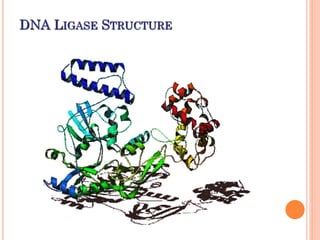
DNA LIGASE STRUCTURE
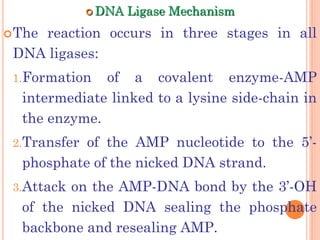
 DNA Ligase Mechanism
The reaction occurs in three stages in all
DNA ligases:
1.Formation of a covalent enzyme-AMP
intermediate linked to a lysine side-chain in
the enzyme.
2.Transfer of the AMP nucleotide to the 5’-
phosphate of the nicked DNA strand.
3.Attack on the AMP-DNA bond by the 3’-OH
of the nicked DNA sealing the phosphate
backbone and resealing AMP.
SUPERCOILS
As two strands unwind ,they result in the formation
of positive supercoils ( super twists ) in the region
of DNA ahead of replication fork.
Accumulation of these supercoils interfere with
further unwinding of ds DNA.
This problem is solved by the enzyme
Topoisomerases.
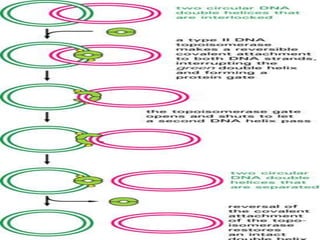
These catalyze the interconvertion of topoisomers of
DNA
Catalyze in a three step process
1. cleavage of one or both strands of DNA
2. passage of a segment of DNA through
this break
3. resealing of the DNA
Two types of topoisomerases are present
DNA which different in the linking numer
Linking number = (Twist +Wreth) 3 dimentional
-type I topoisomerases
-type II topoisomerases
Topoisomerases I
Reversibly cut one strand of double helix
Have both nuclease ( strand cutting ) & ligase (
strand resealing )
Donot require ATP ,rather use the energy released
by phosphodiester bond cleavage to reseal the nick
Removes only negative super coils
Ex : bacteria
Topoisomerases II ( DNA gyrase )
 Heterodimer with 2 swivelase & 2 ATPase subunits
 Swivelase subunit catalyzes trans esterification reaction
that breaks & reforms the phosphodiester backbone
 ATPase subunit hydrolyzes ATP to trigger
conformational changes that allow a double helix to pass
through the transient gap
 Possitive super coiled
DNA POLYMERASES
These are the enzymes responsible for
the polymerisation of deoxy ribo
nucleosides, triphosphates on a DNA
template strand to form a new
complementary DNA strand.
In prokaryotes based on site and
conditions of action. They are divided
into 3 types: I II III.
Common properties:
1. All polymerases can synthesis a new
strand of DNA in 5’ to 3” direction. On a
template strand which is running in 3’to
5’ direction.
2. They also show Exo nuclease activity ( it
cleaves the end terminals of DNA) in 3’to
5’ direction.
3. All DNA polymerases cannot initiate the
process of replication on their own. This is
the basic defect of DNAP synthesis of new
strand .
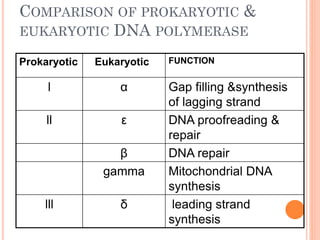
COMPARISON OF PROKARYOTIC &
EUKARYOTIC DNA POLYMERASE
Prokaryotic Eukaryotic FUNCTION
l α Gap filling &synthesis
of lagging strand
ll ε DNA proofreading &
repair
β DNA repair
gamma Mitochondrial DNA
synthesis
lll δ leading strand
synthesis
REPLICATION
There are three phases of replication
1. Initiation
2. Elongation
3. Termination
STEPS IN DNA-REPLICATION
1.Recognition of origin of replication and
Un- winding of double stranded DNA
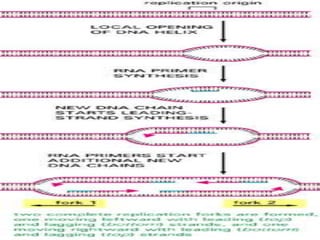
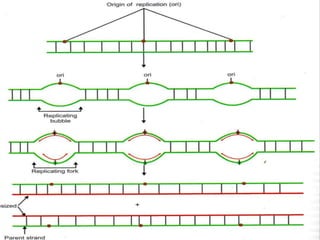
2.Formation of replication bubbles with 2
replication forks for each replication
bubble.
3.Initiation and elongation of DNA strand.
4.Termination and Reconstitution of
chromatin structure.
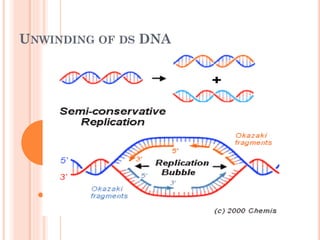
UNWINDING OF DS DNA
INITIATION OF DNA-REPLICATION
1.Identification of the origins of replication.
 The origin of replication [oriC locus] rich in
AT pairs is identified.
 A specific protein [Dna A] binds to the oriC and
results in unwinding of ds DNA.
 Un winding of DNA results in formation of
replication bubble with 2 replication forks.
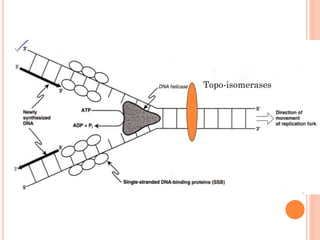
 Ss binding proteins binds to DNA to each strand
to prevent re-annealing of DNA.
 Helicases continues the process of un winding.
 Topoisomerases relieve the super coils formed
during unwinding.
Topo-isomerases
DNA-REPLICATION
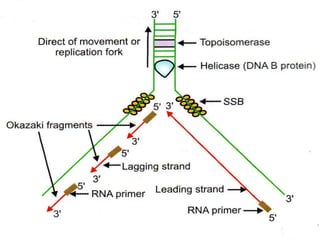
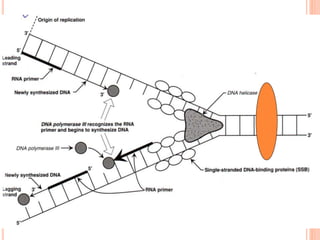
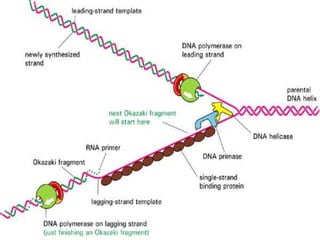
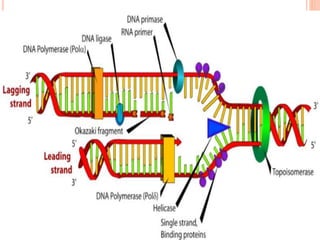
2.Fomation of replication fork
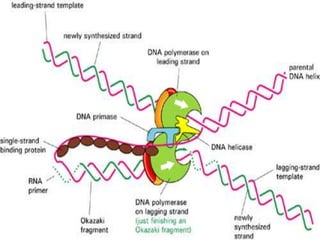
 replication fork has 4 components
1.helicase [unwinds ds DNA]
2.primase [synthesizes RNA primer]
3.DNApolymerase[synthesizes DNA]
4.ss binding proteins [stabilizes the strand]
2.ELONGATION OF DNA
 Requires RNA primer, DNA template , DNAP
enzyme
and deoxyribonucleotides [dATP,dGTP ,dCTP,
dTTP]
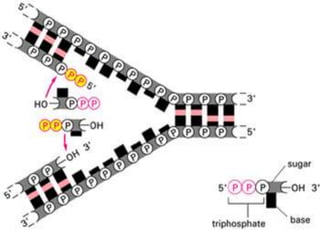
 DNA polymerase catalyze the stepwise addition of
deoxyribonucleotides to 31 end of template strand
and
thus copies the information from the template DNA.
 DNAP requires RNA primer to start elongation.
 DNAP copies the information from DNA template
2.ELONGATION OF DNA
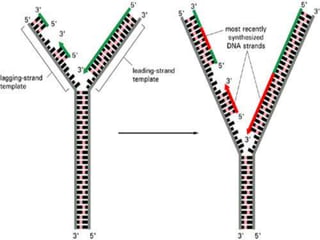
1.continous synthesis occurs towards
the replication fork [leading strand] by
DNA polymerase.
2.discontinuous synthesis occurs
away from the replication fork in pieces
called as okazaki fragments which are
ligated by DNA ligase [lagging strand]. It
requires multiple RNAprimers.
Okazaki fragments
 First demonstrated by Reiji Okazaki
 Short fragments of DNA present on the lagging strand
resulted by retrograde synthesis.
 Okazaki fragments in human cells average about 130 -
200 nucleotide in length
 In E coli they are about ten times this.
REPLICATION
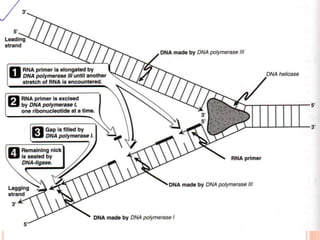
 RNA primer is removed by DNAP with
exonuclease activity. Again the gap is filled by
DNAP. The two Okazaki pieces are later joined
by DNA ligase.
ROLE OF TELOMERS IN
EUKARYOTIC REPLICATION
 A small portion of 31 end of parent strand
is not replicated and length of
chromosome reduces.
 Telomeres play a crucial role in eukaryotic
replication.
 Telomeres contain the repeat sequence of
[TTAGGG]n .
 They prevent the shorting of chromosome
with each cell division by an enzyme
telomerase.
 Telomerase enzyme synthesizes and
maintains the telomeric DNA.
 Telomerase adds repeats to 31end of DNA
3.TERMINATION OF DNA REPLICATION
 In prokaryotes the process of replication is
terminated when the two replication forks
moving in opposite directions from the
origin meet.
 In E.coli replication of circular DNA takes
about 30 minutes.
 In eukaryotes replication is terminated
when entire DNA is duplicated in S phase
of cell cycle.
INHIBITORS OF REPLICATION
1.Inhibitors of DNA; Prevents un-winding of
DNA.
E.g. actinomycin, mitomycin
2.Inhibitors of deoxy-ribonucleotides;
E.g. Anti-folates [ inhibits
Purine
Pyrimidine synthesis]
3.Inhibitors of replicative enzymes;
E.g. norflox [inhibit DNA
gyrase]
ciploflox
Replication in Eukaryotic cells
 More complex than prokaryotic replication
 Semicoservative ,occurs bidirectional from many oigins forming multiple
replication bubbles
Eg:- replication of Drosophilia chromosomes
single Ori C ---16 days to replicate
multiple Ori C ---3 min ( 6000 replication forks )
 Sequence functionally similar to Ori C have been identified in yeast & are
called ARS ( autonomously replicating sequence )
 ARS –span about 300bp ( conserved sequence )
 There are about 400 ARS elements in yeast
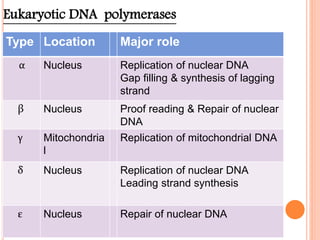
Eukaryotic DNA polymerases
Type Location Major role
α Nucleus Replication of nuclear DNA
Gap filling & synthesis of lagging
strand
β Nucleus Proof reading & Repair of nuclear
DNA
γ Mitochondria
l
Replication of mitochondrial DNA
δ Nucleus Replication of nuclear DNA
Leading strand synthesis
ε Nucleus Repair of nuclear DNA
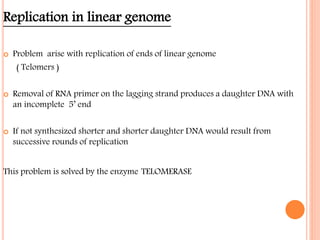
Replication in linear genome
 Problem arise with replication of ends of linear genome
( Telomers )
 Removal of RNA primer on the lagging strand produces a daughter DNA with
an incomplete 5’ end
 If not synthesized shorter and shorter daughter DNA would result from
successive rounds of replication
This problem is solved by the enzyme TELOMERASE
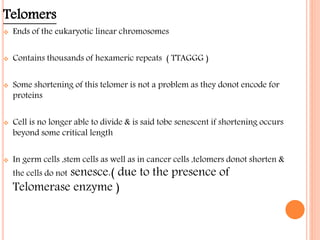
Telomers
 Ends of the eukaryotic linear chromosomes
 Contains thousands of hexameric repeats ( TTAGGG )
 Some shortening of this telomer is not a problem as they donot encode for
proteins
 Cell is no longer able to divide & is said tobe senescent if shortening occurs
beyond some critical length
 In germ cells ,stem cells as well as in cancer cells ,telomers donot shorten &
the cells do not senesce.( due to the presence of
Telomerase enzyme )
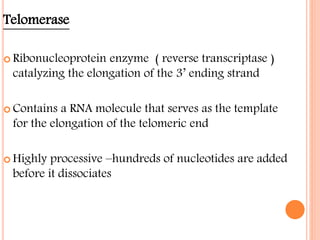
Telomerase
 Ribonucleoprotein enzyme ( reverse transcriptase )
catalyzing the elongation of the 3’ ending strand
 Contains a RNA molecule that serves as the template
for the elongation of the telomeric end
 Highly processive –hundreds of nucleotides are added
before it dissociates
THANK YOU

Replication

  • 1.
  • 3.
  • 4.
     Introduction  Besidesmaintaining the integrity of DNA sequences by DNA repair, all organisms must duplicate their DNA accurately before every cell division.  DNA replication occurs at polymerization rates of about 500 nucleotides per second in bacteria and about 50 nucleotides per second in mammals.  Clearly, the proteins that catalyze this process must be both accurate and fast.  Speed and accuracy are achieved by means of a multienzyme complex that guides the process and constitutes an elaborate "replication machine."
  • 5.
    •Replication occurs in5’ to 3’ direction only. •Replication is simultaneous on both strands. •Replication is bidirectional. •Replication obeys base pair rule •Replication results in 2 daughter DNA strands. • Each daughter DNA strand has one parent strand and one complementary strand synthesized newly. Hence this Replication is semi-conservative. Held by phospho-di-ester bonds and Hydrogen bonds
  • 6.
    CELL - CYCLE Cellcycle is a sequence of events that occur in a cell during cell division. It results in formation of 2 identical daughter cells. Duration of cell cycle varies from cell to cell. It occurs in 4 phases G1 PHASE [ gap-1] S PHASE [synthetic] G2 PHASE [gap-2] M PHASE [ mitotic]
  • 7.
  • 8.
    CELL- CYCLE  G1phase ; Preparative phase for DNA synthesis. All cellular components replicate except DNA . Cell size increases. Any damage to DNA is detected.  S phase ; DNA replication takes place.  G2 phase ; Prepares for cell division and spindle formation. Any damage to DNA is detected.  M phase; Cell undergoes cell division . It includes prophase ,metaphase, anaphase ,and telophase. After mitosis cell may continue cycle by re-entering into G1 or enter G0 and remain dormant or leads to cell death
  • 10.
    MODELS FOR DNAREPLICATION These are many hypothesis to explain the process of replication. They are 1. Conservative model 2. Semi conservative model 3. Dispersive model
  • 12.
  • 13.
  • 15.
  • 16.
    DNA-REPLICATION Requirements 1.Deoxyribonucleotides [ dATP,dGTP, dCTP, dTTP ] 2.Template DNA strand [parent strand] 3.RNA primer 4.Enzymes DNA polymerase Primase Helicase DNA Ligase Topo-isomerases Single Strand Binding Proteins.
  • 17.
    Single strand bindingprotein (SSBP ) Binds to ssDNA Has two function 1. prevents reannealing , thus providing ss template required by polymerases 2. protects ssDNA from nuclease activity Show cooperative binding
  • 18.
    Helicases  Separate theds DNA to ss DNA by dissolving the hydrogen bonds holding the two strands together These separates dsDNA at physiological temperature ATP dependent At least 9 helicases have been described in E coli Of which DNA binding protein A, B , C ( Dna A, Dna B, Dna C ) are most important Initial separation is by Dna A Continued further by Dna B ( major strand separating protein acts bidirectionally ) Dna C is required for loading Dna B at site of replication
  • 20.
    PRIMASE: Primase is aspecilised RNA polymerase It synthesis a short strech of RNA in 5’ 3’ direction on a template running in 3’ 5’ direction. An RNA primer, about 100-200 nucleotides long, is synthesized by the RNA primase. The RNA primer is removed by DANP, using exonuclease activity and is replaced with deoxyribo nucleotides by DNAP
  • 22.
    DNA Ligases DNA ligasesclose nicks in the phosphodiester backbone of DNA. Two of the most important biologically roles of DNA ligases are: 1. Joining of Okazaki fragments during replication. 2. Completing short-patch DNA synthesis occurring in DNA repair process.  There are two classes of DNA ligases: 1. The first uses NAD+ as a cofactor and only found in bacteria. 2. The second uses ATP as a cofactor and found in eukaryotes, viruses and bacteriophages.
  • 23.
  • 24.
     DNA LigaseMechanism The reaction occurs in three stages in all DNA ligases: 1.Formation of a covalent enzyme-AMP intermediate linked to a lysine side-chain in the enzyme. 2.Transfer of the AMP nucleotide to the 5’- phosphate of the nicked DNA strand. 3.Attack on the AMP-DNA bond by the 3’-OH of the nicked DNA sealing the phosphate backbone and resealing AMP.
  • 26.
    SUPERCOILS As two strandsunwind ,they result in the formation of positive supercoils ( super twists ) in the region of DNA ahead of replication fork. Accumulation of these supercoils interfere with further unwinding of ds DNA. This problem is solved by the enzyme Topoisomerases. These catalyze the interconvertion of topoisomers of DNA
  • 27.
    Catalyze in athree step process 1. cleavage of one or both strands of DNA 2. passage of a segment of DNA through this break 3. resealing of the DNA Two types of topoisomerases are present DNA which different in the linking numer Linking number = (Twist +Wreth) 3 dimentional -type I topoisomerases -type II topoisomerases
  • 28.
    Topoisomerases I Reversibly cutone strand of double helix Have both nuclease ( strand cutting ) & ligase ( strand resealing ) Donot require ATP ,rather use the energy released by phosphodiester bond cleavage to reseal the nick Removes only negative super coils Ex : bacteria
  • 29.
    Topoisomerases II (DNA gyrase )  Heterodimer with 2 swivelase & 2 ATPase subunits  Swivelase subunit catalyzes trans esterification reaction that breaks & reforms the phosphodiester backbone  ATPase subunit hydrolyzes ATP to trigger conformational changes that allow a double helix to pass through the transient gap  Possitive super coiled
  • 30.
    DNA POLYMERASES These arethe enzymes responsible for the polymerisation of deoxy ribo nucleosides, triphosphates on a DNA template strand to form a new complementary DNA strand. In prokaryotes based on site and conditions of action. They are divided into 3 types: I II III.
  • 31.
    Common properties: 1. Allpolymerases can synthesis a new strand of DNA in 5’ to 3” direction. On a template strand which is running in 3’to 5’ direction. 2. They also show Exo nuclease activity ( it cleaves the end terminals of DNA) in 3’to 5’ direction. 3. All DNA polymerases cannot initiate the process of replication on their own. This is the basic defect of DNAP synthesis of new strand .
  • 32.
    COMPARISON OF PROKARYOTIC& EUKARYOTIC DNA POLYMERASE Prokaryotic Eukaryotic FUNCTION l α Gap filling &synthesis of lagging strand ll ε DNA proofreading & repair β DNA repair gamma Mitochondrial DNA synthesis lll δ leading strand synthesis
  • 35.
    REPLICATION There are threephases of replication 1. Initiation 2. Elongation 3. Termination
  • 36.
    STEPS IN DNA-REPLICATION 1.Recognitionof origin of replication and Un- winding of double stranded DNA 2.Formation of replication bubbles with 2 replication forks for each replication bubble. 3.Initiation and elongation of DNA strand. 4.Termination and Reconstitution of chromatin structure.
  • 37.
  • 38.
    INITIATION OF DNA-REPLICATION 1.Identificationof the origins of replication.  The origin of replication [oriC locus] rich in AT pairs is identified.  A specific protein [Dna A] binds to the oriC and results in unwinding of ds DNA.  Un winding of DNA results in formation of replication bubble with 2 replication forks.  Ss binding proteins binds to DNA to each strand to prevent re-annealing of DNA.  Helicases continues the process of un winding.  Topoisomerases relieve the super coils formed during unwinding.
  • 42.
  • 44.
    DNA-REPLICATION 2.Fomation of replicationfork  replication fork has 4 components 1.helicase [unwinds ds DNA] 2.primase [synthesizes RNA primer] 3.DNApolymerase[synthesizes DNA] 4.ss binding proteins [stabilizes the strand]
  • 45.
    2.ELONGATION OF DNA Requires RNA primer, DNA template , DNAP enzyme and deoxyribonucleotides [dATP,dGTP ,dCTP, dTTP]  DNA polymerase catalyze the stepwise addition of deoxyribonucleotides to 31 end of template strand and thus copies the information from the template DNA.  DNAP requires RNA primer to start elongation.  DNAP copies the information from DNA template
  • 46.
    2.ELONGATION OF DNA 1.continoussynthesis occurs towards the replication fork [leading strand] by DNA polymerase. 2.discontinuous synthesis occurs away from the replication fork in pieces called as okazaki fragments which are ligated by DNA ligase [lagging strand]. It requires multiple RNAprimers.
  • 48.
    Okazaki fragments  Firstdemonstrated by Reiji Okazaki  Short fragments of DNA present on the lagging strand resulted by retrograde synthesis.  Okazaki fragments in human cells average about 130 - 200 nucleotide in length  In E coli they are about ten times this.
  • 51.
    REPLICATION  RNA primeris removed by DNAP with exonuclease activity. Again the gap is filled by DNAP. The two Okazaki pieces are later joined by DNA ligase.
  • 53.
    ROLE OF TELOMERSIN EUKARYOTIC REPLICATION  A small portion of 31 end of parent strand is not replicated and length of chromosome reduces.  Telomeres play a crucial role in eukaryotic replication.  Telomeres contain the repeat sequence of [TTAGGG]n .  They prevent the shorting of chromosome with each cell division by an enzyme telomerase.  Telomerase enzyme synthesizes and maintains the telomeric DNA.  Telomerase adds repeats to 31end of DNA
  • 54.
    3.TERMINATION OF DNAREPLICATION  In prokaryotes the process of replication is terminated when the two replication forks moving in opposite directions from the origin meet.  In E.coli replication of circular DNA takes about 30 minutes.  In eukaryotes replication is terminated when entire DNA is duplicated in S phase of cell cycle.
  • 57.
    INHIBITORS OF REPLICATION 1.Inhibitorsof DNA; Prevents un-winding of DNA. E.g. actinomycin, mitomycin 2.Inhibitors of deoxy-ribonucleotides; E.g. Anti-folates [ inhibits Purine Pyrimidine synthesis] 3.Inhibitors of replicative enzymes; E.g. norflox [inhibit DNA gyrase] ciploflox
  • 59.
    Replication in Eukaryoticcells  More complex than prokaryotic replication  Semicoservative ,occurs bidirectional from many oigins forming multiple replication bubbles Eg:- replication of Drosophilia chromosomes single Ori C ---16 days to replicate multiple Ori C ---3 min ( 6000 replication forks )  Sequence functionally similar to Ori C have been identified in yeast & are called ARS ( autonomously replicating sequence )  ARS –span about 300bp ( conserved sequence )  There are about 400 ARS elements in yeast
  • 60.
    Eukaryotic DNA polymerases TypeLocation Major role α Nucleus Replication of nuclear DNA Gap filling & synthesis of lagging strand β Nucleus Proof reading & Repair of nuclear DNA γ Mitochondria l Replication of mitochondrial DNA δ Nucleus Replication of nuclear DNA Leading strand synthesis ε Nucleus Repair of nuclear DNA
  • 61.
    Replication in lineargenome  Problem arise with replication of ends of linear genome ( Telomers )  Removal of RNA primer on the lagging strand produces a daughter DNA with an incomplete 5’ end  If not synthesized shorter and shorter daughter DNA would result from successive rounds of replication This problem is solved by the enzyme TELOMERASE
  • 62.
    Telomers  Ends ofthe eukaryotic linear chromosomes  Contains thousands of hexameric repeats ( TTAGGG )  Some shortening of this telomer is not a problem as they donot encode for proteins  Cell is no longer able to divide & is said tobe senescent if shortening occurs beyond some critical length  In germ cells ,stem cells as well as in cancer cells ,telomers donot shorten & the cells do not senesce.( due to the presence of Telomerase enzyme )
  • 63.
    Telomerase  Ribonucleoprotein enzyme( reverse transcriptase ) catalyzing the elongation of the 3’ ending strand  Contains a RNA molecule that serves as the template for the elongation of the telomeric end  Highly processive –hundreds of nucleotides are added before it dissociates
  • 64.