DNA REPLICATION IN
EUKARYOTES
DR. ANU P. ABHIMANNUE
ASSISTANT PROFESSOR,
DEPARTMENT OF BIOTECHNOLOGY,
ST.MARY’S COLLEGE, THRISSUR.
REPLICATION
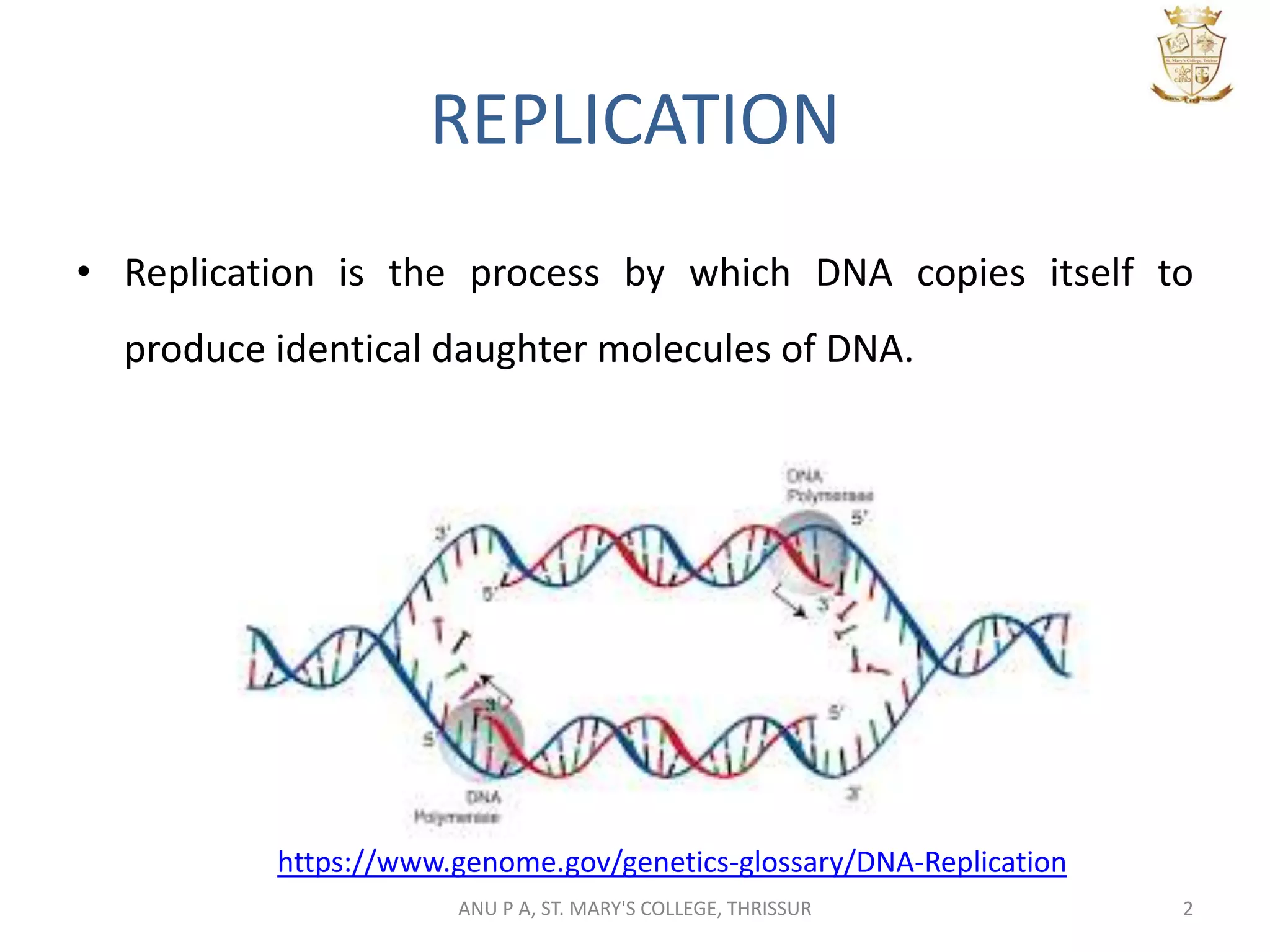
• Replication is the process by which DNA copies itself to
produce identical daughter molecules of DNA.
https://www.genome.gov/genetics-glossary/DNA-Replication
2ANU P A, ST. MARY'S COLLEGE, THRISSUR
EUKARYOTIC REPLICATION
• Eukaryotic genome is relatively complex and their
polymerases incorporate nucleotides at much slower rates.
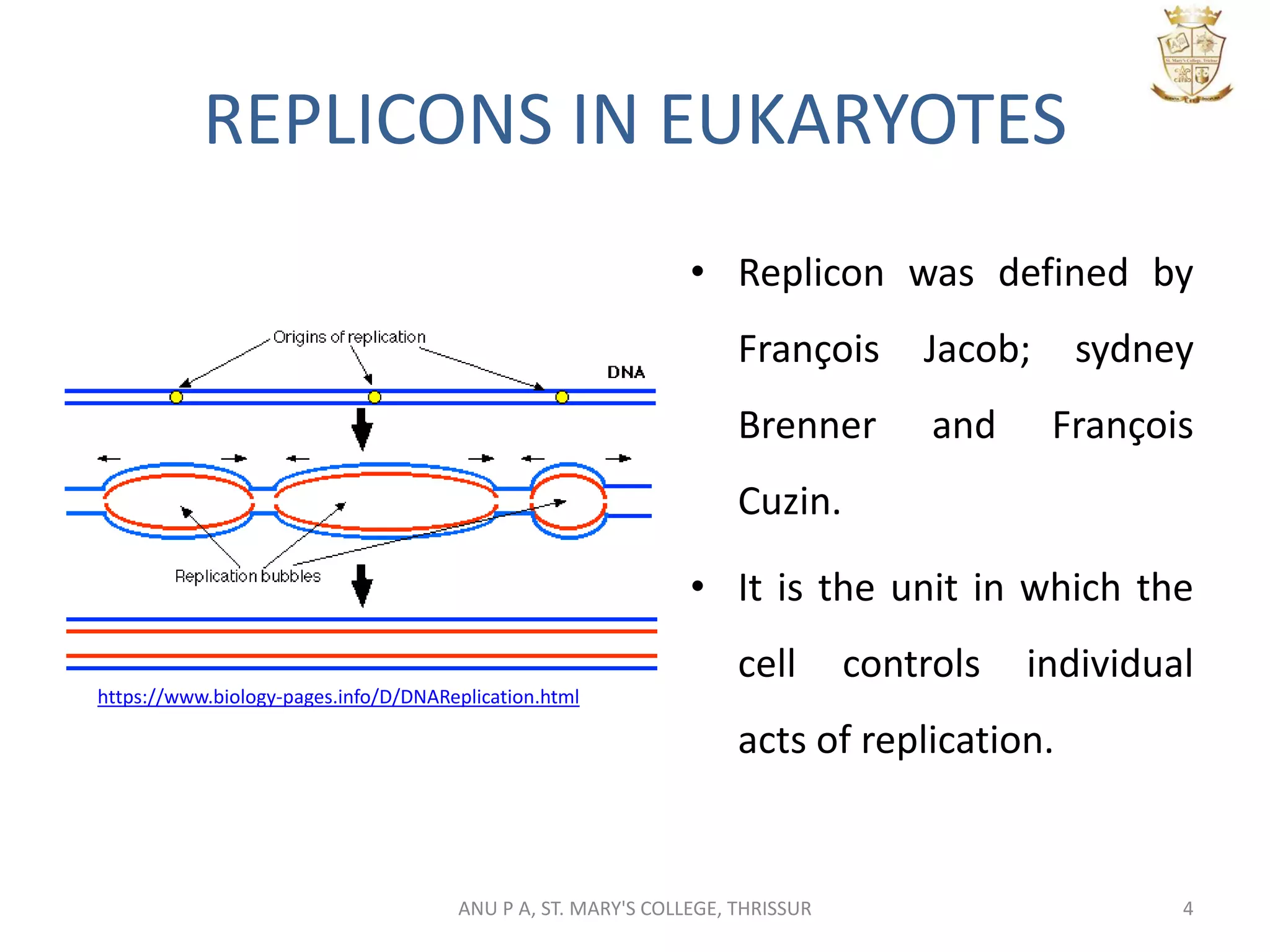
• To overcome this, replication in eukaryotes occur in small
portions, termed replicons.
• In a human cell, there are about 10,000 to 100,000
replicons.
3ANU P A, ST. MARY'S COLLEGE, THRISSUR
REPLICONS IN EUKARYOTES
• Replicon was defined by
François Jacob; sydney
Brenner and François
Cuzin.
• It is the unit in which the
cell controls individual
acts of replication.
4
https://www.biology-pages.info/D/DNAReplication.html
ANU P A, ST. MARY'S COLLEGE, THRISSUR
INITIATION
5ANU P A, ST. MARY'S COLLEGE, THRISSUR
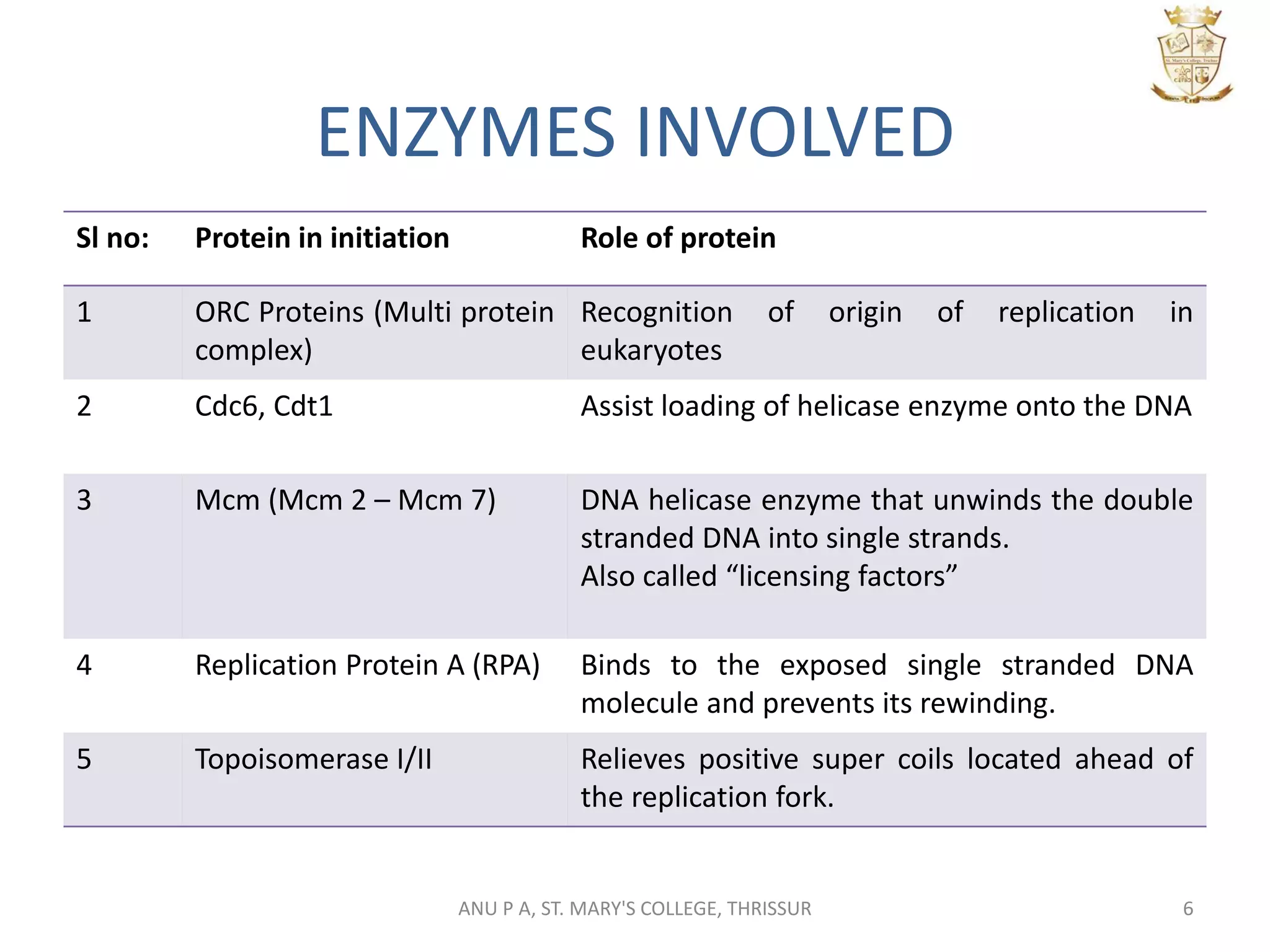
ENZYMES INVOLVED
Sl no: Protein in initiation Role of protein
1 ORC Proteins (Multi protein
complex)
Recognition of origin of replication in
eukaryotes
2 Cdc6, Cdt1 Assist loading of helicase enzyme onto the DNA
3 Mcm (Mcm 2 – Mcm 7) DNA helicase enzyme that unwinds the double
stranded DNA into single strands.
Also called “licensing factors”
4 Replication Protein A (RPA) Binds to the exposed single stranded DNA
molecule and prevents its rewinding.
5 Topoisomerase I/II Relieves positive super coils located ahead of
the replication fork.
6ANU P A, ST. MARY'S COLLEGE, THRISSUR
AUTONOMOUS REPLICATING
SEQUENCES
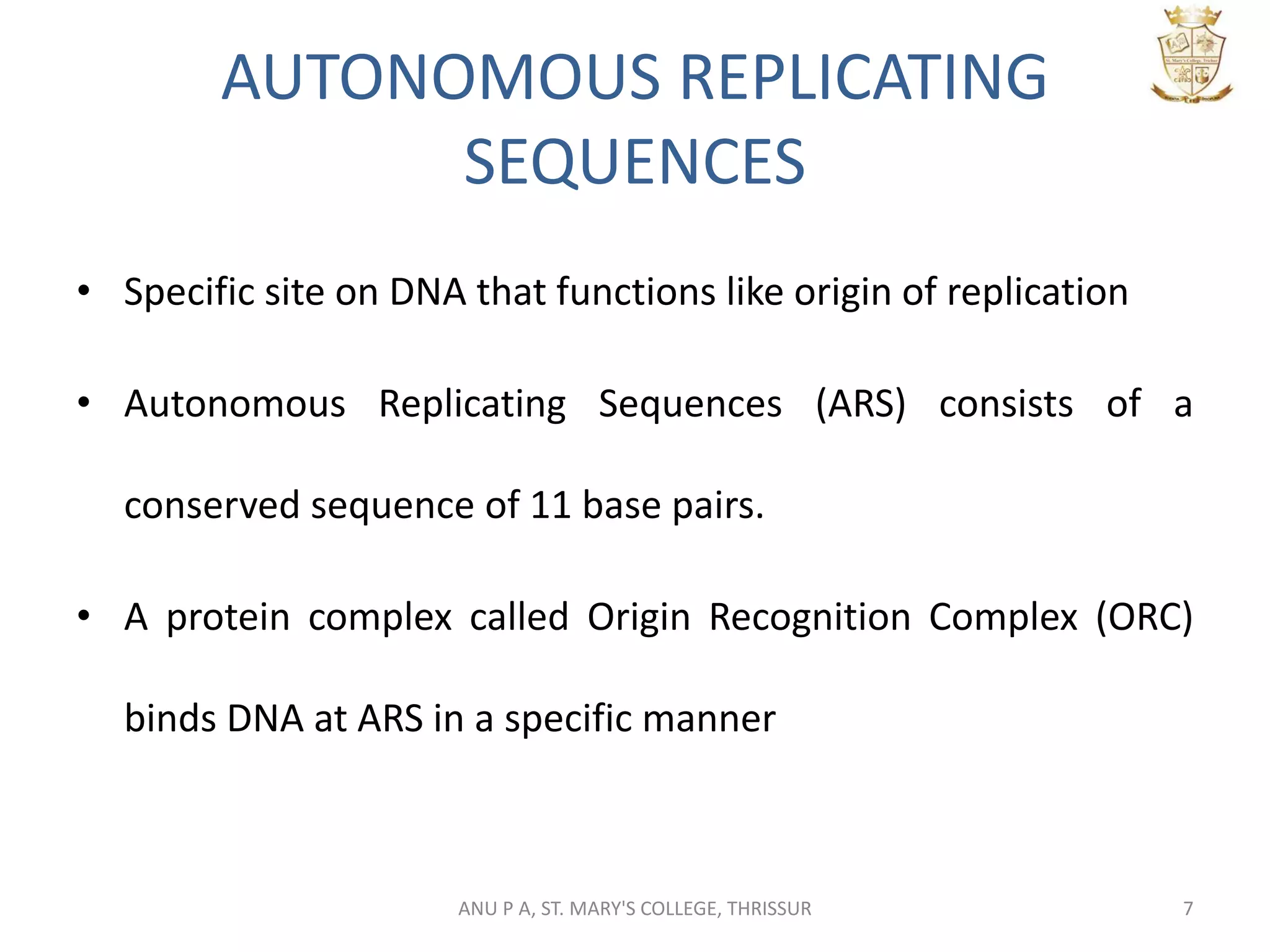
• Specific site on DNA that functions like origin of replication
• Autonomous Replicating Sequences (ARS) consists of a
conserved sequence of 11 base pairs.
• A protein complex called Origin Recognition Complex (ORC)
binds DNA at ARS in a specific manner
7ANU P A, ST. MARY'S COLLEGE, THRISSUR
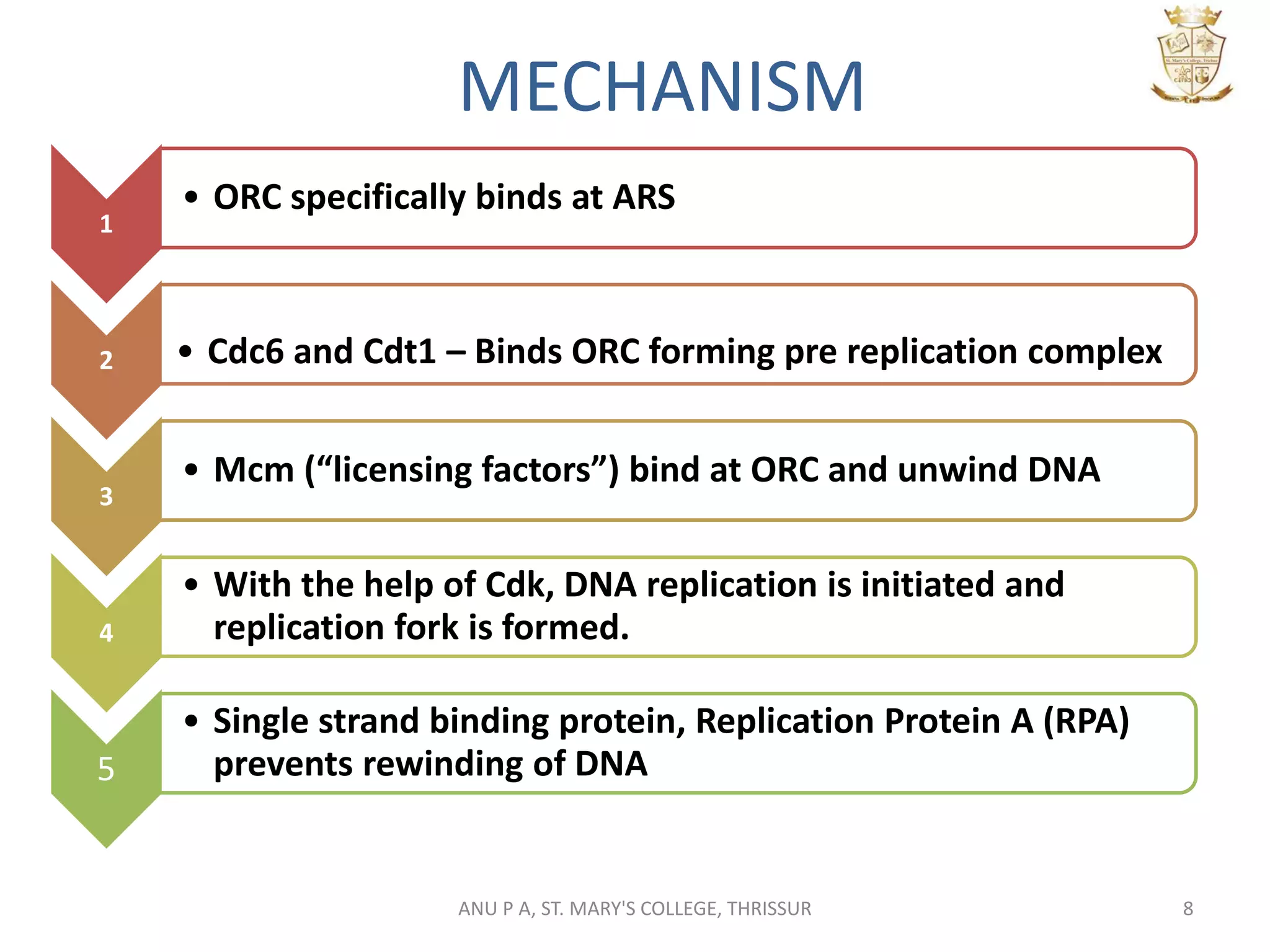
1
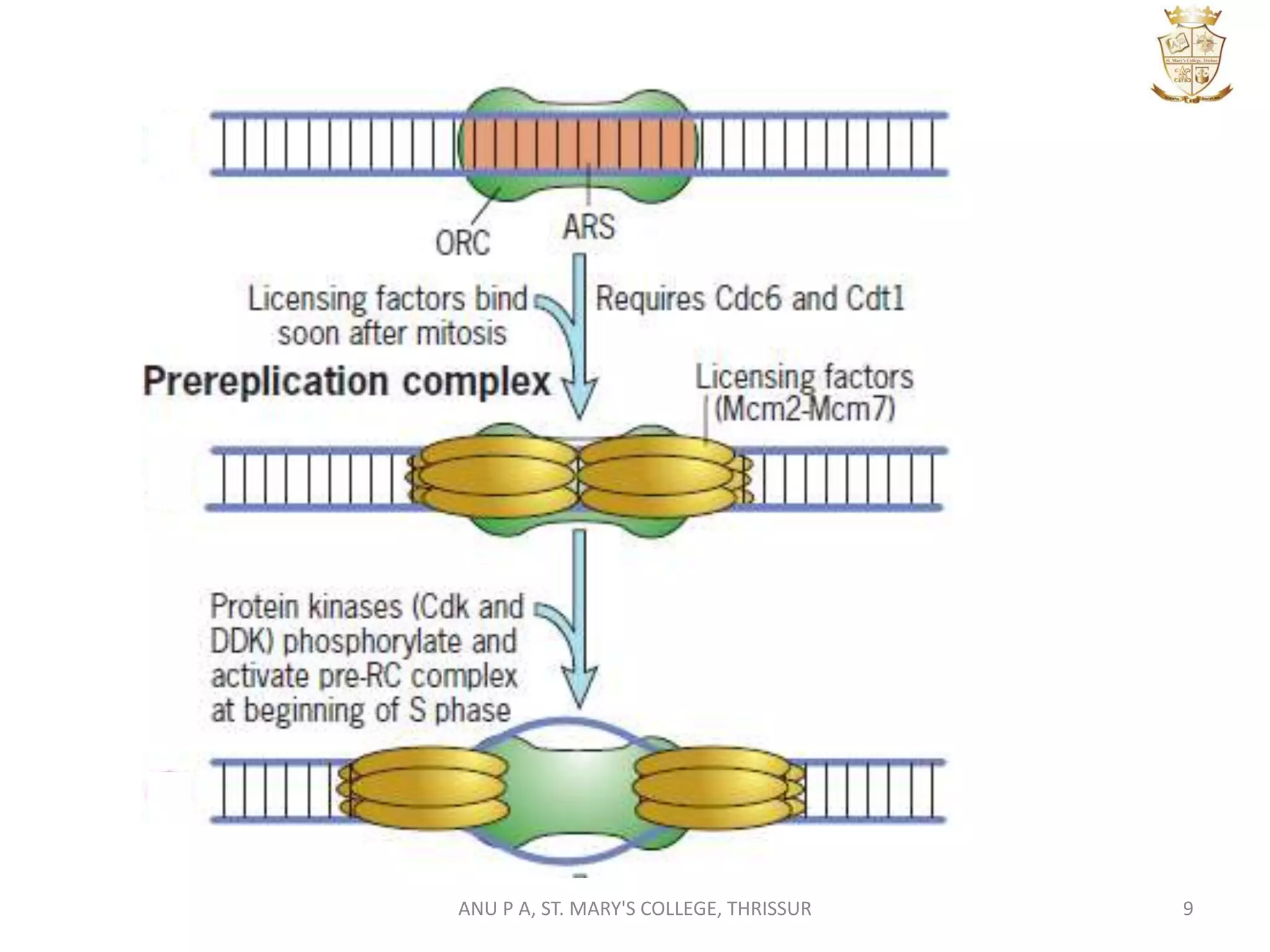
• ORC specifically binds at ARS
2 • Cdc6 and Cdt1 – Binds ORC forming pre replication complex
3
• Mcm (“licensing factors”) bind at ORC and unwind DNA
4
• With the help of Cdk, DNA replication is initiated and
replication fork is formed.
5
• Single strand binding protein, Replication Protein A (RPA)
prevents rewinding of DNA
8
MECHANISM
ANU P A, ST. MARY'S COLLEGE, THRISSUR
9ANU P A, ST. MARY'S COLLEGE, THRISSUR
ELONGATION
10ANU P A, ST. MARY'S COLLEGE, THRISSUR
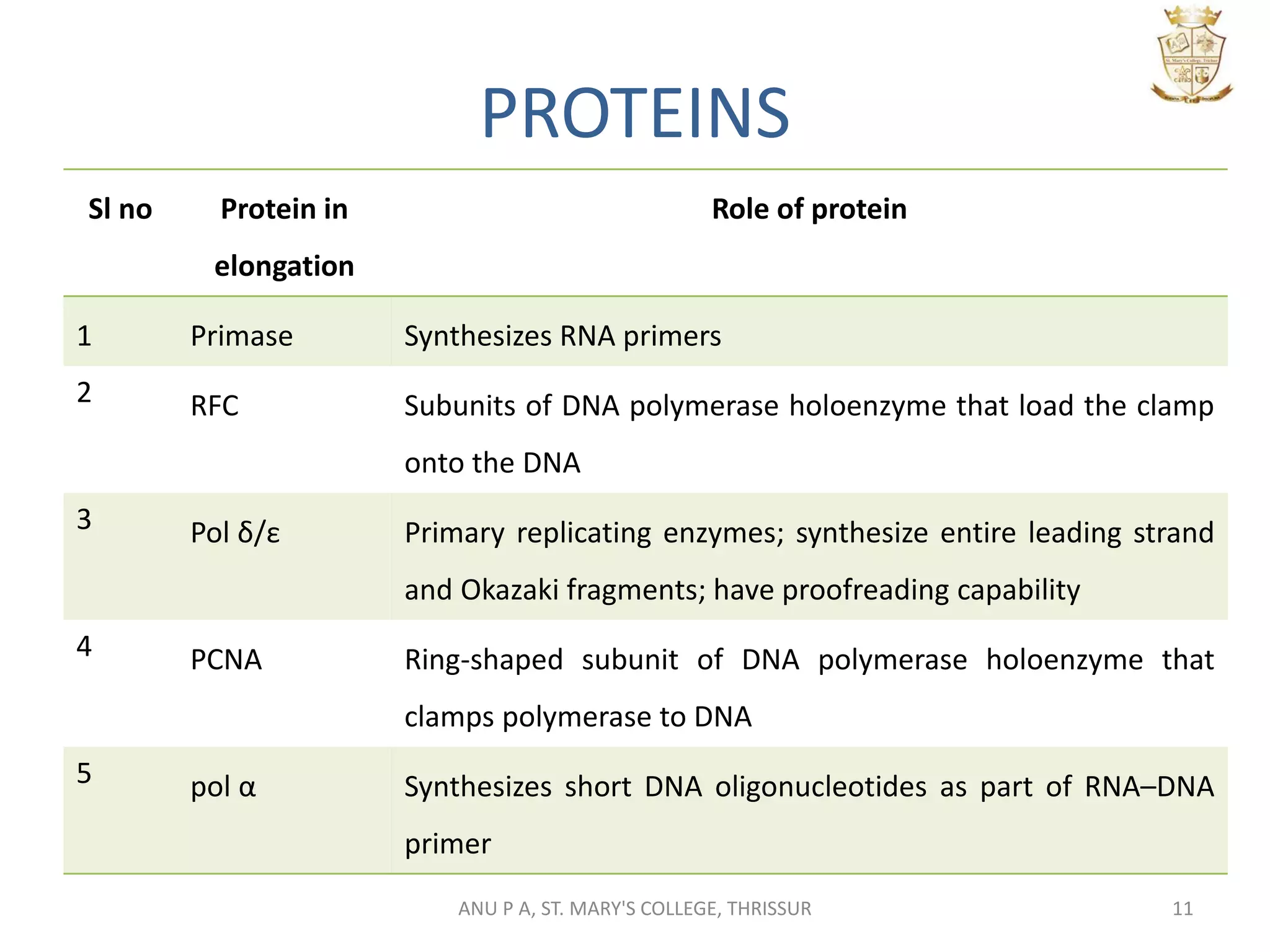
PROTEINS
Sl no Protein in
elongation
Role of protein
1 Primase Synthesizes RNA primers
2 RFC Subunits of DNA polymerase holoenzyme that load the clamp
onto the DNA
3 Pol δ/ε Primary replicating enzymes; synthesize entire leading strand
and Okazaki fragments; have proofreading capability
4 PCNA Ring-shaped subunit of DNA polymerase holoenzyme that
clamps polymerase to DNA
5 pol α Synthesizes short DNA oligonucleotides as part of RNA–DNA
primer
11ANU P A, ST. MARY'S COLLEGE, THRISSUR
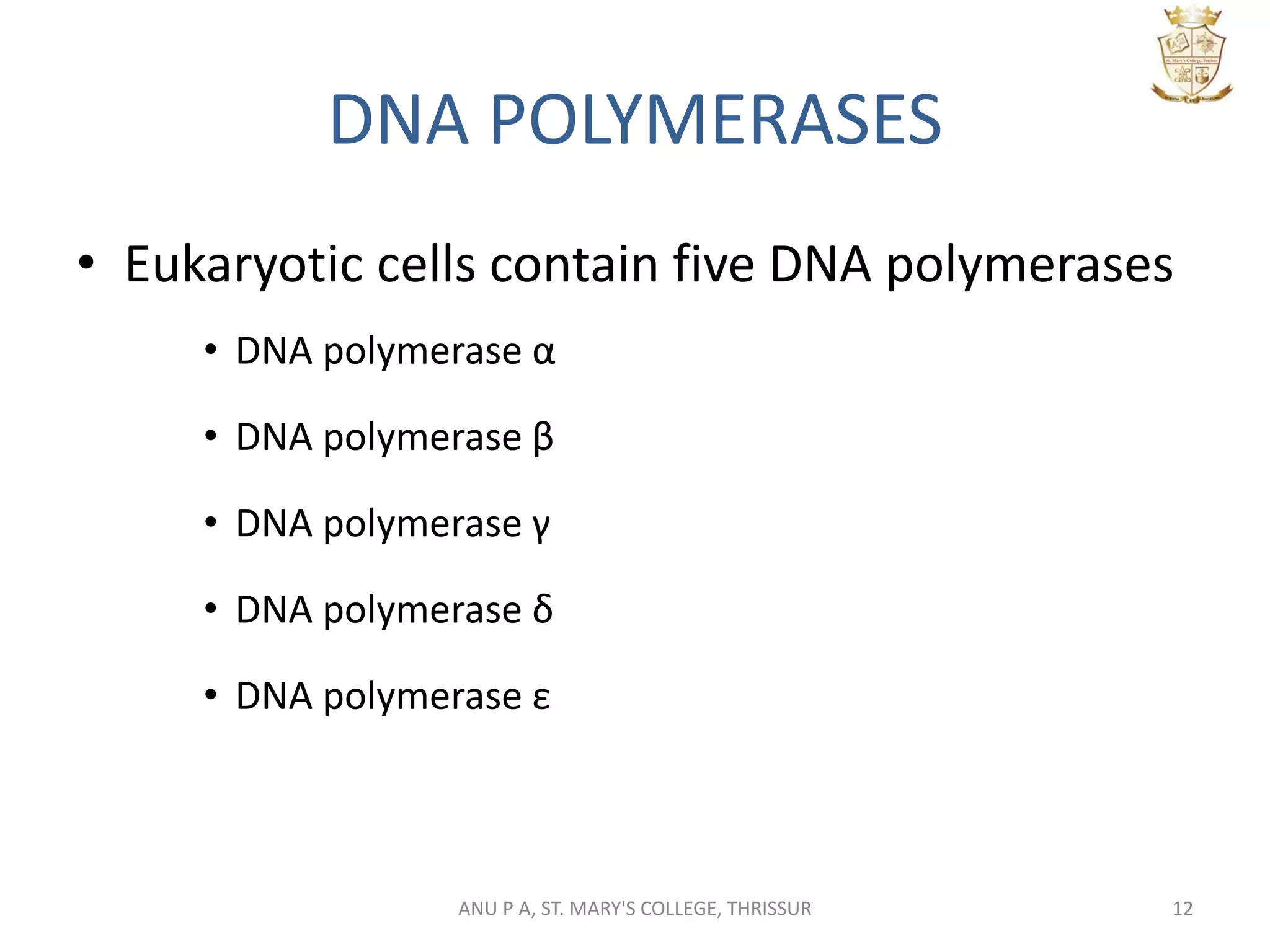
DNA POLYMERASES
• Eukaryotic cells contain five DNA polymerases
• DNA polymerase α
• DNA polymerase β
• DNA polymerase γ
• DNA polymerase δ
• DNA polymerase ε
12ANU P A, ST. MARY'S COLLEGE, THRISSUR
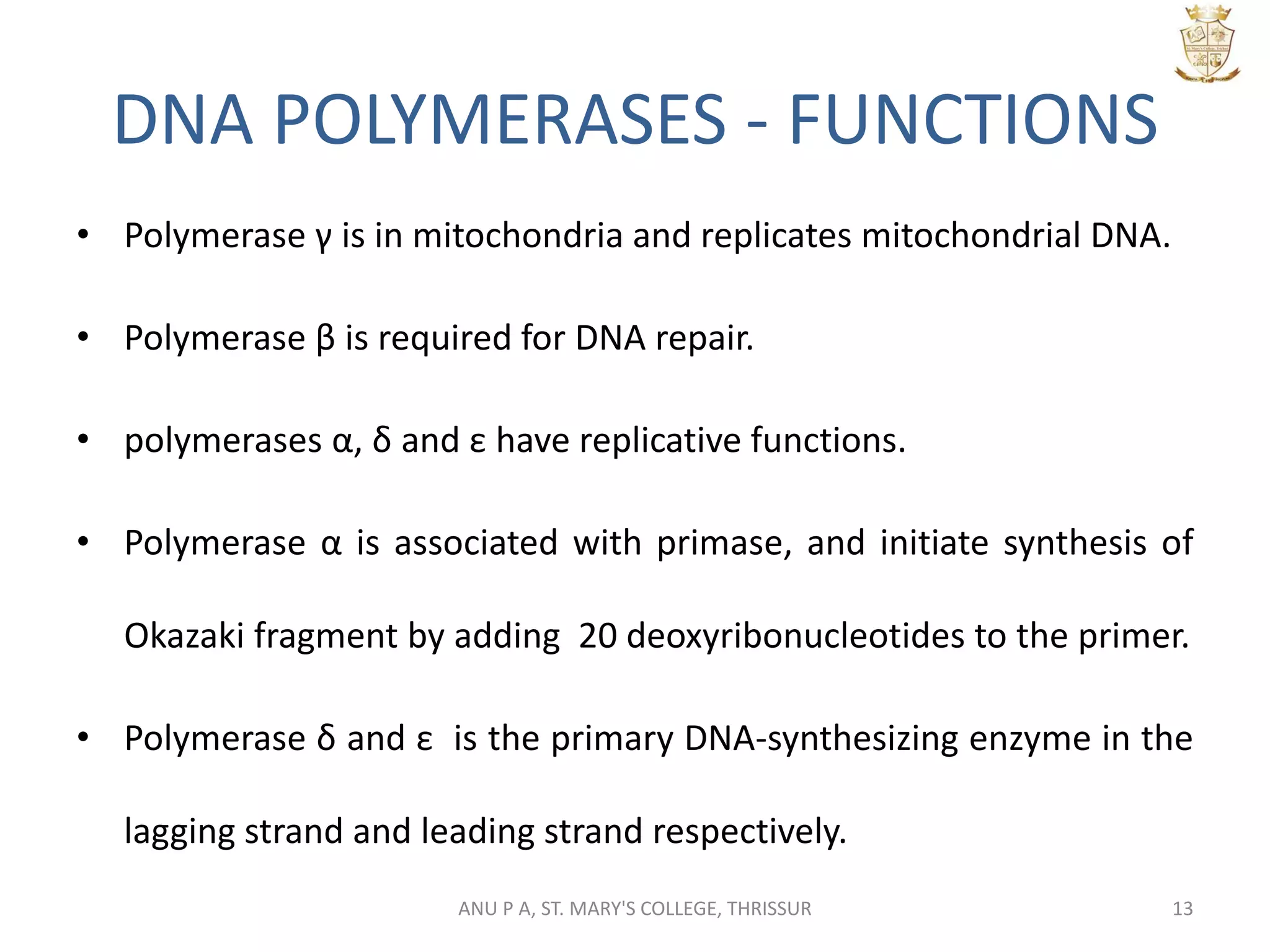
DNA POLYMERASES - FUNCTIONS
• Polymerase γ is in mitochondria and replicates mitochondrial DNA.
• Polymerase β is required for DNA repair.
• polymerases α, δ and ε have replicative functions.
• Polymerase α is associated with primase, and initiate synthesis of
Okazaki fragment by adding 20 deoxyribonucleotides to the primer.
• Polymerase δ and ε is the primary DNA-synthesizing enzyme in the
lagging strand and leading strand respectively.
13ANU P A, ST. MARY'S COLLEGE, THRISSUR
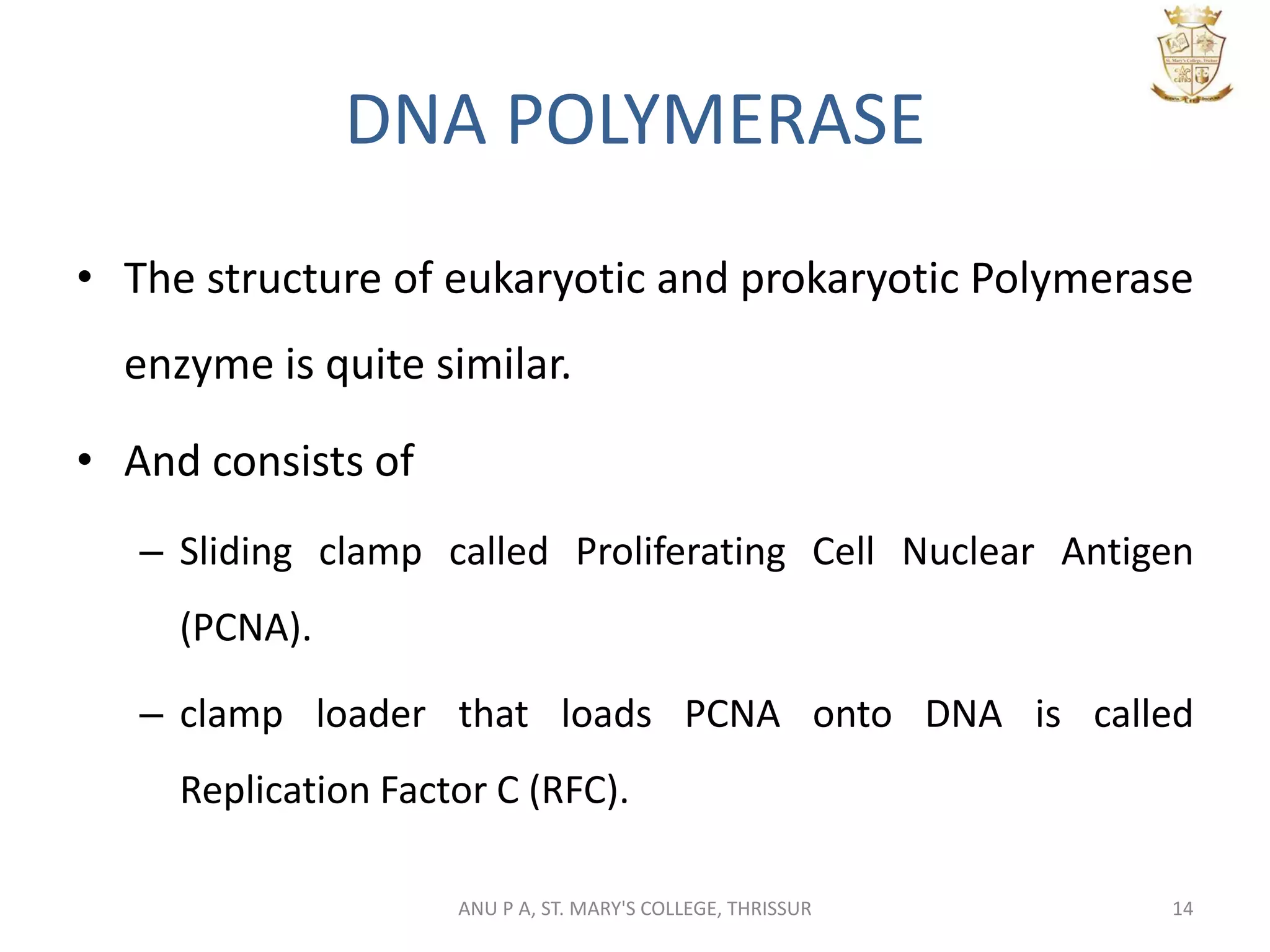
DNA POLYMERASE
• The structure of eukaryotic and prokaryotic Polymerase
enzyme is quite similar.
• And consists of
– Sliding clamp called Proliferating Cell Nuclear Antigen
(PCNA).
– clamp loader that loads PCNA onto DNA is called
Replication Factor C (RFC).
14ANU P A, ST. MARY'S COLLEGE, THRISSUR
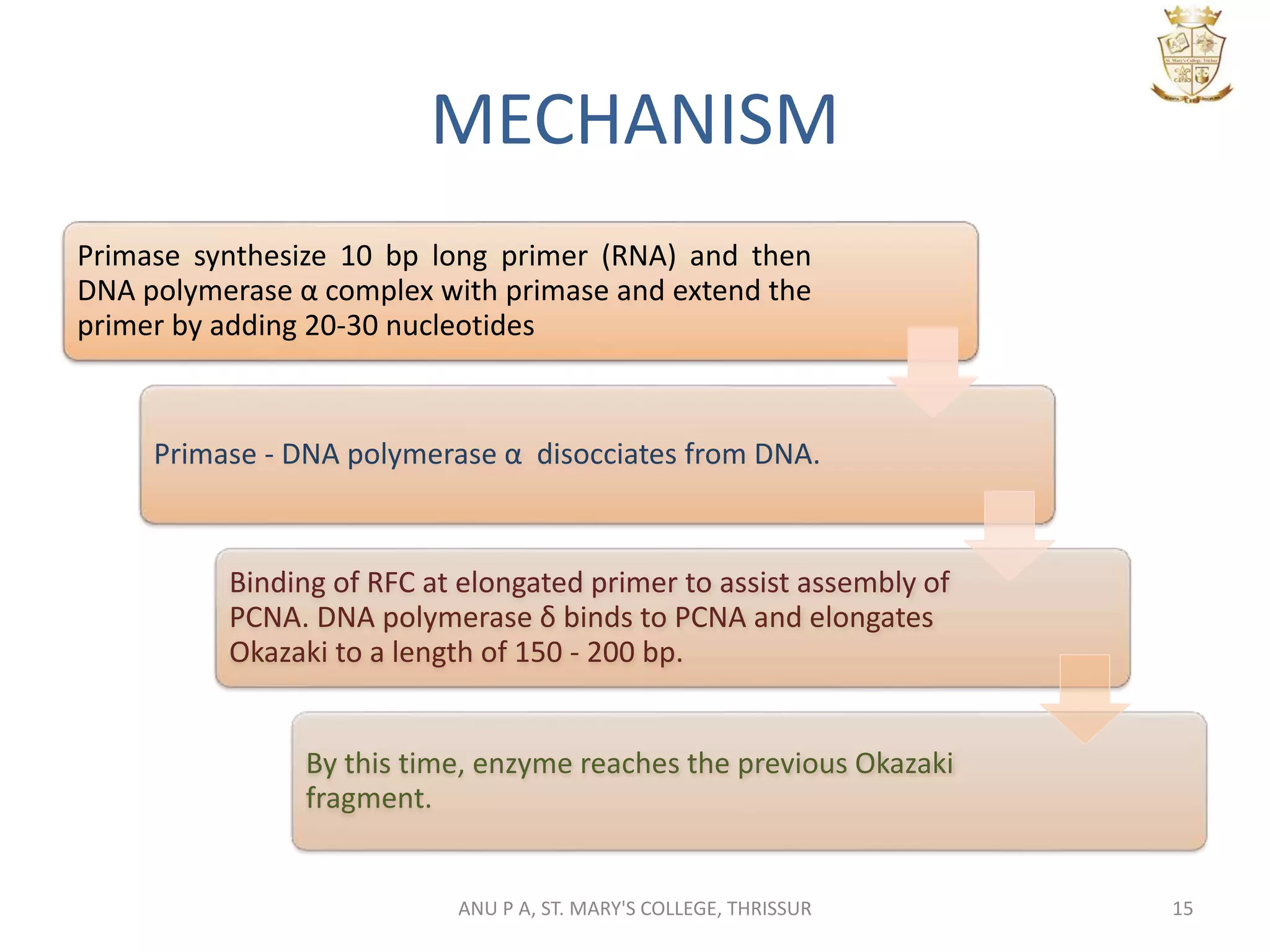
MECHANISM
Primase synthesize 10 bp long primer (RNA) and then
DNA polymerase α complex with primase and extend the
primer by adding 20-30 nucleotides
Primase - DNA polymerase α disocciates from DNA.
Binding of RFC at elongated primer to assist assembly of
PCNA. DNA polymerase δ binds to PCNA and elongates
Okazaki to a length of 150 - 200 bp.
By this time, enzyme reaches the previous Okazaki
fragment.
15ANU P A, ST. MARY'S COLLEGE, THRISSUR
POLYMERIZATION
• Eukaryotic polymerases elongate DNA strands in the 5'→3'
direction by the addition of nucleotides to a 3 hydroxyl group, and
none of them is able to initiate the synthesis of a DNA chain
without a primer.
• Eukaryotic DNA polymerase is present as a dimer, suggesting that
the leading and lagging strands are synthesized in a coordinate
manner by a single replicative complex, or replisome
16ANU P A, ST. MARY'S COLLEGE, THRISSUR
SEMI DISCONTINUOUS
• Leading strand in 5'→3 ‘ is continuous whereas lagging strand
in the opposite direction is dis-continuous
• Okazaki fragments are formed in the lagging strand.
• Okazaki fragments are smaller than in bacteria, averaging
about 150 nucleotides in length.
17ANU P A, ST. MARY'S COLLEGE, THRISSUR
TERMINATION
18ANU P A, ST. MARY'S COLLEGE, THRISSUR
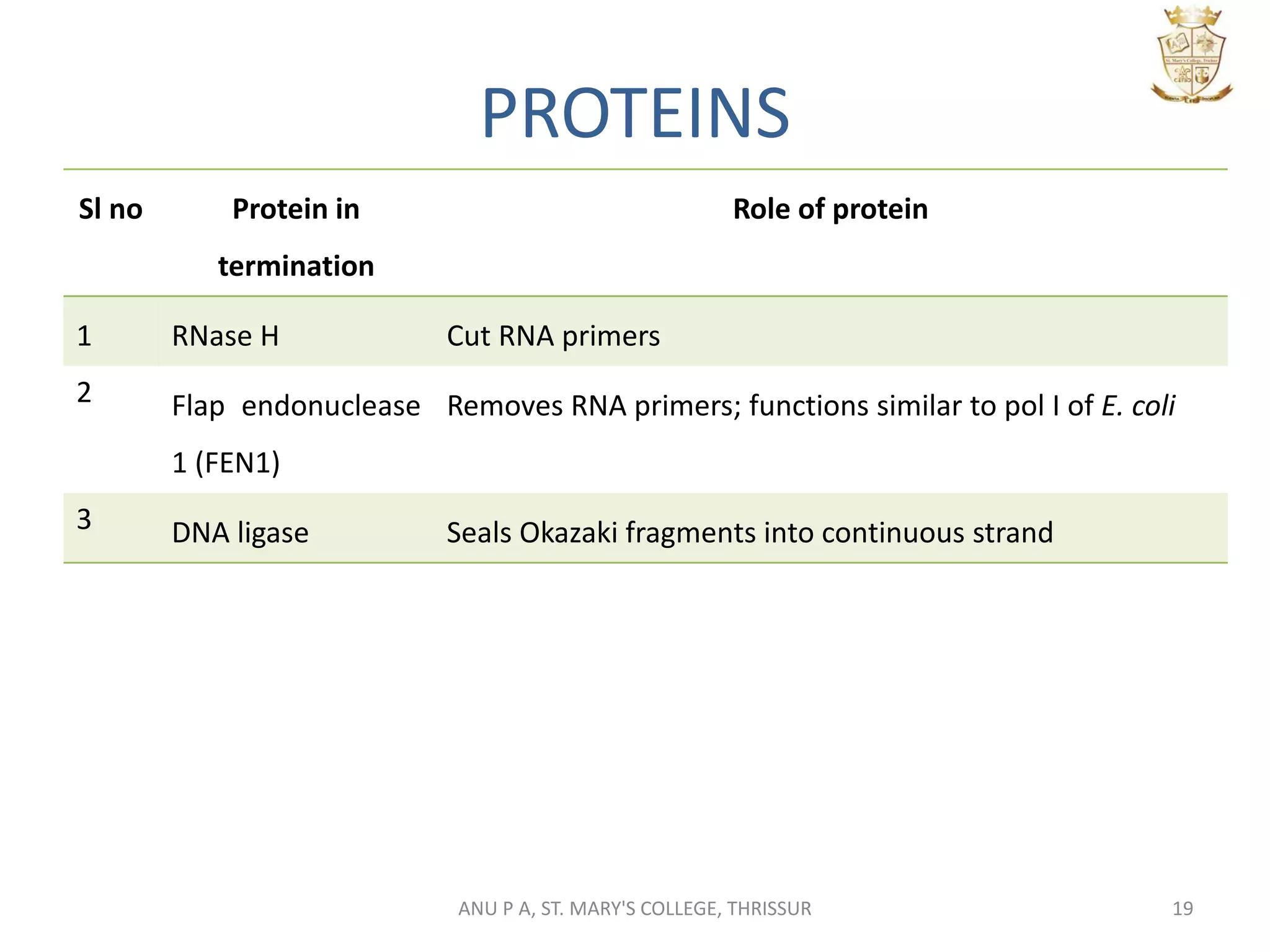
PROTEINS
Sl no Protein in
termination
Role of protein
1 RNase H Cut RNA primers
2 Flap endonuclease
1 (FEN1)
Removes RNA primers; functions similar to pol I of E. coli
3 DNA ligase Seals Okazaki fragments into continuous strand
19ANU P A, ST. MARY'S COLLEGE, THRISSUR
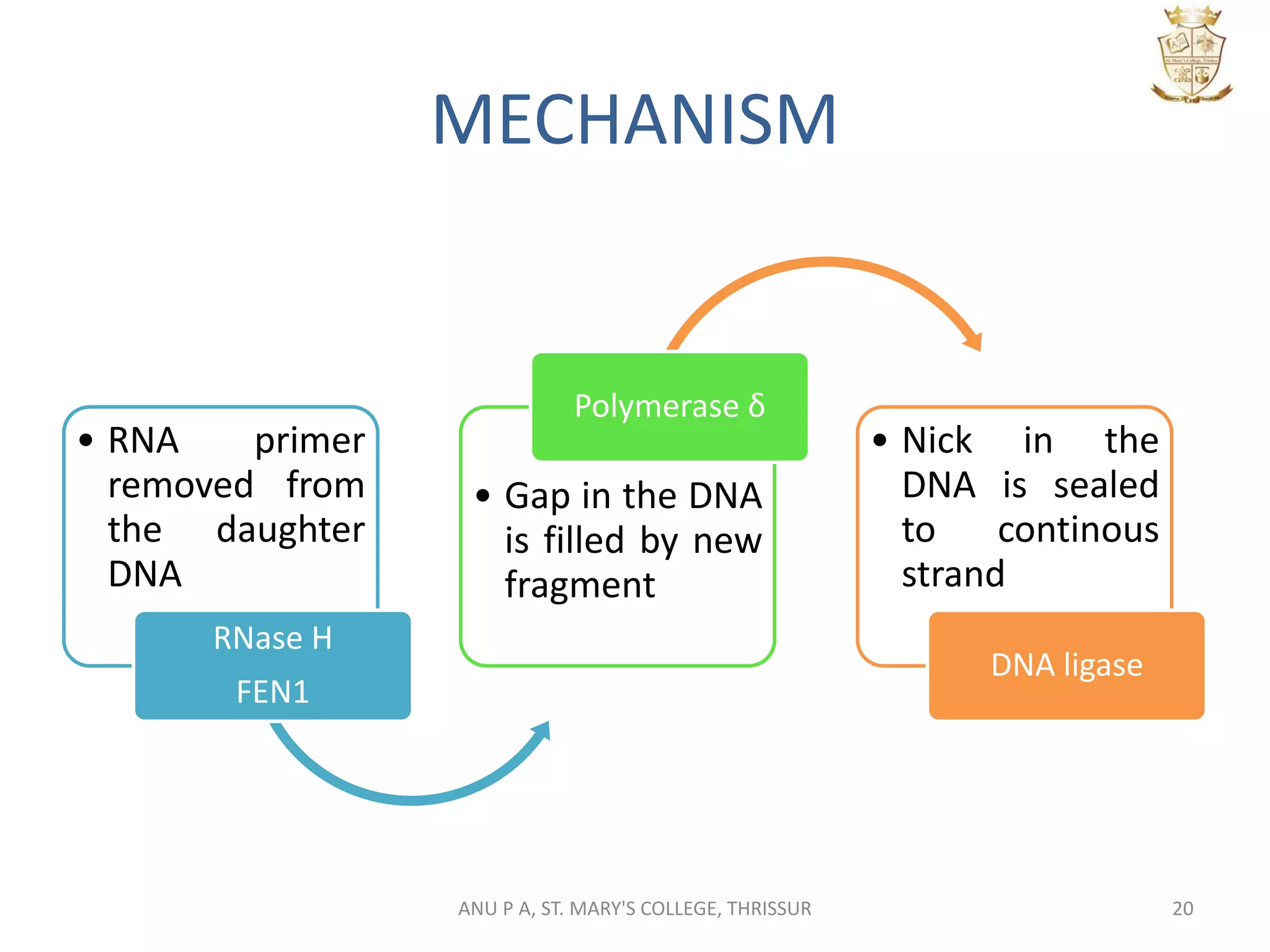
MECHANISM
• RNA primer
removed from
the daughter
DNA
RNase H
FEN1
• Gap in the DNA
is filled by new
fragment
Polymerase δ
• Nick in the
DNA is sealed
to continous
strand
DNA ligase
20ANU P A, ST. MARY'S COLLEGE, THRISSUR
REFERENCES
• Gerald Karp (2010). Cell and molecular biology:
concepts and experiments (6th ed.). John Wiley &
sons. ISBN-13 978-0-470-48337-4.
• https://bio.libretexts.org/Bookshelves/Genetics/
Book%3A_Working_with_Molecular_Genetics_(H
ardison)/Unit_II%3A_Replication%2C_Maintenan
ce_and_Alteration_of_the_Genetic_Material/6._
DNA_replication_II%3A_Start%2C_stop_and_con
trol/6.1%3A_The_Replicon
21ANU P A, ST. MARY'S COLLEGE, THRISSUR

Replication in eukaryotes

  • 1.
    DNA REPLICATION IN EUKARYOTES DR.ANU P. ABHIMANNUE ASSISTANT PROFESSOR, DEPARTMENT OF BIOTECHNOLOGY, ST.MARY’S COLLEGE, THRISSUR.
  • 2.
    REPLICATION • Replication isthe process by which DNA copies itself to produce identical daughter molecules of DNA. https://www.genome.gov/genetics-glossary/DNA-Replication 2ANU P A, ST. MARY'S COLLEGE, THRISSUR
  • 3.
    EUKARYOTIC REPLICATION • Eukaryoticgenome is relatively complex and their polymerases incorporate nucleotides at much slower rates. • To overcome this, replication in eukaryotes occur in small portions, termed replicons. • In a human cell, there are about 10,000 to 100,000 replicons. 3ANU P A, ST. MARY'S COLLEGE, THRISSUR
  • 4.
    REPLICONS IN EUKARYOTES •Replicon was defined by François Jacob; sydney Brenner and François Cuzin. • It is the unit in which the cell controls individual acts of replication. 4 https://www.biology-pages.info/D/DNAReplication.html ANU P A, ST. MARY'S COLLEGE, THRISSUR
  • 5.
    INITIATION 5ANU P A,ST. MARY'S COLLEGE, THRISSUR
  • 6.
    ENZYMES INVOLVED Sl no:Protein in initiation Role of protein 1 ORC Proteins (Multi protein complex) Recognition of origin of replication in eukaryotes 2 Cdc6, Cdt1 Assist loading of helicase enzyme onto the DNA 3 Mcm (Mcm 2 – Mcm 7) DNA helicase enzyme that unwinds the double stranded DNA into single strands. Also called “licensing factors” 4 Replication Protein A (RPA) Binds to the exposed single stranded DNA molecule and prevents its rewinding. 5 Topoisomerase I/II Relieves positive super coils located ahead of the replication fork. 6ANU P A, ST. MARY'S COLLEGE, THRISSUR
  • 7.
    AUTONOMOUS REPLICATING SEQUENCES • Specificsite on DNA that functions like origin of replication • Autonomous Replicating Sequences (ARS) consists of a conserved sequence of 11 base pairs. • A protein complex called Origin Recognition Complex (ORC) binds DNA at ARS in a specific manner 7ANU P A, ST. MARY'S COLLEGE, THRISSUR
  • 8.
    1 • ORC specificallybinds at ARS 2 • Cdc6 and Cdt1 – Binds ORC forming pre replication complex 3 • Mcm (“licensing factors”) bind at ORC and unwind DNA 4 • With the help of Cdk, DNA replication is initiated and replication fork is formed. 5 • Single strand binding protein, Replication Protein A (RPA) prevents rewinding of DNA 8 MECHANISM ANU P A, ST. MARY'S COLLEGE, THRISSUR
  • 9.
    9ANU P A,ST. MARY'S COLLEGE, THRISSUR
  • 10.
    ELONGATION 10ANU P A,ST. MARY'S COLLEGE, THRISSUR
  • 11.
    PROTEINS Sl no Proteinin elongation Role of protein 1 Primase Synthesizes RNA primers 2 RFC Subunits of DNA polymerase holoenzyme that load the clamp onto the DNA 3 Pol δ/ε Primary replicating enzymes; synthesize entire leading strand and Okazaki fragments; have proofreading capability 4 PCNA Ring-shaped subunit of DNA polymerase holoenzyme that clamps polymerase to DNA 5 pol α Synthesizes short DNA oligonucleotides as part of RNA–DNA primer 11ANU P A, ST. MARY'S COLLEGE, THRISSUR
  • 12.
    DNA POLYMERASES • Eukaryoticcells contain five DNA polymerases • DNA polymerase α • DNA polymerase β • DNA polymerase γ • DNA polymerase δ • DNA polymerase ε 12ANU P A, ST. MARY'S COLLEGE, THRISSUR
  • 13.
    DNA POLYMERASES -FUNCTIONS • Polymerase γ is in mitochondria and replicates mitochondrial DNA. • Polymerase β is required for DNA repair. • polymerases α, δ and ε have replicative functions. • Polymerase α is associated with primase, and initiate synthesis of Okazaki fragment by adding 20 deoxyribonucleotides to the primer. • Polymerase δ and ε is the primary DNA-synthesizing enzyme in the lagging strand and leading strand respectively. 13ANU P A, ST. MARY'S COLLEGE, THRISSUR
  • 14.
    DNA POLYMERASE • Thestructure of eukaryotic and prokaryotic Polymerase enzyme is quite similar. • And consists of – Sliding clamp called Proliferating Cell Nuclear Antigen (PCNA). – clamp loader that loads PCNA onto DNA is called Replication Factor C (RFC). 14ANU P A, ST. MARY'S COLLEGE, THRISSUR
  • 15.
    MECHANISM Primase synthesize 10bp long primer (RNA) and then DNA polymerase α complex with primase and extend the primer by adding 20-30 nucleotides Primase - DNA polymerase α disocciates from DNA. Binding of RFC at elongated primer to assist assembly of PCNA. DNA polymerase δ binds to PCNA and elongates Okazaki to a length of 150 - 200 bp. By this time, enzyme reaches the previous Okazaki fragment. 15ANU P A, ST. MARY'S COLLEGE, THRISSUR
  • 16.
    POLYMERIZATION • Eukaryotic polymeraseselongate DNA strands in the 5'→3' direction by the addition of nucleotides to a 3 hydroxyl group, and none of them is able to initiate the synthesis of a DNA chain without a primer. • Eukaryotic DNA polymerase is present as a dimer, suggesting that the leading and lagging strands are synthesized in a coordinate manner by a single replicative complex, or replisome 16ANU P A, ST. MARY'S COLLEGE, THRISSUR
  • 17.
    SEMI DISCONTINUOUS • Leadingstrand in 5'→3 ‘ is continuous whereas lagging strand in the opposite direction is dis-continuous • Okazaki fragments are formed in the lagging strand. • Okazaki fragments are smaller than in bacteria, averaging about 150 nucleotides in length. 17ANU P A, ST. MARY'S COLLEGE, THRISSUR
  • 18.
    TERMINATION 18ANU P A,ST. MARY'S COLLEGE, THRISSUR
  • 19.
    PROTEINS Sl no Proteinin termination Role of protein 1 RNase H Cut RNA primers 2 Flap endonuclease 1 (FEN1) Removes RNA primers; functions similar to pol I of E. coli 3 DNA ligase Seals Okazaki fragments into continuous strand 19ANU P A, ST. MARY'S COLLEGE, THRISSUR
  • 20.
    MECHANISM • RNA primer removedfrom the daughter DNA RNase H FEN1 • Gap in the DNA is filled by new fragment Polymerase δ • Nick in the DNA is sealed to continous strand DNA ligase 20ANU P A, ST. MARY'S COLLEGE, THRISSUR
  • 21.
    REFERENCES • Gerald Karp(2010). Cell and molecular biology: concepts and experiments (6th ed.). John Wiley & sons. ISBN-13 978-0-470-48337-4. • https://bio.libretexts.org/Bookshelves/Genetics/ Book%3A_Working_with_Molecular_Genetics_(H ardison)/Unit_II%3A_Replication%2C_Maintenan ce_and_Alteration_of_the_Genetic_Material/6._ DNA_replication_II%3A_Start%2C_stop_and_con trol/6.1%3A_The_Replicon 21ANU P A, ST. MARY'S COLLEGE, THRISSUR

Editor's Notes

  • #18 The most highly compacted, least acetylated regions of the chromosome are packaged into heterochromatin (page 485), and they are the last regions to be replicated.