DNA Replication
A general Account
A process of producing two identical copies from one original DNA
molecule
Three basic steps:
i) Initiation
ii) Elongation
iii) Termination
i)

Initiation:
During initiation, some enzymes like helicase, cut the
hydrogen bonds or produce the nick in the strands of DNA to make it
available for the enzymes to carry out further process of replication.
Single strand binding proteins restrict the rebinding of hydrogen
bonds. Enzymes & proteins reach to the nick; make the complex and
replication starts.
Real difference is present at the step of elongation.
ii) Elongation:
Polymerase proceeds on the DNA and formation or
elongation starts.
In Eukaryotes, the DNA is much larger so the replication
forms a linear structure often. But in some Prokaryotes, specially
in bacteria who possess the plasmid, a unique type of replication
occurs known as “Rolling circle Replication”.
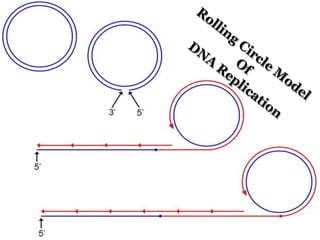
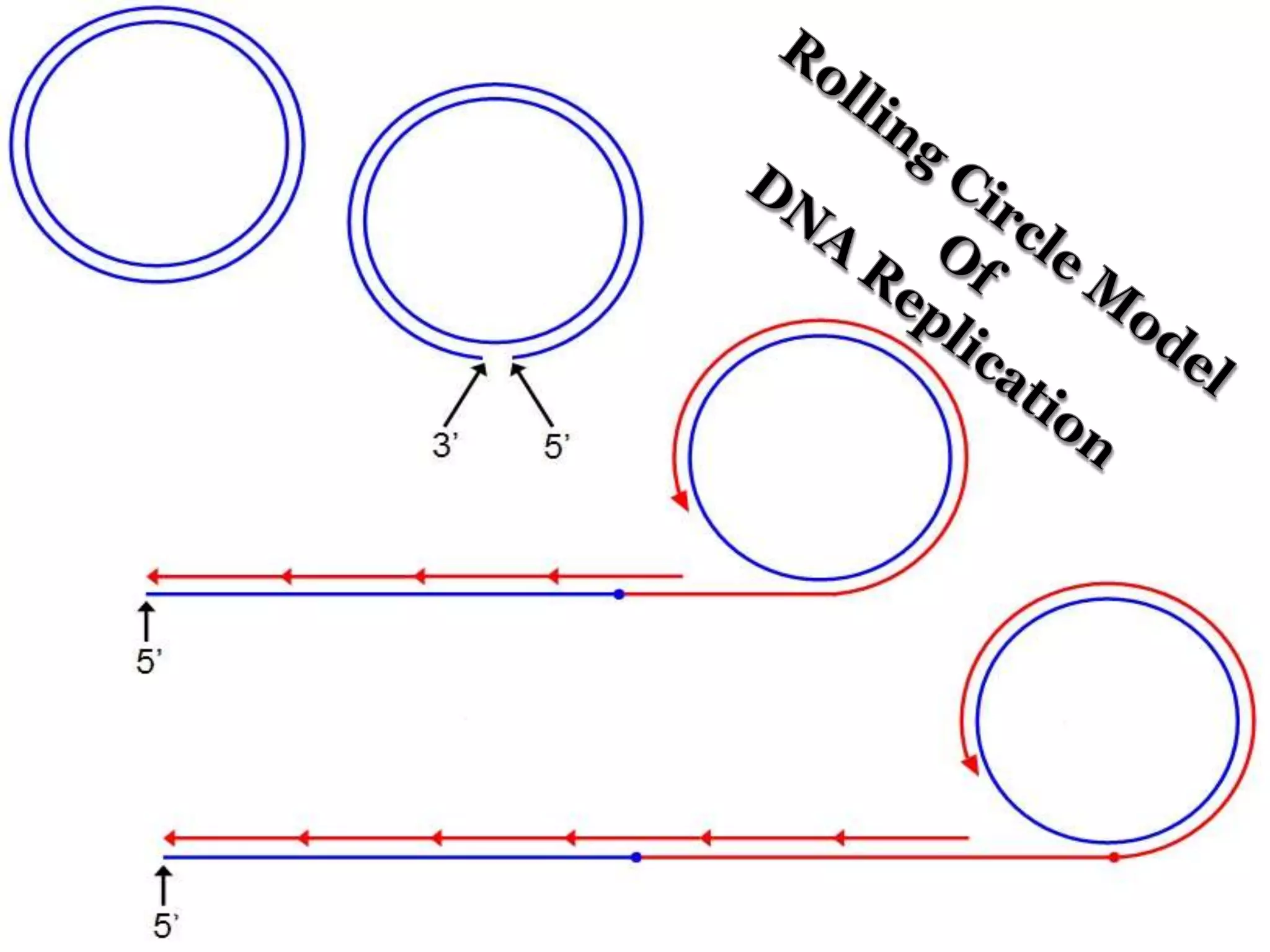
Rolling Circle Model of DNA
Replication
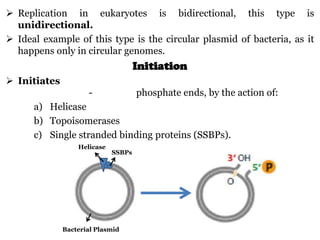
 Replication in eukaryotes is bidirectional, this type is
unidirectional.
 Ideal example of this type is the circular plasmid of bacteria, as it
happens only in circular genomes.

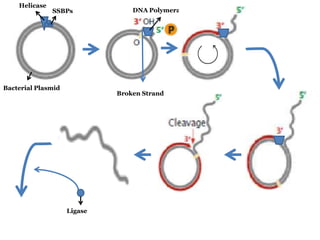
Initiation
 Initiates
-

phosphate ends, by the action of:

a) Helicase
b) Topoisomerases
c) Single stranded binding proteins (SSBPs).
Helicase

SSBPs

Bacterial Plasmid
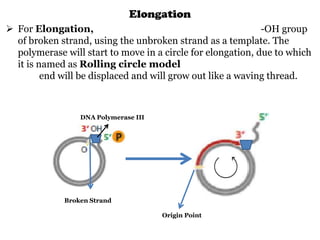
Elongation
 For Elongation,
-OH group
of broken strand, using the unbroken strand as a template. The
polymerase will start to move in a circle for elongation, due to which
it is named as Rolling circle model
end will be displaced and will grow out like a waving thread.

DNA Polymerase III

Broken Strand
Origin Point
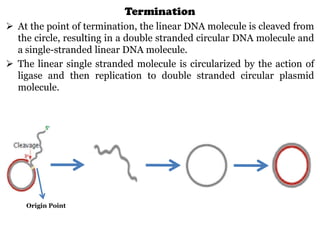
Termination
 At the point of termination, the linear DNA molecule is cleaved from
the circle, resulting in a double stranded circular DNA molecule and
a single-stranded linear DNA molecule.
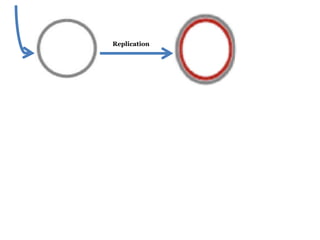
 The linear single stranded molecule is circularized by the action of
ligase and then replication to double stranded circular plasmid
molecule.

Origin Point
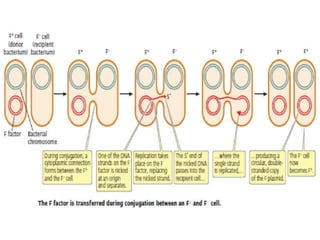
A brilliant Example of
Rolling Circle Model:
The conjugation between F+
and F- Bacteria
Schematic Diagram of Rolling
Circle Model of DNA
Replication
Helicase

SSBPs

Bacterial Plasmid

DNA Polymerase III

Broken Strand

Ligase
Replication
Questions
&
Answers
Thank you
for
listening

Rolling Circle Model of DNA Replication

  • 2.
  • 3.
    A process ofproducing two identical copies from one original DNA molecule Three basic steps: i) Initiation ii) Elongation iii) Termination i) Initiation: During initiation, some enzymes like helicase, cut the hydrogen bonds or produce the nick in the strands of DNA to make it available for the enzymes to carry out further process of replication. Single strand binding proteins restrict the rebinding of hydrogen bonds. Enzymes & proteins reach to the nick; make the complex and replication starts.
  • 4.
    Real difference ispresent at the step of elongation. ii) Elongation: Polymerase proceeds on the DNA and formation or elongation starts. In Eukaryotes, the DNA is much larger so the replication forms a linear structure often. But in some Prokaryotes, specially in bacteria who possess the plasmid, a unique type of replication occurs known as “Rolling circle Replication”.
  • 5.
    Rolling Circle Modelof DNA Replication
  • 6.
     Replication ineukaryotes is bidirectional, this type is unidirectional.  Ideal example of this type is the circular plasmid of bacteria, as it happens only in circular genomes. Initiation  Initiates - phosphate ends, by the action of: a) Helicase b) Topoisomerases c) Single stranded binding proteins (SSBPs). Helicase SSBPs Bacterial Plasmid
  • 7.
    Elongation  For Elongation, -OHgroup of broken strand, using the unbroken strand as a template. The polymerase will start to move in a circle for elongation, due to which it is named as Rolling circle model end will be displaced and will grow out like a waving thread. DNA Polymerase III Broken Strand Origin Point
  • 8.
    Termination  At thepoint of termination, the linear DNA molecule is cleaved from the circle, resulting in a double stranded circular DNA molecule and a single-stranded linear DNA molecule.  The linear single stranded molecule is circularized by the action of ligase and then replication to double stranded circular plasmid molecule. Origin Point
  • 9.
    A brilliant Exampleof Rolling Circle Model: The conjugation between F+ and F- Bacteria
  • 11.
    Schematic Diagram ofRolling Circle Model of DNA Replication
  • 12.
  • 13.
  • 14.
  • 15.