


AMOEBAE
M.PRASAD NAIDU
MSc, (Medical) Ph.D. (Medical)
• An amoeba (also ameba, amœba or amo
eboid) is a type of cell or organism which
has the ability to alter its shape, primarily
by extending and
retracting pseudopods. Amoebae do not
form a single taxonomic group, but are
found in every
major lineage of eukaryotic organisms
(domain Eukaryota).
• Amoeoboid cells occur not only
among the protozoa, but
also fungi, algae and animals.
• Among microbiologists, the terms
"amoeboid" and "amoebae" are
often used interchangeably for
any organism that
exhibits amoeboid movement.
• The best known amoeboid protists are the
"giant amoebae" Chaos
carolinense and Amoeba proteus, both of
which are widely cultivated and studied in
classrooms and laboratories. Other well
known species include the so-called "brain-
eating amoeba" Naegleria fowleri, the
intestinal parasiteEntamoeba histolytica,
which causes amoebic dysentery, and the
multicellular "social amoeba" Dictyostelium
discoideum.
Naegleria fowleri :
 Primary Amoebic Meningo
Encephalitis
(PAM)
 Fowler & Carter (1965 ).
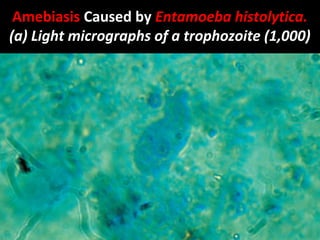
Amebiasis Caused by Entamoeba histolytica.
(a) Light micrographs of a trophozoite (1,000)
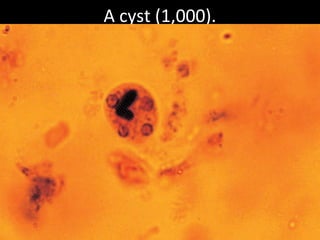
A cyst (1,000).
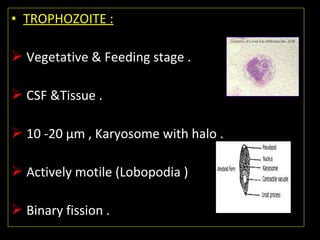
• TROPHOZOITE :
 Vegetative & Feeding stage .
 CSF &Tissue .
 10 -20 µm , Karyosome with halo .
 Actively motile (Lobopodia )
 Binary fission .
• Amoebae move and eat by using pseudopods,
which are bulges of cytoplasm formed by the
coordinated action
of actin microfilaments pushing out the plasma
membrane that surrounds the cell.
• Groups of amoebae are distinguished by the
appearance and internal structure of their
pseudopods.
• Amoebozoan species typically have bulbous
pseudopods, rounded at the ends and roughly
tubular in cross-section (lobose)
• Cercozoan amoeboids, such
as Euglypha and Gromia, have slender,
thread-like (filose)
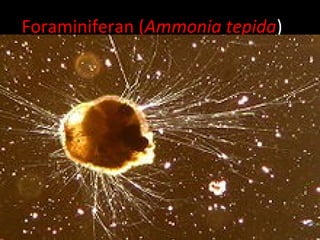
pseudopods. Foraminiferan emit fine,
branching pseudopods that merge with
one another to form net-like (reticulose)
structures. Some groups, such as
the Radiolaria and the amoeboids loosely
called Heliozoa, have stiff, needle-like,
radiating actinopods supported from
within by bundles of microtubules
SHAPE,
MOVEMENT
AND
NUTRITION
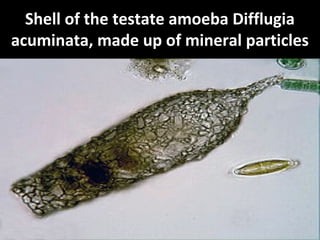
• Free-living amoebae may be "testate"
(enclosed within a hard shell), or "naked"
(lacking any hard covering). Testate amoebae
shells are composed various substances,
including calcium, silica, chitin, or
agglutinations of found materials like small
grains of sand and the frustules of diatoms.
• To regulate osmotic pressure, most
freshwater amoebae have a
contractile vacuole which expels excess water
from the cell.
•  This organelle is necessary because freshwater has 
a lower concentration of solutes (such as salt) than 
the amoeba's own internal fluids (cytosol). Because 
the surrounding water is hypotonic with respect to 
the contents of the cell, water is transferred across 
the amoeba's cell membrane by osmosis. Without a 
contractile vacuole, the cell would fill with excess 
water and, eventually, burst. Marine amoebae do 
not usually possess a contractile vacuole, because 
the concentration of solutes within the cell are in 
balance with the tonicity of the surrounding water.
• The food sources of amoebae vary. Some amoebae 
are predatory and live by consuming bacteria and 
• Some  are detritivores and  eat  dead  organic 
material. Amoebae typically ingest their food 
by phagocytosis,  extending  pseudopods  to 
encircle  and  engulf  live  prey  or  particles  of 
scavenged material. 
• Amoeboid  cells  do  not  have  a  mouth 
or cytostome, and there is no fixed place on 
the  cell  at  which  phagocytosis  normally 
occurs.  Some  amoebae  also  feed 
by pinocytosis,  imbibing  dissolved  nutrients 
through vesicles formed  within  the  cell 
membrane.
AMOEBAE IN
MULTICELLULAR
ORGANISMS: ANIMALS
AND SLIME MOLDS
• Amoebae in multicellular organisms: animals
and slime molds
• Some multicellular organisms have amoeboid 
cells  only  in  certain  phases  of  life,  or  use 
amoeboid  movements  for  specialized 
functions.
•  In the immune system of humans and other 
animals,  amoeboid white  blood  cells pursue 
invading  organisms,  such  as  bacteria  and 
pathogenic  protists,  and  engulf  them 
by phagocytosis.
• Amoeboid  stages  also  occur  in 
the multicellular fungus-like  protists, 
the so-called slime molds. 
• Both  the  plasmodial  slime  molds, 
currently  classified  in  the 
class Myxogastria,  and  the  cellular 
slime  molds  of  the 
groups Acrasida and Dictyosteliida, 
live as amoebae during their feeding 
stage. 
• The  cells  of  the  former  form  a 
giant multinucleate amoeboid 
organism,while  the  cells  of  the 
latter  live  separately  until  food 
runs  out,  at  which  time  the 
amoebae  aggregate  to  form  a 
multicellular  migrating  slug  which 
functions as a single organism
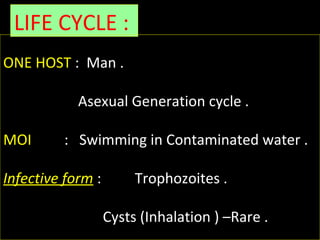
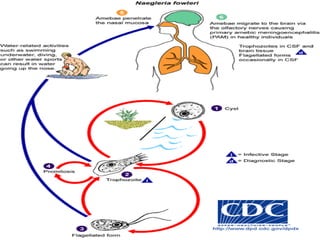
LIFE CYCLE : 
ONE HOST :  Man .
   Asexual Generation cycle .
MOI         :   Swimming in Contaminated water .
Infective form :  Trophozoites .
                      Cysts (Inhalation ) –Rare .
Entry : Nose           
Olfactory mucosa.

Olfactory bulbs
 
Sub Arachnoid space.
 
(Multiplication)
 
Choroid plexus
 
Ventricular destruction.
 
Ependymitis.
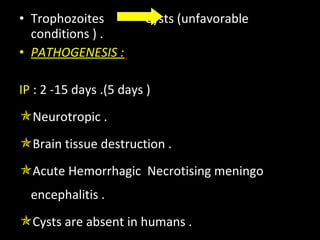
• Trophozoites             Cysts (unfavorable 
conditions ) .
• PATHOGENESIS :
IP : 2 -15 days .(5 days )
Neurotropic .
Brain tissue destruction .
Acute Hemorrhagic  Necrotising meningo 
encephalitis .
Cysts are absent in humans .
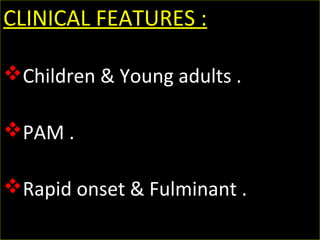
CLINICAL FEATURES : 
Children & Young adults .
PAM .
Rapid onset & Fulminant .
  Sudden severe  Persistent Bifrontal /Bitemporal   
     Headache ,Nausea , Projectile vomiting .
   Ageusia (loss of taste function).
   Parosmia (olfactory dysfunction).
   Generalized seizures  
   Photophobia
   Coma
   Death 
   Poor Prognosis .(95 % death )
DIAGNOSIS :
• Specimen : CSF (Antemortem )
Brain Biopsy (Post
mortem ).
CSF :
• Wet mount : Plenty of Actively motile
trophozoites .
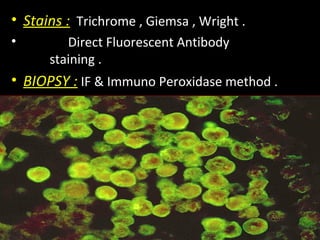
• Stains : Trichrome , Giemsa , Wright .
• Direct Fluorescent Antibody
staining .
• BIOPSY : IF & Immuno Peroxidase method .
• Serodiagnosis : Not Useful .
• Molecular methods : DNA probes & PCR .
• CSF : Features of Pyogenic
Meningitis .
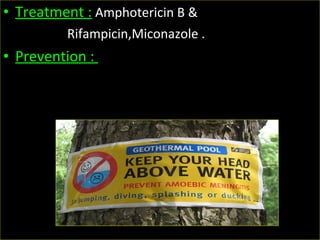
• Treatment : Amphotericin B &
Rifampicin,Miconazole .
• Prevention :
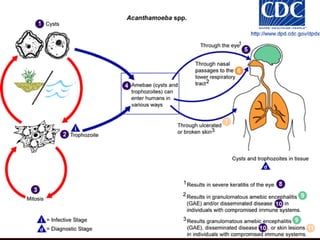
Acanthamoeba
• Opportunistic pathogens .
1. A.castellani .
2. A.astronyxis .
3. A.polyphaga .
4. A.culbertsoni .
• HABITAT : Dust , Soil , Sand , Rivers ,
Ponds , Tap water .
• MORPHOLOGY :
2 stages .
1. Trophozoite .
2. Cyst .
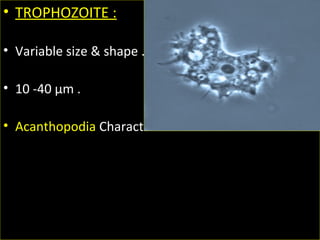
• TROPHOZOITE :
• Variable size & shape .
• 10 -40 µm .
• Acanthopodia Characteristic feature .
• CYST :
Polygonal /Spherical /Star shaped .
15 -20 µm.
Double layered cyst wall .
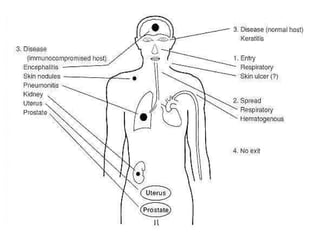
• LIFE CYCLE :
• MOI : Invasion of Broken skin .
• Inhalation of Cysts & Trophozoites .
• ROUTE : Lungs to Blood stream
(Multiplication )
• CNS .
• Sites of Localisation :Basal ganglia ,
• Posterior fossa , Cerebellum .
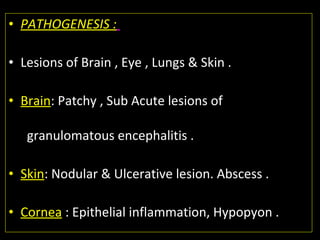
• PATHOGENESIS :
• Lesions of Brain , Eye , Lungs & Skin .
• Brain: Patchy , Sub Acute lesions of
granulomatous encephalitis .
• Skin: Nodular & Ulcerative lesion. Abscess .
• Cornea : Epithelial inflammation, Hypopyon .
• CLINICAL MANIFESTATIONS :
 Granulomatous Amoebic Encephalitis (GAM)
 Acanthamoeba Keratitis .
 Cutaneous Lesions .
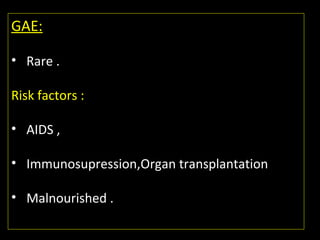
GAE:
• Rare .
Risk factors :
• AIDS ,
• Immunosupression,Organ transplantation
• Malnourished .
• Clinical features :
 Low grade fever,stiff neck ,
 Altered Mental status .
 Seizures ,
 Cranial palsies ,
 Hemiparesis , Ataxia ,
 Photophobia
 Coma ,
 Multi organ Failure ,
 Death .
• Acanthamoeba Keratitis :
Contact lens wearers .(trauma )
Chronic , Progressive , Ulceration .
Annular Infiltration & Congested Cornea .
Perforation .
Blindness .
• CUTANEOUS LESIONS :
• Face & Extremities .
• Nodules , papules & ulcers .
• Poor Prognosis .
• GAE Fatal .
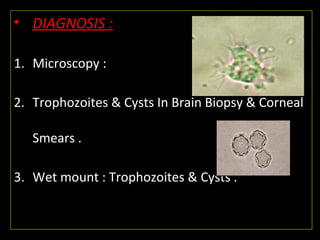
• DIAGNOSIS :
1. Microscopy :
2. Trophozoites & Cysts In Brain Biopsy & Corneal
Smears .
3. Wet mount : Trophozoites & Cysts .
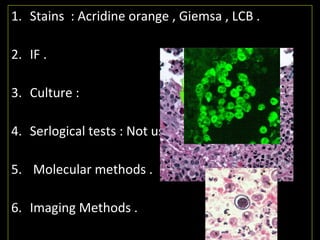
1. Stains : Acridine orange , Giemsa , LCB .
2. IF .
3. Culture :
4. Serlogical tests : Not useful .
5. Molecular methods .
6. Imaging Methods .
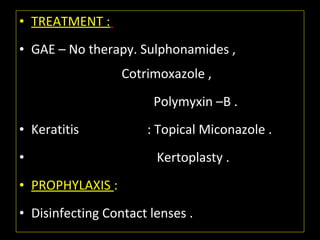
• TREATMENT :
• GAE – No therapy. Sulphonamides ,
Cotrimoxazole ,
Polymyxin –B .
• Keratitis : Topical Miconazole .
• Kertoplasty .
• PROPHYLAXIS :
• Disinfecting Contact lenses .
Foraminiferan (Ammonia tepida)
Shell of the testate amoeba Difflugia
acuminata, made up of mineral particles
THANK
YOU

Free amoebae