Unit 1
Introduction to Gerontology
and Geriatric Nursing
Nabina Paneru
Definitions
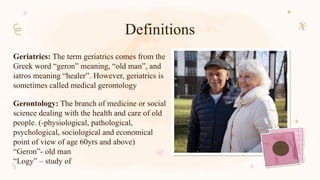
Definitions
Geriatrics: The term geriatrics comes from the
Greek word “geron” meaning, “old man”, and
iatros meaning “healer”. However, geriatrics is
sometimes called medical gerontology
Gerontology: The branch of medicine or social
science dealing with the health and care of old
people. (-physiological, pathological,
psychological, sociological and economical
point of view of age 60yrs and above)
“Geron”- old man
“Logy” – study of
Contd.
Specialty that concerns itself with
the provision of nursing services
to geriatric or aged individuals.
Concerned with assessment of the health
and fundamental status of older adults;
diagnosis, planning, and implementing
health care and services to meet the
identified needs and evaluating such
care
Geriatric
Nursing
Gerontological
Nursing
Gerontic Nursing Geriatric medicine
- Seldom used
- Considers nursing care of
older adults to be the art
and practice of nurturing
caring, and comforting
rather than merely the
treatment of disease
- Sub specialty of internal
medicine and family medicine
that focuses on health care of
elderly people
- Promotes health by preventing
and treating diseases and
disabilities in older adults
Contd.
Gerontologists Aging
Specialists who study the
biological, psychological,
and social aspects of aging
to improve the quality of
life for older adults.
Natural process of becoming
older, characterized by
gradual physiological
changes
Contd.
Ageism Age
Ageism refers to the stereotypes
(how we think), prejudice
(how we feel) and
discrimination (how we act)
towards others or oneself
based on age.
- Biological age
- Social age
- Primary age
- Secondary age
- Psychological age
- Cognitive age
- Functional age
Contd.
Contd.
Mental and physical decline
associated with aging
process
Used rarely to denote
physical and emotional
deterioration
60 and above
Senescence
Senility
Senior citizen
Pace of population ageing is much faster than in past
Contd.
By 2050, proportion of over 60 years will double from 12% to 22%
Data (According to WHO)
In 2020, the number of people aged 60 years and older outnumbered children younger than
5 years
Life expectancy
- Refers to the number of years a person can expect to live.
Contd.
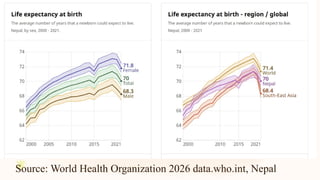
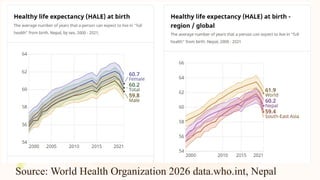
Source: World Health Organization 2026 data.who.int, Nepal
Historical Perspective on
Gerontology, Geriatrics and
Elderly
Global history
- Emerged and developed in different countries based on their
culture, environment and development in technology,
education and knowledge
- Hippocrates noted conditions common in later life
- Aristotle offers a theory of aging based on loss of heart
- In Islamic world – physician wrote on issues related to
Gerontology.
Contd.
- Arabic physician Ibn A-Jazzar wrote on medicine and health
of the elderly (covers sleep disorders, forgetfulness, how to
strengthen memory and causes of mortality.)
- Early pioneers such as Michel Eugene Chevreul (lived up to
102yrs), believed aging should be a science to be studied
Contd.
- Industrial revolution – ideas shifted in favor of a societal
care system.
- In 19th
century – care homes emerged
- Term ‘Geriatrics’ invented by Ignatz Leo Nascher and his
initiative provided a stimulus for social and biological
research on aging. (Father of geriatrics)
Contd.
- During 1936, Dr. Marjory Warren (Mother of geriatrics)
reviewed several old workhouse wards and upgraded and
matched care to their need through system of
classification.
- Advocated creating a medical specialty of geriatrics,
providing special geriatrics units, and care provided by
those who have specialization in geriatrics
Contd.
- Geriatric nursing begins from the time of Florence
Nightingale. At that time care to elderly people were
served by family members
Significant changes
- 1902: First geriatric article published by medical doctor
in American Journal of Nursing (AJN)
- 1904: AJN published first geriatric article by RN
- 1925: AJN considered geriatric nursing as potential
speciality and created column “care of the aged”
- 1935: Social Security Act was designed to increase the
independence of aged – formulation of nursing homes.
Contd.
- 1940s: Organized gerontology into its own field
- 1945: Gerontological society was formed in US
- 1950: First geriatric nursing textbook, first masters thesis done
on geriatric nursing. Geriatric became specialized in nursing
- 1952: first geriatric nursing study published in Nursing
Research
Contd.
- 1960 – 1985: Birth of modern gerontological nursing
(From book)
National History
- In Nepal, concept emerged when nursing started
- Topic related to elderly used to study as older adult in
adult nursing (Medical Surgical Nursing).
- Later “Geriatric Nursing” was used and included in
curriculum of CTEVT, TU, PU and other universities.
- Included as a separate subject in PCL, BN, BSC
Contd.
- Bir hospital, Mahabouddha – first geriatric OPD started
- Government is planning to start a geriatric hospital
Demographics of Aged Population
The number of people aged 60 and older worldwide is
projected to increase from 1.1 in 2023 to 1.4 billion by
2030. This trend is particularly evident and rapid in
developing regions.
Contd.
The UN Decade of Healthy Ageing (2021 – 2030) defines
the following four action areas:
combatting ageism – changing how we think, feel, and act
towards age and ageing;
age-friendly environments – ensuring that communities
foster the abilities of older people;
Contd.
integrated care – delivering person-centered integrated care
and primary health services responsive to older people;
and
long-term care – providing access to long-term care for
older people who need it.
Contd.
According to Nepal Demographic Profile, 2020, Life
expectancy at birth is 71.8 years, where male’s 71.1
years, female’s 72.6 years.
The percentage of age group 55 – 64 years is 6.64% (male
954,836/ female 1,059,360) and age group 65 years and
over is 5.69% (male 852, 969/ female 874,092). Elderly
dependency ratio is 8.9
Aging Process
Aging Process
- Aging: Not a disease but developmental process
- Change from internal process (although undesired) –
normal and sometimes called pure aging.
- Process: Expected and generally unavoidable, which is
normal
Contd.
- For e.g.: Presbyopia occurs as people age because the lens
of the eye thickens, stiffens and becomes less able to
focus on close objects, such as reading materials. This
occurs in all older people and is considered normal aging
Contd.
- Changes with normal aging make people more likely to
develop certain disorders.
- However, people can sometimes take actions to compensate
for these changes.
- E.g.: with proper dental care, visiting dentist regularly, eating
fewer sweets, brushing and flossing regularly may reduce the
chances of tooth loss.
Contd.
- Functional decline which is part of aging sometimes seems
similar to functional decline that is part of a disorder.
- E.g.; With advanced age: mild decline in memory – normal
(difficulty learning new languages, ↓ attention span, ↑
forgetfulness). In contrast, the decline that occurs in
dementia is much more severe. SO dementia is considered
disorder, even though it is common in late life.
Contd.
- Changes related to normal aging can be anticipated &
adapted so that the older person can live happy, healthy
and active life.
Characteristics of Aging
(Physiological and Psychological
Changes of Aging)
Concept of healthy aging
- Reduction in the undesired effects of aging
- Goals:
 Maintaining physical and mental health
 Avoiding disorders
 Remaining active and independent
Contd.
- Every person should have opportunity to live a long and
healthy life but our surrounding environment favor health
or can be harmful
- Environment  influence behavior, exposure to health
risks, access to quality health and social care
Contd.
- Healthy aging: creating the environments and
opportunities that enable people to be and do what they
value throughout their lives.
- WHO defines healthy aging as “the process of
developing and maintaining the functional ability that
enables wellbeing in older age.”
Contd.
- Healthy aging includes a person’s ability to:
 Meet their basic needs
 Learn, grow and make decisions
 Be mobile
 Build and maintain relationships
 Contribute to society
Contd.
- Functional ability consists of the intrinsic capacity (all
mental and physical capacities) of the individual, relevant
environmental characteristics and the interaction between
them.
- Level of Intrinsic capacity is influenced by several
factors such as the presence of diseases, injuries and age
related changes.
Contd.
- Key considerations for Healthy aging
 Diversity: Some 80 year olds have levels of physical and
mental capacity that compare favorably with 30 year
olds. Other of the same age may require extensive care
and support for basic activities. Policy should be framed
to improve the functional ability of all older people,
whether they are robust, care dependent or in between.
Contd.
 Inequity: A large proportion of the diversity in capacity
and circumstance observed in older age is the result of
the cumulative impact of advantage and disadvantage
across people’s lives.
Needs of elderly people for the
promotion and maintenance of health
1. Nutritional Need
Nutrition is the sum total of the processes involved in the
taking in and the utilization of food substances by which
growth, repair and maintenance of the body are
accomplished.
It involves ingestion, digestion, absorption and assimilation.
Contd.
Different factors affect nutritional intake in elderly such as:
 Age related changes: which affects absorption
 Psychosocial factors: lead to lack of interest in eating
and/or cooking
 Economic factors: affects food preparation and storage
 Cultural factors: eating habits
 Other: Anorexia caused by side effects of medicines,
substance use
Contd.
Ways of improving nutrition
 Health challenge assessment
 Appealing food preparation (appearance plus flavors)
 Declined ability to detect thirst. So give at least eight
glasses of water in a day.
 Establish healthy eating schedule; use of visual and
verbal reminders
Contd.
 Limit saturated, fats and cholesterol. High fiber diet with
plenty of vegetables, fruits and grain products. Moderate:
sugar and salt.
 Switch between varieties of foods.
 Careful use of supplements to accommodate need. (may
sometimes cause toxicity)
Contd.
 Encourage to visit dentist regularly (for ill fit dentures,
jaw pain, sores, missing teeth etc.)
 Monitor effects of medicines (change in taste, reduce
appetite) and notify doctor immediately.
 Maintain healthy food storage
 Provide adequate time to eat
 Help to maintain healthy weight
2. Physical Activities and Exercise
- Plays major role in maintaining good health, enhances
sleep, improve digestion, reduce constipation, lower
cholesterol level and blood pressure, maintain weight and
lower the risk of cardiovascular diseases.
- Aging  sedentary or less active life due to
physiological changes  predisposes to different health
issues
Contd.
- Sensory stimulation involved in activities can promote
elderly’s physical health and enhance their cognitive
function, social skills and emotional control.
- Also helps to enhance their self – worthiness.
Contd.
Choice of activity in older adults
Cognitive
activity
• Playing chess
• Computer game
• Reality orientation
activities
• Reading newspaper
etc.
Physical
activity
• Fitness class
• Jogging
• Walking etc.
Social
activity
• Tea time
gathering
• Group game
• Visit group
• Picnic etc.
Contd.
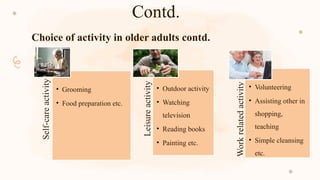
Choice of activity in older adults contd.
Self-care
activity
• Grooming
• Food preparation etc.
Leisure
activity
• Outdoor activity
• Watching
television
• Reading books
• Painting etc.
Work
related
activity
• Volunteering
• Assisting other in
shopping,
teaching
• Simple cleansing
etc.
Contd.
Benefits of activity and exercise
Contd.
Ways to improve activity and exercise in older adults
 Plan activities that do not cause fatigue. Consider physical,
cognitive, social, emotional state of elderly including interest
and preference
 Choose safe area
 Encourage to continue performing activities such as
swimming, walking, jogging, stretching, ROM exercises,
physical therapies
Contd.
 Have frequent rest periods
 Let the older adults wear comfortable cloths and shoes
 Avoid outdoor activities in extremes temperatures
 Activities should not last for long time as most of the
older adults may have problem with concentration
Contd.
WHO recommends:
 At least 150 minutes of moderate intensity aerobic
physical activity throughout the week or do at least 75
minutes of vigorous intensity aerobic physical activity
throughout the week or an equivalent combination of
moderate and vigorous intensity activity
Contd.
 Aerobic activity should be performed in limited period of
time of at least 10 minutes’ duration
 For additional benefits: increase moderate intensity
aerobic physical activity to 300 minutes per week or
engage in 150 minutes of vigorous intensity aerobic
physical activity per week, or combination
Contd.
 Older adults with poor mobility should perform physical
activity to enhance balance and prevent falls on 3 or more
days per week
 Muscle strengthening activities, involving major muscle
groups, should be done on 2 or more days a week
 If medically compromised, they should be physically active
Contd.
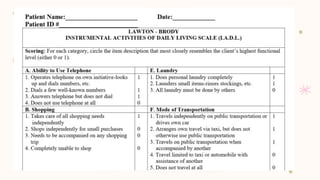
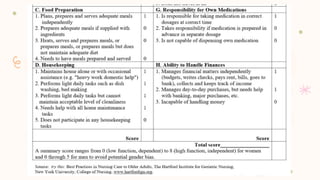
ADLS (Activities of Daily Living)
• Basic Activities of Daily Living: Eating and drinking,
Bathing, Dressing, Toileting, Continence, Walking and
transferring
• Instrumental Activities of Daily Living: Preparing meals
and clean up, Maintaining the home, Shopping, Using the
telephone, Managing medications, Managing finances
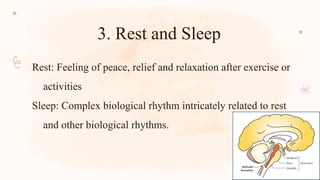
3. Rest and Sleep
Rest: Feeling of peace, relief and relaxation after exercise or
activities
Sleep: Complex biological rhythm intricately related to rest
and other biological rhythms.
Contd.
Rest and sleep is important for conserving energy, providing
organ rest, restoring the mental alertness and neurological
efficiency.
Older adults: take longer time to fall asleep, frequent
awakening  day time napping  poor day time
functioning.
Contd.
Factors causing sleep problems in elderly
 Environment, Dietary habits,
 Chronic/ Co-morbid illness
 Pain
 Medication
 Lack of exercise, Retirement, Day time napping
 Psychological problems such as stress, anxiety
Contd.
Ways of improving sleep
o Create calm and quiet environment
o Make the bed room not too hot or too cold
o Use comfortable beddings
o Keep the bedroom dark
o Manage pain and other symptoms of chronic/co-morbid
illness.
Contd.
o Encourage for regular exercise and activities
o Limit day time napping to 30min
o Avoid heavy meals, spicy food, and tobacco at bed time
o Avoid caffeine containing drinks such as cola, coffee, tea
o Avoid alcohol intake
o Keep the bedroom free from television
Contd.
o Set bed time rituals
o Suggest to eat three to four hours before bed time, limit
fluid intake after 7pm
o Encourage for active retirement life
o Provide counseling as needed to relive psychological
problems such as anxiety
4. Safety and Security
- Major concern as old age people are more susceptible to
accidents and injuries due to age related physiological
changes
- Falls, burns, poisoning and automobile accidents
- Constant vigilance is needed to safeguard the elderly,
both at home and in patient care facilities
Contd.
Safety measures for elderly
 Stay healthy (Regular exercise, diet etc.)
 Correct deficits: Using assistive devices properly
 Well lightening (bedside light, availability of nighlight)
 Manage floors (even, non skid, well anchored rugs, non
slip mats etc.)
Contd.
 Manage proper foot wears
 Modify habits (getting up slowly after sitting or lying
down and making balance before walking)
 Store and use medications safely
 Manage furniture:
- Limit furniture in room
Contd.
- Keep bed attached to the wall
- Adjust height of bed
- Have firm chair, with arms, to sit and dress
- Check the internal door locks, use locks that can be open
from both sides
- Replace door knobs with handles that need only to be
pushed up and down, rather than turned
Contd.
 Follow kitchen safety
- Avoid wearing long sleeves or loose clothing while
cooking
- Keep fire extinguisher next to the stove
- Eliminate need for stepping stools
- Clean up any spills immediately
Contd.
- Repair damaged floor tiles
- Make sure electrical cords plugged into sockets are far
from sinks
- Mark “on” and “off” positions on appliances clearly and
with bright colors
- Store sharp knives in a rack
Contd.
 Promote bathroom safety
- Install a raised toilet seat if needed
- Hand – held shower is preferable for elderly
- Make sure hot or cold is clearly marked
- Install grab bars and handrails (throughout the home if
possible)
Contd.
 Care of electricity
- Check the condition of electrical appliances, cords and
plugs regularly
- Avoid any non – insulated wiring
- Do not place cords under carpeting and across walkways
- Keep all electrical appliances unplugged unless they are
in use to prevent electric shock
5. Regular/Periodical Health Checkup
Importance of periodical medical check up
Helps to;
• assess their level of well being
• identify the health risk factors in elderly
• detect the diseases at an earlier stage and hence decrease
the risk of complication
• reinforce positive promoting and protecting behaviors
Contd.
1. Routine annual physical examination
2. Regular dental assessments
3. Opthalmologic assessment (Macular degeneration,
glaucoma, cataract etc.)
4. Screening for cardiovascular diseases
Contd.
5. Screening for cancer
a. Skin cancer
b. Breast cancer (BSE, clinical breast examination and
mammography every one to two years for women above
40yrs)
Contd.
c. Uterine and cervical cancer (Annual examination with
pap smear test every three years. If a women is above 65
with three negative pap test in a row, then after it is not
necessary)
d. Colorectal cancer (Annual stool test for occult blood,
sigmoidoscopy every 5 years after age 50, Colonoscopy
every 10 years after age 50)
Contd.
e. Prostate disease and cancer (Yearly rectal examination
and blood test for prostate specific antigen in men over
age 50)
f. Testes cancer (monthly testes self examination)
g. Screening for lung disease (medically compromised
should do annual check up for tb, chest x rays)
Contd.
6. Screening for thyroid problems (once every 5 years, esp
for women)
7. Screening for osteoporosis (annual bone density test for
women over age of 60)
8. Immunization (as recommended such as influence
vaccine, pneumococcal vaccine etc.)
6. Psychosocial Needs
- Sense of self worth, confident and sense of productivity
- Adequate support system
7. Religious/Spiritual Need
Religious activities: directly or indirectly related to religion
and which reflect the cultural practices, beliefs, tradition,
customs, norms, rituals, values and are transferred from
generation to generation.
Contd.
Religious activities performed by elderly people
- Bathing early in the morning
- Going to temple, worshipping god, praying and
meditation, Pilgrimage
- Celebrating festivals
- Fasting
- Reciting holy books
- Teaching rituals to new generation
Contd.
Importance of religious activities:
 Provides source of religious activity
 Enables older people to deal with painful and
unexpected life events and to be more productive and
adaptive in threatening conditions
 May provide meaning and identity to the older people
Contd.
 Also necessary for emotional, physical and mental
wellbeing, satisfaction with life, happiness, sense of
energy.
 Observing different feast and festivals and particular type
of food included contributes to increase nutritional
requirement for e.g. quanti in Janai Purnima and ghee
chaku in maghe sankranti
Contd.
Nursing Intervention
֍Nurse should know that being older does not mean that
they are being religious, so a nurse should not enforce an
older people to do religious activity without knowing
him.
֍Nurse should know the types of religious activities,
patient follows
Contd.
֍Whenever possible, interested patient should be enable to
attain religious activities according to individual
preference by providing transportation to religious group
or gathering or alternative methods of religious
fulfillment
֍Nurse can enhance aged person’s self esteem by showing
recognition of contribution he/she had done to others
Contd.
֍If elderly follow religious belief and laws that are no
longer adherence to current majority member of religion,
person must be respected and no attempt must be made to
change them.
֍Be alert to subtle cues which indicates desire to talk
about spiritual matter, need for expression of love and
hope and desire for silence, acceptance of behavior when
patient label self as bad.
8. Stress Management
Stress is simply a reaction to events or stimuli that makes us
feel threatened and disturbs our physical and mental
equilibrium
Stress is a state produced by a chance in the environment
that is perceived as challenging, threatening or damaged
to person’s dynamic equilibrium.
Contd.
Stress (According to Hans Selye): "non-specific response
of the body to any demand for change".
Causes of stress in elderly
• Physiological changes
• Changes in roles and responsibilities towards family and
society
Contd.
• Chronic diseases
• Physical dependence in others
• Retirement from job and low income
• Death of spouse or loved one
• Long term drug therapy
• Generation gap between family members
• Feeling of isolation, neglect/separation from family,
loneliness, etc.
Management of stress
Stress management works on two levels
- The first is about maintaining a harmonious lifestyle so
that stress does not get out of control. This involves
having outlets that allow you to release the stress.
- The second strategy involves learning how to get relax
yourself or change mood if stress is having a negative
impact on life.
Contd.
Measures of stress management in elderly
 Stay active
 Stay involved in the community
 Establish a new purpose of life (Leisure activities- to
focus mind and body on)
 The cure of stress is effectively about changing the state
of our body: the body responds in a certain way if it
believes that it is experiencing stress
Contd.
 Relaxation techniques
- Progressive relaxation
- Relaxation with guided imagery
- Meditation
- Yoga
- Others (Humor and laughter, Listening to music, Writing,
Engaging in art activities, Dance and sports.)
5 min to yourself!!
Contd.
 Nutrition
 Sleep and rest
 Support system
Contd.
Role of nurses in management of stress in hospital
setting
 Help the client identify his personal strengths. Focus on
positive, ignore negatives
 Provide an atmosphere of trust and warmth
 Listen to the client attentively
Contd.
 Inform the family about the prognosis of disease and
treatment
 Tell them the truth as mush as possible; do not give false
reassurance
 Encourage them to face the crisis
 Encourage client participation in his/her own care of plan
Contd.
 Encourage to do stress management activities
 Consider the client cultural, socio economic and ethnic
values
 Encourage them to take part in religious activities
 Advise them to plan for retirement planning; involving in
social services, renovation of home, pilgrimages etc.
Contd.
 Encourage them to take part in social interaction to
maintain self – esteem
 Demonstrate patience and loving care while teaching and
performing other activities. Show loving and caring
behavior to the elderly.
 Teach the client the health promoting behaviors that
enhances the coping mechanism.
Developmental tasks of elderly
people
The following developmental task are to be achieved by the
aging couple as a family as well as by the aging person
alone
According to Havinghurst
 Adjusting to decreasing physical strength and health
 Adjusting to retirement and reduce income
Contd.
 Adjusting to death of spouse
 Establish an explicit affiliation with one’s age group
 Meeting social and civic obligation
 Establishing satisfactory physical living arrangement
 The individual will be left with feelings of bitterness and
despair. Those who feel proud of their accomplishments
will feel a sense of integrity
Developmental Crisis of Older Adulthood: Ego Integrity vs
Despair (According to Erik Ericson)
Theories of Aging
A. Biological (Stochastic and Non Stochastic) Theory
B. Sociological Theory
C. Psychological Theory
D. Developmental Theory
E. Environmental Theory
Biological Theories of aging
It can be:
i. Stochastic theories: Based on random
events that cause cellular damage that
accumulates as the organism ages
ii. Non stochastic theories: Based on
genetically programmed events that
cause cellular damage that accelerates
aging of the organism.
It describes the structural and
functional state of the cells,
tissues and organ system of the
body. That determines the
changes, longevity and death.
Biological Theories:
1. Free radical theory
2. Connective tissue theory/ cross- linkage theory
3. Orgel’s error theory
4. Wear and tear theory
5. Biologic clock
6. Auto-toxication theory
7. Physiological theory
a. Neuroendocrine control or pacemaker theory
b. Immunological/ Autoimmune theory
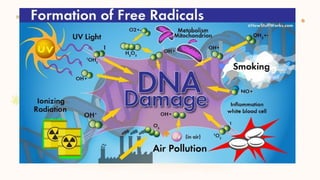
1. Free Radicals Theory
• Accumulated oxygen radicals (by product of normal metabolism produced when
cells turn food and oxygen into energy) cells stop functioning  organ stop
functioning
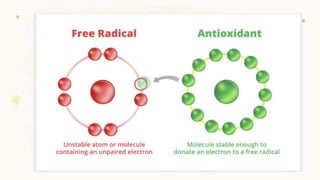
• Free radical takes an electron from another molecule, which becomes unstable
• Superoxide and other free radicals damage molecular components of the cell
(nucleic acid, lipids, sugars, proteins, membranes, DNA, organelles)
• Accelerators of free radicals (diet, tobacco, alcohol, radiation, pesticides etc)
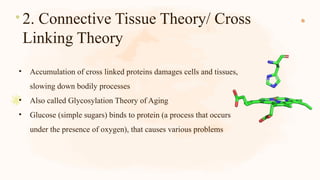
2. Connective Tissue Theory/ Cross
Linking Theory
• Accumulation of cross linked proteins damages cells and tissues,
slowing down bodily processes
• Also called Glycosylation Theory of Aging
• Glucose (simple sugars) binds to protein (a process that occurs
under the presence of oxygen), that causes various problems
Contd.
• Protein becomes impaired and unable to function
• Tissues toughens  Stiffening of connective tissue,
hardened arteries, loss of nerve functions, less efficient
kidneys
• Similar cross links alter the structure and shape of the
enzyme molecules and becomes unable to function
properly in the cell
Contd.
• So living a longer life is going to lead to the increased
possibility of oxygen meeting glucose and protein
• Known cross linking disorders include senile cataract,
wrinkled skin, the appearance of tough and yellow skin
which leads to appear age related changes.
3. Orgel’s Error Theory
This theory states errors in protein translation that reduce
the accuracy of the protein-translating enzymes
(ribosomes) would lead to a feedback loop of
increasingly inaccurate and dysfunctional protein
synthesis (in corporation of wrong amino acids)
terminating in the death of the organism.
Contd.
Accuracy is reduced due to:
- Mutations
- Certain antibiotics (e.g. aminoglycosides)
- Cellular stress or chemical agents
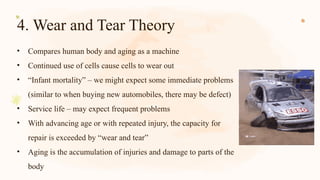
4. Wear and Tear Theory
• Compares human body and aging as a machine
• Continued use of cells cause cells to wear out
• “Infant mortality” – we might expect some immediate problems
(similar to when buying new automobiles, there may be defect)
• Service life – may expect frequent problems
• With advancing age or with repeated injury, the capacity for
repair is exceeded by “wear and tear”
• Aging is the accumulation of injuries and damage to parts of the
body
Contd.
• In addition to mechanical wear, accumulation of
oxidation and other chemical (molecular damage) are
included in the “wear and tear” concept.
• Use, accidents, disease, radiation, toxins and other
detrimental factors adversely affect different parts of the
body.
Contd.
• Years of damage to cells, tissues and organs eventually
wear them out, killing them and, the body like a machine,
loses its function.
• Aging is the result of sequential switching on and
off of certain genes.
• T lymphocytes or B lymphocytes have the
receptors for self-antigens by which they undergo
programmed cell death or apoptosis, thus reducing
number.
5. Gene/ Biological Clock Theory
Contd.
• Genetically pre determined program in which after a set
of number of reproduction (human fibroblast have the
capacity to double about 50 times), the cell gets old and
dies.
6. Autotoxication Theory
Basic metabolic process of the cells produce waste product
called “lipofucin” or known as “age pigment” that
accumulates until they reach a critical level and cause
dysfunction of cells that causes aging and eventually
death.
7. Physiologic Theory
According to this theory changes occur outside the
molecules and cells i.e. in the tissues and organs.
The effects occur in an immunology and endocrine system
within the body function.
• Whenever problems arise with the hypothalamus-pituitary-
endocrine gland feedback system, causes disease.
• Hypothalamus instructs glands to release their hormone and also
responds to the body hormone levels
• As we age, the endocrine system becomes less efficient and
eventually leads to aging.
• ↓ GH, Sex hormones like estrogen and testosterone levels
• ↓ estrogen  bone thinning  disability
a. Neuro Endocrine Control or Pacemaker
Theory
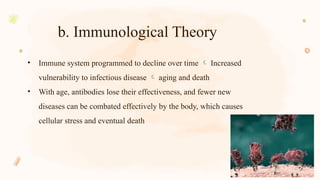
• Immune system programmed to decline over time  Increased
vulnerability to infectious disease  aging and death
• With age, antibodies lose their effectiveness, and fewer new
diseases can be combated effectively by the body, which causes
cellular stress and eventual death
b. Immunological Theory
Living Theory or Rate of Living
Theory
• Aging is the by product of metabolism
• The greater an organism’s rate of oxygen basal metabolism, the
shorter its life span and vice versa.
• Creatures with faster oxygen metabolisms die younger.
*Lack of evidence
Psychological Theories of aging
Explain aging in terms of mental processes, emotions,
attitudes, motivation, cognition, behavior and personality
development that is characterized by life stage
transitions.
Psychological Theories of Aging
1. Maslow’s hierarchy of human needs
2. Jung’s theory of individualism
3. Erikson’s eight stages of life/ personality development
4. Peck’s expansion of Erikson’s theory
5. Selective optimization with compensation
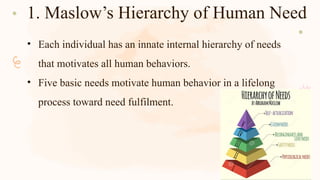
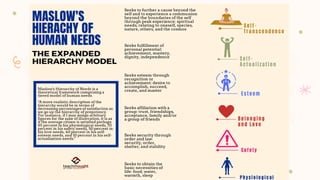
1. Maslow’s Hierarchy of Human Need
• Each individual has an innate internal hierarchy of needs
that motivates all human behaviors.
• Five basic needs motivate human behavior in a lifelong
process toward need fulfilment.
2. Jung’s Theory of Individualism
• Signifies coherent whole, unifying both the consciousness and unconscious
mind of a person.
• According to Jung the self, is realized as the product of individuation, which
is defined as the process of integrating one’s personality.
• Self realization is the goal of personality development as individual ages,
each individual is capable of transforming into a more spiritual being.
• It focuses that personality develops over a life time and is composed of an
ego or self – identity that has personal and collective unconsciousness.
Jung’s Theory of Individualism Contd.
• As individual age, they begin to reflect on their beliefs and life
accomplishments, when one ages successfully he or she accepts the past,
adapts to physical decline, and copes with the loss of significant others.
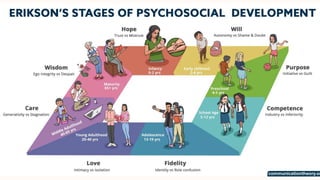
3. Personality Development
• According to Erikson’s personality develops in eight sequential stages with
corresponding life tasks.
3. Personality Development
• According to Erikson’s personality develops in eight sequential stages with
corresponding life tasks.
Integrity vs Despair Role play
Contd.
• “Ego integrity vs Despair”
• Integrity is characterized by evaluating life
accomplishments; struggles include letting go,
acceptance of one’s life as meaningful, accepting care
and detachment, accepting physical and mental decline,
viewing death as part of life.
Contd.
• While, despair looks like failure to accept the
meaningfulness of one’s life, along with fear of death.
• Satisfaction leads to integrity, while dissatisfaction
creates a sense of despair.
Contd.
Older adults face additional challenges or life tasks
including physical and mental decline, accepting the care
of others and detaching from life, creating meaningful
life after retirement, dealing with an “empty nest” as
children move away, and thinking about inevitability of
death.
4. Peck’s Expansion of Erikson’s
Theory
- Expanded and focused more on later developmental
stages. The elderly goes through three developmental
stage to reach full psychosocial development.
a. Ego differentiation vs work role preoccupation
b. Body transcendence vs body preoccupation
c. Ego transcendence vs ego preoccupation
Contd.
a. Ego differentiation vs work role preoccupation:
- As a person matures, that person moves from “Work
Role Preoccupation” which is a concept that describes
defining oneself through work or an occupation.
- A person finds new meaning and value in his or her life.
This process is called “Ego Differentiation”.
Contd.
b. Body transcendence vs Body Preoccupation
- A person either accepts the limitations that accompanies
the aging process (Body Transcendence) or dwells on
diminishing abilities (Body Pre occupation).
- It is a phase concerned with enjoyment of life in the face
of physical discomforts associated with aging.
Contd.
c. Ego Transcendence vs Ego Pre occupation
- In this phase self – examination occurs. If a person
believes his or her life was worth and “life contributions”
will live on after death, the person experiences “Ego
Transcendence”.
- Otherwise, the person may feel that he or she has lived a
useless life and experience “Ego Preoccupation.”
5. Selective Optimization with Compensation
• According to this, individuals cope with the aging losses through the process
of activity/role selection, optimization, and compensation.
• Aging individuals adjust activities and roles as limitations present
themselves, at the same time, they choose those activities and roles that are
most satisfying.
• Coping with illness and functional decline may lead to greater or lesser risk
of mortality.
• It is a positive coping process that facilitates successful aging.
Contd.
• Selection: Increasing restriction of one’s life to fewer domains of functioning
• Optimization: People engage in behaviors to enrich their lives
• Compensation: Developing suitable, alternative adaptations
Sociological Theory of Aging
This focuses on changing roles and relationships, status,
changes in behavior, personality and attitude that accompany
aging and challenges with various life stages. These theories
discuss how these changes impact the older individual’s
ability to adapt. Sub categories:
a. Activity Theory
b. Disengagement Theory
c. Continuity Theory
Contd.
Sub categories contd:
d. Subculture Theory
e. Age Stratification Theory
f. Gerotranscendence Theory
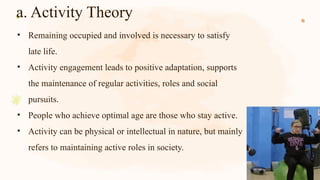
a. Activity Theory
• Remaining occupied and involved is necessary to satisfy
late life.
• Activity engagement leads to positive adaptation, supports
the maintenance of regular activities, roles and social
pursuits.
• People who achieve optimal age are those who stay active.
• Activity can be physical or intellectual in nature, but mainly
refers to maintaining active roles in society.
Activity Theory Contd.
• To maintain positive self image; older person must
develop new interests, hobbies, roles and relationships.
• This theory proposes that an older person should continue
their middle-aged lifestyle, denying limitations of old
age. As possible.
Contd.
Weakness of this theory:
Some aging person cannot maintain a middle aged lifestyle,
due to functional limitations, lack of income, or lack of a
desire to do so.
Many older adults lack the resources to maintain active
roles in society. On a flip side, some elders may insist on
continuing activities in late life that pose a danger to
themselves.
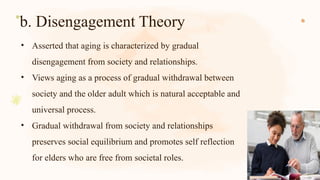
b. Disengagement Theory
• Asserted that aging is characterized by gradual
disengagement from society and relationships.
• Views aging as a process of gradual withdrawal between
society and the older adult which is natural acceptable and
universal process.
• Gradual withdrawal from society and relationships
preserves social equilibrium and promotes self reflection
for elders who are free from societal roles.
Contd.
• Aging is an inevitable, mutual withdrawal or
disengagement, resulting in decreased interaction
between the aging person and others in the social system
he/she belongs to.
• It furnishes on orderly means for the transfer of
knowledge, capital, and power from the older generation
to the young.
Contd.
Weakness:
There is no base of evidence or research to support this
theory. Additionally, many older people desire to remain
occupied and involved with society.
Imposed withdrawal from society may be harmful to elders
and society alike. This theory has been largely discounted
by gerontologists.
c. Continuity Theory
• Proposed in reaction to disengagement theory.
• It says “ Basic personality, attitudes, and behaviors remain constant
throughout the life span”. Personality influences role and life satisfaction.
• The later part of life is simply a continuation of the earlier part of life, a
component of entire life cycle.
• Patterns developed over a lifetime determine behavior, traditions, and beliefs
in old age.
Contd.
• Past coping strategies recur as older adults adjust to the challenges of aging
and facing death.
• It encourages young people to consider that their current behaviors are laying
the foundation for their own future old age.
• What one becomes in late life, is a product of a lifetime of personal choices.
d. Subculture theory
Theorize that older adults form a unique sub culture within
society to defend against society’s negative attitude toward
aging and the accompanying loss of status.
This theory proposed that there is a growing awareness among
many older people that they are not merely members of a
social category, but are members of a social group with
common problems and a distinctive subculture.
Contd.
Health and mobility are key determinants of social status.
Older persons are accepted by and more comfortable
among their own age group.
A component of this theory is the argument for social
reform and greater empowerment of the older populations
so that their rights and needs can be respected.
e. Age Stratification theory
• Refers to the hierarchical ranking of people into age groups within a society.
• Age stratification based on social status is a major source of inequality, and
thus may lead to ageism.
• Age stratification within a population can have major implications, affecting
things such as workforce trends, social norms, family structures, government
policies, and even health outcomes.
• Society is stratified by age groups that are the basis for acquiring resources,
roles, status and deference from others.
Contd.
According to this theory, older adults born during different time
periods form cohorts that define “age strata”. There are two
differences among strata: chronological age and historical
experience. This theory makes two arguments.
- Age is a mechanism for regulating behavior and as a result
determines access to positions of power
- Birth cohorts play an influential role in the process of social
f. Gerotranscendence theory
- One of the newest sociological aging theories
- This proposes that aging individuals undergo a cognitive
transformation from a materialistic, rational perspective
toward “oneness” with the universe.
Contd.
Characteristics of successful transformation include a more
outward or external focus, accepting impending death
without fear, sense of connectedness with preceding
generations and spiritual unity with the universe.
Developmental Theories of Aging
- Major non – evolutionary theory of ageing.
- Links development to ageing
- The concepts of this theory based on the identification of
traits and characteristics that may be developed early in
life or may change emphasis at different stages of
development.
Contd.
Developmental theories of aging
1. Life course theory
2. Havighurst’s theory
3. Newman’s theory
4. Erikson’s eight stages of life
5. Peck’s expansion of Erikson’s theory
6. Jung’s theory of individualism
1. Life Course Theory
• Is concerned with the understanding the group norms and
their characteristics.
• Aging occurs from birth to death.
• The central theme of life course is that, life course in
stages that are structured according to one’s role,
relationships, internal values, and goals.
Contd.
• Goal achievement is linked to life’s satisfaction but
people’s goal achievements are limited by external
factors.
• Individual adapt to changing roles.
• Successful adaptation may require revising one’s beliefs
to be consistent with society’s expectations.
Contd.
• Each of us live through different events, we make
choices, we face the consequences of policies and
systems, and intersecting forms of discrimination that
influence our lives.
• As we grow older, the impact on us of these different
experiences accumulates.
2. Havighurst’s Theory
Developmental tasks
3. Newman’s Theory
Identifies the task of aging as:
• Coping with the physical changes of aging
• Redirecting energy to new activities and roles including
retirement, grand parenting and widowhood
• Accepting one’s own life and
• Developing a point of view about death
Environmental Theories of Aging
Focuses on effects of environment on the cellular structure
of the human which leads to be old.
Factors in the environment e.g. industrial carcinogens,
mercury, lead, arsenic, pesticides, sunlight, air pollutants,
trauma and infections etc. bring about changes in the
aging process.
Contd.
Impact of environment is a secondary rather than the
primary factor of aging.
Environment Theories of Aging
1. Radiation Theory
2. Stress Theory
3. Person environment fit Theory
1. Radiation Theory
Excessive exposure to the radiation of sun puts the skin at
risk during the somatic mutation of organism
2. Stress Theory
Human aging is a disease syndrome arising from struggle
between environmental stress and biological resistance
and relative adaptation to the effects that include air
pollutants, chemical, psychological and sociological
stress or events.
3. Person Environment Fit Theory
• Proposed that capacity to function in one’s environment
is an important aspect of successful aging, and that
function is affected by the ego strength, motor skills,
biologic health, cognitive capacity and sensory perceptual
capacity, as well as external conditions imposed by the
environment.
Contd.
• Functional capacity influences an older adults ability to
adapt to his or her environment.
• Those individuals functioning at lower levels can tolerate
fewer environmental demands.
Geriatric Assessment
Physical assessment
To become proficient in geriatric assessment, geriatric nurse
need to understand the physiologic changes unique to this
population, as well as the differences between normal
aging related changes and health alterations caused by
illnesses and social changes.
Contd.
• Gather baseline data
• Obtain a complete medical history
• General survey of the client
• Complete physical assessment
 Head to toe
 Includes vital signs
General considerations
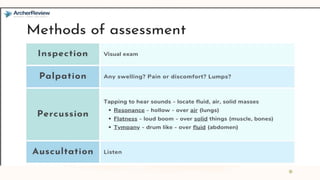
• Follow the usual sequence of physical examination:
history, inspection, palpation, percussion, and
auscultation.
• Limit the time the patient is in the supine position as this
may cause back pain for persons with osteoarthritis or
kyphoscoliosis and shortness of breath for those with
cardiopulmonary disease.
Contd.
• Having several pillows on hand for these patients will be
greatly appreciated. Multiple sessions may be required
for a complete physical exam due to patient fatigue.
• While they are important, the rectal and pelvic exams
may be deffered to a later session, if not urgently
required.
Contd.
• Before starting physical examination, introduce yourself
to the patient, explain the procedure. Be organized and
systematic in assessment. Use appropriate listening and
questioning skills.
• Ensure patient’s privacy and dignity. Assess ABCCS
(airway, breathing, circulation, consciousness, safety).
Contd.
• Apply principles of asepsis and safety, and complete all
necessary focused assessments.
• The examination begins with assessment of the patient’s
weight, height, temperature, pulse, respirations and blood
pressure.
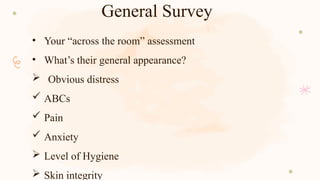
General Survey
• Your “across the room” assessment
• What’s their general appearance?
 Obvious distress
 ABCs
 Pain
 Anxiety
 Level of Hygiene
 Skin integrity
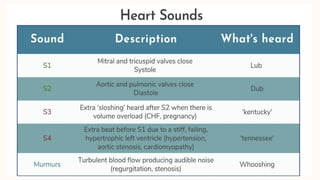
Follow the procedures for physical examination
Contd.
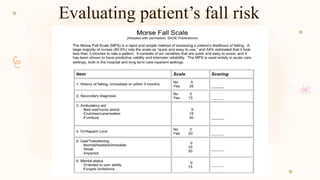
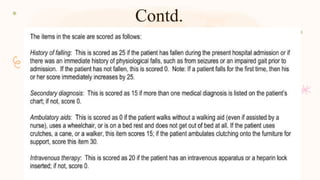
Evaluating patient’s fall risk
Contd.
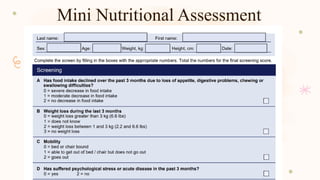
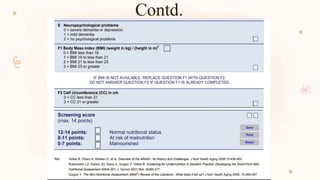
Mini Nutritional Assessment
Contd.
Polypharmacy
Older patient are often prescribed multiple medications,
placing them at increased risk of drug interactions abd
adverse medication events.
The best method of detecting potential problems with
polypharmacy is to have patients provide all medications
(prescription and non – prescription) in their packaging.
Contd.
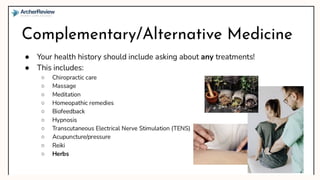
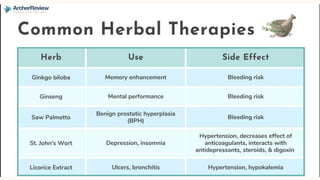
Older people should also be asked about alternative medical
therapies like herbal medicine use, etc.
Psychosocial Assessment
Assess elderly for cognition, mood and anxiety, fears, care
preferences, spirituality, social support and networks,
environment/living situations
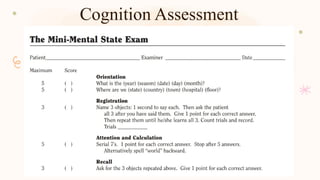
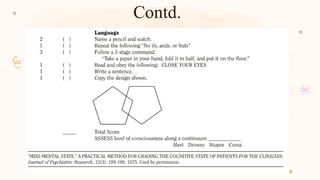
Cognition Assessment
Contd.
Contd.
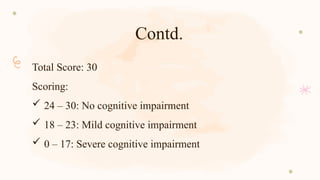
Total Score: 30
Scoring:
 24 – 30: No cognitive impairment
 18 – 23: Mild cognitive impairment
 0 – 17: Severe cognitive impairment
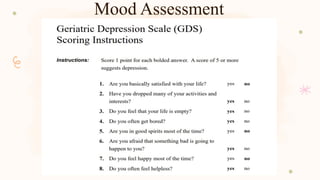
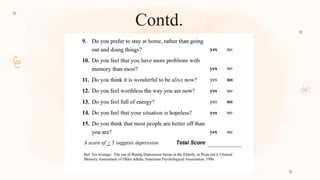
Mood Assessment
Contd.
Paranoia in the Elderly
Paranoia is defined as an unreasonable fear that they are in
danger.
It may be one of the symptoms of psychosis, depression, or
dementia.
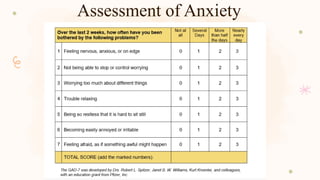
Assessment of Anxiety
Contd.
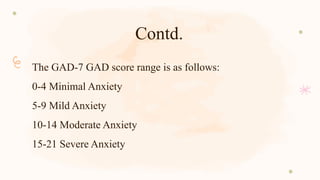
The GAD-7 GAD score range is as follows:
0-4 Minimal Anxiety
5-9 Mild Anxiety
10-14 Moderate Anxiety
15-21 Severe Anxiety
Social support and Financial Assessment
A brief screen of social support includes taking a social
history and determining who would be available to help if
they become ill.
Early identification of problems with social support can
help planning and timely development of resource
referrals.
Spiritual/ Religious Preferences/
Hobbies and Interests
Environment or Living Situation
Reporting and Documentation
Report and document assessment findings and related health
problems. Accurate and timely documentation and
reporting promote patient safety.
Contribution of the elderly to the
young generation
Connecting generation will:
 Strengthen the community
 Encourage positive exchanges between the generations
Benefits of bringing Generations together
 Understand and embrace their similarities and differences
 Encourage learning about other group
 More family time
 More help with household matters
 Financial advantage
 Strengthen communities through mutual understanding
Contd.
 Encourage learning through mentoring
 Connections with a younger generation can help older
adults feel a greater sense of fulfilment
 Provide an opportunity for both to learn new skills
 Give the child and older adult a sense of purpose
 Help to alleviate fears children may have of the elderly
Contd.
 Help children to understand and later accept their own
aging
 Invigorate and energize older adults
 Help reduce the likelihood of depression in the elderly
 Reduce the isolation of older adults
 Children who do not have grandparents available to them
may feel avoidance
Contd.
 Help keep family stories and history alive
 Aid in cognitive stimulation as well as broaden social
circles, young introduce technology into the life of senior
Activities that initiate, build and
strengthen intergenerational
relationship
- Story telling
- Learning skills
- Reading to each other
- Planning/ Preparing a meal (if applicable)
- Scrapbooking
Contd.
- Talking about ethnic heritage, sharing ethnic customs.
- Planting seeds and gardening
- Discussing hobbies and sharing examples
- Having the child teach the senior a new technology, etc.
Scope of geriatric nurse
The scope of geriatric nursing (also known as
gerontological nursing) encompasses a specialized field
of healthcare dedicated to the holistic physical, mental,
and social well-being of older adults, typically those aged
65 and older.
Contd.
Geriatric nurses function as caregivers, advocates, and
educators, managing the "5 Ms" of geriatric care: Mind,
Mobility, Medications, Multicomplexity, and Matters
Most.
Contd.
Comprehensive Assessment: Evaluating physical health,
cognitive function (e.g., screening for dementia or
delirium), and emotional status.
Chronic Disease Management: Caring for patients with
conditions like Alzheimer’s, diabetes, arthritis,
hypertension, and osteoporosis.
Contd.
Medication Management: Supervising complex
medication regimens to prevent adverse drug interactions
and managing polypharmacy.
Safety & Mobility: Implementing fall prevention strategies
and assisting with activities of daily living (ADLs) such
as bathing, dressing, and feeding.
Contd.
Patient & Family Advocacy: Serving as a liaison between
the patient, family, and multidisciplinary healthcare team
to ensure the patient's wishes are respected.
End-of-Life Care: Providing compassionate palliative and
hospice care for terminally ill patients and support for
their grieving families.
Contd.
Diverse work setting
- Hospitals: Specialized geriatric or acute care units.
- Long-Term Care: Nursing homes, assisted living
facilities, and retirement communities.
- Home Healthcare: Providing skilled nursing and
rehabilitation in a patient's private residence.
Contd.
- Hospice & Palliative Care: Centers focused on comfort
for patients with terminal illnesses.
- Community Services: Adult daycares, senior centers,
and outpatient rehabilitation clinics.
Contd.
Career Growth & Specializations
The field offers various levels of practice based on
education:
Registered Nurse (RN): General bedside care and case
management.
Geriatric Nurse Practitioner (GNP): An advanced
practice role with the authority to diagnose, treat, and
prescribe medications.
Contd.
Clinical Nurse Specialist (CNS): Focusing on improving
clinical standards and staff education within a facility.
Leadership Roles: Opportunities as facility administrators,
nursing directors, or case managers.
Roles and responsibility of nurse to
care elderly population
Roles of the Gerontological Nurse
 Healer
 Care Giver
 Teacher/ Educator
 Manager
 Advocate
Contd.
 Innovator
 Researcher / Evidence based clinician
 Supportive role
 Restorative
 Life enhancer
 Communicator
Contd.
 Counselor
 Case Manager
 Coordinator
 Collaborator
Contd.
Responsibilities of Gerontological Nurse
 Integrate advanced knowledge and experience in
delivering safe, effective quality care to geriatric clients
in primary care.
 Demonstrate competence in managing the health/ illness
status of geriatric clients.
Contd.
 Monitor and ensure quality health care for geriatric
clients.
 Demonstrate leadership and competence in implementing
the role of the primary care nurse practitioner.
 Incorporate an understanding of trends in aging in
planning and providing primary health care for clients.
Contd.
 Engage in counseling, communication, collaboration and
teaching in a manner that reflects caring, advocacy, ethics
and professional standards.
 Conceptualize one’s individual role as a primary care
nurse practitioner and one’s personal philosophy or
primary care practice.
Contd.
 Administering medications to patients based on a care
plan.
 Teaching family members about a patient’s condition and
how to promote self-care skills.
 Maintain efficient interpersonal communication with the
patient as well as the patient’s family for moral support
and decision making.
Self-care model in Gerontology and
Geriatric Nursing
Self – care model is the conceptual model based on the self-
care deficit theory developed by Dorothea Orem.
Orem’s self care deficit theory includes:
1. Self-care: consists of actions that individuals freely and
deliberately initiate and perform on their own behalf in
maintaining life, health, and well-being.
Contd.
2. Self – care deficit: An inability of a person to perform
self – care. It occurs when the elderly person suffers from
different health conditions. The requirement for nursing
arises when an adult is unable to maintain the amount and
quality of self-care necessary to sustain health and
recover from injury or illness.
Contd.
Health Care Requisites:
 Physical, mental and socioeconomic abilities to take
action to meet the life demand
 Knowledge, experience, and skill to perform the action
 Desire and decision to take the action
Contd.
3. Nursing Systems: Methods used by nurses to assist
patients, including:
Wholly Compensatory: The nurse provides all care for a
patient who is completely unable to care for themselves.
Partially Compensatory: Nurse and patient share
responsibility for care.
Contd.
Supportive-Educative: The patient can perform tasks but
requires guidance, teaching, or support from the nurse.
Application of self – care model in
caring older adults
1. First phase: Diagnostic Phase
a. The first step includes identifying and prioritizing the
client’s unmet self – care needs (deficit)
b. Nurse evaluates a person’s condition and his/her
functional profile and then considers different self – care
deficits.
Contd.
- A mild therapeutic self – care deficit
- A moderate therapeutic self – care deficit
- A severe or complete therapeutic self – care deficit
Contd.
2. Second Phase: Intervention Phase
a. The second step consists of selecting methods of
assisting the client to compensate for or overcome his
self – care deficits.
b. Select nursing intervention according to diagnosed self –
care deficit. Nursing intervention included are:
Contd.
i) Wholly compensatory:
- Elderly unable to carry out needed self – care actions
- Self – care need provided by nurse
- Such conditions arises if the patient is in coma and is
unable to engage in self – care, or has vertebral fracture
and is aware about self – care but cannot perform by self.
Contd.
ii) Partial compensatory:
- Care provided to the elderly is s/he can meet some self –
care need but requires a nurse to help to meet other self –
care needs.
- For e.g.: Assisting post operative client to ambulate,
providing meal tray to the elderly who can feed himself.
Contd.
iii) Supportive educative:
- Elderly person can meet self – care requisites but needs
assistance with decision making, behavior control or
knowledge acquisition skills.
- For e.g. Providing lifestyle modification teaching to
elderly with different health issues.
Revision
1. Gerontology is the study about
a. Human body
b. Children
c. Senior citizens
d. Genetics
2. Who coined the term ‘geriatrics’
a. Nascher
b. Lenther
c. Checkov
d. Mechinikov
3. The physical and mental decline associated with the
aging process is:
a. Dimentia
b. Delirium
c. Senescence
d. None
4. According to WHO, who are senior citizens
a. People 70 years and above
b. People 65 years and above
c. People 60 years and above
d. People 50 years and above
5. When was senior citizen act formulated in Nepal?
a. 2060 BS
b. 2061 BS
c. 2062 BS
d. 2063 BS
6. Any act that causes mental torture to the elderly through
humiliation and isolation is called:
a. Neglect
b. Physical abuse
c. Emotional
d. Abandonment
7. Healthy aging refers to:
a. Postponement of or reduction in the undesired effects of
aging
b. Remaining young physically
c. Remaining free of disease
d. Taking needed action for health issues
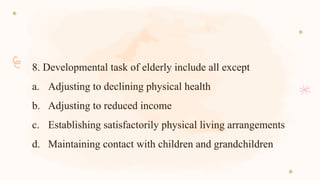
8. Developmental task of elderly include all except
a. Adjusting to declining physical health
b. Adjusting to reduced income
c. Establishing satisfactorily physical living arrangements
d. Maintaining contact with children and grandchildren
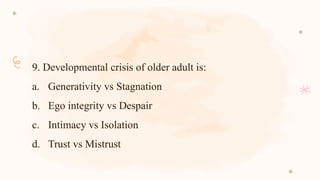
9. Developmental crisis of older adult is:
a. Generativity vs Stagnation
b. Ego integrity vs Despair
c. Intimacy vs Isolation
d. Trust vs Mistrust
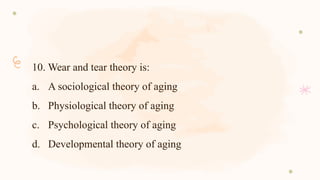
10. Wear and tear theory is:
a. A sociological theory of aging
b. Physiological theory of aging
c. Psychological theory of aging
d. Developmental theory of aging
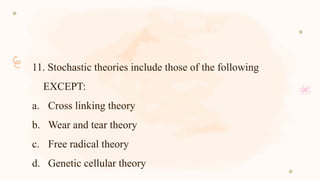
11. Stochastic theories include those of the following
EXCEPT:
a. Cross linking theory
b. Wear and tear theory
c. Free radical theory
d. Genetic cellular theory
12. Non stochastic theories include those of the following
EXCEPT:
a. Apoptosis
b. Physiological system theories
c. Evolutionary
d. Radiation theories
13. “The genetic mutations are responsible for aging by
causing organ decline”. Which theory says this
statement?
a. Error theory
b. DNA damage theory
c. Biological clock theory
d. Free radical theory
CREDITS: This presentation template was created by
Slidesgo, and includes icons by Flaticon, and
infographics & images by Freepik
Thanks!
Do you have any questions?
Introduction to Geriatric Nursing,Theory

Introduction to Geriatric Nursing,Theory

  • 1.
    Unit 1 Introduction toGerontology and Geriatric Nursing Nabina Paneru
  • 2.
  • 3.
    Definitions Geriatrics: The termgeriatrics comes from the Greek word “geron” meaning, “old man”, and iatros meaning “healer”. However, geriatrics is sometimes called medical gerontology Gerontology: The branch of medicine or social science dealing with the health and care of old people. (-physiological, pathological, psychological, sociological and economical point of view of age 60yrs and above) “Geron”- old man “Logy” – study of
  • 4.
    Contd. Specialty that concernsitself with the provision of nursing services to geriatric or aged individuals. Concerned with assessment of the health and fundamental status of older adults; diagnosis, planning, and implementing health care and services to meet the identified needs and evaluating such care Geriatric Nursing Gerontological Nursing
  • 5.
    Gerontic Nursing Geriatricmedicine - Seldom used - Considers nursing care of older adults to be the art and practice of nurturing caring, and comforting rather than merely the treatment of disease - Sub specialty of internal medicine and family medicine that focuses on health care of elderly people - Promotes health by preventing and treating diseases and disabilities in older adults Contd.
  • 6.
    Gerontologists Aging Specialists whostudy the biological, psychological, and social aspects of aging to improve the quality of life for older adults. Natural process of becoming older, characterized by gradual physiological changes Contd.
  • 7.
    Ageism Age Ageism refersto the stereotypes (how we think), prejudice (how we feel) and discrimination (how we act) towards others or oneself based on age. - Biological age - Social age - Primary age - Secondary age - Psychological age - Cognitive age - Functional age Contd.
  • 8.
    Contd. Mental and physicaldecline associated with aging process Used rarely to denote physical and emotional deterioration 60 and above Senescence Senility Senior citizen
  • 9.
    Pace of populationageing is much faster than in past Contd. By 2050, proportion of over 60 years will double from 12% to 22% Data (According to WHO) In 2020, the number of people aged 60 years and older outnumbered children younger than 5 years
  • 10.
    Life expectancy - Refersto the number of years a person can expect to live. Contd.
  • 11.
    Source: World HealthOrganization 2026 data.who.int, Nepal
  • 12.
    Source: World HealthOrganization 2026 data.who.int, Nepal
  • 13.
  • 14.
    Global history - Emergedand developed in different countries based on their culture, environment and development in technology, education and knowledge - Hippocrates noted conditions common in later life - Aristotle offers a theory of aging based on loss of heart - In Islamic world – physician wrote on issues related to Gerontology.
  • 15.
    Contd. - Arabic physicianIbn A-Jazzar wrote on medicine and health of the elderly (covers sleep disorders, forgetfulness, how to strengthen memory and causes of mortality.) - Early pioneers such as Michel Eugene Chevreul (lived up to 102yrs), believed aging should be a science to be studied
  • 16.
    Contd. - Industrial revolution– ideas shifted in favor of a societal care system. - In 19th century – care homes emerged - Term ‘Geriatrics’ invented by Ignatz Leo Nascher and his initiative provided a stimulus for social and biological research on aging. (Father of geriatrics)
  • 17.
    Contd. - During 1936,Dr. Marjory Warren (Mother of geriatrics) reviewed several old workhouse wards and upgraded and matched care to their need through system of classification. - Advocated creating a medical specialty of geriatrics, providing special geriatrics units, and care provided by those who have specialization in geriatrics
  • 18.
    Contd. - Geriatric nursingbegins from the time of Florence Nightingale. At that time care to elderly people were served by family members
  • 19.
    Significant changes - 1902:First geriatric article published by medical doctor in American Journal of Nursing (AJN) - 1904: AJN published first geriatric article by RN - 1925: AJN considered geriatric nursing as potential speciality and created column “care of the aged” - 1935: Social Security Act was designed to increase the independence of aged – formulation of nursing homes.
  • 20.
    Contd. - 1940s: Organizedgerontology into its own field - 1945: Gerontological society was formed in US - 1950: First geriatric nursing textbook, first masters thesis done on geriatric nursing. Geriatric became specialized in nursing - 1952: first geriatric nursing study published in Nursing Research
  • 21.
    Contd. - 1960 –1985: Birth of modern gerontological nursing (From book)
  • 22.
    National History - InNepal, concept emerged when nursing started - Topic related to elderly used to study as older adult in adult nursing (Medical Surgical Nursing). - Later “Geriatric Nursing” was used and included in curriculum of CTEVT, TU, PU and other universities. - Included as a separate subject in PCL, BN, BSC
  • 23.
    Contd. - Bir hospital,Mahabouddha – first geriatric OPD started - Government is planning to start a geriatric hospital
  • 24.
    Demographics of AgedPopulation The number of people aged 60 and older worldwide is projected to increase from 1.1 in 2023 to 1.4 billion by 2030. This trend is particularly evident and rapid in developing regions.
  • 25.
    Contd. The UN Decadeof Healthy Ageing (2021 – 2030) defines the following four action areas: combatting ageism – changing how we think, feel, and act towards age and ageing; age-friendly environments – ensuring that communities foster the abilities of older people;
  • 26.
    Contd. integrated care –delivering person-centered integrated care and primary health services responsive to older people; and long-term care – providing access to long-term care for older people who need it.
  • 27.
    Contd. According to NepalDemographic Profile, 2020, Life expectancy at birth is 71.8 years, where male’s 71.1 years, female’s 72.6 years. The percentage of age group 55 – 64 years is 6.64% (male 954,836/ female 1,059,360) and age group 65 years and over is 5.69% (male 852, 969/ female 874,092). Elderly dependency ratio is 8.9
  • 28.
  • 29.
    Aging Process - Aging:Not a disease but developmental process - Change from internal process (although undesired) – normal and sometimes called pure aging. - Process: Expected and generally unavoidable, which is normal
  • 30.
    Contd. - For e.g.:Presbyopia occurs as people age because the lens of the eye thickens, stiffens and becomes less able to focus on close objects, such as reading materials. This occurs in all older people and is considered normal aging
  • 31.
    Contd. - Changes withnormal aging make people more likely to develop certain disorders. - However, people can sometimes take actions to compensate for these changes. - E.g.: with proper dental care, visiting dentist regularly, eating fewer sweets, brushing and flossing regularly may reduce the chances of tooth loss.
  • 32.
    Contd. - Functional declinewhich is part of aging sometimes seems similar to functional decline that is part of a disorder. - E.g.; With advanced age: mild decline in memory – normal (difficulty learning new languages, ↓ attention span, ↑ forgetfulness). In contrast, the decline that occurs in dementia is much more severe. SO dementia is considered disorder, even though it is common in late life.
  • 33.
    Contd. - Changes relatedto normal aging can be anticipated & adapted so that the older person can live happy, healthy and active life.
  • 34.
    Characteristics of Aging (Physiologicaland Psychological Changes of Aging)
  • 35.
    Concept of healthyaging - Reduction in the undesired effects of aging - Goals:  Maintaining physical and mental health  Avoiding disorders  Remaining active and independent
  • 36.
    Contd. - Every personshould have opportunity to live a long and healthy life but our surrounding environment favor health or can be harmful - Environment  influence behavior, exposure to health risks, access to quality health and social care
  • 37.
    Contd. - Healthy aging:creating the environments and opportunities that enable people to be and do what they value throughout their lives. - WHO defines healthy aging as “the process of developing and maintaining the functional ability that enables wellbeing in older age.”
  • 38.
    Contd. - Healthy agingincludes a person’s ability to:  Meet their basic needs  Learn, grow and make decisions  Be mobile  Build and maintain relationships  Contribute to society
  • 39.
    Contd. - Functional abilityconsists of the intrinsic capacity (all mental and physical capacities) of the individual, relevant environmental characteristics and the interaction between them. - Level of Intrinsic capacity is influenced by several factors such as the presence of diseases, injuries and age related changes.
  • 40.
    Contd. - Key considerationsfor Healthy aging  Diversity: Some 80 year olds have levels of physical and mental capacity that compare favorably with 30 year olds. Other of the same age may require extensive care and support for basic activities. Policy should be framed to improve the functional ability of all older people, whether they are robust, care dependent or in between.
  • 41.
    Contd.  Inequity: Alarge proportion of the diversity in capacity and circumstance observed in older age is the result of the cumulative impact of advantage and disadvantage across people’s lives.
  • 42.
    Needs of elderlypeople for the promotion and maintenance of health
  • 43.
    1. Nutritional Need Nutritionis the sum total of the processes involved in the taking in and the utilization of food substances by which growth, repair and maintenance of the body are accomplished. It involves ingestion, digestion, absorption and assimilation.
  • 44.
    Contd. Different factors affectnutritional intake in elderly such as:  Age related changes: which affects absorption  Psychosocial factors: lead to lack of interest in eating and/or cooking  Economic factors: affects food preparation and storage  Cultural factors: eating habits  Other: Anorexia caused by side effects of medicines, substance use
  • 45.
    Contd. Ways of improvingnutrition  Health challenge assessment  Appealing food preparation (appearance plus flavors)  Declined ability to detect thirst. So give at least eight glasses of water in a day.  Establish healthy eating schedule; use of visual and verbal reminders
  • 46.
    Contd.  Limit saturated,fats and cholesterol. High fiber diet with plenty of vegetables, fruits and grain products. Moderate: sugar and salt.  Switch between varieties of foods.  Careful use of supplements to accommodate need. (may sometimes cause toxicity)
  • 47.
    Contd.  Encourage tovisit dentist regularly (for ill fit dentures, jaw pain, sores, missing teeth etc.)  Monitor effects of medicines (change in taste, reduce appetite) and notify doctor immediately.  Maintain healthy food storage  Provide adequate time to eat  Help to maintain healthy weight
  • 48.
    2. Physical Activitiesand Exercise - Plays major role in maintaining good health, enhances sleep, improve digestion, reduce constipation, lower cholesterol level and blood pressure, maintain weight and lower the risk of cardiovascular diseases. - Aging  sedentary or less active life due to physiological changes  predisposes to different health issues
  • 49.
    Contd. - Sensory stimulationinvolved in activities can promote elderly’s physical health and enhance their cognitive function, social skills and emotional control. - Also helps to enhance their self – worthiness.
  • 50.
    Contd. Choice of activityin older adults Cognitive activity • Playing chess • Computer game • Reality orientation activities • Reading newspaper etc. Physical activity • Fitness class • Jogging • Walking etc. Social activity • Tea time gathering • Group game • Visit group • Picnic etc.
  • 51.
    Contd. Choice of activityin older adults contd. Self-care activity • Grooming • Food preparation etc. Leisure activity • Outdoor activity • Watching television • Reading books • Painting etc. Work related activity • Volunteering • Assisting other in shopping, teaching • Simple cleansing etc.
  • 52.
  • 53.
    Contd. Ways to improveactivity and exercise in older adults  Plan activities that do not cause fatigue. Consider physical, cognitive, social, emotional state of elderly including interest and preference  Choose safe area  Encourage to continue performing activities such as swimming, walking, jogging, stretching, ROM exercises, physical therapies
  • 54.
    Contd.  Have frequentrest periods  Let the older adults wear comfortable cloths and shoes  Avoid outdoor activities in extremes temperatures  Activities should not last for long time as most of the older adults may have problem with concentration
  • 55.
    Contd. WHO recommends:  Atleast 150 minutes of moderate intensity aerobic physical activity throughout the week or do at least 75 minutes of vigorous intensity aerobic physical activity throughout the week or an equivalent combination of moderate and vigorous intensity activity
  • 56.
    Contd.  Aerobic activityshould be performed in limited period of time of at least 10 minutes’ duration  For additional benefits: increase moderate intensity aerobic physical activity to 300 minutes per week or engage in 150 minutes of vigorous intensity aerobic physical activity per week, or combination
  • 57.
    Contd.  Older adultswith poor mobility should perform physical activity to enhance balance and prevent falls on 3 or more days per week  Muscle strengthening activities, involving major muscle groups, should be done on 2 or more days a week  If medically compromised, they should be physically active
  • 58.
    Contd. ADLS (Activities ofDaily Living) • Basic Activities of Daily Living: Eating and drinking, Bathing, Dressing, Toileting, Continence, Walking and transferring • Instrumental Activities of Daily Living: Preparing meals and clean up, Maintaining the home, Shopping, Using the telephone, Managing medications, Managing finances
  • 59.
    3. Rest andSleep Rest: Feeling of peace, relief and relaxation after exercise or activities Sleep: Complex biological rhythm intricately related to rest and other biological rhythms.
  • 60.
    Contd. Rest and sleepis important for conserving energy, providing organ rest, restoring the mental alertness and neurological efficiency. Older adults: take longer time to fall asleep, frequent awakening  day time napping  poor day time functioning.
  • 61.
    Contd. Factors causing sleepproblems in elderly  Environment, Dietary habits,  Chronic/ Co-morbid illness  Pain  Medication  Lack of exercise, Retirement, Day time napping  Psychological problems such as stress, anxiety
  • 62.
    Contd. Ways of improvingsleep o Create calm and quiet environment o Make the bed room not too hot or too cold o Use comfortable beddings o Keep the bedroom dark o Manage pain and other symptoms of chronic/co-morbid illness.
  • 63.
    Contd. o Encourage forregular exercise and activities o Limit day time napping to 30min o Avoid heavy meals, spicy food, and tobacco at bed time o Avoid caffeine containing drinks such as cola, coffee, tea o Avoid alcohol intake o Keep the bedroom free from television
  • 64.
    Contd. o Set bedtime rituals o Suggest to eat three to four hours before bed time, limit fluid intake after 7pm o Encourage for active retirement life o Provide counseling as needed to relive psychological problems such as anxiety
  • 65.
    4. Safety andSecurity - Major concern as old age people are more susceptible to accidents and injuries due to age related physiological changes - Falls, burns, poisoning and automobile accidents - Constant vigilance is needed to safeguard the elderly, both at home and in patient care facilities
  • 66.
    Contd. Safety measures forelderly  Stay healthy (Regular exercise, diet etc.)  Correct deficits: Using assistive devices properly  Well lightening (bedside light, availability of nighlight)  Manage floors (even, non skid, well anchored rugs, non slip mats etc.)
  • 67.
    Contd.  Manage properfoot wears  Modify habits (getting up slowly after sitting or lying down and making balance before walking)  Store and use medications safely  Manage furniture: - Limit furniture in room
  • 68.
    Contd. - Keep bedattached to the wall - Adjust height of bed - Have firm chair, with arms, to sit and dress - Check the internal door locks, use locks that can be open from both sides - Replace door knobs with handles that need only to be pushed up and down, rather than turned
  • 69.
    Contd.  Follow kitchensafety - Avoid wearing long sleeves or loose clothing while cooking - Keep fire extinguisher next to the stove - Eliminate need for stepping stools - Clean up any spills immediately
  • 70.
    Contd. - Repair damagedfloor tiles - Make sure electrical cords plugged into sockets are far from sinks - Mark “on” and “off” positions on appliances clearly and with bright colors - Store sharp knives in a rack
  • 71.
    Contd.  Promote bathroomsafety - Install a raised toilet seat if needed - Hand – held shower is preferable for elderly - Make sure hot or cold is clearly marked - Install grab bars and handrails (throughout the home if possible)
  • 72.
    Contd.  Care ofelectricity - Check the condition of electrical appliances, cords and plugs regularly - Avoid any non – insulated wiring - Do not place cords under carpeting and across walkways - Keep all electrical appliances unplugged unless they are in use to prevent electric shock
  • 74.
    5. Regular/Periodical HealthCheckup Importance of periodical medical check up Helps to; • assess their level of well being • identify the health risk factors in elderly • detect the diseases at an earlier stage and hence decrease the risk of complication • reinforce positive promoting and protecting behaviors
  • 75.
    Contd. 1. Routine annualphysical examination 2. Regular dental assessments 3. Opthalmologic assessment (Macular degeneration, glaucoma, cataract etc.) 4. Screening for cardiovascular diseases
  • 76.
    Contd. 5. Screening forcancer a. Skin cancer b. Breast cancer (BSE, clinical breast examination and mammography every one to two years for women above 40yrs)
  • 77.
    Contd. c. Uterine andcervical cancer (Annual examination with pap smear test every three years. If a women is above 65 with three negative pap test in a row, then after it is not necessary) d. Colorectal cancer (Annual stool test for occult blood, sigmoidoscopy every 5 years after age 50, Colonoscopy every 10 years after age 50)
  • 78.
    Contd. e. Prostate diseaseand cancer (Yearly rectal examination and blood test for prostate specific antigen in men over age 50) f. Testes cancer (monthly testes self examination) g. Screening for lung disease (medically compromised should do annual check up for tb, chest x rays)
  • 79.
    Contd. 6. Screening forthyroid problems (once every 5 years, esp for women) 7. Screening for osteoporosis (annual bone density test for women over age of 60) 8. Immunization (as recommended such as influence vaccine, pneumococcal vaccine etc.)
  • 80.
    6. Psychosocial Needs -Sense of self worth, confident and sense of productivity - Adequate support system
  • 81.
    7. Religious/Spiritual Need Religiousactivities: directly or indirectly related to religion and which reflect the cultural practices, beliefs, tradition, customs, norms, rituals, values and are transferred from generation to generation.
  • 82.
    Contd. Religious activities performedby elderly people - Bathing early in the morning - Going to temple, worshipping god, praying and meditation, Pilgrimage - Celebrating festivals - Fasting - Reciting holy books - Teaching rituals to new generation
  • 83.
    Contd. Importance of religiousactivities:  Provides source of religious activity  Enables older people to deal with painful and unexpected life events and to be more productive and adaptive in threatening conditions  May provide meaning and identity to the older people
  • 84.
    Contd.  Also necessaryfor emotional, physical and mental wellbeing, satisfaction with life, happiness, sense of energy.  Observing different feast and festivals and particular type of food included contributes to increase nutritional requirement for e.g. quanti in Janai Purnima and ghee chaku in maghe sankranti
  • 85.
    Contd. Nursing Intervention ֍Nurse shouldknow that being older does not mean that they are being religious, so a nurse should not enforce an older people to do religious activity without knowing him. ֍Nurse should know the types of religious activities, patient follows
  • 86.
    Contd. ֍Whenever possible, interestedpatient should be enable to attain religious activities according to individual preference by providing transportation to religious group or gathering or alternative methods of religious fulfillment ֍Nurse can enhance aged person’s self esteem by showing recognition of contribution he/she had done to others
  • 87.
    Contd. ֍If elderly followreligious belief and laws that are no longer adherence to current majority member of religion, person must be respected and no attempt must be made to change them. ֍Be alert to subtle cues which indicates desire to talk about spiritual matter, need for expression of love and hope and desire for silence, acceptance of behavior when patient label self as bad.
  • 88.
    8. Stress Management Stressis simply a reaction to events or stimuli that makes us feel threatened and disturbs our physical and mental equilibrium Stress is a state produced by a chance in the environment that is perceived as challenging, threatening or damaged to person’s dynamic equilibrium.
  • 89.
    Contd. Stress (According toHans Selye): "non-specific response of the body to any demand for change". Causes of stress in elderly • Physiological changes • Changes in roles and responsibilities towards family and society
  • 90.
    Contd. • Chronic diseases •Physical dependence in others • Retirement from job and low income • Death of spouse or loved one • Long term drug therapy • Generation gap between family members • Feeling of isolation, neglect/separation from family, loneliness, etc.
  • 91.
    Management of stress Stressmanagement works on two levels - The first is about maintaining a harmonious lifestyle so that stress does not get out of control. This involves having outlets that allow you to release the stress. - The second strategy involves learning how to get relax yourself or change mood if stress is having a negative impact on life.
  • 92.
    Contd. Measures of stressmanagement in elderly  Stay active  Stay involved in the community  Establish a new purpose of life (Leisure activities- to focus mind and body on)  The cure of stress is effectively about changing the state of our body: the body responds in a certain way if it believes that it is experiencing stress
  • 93.
    Contd.  Relaxation techniques -Progressive relaxation - Relaxation with guided imagery - Meditation - Yoga - Others (Humor and laughter, Listening to music, Writing, Engaging in art activities, Dance and sports.)
  • 94.
    5 min toyourself!!
  • 95.
    Contd.  Nutrition  Sleepand rest  Support system
  • 96.
    Contd. Role of nursesin management of stress in hospital setting  Help the client identify his personal strengths. Focus on positive, ignore negatives  Provide an atmosphere of trust and warmth  Listen to the client attentively
  • 97.
    Contd.  Inform thefamily about the prognosis of disease and treatment  Tell them the truth as mush as possible; do not give false reassurance  Encourage them to face the crisis  Encourage client participation in his/her own care of plan
  • 98.
    Contd.  Encourage todo stress management activities  Consider the client cultural, socio economic and ethnic values  Encourage them to take part in religious activities  Advise them to plan for retirement planning; involving in social services, renovation of home, pilgrimages etc.
  • 99.
    Contd.  Encourage themto take part in social interaction to maintain self – esteem  Demonstrate patience and loving care while teaching and performing other activities. Show loving and caring behavior to the elderly.  Teach the client the health promoting behaviors that enhances the coping mechanism.
  • 100.
    Developmental tasks ofelderly people The following developmental task are to be achieved by the aging couple as a family as well as by the aging person alone According to Havinghurst  Adjusting to decreasing physical strength and health  Adjusting to retirement and reduce income
  • 101.
    Contd.  Adjusting todeath of spouse  Establish an explicit affiliation with one’s age group  Meeting social and civic obligation  Establishing satisfactory physical living arrangement  The individual will be left with feelings of bitterness and despair. Those who feel proud of their accomplishments will feel a sense of integrity
  • 102.
    Developmental Crisis ofOlder Adulthood: Ego Integrity vs Despair (According to Erik Ericson)
  • 103.
  • 104.
    A. Biological (Stochasticand Non Stochastic) Theory B. Sociological Theory C. Psychological Theory D. Developmental Theory E. Environmental Theory
  • 105.
    Biological Theories ofaging It can be: i. Stochastic theories: Based on random events that cause cellular damage that accumulates as the organism ages ii. Non stochastic theories: Based on genetically programmed events that cause cellular damage that accelerates aging of the organism. It describes the structural and functional state of the cells, tissues and organ system of the body. That determines the changes, longevity and death.
  • 106.
    Biological Theories: 1. Freeradical theory 2. Connective tissue theory/ cross- linkage theory 3. Orgel’s error theory 4. Wear and tear theory 5. Biologic clock 6. Auto-toxication theory 7. Physiological theory a. Neuroendocrine control or pacemaker theory b. Immunological/ Autoimmune theory
  • 107.
    1. Free RadicalsTheory • Accumulated oxygen radicals (by product of normal metabolism produced when cells turn food and oxygen into energy) cells stop functioning  organ stop functioning • Free radical takes an electron from another molecule, which becomes unstable • Superoxide and other free radicals damage molecular components of the cell (nucleic acid, lipids, sugars, proteins, membranes, DNA, organelles) • Accelerators of free radicals (diet, tobacco, alcohol, radiation, pesticides etc)
  • 110.
    2. Connective TissueTheory/ Cross Linking Theory • Accumulation of cross linked proteins damages cells and tissues, slowing down bodily processes • Also called Glycosylation Theory of Aging • Glucose (simple sugars) binds to protein (a process that occurs under the presence of oxygen), that causes various problems
  • 111.
    Contd. • Protein becomesimpaired and unable to function • Tissues toughens  Stiffening of connective tissue, hardened arteries, loss of nerve functions, less efficient kidneys • Similar cross links alter the structure and shape of the enzyme molecules and becomes unable to function properly in the cell
  • 112.
    Contd. • So livinga longer life is going to lead to the increased possibility of oxygen meeting glucose and protein • Known cross linking disorders include senile cataract, wrinkled skin, the appearance of tough and yellow skin which leads to appear age related changes.
  • 113.
    3. Orgel’s ErrorTheory This theory states errors in protein translation that reduce the accuracy of the protein-translating enzymes (ribosomes) would lead to a feedback loop of increasingly inaccurate and dysfunctional protein synthesis (in corporation of wrong amino acids) terminating in the death of the organism.
  • 114.
    Contd. Accuracy is reduceddue to: - Mutations - Certain antibiotics (e.g. aminoglycosides) - Cellular stress or chemical agents
  • 115.
    4. Wear andTear Theory • Compares human body and aging as a machine • Continued use of cells cause cells to wear out • “Infant mortality” – we might expect some immediate problems (similar to when buying new automobiles, there may be defect) • Service life – may expect frequent problems • With advancing age or with repeated injury, the capacity for repair is exceeded by “wear and tear” • Aging is the accumulation of injuries and damage to parts of the body
  • 116.
    Contd. • In additionto mechanical wear, accumulation of oxidation and other chemical (molecular damage) are included in the “wear and tear” concept. • Use, accidents, disease, radiation, toxins and other detrimental factors adversely affect different parts of the body.
  • 117.
    Contd. • Years ofdamage to cells, tissues and organs eventually wear them out, killing them and, the body like a machine, loses its function.
  • 118.
    • Aging isthe result of sequential switching on and off of certain genes. • T lymphocytes or B lymphocytes have the receptors for self-antigens by which they undergo programmed cell death or apoptosis, thus reducing number. 5. Gene/ Biological Clock Theory
  • 119.
    Contd. • Genetically predetermined program in which after a set of number of reproduction (human fibroblast have the capacity to double about 50 times), the cell gets old and dies.
  • 120.
    6. Autotoxication Theory Basicmetabolic process of the cells produce waste product called “lipofucin” or known as “age pigment” that accumulates until they reach a critical level and cause dysfunction of cells that causes aging and eventually death.
  • 121.
    7. Physiologic Theory Accordingto this theory changes occur outside the molecules and cells i.e. in the tissues and organs. The effects occur in an immunology and endocrine system within the body function.
  • 122.
    • Whenever problemsarise with the hypothalamus-pituitary- endocrine gland feedback system, causes disease. • Hypothalamus instructs glands to release their hormone and also responds to the body hormone levels • As we age, the endocrine system becomes less efficient and eventually leads to aging. • ↓ GH, Sex hormones like estrogen and testosterone levels • ↓ estrogen  bone thinning  disability a. Neuro Endocrine Control or Pacemaker Theory
  • 123.
    • Immune systemprogrammed to decline over time  Increased vulnerability to infectious disease  aging and death • With age, antibodies lose their effectiveness, and fewer new diseases can be combated effectively by the body, which causes cellular stress and eventual death b. Immunological Theory
  • 124.
    Living Theory orRate of Living Theory • Aging is the by product of metabolism • The greater an organism’s rate of oxygen basal metabolism, the shorter its life span and vice versa. • Creatures with faster oxygen metabolisms die younger. *Lack of evidence
  • 125.
    Psychological Theories ofaging Explain aging in terms of mental processes, emotions, attitudes, motivation, cognition, behavior and personality development that is characterized by life stage transitions.
  • 126.
    Psychological Theories ofAging 1. Maslow’s hierarchy of human needs 2. Jung’s theory of individualism 3. Erikson’s eight stages of life/ personality development 4. Peck’s expansion of Erikson’s theory 5. Selective optimization with compensation
  • 127.
    1. Maslow’s Hierarchyof Human Need • Each individual has an innate internal hierarchy of needs that motivates all human behaviors. • Five basic needs motivate human behavior in a lifelong process toward need fulfilment.
  • 129.
    2. Jung’s Theoryof Individualism • Signifies coherent whole, unifying both the consciousness and unconscious mind of a person. • According to Jung the self, is realized as the product of individuation, which is defined as the process of integrating one’s personality. • Self realization is the goal of personality development as individual ages, each individual is capable of transforming into a more spiritual being. • It focuses that personality develops over a life time and is composed of an ego or self – identity that has personal and collective unconsciousness.
  • 130.
    Jung’s Theory ofIndividualism Contd. • As individual age, they begin to reflect on their beliefs and life accomplishments, when one ages successfully he or she accepts the past, adapts to physical decline, and copes with the loss of significant others.
  • 131.
    3. Personality Development •According to Erikson’s personality develops in eight sequential stages with corresponding life tasks.
  • 132.
    3. Personality Development •According to Erikson’s personality develops in eight sequential stages with corresponding life tasks.
  • 133.
  • 134.
    Contd. • “Ego integrityvs Despair” • Integrity is characterized by evaluating life accomplishments; struggles include letting go, acceptance of one’s life as meaningful, accepting care and detachment, accepting physical and mental decline, viewing death as part of life.
  • 135.
    Contd. • While, despairlooks like failure to accept the meaningfulness of one’s life, along with fear of death. • Satisfaction leads to integrity, while dissatisfaction creates a sense of despair.
  • 136.
    Contd. Older adults faceadditional challenges or life tasks including physical and mental decline, accepting the care of others and detaching from life, creating meaningful life after retirement, dealing with an “empty nest” as children move away, and thinking about inevitability of death.
  • 137.
    4. Peck’s Expansionof Erikson’s Theory - Expanded and focused more on later developmental stages. The elderly goes through three developmental stage to reach full psychosocial development. a. Ego differentiation vs work role preoccupation b. Body transcendence vs body preoccupation c. Ego transcendence vs ego preoccupation
  • 138.
    Contd. a. Ego differentiationvs work role preoccupation: - As a person matures, that person moves from “Work Role Preoccupation” which is a concept that describes defining oneself through work or an occupation. - A person finds new meaning and value in his or her life. This process is called “Ego Differentiation”.
  • 139.
    Contd. b. Body transcendencevs Body Preoccupation - A person either accepts the limitations that accompanies the aging process (Body Transcendence) or dwells on diminishing abilities (Body Pre occupation). - It is a phase concerned with enjoyment of life in the face of physical discomforts associated with aging.
  • 140.
    Contd. c. Ego Transcendencevs Ego Pre occupation - In this phase self – examination occurs. If a person believes his or her life was worth and “life contributions” will live on after death, the person experiences “Ego Transcendence”. - Otherwise, the person may feel that he or she has lived a useless life and experience “Ego Preoccupation.”
  • 141.
    5. Selective Optimizationwith Compensation • According to this, individuals cope with the aging losses through the process of activity/role selection, optimization, and compensation. • Aging individuals adjust activities and roles as limitations present themselves, at the same time, they choose those activities and roles that are most satisfying. • Coping with illness and functional decline may lead to greater or lesser risk of mortality. • It is a positive coping process that facilitates successful aging.
  • 142.
    Contd. • Selection: Increasingrestriction of one’s life to fewer domains of functioning • Optimization: People engage in behaviors to enrich their lives • Compensation: Developing suitable, alternative adaptations
  • 143.
    Sociological Theory ofAging This focuses on changing roles and relationships, status, changes in behavior, personality and attitude that accompany aging and challenges with various life stages. These theories discuss how these changes impact the older individual’s ability to adapt. Sub categories: a. Activity Theory b. Disengagement Theory c. Continuity Theory
  • 144.
    Contd. Sub categories contd: d.Subculture Theory e. Age Stratification Theory f. Gerotranscendence Theory
  • 145.
    a. Activity Theory •Remaining occupied and involved is necessary to satisfy late life. • Activity engagement leads to positive adaptation, supports the maintenance of regular activities, roles and social pursuits. • People who achieve optimal age are those who stay active. • Activity can be physical or intellectual in nature, but mainly refers to maintaining active roles in society.
  • 146.
    Activity Theory Contd. •To maintain positive self image; older person must develop new interests, hobbies, roles and relationships. • This theory proposes that an older person should continue their middle-aged lifestyle, denying limitations of old age. As possible.
  • 147.
    Contd. Weakness of thistheory: Some aging person cannot maintain a middle aged lifestyle, due to functional limitations, lack of income, or lack of a desire to do so. Many older adults lack the resources to maintain active roles in society. On a flip side, some elders may insist on continuing activities in late life that pose a danger to themselves.
  • 148.
    b. Disengagement Theory •Asserted that aging is characterized by gradual disengagement from society and relationships. • Views aging as a process of gradual withdrawal between society and the older adult which is natural acceptable and universal process. • Gradual withdrawal from society and relationships preserves social equilibrium and promotes self reflection for elders who are free from societal roles.
  • 149.
    Contd. • Aging isan inevitable, mutual withdrawal or disengagement, resulting in decreased interaction between the aging person and others in the social system he/she belongs to. • It furnishes on orderly means for the transfer of knowledge, capital, and power from the older generation to the young.
  • 150.
    Contd. Weakness: There is nobase of evidence or research to support this theory. Additionally, many older people desire to remain occupied and involved with society. Imposed withdrawal from society may be harmful to elders and society alike. This theory has been largely discounted by gerontologists.
  • 151.
    c. Continuity Theory •Proposed in reaction to disengagement theory. • It says “ Basic personality, attitudes, and behaviors remain constant throughout the life span”. Personality influences role and life satisfaction. • The later part of life is simply a continuation of the earlier part of life, a component of entire life cycle. • Patterns developed over a lifetime determine behavior, traditions, and beliefs in old age.
  • 152.
    Contd. • Past copingstrategies recur as older adults adjust to the challenges of aging and facing death. • It encourages young people to consider that their current behaviors are laying the foundation for their own future old age. • What one becomes in late life, is a product of a lifetime of personal choices.
  • 153.
    d. Subculture theory Theorizethat older adults form a unique sub culture within society to defend against society’s negative attitude toward aging and the accompanying loss of status. This theory proposed that there is a growing awareness among many older people that they are not merely members of a social category, but are members of a social group with common problems and a distinctive subculture.
  • 154.
    Contd. Health and mobilityare key determinants of social status. Older persons are accepted by and more comfortable among their own age group. A component of this theory is the argument for social reform and greater empowerment of the older populations so that their rights and needs can be respected.
  • 155.
    e. Age Stratificationtheory • Refers to the hierarchical ranking of people into age groups within a society. • Age stratification based on social status is a major source of inequality, and thus may lead to ageism. • Age stratification within a population can have major implications, affecting things such as workforce trends, social norms, family structures, government policies, and even health outcomes. • Society is stratified by age groups that are the basis for acquiring resources, roles, status and deference from others.
  • 156.
    Contd. According to thistheory, older adults born during different time periods form cohorts that define “age strata”. There are two differences among strata: chronological age and historical experience. This theory makes two arguments. - Age is a mechanism for regulating behavior and as a result determines access to positions of power - Birth cohorts play an influential role in the process of social
  • 157.
    f. Gerotranscendence theory -One of the newest sociological aging theories - This proposes that aging individuals undergo a cognitive transformation from a materialistic, rational perspective toward “oneness” with the universe.
  • 158.
    Contd. Characteristics of successfultransformation include a more outward or external focus, accepting impending death without fear, sense of connectedness with preceding generations and spiritual unity with the universe.
  • 159.
    Developmental Theories ofAging - Major non – evolutionary theory of ageing. - Links development to ageing - The concepts of this theory based on the identification of traits and characteristics that may be developed early in life or may change emphasis at different stages of development.
  • 160.
    Contd. Developmental theories ofaging 1. Life course theory 2. Havighurst’s theory 3. Newman’s theory 4. Erikson’s eight stages of life 5. Peck’s expansion of Erikson’s theory 6. Jung’s theory of individualism
  • 161.
    1. Life CourseTheory • Is concerned with the understanding the group norms and their characteristics. • Aging occurs from birth to death. • The central theme of life course is that, life course in stages that are structured according to one’s role, relationships, internal values, and goals.
  • 162.
    Contd. • Goal achievementis linked to life’s satisfaction but people’s goal achievements are limited by external factors. • Individual adapt to changing roles. • Successful adaptation may require revising one’s beliefs to be consistent with society’s expectations.
  • 163.
    Contd. • Each ofus live through different events, we make choices, we face the consequences of policies and systems, and intersecting forms of discrimination that influence our lives. • As we grow older, the impact on us of these different experiences accumulates.
  • 164.
  • 165.
    3. Newman’s Theory Identifiesthe task of aging as: • Coping with the physical changes of aging • Redirecting energy to new activities and roles including retirement, grand parenting and widowhood • Accepting one’s own life and • Developing a point of view about death
  • 166.
    Environmental Theories ofAging Focuses on effects of environment on the cellular structure of the human which leads to be old. Factors in the environment e.g. industrial carcinogens, mercury, lead, arsenic, pesticides, sunlight, air pollutants, trauma and infections etc. bring about changes in the aging process.
  • 167.
    Contd. Impact of environmentis a secondary rather than the primary factor of aging. Environment Theories of Aging 1. Radiation Theory 2. Stress Theory 3. Person environment fit Theory
  • 168.
    1. Radiation Theory Excessiveexposure to the radiation of sun puts the skin at risk during the somatic mutation of organism
  • 169.
    2. Stress Theory Humanaging is a disease syndrome arising from struggle between environmental stress and biological resistance and relative adaptation to the effects that include air pollutants, chemical, psychological and sociological stress or events.
  • 170.
    3. Person EnvironmentFit Theory • Proposed that capacity to function in one’s environment is an important aspect of successful aging, and that function is affected by the ego strength, motor skills, biologic health, cognitive capacity and sensory perceptual capacity, as well as external conditions imposed by the environment.
  • 171.
    Contd. • Functional capacityinfluences an older adults ability to adapt to his or her environment. • Those individuals functioning at lower levels can tolerate fewer environmental demands.
  • 172.
  • 173.
    Physical assessment To becomeproficient in geriatric assessment, geriatric nurse need to understand the physiologic changes unique to this population, as well as the differences between normal aging related changes and health alterations caused by illnesses and social changes.
  • 174.
    Contd. • Gather baselinedata • Obtain a complete medical history • General survey of the client • Complete physical assessment  Head to toe  Includes vital signs
  • 175.
    General considerations • Followthe usual sequence of physical examination: history, inspection, palpation, percussion, and auscultation. • Limit the time the patient is in the supine position as this may cause back pain for persons with osteoarthritis or kyphoscoliosis and shortness of breath for those with cardiopulmonary disease.
  • 176.
    Contd. • Having severalpillows on hand for these patients will be greatly appreciated. Multiple sessions may be required for a complete physical exam due to patient fatigue. • While they are important, the rectal and pelvic exams may be deffered to a later session, if not urgently required.
  • 177.
    Contd. • Before startingphysical examination, introduce yourself to the patient, explain the procedure. Be organized and systematic in assessment. Use appropriate listening and questioning skills. • Ensure patient’s privacy and dignity. Assess ABCCS (airway, breathing, circulation, consciousness, safety).
  • 178.
    Contd. • Apply principlesof asepsis and safety, and complete all necessary focused assessments. • The examination begins with assessment of the patient’s weight, height, temperature, pulse, respirations and blood pressure.
  • 179.
    General Survey • Your“across the room” assessment • What’s their general appearance?  Obvious distress  ABCs  Pain  Anxiety  Level of Hygiene  Skin integrity
  • 184.
    Follow the proceduresfor physical examination
  • 186.
  • 189.
  • 190.
  • 191.
  • 192.
  • 193.
    Polypharmacy Older patient areoften prescribed multiple medications, placing them at increased risk of drug interactions abd adverse medication events. The best method of detecting potential problems with polypharmacy is to have patients provide all medications (prescription and non – prescription) in their packaging.
  • 194.
    Contd. Older people shouldalso be asked about alternative medical therapies like herbal medicine use, etc.
  • 197.
    Psychosocial Assessment Assess elderlyfor cognition, mood and anxiety, fears, care preferences, spirituality, social support and networks, environment/living situations
  • 198.
  • 199.
  • 200.
    Contd. Total Score: 30 Scoring: 24 – 30: No cognitive impairment  18 – 23: Mild cognitive impairment  0 – 17: Severe cognitive impairment
  • 201.
  • 202.
  • 203.
    Paranoia in theElderly Paranoia is defined as an unreasonable fear that they are in danger. It may be one of the symptoms of psychosis, depression, or dementia.
  • 204.
  • 205.
    Contd. The GAD-7 GADscore range is as follows: 0-4 Minimal Anxiety 5-9 Mild Anxiety 10-14 Moderate Anxiety 15-21 Severe Anxiety
  • 206.
    Social support andFinancial Assessment A brief screen of social support includes taking a social history and determining who would be available to help if they become ill. Early identification of problems with social support can help planning and timely development of resource referrals.
  • 207.
  • 208.
  • 209.
    Reporting and Documentation Reportand document assessment findings and related health problems. Accurate and timely documentation and reporting promote patient safety.
  • 210.
    Contribution of theelderly to the young generation Connecting generation will:  Strengthen the community  Encourage positive exchanges between the generations
  • 211.
    Benefits of bringingGenerations together  Understand and embrace their similarities and differences  Encourage learning about other group  More family time  More help with household matters  Financial advantage  Strengthen communities through mutual understanding
  • 212.
    Contd.  Encourage learningthrough mentoring  Connections with a younger generation can help older adults feel a greater sense of fulfilment  Provide an opportunity for both to learn new skills  Give the child and older adult a sense of purpose  Help to alleviate fears children may have of the elderly
  • 213.
    Contd.  Help childrento understand and later accept their own aging  Invigorate and energize older adults  Help reduce the likelihood of depression in the elderly  Reduce the isolation of older adults  Children who do not have grandparents available to them may feel avoidance
  • 214.
    Contd.  Help keepfamily stories and history alive  Aid in cognitive stimulation as well as broaden social circles, young introduce technology into the life of senior
  • 215.
    Activities that initiate,build and strengthen intergenerational relationship - Story telling - Learning skills - Reading to each other - Planning/ Preparing a meal (if applicable) - Scrapbooking
  • 216.
    Contd. - Talking aboutethnic heritage, sharing ethnic customs. - Planting seeds and gardening - Discussing hobbies and sharing examples - Having the child teach the senior a new technology, etc.
  • 217.
    Scope of geriatricnurse The scope of geriatric nursing (also known as gerontological nursing) encompasses a specialized field of healthcare dedicated to the holistic physical, mental, and social well-being of older adults, typically those aged 65 and older.
  • 218.
    Contd. Geriatric nurses functionas caregivers, advocates, and educators, managing the "5 Ms" of geriatric care: Mind, Mobility, Medications, Multicomplexity, and Matters Most.
  • 219.
    Contd. Comprehensive Assessment: Evaluatingphysical health, cognitive function (e.g., screening for dementia or delirium), and emotional status. Chronic Disease Management: Caring for patients with conditions like Alzheimer’s, diabetes, arthritis, hypertension, and osteoporosis.
  • 220.
    Contd. Medication Management: Supervisingcomplex medication regimens to prevent adverse drug interactions and managing polypharmacy. Safety & Mobility: Implementing fall prevention strategies and assisting with activities of daily living (ADLs) such as bathing, dressing, and feeding.
  • 221.
    Contd. Patient & FamilyAdvocacy: Serving as a liaison between the patient, family, and multidisciplinary healthcare team to ensure the patient's wishes are respected. End-of-Life Care: Providing compassionate palliative and hospice care for terminally ill patients and support for their grieving families.
  • 222.
    Contd. Diverse work setting -Hospitals: Specialized geriatric or acute care units. - Long-Term Care: Nursing homes, assisted living facilities, and retirement communities. - Home Healthcare: Providing skilled nursing and rehabilitation in a patient's private residence.
  • 223.
    Contd. - Hospice &Palliative Care: Centers focused on comfort for patients with terminal illnesses. - Community Services: Adult daycares, senior centers, and outpatient rehabilitation clinics.
  • 224.
    Contd. Career Growth &Specializations The field offers various levels of practice based on education: Registered Nurse (RN): General bedside care and case management. Geriatric Nurse Practitioner (GNP): An advanced practice role with the authority to diagnose, treat, and prescribe medications.
  • 225.
    Contd. Clinical Nurse Specialist(CNS): Focusing on improving clinical standards and staff education within a facility. Leadership Roles: Opportunities as facility administrators, nursing directors, or case managers.
  • 226.
    Roles and responsibilityof nurse to care elderly population Roles of the Gerontological Nurse  Healer  Care Giver  Teacher/ Educator  Manager  Advocate
  • 227.
    Contd.  Innovator  Researcher/ Evidence based clinician  Supportive role  Restorative  Life enhancer  Communicator
  • 228.
    Contd.  Counselor  CaseManager  Coordinator  Collaborator
  • 229.
    Contd. Responsibilities of GerontologicalNurse  Integrate advanced knowledge and experience in delivering safe, effective quality care to geriatric clients in primary care.  Demonstrate competence in managing the health/ illness status of geriatric clients.
  • 230.
    Contd.  Monitor andensure quality health care for geriatric clients.  Demonstrate leadership and competence in implementing the role of the primary care nurse practitioner.  Incorporate an understanding of trends in aging in planning and providing primary health care for clients.
  • 231.
    Contd.  Engage incounseling, communication, collaboration and teaching in a manner that reflects caring, advocacy, ethics and professional standards.  Conceptualize one’s individual role as a primary care nurse practitioner and one’s personal philosophy or primary care practice.
  • 232.
    Contd.  Administering medicationsto patients based on a care plan.  Teaching family members about a patient’s condition and how to promote self-care skills.  Maintain efficient interpersonal communication with the patient as well as the patient’s family for moral support and decision making.
  • 233.
    Self-care model inGerontology and Geriatric Nursing Self – care model is the conceptual model based on the self- care deficit theory developed by Dorothea Orem. Orem’s self care deficit theory includes: 1. Self-care: consists of actions that individuals freely and deliberately initiate and perform on their own behalf in maintaining life, health, and well-being.
  • 234.
    Contd. 2. Self –care deficit: An inability of a person to perform self – care. It occurs when the elderly person suffers from different health conditions. The requirement for nursing arises when an adult is unable to maintain the amount and quality of self-care necessary to sustain health and recover from injury or illness.
  • 235.
    Contd. Health Care Requisites: Physical, mental and socioeconomic abilities to take action to meet the life demand  Knowledge, experience, and skill to perform the action  Desire and decision to take the action
  • 236.
    Contd. 3. Nursing Systems:Methods used by nurses to assist patients, including: Wholly Compensatory: The nurse provides all care for a patient who is completely unable to care for themselves. Partially Compensatory: Nurse and patient share responsibility for care.
  • 237.
    Contd. Supportive-Educative: The patientcan perform tasks but requires guidance, teaching, or support from the nurse.
  • 238.
    Application of self– care model in caring older adults 1. First phase: Diagnostic Phase a. The first step includes identifying and prioritizing the client’s unmet self – care needs (deficit) b. Nurse evaluates a person’s condition and his/her functional profile and then considers different self – care deficits.
  • 239.
    Contd. - A mildtherapeutic self – care deficit - A moderate therapeutic self – care deficit - A severe or complete therapeutic self – care deficit
  • 240.
    Contd. 2. Second Phase:Intervention Phase a. The second step consists of selecting methods of assisting the client to compensate for or overcome his self – care deficits. b. Select nursing intervention according to diagnosed self – care deficit. Nursing intervention included are:
  • 241.
    Contd. i) Wholly compensatory: -Elderly unable to carry out needed self – care actions - Self – care need provided by nurse - Such conditions arises if the patient is in coma and is unable to engage in self – care, or has vertebral fracture and is aware about self – care but cannot perform by self.
  • 242.
    Contd. ii) Partial compensatory: -Care provided to the elderly is s/he can meet some self – care need but requires a nurse to help to meet other self – care needs. - For e.g.: Assisting post operative client to ambulate, providing meal tray to the elderly who can feed himself.
  • 243.
    Contd. iii) Supportive educative: -Elderly person can meet self – care requisites but needs assistance with decision making, behavior control or knowledge acquisition skills. - For e.g. Providing lifestyle modification teaching to elderly with different health issues.
  • 244.
    Revision 1. Gerontology isthe study about a. Human body b. Children c. Senior citizens d. Genetics
  • 245.
    2. Who coinedthe term ‘geriatrics’ a. Nascher b. Lenther c. Checkov d. Mechinikov
  • 246.
    3. The physicaland mental decline associated with the aging process is: a. Dimentia b. Delirium c. Senescence d. None
  • 247.
    4. According toWHO, who are senior citizens a. People 70 years and above b. People 65 years and above c. People 60 years and above d. People 50 years and above
  • 248.
    5. When wassenior citizen act formulated in Nepal? a. 2060 BS b. 2061 BS c. 2062 BS d. 2063 BS
  • 249.
    6. Any actthat causes mental torture to the elderly through humiliation and isolation is called: a. Neglect b. Physical abuse c. Emotional d. Abandonment
  • 250.
    7. Healthy agingrefers to: a. Postponement of or reduction in the undesired effects of aging b. Remaining young physically c. Remaining free of disease d. Taking needed action for health issues
  • 251.
    8. Developmental taskof elderly include all except a. Adjusting to declining physical health b. Adjusting to reduced income c. Establishing satisfactorily physical living arrangements d. Maintaining contact with children and grandchildren
  • 252.
    9. Developmental crisisof older adult is: a. Generativity vs Stagnation b. Ego integrity vs Despair c. Intimacy vs Isolation d. Trust vs Mistrust
  • 253.
    10. Wear andtear theory is: a. A sociological theory of aging b. Physiological theory of aging c. Psychological theory of aging d. Developmental theory of aging
  • 254.
    11. Stochastic theoriesinclude those of the following EXCEPT: a. Cross linking theory b. Wear and tear theory c. Free radical theory d. Genetic cellular theory
  • 255.
    12. Non stochastictheories include those of the following EXCEPT: a. Apoptosis b. Physiological system theories c. Evolutionary d. Radiation theories
  • 256.
    13. “The geneticmutations are responsible for aging by causing organ decline”. Which theory says this statement? a. Error theory b. DNA damage theory c. Biological clock theory d. Free radical theory
  • 257.
    CREDITS: This presentationtemplate was created by Slidesgo, and includes icons by Flaticon, and infographics & images by Freepik Thanks! Do you have any questions?

Editor's Notes

  • #7 Social age: refers to roles and habits of the person with respect to other member of society. Social age includes such aspects as the person’s type of dress, language usage, and difference to people in leadership position Primary – universal changes that occurs with ageing Secondary – refers to consequences of particular diseases, but these health changes may not be caused by age alone Psychological – behavioral capacity of the person to adapt to changing environmental demands; memory, learning, intelligence Cognitive: age in which a person feels and looks to self, plus the fit of behavior to his chronological age; Eg I do most things as if I were --- years old. Functional: refers to how well a person functions in a physical and social environment in comparison with others of same chronological age
  • #27 Elderly dependency ratio: Population Aged 65+/Population aged 15-64*100 (indicating the potential economic burden of an aging population on the workforce.)
  • #29 Presbyopia is the natural, age-related loss of the eye's ability to focus on close objects
  • #58 Continence: includes being able to control one’s bowels and bladder
  • #59 Waking center of brain: Reticular formation of mid brain fails to function or functions less efficiently – sleep is ensured
  • #60 Brain Waste Clearance: Sleep initiates the "glymphatic system," a "housekeeping" process that removes toxic waste products using CSF like amyloid-beta and tau proteins, reducing the risk of neurodegenerative diseases. Amyloid-Beta (Aβcap A beta 𝐴𝛽): These are protein fragments that accumulate outside neurons, forming plaques that are toxic to synapses and may trigger early-stage disease processes. Tau Protein: Normally, tau stabilizes the internal skeleton (microtubules) of neurons. In ADcap A cap D 𝐴𝐷, tau becomes hyperphosphorylated, detaches from the microtubules, and forms toxic, tangled aggregates inside the nerve cell, leading to cell death. Interaction: Toxic Aβcap A beta 𝐴𝛽 is believed to promote the spread of tau throughout the brain. Together, they cause synaptic dysfunction and memory loss, with tau pathology often correlating better with cognitive decline than Aβcap A beta 𝐴𝛽
  • #62 Circadian Rhythm: Managed by the suprachiasmatic nucleus (SCN) SCN is a pair of tiny structures located in the hypothalamus)) in the brain, this "master clock" responds to light and dark cues. In the morning, light signals the SCN to trigger cortisol, which wakes you up. As darkness falls, the SCN signals the pineal gland to release melatonin, the hormone that makes you sleepy. sleep-Wake Homeostasis: This system tracks your "sleep debt". A compound called adenosine builds up in your brain the longer you stay awake, increasing your drive to sleep. Adenosine levels dissipate while you sleep, resetting your energy for the next day.
  • #63 Alcohol suppresses Rapid Eye Movement (REM) sleep, which is essential for memory, learning, and mood regulation. Fragmented Sleep: As the alcohol metabolizes, it leads to increased, fragmented waking in the second half of the night. Breathing and Snoring: Alcohol relaxes throat muscles, increasing the likelihood of snoring and sleep apnea. Diuretic Effect: Alcohol acts as a diuretic, leading to more frequent nighttime trips to the bathroom. 
  • #75 Age-related macular degeneration (AMD) is a progressive eye disease and leading cause of vision loss in people over 60, damaging the macula to blur central vision The macula is a small, specialized, oval-shaped spot (approx. 5mm) in the center of the retina at the back of the eye, responsible for sharp, detailed, and color central vision
  • #79 Estrogen and progesterone, two key hormones in women, play a significant role in regulating thyroid function. Estrogen is essential for maintaining bone density by inhibiting the activity of osteoclasts (cells that break down bone) and supporting bone formation. During menopause and with aging, the rapid decline in estrogen levels causes accelerated bone loss, and limits the production of cytokines (IL-1, IL-6) (act as chemical messengers to regulate immunity, inflammation, and hematopoiesis. They function by binding to specific cell surface receptors, influencing cell growth, differentiation, and immune responses) that promote bone breakdown.
  • #80 Stage 7: Generativity vs. Stagnation (40 to 65 years): Adults create or nurture things that will outlast them, often through work or family. Success results in the virtue of care. Stage 8: Integrity vs. Despair (65+ years): Older adults reflect on their lives, feeling either a sense of satisfaction or failure. Success results in the virtue of wisdom
  • #82 Bathing (religious view: makes them clean and pure; scientific view: improves circulation, Removal of Overnight Toxins and Bacteria: While sleeping, the body sheds skin cells and sweats. Bacteria on the skin feed on this sweat, producing body odor (BO). Temple: Purifying sins (religious), scientific: concentration power, positive energy, optimistic thinking, improves mental health
  • #89 Non-specific Response: The body reacts in the same manner, regardless of the cause (e.g., cold, pain, joy, fear). General Adaptation Syndrome (GAS): Selye developed a three-stage model of how the body responds to stress: Alarm Reaction: Immediate fight-or-flight, activating hormones. Stage of Resistance: The body adapts to the stressor. Stage of Exhaustion: Prolonged stress drains adaptive energy, causing wear and tear, and potentially disease or death. 
  • #95 Circadian Rhythm: Managed by the suprachiasmatic nucleus (SCN) SCN is a pair of tiny structures located in the hypothalamus)) in the brain, this "master clock" responds to light and dark cues. In the morning, light signals the SCN to trigger cortisol, which wakes you up. As darkness falls, the SCN signals the pineal gland to release melatonin, the hormone that makes you sleepy.
  • #107 Body produces natural antioxidants in the form of enzymes, which help to curb the dangerous build up of these free radicals, without which cellular death rates would be greatly increased, and life expectations would decrease.
  • #108 During inflammation, activated white blood cells (phagocytes, neutrophils, macrophages) consume large amounts of oxygen to produce free radicals, specifically Reactive Oxygen Species (ROS) like superoxide and hydrogen peroxide. This process, crucial for killing pathogens, causes oxidative stress, damaging surrounding tissues and promoting chronic inflammation.  O2 dioxygen Oh hydroxide Oh2 water H2o2 hydrogen peroxide No nitric oxide
  • #113 Protein synthesis/translation is a core biological process to adapt to environmental alterations and maintain cellular homeostasis,
  • #114 error catastrophe theory of aging (Orgel’s Error theory) has been generally disregarded by researchers due to a lack of evidence for an age-related increase in protein errors.
  • #117 The traditional theory that osteoarthritis (OA) is simply a "wear and tear" disease, akin to tires on a car wearing out with mileage, is considered an outdated oversimplification by modern research.  While mechanical stress from "wear and tear" is a factor, OA is now understood as an active, complex, whole-joint disease involving inflammation, biological, and metabolic processes, not just mechanical breakdown.  "Use it or Lose it": Contrary to the "wear and tear" notion that exercise destroys joints, movement actually helps prevent OA. Movement triggers beneficial factors (like TGF-β) that help repair cartilage. 
  • #118 Receptors for Self-Antigens: During their development, immature T lymphocytes (in the thymus) and B lymphocytes (in the bone marrow) produce antigen receptors (TCRs for T cells, BCRs for B cells) via random genetic rearrangement. This process often creates receptors that recognize the body's own proteins (self-antigens). Programmed Cell Death (Apoptosis): When these immature lymphocytes encounter self-antigens with high affinity in the primary lymphoid organs, they receive a signal to undergo apoptosis, which is a form of programmed cell death.
  • #119 Fibroblast: a cell in connective tissue which produces collagen and other fibres. Epigenetic Clocks: Researchers can accurately measure "biological age" by looking at DNA methylation (epigenetic changes). These clocks (e.g., Horvath’s) tick from conception to old age. DNA methylation is a fundamental epigenetic mechanism that adds a chemical methyl group (CH3cap C cap H sub 3 𝐶𝐻3 The "clock" (epigenetic alterations) might actually be a marker of a repair system that is failing, or it might be that damage accumulates at a predictable rate.
  • #124 The rate-of-living theory (that faster metabolism equals a shorter lifespan) is generally considered not true in its strict, original form, as modern studies across species show inconsistent evidence. While high metabolic rates can increase oxidative damage, lifespan is not solely determined by metabolic speed, as demonstrated by studies on various animals. 
  • #168 An alteration in DNA that occurs after conception. Somatic mutations can occur in any of the cells of the body except the germ cells (sperm and egg) and therefore are not passed on to children. 
  • #179 “Across-the-room assessment” means the very first, quick clinical assessment you make just by looking at a patient from a distance, before touching them or asking detailed questions.
  • #195 Chiropractic (/ˌkaɪroʊˈpræktɪk/) is a form of alternative medicine[1] concerned with the diagnosis, treatment and prevention of mechanical disorders of the musculoskeletal system, especially of the spine.[2] The main chiropractic treatment technique involves manual therapy but may also include exercises and health and lifestyle counseling Reiki is a Japanese energy healing technique for stress reduction and relaxation that promotes healing by balancing the body's energy flow. Practitioners use light touch or hover their hands just above the clothed body to channel "universal life energy". It is used as a complementary, non-invasive therapy in hospitals to reduce anxiety and pain. 
  • #215 Scrapbooking is the creative, personalized practice of documenting, preserving, and presenting personal and family history through photos, memorabilia, and, often, decorative,,,journaling.
  • #244 c
  • #245 a
  • #246 c
  • #247 c
  • #248 d
  • #249 a
  • #250 a
  • #251 d
  • #252 b
  • #253 b
  • #254 d
  • #255 c
  • #256 a