ManglaM arya
Msc.(ag.)
Biotechnology
cPBMB, coh.
DNA Replication-Introduction
• Basis for inheritance
• Fundamental process occurring
in all cells for transfer of genetic
information to daughter cells
• Each cell must replicate its DNA
before division.
• DNA is copied during the S or
synthesis phase of interphase
• New cells will need identical
DNA strands
Cell cycle
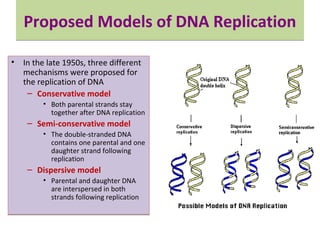
Proposed Models of DNA ReplicationProposed Models of DNA Replication
• In the late 1950s, three different
mechanisms were proposed for
the replication of DNA
– Conservative model
• Both parental strands stay
together after DNA replication
– Semi-conservative model
• The double-stranded DNA
contains one parental and one
daughter strand following
replication
– Dispersive model
• Parental and daughter DNA
are interspersed in both
strands following replication
• In the late 1950s, three different
mechanisms were proposed for
the replication of DNA
– Conservative model
• Both parental strands stay
together after DNA replication
– Semi-conservative model
• The double-stranded DNA
contains one parental and one
daughter strand following
replication
– Dispersive model
• Parental and daughter DNA
are interspersed in both
strands following replication
Basic rules of DNA replicationBasic rules of DNA replication
• Specificity of base pairing
• Synthesis direction 5’-3’ (C
at 3’ position in 3’ end has
free –OH)
• Nucleotides added at 3’ of
growing strand – DNA
polymerase
Components of DNA ReplicationComponents of DNA Replication
 DNA polymerases- Deoxynucleotide polymerization
 Helicase -Processive unwinding of DNA
 Topoisomerases Relieve torsional strain that results from
helicase-induced unwinding
 RNA primase Initiates synthesis of RNA primers
 Single-strand binding proteins Prevent premature
reannealing of dsDNA
 DNA ligase Seals the single strand nick between the nascent
chain and Okazaki fragments on lagging strand
 DNA polymerases- Deoxynucleotide polymerization
 Helicase -Processive unwinding of DNA
 Topoisomerases Relieve torsional strain that results from
helicase-induced unwinding
 RNA primase Initiates synthesis of RNA primers
 Single-strand binding proteins Prevent premature
reannealing of dsDNA
 DNA ligase Seals the single strand nick between the nascent
chain and Okazaki fragments on lagging strand
Steps In DNA ReplicationSteps In DNA Replication
• Identification of the origins of replication
• Unwinding (denaturation) of dsDNA to provide an ssDNA template
• Formation of the replication fork
• Initiation of DNA synthesis and elongation - Synthesis of leading and
lagging strands(okazaki fragment)
• Primer removal and ligation of the newly synthesized DNA segments
• Reconstitution of chromatin structure
• Identification of the origins of replication
• Unwinding (denaturation) of dsDNA to provide an ssDNA template
• Formation of the replication fork
• Initiation of DNA synthesis and elongation - Synthesis of leading and
lagging strands(okazaki fragment)
• Primer removal and ligation of the newly synthesized DNA segments
• Reconstitution of chromatin structure
PROKARYOTIC DNA POLYMERASE
Property Polymerase I Polymerase II Polymerase III
Mass (kDa) 103 90 830
Turnover no/ min 600 30 1200
No. of subunits One >4 >10
Structural gene polA polB polC
Polymerization 5’-3’ Yes Yes Yes
Exonuclease 5’-3’ Yes No No
Exonuclease 3’-5’ Yes Yes Yes
DNA Replication in ProkaryotesDNA Replication in Prokaryotes
Origin of Replication(oriC)
• 245 bp long
• contains several conserved
sequences:
 Four 9-bp repeats
5' - TTATCCACA – 3’ (DnaA box)
Orientation, spacing, and sequences
of the 9-bp repeats are critical for
function of oriC
 Three 13-bp repeats
5' - GATCTNTTNTTTT – 3’ (DnaB
box)
AT-richness of 13-bp repeats crucial
13 13 13 9 999
245bp
oriC(E.coli)
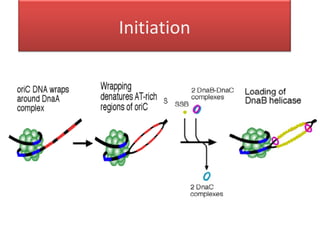
Initiation
ElongationElongation
 Once priming is complete DNA pol III
is loaded into the DNA and
replication begins
 Nucleophilic attack by the 3' OH on
the alpha phosphate releases
pyrophosphate
 Subsequently hydrolyzed (by
inorganic phosphatase) into two
phosphates
 This hydrolysis drives DNA synthesis
to completion
 Once priming is complete DNA pol III
is loaded into the DNA and
replication begins
 Nucleophilic attack by the 3' OH on
the alpha phosphate releases
pyrophosphate
 Subsequently hydrolyzed (by
inorganic phosphatase) into two
phosphates
 This hydrolysis drives DNA synthesis
to completion
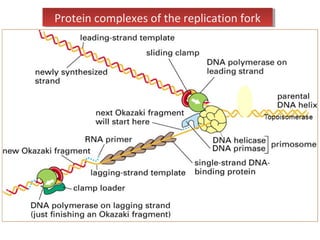
Protein complexes of the replication forkProtein complexes of the replication fork
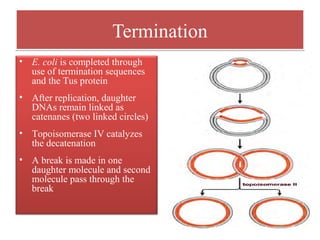
TerminationTermination
• E. coli is completed through
use of termination sequences
and the Tus protein
• After replication, daughter
DNAs remain linked as
catenanes (two linked circles)
• Topoisomerase IV catalyzes
the decatenation
• A break is made in one
daughter molecule and second
molecule pass through the
break
DNA Replication in EukaryotesDNA Replication in Eukaryotes
• Multiple replication origins
 Eukaryotic chromosomes
have multiple replication
origins
 One origin for 3-300kb
 Clusters of 20-80 adjacent
replicons (DNA segments that
are served by a origin) are
activated simultaneously
• Multiple replication origins
 Eukaryotic chromosomes
have multiple replication
origins
 One origin for 3-300kb
 Clusters of 20-80 adjacent
replicons (DNA segments that
are served by a origin) are
activated simultaneously
Bidirectional movement of the Eukaryotic
DNA replication machinery
Eukaryotic DNA PolymeraseEukaryotic DNA Polymerase
Eukaryotic Initiation Complex
Pre-replicative complex (pre-RC)
•Assembled at each ori. during the G1G1 phasephase
•LicensingLicensing – This is the only phase when pre-RC assembles –
ensuring single DNA replication/cell cycle
•Pre-RC will be activated only during S phaseS phase to start replication
•This temporal separation of pre-RC assembly and origin
activation ensures that a new pre-RC cannot assemble on an origin
that is already “fired”
Assembly of licensed pre-RC
• Begins with binding of the origin recognition
complex (ORC hexamer Orc 1-6) proteins to
the origin
• ORC - functional analog of DnaA proteins in
prokaryotes
• ORC recruits two proteins, Cdc6 and Cdt1
• These proteins then cooperate with the ORC
to load the MCM complex (hexamer of
Mcm2-7, does MiniChromosome
Maintenance function)
• Cdc6/Cdc18 + Cdt1 - analog of prokaryote
DnaC - facilitates DnaB loading
• MCM complex - ATP-driven helicase - analog
of prokaryote DnaB helicase
Activation of licensed pre-RC to initiation complex
• Needs the addition of pol α/primase, pol , and several accessoryε
proteins
• Process begins with addition of Mcm10 protein to pre-RC
• Mcm10 displaces Cdt1
• Addition of at least two protein kinases, a Cdk and Ddk happens
• Ddk phosphorylates five of the six MCM subunits (except Mcm2)
- activate the MCM complex as a Helicase
• Cdc6/Cdc18 and Cdt1are phosphorylated by Cdks(Removal of
Cdc6 and Cdt1 molecules)
• Ddk together with a Cdk also recruits Cdc45
• Cdc45 – assembles the initiating synthetic machinery at the
replication fork (pol α/primase + pol + PCNA + replicationε
protein A (RPA which is the heterotrimeric eukaryotic counterpart
of SSB)
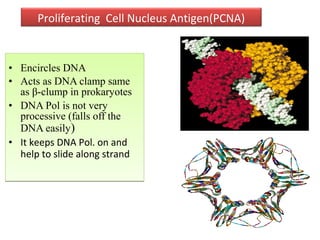
• Encircles DNA
• Acts as DNA clamp same
as β-clump in prokaryotes
• DNA Pol is not very
processive (falls off the
DNA easily)
• It keeps DNA Pol. on and
help to slide along strand
• Encircles DNA
• Acts as DNA clamp same
as β-clump in prokaryotes
• DNA Pol is not very
processive (falls off the
DNA easily)
• It keeps DNA Pol. on and
help to slide along strand
Proliferating Cell Nucleus Antigen(PCNA)
• Eukaryotic clamp loader function
same as DnaC in prokaryotes
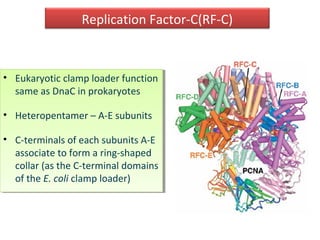
• Heteropentamer – A-E subunits
• C-terminals of each subunits A-E
associate to form a ring-shaped
collar (as the C-terminal domains
of the E. coli clamp loader)
• Eukaryotic clamp loader function
same as DnaC in prokaryotes
• Heteropentamer – A-E subunits
• C-terminals of each subunits A-E
associate to form a ring-shaped
collar (as the C-terminal domains
of the E. coli clamp loader)
Replication Factor-C(RF-C)
Lagging strand synthesis
• Pol α/primase generates RNA primers and extends it by ~20 nt
• Pol α lacks proofreading (this primer extension will have more
errors than the DNA synthesized by pol δ)
• When Pol. δ reaches the previously synthesized Okazaki
fragment, it partially displaces RNA primer through DNA
synthesis
• This generates an RNA flap
Lagging strand synthesis
• Pol α/primase generates RNA primers and extends it by ~20 nt
• Pol α lacks proofreading (this primer extension will have more
errors than the DNA synthesized by pol δ)
• When Pol. δ reaches the previously synthesized Okazaki
fragment, it partially displaces RNA primer through DNA
synthesis
• This generates an RNA flap
• The primer is then removed by two
enzymes
(i) RNase H1 - removes most of the
RNA, leaving only a 5’
ribonucleotide adjacent to the DNA
(ii) Flap endonuclease-1 (FEN1) –
removes 5’ ribonucleotide and effects
5’-3’ proof reading
• Any excision during the FEN1
proofreading is later replaced by pol
δ, during succeeding Okazaki
fragment synthesis
• Eukaryotes lack termination
sequences and proteins analogous to
Ter sites and Tus protein in
prokaryotes
• The primer is then removed by two
enzymes
(i) RNase H1 - removes most of the
RNA, leaving only a 5’
ribonucleotide adjacent to the DNA
(ii) Flap endonuclease-1 (FEN1) –
removes 5’ ribonucleotide and effects
5’-3’ proof reading
• Any excision during the FEN1
proofreading is later replaced by pol
δ, during succeeding Okazaki
fragment synthesis
• Eukaryotes lack termination
sequences and proteins analogous to
Ter sites and Tus protein in
prokaryotes
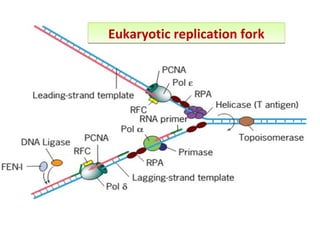
Eukaryotic replication forkEukaryotic replication fork
Telomeres of linear chromosomes
• Repair polymerases & ligase cannot fill gap at end of
chromosome after RNA primer is removed
• If this gap is not filled, chromosomes would become shorter
each round of replication
Telomeric Replication
SolutionsSolutions
1. Eukaryotes have tandem repeated sequences at the ends of their
chromosomes
2. Telomerase (composed of protein and RNA primer
complementary to the telomere repeat) binds to the terminal
telomere repeat and catalyzes the addition of new repeats
3. Compensates by lengthening the chromosome - rare
Proof: Arabidopsis mutants with no telomerase activity had shown
reduction in chromosome length and limited cell division
Telomerase
•A large protein-RNA
complex
•The RNA (blue) contains a
templating sequence for
synthesizing new DNA
telomere repeats.
•The synthesis reaction is
done by the reversereverse
transcriptase domaintranscriptase domain of the
protein (green)
• Telomerase – carries its own RNA template with it at all times
• Telomerase also has several additional protein domains needed to
assemble the enzyme at the ends of chromosomes properly
Synthesis of telomeric DNA by telomeraseSynthesis of telomeric DNA by telomerase
Lagging strand
Direction of replication
• As DNA unwinds, nucleosomes must disassemble
• Histones and the associated chromatin proteins must be
duplicated by new protein synthesis
• Newly replicated DNA is assembled into nucleosomes almost
immediately
• Histone chaperone proteins control the assembly
• As DNA unwinds, nucleosomes must disassemble
• Histones and the associated chromatin proteins must be
duplicated by new protein synthesis
• Newly replicated DNA is assembled into nucleosomes almost
immediately
• Histone chaperone proteins control the assembly
Final Step - Assembly into NucleosomesFinal Step - Assembly into NucleosomesFinal Step - Assembly into NucleosomesFinal Step - Assembly into Nucleosomes
SummarySummary
Reference
1. Life Science-Fundamental and Practices (part-II).
Page no.-95-111
2. Molecular Biology of the Gene 212/755 p. 184
3. Instant notes on Biochemistry, thired edition,p-173
4. e-Sources
5. Classnote (Microbiology)
Click here to download this powerpoint template : Brown Floral Background Free Powerpoint Template
For more : Templates For Powerpoint
Page 32

Dna replication

  • 1.
  • 2.
    DNA Replication-Introduction • Basisfor inheritance • Fundamental process occurring in all cells for transfer of genetic information to daughter cells • Each cell must replicate its DNA before division. • DNA is copied during the S or synthesis phase of interphase • New cells will need identical DNA strands Cell cycle
  • 3.
    Proposed Models ofDNA ReplicationProposed Models of DNA Replication • In the late 1950s, three different mechanisms were proposed for the replication of DNA – Conservative model • Both parental strands stay together after DNA replication – Semi-conservative model • The double-stranded DNA contains one parental and one daughter strand following replication – Dispersive model • Parental and daughter DNA are interspersed in both strands following replication • In the late 1950s, three different mechanisms were proposed for the replication of DNA – Conservative model • Both parental strands stay together after DNA replication – Semi-conservative model • The double-stranded DNA contains one parental and one daughter strand following replication – Dispersive model • Parental and daughter DNA are interspersed in both strands following replication
  • 4.
    Basic rules ofDNA replicationBasic rules of DNA replication • Specificity of base pairing • Synthesis direction 5’-3’ (C at 3’ position in 3’ end has free –OH) • Nucleotides added at 3’ of growing strand – DNA polymerase
  • 5.
    Components of DNAReplicationComponents of DNA Replication  DNA polymerases- Deoxynucleotide polymerization  Helicase -Processive unwinding of DNA  Topoisomerases Relieve torsional strain that results from helicase-induced unwinding  RNA primase Initiates synthesis of RNA primers  Single-strand binding proteins Prevent premature reannealing of dsDNA  DNA ligase Seals the single strand nick between the nascent chain and Okazaki fragments on lagging strand  DNA polymerases- Deoxynucleotide polymerization  Helicase -Processive unwinding of DNA  Topoisomerases Relieve torsional strain that results from helicase-induced unwinding  RNA primase Initiates synthesis of RNA primers  Single-strand binding proteins Prevent premature reannealing of dsDNA  DNA ligase Seals the single strand nick between the nascent chain and Okazaki fragments on lagging strand
  • 6.
    Steps In DNAReplicationSteps In DNA Replication • Identification of the origins of replication • Unwinding (denaturation) of dsDNA to provide an ssDNA template • Formation of the replication fork • Initiation of DNA synthesis and elongation - Synthesis of leading and lagging strands(okazaki fragment) • Primer removal and ligation of the newly synthesized DNA segments • Reconstitution of chromatin structure • Identification of the origins of replication • Unwinding (denaturation) of dsDNA to provide an ssDNA template • Formation of the replication fork • Initiation of DNA synthesis and elongation - Synthesis of leading and lagging strands(okazaki fragment) • Primer removal and ligation of the newly synthesized DNA segments • Reconstitution of chromatin structure
  • 7.
    PROKARYOTIC DNA POLYMERASE PropertyPolymerase I Polymerase II Polymerase III Mass (kDa) 103 90 830 Turnover no/ min 600 30 1200 No. of subunits One >4 >10 Structural gene polA polB polC Polymerization 5’-3’ Yes Yes Yes Exonuclease 5’-3’ Yes No No Exonuclease 3’-5’ Yes Yes Yes
  • 8.
    DNA Replication inProkaryotesDNA Replication in Prokaryotes Origin of Replication(oriC) • 245 bp long • contains several conserved sequences:  Four 9-bp repeats 5' - TTATCCACA – 3’ (DnaA box) Orientation, spacing, and sequences of the 9-bp repeats are critical for function of oriC  Three 13-bp repeats 5' - GATCTNTTNTTTT – 3’ (DnaB box) AT-richness of 13-bp repeats crucial 13 13 13 9 999 245bp oriC(E.coli)
  • 9.
  • 10.
    ElongationElongation  Once primingis complete DNA pol III is loaded into the DNA and replication begins  Nucleophilic attack by the 3' OH on the alpha phosphate releases pyrophosphate  Subsequently hydrolyzed (by inorganic phosphatase) into two phosphates  This hydrolysis drives DNA synthesis to completion  Once priming is complete DNA pol III is loaded into the DNA and replication begins  Nucleophilic attack by the 3' OH on the alpha phosphate releases pyrophosphate  Subsequently hydrolyzed (by inorganic phosphatase) into two phosphates  This hydrolysis drives DNA synthesis to completion
  • 11.
    Protein complexes ofthe replication forkProtein complexes of the replication fork
  • 12.
    TerminationTermination • E. coliis completed through use of termination sequences and the Tus protein • After replication, daughter DNAs remain linked as catenanes (two linked circles) • Topoisomerase IV catalyzes the decatenation • A break is made in one daughter molecule and second molecule pass through the break
  • 13.
    DNA Replication inEukaryotesDNA Replication in Eukaryotes • Multiple replication origins  Eukaryotic chromosomes have multiple replication origins  One origin for 3-300kb  Clusters of 20-80 adjacent replicons (DNA segments that are served by a origin) are activated simultaneously • Multiple replication origins  Eukaryotic chromosomes have multiple replication origins  One origin for 3-300kb  Clusters of 20-80 adjacent replicons (DNA segments that are served by a origin) are activated simultaneously Bidirectional movement of the Eukaryotic DNA replication machinery
  • 14.
  • 15.
    Eukaryotic Initiation Complex Pre-replicativecomplex (pre-RC) •Assembled at each ori. during the G1G1 phasephase •LicensingLicensing – This is the only phase when pre-RC assembles – ensuring single DNA replication/cell cycle •Pre-RC will be activated only during S phaseS phase to start replication •This temporal separation of pre-RC assembly and origin activation ensures that a new pre-RC cannot assemble on an origin that is already “fired”
  • 16.
    Assembly of licensedpre-RC • Begins with binding of the origin recognition complex (ORC hexamer Orc 1-6) proteins to the origin • ORC - functional analog of DnaA proteins in prokaryotes • ORC recruits two proteins, Cdc6 and Cdt1 • These proteins then cooperate with the ORC to load the MCM complex (hexamer of Mcm2-7, does MiniChromosome Maintenance function) • Cdc6/Cdc18 + Cdt1 - analog of prokaryote DnaC - facilitates DnaB loading • MCM complex - ATP-driven helicase - analog of prokaryote DnaB helicase
  • 17.
    Activation of licensedpre-RC to initiation complex • Needs the addition of pol α/primase, pol , and several accessoryε proteins • Process begins with addition of Mcm10 protein to pre-RC • Mcm10 displaces Cdt1 • Addition of at least two protein kinases, a Cdk and Ddk happens • Ddk phosphorylates five of the six MCM subunits (except Mcm2) - activate the MCM complex as a Helicase • Cdc6/Cdc18 and Cdt1are phosphorylated by Cdks(Removal of Cdc6 and Cdt1 molecules) • Ddk together with a Cdk also recruits Cdc45 • Cdc45 – assembles the initiating synthetic machinery at the replication fork (pol α/primase + pol + PCNA + replicationε protein A (RPA which is the heterotrimeric eukaryotic counterpart of SSB)
  • 19.
    • Encircles DNA •Acts as DNA clamp same as β-clump in prokaryotes • DNA Pol is not very processive (falls off the DNA easily) • It keeps DNA Pol. on and help to slide along strand • Encircles DNA • Acts as DNA clamp same as β-clump in prokaryotes • DNA Pol is not very processive (falls off the DNA easily) • It keeps DNA Pol. on and help to slide along strand Proliferating Cell Nucleus Antigen(PCNA)
  • 20.
    • Eukaryotic clamploader function same as DnaC in prokaryotes • Heteropentamer – A-E subunits • C-terminals of each subunits A-E associate to form a ring-shaped collar (as the C-terminal domains of the E. coli clamp loader) • Eukaryotic clamp loader function same as DnaC in prokaryotes • Heteropentamer – A-E subunits • C-terminals of each subunits A-E associate to form a ring-shaped collar (as the C-terminal domains of the E. coli clamp loader) Replication Factor-C(RF-C)
  • 21.
    Lagging strand synthesis •Pol α/primase generates RNA primers and extends it by ~20 nt • Pol α lacks proofreading (this primer extension will have more errors than the DNA synthesized by pol δ) • When Pol. δ reaches the previously synthesized Okazaki fragment, it partially displaces RNA primer through DNA synthesis • This generates an RNA flap Lagging strand synthesis • Pol α/primase generates RNA primers and extends it by ~20 nt • Pol α lacks proofreading (this primer extension will have more errors than the DNA synthesized by pol δ) • When Pol. δ reaches the previously synthesized Okazaki fragment, it partially displaces RNA primer through DNA synthesis • This generates an RNA flap
  • 22.
    • The primeris then removed by two enzymes (i) RNase H1 - removes most of the RNA, leaving only a 5’ ribonucleotide adjacent to the DNA (ii) Flap endonuclease-1 (FEN1) – removes 5’ ribonucleotide and effects 5’-3’ proof reading • Any excision during the FEN1 proofreading is later replaced by pol δ, during succeeding Okazaki fragment synthesis • Eukaryotes lack termination sequences and proteins analogous to Ter sites and Tus protein in prokaryotes • The primer is then removed by two enzymes (i) RNase H1 - removes most of the RNA, leaving only a 5’ ribonucleotide adjacent to the DNA (ii) Flap endonuclease-1 (FEN1) – removes 5’ ribonucleotide and effects 5’-3’ proof reading • Any excision during the FEN1 proofreading is later replaced by pol δ, during succeeding Okazaki fragment synthesis • Eukaryotes lack termination sequences and proteins analogous to Ter sites and Tus protein in prokaryotes
  • 23.
  • 24.
    Telomeres of linearchromosomes • Repair polymerases & ligase cannot fill gap at end of chromosome after RNA primer is removed • If this gap is not filled, chromosomes would become shorter each round of replication Telomeric Replication
  • 25.
    SolutionsSolutions 1. Eukaryotes havetandem repeated sequences at the ends of their chromosomes 2. Telomerase (composed of protein and RNA primer complementary to the telomere repeat) binds to the terminal telomere repeat and catalyzes the addition of new repeats 3. Compensates by lengthening the chromosome - rare Proof: Arabidopsis mutants with no telomerase activity had shown reduction in chromosome length and limited cell division
  • 26.
    Telomerase •A large protein-RNA complex •TheRNA (blue) contains a templating sequence for synthesizing new DNA telomere repeats. •The synthesis reaction is done by the reversereverse transcriptase domaintranscriptase domain of the protein (green) • Telomerase – carries its own RNA template with it at all times • Telomerase also has several additional protein domains needed to assemble the enzyme at the ends of chromosomes properly
  • 27.
    Synthesis of telomericDNA by telomeraseSynthesis of telomeric DNA by telomerase Lagging strand Direction of replication
  • 28.
    • As DNAunwinds, nucleosomes must disassemble • Histones and the associated chromatin proteins must be duplicated by new protein synthesis • Newly replicated DNA is assembled into nucleosomes almost immediately • Histone chaperone proteins control the assembly • As DNA unwinds, nucleosomes must disassemble • Histones and the associated chromatin proteins must be duplicated by new protein synthesis • Newly replicated DNA is assembled into nucleosomes almost immediately • Histone chaperone proteins control the assembly Final Step - Assembly into NucleosomesFinal Step - Assembly into NucleosomesFinal Step - Assembly into NucleosomesFinal Step - Assembly into Nucleosomes
  • 30.
  • 31.
    Reference 1. Life Science-Fundamentaland Practices (part-II). Page no.-95-111 2. Molecular Biology of the Gene 212/755 p. 184 3. Instant notes on Biochemistry, thired edition,p-173 4. e-Sources 5. Classnote (Microbiology)
  • 32.
    Click here todownload this powerpoint template : Brown Floral Background Free Powerpoint Template For more : Templates For Powerpoint Page 32