*
1.   Take out PD and Reading Annotations
2.   Take 1 sheet of DNA – Double Helix Game,
     DNA replication Notes, and 1 laptop per
     table. Log-on and go to nobelprize.org. Then
     click on the educational tab on top of the
     menu
3.   Swap and Comment on PDs


                                *
Objective: be the fastest team that makes a copy
of DNA with the least amount of nucleotides so
that you end up with 2 copies of DNA in the end
Rules:
- No talking during the activity
- 2 min to discuss strategy before
   activity
- When finished, tape your 2 DNA
   strands on the white board as shown
- The game does not end until the top
   3 teams are established


   http://www.online-stopwatch.com/
Fun Fact:


Speed of DNA replication in human cells
50bps/sec
Speed of DNA replication in bacterial cells
1000bps/sec


                *
1.   What are some differences and similarities
     between DNA and RNA
2.   Draw how the two strands of DNA align.
     Label the 5’ (prime) and 3’ (prime)
     ends.(draw out the molecules) What is this
     type of alignment called?
3.   What is going well in this class so far? What
     are your criticisms of this class?


                                  *
http://www.youtube.com/watch?v=bee6PWUgPo8&feature=relmfu
DNA Replication means to

      Make copies of DNA

DNA Replication happens when


     new cells need to be
                    made
           Mitosis and Meiosis
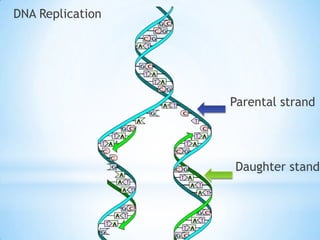
DNA Replication


                  Parental strand


                  Daughter stand
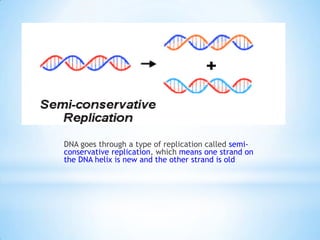
DNA goes through a type of replication called semi-
conservative replication, which means one strand on
the DNA helix is new and the other strand is old
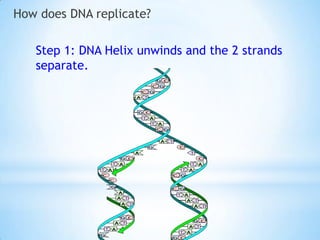
How does DNA replicate?

   Step 1: DNA Helix unwinds and the 2 strands
   separate.
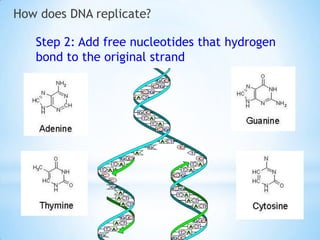
How does DNA replicate?

   Step 2: Add free nucleotides that hydrogen
   bond to the original strand
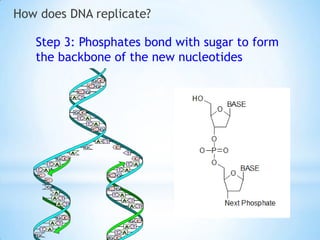
How does DNA replicate?

   Step 3: Phosphates bond with sugar to form
   the backbone of the new nucleotides
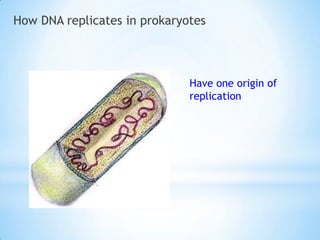
How DNA replicates in prokaryotes


                              Have one origin of
                              replication
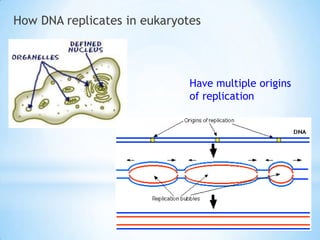
How DNA replicates in eukaryotes


                              Have multiple origins
                              of replication
The main difference between replication in prokaryotes and
eukaryotes is that prokaryotes have one origin of replication and
eukaryotes have many
Mechanism of DNA Replication:
http://www.youtube.com/watch?v=teV62zrm2P0
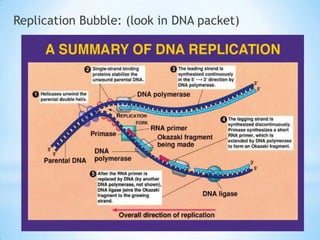
Replication Bubble: (look in DNA packet)
DNA REPLication Real Time Advanced:
http://www.youtube.com/watch?v=I9ArIJWYZHI
Replication fork:
      • Where the DNA strands split off
      • Moves with the path of the replication
        bubble
Primer:
          Short sequence of RNA that binds to the
          lagging parental strand in order for DNA
          polymerase to copy the lagging strnad
Primase:
          A protein that binds to the parental lagging
          strand to make a primer

Helicase:
          A protein that unwinds DNA
Single strand binding protein:
       A protein that binds each DNA strand to
       stabilize it and hold it apart


DNA polymerase:
       A protein that adds free nucleotides from
       5’ to 3’ to make a new strand of DNA.
       Also fixes mistakes in DNA
DNA ligase:
       A protein that binds the phosphates of
       nucleic acids to the sugar group of
       adjacent nucleic acids
A. Using Conservative replication
B. Using Dispersive replication
C.Using Liberal replication
D.Using Semi-conservative replication
A. DNA Polymerase
B. Helicase
C.Primase
D.Ligase
E. Unwindase
A. Leading Strand
B. Following Strand
C. Lagging Strand
D. Continuous Strand
A. Eukaryotes have a nucleus
B. Prokaryotes use conservative replication and
   Eukaryotes use semi-conservative.
C. Eukaryotes have multiple origins of
   replication and prokaryotes only have one
D. There is no difference
*
PCR HIDDEN HISTORY!


        *
* http://www.hulu.com/watch/101375/the-
 nobel-prize-he-surfs-he-walks-mazes-he-
 invents-pcr-profile-of-biochemist-kary-mullis
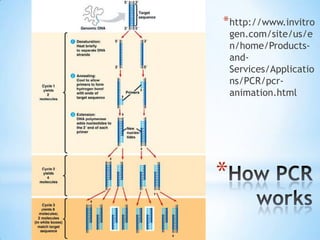
* PCR stands for Polymerase Chain Reaction
* PCR is a scientific technique to amplify (make
 large copies) of a specific sequence of DNA
* What protein unwinds DNA
* What protein adds nucleotides to make the
 new strand of DNA

* Draw a general diagram of how DNA replication
 works or Explain how DNA replication works

* Happy Friday!

                                *
1.   DNA Template
2.   dNTPs (deoxyribonucleotide)
3.   Taq Polymerase
4.   Primers
5.   Buffer and MgCl


               *
* http://www.invitrogen.com/site/us/en/home/
 Products-and-Services/Applications/PCR/pcr-
 animation.html


                           *
* http://www.invitro
    gen.com/site/us/e
    n/home/Products-
    and-
    Services/Applicatio
    ns/PCR/pcr-
    animation.html


*
*

Dna replication slide

  • 1.
  • 2.
    1. Take out PD and Reading Annotations 2. Take 1 sheet of DNA – Double Helix Game, DNA replication Notes, and 1 laptop per table. Log-on and go to nobelprize.org. Then click on the educational tab on top of the menu 3. Swap and Comment on PDs *
  • 3.
    Objective: be thefastest team that makes a copy of DNA with the least amount of nucleotides so that you end up with 2 copies of DNA in the end Rules: - No talking during the activity - 2 min to discuss strategy before activity - When finished, tape your 2 DNA strands on the white board as shown - The game does not end until the top 3 teams are established http://www.online-stopwatch.com/
  • 4.
    Fun Fact: Speed ofDNA replication in human cells 50bps/sec Speed of DNA replication in bacterial cells 1000bps/sec *
  • 5.
    1. What are some differences and similarities between DNA and RNA 2. Draw how the two strands of DNA align. Label the 5’ (prime) and 3’ (prime) ends.(draw out the molecules) What is this type of alignment called? 3. What is going well in this class so far? What are your criticisms of this class? *
  • 6.
  • 7.
    DNA Replication meansto Make copies of DNA DNA Replication happens when new cells need to be made Mitosis and Meiosis
  • 8.
    DNA Replication Parental strand Daughter stand
  • 9.
    DNA goes througha type of replication called semi- conservative replication, which means one strand on the DNA helix is new and the other strand is old
  • 10.
    How does DNAreplicate? Step 1: DNA Helix unwinds and the 2 strands separate.
  • 11.
    How does DNAreplicate? Step 2: Add free nucleotides that hydrogen bond to the original strand
  • 12.
    How does DNAreplicate? Step 3: Phosphates bond with sugar to form the backbone of the new nucleotides
  • 13.
    How DNA replicatesin prokaryotes Have one origin of replication
  • 14.
    How DNA replicatesin eukaryotes Have multiple origins of replication
  • 15.
    The main differencebetween replication in prokaryotes and eukaryotes is that prokaryotes have one origin of replication and eukaryotes have many
  • 16.
    Mechanism of DNAReplication: http://www.youtube.com/watch?v=teV62zrm2P0
  • 17.
  • 18.
    DNA REPLication RealTime Advanced: http://www.youtube.com/watch?v=I9ArIJWYZHI
  • 19.
    Replication fork: • Where the DNA strands split off • Moves with the path of the replication bubble Primer: Short sequence of RNA that binds to the lagging parental strand in order for DNA polymerase to copy the lagging strnad Primase: A protein that binds to the parental lagging strand to make a primer Helicase: A protein that unwinds DNA
  • 20.
    Single strand bindingprotein: A protein that binds each DNA strand to stabilize it and hold it apart DNA polymerase: A protein that adds free nucleotides from 5’ to 3’ to make a new strand of DNA. Also fixes mistakes in DNA DNA ligase: A protein that binds the phosphates of nucleic acids to the sugar group of adjacent nucleic acids
  • 21.
    A. Using Conservativereplication B. Using Dispersive replication C.Using Liberal replication D.Using Semi-conservative replication
  • 22.
    A. DNA Polymerase B.Helicase C.Primase D.Ligase E. Unwindase
  • 23.
    A. Leading Strand B.Following Strand C. Lagging Strand D. Continuous Strand
  • 24.
    A. Eukaryotes havea nucleus B. Prokaryotes use conservative replication and Eukaryotes use semi-conservative. C. Eukaryotes have multiple origins of replication and prokaryotes only have one D. There is no difference
  • 25.
  • 26.
  • 27.
  • 28.
    * PCR standsfor Polymerase Chain Reaction * PCR is a scientific technique to amplify (make large copies) of a specific sequence of DNA
  • 29.
    * What proteinunwinds DNA * What protein adds nucleotides to make the new strand of DNA * Draw a general diagram of how DNA replication works or Explain how DNA replication works * Happy Friday! *
  • 30.
    1. DNA Template 2. dNTPs (deoxyribonucleotide) 3. Taq Polymerase 4. Primers 5. Buffer and MgCl *
  • 31.
  • 32.
    * http://www.invitro gen.com/site/us/e n/home/Products- and- Services/Applicatio ns/PCR/pcr- animation.html *
  • 33.