V I G N E S H M
I M . S C . , H G M B
DNA Replication in Eukaryotes
REPLICATION
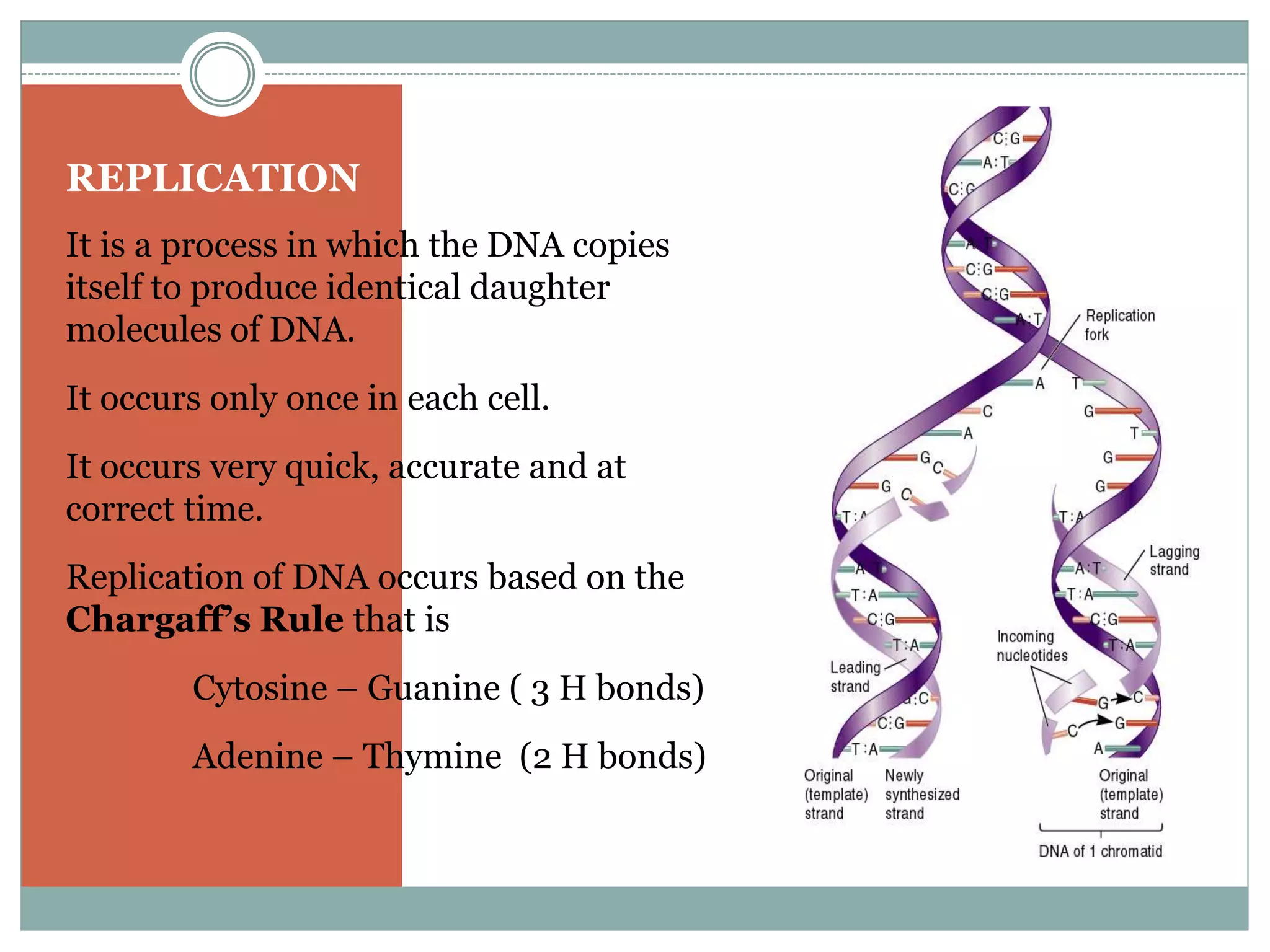
It is a process in which the DNA copies
itself to produce identical daughter
molecules of DNA.
It occurs only once in each cell.
It occurs very quick, accurate and at
correct time.
Replication of DNA occurs based on the
Chargaff’s Rule that is
 Cytosine – Guanine ( 3 H bonds)
 Adenine – Thymine (2 H bonds)
Modes of Replication
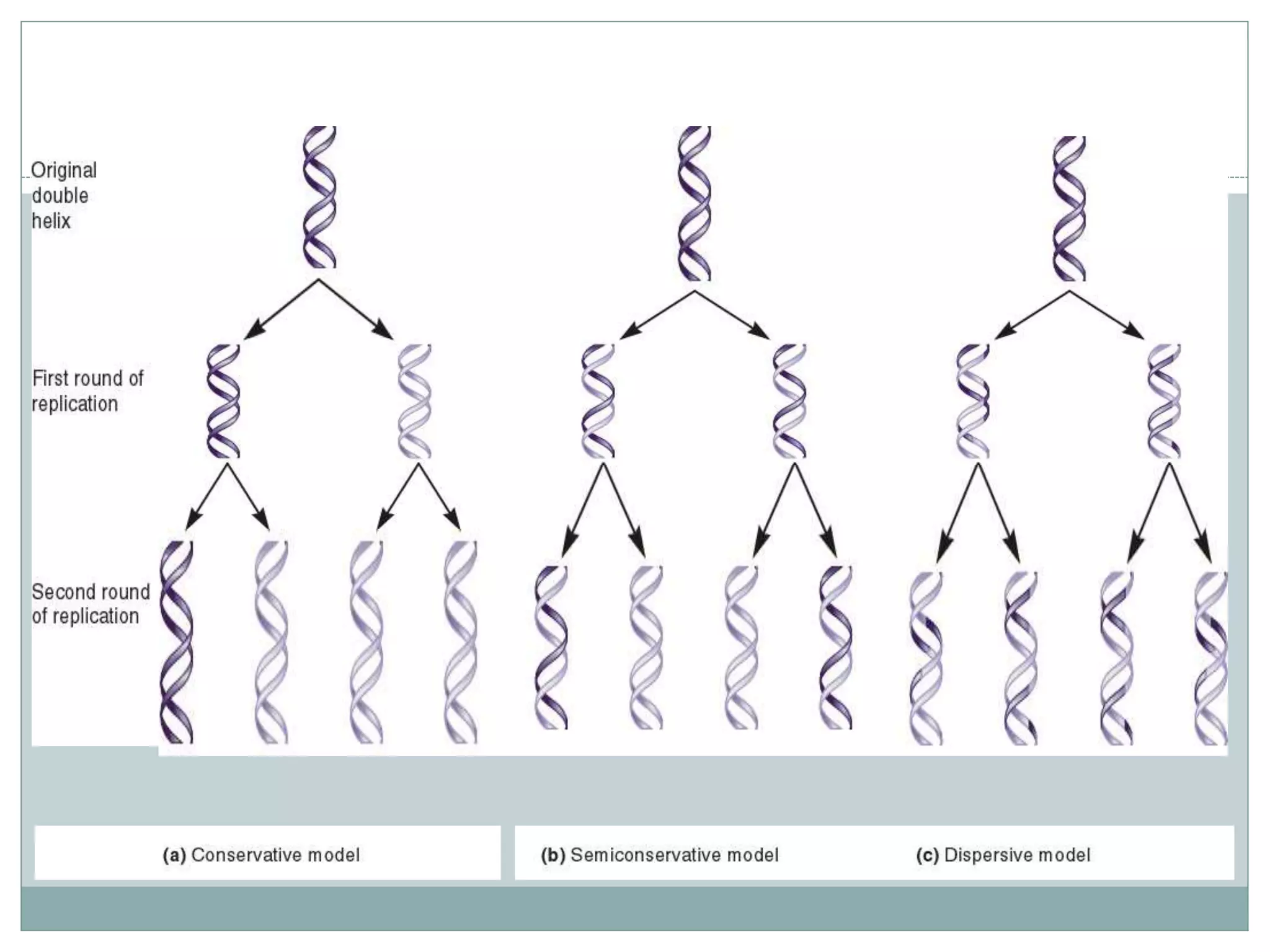
 Delbruck suggest that Watson-Crick model of DNA
could theoretically be replicated by three modes
• Conservative
• Semi-conservative
• dispersive
Simple Process
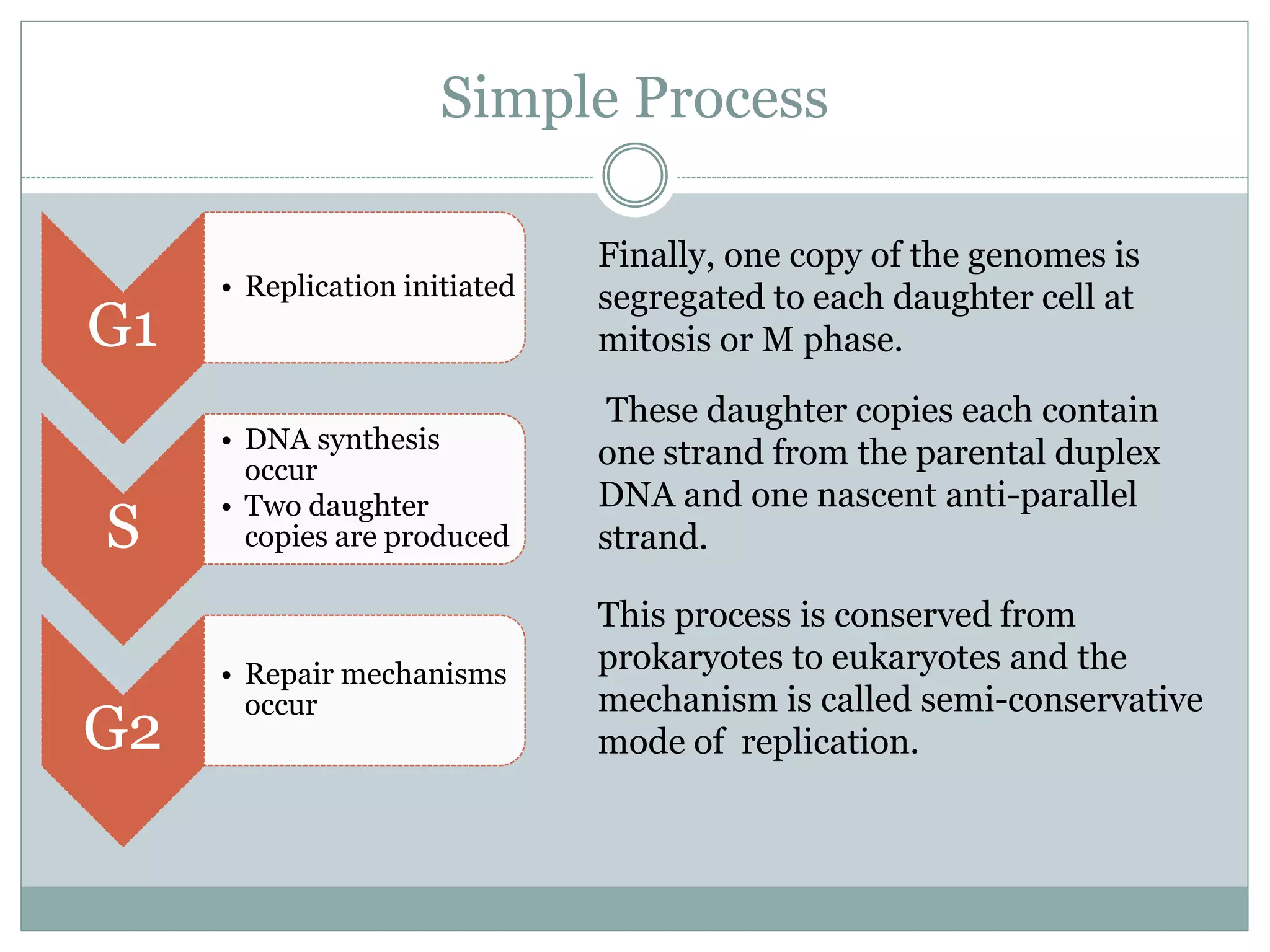
G1
• Replication initiated
S
• DNA synthesis
occur
• Two daughter
copies are produced
G2
• Repair mechanisms
occur
Finally, one copy of the genomes is
segregated to each daughter cell at
mitosis or M phase.
These daughter copies each contain
one strand from the parental duplex
DNA and one nascent anti-parallel
strand.
This process is conserved from
prokaryotes to eukaryotes and the
mechanism is called semi-conservative
mode of replication.
Complex Process
 DNA replication in eukaryotes divided into three
stages
1. Initiation ( Formation of Pre – Replicative
Complex)
2. Initiation complex
3. Elongation (Replication fork and
Polymerization)
4. Termination
Initiation of Replication
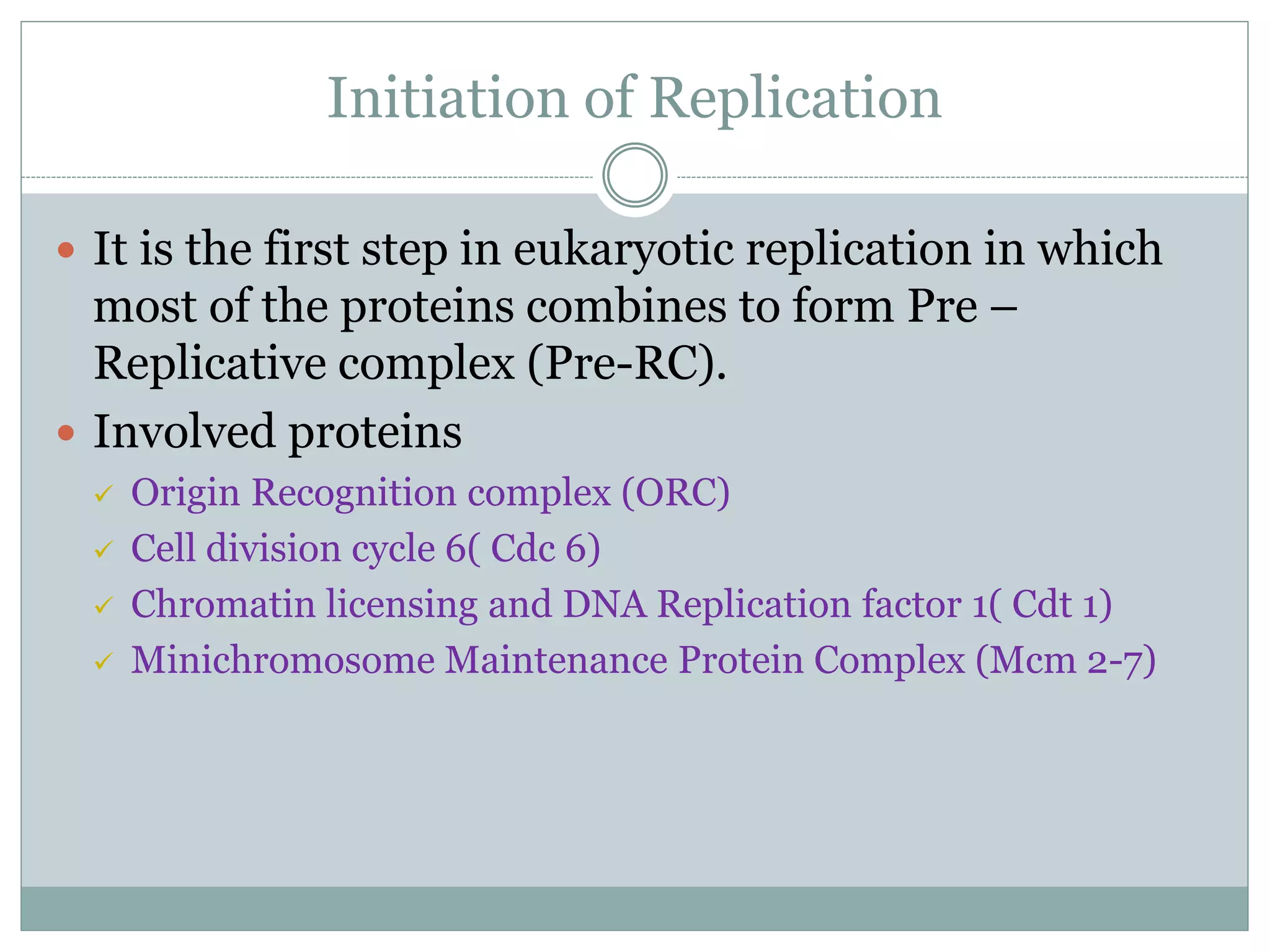
 It is the first step in eukaryotic replication in which
most of the proteins combines to form Pre –
Replicative complex (Pre-RC).
 Involved proteins
 Origin Recognition complex (ORC)
 Cell division cycle 6( Cdc 6)
 Chromatin licensing and DNA Replication factor 1( Cdt 1)
 Minichromosome Maintenance Protein Complex (Mcm 2-7)
Steps in initiation
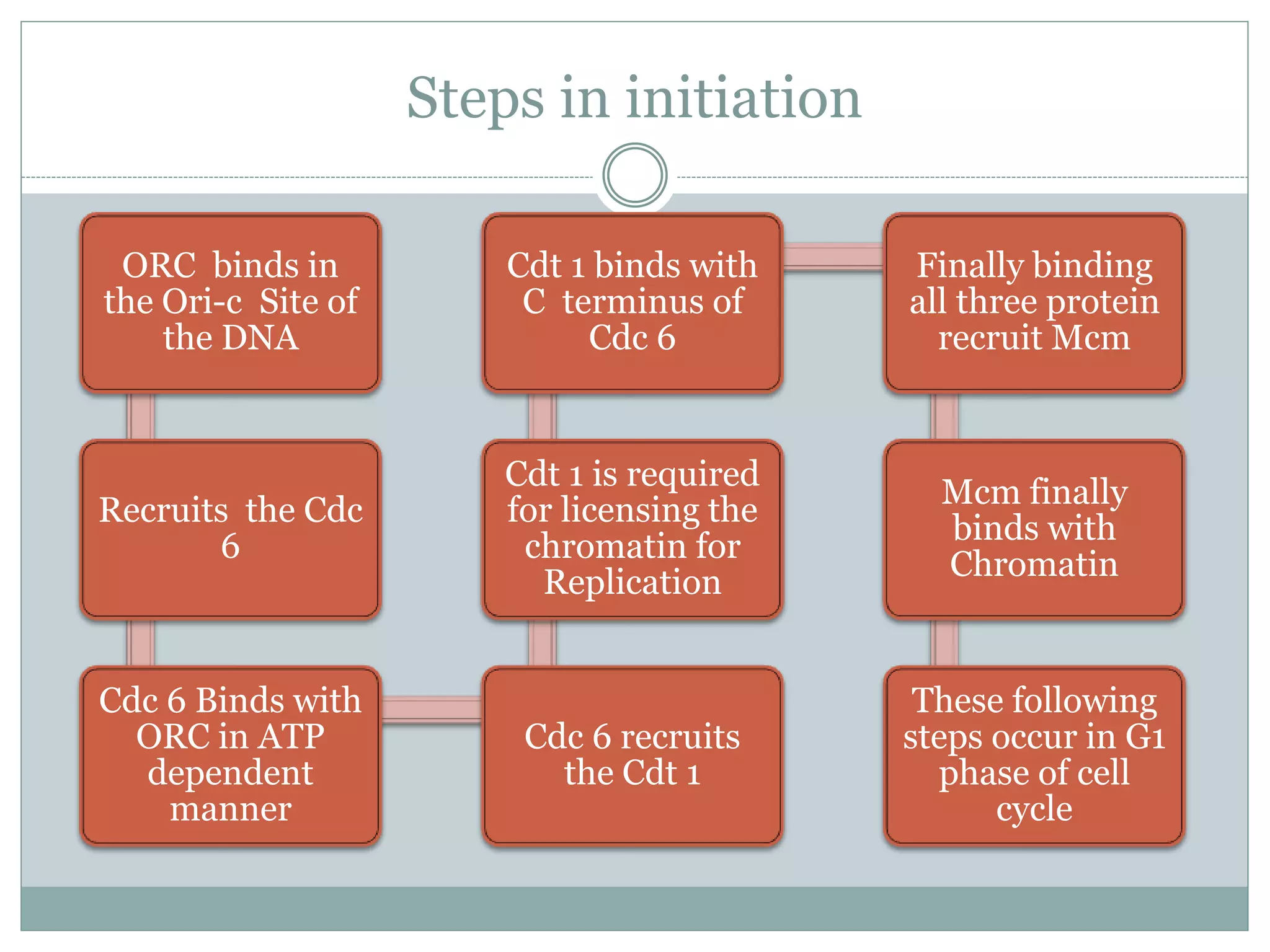
ORC binds in
the Ori-c Site of
the DNA
Recruits the Cdc
6
Cdc 6 Binds with
ORC in ATP
dependent
manner
Cdc 6 recruits
the Cdt 1
Cdt 1 is required
for licensing the
chromatin for
Replication
Cdt 1 binds with
C terminus of
Cdc 6
Finally binding
all three protein
recruit Mcm
Mcm finally
binds with
Chromatin
These following
steps occur in G1
phase of cell
cycle
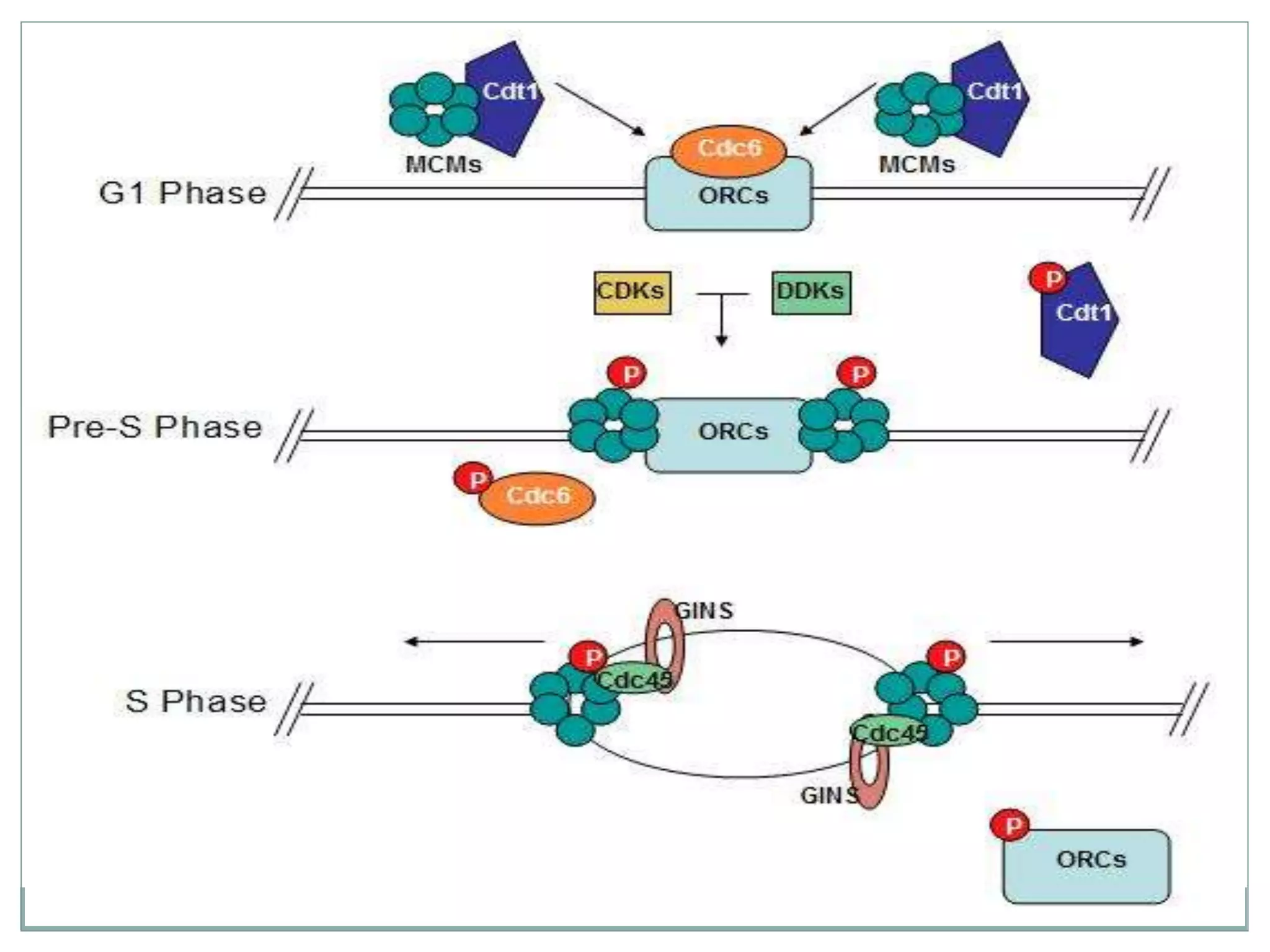
 The activity of Cdt 1 during the cell cycle is regulated
by a protein called Geminin.
 It also inhibits Cdt 1 activity during the S phase in
order to prevent the re-replication of DNA,
Ubiquitination and proteolysis.
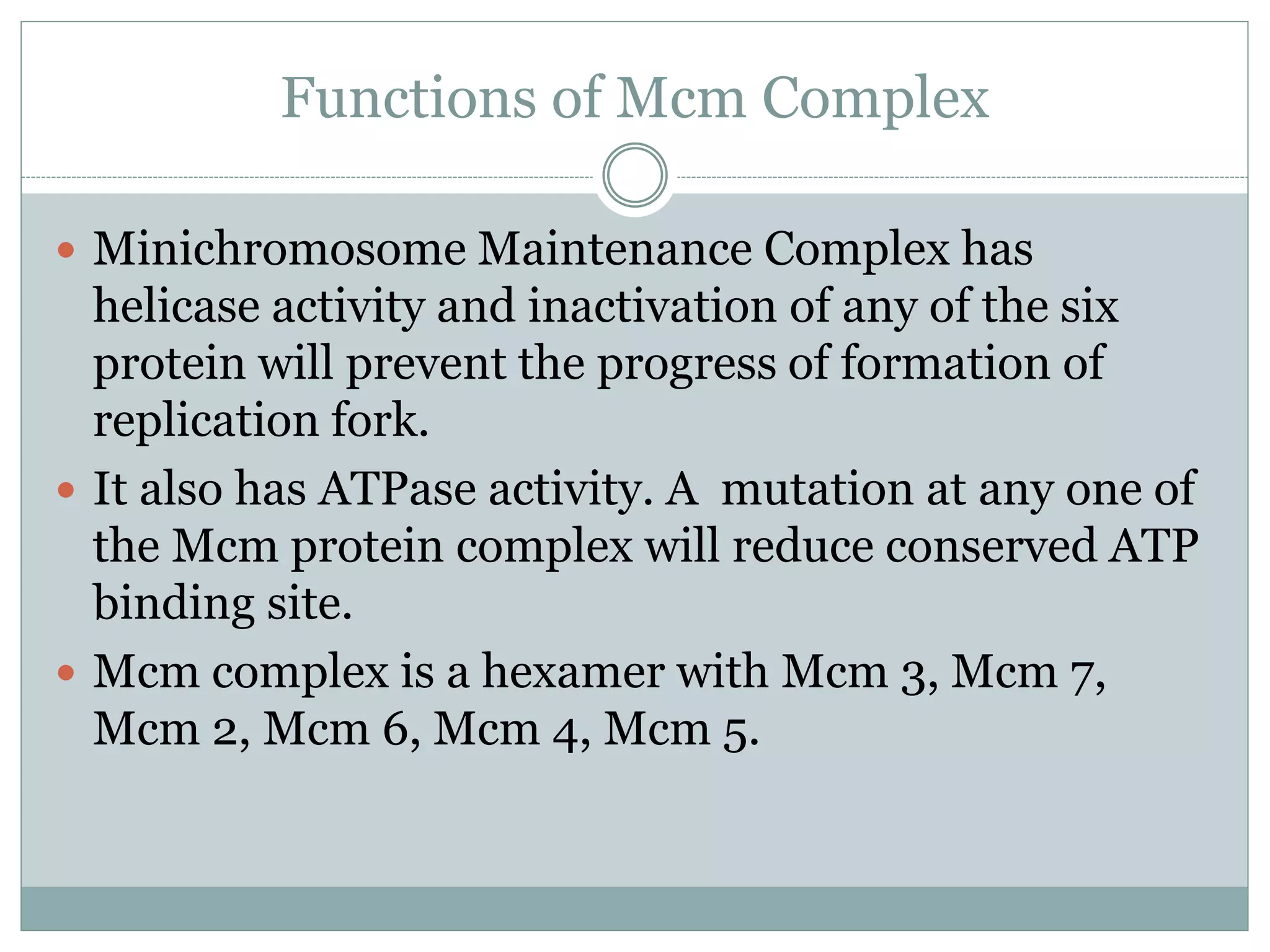
Functions of Mcm Complex
 Minichromosome Maintenance Complex has
helicase activity and inactivation of any of the six
protein will prevent the progress of formation of
replication fork.
 It also has ATPase activity. A mutation at any one of
the Mcm protein complex will reduce conserved ATP
binding site.
 Mcm complex is a hexamer with Mcm 3, Mcm 7,
Mcm 2, Mcm 6, Mcm 4, Mcm 5.
Initiation Complex
 It is the 2nd stage in DNA replication where the Pre –
Replicative complex is converted into Initiation
complex.
 Involved proteins
 Cell Division Cycle 45 ( Cdc 45)
 GINS
 Cyclin Dependent Kinase ( CDK)
 Dbf 4 Dependent Kinase (DDK) – Combination of Cdc 7 and
dbf 4
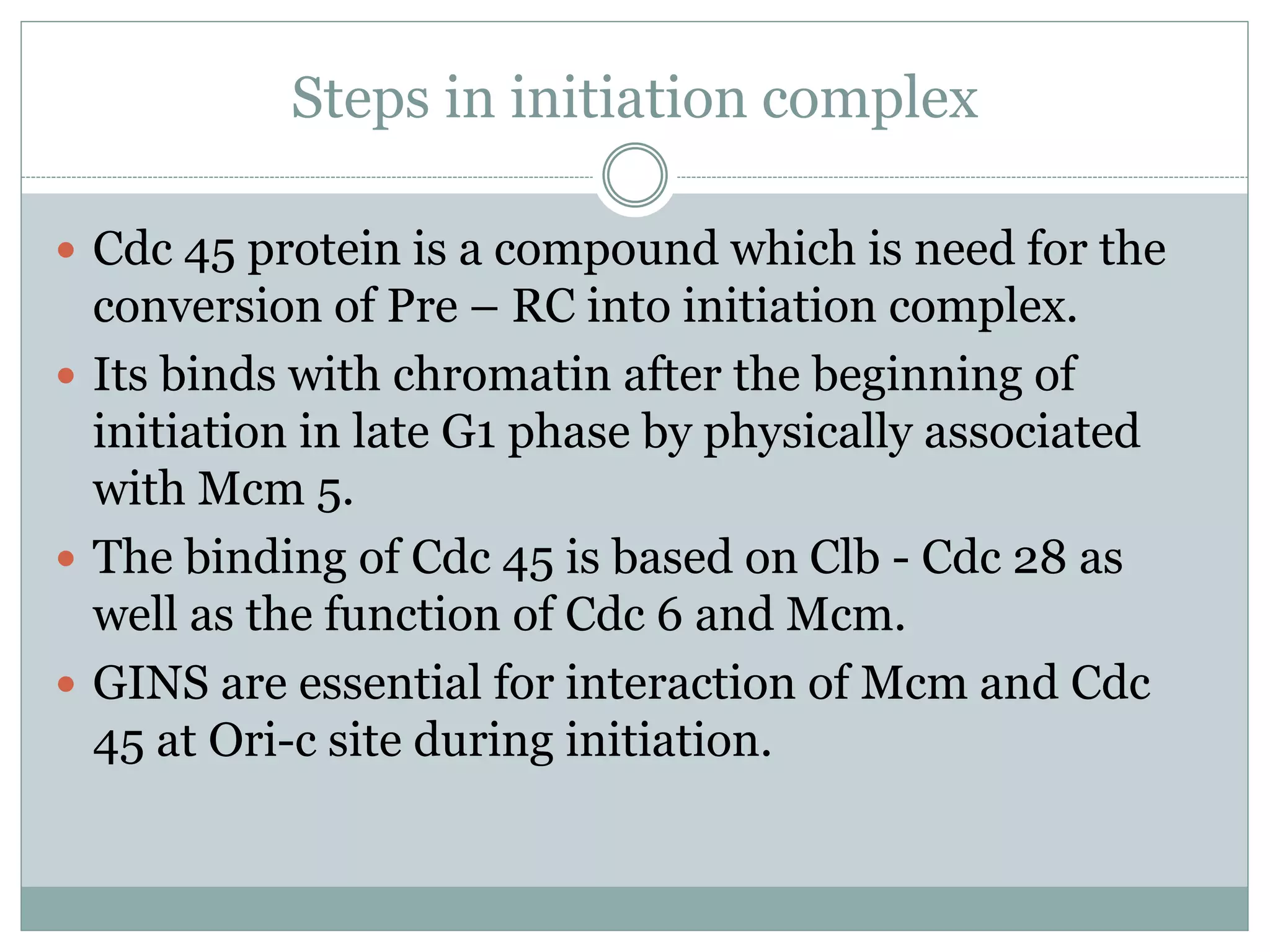
Steps in initiation complex
 Cdc 45 protein is a compound which is need for the
conversion of Pre – RC into initiation complex.
 Its binds with chromatin after the beginning of
initiation in late G1 phase by physically associated
with Mcm 5.
 The binding of Cdc 45 is based on Clb - Cdc 28 as
well as the function of Cdc 6 and Mcm.
 GINS are essential for interaction of Mcm and Cdc
45 at Ori-c site during initiation.
 GINS complex is composed of four small proteins
namely
 Sld5 (Cdc105)
 Psf1 (Cdc101)
 Psf2 (Cdc102)
 Psf3 (Cdc103)
GINS represents 'go, ichi, ni, san' which means '5, 1, 2, 3' in
Japanese.
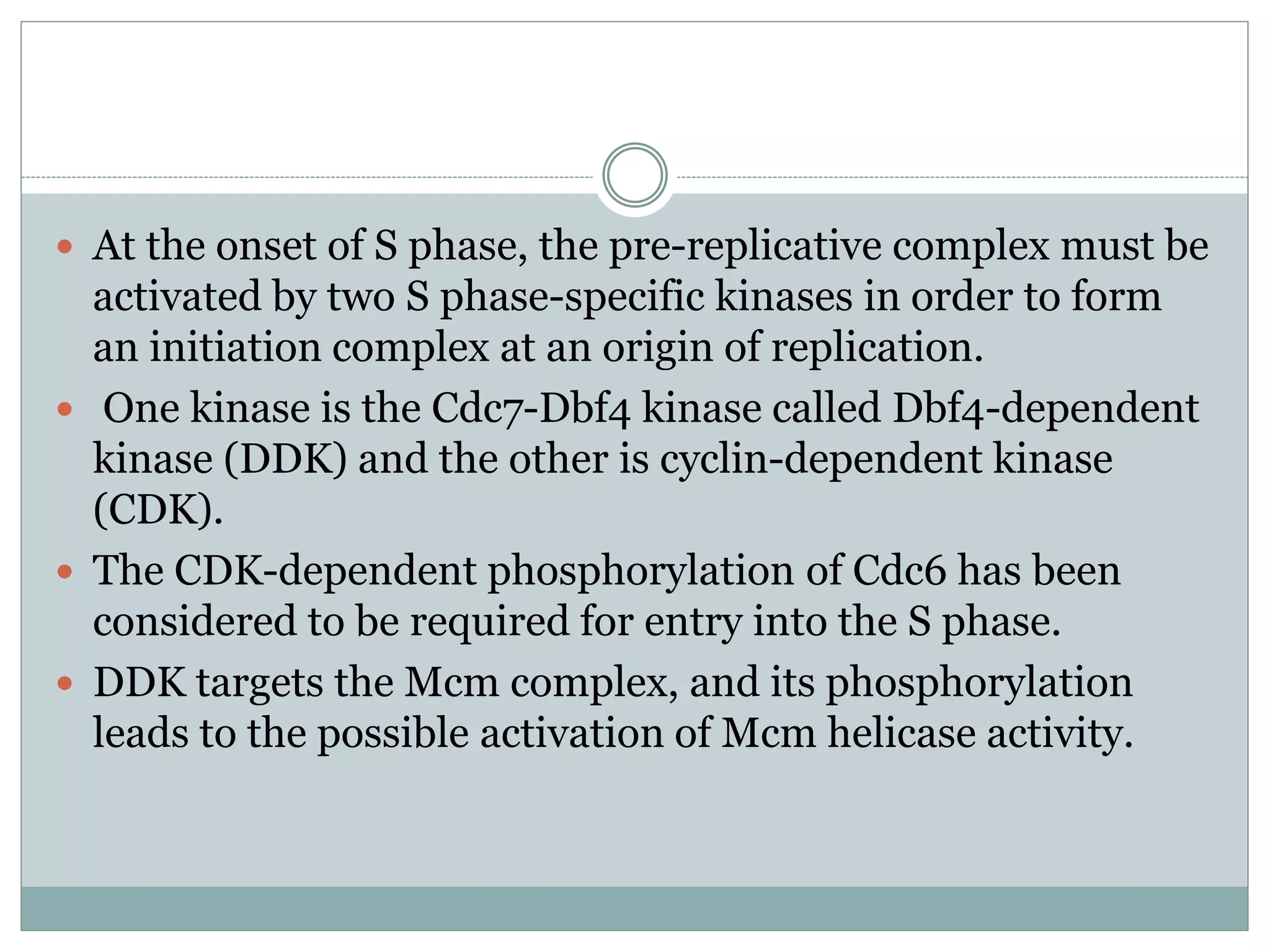
 At the onset of S phase, the pre-replicative complex must be
activated by two S phase-specific kinases in order to form
an initiation complex at an origin of replication.
 One kinase is the Cdc7-Dbf4 kinase called Dbf4-dependent
kinase (DDK) and the other is cyclin-dependent kinase
(CDK).
 The CDK-dependent phosphorylation of Cdc6 has been
considered to be required for entry into the S phase.
 DDK targets the Mcm complex, and its phosphorylation
leads to the possible activation of Mcm helicase activity.
Elongation
 Once the initiation complex is formed and the cells
pass into the S phase, the complex then becomes a
replisome and elongation is initiated.
 Once the elongation is initiated, it form the
replication fork by unwinding the DNA strand.
 As the double helix of DNA separates from one side
and super coils are formed on the other side.
 The problem of super coils comes in the way of DNA
replication is solved by a group of enzymes called
DNA topoisomerase.
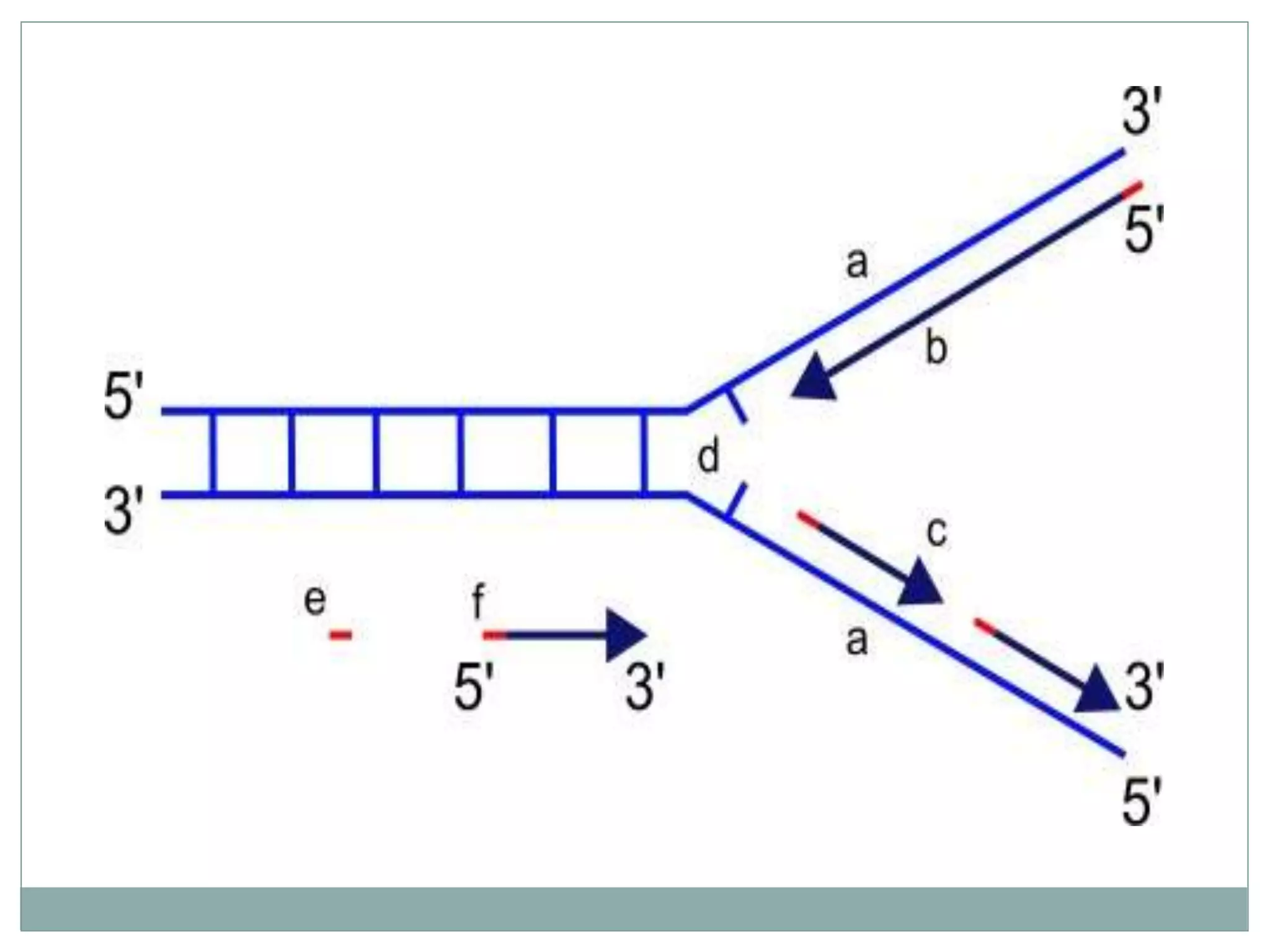
Replication Fork
 The replication fork is the junction the between the
newly separated template strands, known as the
leading and lagging strands, and the double stranded
DNA.
 Elongation occur in 5’ to 3’ direction in both the
leading and lagging strand.
Leading Strand
 The leading strand is the template strand that is
being replicated in the same direction as the
movement of the replication fork.
 Nucleotides are added by the DNA Polymerase ε.
 DNA polymerase requires the RNA primer produced
by Primase.
 Elongation take place in 5’ to 3’ direction.
 Finally the primer are removed by RNAse H and the
gap is sealed by the DNA Ligase 1.
Lagging Strand
 DNA replication on lagging strand is discontinuous
and elongation opposite direction to replication fork.
 Nucleotide are added by the DNA Polymerase δ.
 Lagging strand used more RNA Primer for loading
nucleotide.
 DNA polymerase will synthesize short fragments of
DNA called Okazaki fragments which are added to
the 3' end of the primer. These fragments can be
anywhere between 100-400 nucleotides long in
eukaryotes.
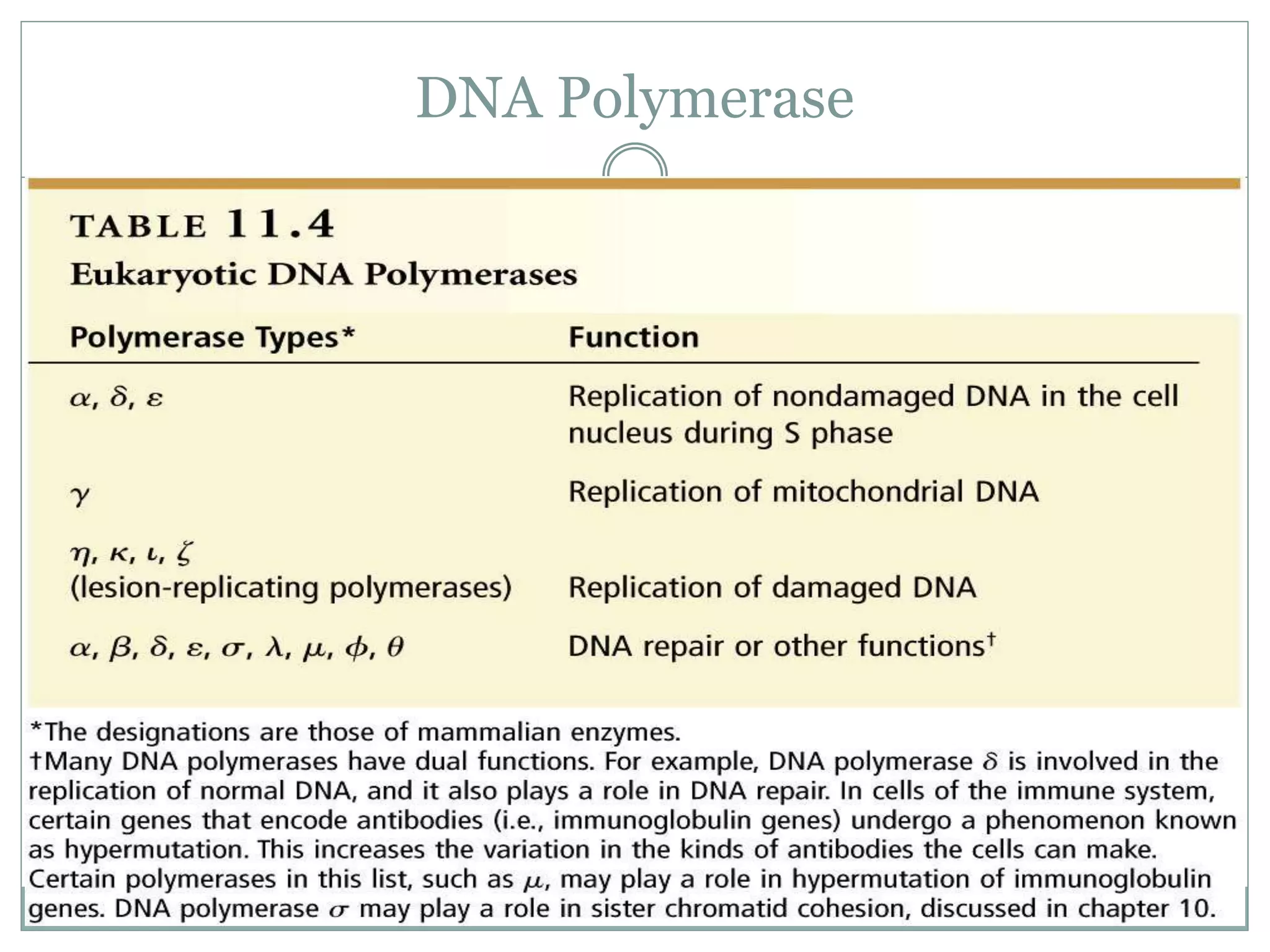
DNA Polymerase
Termination
 The termination of replication in eukaryotic cells occures by
telomere regions and telomerase. Telomeres extend the 3' end of
the parental chromosome beyond the 5' end of the daughter
strand.
 This single-stranded DNA structure can act as an origin of
replication that recruits telomerase. Telomerase is a specialized
DNA polymerase that consists of multiple protein subunits and
an RNA component.
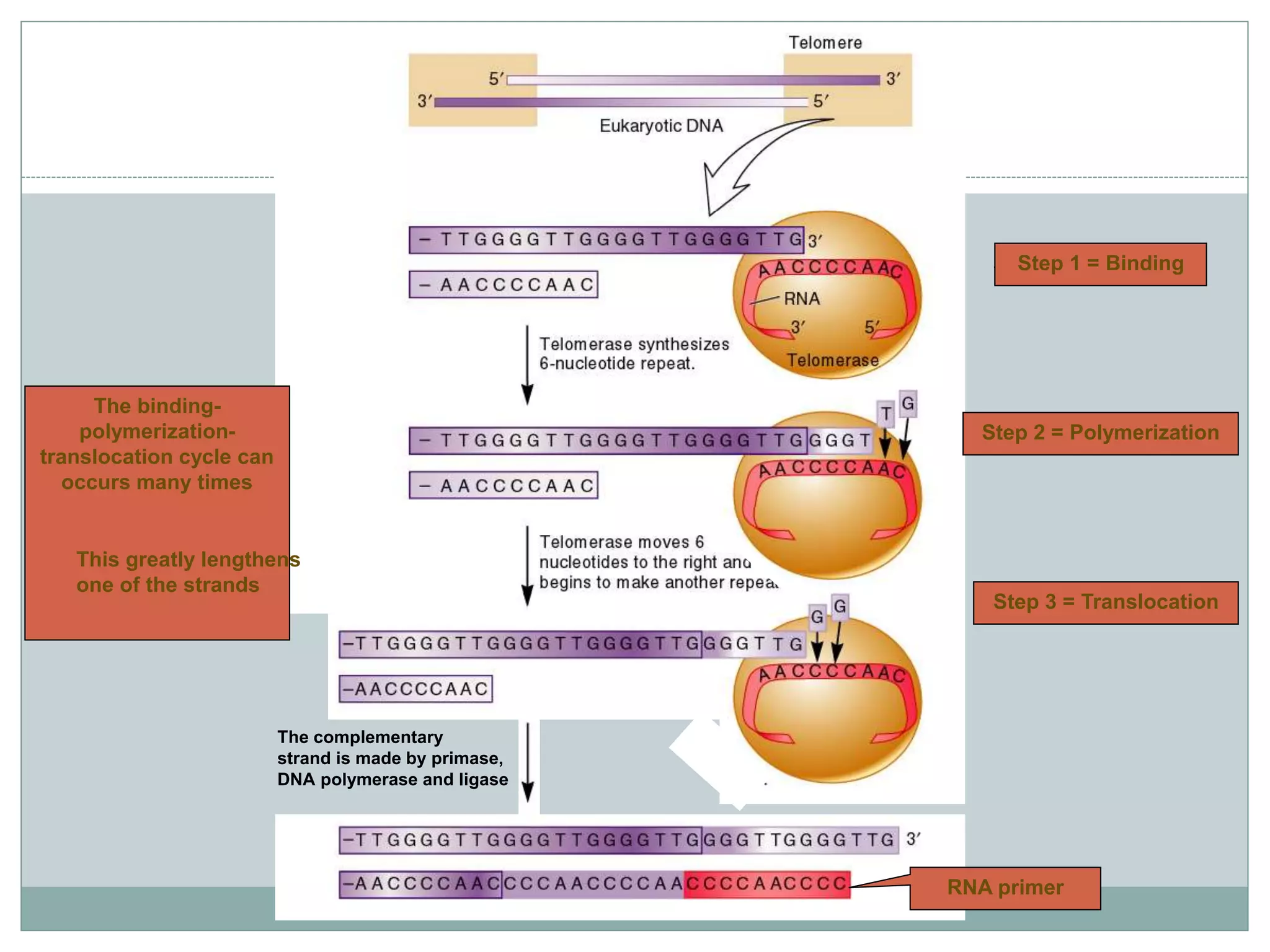
 The RNA component of telomerase anneals to the single
stranded 3' end of the template DNA and contains 1.5 copies of
the telomeric sequence. Telomerase contains a protein subunit
that is a reverse transcriptase called telomerase reverse
transcriptase or TERT. TERT synthesizes DNA until the end of
the template telomerase RNA and then disengages.
Step 1 = Binding
Step 3 = Translocation
The binding-
polymerization-
translocation cycle can
occurs many times
This greatly lengthens
one of the strands
The complementary
strand is made by primase,
DNA polymerase and ligase
RNA primer
Step 2 = Polymerization

Dna replication in eukaryotes

  • 1.
    V I GN E S H M I M . S C . , H G M B DNA Replication in Eukaryotes
  • 2.
    REPLICATION It is aprocess in which the DNA copies itself to produce identical daughter molecules of DNA. It occurs only once in each cell. It occurs very quick, accurate and at correct time. Replication of DNA occurs based on the Chargaff’s Rule that is  Cytosine – Guanine ( 3 H bonds)  Adenine – Thymine (2 H bonds)
  • 3.
    Modes of Replication Delbruck suggest that Watson-Crick model of DNA could theoretically be replicated by three modes • Conservative • Semi-conservative • dispersive
  • 5.
    Simple Process G1 • Replicationinitiated S • DNA synthesis occur • Two daughter copies are produced G2 • Repair mechanisms occur Finally, one copy of the genomes is segregated to each daughter cell at mitosis or M phase. These daughter copies each contain one strand from the parental duplex DNA and one nascent anti-parallel strand. This process is conserved from prokaryotes to eukaryotes and the mechanism is called semi-conservative mode of replication.
  • 6.
    Complex Process  DNAreplication in eukaryotes divided into three stages 1. Initiation ( Formation of Pre – Replicative Complex) 2. Initiation complex 3. Elongation (Replication fork and Polymerization) 4. Termination
  • 7.
    Initiation of Replication It is the first step in eukaryotic replication in which most of the proteins combines to form Pre – Replicative complex (Pre-RC).  Involved proteins  Origin Recognition complex (ORC)  Cell division cycle 6( Cdc 6)  Chromatin licensing and DNA Replication factor 1( Cdt 1)  Minichromosome Maintenance Protein Complex (Mcm 2-7)
  • 8.
    Steps in initiation ORCbinds in the Ori-c Site of the DNA Recruits the Cdc 6 Cdc 6 Binds with ORC in ATP dependent manner Cdc 6 recruits the Cdt 1 Cdt 1 is required for licensing the chromatin for Replication Cdt 1 binds with C terminus of Cdc 6 Finally binding all three protein recruit Mcm Mcm finally binds with Chromatin These following steps occur in G1 phase of cell cycle
  • 10.
     The activityof Cdt 1 during the cell cycle is regulated by a protein called Geminin.  It also inhibits Cdt 1 activity during the S phase in order to prevent the re-replication of DNA, Ubiquitination and proteolysis.
  • 11.
    Functions of McmComplex  Minichromosome Maintenance Complex has helicase activity and inactivation of any of the six protein will prevent the progress of formation of replication fork.  It also has ATPase activity. A mutation at any one of the Mcm protein complex will reduce conserved ATP binding site.  Mcm complex is a hexamer with Mcm 3, Mcm 7, Mcm 2, Mcm 6, Mcm 4, Mcm 5.
  • 12.
    Initiation Complex  Itis the 2nd stage in DNA replication where the Pre – Replicative complex is converted into Initiation complex.  Involved proteins  Cell Division Cycle 45 ( Cdc 45)  GINS  Cyclin Dependent Kinase ( CDK)  Dbf 4 Dependent Kinase (DDK) – Combination of Cdc 7 and dbf 4
  • 13.
    Steps in initiationcomplex  Cdc 45 protein is a compound which is need for the conversion of Pre – RC into initiation complex.  Its binds with chromatin after the beginning of initiation in late G1 phase by physically associated with Mcm 5.  The binding of Cdc 45 is based on Clb - Cdc 28 as well as the function of Cdc 6 and Mcm.  GINS are essential for interaction of Mcm and Cdc 45 at Ori-c site during initiation.
  • 14.
     GINS complexis composed of four small proteins namely  Sld5 (Cdc105)  Psf1 (Cdc101)  Psf2 (Cdc102)  Psf3 (Cdc103) GINS represents 'go, ichi, ni, san' which means '5, 1, 2, 3' in Japanese.
  • 15.
     At theonset of S phase, the pre-replicative complex must be activated by two S phase-specific kinases in order to form an initiation complex at an origin of replication.  One kinase is the Cdc7-Dbf4 kinase called Dbf4-dependent kinase (DDK) and the other is cyclin-dependent kinase (CDK).  The CDK-dependent phosphorylation of Cdc6 has been considered to be required for entry into the S phase.  DDK targets the Mcm complex, and its phosphorylation leads to the possible activation of Mcm helicase activity.
  • 16.
    Elongation  Once theinitiation complex is formed and the cells pass into the S phase, the complex then becomes a replisome and elongation is initiated.  Once the elongation is initiated, it form the replication fork by unwinding the DNA strand.  As the double helix of DNA separates from one side and super coils are formed on the other side.  The problem of super coils comes in the way of DNA replication is solved by a group of enzymes called DNA topoisomerase.
  • 17.
    Replication Fork  Thereplication fork is the junction the between the newly separated template strands, known as the leading and lagging strands, and the double stranded DNA.  Elongation occur in 5’ to 3’ direction in both the leading and lagging strand.
  • 19.
    Leading Strand  Theleading strand is the template strand that is being replicated in the same direction as the movement of the replication fork.  Nucleotides are added by the DNA Polymerase ε.  DNA polymerase requires the RNA primer produced by Primase.  Elongation take place in 5’ to 3’ direction.  Finally the primer are removed by RNAse H and the gap is sealed by the DNA Ligase 1.
  • 20.
    Lagging Strand  DNAreplication on lagging strand is discontinuous and elongation opposite direction to replication fork.  Nucleotide are added by the DNA Polymerase δ.  Lagging strand used more RNA Primer for loading nucleotide.  DNA polymerase will synthesize short fragments of DNA called Okazaki fragments which are added to the 3' end of the primer. These fragments can be anywhere between 100-400 nucleotides long in eukaryotes.
  • 21.
  • 22.
    Termination  The terminationof replication in eukaryotic cells occures by telomere regions and telomerase. Telomeres extend the 3' end of the parental chromosome beyond the 5' end of the daughter strand.  This single-stranded DNA structure can act as an origin of replication that recruits telomerase. Telomerase is a specialized DNA polymerase that consists of multiple protein subunits and an RNA component.  The RNA component of telomerase anneals to the single stranded 3' end of the template DNA and contains 1.5 copies of the telomeric sequence. Telomerase contains a protein subunit that is a reverse transcriptase called telomerase reverse transcriptase or TERT. TERT synthesizes DNA until the end of the template telomerase RNA and then disengages.
  • 24.
    Step 1 =Binding Step 3 = Translocation The binding- polymerization- translocation cycle can occurs many times This greatly lengthens one of the strands The complementary strand is made by primase, DNA polymerase and ligase RNA primer Step 2 = Polymerization

Editor's Notes