Basics of DNA Isolation
Prepared by: Md Abu Bakar Siddik
Matrikelnummer: 21435158
Name of module : Molecular and
biological methods in plant and animal
breeding.
Date: 03.08.17
George-AugustUniversität, Göttingen
1
1. Aim of DNA isolation
2. Definition DNA
3. Definition of DNA isolation
4. Purposes of DNA isolation
5. Sample selection
6. Steps of DNA isolation
7. Chemistry behind it
Outline
2
AIM Of DNA Isolation
Seperate the DNA that is present in the nucleus
of the cell from other cellular components.
3
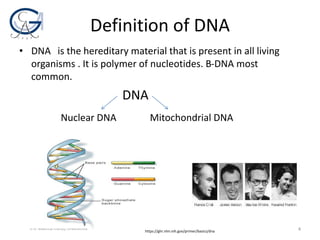
Definition of DNA
• DNA is the hereditary material that is present in all living
organisms . It is polymer of nucleotides. B-DNA most
common.
DNA
Nuclear DNA Mitochondrial DNA
https://ghr.nlm.nih.gov/primer/basics/dna 4
Definition : DNA isolation is the extraction process of DNA
from various sources by using both chemical and physical
methods.
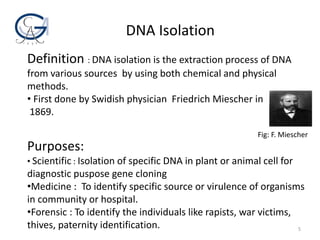
• First done by Swidish physician Friedrich Miescher in
1869.
Purposes:
• Scientific : Isolation of specific DNA in plant or animal cell for
diagnostic puspose gene cloning
•Medicine : To identify specific source or virulence of organisms
in community or hospital.
•Forensic : To identify the individuals like rapists, war victims,
thives, paternity identification.
Fig: F. Miescher
DNA Isolation
5
Sample Selection
Tissue sample
• Good sample: muscle liver, spleen bone marrow
•Bad sample: cartilage, adipose tissue, connective tissues
Semen: very good ,high dense quality.
Blood cell: only in leukocytes
Plant sample : more difficult due to cell wall, polysaccharides
6
Basic principles or steps of DNA Isolation
1. Cell lysis
2. Isolation of DNA from mixture
Precipitation
Adsorption
7
Chemistry behind
Cell lysis: Means lysis or breakdown of tissues or cells.
• Salt solution: Detergent eg, Sodium dodecyl sulphate(SDS) –
to destroy the cell membrane and lipids.
• For protein denaturation: Proteinase K enzyme, DNAase enzyme
and histone
•For sperm: Dithiothreitol (DDT) – to breakdown the disulfide
bond of sperm coat.
8
Diffrent cell components like protein, DNA, RNA, saccharides,
lipidsare lysate togeter.
1. Precipitation of protein- high salt concentration- induced
by Nacl, acetate
- organic solvent – chloroform, Phenol
Chloroform: It solubilizes lipids and lot of proteins to remove them
from DNA.
• 2 distinct phase.
• A) Lower phase- chloroform with protein and polysaccharides.
• B)Lower phase: DNA with deionized water
Isolation of DNA from mixture:
Chemistry Behind
9
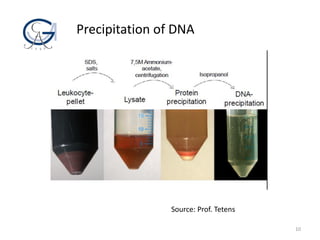
Precipitation of DNA
10
Source: Prof. Tetens
11
2. Precipitation of DNA – Ethanol or isopropanol.
a.) Isopropanol: DNA is less soluable in isopropanol
containing solution than solution containg ethanol.
• Easier to perform in room temperature that lessen the
risk of coprecipitation of DNA with Nacl or others.
Chemistry behind
Isolation DNA from mixture :
Adsorption – It means Binding of DNA with a solid phase.
- Only ion exchanger column is capable to bind with
DNA,whereas, the other components will be discarded
Chemistry behind
b.) Ethanol: Chilled ethanol only dissolves the DNA. Colder
ethanol makes slower the activity of enzymes which
can break down the DNA, thus giving better result.
2. Precipitation of DNA –
12
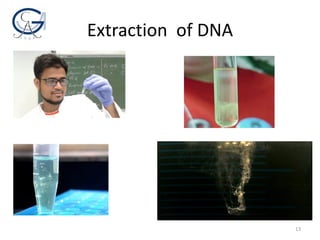
Extraction of DNA
13
Thank you for
your attention
14
Reference
1. https://ghr.nlm.nih.gov/primer/basics/dna
2. https://en.wikipedia.org/wiki/Friedrich_Miescher#/media/File:Friedrich_Miescher.jpg
3. https://bioprep.community.uaf.edu/learning-modules/2-dna-extraction-4/the-basics-of-dna-extraction/
4. https://www.slideshare.net/zohaibkhan404/role-of-chemicals-used-in-dna-extraction-recombinant
15

Basics of DNA isolation

  • 1.
    Basics of DNAIsolation Prepared by: Md Abu Bakar Siddik Matrikelnummer: 21435158 Name of module : Molecular and biological methods in plant and animal breeding. Date: 03.08.17 George-AugustUniversität, Göttingen 1
  • 2.
    1. Aim ofDNA isolation 2. Definition DNA 3. Definition of DNA isolation 4. Purposes of DNA isolation 5. Sample selection 6. Steps of DNA isolation 7. Chemistry behind it Outline 2
  • 3.
    AIM Of DNAIsolation Seperate the DNA that is present in the nucleus of the cell from other cellular components. 3
  • 4.
    Definition of DNA •DNA is the hereditary material that is present in all living organisms . It is polymer of nucleotides. B-DNA most common. DNA Nuclear DNA Mitochondrial DNA https://ghr.nlm.nih.gov/primer/basics/dna 4
  • 5.
    Definition : DNAisolation is the extraction process of DNA from various sources by using both chemical and physical methods. • First done by Swidish physician Friedrich Miescher in 1869. Purposes: • Scientific : Isolation of specific DNA in plant or animal cell for diagnostic puspose gene cloning •Medicine : To identify specific source or virulence of organisms in community or hospital. •Forensic : To identify the individuals like rapists, war victims, thives, paternity identification. Fig: F. Miescher DNA Isolation 5
  • 6.
    Sample Selection Tissue sample •Good sample: muscle liver, spleen bone marrow •Bad sample: cartilage, adipose tissue, connective tissues Semen: very good ,high dense quality. Blood cell: only in leukocytes Plant sample : more difficult due to cell wall, polysaccharides 6
  • 7.
    Basic principles orsteps of DNA Isolation 1. Cell lysis 2. Isolation of DNA from mixture Precipitation Adsorption 7
  • 8.
    Chemistry behind Cell lysis:Means lysis or breakdown of tissues or cells. • Salt solution: Detergent eg, Sodium dodecyl sulphate(SDS) – to destroy the cell membrane and lipids. • For protein denaturation: Proteinase K enzyme, DNAase enzyme and histone •For sperm: Dithiothreitol (DDT) – to breakdown the disulfide bond of sperm coat. 8
  • 9.
    Diffrent cell componentslike protein, DNA, RNA, saccharides, lipidsare lysate togeter. 1. Precipitation of protein- high salt concentration- induced by Nacl, acetate - organic solvent – chloroform, Phenol Chloroform: It solubilizes lipids and lot of proteins to remove them from DNA. • 2 distinct phase. • A) Lower phase- chloroform with protein and polysaccharides. • B)Lower phase: DNA with deionized water Isolation of DNA from mixture: Chemistry Behind 9
  • 10.
  • 11.
    11 2. Precipitation ofDNA – Ethanol or isopropanol. a.) Isopropanol: DNA is less soluable in isopropanol containing solution than solution containg ethanol. • Easier to perform in room temperature that lessen the risk of coprecipitation of DNA with Nacl or others. Chemistry behind Isolation DNA from mixture :
  • 12.
    Adsorption – Itmeans Binding of DNA with a solid phase. - Only ion exchanger column is capable to bind with DNA,whereas, the other components will be discarded Chemistry behind b.) Ethanol: Chilled ethanol only dissolves the DNA. Colder ethanol makes slower the activity of enzymes which can break down the DNA, thus giving better result. 2. Precipitation of DNA – 12
  • 13.
  • 14.
    Thank you for yourattention 14
  • 15.
    Reference 1. https://ghr.nlm.nih.gov/primer/basics/dna 2. https://en.wikipedia.org/wiki/Friedrich_Miescher#/media/File:Friedrich_Miescher.jpg 3.https://bioprep.community.uaf.edu/learning-modules/2-dna-extraction-4/the-basics-of-dna-extraction/ 4. https://www.slideshare.net/zohaibkhan404/role-of-chemicals-used-in-dna-extraction-recombinant 15