Faculty of Biosciences,
Institute of Biosciences and Technology,
Shri Ramswaroop Memorial University
By. Himanshu Verma
Roll No. 202110902120006
BSc. (H) Biotechnology
3rd Semester
Submitted To Dr. Nishu Mittal
Noncoding DNA in Eukaryotes: Introduction
 Each cell in our bodies has about 6 feet of DNA stuffed into
it. -However, less than one inch is devoted to genes!
 Non-coding DNA describes components of an organism’s
DNA sequences that do not encode for protein sequences.
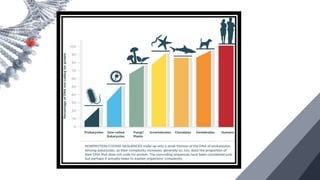
 In many eukaryotes, a large % of an organism’s total
genome size is non- coding DNA.
 Amount of non-coding DNA & the proportion of coding
versus non-coding DNA varies greatly between species.
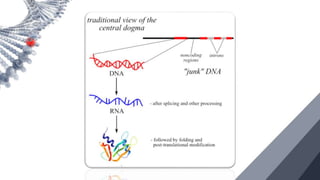
 Much of this DNA has no known biological function & was
referred to as “Junk DNA”.
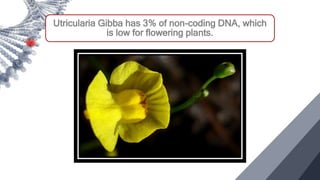
Utricularia Gibba has 3% of non-coding DNA, which
is low for flowering plants.
Types of non- coding DNA sequences
 Non – coding functional RNA
 Cis- and Trans- regulatory elements
 Introns
 Pseddogenes
 Repeat sequences, transposons and viral elements
 Telomers
1- Non- coding Functional RNA
 The RNA molecules which are not translated into
proteins.
 For eg:- Ribosomal RNA, Transfer RNA & Micro
RNA
2- Cis- and Trans- regulatory elements
 Those are sequences that control the transcription of a
nearby gene.
 Located within 5’ or 3’ untranslated regions or within introns.
 trans-regulatory element control the transcription of a distant
gene
3- Introns
 They are non-coding sections of a gene.
 Transcribed in the precursor m-RNA sequence but is
ultimately removed by RNA splicing.
 Most of the introns appear to be mobile genetic elements.
4- Pseudogenes
 They are related to known genes, that have lost their protein-
coding ability or are otherwise no longer expressed in the
cell.
 Arise from retrotransposition or genomic duplication of
functional genes.
 Therefore become “Genomic Fossils” : non-functional.
5- Repeat Sequences, Transposons & Viral Elements
 Transposons & Retrotransposons are mobile genetic element.
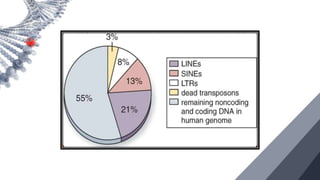
 Retrotransposons : LINEs, SINEs – account for large proportion of the
genomic sequences in many species.
 Over 8% of the human genome is made up of endogenous retrovirus
sequences as a part of over 42% fraction that is recognizably derived
of retrotransposons.
 Remaining 3% can be identified to be the remains of DNA transposons.
6- Telomeres
 Telomeres are regions of repetitive DNA.
 Located at the end of a chromosome.
 They provide protection from chromosomal deterioration during DNA
replication.
Functions of Non- Coding DNA
 They have strong biological functions : some regions that are highly conserved are under
evolutionary pressure & positive selection.
 Some specific sequences of non-coding DNA are essential for chromosome structure, centromere
function & homolog recognition in meiosis.
 From study over 300 prokaryotic & 30 eukaryotic genomes, eukaryotes appear to require less
amount of non-coding DNA.
 Apart from this: 1. Protection of genome 5. Enhancers
2. Genetic switches 6. Silencers
3. Regulation of gene expression 7. Promoters
4. Trancription factor sites 8. Insulators
References
•https://en.wikipedia.org/wiki/Non-coding_DNA
•https://www.genome.gov/genetics-glossary/Non-Coding-DNA
•http://ib.bioninja.com.au/higher-level/topic-7-nucleic-acids/71-dna-
structure-and-replic/non-coding-dna.html
•https://www.sciencedirect.com/topics/biochemistry-genetics-and-
molecular-biology/noncoding-dna
NON CODING DNA.pptx

NON CODING DNA.pptx

  • 1.
    Faculty of Biosciences, Instituteof Biosciences and Technology, Shri Ramswaroop Memorial University By. Himanshu Verma Roll No. 202110902120006 BSc. (H) Biotechnology 3rd Semester Submitted To Dr. Nishu Mittal
  • 2.
    Noncoding DNA inEukaryotes: Introduction  Each cell in our bodies has about 6 feet of DNA stuffed into it. -However, less than one inch is devoted to genes!  Non-coding DNA describes components of an organism’s DNA sequences that do not encode for protein sequences.  In many eukaryotes, a large % of an organism’s total genome size is non- coding DNA.  Amount of non-coding DNA & the proportion of coding versus non-coding DNA varies greatly between species.  Much of this DNA has no known biological function & was referred to as “Junk DNA”.
  • 4.
    Utricularia Gibba has3% of non-coding DNA, which is low for flowering plants.
  • 5.
    Types of non-coding DNA sequences  Non – coding functional RNA  Cis- and Trans- regulatory elements  Introns  Pseddogenes  Repeat sequences, transposons and viral elements  Telomers
  • 6.
    1- Non- codingFunctional RNA  The RNA molecules which are not translated into proteins.  For eg:- Ribosomal RNA, Transfer RNA & Micro RNA
  • 7.
    2- Cis- andTrans- regulatory elements  Those are sequences that control the transcription of a nearby gene.  Located within 5’ or 3’ untranslated regions or within introns.  trans-regulatory element control the transcription of a distant gene
  • 8.
    3- Introns  Theyare non-coding sections of a gene.  Transcribed in the precursor m-RNA sequence but is ultimately removed by RNA splicing.  Most of the introns appear to be mobile genetic elements.
  • 9.
    4- Pseudogenes  Theyare related to known genes, that have lost their protein- coding ability or are otherwise no longer expressed in the cell.  Arise from retrotransposition or genomic duplication of functional genes.  Therefore become “Genomic Fossils” : non-functional.
  • 10.
    5- Repeat Sequences,Transposons & Viral Elements  Transposons & Retrotransposons are mobile genetic element.  Retrotransposons : LINEs, SINEs – account for large proportion of the genomic sequences in many species.  Over 8% of the human genome is made up of endogenous retrovirus sequences as a part of over 42% fraction that is recognizably derived of retrotransposons.  Remaining 3% can be identified to be the remains of DNA transposons.
  • 12.
    6- Telomeres  Telomeresare regions of repetitive DNA.  Located at the end of a chromosome.  They provide protection from chromosomal deterioration during DNA replication.
  • 14.
    Functions of Non-Coding DNA  They have strong biological functions : some regions that are highly conserved are under evolutionary pressure & positive selection.  Some specific sequences of non-coding DNA are essential for chromosome structure, centromere function & homolog recognition in meiosis.  From study over 300 prokaryotic & 30 eukaryotic genomes, eukaryotes appear to require less amount of non-coding DNA.  Apart from this: 1. Protection of genome 5. Enhancers 2. Genetic switches 6. Silencers 3. Regulation of gene expression 7. Promoters 4. Trancription factor sites 8. Insulators
  • 15.