


ETHYL GLUCURONIDE
M.Prasad Naidu
MSc Medical Biochemistry, Ph.D,.
.
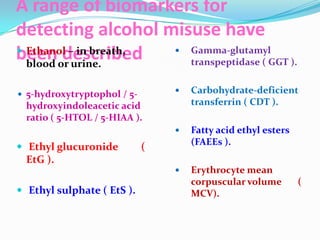
A range of biomarkers for
detecting alcohol misuse have
been described Ethanol – in breath,
blood or urine.
 5-hydroxytryptophol / 5-
hydroxyindoleacetic acid
ratio ( 5-HTOL / 5-HIAA ).
 Ethyl glucuronide (
EtG ).
 Ethyl sulphate ( EtS ).
 Gamma-glutamyl
transpeptidase ( GGT ).
 Carbohydrate-deficient
transferrin ( CDT ).
 Fatty acid ethyl esters
(FAEEs ).
 Erythrocyte mean
corpuscular volume (
MCV).
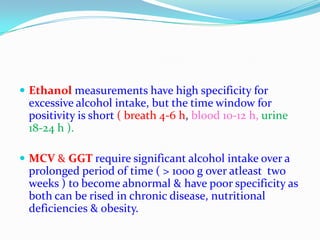
 Ethanol measurements have high specificity for
excessive alcohol intake, but the time window for
positivity is short ( breath 4-6 h, blood 10-12 h, urine
18-24 h ).
 MCV & GGT require significant alcohol intake over a
prolonged period of time ( > 1000 g over atleast two
weeks ) to become abnormal & have poor specificity as
both can be rised in chronic disease, nutritional
deficiencies & obesity.
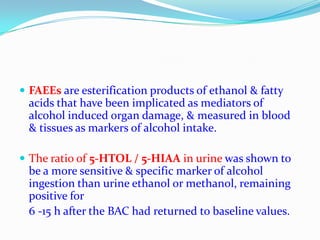
 FAEEs are esterification products of ethanol & fatty
acids that have been implicated as mediators of
alcohol induced organ damage, & measured in blood
& tissues as markers of alcohol intake.
 The ratio of 5-HTOL / 5-HIAA in urine was shown to
be a more sensitive & specific marker of alcohol
ingestion than urine ethanol or methanol, remaining
positive for
6 -15 h after the BAC had returned to baseline values.
 CDT has good specificity for alcohol misuse, but is a
marker of alcohol misuse over a 7-14 d period & does
not become positive after a single session of heavy
drinking.
 Exessive drinking in one session, ‘binge’ drinking,
appears to be on the increase in some societies.
 There is, therefore, a need for a biomarker that will be
positive in the gap in the time window, between one
day & one week, left by the current biomarkers of
alcohol consumption.
 Ethyl glucuronide ( EtG ) is a direct metabolite of
ethanol formed by the enzymatic conjugation of
ethanol with glucuronic acid in liver.
 This phase II reaction is catalysed by mitochondrial
membrane-bound UDP-glucuronosyltransferase.
 Ethanol is also conjugated to sulphate by
sulfotransferase to form ethyl sulphate ( EtS )
 EtG & EtS are most commonly measured in urine as
markers for alcohol intake.
 EtG has also been detected in postmortem hair
samples together with tissue samples ( gluteal &
abdominal fat, liver & brain ) from intoxicated
subjects.
 EtG has been shown to be a stable marker.
 Studies have shown that urine samples stored at 4ºC
for five weeks were found to have no change in EtG
concentration.
 EtG : 100-200 µg/L ,
 EtS : 100-110 µg/L.
 In routine clinical use, cut-offs as high as 500 µg/L
have been used to reduce the risk of false-positive
results.
 The most commonly used method is Liquid
chromatography - mass spectrometry ( LC-MS )
since it is highly sensitive, specific & is able to
determine both EtG & EtS simultaneously.
 This technology has been used to determine EtG in
urine, whole blood, serum, muconium, saliva &
hair.
 Recently, a commercially available enzyme immuno
assay (EIA ) method based on a new monoclonal
antibody came into the market for the analysis of EtG in
urine.
 The method evaluation showed that the EIA is sensitive &
specific.
 The EIA method is considered a screening test & EtG
positive samples should always be confirmed by LC-MS
with EtS to rule out false positives due to contamination.
 The largest study incorporating EtG measurements was the
World Health Organization / International Society for
Biomedical Research on Alcoholism ( WHO / ISBRA ) Study of
State & Trait Markers of Alcohol Use & Dependence that
recruted 304 subjects from Brazil & Australia of whom 158 were
diagnosed as lifetime alcohol abusers.
 The study also measured the 5-HTOL / 5-HIAA ratio in urine,
blood ethanol & serum CDT & GGT.
 The authers concluded that EtG was a good candidate for a
sensitive, specific & reliable marker of recent alcohol intake.
conclusions
 EtG has potential as a marker of high sensitivity &
specificity for the detection of alcohol misuse in a
varity of settings, both in clinical & forensic
medicine.
 As non invasive marker, EtG in urine or hair could
have a role in screening, diagnosis & monitoring
treatment.
 Urine EtG remains positive for periods upto 90 h
following heavy alcohol consumption; therefore,
providing a marker with an intermediate timeframe
between ethanol measurements & GGT / CDT.
 This may prove perticularly useful in workplace
monitoring schemes, prior to & following liver
transplantation, alcohol detoxification programmes &
in the identification of neonates at risk of Fetal alcohol
syndrome ( FAS ).
THAN “Q”

Ethyl Glucuronide

  • 1.
    ETHYL GLUCURONIDE M.Prasad Naidu MScMedical Biochemistry, Ph.D,. .
  • 2.
    A range ofbiomarkers for detecting alcohol misuse have been described Ethanol – in breath, blood or urine.  5-hydroxytryptophol / 5- hydroxyindoleacetic acid ratio ( 5-HTOL / 5-HIAA ).  Ethyl glucuronide ( EtG ).  Ethyl sulphate ( EtS ).  Gamma-glutamyl transpeptidase ( GGT ).  Carbohydrate-deficient transferrin ( CDT ).  Fatty acid ethyl esters (FAEEs ).  Erythrocyte mean corpuscular volume ( MCV).
  • 3.
     Ethanol measurementshave high specificity for excessive alcohol intake, but the time window for positivity is short ( breath 4-6 h, blood 10-12 h, urine 18-24 h ).  MCV & GGT require significant alcohol intake over a prolonged period of time ( > 1000 g over atleast two weeks ) to become abnormal & have poor specificity as both can be rised in chronic disease, nutritional deficiencies & obesity.
  • 4.
     FAEEs areesterification products of ethanol & fatty acids that have been implicated as mediators of alcohol induced organ damage, & measured in blood & tissues as markers of alcohol intake.  The ratio of 5-HTOL / 5-HIAA in urine was shown to be a more sensitive & specific marker of alcohol ingestion than urine ethanol or methanol, remaining positive for 6 -15 h after the BAC had returned to baseline values.
  • 5.
     CDT hasgood specificity for alcohol misuse, but is a marker of alcohol misuse over a 7-14 d period & does not become positive after a single session of heavy drinking.
  • 6.
     Exessive drinkingin one session, ‘binge’ drinking, appears to be on the increase in some societies.  There is, therefore, a need for a biomarker that will be positive in the gap in the time window, between one day & one week, left by the current biomarkers of alcohol consumption.
  • 7.
     Ethyl glucuronide( EtG ) is a direct metabolite of ethanol formed by the enzymatic conjugation of ethanol with glucuronic acid in liver.  This phase II reaction is catalysed by mitochondrial membrane-bound UDP-glucuronosyltransferase.  Ethanol is also conjugated to sulphate by sulfotransferase to form ethyl sulphate ( EtS )
  • 9.
     EtG &EtS are most commonly measured in urine as markers for alcohol intake.  EtG has also been detected in postmortem hair samples together with tissue samples ( gluteal & abdominal fat, liver & brain ) from intoxicated subjects.
  • 10.
     EtG hasbeen shown to be a stable marker.  Studies have shown that urine samples stored at 4ºC for five weeks were found to have no change in EtG concentration.  EtG : 100-200 µg/L ,  EtS : 100-110 µg/L.  In routine clinical use, cut-offs as high as 500 µg/L have been used to reduce the risk of false-positive results.
  • 11.
     The mostcommonly used method is Liquid chromatography - mass spectrometry ( LC-MS ) since it is highly sensitive, specific & is able to determine both EtG & EtS simultaneously.  This technology has been used to determine EtG in urine, whole blood, serum, muconium, saliva & hair.
  • 12.
     Recently, acommercially available enzyme immuno assay (EIA ) method based on a new monoclonal antibody came into the market for the analysis of EtG in urine.  The method evaluation showed that the EIA is sensitive & specific.  The EIA method is considered a screening test & EtG positive samples should always be confirmed by LC-MS with EtS to rule out false positives due to contamination.
  • 13.
     The largeststudy incorporating EtG measurements was the World Health Organization / International Society for Biomedical Research on Alcoholism ( WHO / ISBRA ) Study of State & Trait Markers of Alcohol Use & Dependence that recruted 304 subjects from Brazil & Australia of whom 158 were diagnosed as lifetime alcohol abusers.  The study also measured the 5-HTOL / 5-HIAA ratio in urine, blood ethanol & serum CDT & GGT.  The authers concluded that EtG was a good candidate for a sensitive, specific & reliable marker of recent alcohol intake.
  • 14.
    conclusions  EtG haspotential as a marker of high sensitivity & specificity for the detection of alcohol misuse in a varity of settings, both in clinical & forensic medicine.  As non invasive marker, EtG in urine or hair could have a role in screening, diagnosis & monitoring treatment.
  • 15.
     Urine EtGremains positive for periods upto 90 h following heavy alcohol consumption; therefore, providing a marker with an intermediate timeframe between ethanol measurements & GGT / CDT.  This may prove perticularly useful in workplace monitoring schemes, prior to & following liver transplantation, alcohol detoxification programmes & in the identification of neonates at risk of Fetal alcohol syndrome ( FAS ).
  • 16.