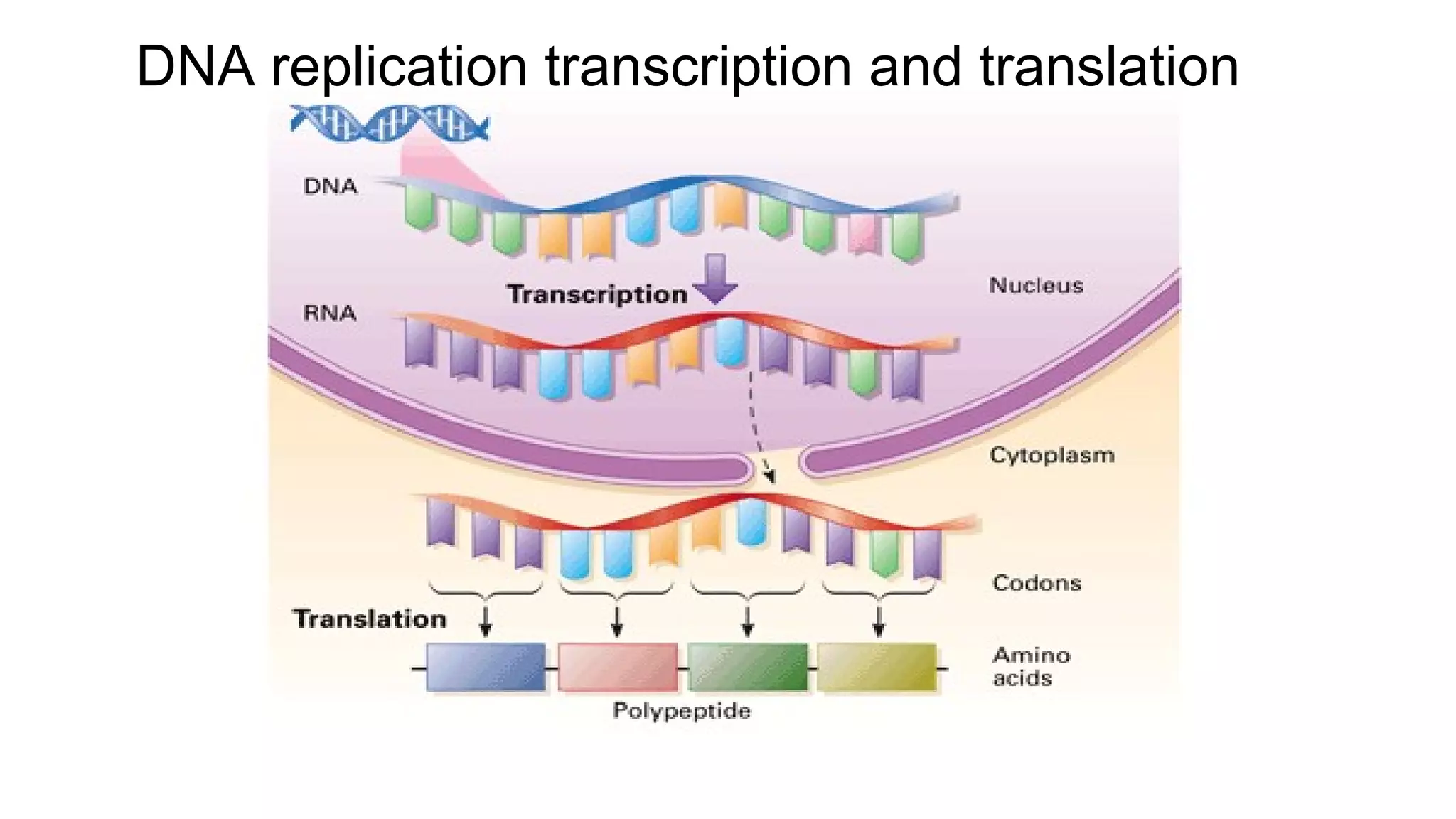
DNA replication transcription and translation
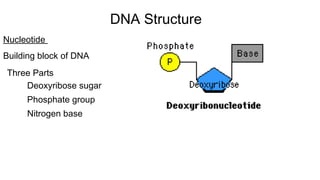
Nucleotide
Building block of DNA
Three Parts
Deoxyribose sugar
Phosphate group
Nitrogen base
DNA Structure
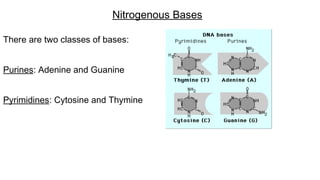
There are two classes of bases:
Purines: Adenine and Guanine
Pyrimidines: Cytosine and Thymine
Nitrogenous Bases
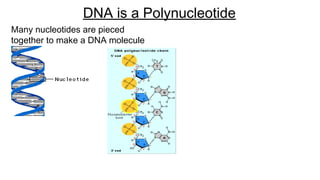
Many nucleotides are pieced
together to make a DNA molecule
DNA is a Polynucleotide
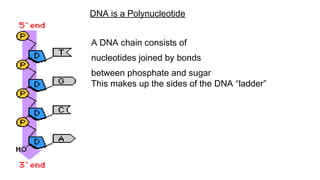
A DNA chain consists of
nucleotides joined by bonds
between phosphate and sugar
This makes up the sides of the DNA “ladder”
DNA is a Polynucleotide
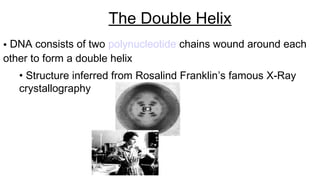
• DNA consists of two polynucleotide chains wound around each
other to form a double helix
• Structure inferred from Rosalind Franklin’s famous X-Ray
crystallography
The Double Helix
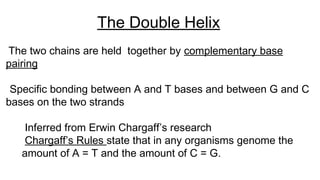
The two chains are held together by complementary base
pairing
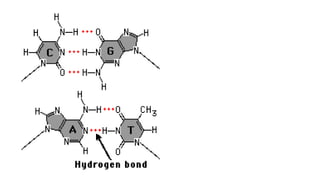
Specific bonding between A and T bases and between G and C
bases on the two strands
Inferred from Erwin Chargaff’s research
Chargaff’s Rules state that in any organisms genome the
amount of A = T and the amount of C = G.
The Double Helix
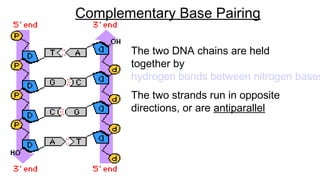
The two DNA chains are held
together by
hydrogen bonds between nitrogen bases
The two strands run in opposite
directions, or are antiparallel
Complementary Base Pairing
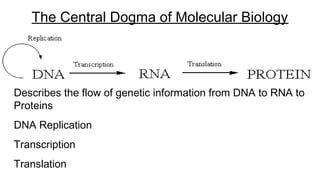
Describes the flow of genetic information from DNA to RNA to
Proteins
DNA Replication
Transcription
Translation
The Central Dogma of Molecular Biology
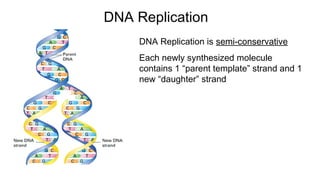
DNA Replication is semi-conservative
Each newly synthesized molecule
contains 1 “parent template” strand and 1
new “daughter” strand
DNA Replication
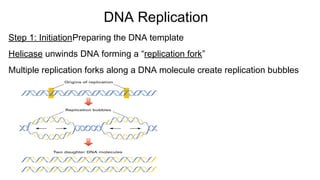
Step 1: InitiationPreparing the DNA template
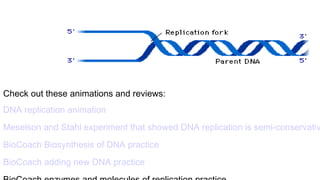
Helicase unwinds DNA forming a “replication fork”
Multiple replication forks along a DNA molecule create replication bubbles
DNA Replication
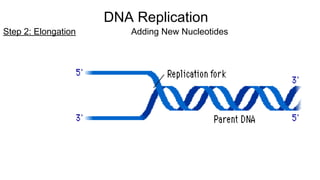
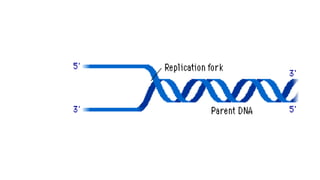
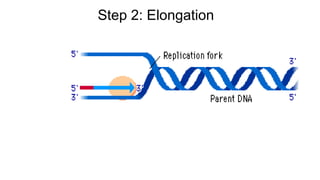
Step 2: Elongation Adding New Nucleotides
DNA Replication
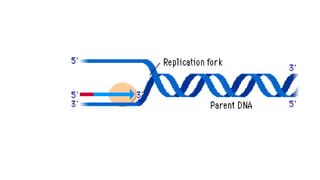
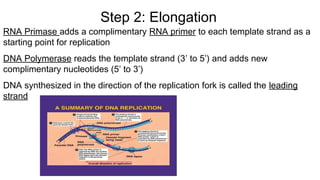
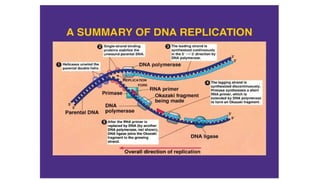
RNA Primase adds a complimentary RNA primer to each template strand as a
starting point for replication
DNA Polymerase reads the template strand (3’ to 5’) and adds new
complimentary nucleotides (5’ to 3’)
DNA synthesized in the direction of the replication fork is called the leading
strand
Step 2: Elongation
Step 2: Elongation
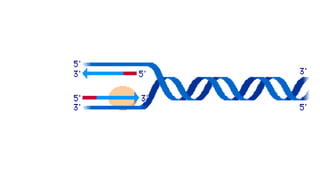
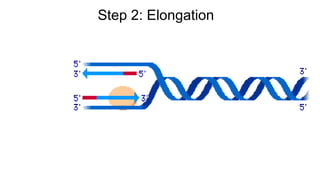
DNA polymerase can only add new nucleotides in the 5’ to 3’ direction
Because of the antiparallel nature of DNA, replication occurs in two directions
An RNA primer is laid down on the other strand, and new nucleotides are
added 5’ to 3’ moving away from the replication fork. This is the lagging strand
and the segment of DNA produced is called an Okazaki fragment
Step 2: Elongation The Lagging Strand
Step 2: Elongation
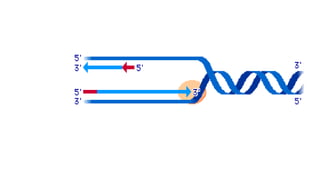
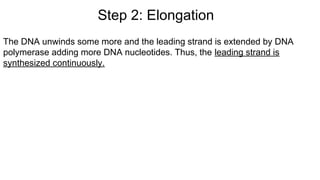
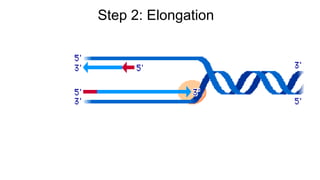
The DNA unwinds some more and the leading strand is extended by DNA
polymerase adding more DNA nucleotides. Thus, the leading strand is
synthesized continuously.
Step 2: Elongation
Step 2: Elongation
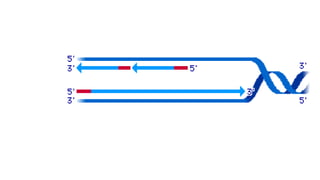
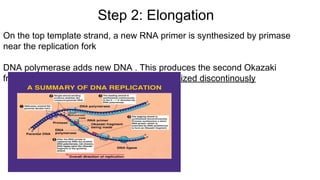
On the top template strand, a new RNA primer is synthesized by primase
near the replication fork
DNA polymerase adds new DNA . This produces the second Okazaki
fragment. Thus, the lagging strand is synthesized discontinously
Step 2: Elongation
Step 3: Termination
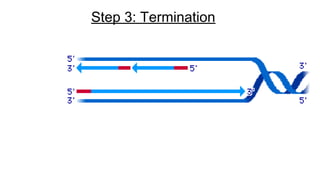
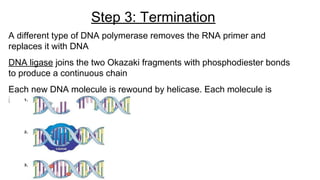
A different type of DNA polymerase removes the RNA primer and
replaces it with DNA
DNA ligase joins the two Okazaki fragments with phosphodiester bonds
to produce a continuous chain
Each new DNA molecule is rewound by helicase. Each molecule is
identical
Step 3: Termination
Leading Strand: 1 primer, 5’ to 3’ continuous
Lagging Strand: multiple primers, 5’ to 3’ discontinuous
In humans, DNA polymerase adds 50 nucleotides/second
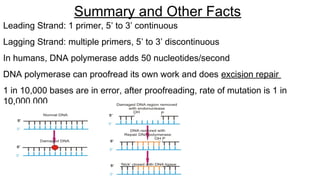
DNA polymerase can proofread its own work and does excision repair
1 in 10,000 bases are in error, after proofreading, rate of mutation is 1 in
10,000,000
Summary and Other Facts
Check out these animations and reviews:
DNA replication animation
Meselson and Stahl experiment that showed DNA replication is semi-conservativ
BioCoach Biosynthesis of DNA practice
BioCoach adding new DNA practice
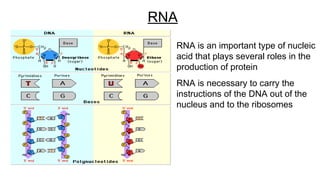
RNA is an important type of nucleic
acid that plays several roles in the
production of protein
RNA is necessary to carry the
instructions of the DNA out of the
nucleus and to the ribosomes
RNA
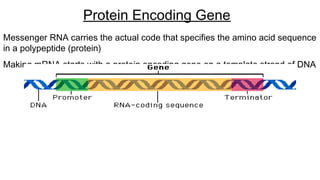
Messenger RNA carries the actual code that specifies the amino acid sequence
in a polypeptide (protein)
Making mRNA starts with a protein encoding gene on a template strand of DNA
Protein Encoding Gene
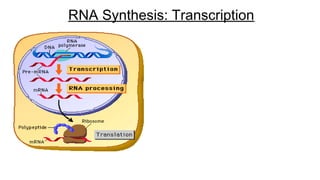
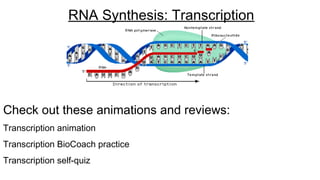
RNA Synthesis: Transcription
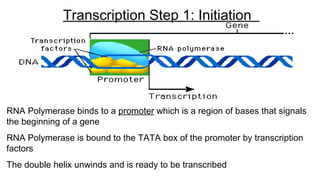
RNA Polymerase binds to a promoter which is a region of bases that signals
the beginning of a gene
RNA Polymerase is bound to the TATA box of the promoter by transcription
factors
The double helix unwinds and is ready to be transcribed
Transcription Step 1: Initiation
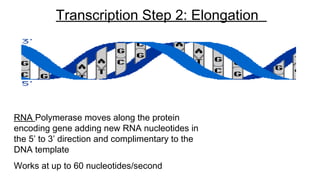
RNA Polymerase moves along the protein
encoding gene adding new RNA nucleotides in
the 5’ to 3’ direction and complimentary to the
DNA template
Works at up to 60 nucleotides/second
Transcription Step 2: Elongation
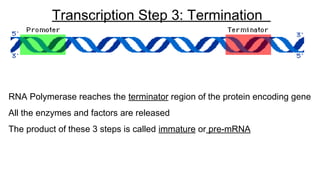
RNA Polymerase reaches the terminator region of the protein encoding gene
All the enzymes and factors are released
The product of these 3 steps is called immature or pre-mRNA
Transcription Step 3: Termination
Check out these animations and reviews:
Transcription animation
Transcription BioCoach practice
Transcription self-quiz
RNA Synthesis: Transcription
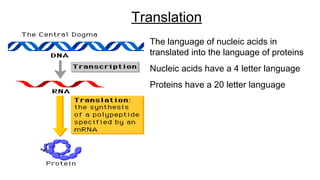
The language of nucleic acids in
translated into the language of proteins
Nucleic acids have a 4 letter language
Proteins have a 20 letter language
Translation
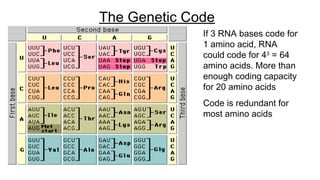
The Genetic Code
If 3 RNA bases code for
1 amino acid, RNA
could code for 43
= 64
amino acids. More than
enough coding capacity
for 20 amino acids
Code is redundant for
most amino acids
The “Players”
Messenger RNA (mRNA)
Ribosomes
Transfer RNA (tRNA)
Amino Acids
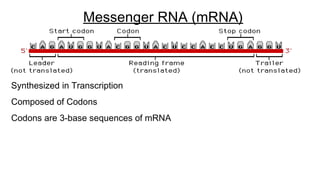
Messenger RNA (mRNA)
Synthesized in Transcription
Composed of Codons
Codons are 3-base sequences of mRNA
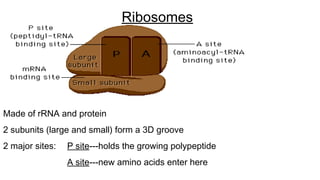
Ribosomes
Made of rRNA and protein
2 subunits (large and small) form a 3D groove
2 major sites: P site---holds the growing polypeptide
A site---new amino acids enter here
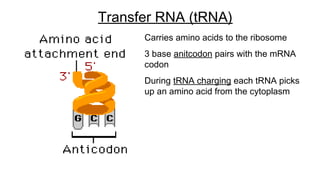
Transfer RNA (tRNA)
Carries amino acids to the ribosome
3 base anitcodon pairs with the mRNA
codon
During tRNA charging each tRNA picks
up an amino acid from the cytoplasm
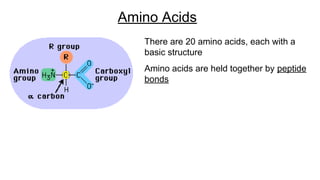
There are 20 amino acids, each with a
basic structure
Amino acids are held together by peptide
bonds
Amino Acids
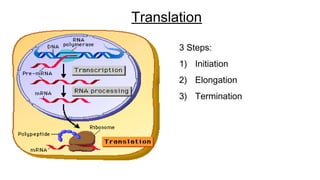
3 Steps:
1) Initiation
2) Elongation
3) Termination
Translation
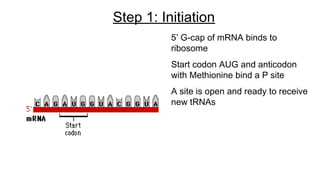
Step 1: Initiation
5’ G-cap of mRNA binds to
ribosome
Start codon AUG and anticodon
with Methionine bind a P site
A site is open and ready to receive
new tRNAs
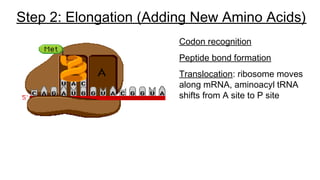
Step 2: Elongation (Adding New Amino Acids)
Codon recognition
Peptide bond formation
Translocation: ribosome moves
along mRNA, aminoacyl tRNA
shifts from A site to P site
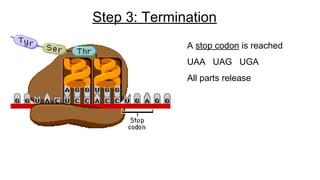
Step 3: Termination
A stop codon is reached
UAA UAG UGA
All parts release
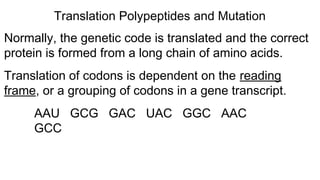
Normally, the genetic code is translated and the correct
protein is formed from a long chain of amino acids.
Translation of codons is dependent on the reading
frame, or a grouping of codons in a gene transcript.
AAU GCG GAC UAC GGC AAC
GCC
Translation Polypeptides and Mutation
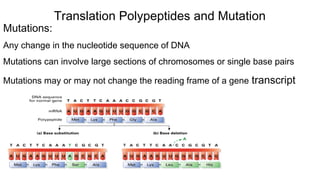
Mutations:
Any change in the nucleotide sequence of DNA
Mutations can involve large sections of chromosomes or single base pairs
Mutations may or may not change the reading frame of a gene transcript
Translation Polypeptides and Mutation
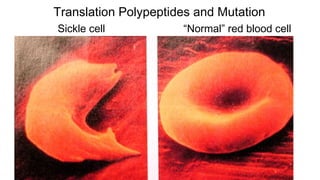
Sickle cell “Normal” red blood cell
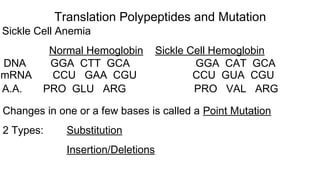
Sickle Cell Anemia
Normal Hemoglobin Sickle Cell Hemoglobin
DNA GGA CTT GCA GGA CAT GCA
mRNA CCU GAA CGU CCU GUA CGU
A.A. PRO GLU ARG PRO VAL ARG
Changes in one or a few bases is called a Point Mutation
2 Types: Substitution
Insertion/Deletions
Translation Polypeptides and Mutation
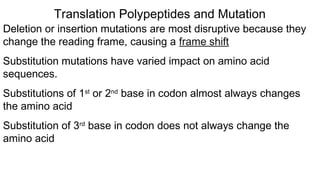
Deletion or insertion mutations are most disruptive because they
change the reading frame, causing a frame shift
Substitution mutations have varied impact on amino acid
sequences.
Substitutions of 1st
or 2nd
base in codon almost always changes
the amino acid
Substitution of 3rd
base in codon does not always change the
amino acid
Translation Polypeptides and Mutation
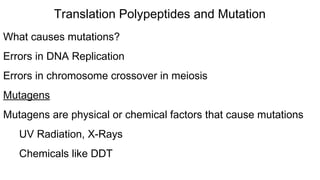
What causes mutations?
Errors in DNA Replication
Errors in chromosome crossover in meiosis
Mutagens
Mutagens are physical or chemical factors that cause mutations
UV Radiation, X-Rays
Chemicals like DDT
Translation Polypeptides and Mutation
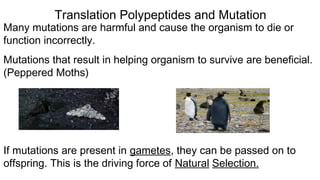
Many mutations are harmful and cause the organism to die or
function incorrectly.
Mutations that result in helping organism to survive are beneficial.
(Peppered Moths)
If mutations are present in gametes, they can be passed on to
offspring. This is the driving force of Natural Selection.
Translation Polypeptides and Mutation

Dna replication transcription and translation

  • 1.
  • 2.
    Nucleotide Building block ofDNA Three Parts Deoxyribose sugar Phosphate group Nitrogen base DNA Structure
  • 3.
    There are twoclasses of bases: Purines: Adenine and Guanine Pyrimidines: Cytosine and Thymine Nitrogenous Bases
  • 4.
    Many nucleotides arepieced together to make a DNA molecule DNA is a Polynucleotide
  • 5.
    A DNA chainconsists of nucleotides joined by bonds between phosphate and sugar This makes up the sides of the DNA “ladder” DNA is a Polynucleotide
  • 6.
    • DNA consistsof two polynucleotide chains wound around each other to form a double helix • Structure inferred from Rosalind Franklin’s famous X-Ray crystallography The Double Helix
  • 7.
    The two chainsare held together by complementary base pairing Specific bonding between A and T bases and between G and C bases on the two strands Inferred from Erwin Chargaff’s research Chargaff’s Rules state that in any organisms genome the amount of A = T and the amount of C = G. The Double Helix
  • 8.
    The two DNAchains are held together by hydrogen bonds between nitrogen bases The two strands run in opposite directions, or are antiparallel Complementary Base Pairing
  • 10.
    Describes the flowof genetic information from DNA to RNA to Proteins DNA Replication Transcription Translation The Central Dogma of Molecular Biology
  • 11.
    DNA Replication issemi-conservative Each newly synthesized molecule contains 1 “parent template” strand and 1 new “daughter” strand DNA Replication
  • 12.
    Step 1: InitiationPreparingthe DNA template Helicase unwinds DNA forming a “replication fork” Multiple replication forks along a DNA molecule create replication bubbles DNA Replication
  • 13.
    Step 2: ElongationAdding New Nucleotides DNA Replication
  • 19.
    RNA Primase addsa complimentary RNA primer to each template strand as a starting point for replication DNA Polymerase reads the template strand (3’ to 5’) and adds new complimentary nucleotides (5’ to 3’) DNA synthesized in the direction of the replication fork is called the leading strand Step 2: Elongation
  • 20.
  • 21.
    DNA polymerase canonly add new nucleotides in the 5’ to 3’ direction Because of the antiparallel nature of DNA, replication occurs in two directions An RNA primer is laid down on the other strand, and new nucleotides are added 5’ to 3’ moving away from the replication fork. This is the lagging strand and the segment of DNA produced is called an Okazaki fragment Step 2: Elongation The Lagging Strand
  • 23.
  • 24.
    The DNA unwindssome more and the leading strand is extended by DNA polymerase adding more DNA nucleotides. Thus, the leading strand is synthesized continuously. Step 2: Elongation
  • 25.
  • 26.
    On the toptemplate strand, a new RNA primer is synthesized by primase near the replication fork DNA polymerase adds new DNA . This produces the second Okazaki fragment. Thus, the lagging strand is synthesized discontinously Step 2: Elongation
  • 27.
  • 28.
    A different typeof DNA polymerase removes the RNA primer and replaces it with DNA DNA ligase joins the two Okazaki fragments with phosphodiester bonds to produce a continuous chain Each new DNA molecule is rewound by helicase. Each molecule is identical Step 3: Termination
  • 29.
    Leading Strand: 1primer, 5’ to 3’ continuous Lagging Strand: multiple primers, 5’ to 3’ discontinuous In humans, DNA polymerase adds 50 nucleotides/second DNA polymerase can proofread its own work and does excision repair 1 in 10,000 bases are in error, after proofreading, rate of mutation is 1 in 10,000,000 Summary and Other Facts
  • 30.
    Check out theseanimations and reviews: DNA replication animation Meselson and Stahl experiment that showed DNA replication is semi-conservativ BioCoach Biosynthesis of DNA practice BioCoach adding new DNA practice
  • 31.
    RNA is animportant type of nucleic acid that plays several roles in the production of protein RNA is necessary to carry the instructions of the DNA out of the nucleus and to the ribosomes RNA
  • 32.
    Messenger RNA carriesthe actual code that specifies the amino acid sequence in a polypeptide (protein) Making mRNA starts with a protein encoding gene on a template strand of DNA Protein Encoding Gene
  • 33.
  • 34.
    RNA Polymerase bindsto a promoter which is a region of bases that signals the beginning of a gene RNA Polymerase is bound to the TATA box of the promoter by transcription factors The double helix unwinds and is ready to be transcribed Transcription Step 1: Initiation
  • 35.
    RNA Polymerase movesalong the protein encoding gene adding new RNA nucleotides in the 5’ to 3’ direction and complimentary to the DNA template Works at up to 60 nucleotides/second Transcription Step 2: Elongation
  • 36.
    RNA Polymerase reachesthe terminator region of the protein encoding gene All the enzymes and factors are released The product of these 3 steps is called immature or pre-mRNA Transcription Step 3: Termination
  • 37.
    Check out theseanimations and reviews: Transcription animation Transcription BioCoach practice Transcription self-quiz RNA Synthesis: Transcription
  • 38.
    The language ofnucleic acids in translated into the language of proteins Nucleic acids have a 4 letter language Proteins have a 20 letter language Translation
  • 39.
    The Genetic Code If3 RNA bases code for 1 amino acid, RNA could code for 43 = 64 amino acids. More than enough coding capacity for 20 amino acids Code is redundant for most amino acids
  • 40.
    The “Players” Messenger RNA(mRNA) Ribosomes Transfer RNA (tRNA) Amino Acids
  • 41.
    Messenger RNA (mRNA) Synthesizedin Transcription Composed of Codons Codons are 3-base sequences of mRNA
  • 42.
    Ribosomes Made of rRNAand protein 2 subunits (large and small) form a 3D groove 2 major sites: P site---holds the growing polypeptide A site---new amino acids enter here
  • 43.
    Transfer RNA (tRNA) Carriesamino acids to the ribosome 3 base anitcodon pairs with the mRNA codon During tRNA charging each tRNA picks up an amino acid from the cytoplasm
  • 44.
    There are 20amino acids, each with a basic structure Amino acids are held together by peptide bonds Amino Acids
  • 45.
    3 Steps: 1) Initiation 2)Elongation 3) Termination Translation
  • 46.
    Step 1: Initiation 5’G-cap of mRNA binds to ribosome Start codon AUG and anticodon with Methionine bind a P site A site is open and ready to receive new tRNAs
  • 47.
    Step 2: Elongation(Adding New Amino Acids) Codon recognition Peptide bond formation Translocation: ribosome moves along mRNA, aminoacyl tRNA shifts from A site to P site
  • 48.
    Step 3: Termination Astop codon is reached UAA UAG UGA All parts release
  • 49.
    Normally, the geneticcode is translated and the correct protein is formed from a long chain of amino acids. Translation of codons is dependent on the reading frame, or a grouping of codons in a gene transcript. AAU GCG GAC UAC GGC AAC GCC Translation Polypeptides and Mutation
  • 50.
    Mutations: Any change inthe nucleotide sequence of DNA Mutations can involve large sections of chromosomes or single base pairs Mutations may or may not change the reading frame of a gene transcript Translation Polypeptides and Mutation
  • 51.
    Translation Polypeptides andMutation Sickle cell “Normal” red blood cell
  • 52.
    Sickle Cell Anemia NormalHemoglobin Sickle Cell Hemoglobin DNA GGA CTT GCA GGA CAT GCA mRNA CCU GAA CGU CCU GUA CGU A.A. PRO GLU ARG PRO VAL ARG Changes in one or a few bases is called a Point Mutation 2 Types: Substitution Insertion/Deletions Translation Polypeptides and Mutation
  • 53.
    Deletion or insertionmutations are most disruptive because they change the reading frame, causing a frame shift Substitution mutations have varied impact on amino acid sequences. Substitutions of 1st or 2nd base in codon almost always changes the amino acid Substitution of 3rd base in codon does not always change the amino acid Translation Polypeptides and Mutation
  • 54.
    What causes mutations? Errorsin DNA Replication Errors in chromosome crossover in meiosis Mutagens Mutagens are physical or chemical factors that cause mutations UV Radiation, X-Rays Chemicals like DDT Translation Polypeptides and Mutation
  • 55.
    Many mutations areharmful and cause the organism to die or function incorrectly. Mutations that result in helping organism to survive are beneficial. (Peppered Moths) If mutations are present in gametes, they can be passed on to offspring. This is the driving force of Natural Selection. Translation Polypeptides and Mutation