DNA Replication
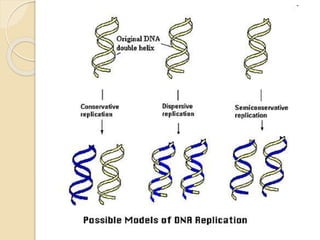
 Conservative replication
◦ Intact the original DNA molecule and
generate a completely new molecule.
 Dispersive replication
◦ Produce two DNA molecules with sections of
both old and new DNA interspersed along
each strand.
 Semi-conservative replication
◦ Produce molecules with both old and new
DNA – each molecule would be composed of
one old strand and one new one.
DNA Replication is Semi-
conservative: Experimental Proof
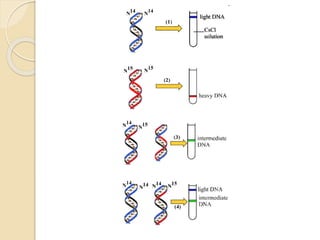
(1957) Matthew Meselson and Franklin
Stahl
 They grew the bacterium Escherichia
coli medium that contained 15N in the
form of ammonium chloride.
 Conclusion: Semi-conservative model
is the most appropriate for replication
John Cairns
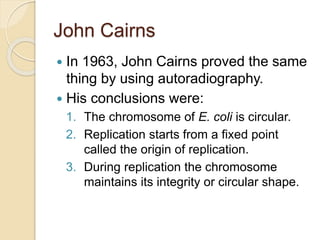
 In 1963, John Cairns proved the same
thing by using autoradiography.
 His conclusions were:
1. The chromosome of E. coli is circular.
2. Replication starts from a fixed point
called the origin of replication.
3. During replication the chromosome
maintains its integrity or circular shape.
DNA Replication in Bacteria
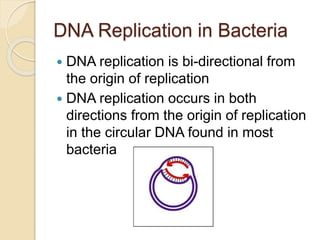
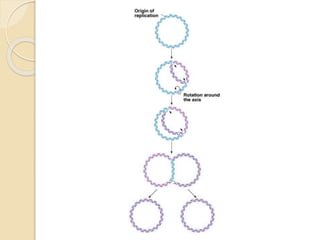
 DNA replication is bi-directional from
the origin of replication
 DNA replication occurs in both
directions from the origin of replication
in the circular DNA found in most
bacteria
The Mechanism of
Replication
 Tightly controlled process:
◦ Occurs at specified times during the cell cycle
◦ Starts at a fixed point
 Requires:
◦ A set of proteins and enzymes
◦ Energy
 Two basic steps:
◦ Initiation
◦ Elongation
 Two basic components:
◦ Template
◦ Primer
Origin of Replication
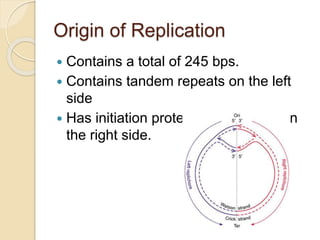
 Contains a total of 245 bps.
 Contains tandem repeats on the left
side
 Has initiation protein binding sites on
the right side.
Enzymology of DNA
Replication
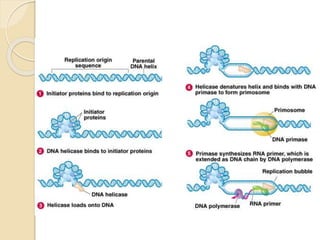
 DNA Helicase: Unwinds DNA ahead of
replication fork.
 DNA Polymerase: DNA synthesis and
repair of gaps.
 DNA Ligase: Joins fragments of DNA
 DNA Primase: Synthesizes primers
 DNA gyrase: Releases torsional strain
caused by helicase activity
 SSBs: Stabilize single-stranded regions
of the replication fork
Helicase
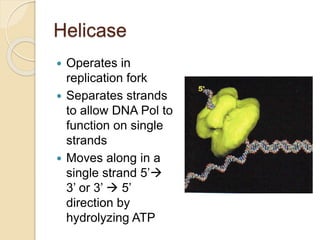
 Operates in
replication fork
 Separates strands
to allow DNA Pol to
function on single
strands
 Moves along in a
single strand 5’
3’ or 3’  5’
direction by
hydrolyzing ATP
Topoisomerase Enzyme
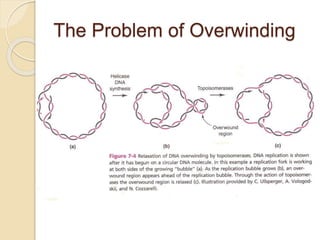
 Regulates the overwinding or
underwinding of DNA
 Topoisomerases bind to either single-
stranded or double-stranded DNA
 It also cuts the phosphate backbone of
the DNA
 It is further categorized into
a) Topoisomerase I, and
b) Topoisomerase II enzyme
Single Stranded DNA Binding
Proteins (SSB)
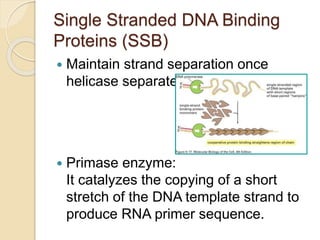
 Maintain strand separation once
helicase separates strands.
 Primase enzyme:
It catalyzes the copying of a short
stretch of the DNA template strand to
produce RNA primer sequence.
The DNA Polymerase Family
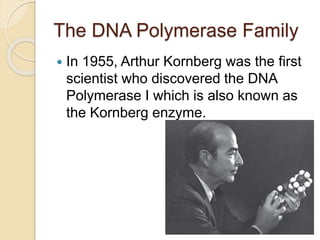
 In 1955, Arthur Kornberg was the first
scientist who discovered the DNA
Polymerase I which is also known as
the Kornberg enzyme.
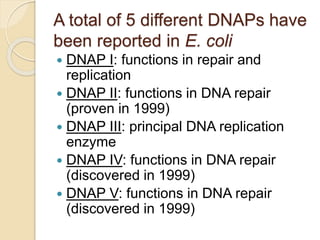
A total of 5 different DNAPs have
been reported in E. coli
 DNAP I: functions in repair and
replication
 DNAP II: functions in DNA repair
(proven in 1999)
 DNAP III: principal DNA replication
enzyme
 DNAP IV: functions in DNA repair
(discovered in 1999)
 DNAP V: functions in DNA repair
(discovered in 1999)
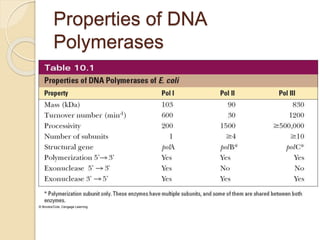
Properties of DNA
Polymerases
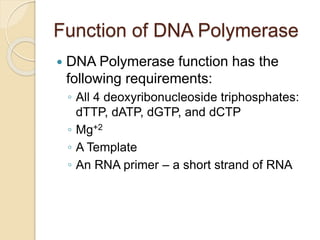
Function of DNA Polymerase
 DNA Polymerase function has the
following requirements:
◦ All 4 deoxyribonucleoside triphosphates:
dTTP, dATP, dGTP, and dCTP
◦ Mg+2
◦ A Template
◦ An RNA primer – a short strand of RNA
Initiation
Initiation of Replication
 Replication initiated at specific sites:
Origin of Replication (ori)
 Two types of initiation:
◦ De novo – Synthesis initiated with RNA
primers. Most common
◦ Covalent extension – Synthesis of new
strand as an extension of an old strand
(“Rolling Circle”)
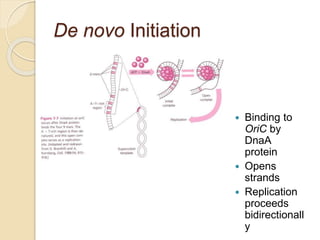
De novo Initiation
 Binding to
OriC by
DnaA
protein
 Opens
strands
 Replication
proceeds
bidirectionall
y
The Problem of Overwinding
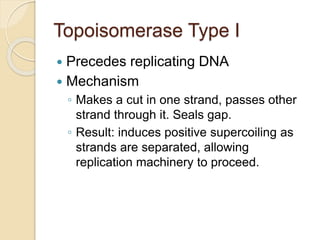
Topoisomerase Type I
 Precedes replicating DNA
 Mechanism
◦ Makes a cut in one strand, passes other
strand through it. Seals gap.
◦ Result: induces positive supercoiling as
strands are separated, allowing
replication machinery to proceed.
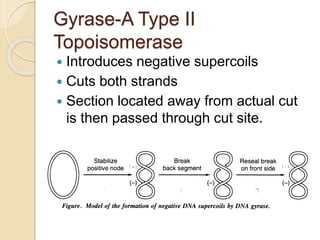
Gyrase-A Type II
Topoisomerase
 Introduces negative supercoils
 Cuts both strands
 Section located away from actual cut
is then passed through cut site.
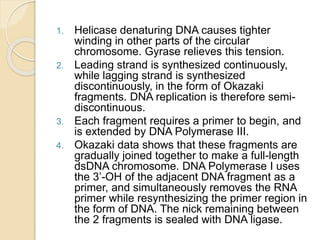
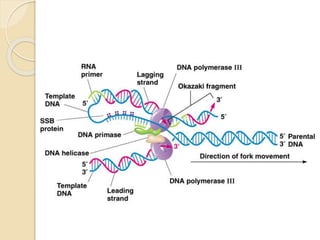
1. Helicase denaturing DNA causes tighter
winding in other parts of the circular
chromosome. Gyrase relieves this tension.
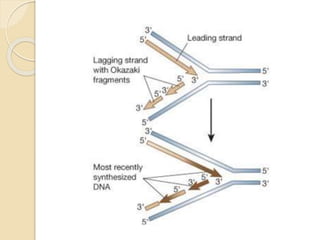
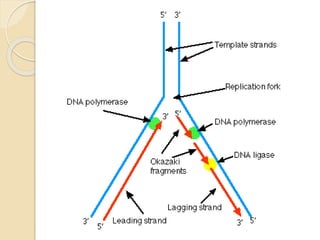
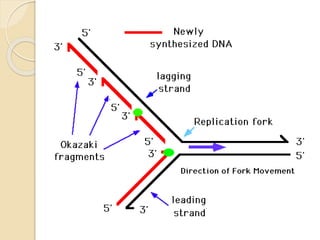
2. Leading strand is synthesized continuously,
while lagging strand is synthesized
discontinuously, in the form of Okazaki
fragments. DNA replication is therefore semi-
discontinuous.
3. Each fragment requires a primer to begin, and
is extended by DNA Polymerase III.
4. Okazaki data shows that these fragments are
gradually joined together to make a full-length
dsDNA chromosome. DNA Polymerase I uses
the 3’-OH of the adjacent DNA fragment as a
primer, and simultaneously removes the RNA
primer while resynthesizing the primer region in
the form of DNA. The nick remaining between
the 2 fragments is sealed with DNA ligase.
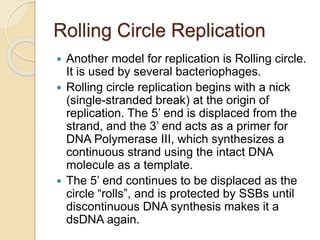
Rolling Circle Replication
 Another model for replication is Rolling circle.
It is used by several bacteriophages.
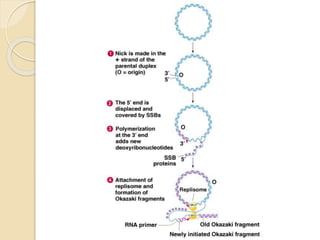
 Rolling circle replication begins with a nick
(single-stranded break) at the origin of
replication. The 5’ end is displaced from the
strand, and the 3’ end acts as a primer for
DNA Polymerase III, which synthesizes a
continuous strand using the intact DNA
molecule as a template.
 The 5’ end continues to be displaced as the
circle “rolls”, and is protected by SSBs until
discontinuous DNA synthesis makes it a
dsDNA again.
 A DNA molecule many genomes in
length can be made by rolling circle
replication. During viral assembly it is
cut into individual viral chromosomes
and packaged into phage head.
 Bacteriophage λ, regardless of
whether entering the lytic or lysogenic
pathway, circularizes its chromosome
immediately after infection.
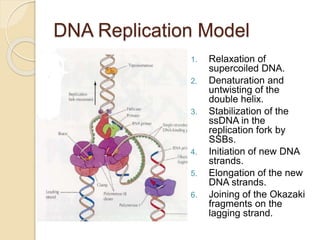
DNA Replication Model
1. Relaxation of
supercoiled DNA.
2. Denaturation and
untwisting of the
double helix.
3. Stabilization of the
ssDNA in the
replication fork by
SSBs.
4. Initiation of new DNA
strands.
5. Elongation of the new
DNA strands.
6. Joining of the Okazaki
fragments on the
lagging strand.
Elongation
2 Strands
 Leading Strand
 Lagging Strand
Leading strand
 Continuously elongating strand
 In 5’ to 3’ direction
 Towards the replication fork
Primosome
 Contains Primase and Helicase
 Forms RNA primer
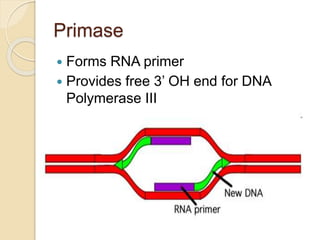
Primase
 Forms RNA primer
 Provides free 3’ OH end for DNA
Polymerase III
DNA Polymerase III
 Addition of new nucleotides to 3’ end
of primer
 About 1000 nucleotides/second
Okazaki fragments
 Discovered by Reiji Okazaki
 1000 to 2000 nucleotide sequence
 Separated by 10 nucleotide RNA
primer
Lagging strand
 Discontinuously elongating strand
 Away from replication fork
 Primosome formation
DNA Polymerase I
DNA Ligase
 Removes DNA Polymerase III
 Replaces RNA primer
 Joins the okazaki fragments
Speed of Elongation
 Due to continuous and discontinuous
elongation, leading strand should
elongate quickly
 Prevented by helicase which acts as
temporary halting signal, stopping
DNA unwinding
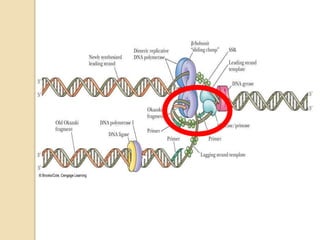
Folding of Lagging strand
 For simultaneous replication of both
strands by DNA Polymerase III
subunits
Termination
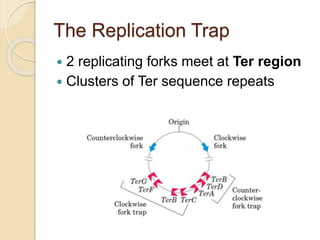
The Replication Trap
 2 replicating forks meet at Ter region
 Clusters of Ter sequence repeats
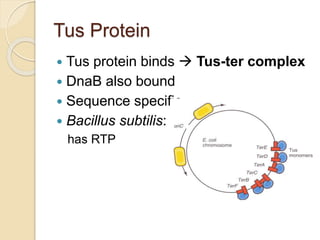
Tus Protein
 Tus protein binds  Tus-ter complex
 DnaB also bound
 Sequence specific
 Bacillus subtilis:
has RTP
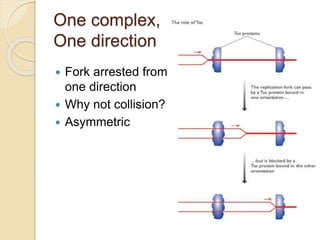
One complex,
One direction
 Fork arrested from
one direction
 Why not collision?
 Asymmetric
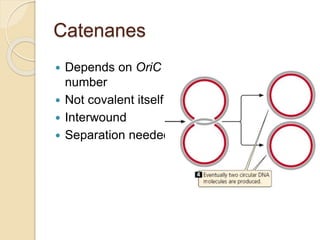
Catenanes
 Depends on OriC
number
 Not covalent itself
 Interwound
 Separation needed
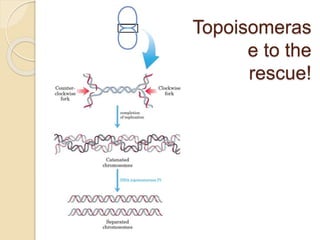
Topoisomeras
e to the
rescue!
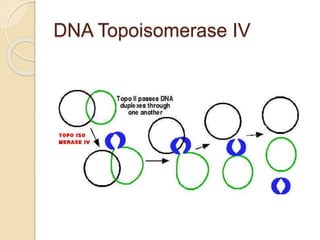
DNA Topoisomerase IV
Regulation
Regulation of Initiation
 Ratio of ATP to ADP
 Ratio of DnaA to number of DnaA
boxes
 Hemimethylation of OriC
 Sequestering of OriC
ATP : ADP
 DnaA complexes with ATP and ADP
 Faster growth, more ATP complex
 Strict regulation of DnaA
Methylation and Sequestering
 OriC hemimethylated by Dam
methylase
 GATC: N6 position of adenine
 OriC = 11/245
 Whole = only 1 in 256
Right after replication…
 Parental strand hemimethylated
 OriC seq. to membrane by SeqA
binding protein
◦ DnaA cannot access for a while
◦ DnaA binds better with full than hemi
 OriC released, fully methylated
 DnaA can bind
Why these two?
 With more DnaA, more DNA to cell
mass (and vice versa).
 Without Dam methylase, E. coli
inefficiently replicates
◦ Therefore, OriC methylation triggers, too.

Replication in prokaryotes

  • 1.
    DNA Replication  Conservativereplication ◦ Intact the original DNA molecule and generate a completely new molecule.  Dispersive replication ◦ Produce two DNA molecules with sections of both old and new DNA interspersed along each strand.  Semi-conservative replication ◦ Produce molecules with both old and new DNA – each molecule would be composed of one old strand and one new one.
  • 3.
    DNA Replication isSemi- conservative: Experimental Proof (1957) Matthew Meselson and Franklin Stahl  They grew the bacterium Escherichia coli medium that contained 15N in the form of ammonium chloride.  Conclusion: Semi-conservative model is the most appropriate for replication
  • 5.
    John Cairns  In1963, John Cairns proved the same thing by using autoradiography.  His conclusions were: 1. The chromosome of E. coli is circular. 2. Replication starts from a fixed point called the origin of replication. 3. During replication the chromosome maintains its integrity or circular shape.
  • 6.
    DNA Replication inBacteria  DNA replication is bi-directional from the origin of replication  DNA replication occurs in both directions from the origin of replication in the circular DNA found in most bacteria
  • 7.
    The Mechanism of Replication Tightly controlled process: ◦ Occurs at specified times during the cell cycle ◦ Starts at a fixed point  Requires: ◦ A set of proteins and enzymes ◦ Energy  Two basic steps: ◦ Initiation ◦ Elongation  Two basic components: ◦ Template ◦ Primer
  • 8.
    Origin of Replication Contains a total of 245 bps.  Contains tandem repeats on the left side  Has initiation protein binding sites on the right side.
  • 9.
    Enzymology of DNA Replication DNA Helicase: Unwinds DNA ahead of replication fork.  DNA Polymerase: DNA synthesis and repair of gaps.  DNA Ligase: Joins fragments of DNA  DNA Primase: Synthesizes primers  DNA gyrase: Releases torsional strain caused by helicase activity  SSBs: Stabilize single-stranded regions of the replication fork
  • 10.
    Helicase  Operates in replicationfork  Separates strands to allow DNA Pol to function on single strands  Moves along in a single strand 5’ 3’ or 3’  5’ direction by hydrolyzing ATP
  • 11.
    Topoisomerase Enzyme  Regulatesthe overwinding or underwinding of DNA  Topoisomerases bind to either single- stranded or double-stranded DNA  It also cuts the phosphate backbone of the DNA  It is further categorized into a) Topoisomerase I, and b) Topoisomerase II enzyme
  • 12.
    Single Stranded DNABinding Proteins (SSB)  Maintain strand separation once helicase separates strands.  Primase enzyme: It catalyzes the copying of a short stretch of the DNA template strand to produce RNA primer sequence.
  • 13.
    The DNA PolymeraseFamily  In 1955, Arthur Kornberg was the first scientist who discovered the DNA Polymerase I which is also known as the Kornberg enzyme.
  • 14.
    A total of5 different DNAPs have been reported in E. coli  DNAP I: functions in repair and replication  DNAP II: functions in DNA repair (proven in 1999)  DNAP III: principal DNA replication enzyme  DNAP IV: functions in DNA repair (discovered in 1999)  DNAP V: functions in DNA repair (discovered in 1999)
  • 15.
  • 16.
    Function of DNAPolymerase  DNA Polymerase function has the following requirements: ◦ All 4 deoxyribonucleoside triphosphates: dTTP, dATP, dGTP, and dCTP ◦ Mg+2 ◦ A Template ◦ An RNA primer – a short strand of RNA
  • 17.
  • 18.
    Initiation of Replication Replication initiated at specific sites: Origin of Replication (ori)  Two types of initiation: ◦ De novo – Synthesis initiated with RNA primers. Most common ◦ Covalent extension – Synthesis of new strand as an extension of an old strand (“Rolling Circle”)
  • 19.
    De novo Initiation Binding to OriC by DnaA protein  Opens strands  Replication proceeds bidirectionall y
  • 22.
    The Problem ofOverwinding
  • 23.
    Topoisomerase Type I Precedes replicating DNA  Mechanism ◦ Makes a cut in one strand, passes other strand through it. Seals gap. ◦ Result: induces positive supercoiling as strands are separated, allowing replication machinery to proceed.
  • 24.
    Gyrase-A Type II Topoisomerase Introduces negative supercoils  Cuts both strands  Section located away from actual cut is then passed through cut site.
  • 25.
    1. Helicase denaturingDNA causes tighter winding in other parts of the circular chromosome. Gyrase relieves this tension. 2. Leading strand is synthesized continuously, while lagging strand is synthesized discontinuously, in the form of Okazaki fragments. DNA replication is therefore semi- discontinuous. 3. Each fragment requires a primer to begin, and is extended by DNA Polymerase III. 4. Okazaki data shows that these fragments are gradually joined together to make a full-length dsDNA chromosome. DNA Polymerase I uses the 3’-OH of the adjacent DNA fragment as a primer, and simultaneously removes the RNA primer while resynthesizing the primer region in the form of DNA. The nick remaining between the 2 fragments is sealed with DNA ligase.
  • 27.
    Rolling Circle Replication Another model for replication is Rolling circle. It is used by several bacteriophages.  Rolling circle replication begins with a nick (single-stranded break) at the origin of replication. The 5’ end is displaced from the strand, and the 3’ end acts as a primer for DNA Polymerase III, which synthesizes a continuous strand using the intact DNA molecule as a template.  The 5’ end continues to be displaced as the circle “rolls”, and is protected by SSBs until discontinuous DNA synthesis makes it a dsDNA again.
  • 29.
     A DNAmolecule many genomes in length can be made by rolling circle replication. During viral assembly it is cut into individual viral chromosomes and packaged into phage head.  Bacteriophage λ, regardless of whether entering the lytic or lysogenic pathway, circularizes its chromosome immediately after infection.
  • 30.
    DNA Replication Model 1.Relaxation of supercoiled DNA. 2. Denaturation and untwisting of the double helix. 3. Stabilization of the ssDNA in the replication fork by SSBs. 4. Initiation of new DNA strands. 5. Elongation of the new DNA strands. 6. Joining of the Okazaki fragments on the lagging strand.
  • 31.
  • 32.
    2 Strands  LeadingStrand  Lagging Strand
  • 33.
    Leading strand  Continuouslyelongating strand  In 5’ to 3’ direction  Towards the replication fork
  • 35.
    Primosome  Contains Primaseand Helicase  Forms RNA primer
  • 36.
    Primase  Forms RNAprimer  Provides free 3’ OH end for DNA Polymerase III
  • 37.
    DNA Polymerase III Addition of new nucleotides to 3’ end of primer  About 1000 nucleotides/second
  • 38.
    Okazaki fragments  Discoveredby Reiji Okazaki  1000 to 2000 nucleotide sequence  Separated by 10 nucleotide RNA primer
  • 40.
    Lagging strand  Discontinuouslyelongating strand  Away from replication fork  Primosome formation
  • 41.
    DNA Polymerase I DNALigase  Removes DNA Polymerase III  Replaces RNA primer  Joins the okazaki fragments
  • 43.
    Speed of Elongation Due to continuous and discontinuous elongation, leading strand should elongate quickly  Prevented by helicase which acts as temporary halting signal, stopping DNA unwinding
  • 44.
    Folding of Laggingstrand  For simultaneous replication of both strands by DNA Polymerase III subunits
  • 46.
  • 47.
    The Replication Trap 2 replicating forks meet at Ter region  Clusters of Ter sequence repeats
  • 48.
    Tus Protein  Tusprotein binds  Tus-ter complex  DnaB also bound  Sequence specific  Bacillus subtilis: has RTP
  • 49.
    One complex, One direction Fork arrested from one direction  Why not collision?  Asymmetric
  • 50.
    Catenanes  Depends onOriC number  Not covalent itself  Interwound  Separation needed
  • 51.
  • 52.
  • 53.
  • 54.
    Regulation of Initiation Ratio of ATP to ADP  Ratio of DnaA to number of DnaA boxes  Hemimethylation of OriC  Sequestering of OriC
  • 55.
    ATP : ADP DnaA complexes with ATP and ADP  Faster growth, more ATP complex  Strict regulation of DnaA
  • 56.
    Methylation and Sequestering OriC hemimethylated by Dam methylase  GATC: N6 position of adenine  OriC = 11/245  Whole = only 1 in 256
  • 57.
    Right after replication… Parental strand hemimethylated  OriC seq. to membrane by SeqA binding protein ◦ DnaA cannot access for a while ◦ DnaA binds better with full than hemi  OriC released, fully methylated  DnaA can bind
  • 58.
    Why these two? With more DnaA, more DNA to cell mass (and vice versa).  Without Dam methylase, E. coli inefficiently replicates ◦ Therefore, OriC methylation triggers, too.

Editor's Notes

  • #2 In conservative replication one of the daughter DNA molecules contained both parental strands and the other contained an entirely new stand. Parent strand in this case acts as a template to synthesize the new strand. After that the parent strand reunites hence this is called conservative replication. In this case only the phosphodiester bonds break. In the second case, i.e. the semi conservative replication each daughter has one parental strand and one new strand. In this both the strands are the same. In the last case the parental DNA strands do not maintain their identity. It breaks up into tiny strands and forma an entirely new strand.
  • #4  (1957) Mathew Meselson and Franklin Stahl grew the bacterium Escherichia coli on medium that contained 15N in the form of ammonium chloride. The 15N became incorporated into DNA (nitrogenous bases). The resulting heavy nitrogen-containing DNA molecules were extracted from some of the cells. When subject to density gradient centrifugation, they accumulated in the high-density region of the gradient. The rest of the bacteria were transferred to a new growth medium in which ammonium chloride contained the naturally abundant, lighter 14N isotope. The newly synthesized strands were expected to be less dense since they incorporated bases containing the lighter 14N isotope. The DNA from cells isolated after one generation had an intermediate density, indicating that they contained half as many 15N isotope as the parent DNA. This finding supported the semi-conservative model - each double helix would contain one previously synthesized strand and a newly synthesized strand. It is also consistent with the dispersive model which would yield one class of molecules, all with intermediate density. It was inconsistent with the conservative model which predicted that there would be two classes of double-stranded molecules, those with two heavy strands and those with two light strands. After another cycle of cell division in the medium with the lighter 14N isotope, two types of DNA appeared in the density gradient. One with hybrid DNA helices (one strand 15N isotope and the other strand 14N), whereas the other contained only strands of the light isotope. This finding refuted the dispersive model, which predicted that all stands should have intermediate density. It however supported the semiconservative method which predicted that each parent strand would act as a template for the synthesis of new strands.
  • #6 Then in 1963 John Cairns proved the same thing by using autoradiography. It is a technique whereby he used an x-ray film to visualize molecules or fragments of molecules that had been labeled by radioactive elements. He grew E. coli on a medium containing 3H-thymine. In his conclusions he said that the chromosome of E. coli is circular. He also stated that replication starts from a fixed point which is now called as the origin of replication. An intermediate theta structure forms (topologically similar in shape to the Greek letter.) He also stated that during replication the chromosome maintains its integrity or circular shape. Therefore according to him a part of chromosome opens up during replication and after replication it again coils up over one another.
  • #7 • At each origin of replication, there are two replication forks, points at which new polynucleotide chains are formed • There is one origin of replication and two replication forks in the circular DNA of prokaryotes
  • #9 Replication in case of prokaryotes starts from a fixed point called the Ori-c or origin or replication. It contains a total of 245 bps. This region contains 13mer sequences also called the Tandem repeats having 13 base pairs on the left side. Along with this it also contains 4 9mer sequences on the right side that act as the initiation protein binding sites. Tandem repeats are dispersed.
  • #12 Topoisomerases are enzymes that regulate the overwinding or underwinding of DNA. The winding problem of DNA arises due to the intertwined nature of its double helical structure. For example, during DNA replication, DNA becomes overwound ahead of a replication fork. If left unabated, this tension would eventually grind replication to a halt (a similar event happens during transcription.) In order to help overcome these types of topological problems caused by the double helix, topoisomerases bind to either single-stranded or double-stranded DNA and cut the phosphate backbone of the DNA. This intermediate break allows the DNA to be untangled or unwound, and, at the end of these processes, the DNA backbone is resealed again.
  • #16 Processivity is basically defined as the average number of nucleotides that are added before a polymerase dissociates. Before separation, Polymerase I can add about 3-200 nucleotides to the strand, whereas polymerase II can add about 1500 nucleotides and polymerase III can add up to 50,000 nucleotides. Therefore the efficiency of the enzyme is calculated on the basis of its accuracy and processivity. Hence DNA polymerase III is considered to be a very processive enzyme.
  • #32 The second step in the replication process is the elongation of the strands. As we know, there are two single separated strands termed as leading and lagging strand.
  • #34 ELONGATION OF THE LEADING STRAND: It is the continuous elongating strand in which elongation moves in the direction of replication fork i.e. from 5’ to 3’. The dnaB enzyme (primase) and dnaG (helicase) form a functional unit called as primosome. On the single separated leading strand, this primosome synthesizes a RNA primer which is a short nucleotide sequence of about 10 base pairs. Another enzyme DNA polymerase III binds with this primer and add new nucleotides to the 3’ end of the primer, thus elongating it.
  • #41 ELONGATION OF THE LAGGING STRAND: This strand is elongated discontinuously in 3’ to 5’ direction i.e. away from the replication fork. As in the case of elongation of leading strand, a primosome is formed, which synthesizes RNA primer. The basic purpose of the primer is to provide a free 3’ end because DNA polymerase III can add free nucleotides only at 3’ end. When DNA polymerase III reaches primer, it adds a short sequence of nucleotides of about 1000 to 2000 base pairs to the primer. These sequences are called as okazaki fragments. After the addition of okazaki fragments DNA polymerase I replaces DNA polymerase III. It removes RNA primer and replaces it with DNA sequence. Basically DNA polymerase I removes DNA polymerase III and replaces Uridine in RNA primer with Thymine. After the addition of one fragment, the primosome moves forward on thE replication fork, it synthesizes new primer and the process is repeated. DNA ligase binds the two fragments together by the formation of phosphodiester bond.
  • #42 SPECIAL PROPERTY OF DNA POLYEMRASE III DNA polymerase III is a single enzyme and its subunits act on both strands i.e. two different DNA polymerase III doesn’t act on both strands. The lagging strand folds upon itself so that DNA polymerase III subunit can act as one unit and both strands can replicate simultaneously.