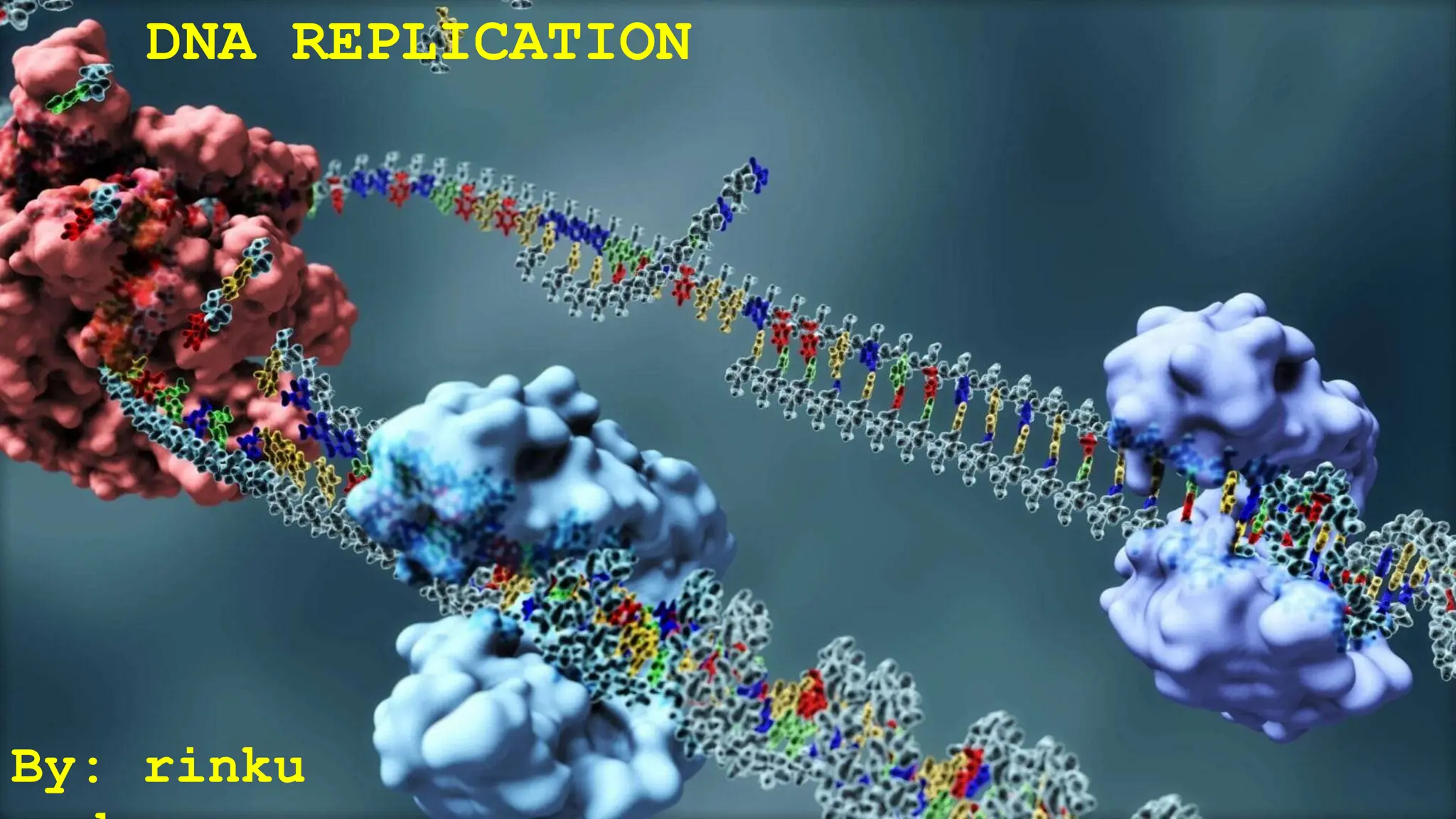
DNA REPLICATION
By: rinku
 DNA replication is the biological process of producing two
identical replicas of DNA from one original DNA molecule.
 DNA replication occurs in all living organisms acting as the most
essential part for biological inheritance.
Basic requirement of replication :
dATP
dGTP
dCTP
dTTP
 template: is defined as a single-stranded nucleic acid – a DNA
or RNA polymer made of nucleotides – that is used to synthesize
a new DNA, RNA or protein polymer.
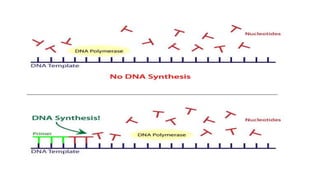
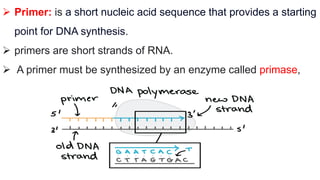
 Primer: is a short nucleic acid sequence that provides a starting
point for DNA synthesis.
 primers are short strands of RNA.
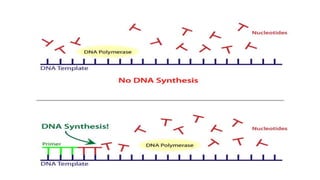
 A primer must be synthesized by an enzyme called primase,
 helicase: unwind the double-stranded DNA molecule by
breaking the hydrogen bonds between the complementary base
pairs, allowing the DNA strands to separate.
DNA C proteins then help DNA helicase (DNA B) load onto the
origin correctly.
Histone-like proteins (maintaining DNA architecture and
regulating DNA transactions such as replication,
recombination/repair and transcription.
STEPS OF REPLICATION
separation of DNA strands:
 The regulation of DNA replication origins starts in the G1 phase
of the cell cycle
 The Origin of replication in DNA stand the sequence present in
A=T
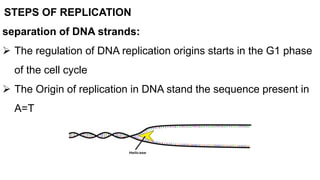
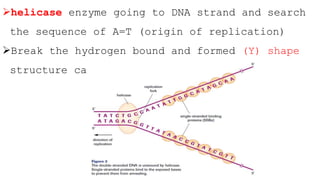
helicase enzyme going to DNA strand and search
the sequence of A=T (origin of replication)
Break the hydrogen bound and formed (Y) shape
structure called replication fork
Step -2 Synthesis of new strand
 DNA polymerase responsible for adding new
nucleotides synthesis new DNA stand
 DNA Polymerases also possess exonuclease activity, that cuts
incorrectly added nucleotides, and allows the DNA replication to
happen without errors.
 DNA polymerase work as a single stand
 DNA polymerase the 2nd condition gives work as
a 3 prime to 5 prime
Single strand binding proteins
 (SSB) protein are DNA binding proteins, that binds to single-
stranded DNA to help DNA replication.
 SSB proteins prevent the hardening of strands during DNA
replication. It also protects strands from nuclease degradation
and prevents the rewinding of DNA.
DNA topoisomerase
 DNA topoisomerase is a class of enzymes that release helical
tension during transcription and replication
 Class Ι DNA topoisomerase makes a single-stranded break to
relax the helix and progress the process.
 Class ΙΙ DNA topoisomerase break both the strands of DNA
helix, this class of topoisomerases is also very important during
the cell cycle for the condensation of chromosomes.
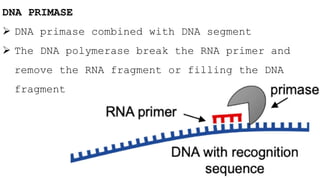
DNA PRIMASE
 DNA primase combined with DNA segment
 The DNA polymerase break the RNA primer and
remove the RNA fragment or filling the DNA
fragment
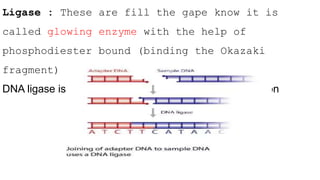
Ligase : These are fill the gape know it is
called glowing enzyme with the help of
phosphodiester bound (binding the Okazaki
fragment)
DNA ligase is used in both DNA repair and DNA replication
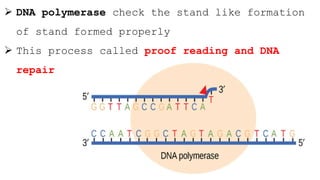
 DNA polymerase check the stand like formation
of stand formed properly
 This process called proof reading and DNA
repair
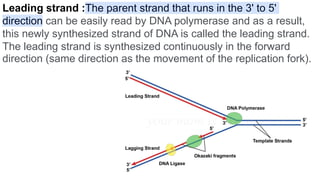
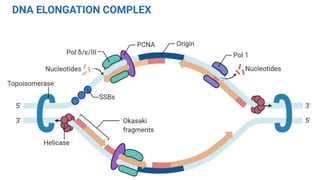
Leading strand :The parent strand that runs in the 3' to 5'
direction can be easily read by DNA polymerase and as a result,
this newly synthesized strand of DNA is called the leading strand.
The leading strand is synthesized continuously in the forward
direction (same direction as the movement of the replication fork).
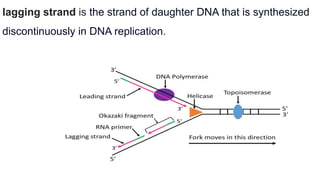
lagging strand is the strand of daughter DNA that is synthesized
discontinuously in DNA replication.
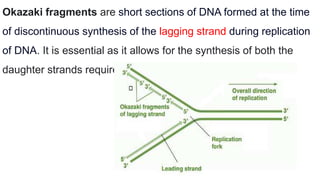
Okazaki fragments are short sections of DNA formed at the time
of discontinuous synthesis of the lagging strand during replication
of DNA. It is essential as it allows for the synthesis of both the
daughter strands required for cell division.
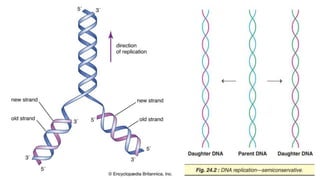
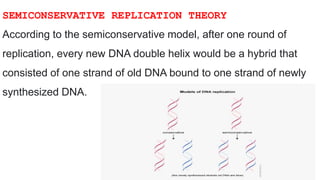
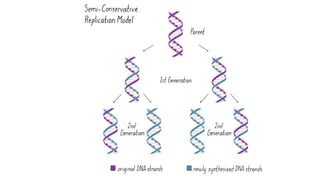
SEMICONSERVATIVE REPLICATION THEORY
According to the semiconservative model, after one round of
replication, every new DNA double helix would be a hybrid that
consisted of one strand of old DNA bound to one strand of newly
synthesized DNA.
Steps in DNA Replication
Formation of Replication Fork
Initiation
Elongation
Termination
DNA Replication in Prokaryotes
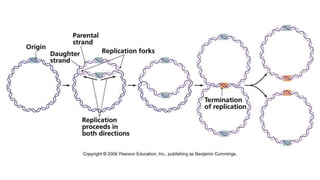
the small size of the genome and the mutants that are
available. E. coli has 4.6 million base pairs
single circular chromosome and all of it gets replicated in
approximately 42 minutes, starting from a single origin of
replication and proceeding around the circle in both directions.
approximately 1000 nucleotides are added per second.
In prokaryotes, three main types of polymerases
are known: DNA pol
DNA pol I:Exonuclease activity removes RNA
primer and replaces with newly synthesized DNA
DNA pol II:Repair function
DNA pol III:Main enzyme that adds nucleotides
in the 5'-3' direction
specific nucleotide sequences called origins of
replication where replication begins. In E.
coli, which has a single origin of replication.
 The origin of replication is recognized by
certain proteins that bind to this site. An
enzyme called helicase unwinds the DNA by
breaking the hydrogen bonds between the
nitrogenous base pairs.
the DNA opens up, Y-shaped structures
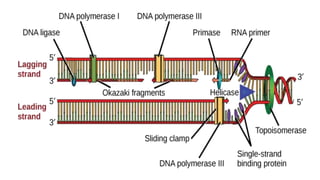
Single-strand binding
the single strands of DNA near the replication
fork to prevent the single-stranded DNA from
winding back into a double helix.
DNA polymerase is able to add nucleotides only
in the 5' to 3'
RNA primase, synthesizes an RNA primer that is
about five to ten nucleotides long and
complementary to the DNA. Because this sequence
DNA replication steps
1.DNA unwinds at the origin of replication.
2.Helicase opens up the DNA-forming replication
forks; these are extended bidirectionally.
3.Single-strand binding proteins coat the DNA
around the replication fork to prevent rewinding
of the DNA.
4.Topoisomerase binds at the region ahead of the
replication fork to prevent supercoiling.
6.DNA polymerase starts adding nucleotides to the
3'-OH end of the primer.
7.Elongation of both the lagging and the leading
strand continues.
8.RNA primers are removed by exonuclease
activity.
9.Gaps are filled by DNA pol by adding dNTPs.
10.The gap between the two DNA fragments is
sealed by DNA ligase, which helps in the
DNA Replication in Eukaryotes :DNA replication in
eukaryotes occurs in three stages: initiation,
elongation, and termination.
Eukaryotic DNA Replication- Features, Enzymes, Process,
Significance
•DNA replication is the process by which an organism duplicates
its DNA into another copy that is passed on to daughter cells.
•Replication occurs before a cell divides to ensure that both cells
receive an exact copy of the parent’s genetic material.
Features of Eukaryotic DNA Replication
•Replication is bi-directional and originates at
multiple origins of replication (Ori C) in
eukaryotes.
•DNA replication uses a semi-conservative method
that results in a double-stranded DNA with one
parental strand and a new daughter strand.
•It occurs only in the S phase and at many
chromosomal origins.
•Individual strands of DNA are manufactured in
different directions, producing a leading and a
lagging strand.
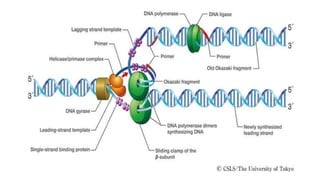
•Lagging strands are created by the production of
small DNA fragments called Okazaki fragments
that are eventually joined together.
•Eukaryotic cells possess five types of
polymerases involved in the replication process.
THE ENZYMES OF DNA REPLICATION
•Helicases: Unwind the DNA helix at the start of
replication.
•SSB proteins: Bind to the single strands of
unwound DNA to prevent reformation of the DNA
helix during replication.
DNA Polymerases:
•Eukaryotic cells contain five different DNA
polymerases; α, β, γ, δ & ε.
•DNA polymerase α and δ synthesize the lagging
strand, via Okazaki fragments.
•The RNA primers are synthesized by DNA
polymerase α which carries a primase subunit.
•DNA polymerase δ synthesizes the leading strand.
•Telomerase, a DNA polymerase that contains an
integral RNA that acts as its own primer, is
used to replicate DNA at the ends of chromosomes
(telomeres).
•DNA topoisomerase I: Relaxes the DNA helix
during replication through creation of a nick in
one of the DNA strands.
•DNA topoisomerase II: Relieves the strain on the
DNA helix during replication by forming
supercoils in the helix through the creation of
nicks in both strands of DNA.
•DNA ligase: Forms a 3′-5′phosphodiester bond
between adjacent fragments of DNA.
Process of Eukaryotic DNA Replication
•Replication of each linear DNA molecule in a
chromosome starts at many origins, one every 30–
300 kb of DNA depending on the species and
tissue, and proceeds bi-directionally from each
origin.
•At each origin, a replication bubble forms
consisting of two replication forks moving in
opposite directions. The DNA replicated under the
•At the origin, enzymes unwind the double helix
making its components accessible for
replication.
•The helix is unwound by helicase to form a pair
of replication forks.
•The unwound helix is stabilized by SSB proteins
and DNA topoisomerases.
•The RNA primers required are made by DNA
polymerase α which carries a primase subunit.
•DNA polymerase δ then synthesizes the rest of
the Okazaki fragment.
•The leading strand is synthesized by DNA
polymerase δ.
•The leading strand is synthesized continuously
in the 5′to 3′ direction while the lagging strand
is synthesized discontinuously in the 5′to 3′
direction through the formation of Okazaki
fragments.
DNA Proofreading
In eukaryotes only the polymerases that deal with the elongation
(delta and epsilon) have proofreading ability (3’ → 5’ exonuclease
activity).
If an error is detected, the erroneous base is removed via 3′to
5′exonuclease activity replaced with the correct base.
Excision repair:
Removes pyrimidine dimers formed by UV rays or other mutated
bases and replaces them.
Significance of Eukaryotic DNA Replication
•DNA replication is a fundamental genetic process that is essential
for cell growth and division.
•DNA replication involve the generation of a new molecule of
nucleic acid, DNA, crucial for life.
•DNA replication is important for properly regulating the growth and
division of cells.
•It conserves the entire genome for the next generation.
DNA Repair Types and Mechanisms
Nucleotide excision repair
•NER deals with bulky adducts and cross-linking
lesions caused by UV radiation or chemical
exposure.
•NER removes a fragment of nucleotides containing
the damaged lesion and synthesizes a new DNA
strand using the undamaged strand as a template.
NER consists of two pathways:
•Global Genome NER (GG-NER) repairs bulky damages
throughout the entire genome, including regions
that are not actively transcribed.
•Transcription-Coupled NER (TC-NER repairs damage
that occurs on the transcribed DNA strand.
•Mutations in NER pathway genes can lead to
disorders such as xeroderma pigmentosum (XP) and
certain other neurodegenerative conditions.
Inhibitors of Replication
1.Aphidicolin:Reversible inhibitor of eukaryotic nuclear DNA
replication. Blocks the cell cycle at early S phase .Specific inhibitor
of DNA polymerase in eukaryotic cells and in some viruses
of animal origin. Apoptosis inhibitor/inducer.
.Emetine dihydrochloride: Irreversibly blocks protein synthesis
by inhibiting the movement of ribosome along the mRNA. Inhibits
DNA replication in the early S phase as determined by cytometric
analysis
5-Fluorouracil: A pyrimidine antimetabolite. Prevents the
biosynthesis of thymidine during DNA synthesis.
Ganciclovir: Nucleoside analog used to disrupt DNA replication.
Lomefloxacin :A fluoroquinolone antibiotic that inhibits DNA
gyrase.
Mitomycin - C Inhibitor of DNA synthesis, nuclear division and
cancer cells.
Penciclovir: Nucleoside analog that blocks DNA replication.
dna replication.pptx by Sahil khan sahab

dna replication.pptx by Sahil khan sahab

  • 1.
  • 2.
     DNA replicationis the biological process of producing two identical replicas of DNA from one original DNA molecule.  DNA replication occurs in all living organisms acting as the most essential part for biological inheritance.
  • 4.
    Basic requirement ofreplication : dATP dGTP dCTP dTTP  template: is defined as a single-stranded nucleic acid – a DNA or RNA polymer made of nucleotides – that is used to synthesize a new DNA, RNA or protein polymer.
  • 6.
     Primer: isa short nucleic acid sequence that provides a starting point for DNA synthesis.  primers are short strands of RNA.  A primer must be synthesized by an enzyme called primase,
  • 7.
     helicase: unwindthe double-stranded DNA molecule by breaking the hydrogen bonds between the complementary base pairs, allowing the DNA strands to separate. DNA C proteins then help DNA helicase (DNA B) load onto the origin correctly. Histone-like proteins (maintaining DNA architecture and regulating DNA transactions such as replication, recombination/repair and transcription.
  • 8.
    STEPS OF REPLICATION separationof DNA strands:  The regulation of DNA replication origins starts in the G1 phase of the cell cycle  The Origin of replication in DNA stand the sequence present in A=T
  • 9.
    helicase enzyme goingto DNA strand and search the sequence of A=T (origin of replication) Break the hydrogen bound and formed (Y) shape structure called replication fork
  • 10.
    Step -2 Synthesisof new strand  DNA polymerase responsible for adding new nucleotides synthesis new DNA stand  DNA Polymerases also possess exonuclease activity, that cuts incorrectly added nucleotides, and allows the DNA replication to happen without errors.  DNA polymerase work as a single stand  DNA polymerase the 2nd condition gives work as a 3 prime to 5 prime
  • 12.
    Single strand bindingproteins  (SSB) protein are DNA binding proteins, that binds to single- stranded DNA to help DNA replication.  SSB proteins prevent the hardening of strands during DNA replication. It also protects strands from nuclease degradation and prevents the rewinding of DNA.
  • 13.
    DNA topoisomerase  DNAtopoisomerase is a class of enzymes that release helical tension during transcription and replication  Class Ι DNA topoisomerase makes a single-stranded break to relax the helix and progress the process.  Class ΙΙ DNA topoisomerase break both the strands of DNA helix, this class of topoisomerases is also very important during the cell cycle for the condensation of chromosomes.
  • 14.
    DNA PRIMASE  DNAprimase combined with DNA segment  The DNA polymerase break the RNA primer and remove the RNA fragment or filling the DNA fragment
  • 15.
    Ligase : Theseare fill the gape know it is called glowing enzyme with the help of phosphodiester bound (binding the Okazaki fragment) DNA ligase is used in both DNA repair and DNA replication
  • 16.
     DNA polymerasecheck the stand like formation of stand formed properly  This process called proof reading and DNA repair
  • 17.
    Leading strand :Theparent strand that runs in the 3' to 5' direction can be easily read by DNA polymerase and as a result, this newly synthesized strand of DNA is called the leading strand. The leading strand is synthesized continuously in the forward direction (same direction as the movement of the replication fork).
  • 18.
    lagging strand isthe strand of daughter DNA that is synthesized discontinuously in DNA replication.
  • 19.
    Okazaki fragments areshort sections of DNA formed at the time of discontinuous synthesis of the lagging strand during replication of DNA. It is essential as it allows for the synthesis of both the daughter strands required for cell division.
  • 20.
    SEMICONSERVATIVE REPLICATION THEORY Accordingto the semiconservative model, after one round of replication, every new DNA double helix would be a hybrid that consisted of one strand of old DNA bound to one strand of newly synthesized DNA.
  • 22.
    Steps in DNAReplication Formation of Replication Fork Initiation Elongation Termination
  • 23.
    DNA Replication inProkaryotes the small size of the genome and the mutants that are available. E. coli has 4.6 million base pairs single circular chromosome and all of it gets replicated in approximately 42 minutes, starting from a single origin of replication and proceeding around the circle in both directions. approximately 1000 nucleotides are added per second.
  • 24.
    In prokaryotes, threemain types of polymerases are known: DNA pol DNA pol I:Exonuclease activity removes RNA primer and replaces with newly synthesized DNA DNA pol II:Repair function DNA pol III:Main enzyme that adds nucleotides in the 5'-3' direction
  • 25.
    specific nucleotide sequencescalled origins of replication where replication begins. In E. coli, which has a single origin of replication.  The origin of replication is recognized by certain proteins that bind to this site. An enzyme called helicase unwinds the DNA by breaking the hydrogen bonds between the nitrogenous base pairs. the DNA opens up, Y-shaped structures
  • 27.
    Single-strand binding the singlestrands of DNA near the replication fork to prevent the single-stranded DNA from winding back into a double helix. DNA polymerase is able to add nucleotides only in the 5' to 3' RNA primase, synthesizes an RNA primer that is about five to ten nucleotides long and complementary to the DNA. Because this sequence
  • 29.
    DNA replication steps 1.DNAunwinds at the origin of replication. 2.Helicase opens up the DNA-forming replication forks; these are extended bidirectionally. 3.Single-strand binding proteins coat the DNA around the replication fork to prevent rewinding of the DNA. 4.Topoisomerase binds at the region ahead of the replication fork to prevent supercoiling.
  • 30.
    6.DNA polymerase startsadding nucleotides to the 3'-OH end of the primer. 7.Elongation of both the lagging and the leading strand continues. 8.RNA primers are removed by exonuclease activity. 9.Gaps are filled by DNA pol by adding dNTPs. 10.The gap between the two DNA fragments is sealed by DNA ligase, which helps in the
  • 31.
    DNA Replication inEukaryotes :DNA replication in eukaryotes occurs in three stages: initiation, elongation, and termination.
  • 32.
    Eukaryotic DNA Replication-Features, Enzymes, Process, Significance •DNA replication is the process by which an organism duplicates its DNA into another copy that is passed on to daughter cells. •Replication occurs before a cell divides to ensure that both cells receive an exact copy of the parent’s genetic material.
  • 34.
    Features of EukaryoticDNA Replication •Replication is bi-directional and originates at multiple origins of replication (Ori C) in eukaryotes. •DNA replication uses a semi-conservative method that results in a double-stranded DNA with one parental strand and a new daughter strand. •It occurs only in the S phase and at many chromosomal origins.
  • 35.
    •Individual strands ofDNA are manufactured in different directions, producing a leading and a lagging strand. •Lagging strands are created by the production of small DNA fragments called Okazaki fragments that are eventually joined together. •Eukaryotic cells possess five types of polymerases involved in the replication process.
  • 37.
    THE ENZYMES OFDNA REPLICATION •Helicases: Unwind the DNA helix at the start of replication. •SSB proteins: Bind to the single strands of unwound DNA to prevent reformation of the DNA helix during replication. DNA Polymerases: •Eukaryotic cells contain five different DNA polymerases; α, β, γ, δ & ε.
  • 38.
    •DNA polymerase αand δ synthesize the lagging strand, via Okazaki fragments. •The RNA primers are synthesized by DNA polymerase α which carries a primase subunit. •DNA polymerase δ synthesizes the leading strand. •Telomerase, a DNA polymerase that contains an integral RNA that acts as its own primer, is used to replicate DNA at the ends of chromosomes (telomeres).
  • 39.
    •DNA topoisomerase I:Relaxes the DNA helix during replication through creation of a nick in one of the DNA strands. •DNA topoisomerase II: Relieves the strain on the DNA helix during replication by forming supercoils in the helix through the creation of nicks in both strands of DNA. •DNA ligase: Forms a 3′-5′phosphodiester bond between adjacent fragments of DNA.
  • 40.
    Process of EukaryoticDNA Replication •Replication of each linear DNA molecule in a chromosome starts at many origins, one every 30– 300 kb of DNA depending on the species and tissue, and proceeds bi-directionally from each origin. •At each origin, a replication bubble forms consisting of two replication forks moving in opposite directions. The DNA replicated under the
  • 41.
    •At the origin,enzymes unwind the double helix making its components accessible for replication. •The helix is unwound by helicase to form a pair of replication forks. •The unwound helix is stabilized by SSB proteins and DNA topoisomerases. •The RNA primers required are made by DNA polymerase α which carries a primase subunit.
  • 42.
    •DNA polymerase δthen synthesizes the rest of the Okazaki fragment. •The leading strand is synthesized by DNA polymerase δ. •The leading strand is synthesized continuously in the 5′to 3′ direction while the lagging strand is synthesized discontinuously in the 5′to 3′ direction through the formation of Okazaki fragments.
  • 43.
    DNA Proofreading In eukaryotesonly the polymerases that deal with the elongation (delta and epsilon) have proofreading ability (3’ → 5’ exonuclease activity). If an error is detected, the erroneous base is removed via 3′to 5′exonuclease activity replaced with the correct base. Excision repair: Removes pyrimidine dimers formed by UV rays or other mutated bases and replaces them.
  • 44.
    Significance of EukaryoticDNA Replication •DNA replication is a fundamental genetic process that is essential for cell growth and division. •DNA replication involve the generation of a new molecule of nucleic acid, DNA, crucial for life. •DNA replication is important for properly regulating the growth and division of cells. •It conserves the entire genome for the next generation.
  • 45.
    DNA Repair Typesand Mechanisms Nucleotide excision repair •NER deals with bulky adducts and cross-linking lesions caused by UV radiation or chemical exposure. •NER removes a fragment of nucleotides containing the damaged lesion and synthesizes a new DNA strand using the undamaged strand as a template.
  • 46.
    NER consists oftwo pathways: •Global Genome NER (GG-NER) repairs bulky damages throughout the entire genome, including regions that are not actively transcribed. •Transcription-Coupled NER (TC-NER repairs damage that occurs on the transcribed DNA strand. •Mutations in NER pathway genes can lead to disorders such as xeroderma pigmentosum (XP) and certain other neurodegenerative conditions.
  • 47.
    Inhibitors of Replication 1.Aphidicolin:Reversibleinhibitor of eukaryotic nuclear DNA replication. Blocks the cell cycle at early S phase .Specific inhibitor of DNA polymerase in eukaryotic cells and in some viruses of animal origin. Apoptosis inhibitor/inducer. .Emetine dihydrochloride: Irreversibly blocks protein synthesis by inhibiting the movement of ribosome along the mRNA. Inhibits DNA replication in the early S phase as determined by cytometric analysis
  • 48.
    5-Fluorouracil: A pyrimidineantimetabolite. Prevents the biosynthesis of thymidine during DNA synthesis. Ganciclovir: Nucleoside analog used to disrupt DNA replication. Lomefloxacin :A fluoroquinolone antibiotic that inhibits DNA gyrase. Mitomycin - C Inhibitor of DNA synthesis, nuclear division and cancer cells. Penciclovir: Nucleoside analog that blocks DNA replication.