M.Prasad Naidu
MSc Medical Biochemistry, Ph.D,.
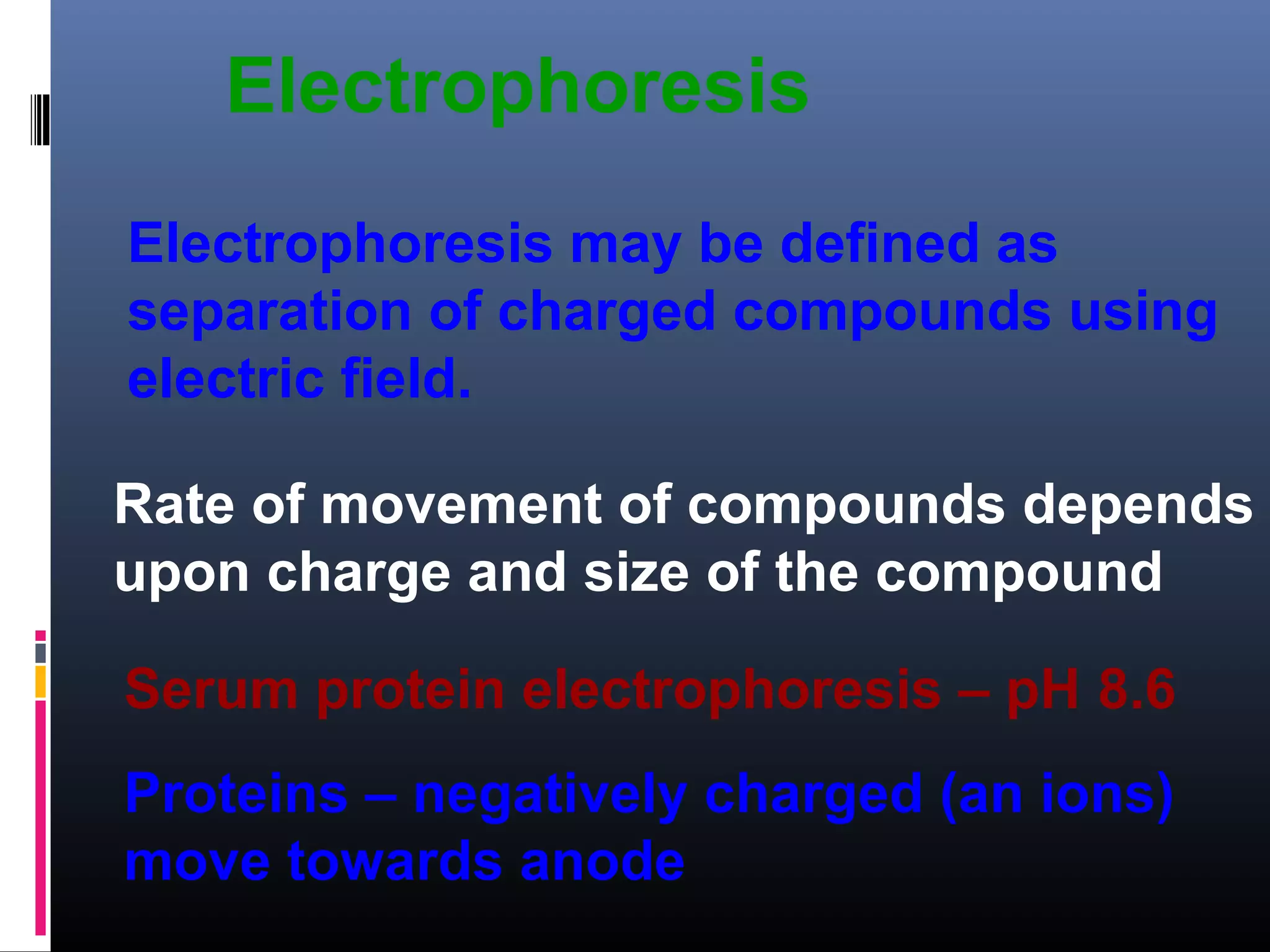
Electrophoresis
Electrophoresis may be defined as
separation of charged compounds using
electric field.
Rate of movement of compounds depends
upon charge and size of the compound
Serum protein electrophoresis – pH 8.6
Proteins – negatively charged (an ions)
move towards anode
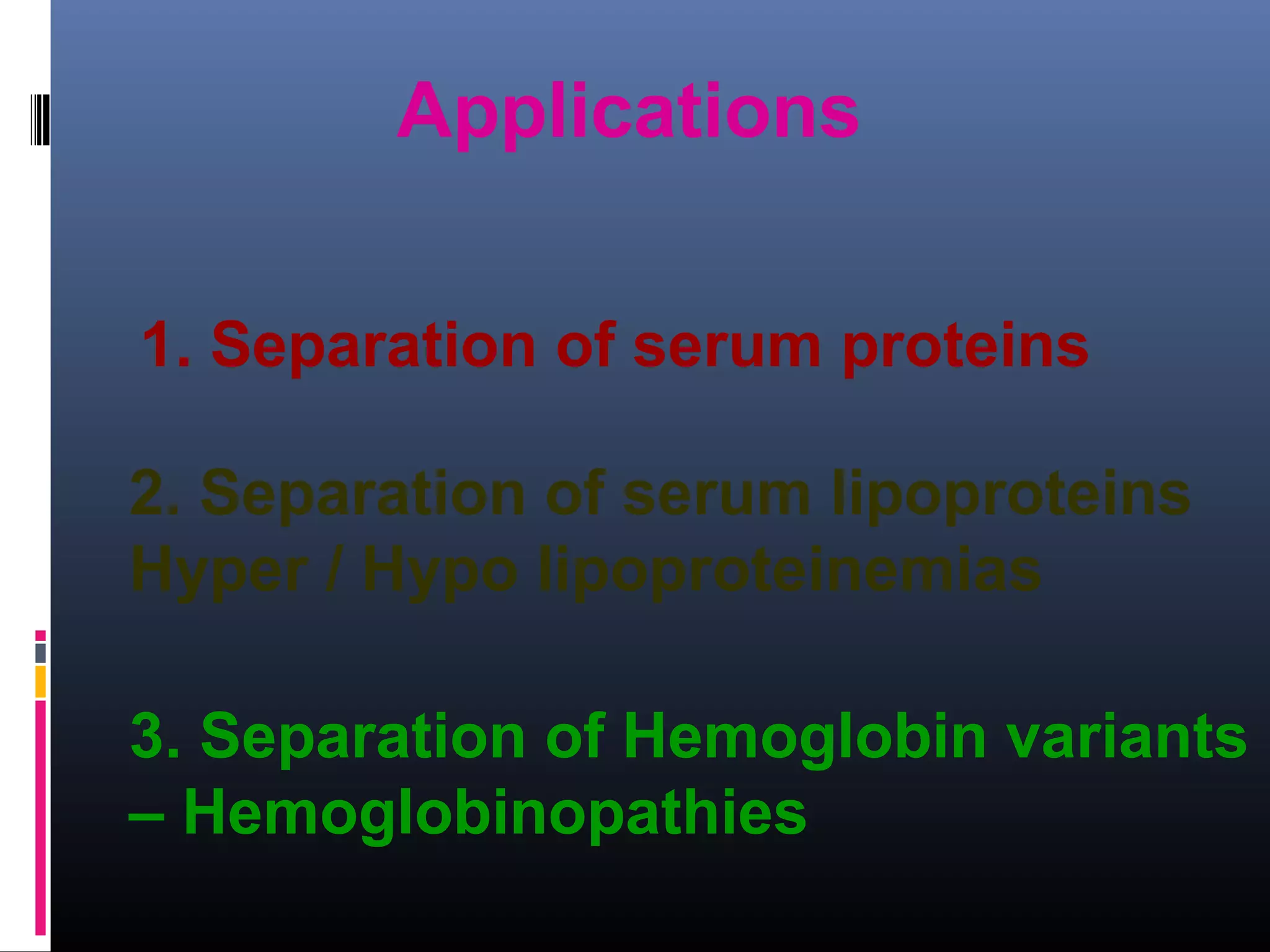
2. Separation of serum lipoproteins
Hyper / Hypo lipoproteinemias
1. Separation of serum proteins
Applications
3. Separation of Hemoglobin variants
– Hemoglobinopathies
4. Separation iso Enzymes - LDH, CK
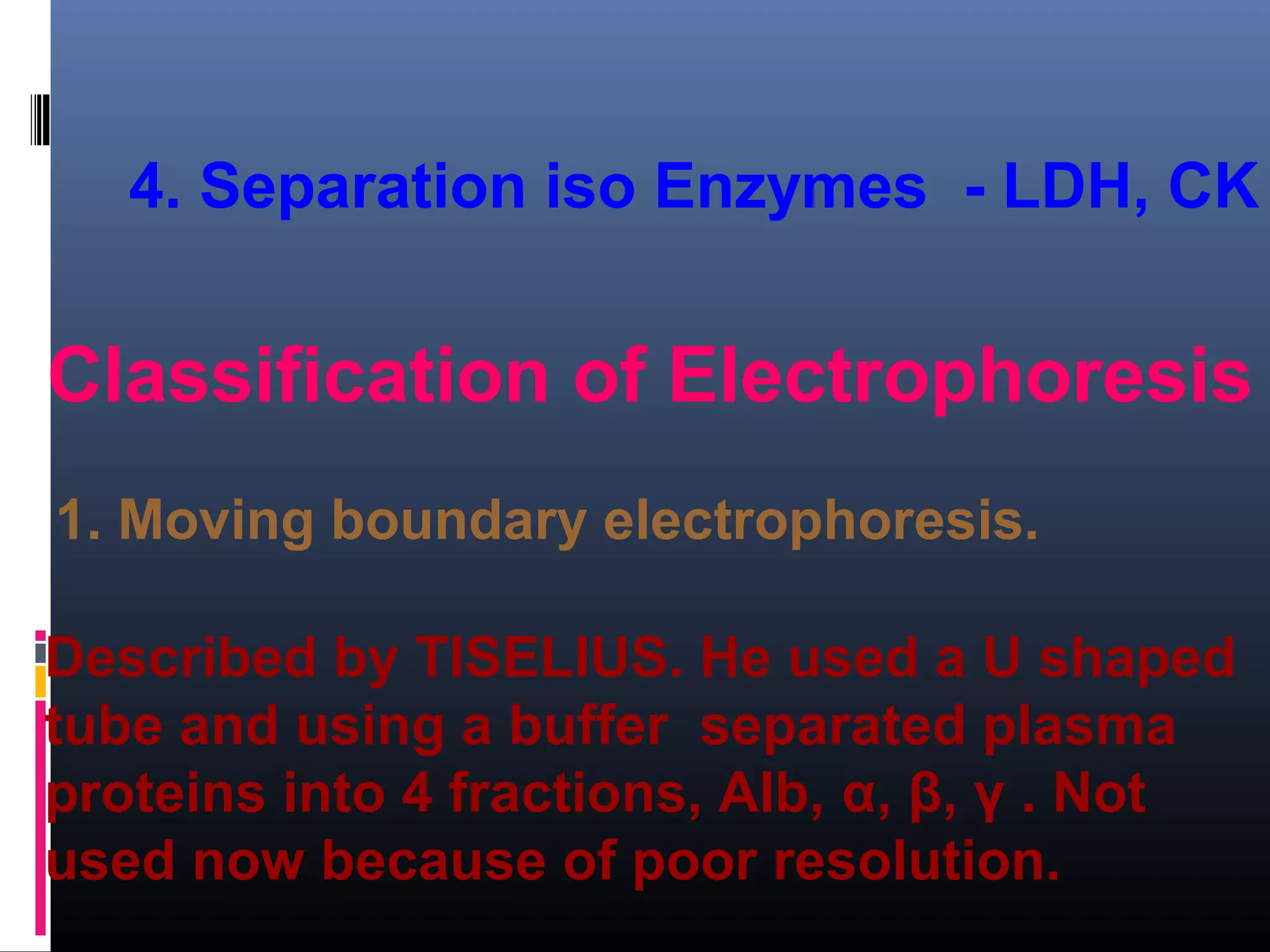
Classification of Electrophoresis
1. Moving boundary electrophoresis.
Described by TISELIUS. He used a U shaped
tube and using a buffer separated plasma
proteins into 4 fractions, Alb, α, β, γ . Not
used now because of poor resolution.
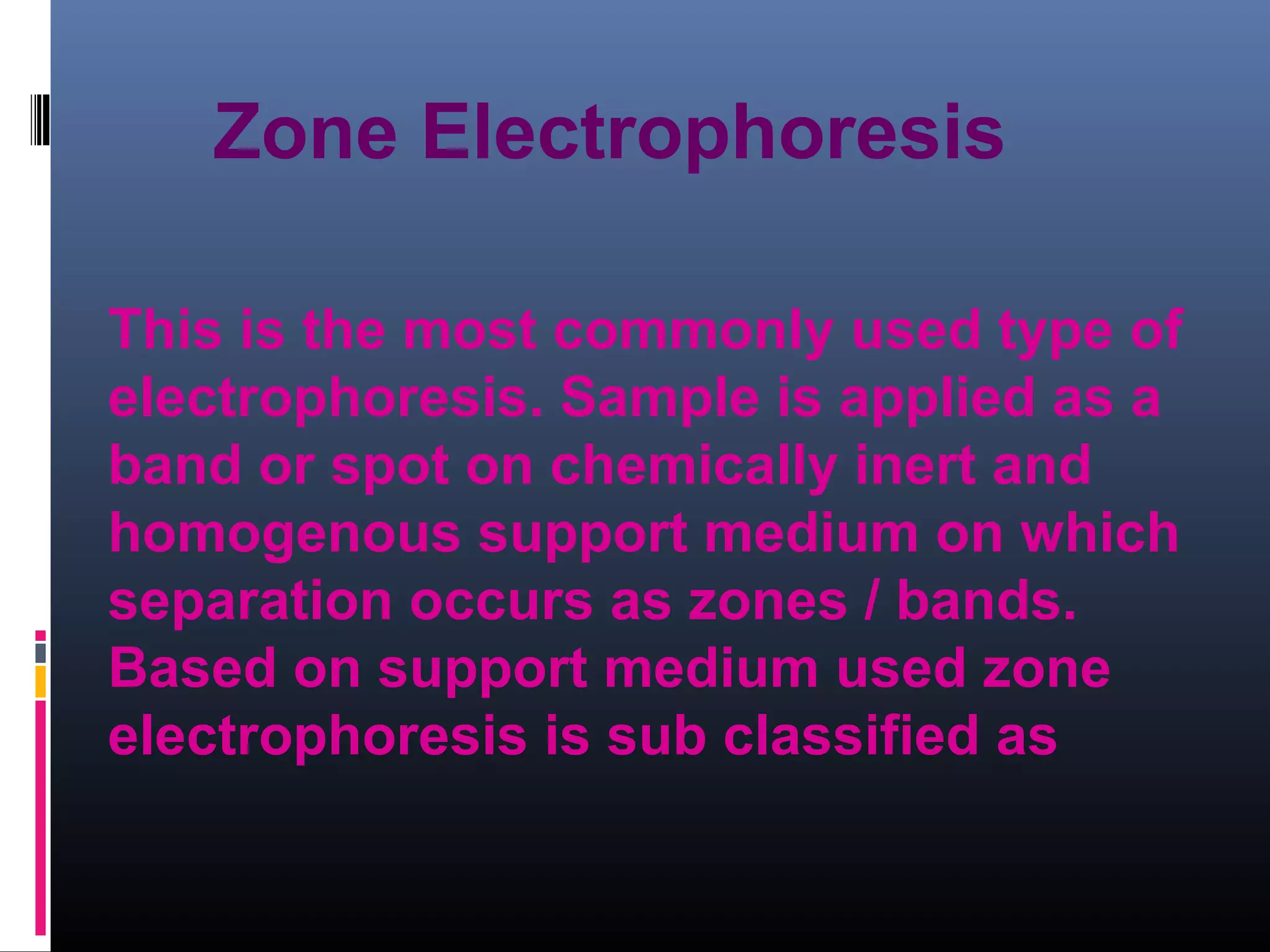
This is the most commonly used type of
electrophoresis. Sample is applied as a
band or spot on chemically inert and
homogenous support medium on which
separation occurs as zones / bands.
Based on support medium used zone
electrophoresis is sub classified as
Zone Electrophoresis
1. Paper electrophoresis
Cheapest method but the disadvantage is
some mixing occurs between different
zones. Requires several hours. Separation
is not very sharp.
2. Cellulose acetate membrane
electrophoresis
3. Gel electrophoresis
There is clear separation into discrete
zones. Requires about one hour time.
A) Agar gel is commonly used for
immuno electrophoresis.
B) Starch gel is commonly used
for separation of iso enzymes
C) Poly acrylamide gel electrophoresis
(PAGE).
Maximum number of protein bands are
obtainted in this technique.
Factor affecting separation
1. Charge of the compound
2. Size of the compound
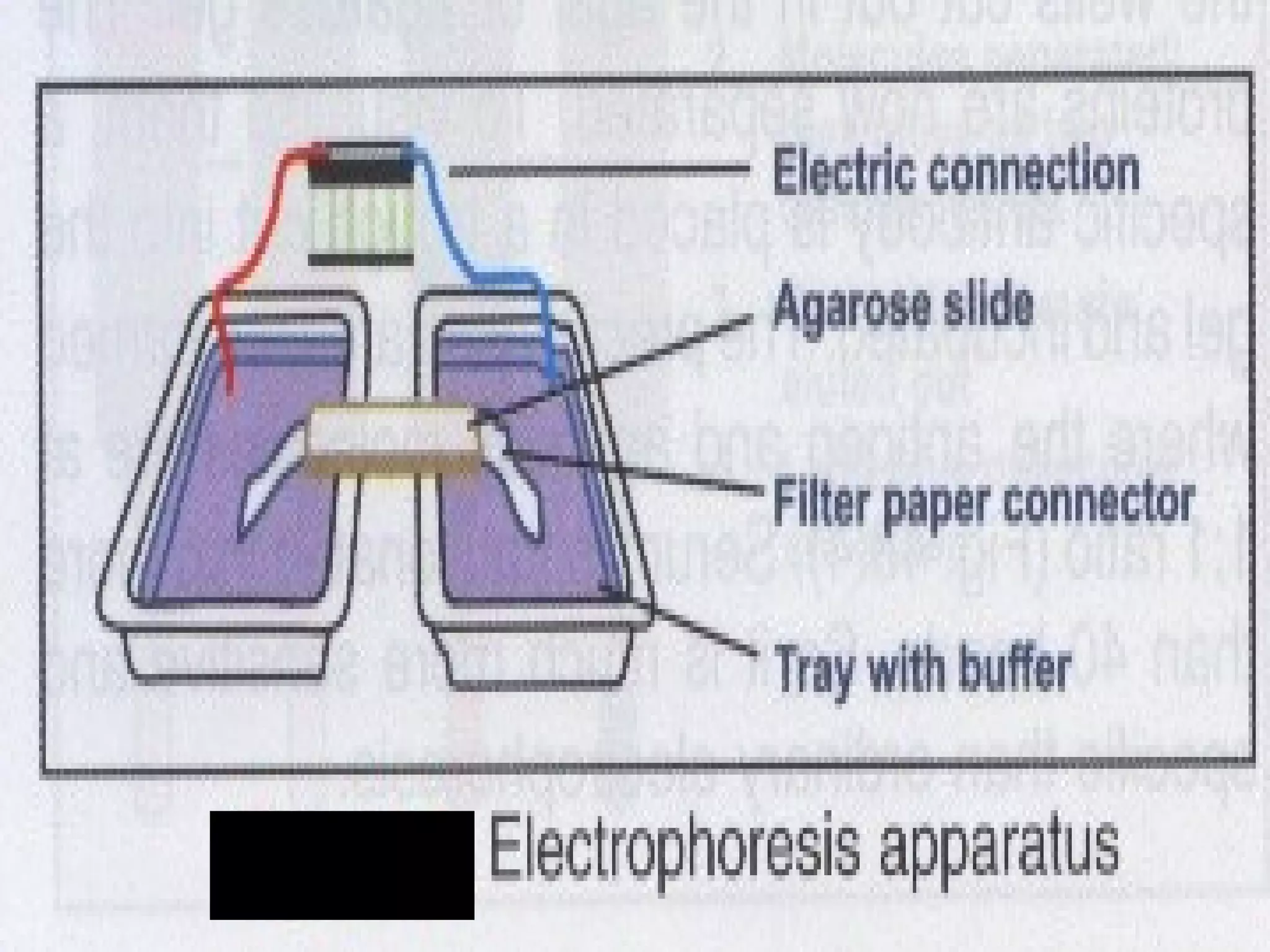
Electrophoresis Unit
Electrophoresis chamber consists of
two compartments separated from each
other by a dividing wall, one side
contains the anode and the other the
cathode.
Each side is filled to the same level
with a buffer ( barbital buffer, pH 8.6)
The only connection between the two
compartments is by the way of the
membrane.
A “bridge” across the top of the
dividing wall holds a cellulose
membrane or other support material like
filter paper, agar gel etc., so that each
end of it is in contact with the buffer in
one of the compartments.
First membrane is immersed in buffer
and placed in the chamber and the
sample is applied.
When a voltage is applied to the cell
the current is carried across the
porous membrane by the buffer ions.
At. pH 8.6 all the serum proteins
carry a net negative charge and tend
to migrate toward the anode.
Albumin carries the largest charge
and therefore moves the fastest.
The γ – globulins have the smallest
net charge and move the least
distance.
Densitometric Scanning
After separation of the compounds by
electrophoresis and staining the
compounds whether the pattern is normal
or abnormal can be visualized. For more
accurate fractination densitometry is very
valuable
After completion of electrophoresis,
the supporting medium is placed in a
fixative ( 7 % acetic acid), to prevent
diffusion of separated fractions.
Separated fractions are then
visualized by using appropriate
stains, e.g.
Bromophenol blue and amido
schwartz for plasma proteins and
Sudan black for lipoproteins.
Quantitation is done by
Densitometry or
Elution, followed by colorimetry or
spectro – photometry of the eluted
fractions.
- - - - -
S
Serum protein
electrophoresis
Albumin – 55 – 65 %
Globulins – 35 – 45%
α 1 globulins 2 – 4%
α 1 Acid glycoprotein ( oromucoid): 0.6 – 1.4
gm/dl Carbohydrate content is 41%.
Oromucoid is considered as an acute phase
reactive protein. Increased in acute
inflammations & cirrhosis of liver. It binds to
progesterone and transports it. Carries
carbohydrate to the site of injury for repair.
α 1 anti trypsin ( α1 AT)
200 – 400 mg / dl. Active elastase + α1 AT
inactive elastase
Decreased in emphysema, cirrhosis of liver
AFP ( if present) principal foetal protein normal
plasma concentration less than 1 micro gram per
dl. Increased in hepatocellular cancer.
α 1 Lipoprotein (HDL)
α 2 globulins 6 – 12%
Haptoglobin - Synthesized in liver. Binds free
hemoglobin and prevents its loss through kidney /
urine. Heptoglobin concentration is decreased in
hemolysis.
Caeruloplasmin – contains copper blue
coloured protein. Molecular weight 151000. It has
8 sites for copper binding. Normal concentration
30 mg / dl. Decreased in Wilson's disease.
β globulins 8 – 12%
Transferrin - Transports iron
in plasma. Increased in iron
deficiency anemia.
Hemo pexin – Binds with heme
and prevents its loss through
urine
β – Lipoprotein (LDL)
γ globulins 12 – 22%
Changes in serum protein pattern
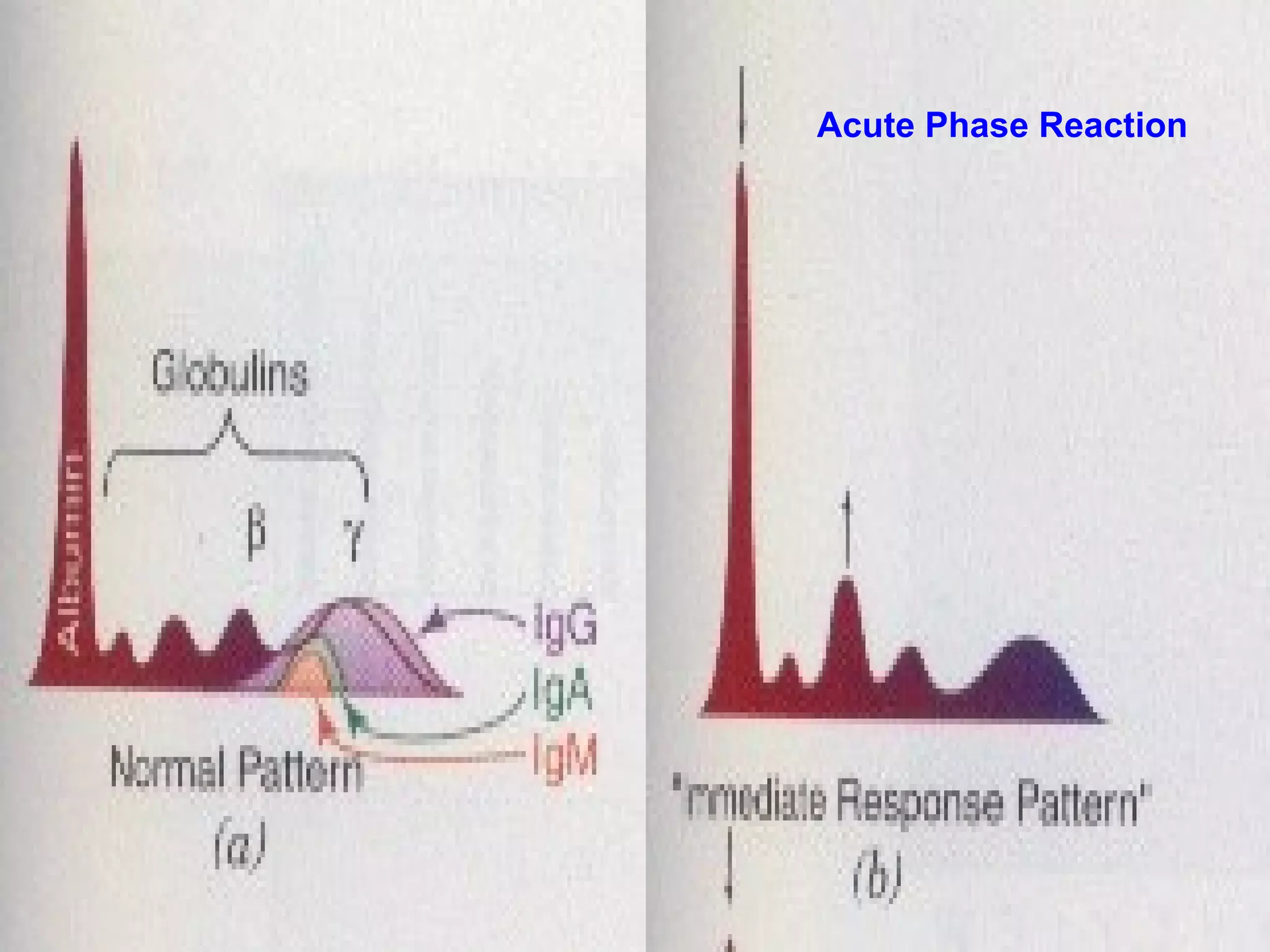
The Acute Phase Reaction
Acute inflammation / tissue necrosis there
is increase in serum levels of α1 – acid
glycoprotein, α1 AT, ceruloplasmin.
Fibrinogen, C – reactive protein and
haptoglobin. Increased ESR is due to
increased fibrinogen and other globulins.
Acute Phase Reaction
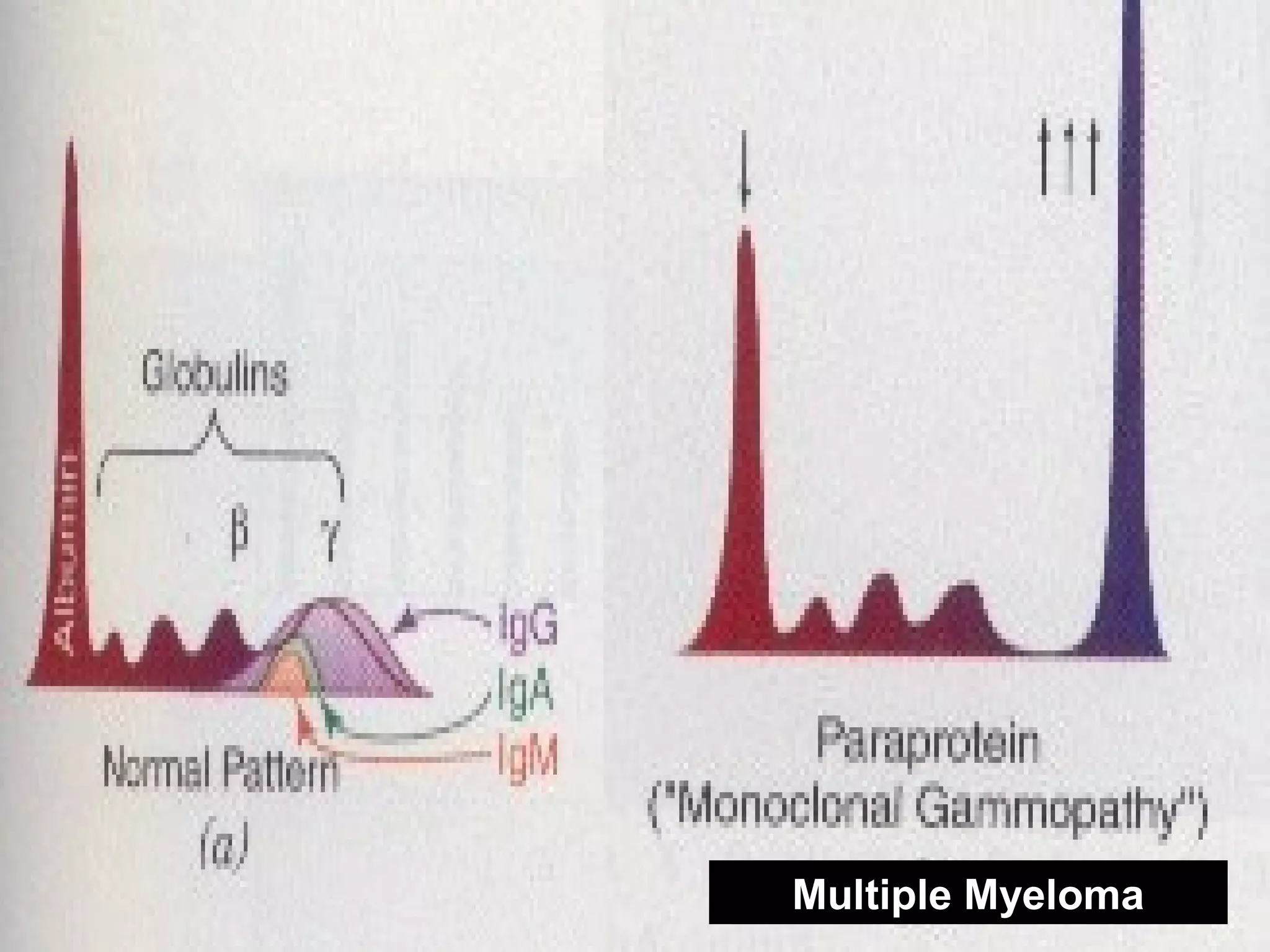
Para Proteins
(M – Proteins)
M refers to Myeloma / Monoclonal
globulins. para protein may be whole or
part of immunoglobulin. If the para protein
is of light chain it may spill in to urine
(Bence – Jones proteinuria) Bence – jones
proteins precipitate around 40 – 600
C and
then redissolve at higher temp. These
proteins appear as sharp peak ( spike )
mainly in γ region
Multiple Myeloma
Causes : Multiple myeloma (Plasma
cell myeloma), lymphoma
paraprotemias are associated with
decreased γ globulins and albumin.
Cirrhosis of Liver – Albumin
Decreased, γ globulins increased.
β γ bridging due to IgA increase
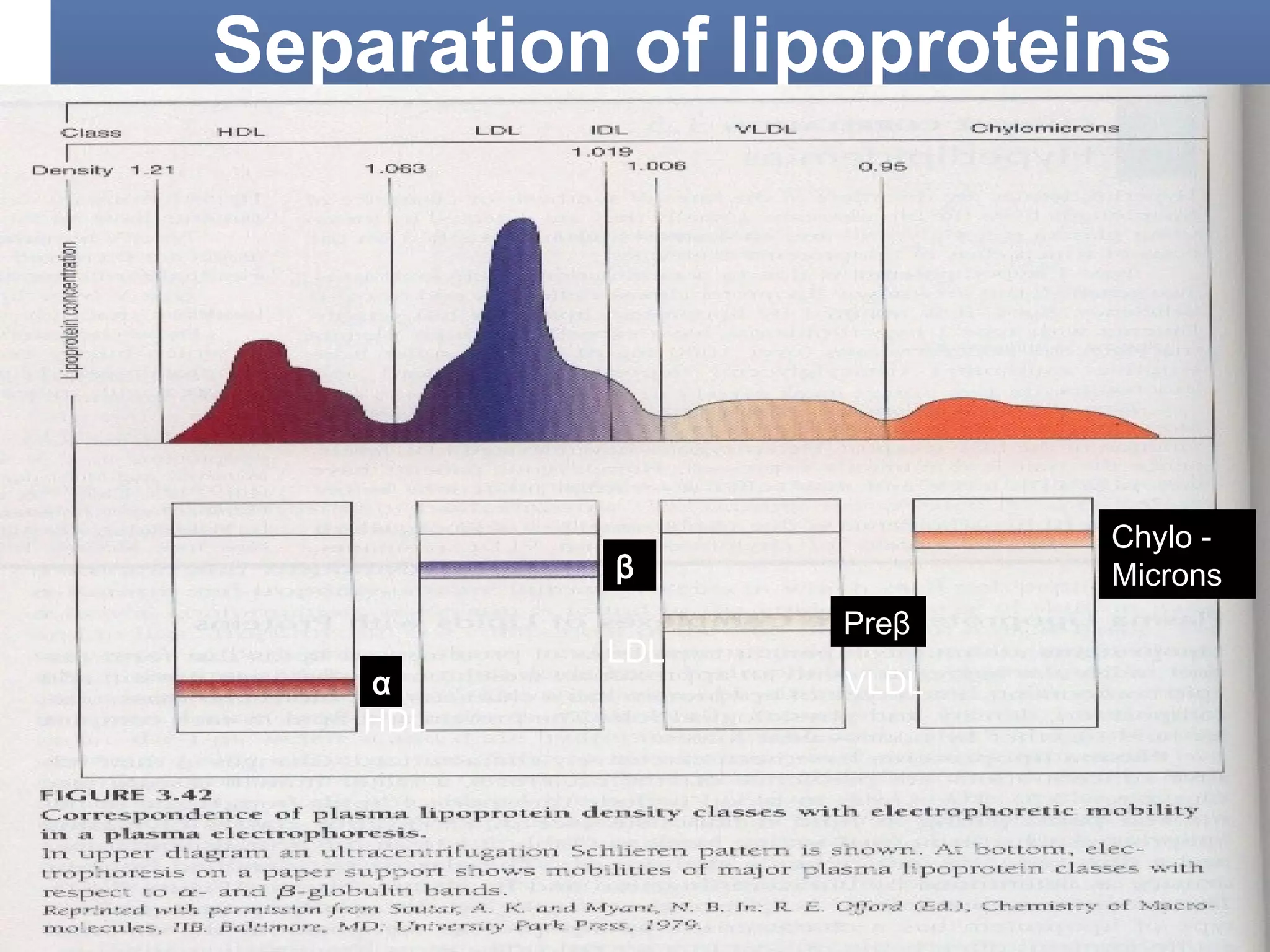
Separation of lipoproteins
Preβ
β
α
Chylo -
Microns
VLDL
LDL
HDL
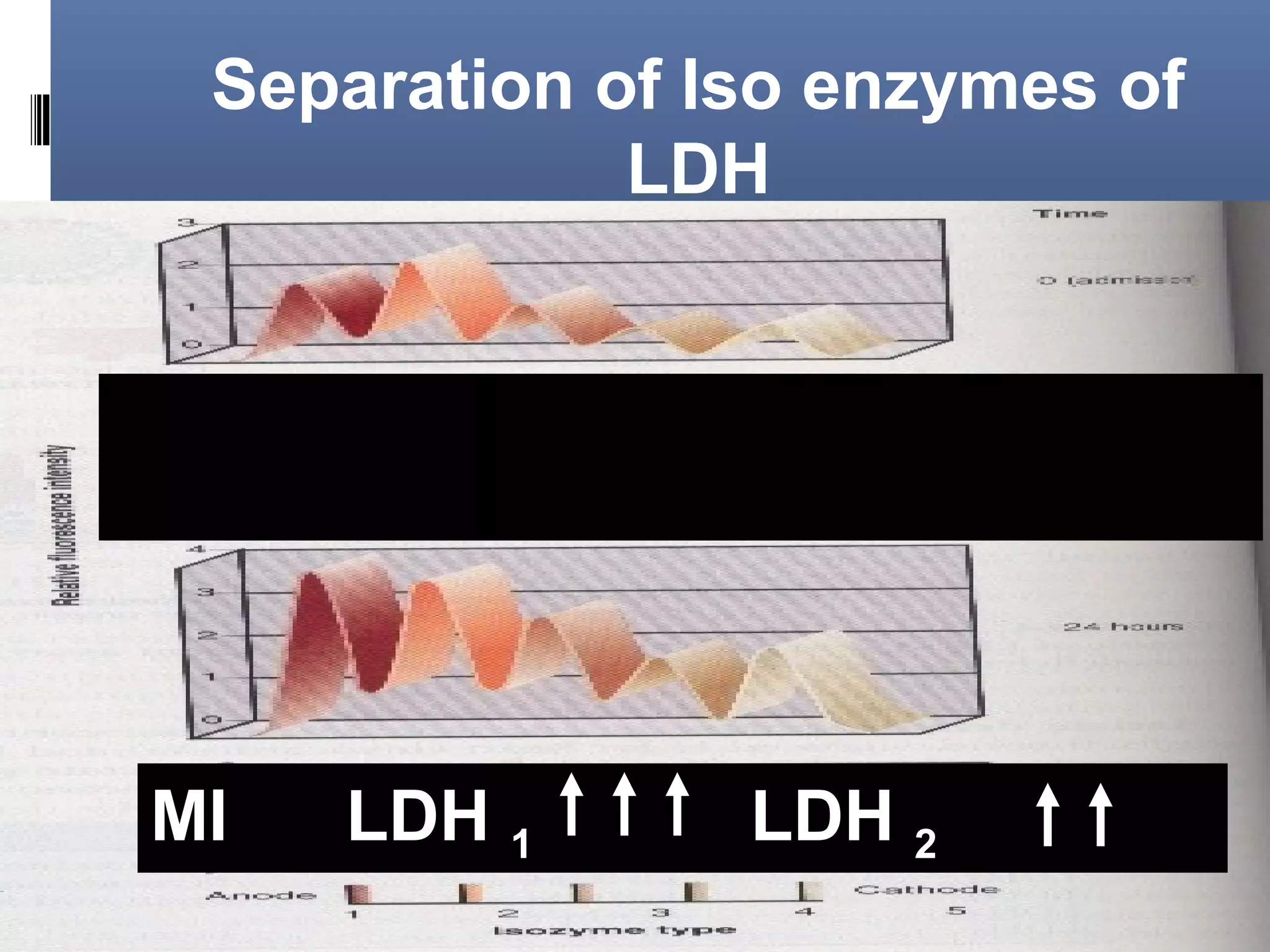
Separation of Iso enzymes of
LDH
MI LDH 1 LDH 2
Electrophoresis

Electrophoresis

  • 1.
    M.Prasad Naidu MSc MedicalBiochemistry, Ph.D,.
  • 2.
    Electrophoresis Electrophoresis may bedefined as separation of charged compounds using electric field. Rate of movement of compounds depends upon charge and size of the compound Serum protein electrophoresis – pH 8.6 Proteins – negatively charged (an ions) move towards anode
  • 3.
    2. Separation ofserum lipoproteins Hyper / Hypo lipoproteinemias 1. Separation of serum proteins Applications 3. Separation of Hemoglobin variants – Hemoglobinopathies
  • 4.
    4. Separation isoEnzymes - LDH, CK Classification of Electrophoresis 1. Moving boundary electrophoresis. Described by TISELIUS. He used a U shaped tube and using a buffer separated plasma proteins into 4 fractions, Alb, α, β, γ . Not used now because of poor resolution.
  • 5.
    This is themost commonly used type of electrophoresis. Sample is applied as a band or spot on chemically inert and homogenous support medium on which separation occurs as zones / bands. Based on support medium used zone electrophoresis is sub classified as Zone Electrophoresis
  • 6.
    1. Paper electrophoresis Cheapestmethod but the disadvantage is some mixing occurs between different zones. Requires several hours. Separation is not very sharp.
  • 7.
    2. Cellulose acetatemembrane electrophoresis 3. Gel electrophoresis There is clear separation into discrete zones. Requires about one hour time. A) Agar gel is commonly used for immuno electrophoresis. B) Starch gel is commonly used for separation of iso enzymes
  • 8.
    C) Poly acrylamidegel electrophoresis (PAGE). Maximum number of protein bands are obtainted in this technique. Factor affecting separation 1. Charge of the compound 2. Size of the compound
  • 10.
    Electrophoresis Unit Electrophoresis chamberconsists of two compartments separated from each other by a dividing wall, one side contains the anode and the other the cathode. Each side is filled to the same level with a buffer ( barbital buffer, pH 8.6)
  • 11.
    The only connectionbetween the two compartments is by the way of the membrane. A “bridge” across the top of the dividing wall holds a cellulose membrane or other support material like filter paper, agar gel etc., so that each end of it is in contact with the buffer in one of the compartments.
  • 12.
    First membrane isimmersed in buffer and placed in the chamber and the sample is applied. When a voltage is applied to the cell the current is carried across the porous membrane by the buffer ions.
  • 13.
    At. pH 8.6all the serum proteins carry a net negative charge and tend to migrate toward the anode. Albumin carries the largest charge and therefore moves the fastest. The γ – globulins have the smallest net charge and move the least distance.
  • 14.
    Densitometric Scanning After separationof the compounds by electrophoresis and staining the compounds whether the pattern is normal or abnormal can be visualized. For more accurate fractination densitometry is very valuable
  • 15.
    After completion ofelectrophoresis, the supporting medium is placed in a fixative ( 7 % acetic acid), to prevent diffusion of separated fractions. Separated fractions are then visualized by using appropriate stains, e.g. Bromophenol blue and amido schwartz for plasma proteins and Sudan black for lipoproteins.
  • 16.
    Quantitation is doneby Densitometry or Elution, followed by colorimetry or spectro – photometry of the eluted fractions.
  • 17.
    - - -- - S
  • 18.
    Serum protein electrophoresis Albumin –55 – 65 % Globulins – 35 – 45%
  • 19.
    α 1 globulins2 – 4% α 1 Acid glycoprotein ( oromucoid): 0.6 – 1.4 gm/dl Carbohydrate content is 41%. Oromucoid is considered as an acute phase reactive protein. Increased in acute inflammations & cirrhosis of liver. It binds to progesterone and transports it. Carries carbohydrate to the site of injury for repair.
  • 20.
    α 1 antitrypsin ( α1 AT) 200 – 400 mg / dl. Active elastase + α1 AT inactive elastase Decreased in emphysema, cirrhosis of liver AFP ( if present) principal foetal protein normal plasma concentration less than 1 micro gram per dl. Increased in hepatocellular cancer. α 1 Lipoprotein (HDL)
  • 21.
    α 2 globulins6 – 12% Haptoglobin - Synthesized in liver. Binds free hemoglobin and prevents its loss through kidney / urine. Heptoglobin concentration is decreased in hemolysis. Caeruloplasmin – contains copper blue coloured protein. Molecular weight 151000. It has 8 sites for copper binding. Normal concentration 30 mg / dl. Decreased in Wilson's disease.
  • 22.
    β globulins 8– 12% Transferrin - Transports iron in plasma. Increased in iron deficiency anemia. Hemo pexin – Binds with heme and prevents its loss through urine β – Lipoprotein (LDL)
  • 23.
    γ globulins 12– 22% Changes in serum protein pattern The Acute Phase Reaction Acute inflammation / tissue necrosis there is increase in serum levels of α1 – acid glycoprotein, α1 AT, ceruloplasmin. Fibrinogen, C – reactive protein and haptoglobin. Increased ESR is due to increased fibrinogen and other globulins.
  • 24.
  • 25.
    Para Proteins (M –Proteins) M refers to Myeloma / Monoclonal globulins. para protein may be whole or part of immunoglobulin. If the para protein is of light chain it may spill in to urine (Bence – Jones proteinuria) Bence – jones proteins precipitate around 40 – 600 C and then redissolve at higher temp. These proteins appear as sharp peak ( spike ) mainly in γ region
  • 26.
  • 27.
    Causes : Multiplemyeloma (Plasma cell myeloma), lymphoma paraprotemias are associated with decreased γ globulins and albumin. Cirrhosis of Liver – Albumin Decreased, γ globulins increased. β γ bridging due to IgA increase
  • 29.
  • 30.
    Separation of Isoenzymes of LDH MI LDH 1 LDH 2