Vitamin K works in conjunction with D to the Knesset .pdf
1.
Haim R. Branisteanu
12Gotlieb Street Tel Aviv 03-523-2744 e-mail haimbranisteanu@gmail.com
Vitamin K and D and their interactions January 19 2016 Page 1 of 8
Summary of January 19, 2016
This document in its entirely is proprietary & confidential in accordance with US laws
Title 18 USC Chapter 90: Protection of Trade Secrets (including all Sections)
Discussing the benefits of Vitamins D and Vitamins K to prolong life
Vitamins K works in conjunction with D to improve bone health. There are 2+
types of K (K1 & K2…14) and 2+ types of D (D2 & D3). K is found also in dark
leafy green vegetables and also it is contained in chicken, pig or cow manure.
Discussing the issue of the of Vitamin D and Vitamin K, refers to several different forms of
those vitamins, which combination is substantially improving skeleton bone health and it is
missing from our diets for the simple reason that a big part of the consumed meat and other
farm products is grown in shades, away from sunshine and the specific light wavelength that
generates Vitamin D in the skin. The net result is Vitamin D deficiencies, growing demand for
expensive anti-osteoporosis medication including synthetic Vitamin D, easily broken bones at
advanced age and the elderly with long hospitalization time expenses and suffering.
Introducing my concept in chicken cops, cattle barns etc., will increase the content of Vitamin
D in the produce from farm animal husbandry, (eggs, milk, cheeses, chickens and cattle
meat), but there again is the formality of controlled prices and no farmer will invest a penny
without reward that covers his investment plus some benefits.
Please take notice that (http://lpi.oregonstate.edu/mic/vitamins/vitamin-K ) the Vitamins D
and K are actually not vitamins but so called “radicals”. Vitamin D transports
calcium to the bones and through a complex metabolism process with Vitamin K cement the
calcium in the bone structure, resulting over time in stronger bones within the human
skeleton (based on new evolving research - Vitamin K deficiency may impair the
activity of VKDPs (Vitamin K Dependent Protein) and increase the risk of
osteoporosis and fractures).
Vitamin K is the essential cofactor for the carboxylation of glutamic acid residues in
many vitamins K-dependent proteins (VKDPs) are involved in blood coagulation, bone
metabolism, prevention of vessel mineralization, and regulation of various cellular functions.
The adequate intake level for vitamin K is set at 90 μg/day for women & 120 μg/day for men.
An important issue to remember is, that German funded research, found that chicken eggs
or cooking of chicken meat rich in Vitamin D. Cooked chicken flesh does not
remove the vitamin D from the chicken flesh, and I assume other farm products derived
from farm animals rich in vitamin D. Therefore, supply of food rich in Vitamin D is beneficial
and not everything can be solved with “correct diet” or exercise.
Study Shows Early Promise Vitamin K2 Can Prevent GC-Induced Bone Loss –
Robust inhibition of glucocorticoid (GC) on angiogenesis has been illustrated both in vitro
and in vivo, as well as decreased bone formation and increased bone resorption.
Furthermore, GC administration has been attributed to the most common cause of
atraumatic osteonecrosis of the femoral head and secondary osteoporosis. Therefore, there is
a need, of a combination of Vitamin D and K to achieve the necessary results.
2.
Haim R. Branisteanu
12Gotlieb Street Tel Aviv 03-523-2744 e-mail haimbranisteanu@gmail.com
Vitamin K and D and their interactions January 19 2016 Page 2 of 8
To implement the above, problems will arise, and I anticipate the main issue, would be
transfer of funds from the Ministry of Health to the Ministry of Agriculture in an orderly and
strictly supervised fashion to improve substantially of the public health.
Vitamin K may improve bone health, according to a 2001 research review published in
Nutrition. Sizing up the available data on vitamin K and bone health, the review's authors
found that vitamin K can increase bone mineral density and reduce fracture rates in people
with osteoporosis. The authors note that vitamin K may be particularly effective when
combined with vitamin D, a nutrient known to play a critical role in bone metabolism.
Preliminary findings from animal-based studies indicate that vitamin K may protect against
atherosclerosis (hardening of the arteries). However, in a 2008 report from Current
Opinion in Lipidology, scientists caution that human-based research on vitamin
K1 and heart disease has yielded mixed results.
Chickens’ legs are the generators of D in chickens and synthesis by modified duckweed that
emphasis absorption of vitamin K between other in chicken manure lagoon or cow manure
lagoon and added to the animal diets or administered with my other BWW (threated bark
and woody waste) product can be a winning solution. (I discussed this in my proposed
project at the time but with cow manure)
2. Vitamin K2 Protects your heart; lowers cardiovascular disease and mortality
https://www.ncbi.nlm.nih.gov/pmc/articles/PMC5946231/
Vitamin K2 helps to prevent hardening of the arteries, which is a common factor in coronary
artery disease and heart failure. Research suggests vitamin K2 may help to keep calcium out
of your artery linings and other body tissues, where it can cause damage. The latest studies
show it is vitamin K2, rather than K1, in concert with vitamin D, that prevents calcification in
your coronary arteries, thereby preventing cardiovascular disease.
3. Vitamin K2 Helps Prevent Osteoporosis
The absolute best way to achieve healthy bones is a diet rich in fresh, raw whole foods that
maximizes natural minerals so your body has the raw materials it needs to do what it was
designed to do. Vitamin K2 is one of the most important nutritional interventions for
improving your bone density. It serves as the biological "glue" that helps plug calcium and
other important minerals into your bone matrix. There have been some remarkable research
studies about the protective effects of vitamin K2 against osteoporosis [1]
https://www.ncbi.nlm.nih.gov/pubmed/23525894 :
A number of Japanese trials have shown that vitamin K2 completely reverses bone loss and,
in some cases, even increases bone mass in people with osteoporosis. The pooled evidence of
seven Japanese trials shows, that vitamin K2 supplementation produces a 60% reduction in
vertebral fractures and an 80 percent reduction in hip and other non-vertebral fractures.
Researchers in the Netherlands showed vitamin K2 is three times more effective than vitamin
K1 in raising osteocalcin, which controls the building of bone in vertebrates.
1
Three-year low-dose menaquinone-7 supplementation helps decrease bone loss in healthy
postmenopausal women.
3.
Haim R. Branisteanu
12Gotlieb Street Tel Aviv 03-523-2744 e-mail haimbranisteanu@gmail.com
Vitamin K and D and their interactions January 19 2016 Page 3 of 8
Your bone strength depends on more than just calcium. Your bones are actually composed of
more than a dozen minerals. If you focus just on calcium, you will likely weaken your bones
and increase your risk of osteoporosis, as Dr. Robert Thompson explains in his book “The
Calcium Lie”. It's more likely your body can use calcium correctly if it's plant-derived
calcium. Good sources include raw milk from pasture-raised cows (who eat the calcium-rich
plants), leafy green vegetables, the pith of citrus fruits, carob, and wheatgrass, to name a few.
4. Vitamin K Helps Prevent Cancer
A number of studies have shown that vitamins K1 and K2 are effective against cancer.
Consider the following:
One study published in September 2003 in the International Journal of Oncology, found that
treating lung cancer patients with vitamin K2 slowed the growth of cancer cells, and previous
studies have shown benefit in treating leukemia. In an August 2003 study published in the
Alternative Medicine Review2 involving 30 patients with a type of liver cancer called
hepatocellular carcinoma, who took oral vitamin K1, the disease stabilized in six patients;
seven patients had a partial response; and seven others had improved liver function. In 15
patients, abnormal prothrombin normalized.
In 2008, a German research group discovered vitamin K2 provides substantial protection
against prostate cancer, one of the most common types of cancer among men in the United
States. According to Dr. Vermeer, [2] men taking the highest amounts of K2 had
about 50 percent less prostate cancer.
Vitamin K has also been found beneficial in the fight against non-Hodgkin lymphoma, colon,
stomach, nasopharynx, and oral cancers.
5. Additional Health Benefits of Vitamin K
As written in the March 2004 Life Extension magazine 4, researchers have found many other
beneficial effects of vitamin K including:
2
OSLO, NORWAY -- Renowned vitamin K2 researcher, Dr. Cees Vermeer, Professor of the Cardiovascular
Research Institute Maastricht, University of Maastricht, the long-time research partner of Natto-Pharma ASA,
Oslo, Norway, has been identified as being among the top 2.5% of all scientists worldwide by the independent
monitoring agency Research Gate. Recently, Dr. Vermeer has led a research team that studied vitamin K2
menaquinone-7 for three years and that has shown the most significant bone health finding in recent history:
vitamin K2, taken daily for the long-term such as a multivitamin, can prevent bone loss/porosity in women --
even after menopause.
Professor Vermeer belongs to the world’s top-2½ % of scientists, received an Honorary Doctorate (in 2001) at
the Iuliu Hatieganu University of Medicine and Pharmacy in Cluj Napoca, Romania, is a Visiting Professor at
the American University and has been a temporary advisor of the World Health Organization.
Professor Vermeer’s current research activities include molecular biology, biochemistry, animal and human
nutrition, pharmacology, and clinical trials in arteriosclerosis and osteoporosis. He has held a wide variety of
administrative positions within the Maastricht University, including Chairman of the Department of
Biochemistry and Member of Medical Faculty Board (portfolio R&D). Professor Vermeer has supervised 17
PhD students, is author of over 350 international scientific publications and inventor of 14 patents and patent
applications.
4.
Haim R. Branisteanu
12Gotlieb Street Tel Aviv 03-523-2744 e-mail haimbranisteanu@gmail.com
Vitamin K and D and their interactions January 19 2016 Page 4 of 8
Vitamin K2 deficiency may be a contributing factor to Alzheimer's disease, and vitamin
K2 supplementation may help in preventing it.
Vitamin K2 improves insulin sensitivity; people who get the most vitamin K2 from their
foods are about 20 percent less likely to develop type 2 diabetes. Topical vitamin K
may help to reduce bruising. Vitamin K may have antioxidant properties
6. Vitamin K is a Fat-Soluble Vitamin
This is important because dietary fat is necessary for the absorption of this vitamin.
Therefore, in order for your body to absorb vitamin K effectively, you need to eat some fat
along with it.
7. Food Sources of Vitamin K2
Fermented foods, such as natto, typically have the highest concentration of vitamin K found
in the human diet and can provide several milligrams of vitamin K2 on a daily basis. This
level far exceeds the amount found in dark green vegetables. Unfortunately, most Americans
do not eat many fermented foods. Adding traditionally fermented foods to your diet is a
must, and although not widely known, the health benefits of these foods are tremendous.
Precise K2 values for foods are difficult to find. However, I did find a few estimates for
comparison, which I've listed in the table below. Other foods high in K2 include raw dairy
products such as; goat cheese and soft cheeses, raw butter, kefir, and sauerkraut. Realize that
the K2 content of pasteurized dairy and products from confined animal feeding operations,
which comprise most commercial sources, are NOT high in K2 and should be avoided. Only
grass-fed animals (not grain fed) will develop naturally high K2 levels.
Top 9 Vitamin K Rich Foods List (https://www.cigna.com/individuals-families/health-
wellness/hw/warfarin-and-vitamin-k-abo16321 )
1) Green Leafy Vegetables (Kale) Cup: 1062 mcg 7) Cup Spinach boiled 1027 mcg
2) Natto (fermented soy) 2 oz: 500 mcg 8) Broccoli boiled 1 cup: 220 mcg
3) Spring onions (Scallions) ½ c: 103 mcg 9) Cabbage boiled 1 cup: 163 mcg
4) Brussel’s Sprouts. Cup: 218 mcg 10) Prune ‘s ½ c: 52 mcg
5) Cucumbers 1 medium: 49 mcg 11) Virgin olive oil spoon 15 mcg
6) Asparagus cup boiled: 92 mcg 12) Dairy (fermented) ½ c: 10 mcg
Vitamin D2/D3 and K1/K2 ….K14 etc. do not lose their efficiency in cooked meals
https://pubmed.ncbi.nlm.nih.gov/23894475/ and
https://www.ncbi.nlm.nih.gov/pmc/articles/PMC8067486/
A new study from the University of South Australia provides compelling evidence
that vitamin D2/D3 deficiency is linked to early mortality, prompting calls for individuals to
follow healthy Vit. D level guidelines. The study provides strong evidence for the connection
between low levels of vitamin D and mortality, and this is the first study of its kind to also
include respiratory disease-related mortality as an outcome. By using new genetic method to
explore and affirm the non-linear relationships that they have seen in observational settings,
and through this, we’ve been able to give strong evidence for the connection between low Vit
D status and premature death. https://www.acpjournals.org/doi/10.7326/M21-3324
5.
Haim R. Branisteanu
12Gotlieb Street Tel Aviv 03-523-2744 e-mail haimbranisteanu@gmail.com
Vitamin K and D and their interactions January 19 2016 Page 5 of 8
Last Word; There are relative very simple solutions to include the above-mentioned
vitamins D2/D3 and K1/3…7 within our food chain, improve farm animal husbandry health
and save a lot of pain and troubles at older age, including early mortality, not to mention
money. But for the implementation of this concept full cooperation of the relevant ministries
are needed, that are not ignorant to the problem.
This proposal was forwarded to the Knesset Economic Committee on Jan. 12,
2016 to Mrs. Lea Varon and MK Eitan Cabel, with no response. Implementation needs
full cooperation and shifting of budgets funding between the Ministry of Health and Ministry
of Agriculture which is an uphill battle with total disregard of the actual benefits to the Israeli
population and the substantial saving that will arose from less incidents of hospitalization
and improvement of public health. Anyone is encouraged to forward them this analysis to the
Knesset Economic Committee for re-evaluation.
Additional Conclusions in: “The Role of Vitamin K in Humans: Implication
in Aging and Age-Associated Diseases” Published April 6th 2021 on NCBI/PMC
The latest scientific evidence summarized in this review indicated that, Vit. K has a
significant role in mitigating aging and preventing age-related diseases and has
the potential to improve the efficacy of some medical treatments among adults over the age
of 50 years. The novel role of Vit. K on aging and age-associated diseases is mainly due to its
antioxidant and anti-inflammatory effects. The review focused on the most prevalent
age-related diseases, including osteoporosis and bone fractures, neurodegenerative
diseases, vascular calcification, cardiovascular disease, and cancer, as well as metabolic
disorders, mainly type 2 diabetes and obesity. In addition, we presented the most recent
findings on the association between Vit. K and COVID-19 and its potential effect on reducing
fatal outcomes in such cases.
Specifically, the scientific data showed that Vit. K has an integral role in bone metabolism
through the carboxylation of osteocalcin, which is an important protein capable of
transporting and depositing calcium in bone. Menaquinone-4 was revealed to be a
more effective anti-osteoporotic agent than Vit. K1, with increased pro-osteoblastic
and anti-osteoclastogenic actions achieved by inhibiting the nuclear factor kappa-light-chain-
enhancer of activated B cells pathway in the secondary lymphoid organs. Vit D improves
Osteocalcin carboxylation and, along with Vit. K and magnesium supplementations,
can be a better strategy for reducing bone fractures, a highly public health
concern among the elderly. In addition, the review concluded that, Vit. K and Vit. D
supplement is an essential nutrient that helps us maintain good health by keeping our
bones and muscles strong and healthy as a safe approach for reducing cardiovascular disease
morbidity and mortality. By activating matrix γ-carboxylate glutamic acid protein, Vit. K
keeps calcium from accumulating in the walls of blood vessels, thus making Vit. K
a potential treatment for patients at risk for either vascular calcification or cardiovascular
disease.
Furthermore, Vit. K may reduce the risk for metabolic disorders, such as type 2
diabetes, by improving insulin sensitivity and anti-inflammatory activity, as well as obesity,
6.
Haim R. Branisteanu
12Gotlieb Street Tel Aviv 03-523-2744 e-mail haimbranisteanu@gmail.com
Vitamin K and D and their interactions January 19 2016 Page 6 of 8
through a lipid-lowering effect. The review also showed the influence Vit. K has on age-
related neurodegenerative diseases, such as Alzheimer’s disease and Parkinson’s disease.
Vit. K is involved in the brain’s physiology and can reduce its cognitive decline by
carboxylation of Growth arrest-specific protein 6, a Vit. K-dependent protein that could
defend against neuronal apoptosis induced by OS[3] and amyloid beta. The anticancer
potential of Vit. K was summarized by reviewing several in vitro and epidemiological studies.
There are multiple mechanisms where the potential anticancer agent of Vit. K can react,
including the modulation of various transcription factors, which induced antiproliferative,
proapoptotic, and autophagic effects, which were found to be associated with a reduced risk
of cancer. The latest evidence on Vit. K and pulmonary disease stem from the fact that Vit. K
can activate protein S, which was recently shown to prevent the generation of inflammatory
cytokines and cytokine storms detected in COVID-19 cases. Low levels of protein S, due to
pneumonia-induced Vit. K depletion, were correlated with higher thrombogenicity and
possibly fatal outcomes in COVID-19 patients. Proteins S acts as a principal cofactor to
protein C, the two proteins in the blood help regulate blood clot formation, inactivating
specific coagulation factors V & VIII when needed Protein S formation is triggered with Vit. K
Consuming a healthy diet is vital throughout the aging process to maintain and promote
wellbeing. The aging population may be at risk for many suboptimal nutrient intakes,
including Vit. K, which have been shown to be associated with adverse health outcomes
highly prevalent in this age group. Thus, the intake of Vit. K-rich diets or Vit. K supplements
could prevent age-related diseases and/or support the effectiveness of medical treatments.
However, more studies are needed to formulate the exactly recommended intakes of Vit. K,
including Vit. K1, Menaquinone-4, and Menaquinone-7, due to their distinct bioavailability
and biological activities. According to this review, higher values of Vit. K intakes are needed,
especially among the elderly and people who have co-morbidities conditions that are most
likely to be Vit. K deficient.
Addendum 1: Nutritional Value of the Duckweed Species of the Genus Wolffia
(Lemnaceae) as Human Food, & also as a feeding additive to chickens, pigs, and milking cows
within their feed. https://www.frontiersin.org/articles/10.3389/fchem.2018.00483/full
Crop yield of 25t/hectare dry duckweed were achieved under controlled conditions.
Species of the genus Wolffia are traditionally used as human food in some of the Asian
countries. Therefore, all 11 species of this genus, identified by molecular barcoding, were
investigated for ingredients relevant to human nutrition. The total protein content varied
between 20 and 30% of the freeze-dry weight, the starch content between 10 and 20%, the
fat content between 1 and 5%, and the fiber content was ~25%. The essential amino acid
content was higher or close to the requirements of preschool-aged children according to
standards of the World Health Organization. The fat content was low, but the fraction of
polyunsaturated fatty acids was above 60% of total fat and the content of n-3
polyunsaturated fatty acids were higher than that of n-6 polyunsaturated fatty acids in
most species. The content of macro- and microelements (minerals) not only depended on the
cultivation conditions but also on the genetic background of the species. This holds true also
for the content of tocopherols, several carotenoids and phytosterols in different species and
3
The length of time from either the date of diagnosis or the start of treatment for a disease, that patients is diagnosed
with the disease are still alive. In a clinical trial, measuring the OS is one way to see how well a new treatment works.
7.
Haim R. Branisteanu
12Gotlieb Street Tel Aviv 03-523-2744 e-mail haimbranisteanu@gmail.com
Vitamin K and D and their interactions January 19 2016 Page 7 of 8
even intraspecific, clonal differences were detected in Wolffia globosa and Wolffia arrhiza.
Thus, the selection of suitable clones for further applications is important. Due to the very
fast growth and the highest yield in most of the nutrients, Wolffia microscopica has a high
potential for practical applications in human nutrition.
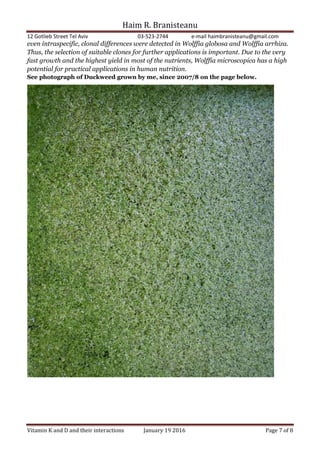
See photograph of Duckweed grown by me, since 2007/8 on the page below.
8.
Haim R. Branisteanu
12Gotlieb Street Tel Aviv 03-523-2744 e-mail haimbranisteanu@gmail.com
Vitamin K and D and their interactions January 19 2016 Page 8 of 8
9.
Haim R. Branisteanu
12Gotlieb Street Tel Aviv 03-523-2744 e-mail haimbranisteanu@gmail.com
Vitamin K and D and their interactions January 19 2016 Page 9 of 8
Addendum 2 - OCTOBER 3, 2022 Nature DOI: 10.1038/s41586-022-05022-3
A non-canonical vitamin K cycle is a potent ferroptosis suppressor
Ferroptosis is an intracellular iron-dependent form of cell death that is distinct from
apoptosis, necrosis, and autophagy. Extensive studies suggest that ferroptosis plays a pivotal
role in tumor suppression, thus providing new opportunities for cancer therapy. The
development of resistance to cancer therapy remains a major challenge.
Researchers from Helmholtz Munich has discovered a new function for vitamin K, which is
generally known for its role in blood clotting. The scientists found that vitamin K in its
completely reduced form functions as an antioxidant by efficiently inhibiting ferroptosis cell
death. Ferroptosis is a natural type of cell death in which cellular iron plays a major role and
is characterized by the oxidative breakdown of cellular membranes. Furthermore, the
researchers identified FSP1 as the warfarin-insensitive enzyme decreasing vitamin K, the
identity of which had been speculated but remained unknown for more than a half-century.
Vitamin K is a potent ferroptosis suppressor
Since ferroptosis prevention is considered a highly promising approach for the therapy of
many degenerative diseases, new mechanisms and compounds regulating ferroptosis are
extensively being explored. To identify these new molecules, a team of researchers from the
Institute of Metabolism and Cell Death at Helmholtz Munich, along with collaborators from
Tohoku University, University of Ottawa and Technical University of Dresden, systematically
studied a number of naturally occurring vitamins, as well as their derivatives.
Unraveling the long sought-after vitamin K reducing enzyme FSP1
In 2019 a team of researchers already identified an enzyme as a novel and strong inhibitor of
ferroptosis: ferroptosis suppressor protein-1, short FSP1. The researchers have now
discovered that the completely reduced form of vitamin K (vitamin K hydroquinone) is a
potent lipophilic antioxidant that suppresses ferroptosis by trapping oxygen radicals in lipid
bilayers. Furthermore, they discovered that FSP1 is the enzyme that effectively converts
vitamin K to vitamin K hydroquinone, resulting in a new non-canonical vitamin K cycle.
10.
Haim R. Branisteanu
12Gotlieb Street Tel Aviv 03-523-2744 e-mail haimbranisteanu@gmail.com
Vitamin K and D and their interactions January 19 2016 Page 10 of 8
Because vitamin K is important in blood clotting, the scientists further determined that FSP1
is responsible for a vitamin K-reduction pathway that is resistant to warfarin, one of the most
commonly used anticoagulants.
Breakthrough in understanding vitamin K metabolism
Unraveling the identity of this enzyme solved the last riddle of vitamin K metabolism in
blood clotting and elucidated the molecular mechanism of why vitamin K constitutes the
antidote for overdosing on warfarin. “Our results, therefore, link the two worlds of ferroptosis
research and vitamin K biology. They will serve as the stepping stone for the development of
novel therapeutic strategies for diseases where ferroptosis has been implicated “ In addition,
since ferroptosis most likely constitutes one of the oldest types of cell death, the researchers
hypothesize that vitamin K might be one of the most ancient types of naturally occurring
antioxidants. “Thus, new aspects of the role of vitamin K throughout the evolution of life are
expected to be unveiled”
A non-canonical vitamin K cycle is a potent ferroptosis suppressor
Abstract - Ferroptosis, a non-apoptotic form of cell death marked by iron-dependent lipid
peroxidation1, has a key role in organ injury, degenerative disease and vulnerability of
therapy-resistant cancers2. Although substantial progress has been made in understanding
the molecular processes relevant to ferroptosis, additional cell-extrinsic and cell-intrinsic
processes that determine cell sensitivity toward ferroptosis remain unknown. Here we show
that the fully reduced forms of vitamin K—a group of naphthoquinones that includes
menaquinone and phylloquinone3—confer a strong anti-ferroptotic function, in addition to
the conventional function linked to blood clotting by acting as a cofactor for γ-glutamyl
carboxylase. Ferroptosis suppressor protein 1 (FSP1), a NAD(P)H-ubiquinone reductase and
the second mainstay of ferroptosis control after glutathione peroxidase-4, was found to
efficiently reduce vitamin K to its hydroquinone, a potent radical-trapping antioxidant and
inhibitor of (phospho)lipid peroxidation. The FSP1-mediated reduction of vitamin K was also
responsible for the antidotal effect of vitamin K against warfarin poisoning. It follows that
FSP1 is the enzyme mediating warfarin-resistant vitamin K reduction in the canonical
vitamin K cycle6. The FSP1-dependent non-canonical vitamin K cycle can act to protect cells
against detrimental lipid peroxidation and ferroptosis.
Unrestrained iron-dependent lipid peroxidation is the common downstream cellular event
leading to rupture of cellular membranes and ferroptosis7. Cells have evolved a number of
highly efficient redox systems that counteract uncontrolled lipid peroxidation, such as
selenium-dependent glutathione peroxidase-4 (GPX4), the FSP1-ubiquinone pathway, and
the biopterin-dihydrofolate reductase system. In addition, cells and tissues harness vitamin E
(comprising both tocopherols and tocotrienols), Nature’s premier lipophilic radical-trapping
antioxidants13 (RTA), to protect them from overwhelming lipid peroxidation and ferroptosis.
Vitamin E has also been shown to rescue certain tissues, including liver, endothelium, CD8+
T cells and hematopoietic stem cells, from the deleterious consequences induced by the
tissue-specific disruption of the key ferroptosis regulator GPX4