ENERGY BALANCE
and
ENERGY EXPENDITURE
M.Prasad Naidu
MSc Medical Biochemistry, Ph.D,.
Learning objectives
 Explain and discuss energy balance
Energy intake
Energy expenditure
Energy balance
 Relationship between level of energy intake
and expenditure
Energy intake
○ Energy absorbed and maintained by body
Energy expenditure
○ Energy used in cellular metabolism or lost from
excretory routes
 Occurs when energy intake matches energy
expenditure
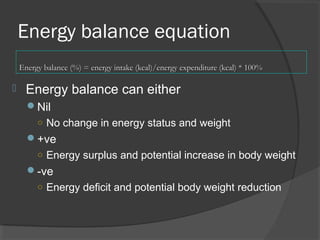
Energy balance equation
 Energy balance can either
Nil
○ No change in energy status and weight
+ve
○ Energy surplus and potential increase in body weight
-ve
○ Energy deficit and potential body weight reduction
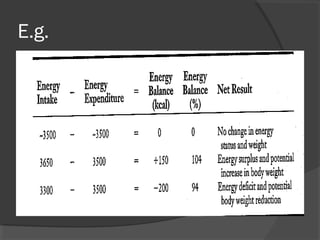
Energy balance (%) = energy intake (kcal)/energy expenditure (kcal) * 100%Energy balance (%) = energy intake (kcal)/energy expenditure (kcal) * 100%
E.g.
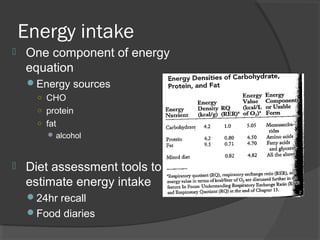
Energy intake
 One component of energy
equation
Energy sources
○ CHO
○ protein
○ fat
alcohol
 Diet assessment tools to
estimate energy intake
24hr recall
Food diaries
Energy expenditure
 Other component of energy balance equation
 Energy nutrients (CHO, fat, protein) broken down
in tissue to power muscle contractions and other
cell activities
Resulted in energy released from body in the form of
heat energy (kcal)
1kcal of heat energy
○ Amount of heat required to raise temp of 1kg of H2O by 1o
C =
4.184 kj
Metabolic rate describes amount of energy released in
a given unit of time
Tools for assessment of energy expenditure
 Direct calorimetry
Metabolic chamber
○ by measuring amount of gases utilized and produced
during energy metabolism directly
○ where a person enters an insulated room or metabolic
chamber for a specific period
and heat dissipated by body is measured
○ Mechanism
Heat release warms a layer of water or other fluid surrounding
chamber, and change in fluid temp reflects person’s energy
expenditure
 Indirect calorimetry
i. Metabolic cart that measures VO2 and VCO2
○ where tubing connects to person while at rest or
engaged in physical act
○ Mechanism
Volume of CO2 produced is divided by volume of O2 consumed
to yield respiratory exchange ration (RER)
- RER
- used to predict the contribution made by fat and CHO to total
energy experiment, because oxidations of these nutrients are
associated with different ratios of VO2 and CO2
- now used in weight management programms to better predict
energy expenditure for diet prescription
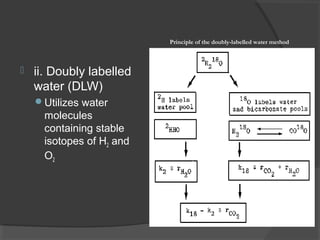
 ii. Doubly labelled
water (DLW)
Utilizes water
molecules
containing stable
isotopes of H2 and
O2
Principle of the doubly-labelled water method
Components of Energy
Expenditure (EE)
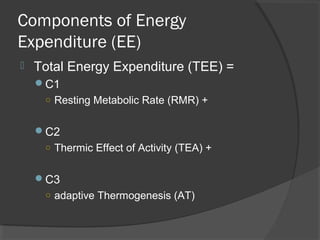
 Total Energy Expenditure (TEE) =
C1
○ Resting Metabolic Rate (RMR) +
C2
○ Thermic Effect of Activity (TEA) +
C3
○ adaptive Thermogenesis (AT)
C1: Basal and RMR
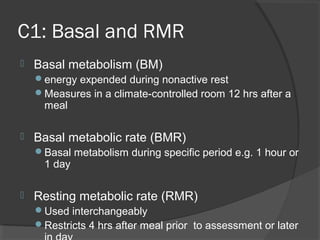
 Basal metabolism (BM)
energy expended during nonactive rest
Measures in a climate-controlled room 12 hrs after a
meal
 Basal metabolic rate (BMR)
Basal metabolism during specific period e.g. 1 hour or
1 day
 Resting metabolic rate (RMR)
Used interchangeably
Restricts 4 hrs after meal prior to assessment or later
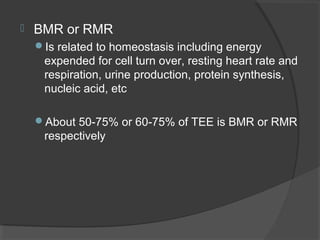
 BMR or RMR
Is related to homeostasis including energy
expended for cell turn over, resting heart rate and
respiration, urine production, protein synthesis,
nucleic acid, etc
About 50-75% or 60-75% of TEE is BMR or RMR
respectively
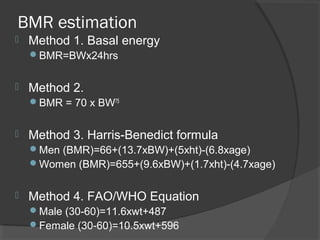
BMR estimation
 Method 1. Basal energy
BMR=BWx24hrs
 Method 2.
BMR = 70 x BW75
 Method 3. Harris-Benedict formula
Men (BMR)=66+(13.7xBW)+(5xht)-(6.8xage)
Women (BMR)=655+(9.6xBW)+(1.7xht)-(4.7xage)
 Method 4. FAO/WHO Equation
Male (30-60)=11.6xwt+487
Female (30-60)=10.5xwt+596
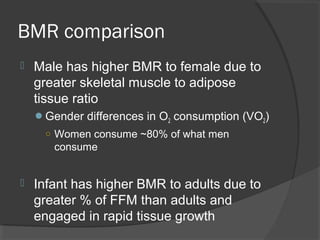
BMR comparison
 Male has higher BMR to female due to
greater skeletal muscle to adipose
tissue ratio
Gender differences in O2 consumption (VO2)
○ Women consume ~80% of what men
consume
 Infant has higher BMR to adults due to
greater % of FFM than adults and
engaged in rapid tissue growth
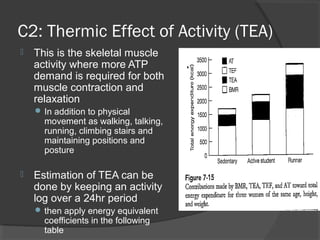
C2: Thermic Effect of Activity (TEA)
 This is the skeletal muscle
activity where more ATP
demand is required for both
muscle contraction and
relaxation
 In addition to physical
movement as walking, talking,
running, climbing stairs and
maintaining positions and
posture
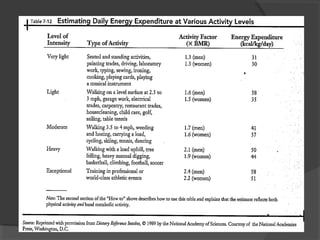
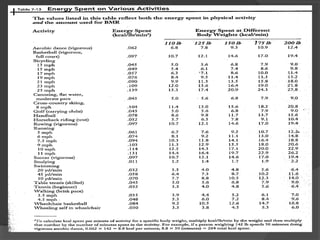
 Estimation of TEA can be
done by keeping an activity
log over a 24hr period
 then apply energy equivalent
coefficients in the following
table
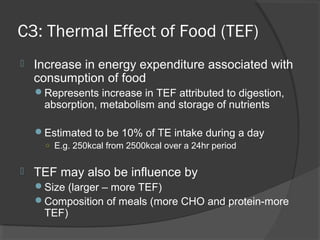
C3: Thermal Effect of Food (TEF)
 Increase in energy expenditure associated with
consumption of food
Represents increase in TEF attributed to digestion,
absorption, metabolism and storage of nutrients
Estimated to be 10% of TE intake during a day
○ E.g. 250kcal from 2500kcal over a 24hr period
 TEF may also be influence by
Size (larger – more TEF)
Composition of meals (more CHO and protein-more
TEF)
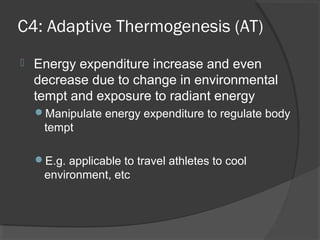
C4: Adaptive Thermogenesis (AT)
 Energy expenditure increase and even
decrease due to change in environmental
tempt and exposure to radiant energy
Manipulate energy expenditure to regulate body
tempt
E.g. applicable to travel athletes to cool
environment, etc
Conclusion
 Energy balance
Energy intake (CHO, protein, fat)
Energy expenditure
○ BMR or RMR
○ TEA
○ TEF
AT
Energy Balance

Energy Balance

  • 1.
    ENERGY BALANCE and ENERGY EXPENDITURE M.PrasadNaidu MSc Medical Biochemistry, Ph.D,.
  • 2.
    Learning objectives  Explainand discuss energy balance Energy intake Energy expenditure
  • 3.
    Energy balance  Relationshipbetween level of energy intake and expenditure Energy intake ○ Energy absorbed and maintained by body Energy expenditure ○ Energy used in cellular metabolism or lost from excretory routes  Occurs when energy intake matches energy expenditure
  • 4.
    Energy balance equation Energy balance can either Nil ○ No change in energy status and weight +ve ○ Energy surplus and potential increase in body weight -ve ○ Energy deficit and potential body weight reduction Energy balance (%) = energy intake (kcal)/energy expenditure (kcal) * 100%Energy balance (%) = energy intake (kcal)/energy expenditure (kcal) * 100%
  • 5.
  • 6.
    Energy intake  Onecomponent of energy equation Energy sources ○ CHO ○ protein ○ fat alcohol  Diet assessment tools to estimate energy intake 24hr recall Food diaries
  • 7.
    Energy expenditure  Othercomponent of energy balance equation  Energy nutrients (CHO, fat, protein) broken down in tissue to power muscle contractions and other cell activities Resulted in energy released from body in the form of heat energy (kcal) 1kcal of heat energy ○ Amount of heat required to raise temp of 1kg of H2O by 1o C = 4.184 kj Metabolic rate describes amount of energy released in a given unit of time
  • 8.
    Tools for assessmentof energy expenditure  Direct calorimetry Metabolic chamber ○ by measuring amount of gases utilized and produced during energy metabolism directly ○ where a person enters an insulated room or metabolic chamber for a specific period and heat dissipated by body is measured ○ Mechanism Heat release warms a layer of water or other fluid surrounding chamber, and change in fluid temp reflects person’s energy expenditure
  • 9.
     Indirect calorimetry i.Metabolic cart that measures VO2 and VCO2 ○ where tubing connects to person while at rest or engaged in physical act ○ Mechanism Volume of CO2 produced is divided by volume of O2 consumed to yield respiratory exchange ration (RER) - RER - used to predict the contribution made by fat and CHO to total energy experiment, because oxidations of these nutrients are associated with different ratios of VO2 and CO2 - now used in weight management programms to better predict energy expenditure for diet prescription
  • 10.
     ii. Doublylabelled water (DLW) Utilizes water molecules containing stable isotopes of H2 and O2 Principle of the doubly-labelled water method
  • 11.
    Components of Energy Expenditure(EE)  Total Energy Expenditure (TEE) = C1 ○ Resting Metabolic Rate (RMR) + C2 ○ Thermic Effect of Activity (TEA) + C3 ○ adaptive Thermogenesis (AT)
  • 12.
    C1: Basal andRMR  Basal metabolism (BM) energy expended during nonactive rest Measures in a climate-controlled room 12 hrs after a meal  Basal metabolic rate (BMR) Basal metabolism during specific period e.g. 1 hour or 1 day  Resting metabolic rate (RMR) Used interchangeably Restricts 4 hrs after meal prior to assessment or later
  • 13.
     BMR orRMR Is related to homeostasis including energy expended for cell turn over, resting heart rate and respiration, urine production, protein synthesis, nucleic acid, etc About 50-75% or 60-75% of TEE is BMR or RMR respectively
  • 14.
    BMR estimation  Method1. Basal energy BMR=BWx24hrs  Method 2. BMR = 70 x BW75  Method 3. Harris-Benedict formula Men (BMR)=66+(13.7xBW)+(5xht)-(6.8xage) Women (BMR)=655+(9.6xBW)+(1.7xht)-(4.7xage)  Method 4. FAO/WHO Equation Male (30-60)=11.6xwt+487 Female (30-60)=10.5xwt+596
  • 15.
    BMR comparison  Malehas higher BMR to female due to greater skeletal muscle to adipose tissue ratio Gender differences in O2 consumption (VO2) ○ Women consume ~80% of what men consume  Infant has higher BMR to adults due to greater % of FFM than adults and engaged in rapid tissue growth
  • 16.
    C2: Thermic Effectof Activity (TEA)  This is the skeletal muscle activity where more ATP demand is required for both muscle contraction and relaxation  In addition to physical movement as walking, talking, running, climbing stairs and maintaining positions and posture  Estimation of TEA can be done by keeping an activity log over a 24hr period  then apply energy equivalent coefficients in the following table
  • 19.
    C3: Thermal Effectof Food (TEF)  Increase in energy expenditure associated with consumption of food Represents increase in TEF attributed to digestion, absorption, metabolism and storage of nutrients Estimated to be 10% of TE intake during a day ○ E.g. 250kcal from 2500kcal over a 24hr period  TEF may also be influence by Size (larger – more TEF) Composition of meals (more CHO and protein-more TEF)
  • 20.
    C4: Adaptive Thermogenesis(AT)  Energy expenditure increase and even decrease due to change in environmental tempt and exposure to radiant energy Manipulate energy expenditure to regulate body tempt E.g. applicable to travel athletes to cool environment, etc
  • 21.
    Conclusion  Energy balance Energyintake (CHO, protein, fat) Energy expenditure ○ BMR or RMR ○ TEA ○ TEF AT