Electron Transport and
Oxidative Phosphorylation
M.Prasad Naidu
MSc Medical Biochemistry, Ph.D,.
Electron Transport and
Oxidative Phosphorylation
*Introduction*
stage 3 of respiration
NADH & FADH oxidized, electrons
are “carried” (ETS) energy in form
of ATP (Ox/Phos)
 aerobic acceptor = oxygen
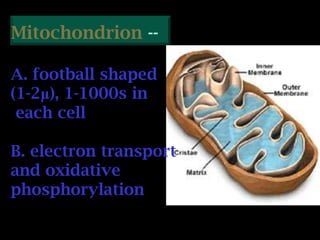
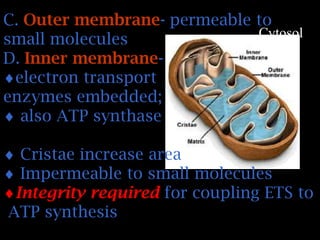
Mitochondrion --
A. football shaped
(1-2μ), 1-1000s in
each cell
B. electron transport
and oxidative
phosphorylation
Cytosol
C. Outer membrane- permeable to
small molecules
D. Inner membrane-
electron transport
enzymes embedded;
 also ATP synthase
 Cristae increase area
 Impermeable to small molecules
Integrity required for coupling ETS to
ATP synthesis
Cytosol
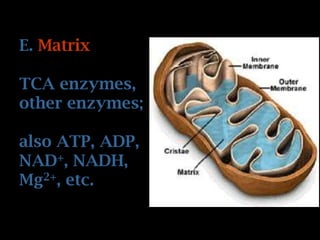
E. Matrix
TCA enzymes,
other enzymes;
also ATP, ADP,
NAD+, NADH,
Mg2+, etc.
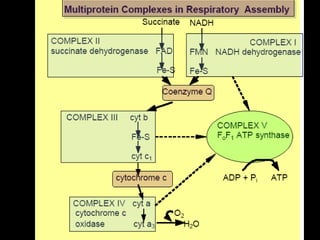
 The Electron Transport System is the
mechanism the cell uses to convert the
energy in NADH and FADH2 into ATP.
 Electrons flow along an energy
gradient via carriers in one direction from
a higher reducing potential (greater
tendency to donate electrons) to a lower
reducing potential (greater tendency to
accept electrons).
 The ultimate acceptor is molecular
oxygen.
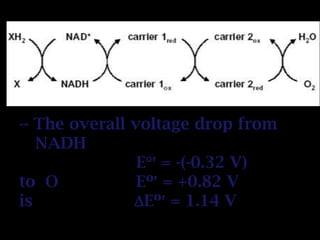
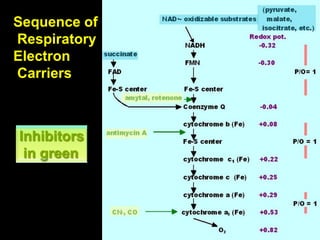
-- The overall voltage drop from
NADH
E = -(-0.32 V)
to O Eº = +0.82 V
is Eº = 1.14 V
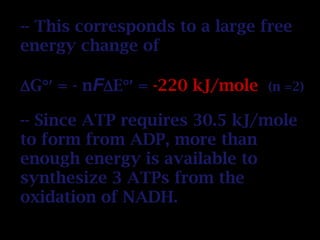
-- This corresponds to a large free
energy change of
G = - nFE = -220 kJ/mole (n =2)
-- Since ATP requires 30.5 kJ/mole
to form from ADP, more than
enough energy is available to
synthesize 3 ATPs from the
oxidation of NADH.
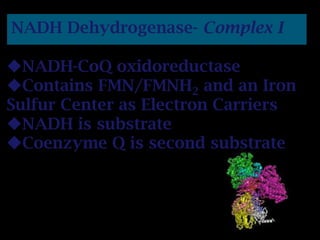
NADH Dehydrogenase- Complex I
NADH-CoQ oxidoreductase
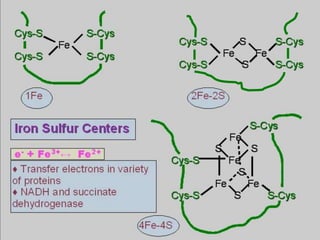
Contains FMN/FMNH2 and an Iron
Sulfur Center as Electron Carriers
NADH is substrate
Coenzyme Q is second substrate
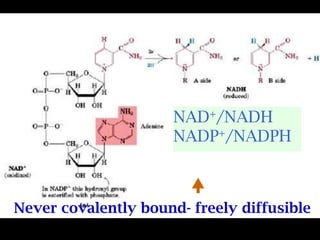
NAD+/NADH
NADP+/NADPH
Never covalently bound- freely diffusible

Nicotinamide

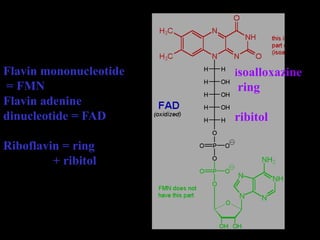
Flavin mononucleotide
= FMN
Flavin adenine
dinucleotide = FAD
Riboflavin = ring
+ ribitol
isoalloxazine
ring
ribitol
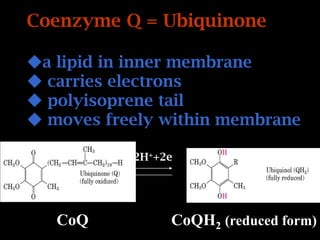
2H++2e
Coenzyme Q
Coenzyme Q
Coenzyme Q = Ubiquinone
a lipid in inner membrane
 carries electrons
 polyisoprene tail
 moves freely within membrane
CoQ CoQH2 (reduced form)
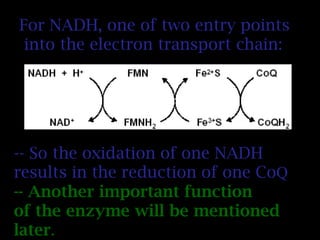
For NADH, one of two entry points
into the electron transport chain:
-- So the oxidation of one NADH
results in the reduction of one CoQ
-- Another important function
of the enzyme will be mentioned
later.
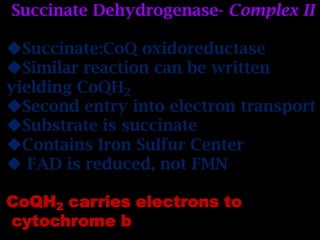
Succinate Dehydrogenase- Complex II
Succinate:CoQ oxidoreductase
Similar reaction can be written
yielding CoQH2
Second entry into electron transport
Substrate is succinate
Contains Iron Sulfur Center
 FAD is reduced, not FMN
CoQH2 carries electrons to
cytochrome b
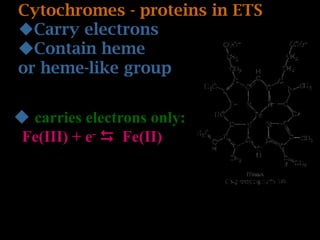
Cytochromes - proteins in ETS
Carry electrons
Contain heme
or heme-like group
 carries electrons only:
Fe(III) + e-  Fe(II)
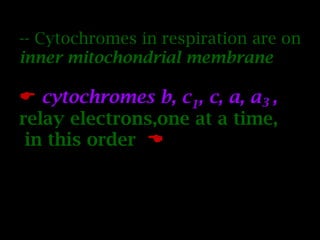
-- Cytochromes in respiration are on
inner mitochondrial membrane
 cytochromes b, c1, c, a, a3 ,
relay electrons,one at a time,
in this order 
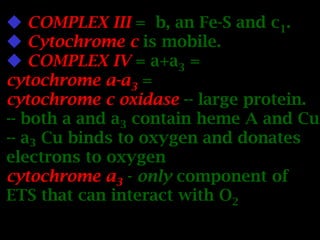
 COMPLEX III = b, an Fe-S and c1.
 Cytochrome c is mobile.
 COMPLEX IV = a+a3 =
cytochrome a-a3 =
cytochrome c oxidase -- large protein.
-- both a and a3 contain heme A and Cu
-- a3 Cu binds to oxygen and donates
electrons to oxygen
cytochrome a3 - only component of
ETS that can interact with O2
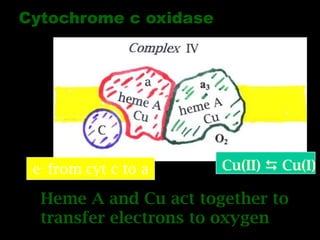
Cytochrome c oxidase
Heme A and Cu act together to
transfer electrons to oxygen
Cu(II)  Cu(I)e- from cyt c to a
Sequence of
Respiratory
Electron
Carriers
Inhibitors
in green
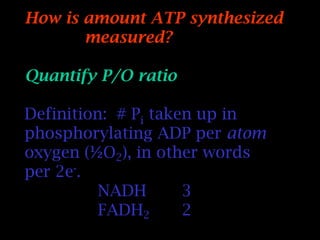
How is amount ATP synthesized
measured?
Quantify P/O ratio
Definition: # Pi taken up in
phosphorylating ADP per atom
oxygen (½O2), in other words
per 2e-.
NADH 3
FADH2 2
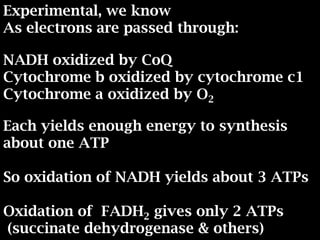
Experimental, we know
As electrons are passed through:
NADH oxidized by CoQ
Cytochrome b oxidized by cytochrome c1
Cytochrome a oxidized by O2
Each yields enough energy to synthesis
about one ATP
So oxidation of NADH yields about 3 ATPs
Oxidation of FADH2 gives only 2 ATPs
(succinate dehydrogenase & others)
What about energy and ATP
stoichiometry? -- measured
-- 220 kJ/mole from NADH oxidation
-- Each ATP produced: ADP + Pi  ATP
G = +30.5 kJ/mole
[3 (30.5)/220] 100 = 41% efficiency
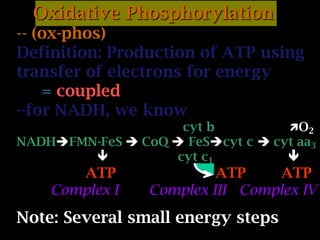
Oxidative Phosphorylation
-- (ox-phos)
Definition: Production of ATP using
transfer of electrons for energy
= coupled
--for NADH, we know
cyt b O2
NADHFMN-FeS  CoQ  FeScyt c  cyt aa3
 cyt c1 
ATP ATP ATP
Complex I Complex III Complex IV
Note: Several small energy steps
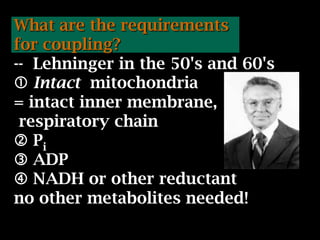
What are the requirements
for coupling?
-- Lehninger in the 50's and 60's
 Intact mitochondria
= intact inner membrane,
respiratory chain
 Pi
 ADP
 NADH or other reductant
no other metabolites needed!
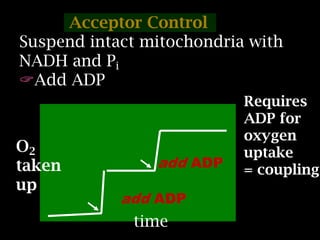
Acceptor Control
Suspend intact mitochondria with
NADH and Pi
Add ADP
add ADP
O2
taken
up
time
add ADP
Requires
ADP for
oxygen
uptake
= coupling
How is this coupling accomplished?
-- It was originally thought that ATP
generation was somehow directly
done at Complexes I, III and IV.
-- We now know that the coupling is
indirect in that a proton gradient is
generated across the inner
mitochondrial membrane which
drives ATP synthesis.
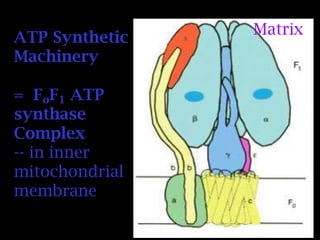
ATP Synthetic
Machinery
= FoF1 ATP
synthase
Complex
-- in inner
mitochondrial
membrane
Matrix
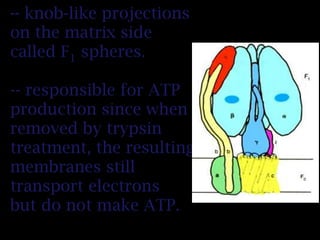
-- knob-like projections
on the matrix side
called F1 spheres.
-- responsible for ATP
production since when
removed by trypsin
treatment, the resulting
membranes still
transport electrons
but do not make ATP.
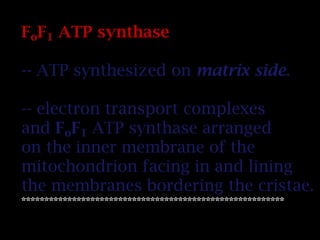
FoF1 ATP synthase
-- ATP synthesized on matrix side.
-- electron transport complexes
and FoF1 ATP synthase arranged
on the inner membrane of the
mitochondrion facing in and lining
the membranes bordering the cristae.
*********************************************************
Chemiosmotic Theory --Peter Mitchell
-- A proton gradient is
generated using energy
from electron transport.
--The vectorial transport
of protons (proton
pumping) is done by
Complexes I, III, IV from the matrix to
intermembrane space of the
mitochondrion.
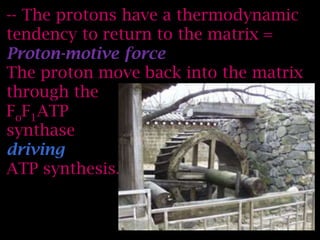
-- The protons have a thermodynamic
tendency to return to the matrix =
Proton-motive force
The proton move back into the matrix
through the
FoF1ATP
synthase
driving
ATP synthesis.
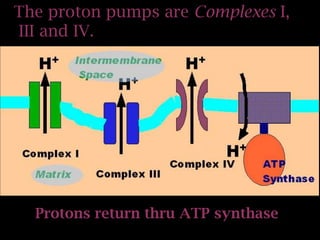
The proton pumps are Complexes I,
III and IV.
Protons return thru ATP synthase
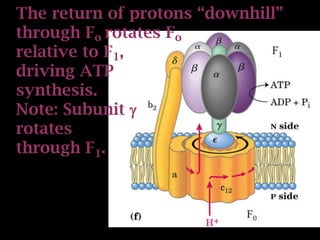
The return of protons “downhill”
through Fo rotates Fo
relative to F1,
driving ATP
synthesis.
Note: Subunit 
rotates
through F1.
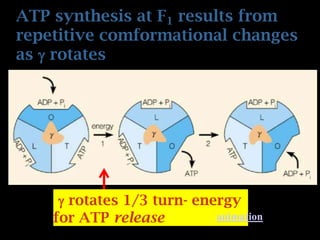
ATP synthesis at F1 results from
repetitive comformational changes
as  rotates
 rotates 1/3 turn- energy
for ATP release animation
Experimental corroboration
 Uncoupling. The compound
2,4 dinitrophenol (DNP)
allows proton
through the membrane
and uncouples.
Blocking. The antibiotic oligomycin
blocks the flow of H+
through the Fo,
directly inhibiting ox-phos.
Respiratory Control
-- Most mitochondria are said to be
tightly coupled.
That is there is no electron flow
without phosphorylation and no
phosphorylation without
electron flow.
-- Reduced substrate, ADP, Pi and O2
are all necessary for
oxidative phosphorylation.
For example, in the absence of ADP
or O2 electron flow stops, reduced
substrate is not consumed and no
ATP is made = acceptor control.
Under certain conditions, coupling
can be lost.
-- A toxic, nonphysiological uncoupler,
DNP, was described previously.
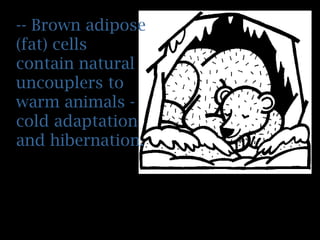
-- Brown adipose
(fat) cells
contain natural
uncouplers to
warm animals -
cold adaptation
and hibernation.
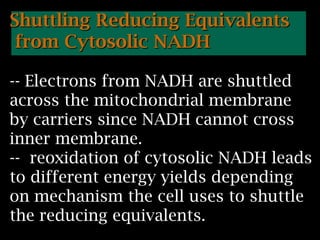
Shuttling Reducing Equivalents
from Cytosolic NADH
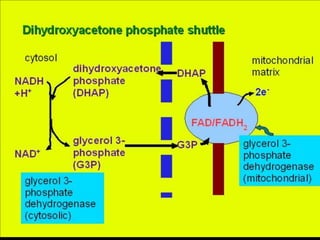
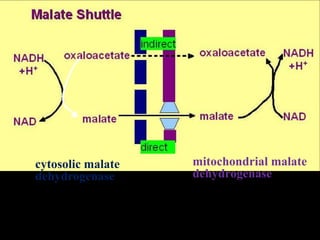
-- Electrons from NADH are shuttled
across the mitochondrial membrane
by carriers since NADH cannot cross
inner membrane.
-- reoxidation of cytosolic NADH leads
to different energy yields depending
on mechanism the cell uses to shuttle
the reducing equivalents.
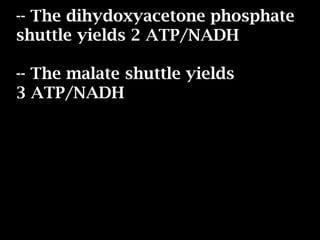
-- The dihydoxyacetone phosphate
shuttle yields 2 ATP/NADH
-- The malate shuttle yields
3 ATP/NADH
cytosolic malate
dehydrogenase
mitochondrial malate
dehydrogenase
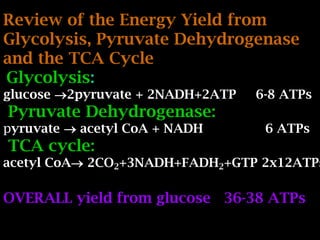
Review of the Energy Yield from
Glycolysis, Pyruvate Dehydrogenase
and the TCA Cycle
Glycolysis:
glucose 2pyruvate + 2NADH+2ATP 6-8 ATPs
Pyruvate Dehydrogenase:
pyruvate  acetyl CoA + NADH 6 ATPs
TCA cycle:
acetyl CoA 2CO2+3NADH+FADH2+GTP 2x12ATPs
OVERALL yield from glucose 36-38 ATPs

ELECTRON TRANSPORT AND OXIDATIVE PHOSPHORYLATION

  • 1.
    Electron Transport and OxidativePhosphorylation M.Prasad Naidu MSc Medical Biochemistry, Ph.D,.
  • 2.
    Electron Transport and OxidativePhosphorylation *Introduction* stage 3 of respiration NADH & FADH oxidized, electrons are “carried” (ETS) energy in form of ATP (Ox/Phos)  aerobic acceptor = oxygen
  • 3.
    Mitochondrion -- A. footballshaped (1-2μ), 1-1000s in each cell B. electron transport and oxidative phosphorylation Cytosol
  • 4.
    C. Outer membrane-permeable to small molecules D. Inner membrane- electron transport enzymes embedded;  also ATP synthase  Cristae increase area  Impermeable to small molecules Integrity required for coupling ETS to ATP synthesis Cytosol
  • 5.
    E. Matrix TCA enzymes, otherenzymes; also ATP, ADP, NAD+, NADH, Mg2+, etc.
  • 6.
     The ElectronTransport System is the mechanism the cell uses to convert the energy in NADH and FADH2 into ATP.  Electrons flow along an energy gradient via carriers in one direction from a higher reducing potential (greater tendency to donate electrons) to a lower reducing potential (greater tendency to accept electrons).  The ultimate acceptor is molecular oxygen.
  • 7.
    -- The overallvoltage drop from NADH E = -(-0.32 V) to O Eº = +0.82 V is Eº = 1.14 V
  • 8.
    -- This correspondsto a large free energy change of G = - nFE = -220 kJ/mole (n =2) -- Since ATP requires 30.5 kJ/mole to form from ADP, more than enough energy is available to synthesize 3 ATPs from the oxidation of NADH.
  • 9.
    NADH Dehydrogenase- ComplexI NADH-CoQ oxidoreductase Contains FMN/FMNH2 and an Iron Sulfur Center as Electron Carriers NADH is substrate Coenzyme Q is second substrate
  • 10.
    NAD+/NADH NADP+/NADPH Never covalently bound-freely diffusible  Nicotinamide 
  • 11.
    Flavin mononucleotide = FMN Flavinadenine dinucleotide = FAD Riboflavin = ring + ribitol isoalloxazine ring ribitol
  • 13.
    2H++2e Coenzyme Q Coenzyme Q CoenzymeQ = Ubiquinone a lipid in inner membrane  carries electrons  polyisoprene tail  moves freely within membrane CoQ CoQH2 (reduced form)
  • 14.
    For NADH, oneof two entry points into the electron transport chain: -- So the oxidation of one NADH results in the reduction of one CoQ -- Another important function of the enzyme will be mentioned later.
  • 15.
    Succinate Dehydrogenase- ComplexII Succinate:CoQ oxidoreductase Similar reaction can be written yielding CoQH2 Second entry into electron transport Substrate is succinate Contains Iron Sulfur Center  FAD is reduced, not FMN CoQH2 carries electrons to cytochrome b
  • 16.
    Cytochromes - proteinsin ETS Carry electrons Contain heme or heme-like group  carries electrons only: Fe(III) + e-  Fe(II)
  • 17.
    -- Cytochromes inrespiration are on inner mitochondrial membrane  cytochromes b, c1, c, a, a3 , relay electrons,one at a time, in this order 
  • 18.
     COMPLEX III= b, an Fe-S and c1.  Cytochrome c is mobile.  COMPLEX IV = a+a3 = cytochrome a-a3 = cytochrome c oxidase -- large protein. -- both a and a3 contain heme A and Cu -- a3 Cu binds to oxygen and donates electrons to oxygen cytochrome a3 - only component of ETS that can interact with O2
  • 19.
    Cytochrome c oxidase HemeA and Cu act together to transfer electrons to oxygen Cu(II)  Cu(I)e- from cyt c to a
  • 21.
  • 22.
    How is amountATP synthesized measured? Quantify P/O ratio Definition: # Pi taken up in phosphorylating ADP per atom oxygen (½O2), in other words per 2e-. NADH 3 FADH2 2
  • 23.
    Experimental, we know Aselectrons are passed through: NADH oxidized by CoQ Cytochrome b oxidized by cytochrome c1 Cytochrome a oxidized by O2 Each yields enough energy to synthesis about one ATP So oxidation of NADH yields about 3 ATPs Oxidation of FADH2 gives only 2 ATPs (succinate dehydrogenase & others)
  • 24.
    What about energyand ATP stoichiometry? -- measured -- 220 kJ/mole from NADH oxidation -- Each ATP produced: ADP + Pi  ATP G = +30.5 kJ/mole [3 (30.5)/220] 100 = 41% efficiency
  • 25.
    Oxidative Phosphorylation -- (ox-phos) Definition:Production of ATP using transfer of electrons for energy = coupled --for NADH, we know cyt b O2 NADHFMN-FeS  CoQ  FeScyt c  cyt aa3  cyt c1  ATP ATP ATP Complex I Complex III Complex IV Note: Several small energy steps
  • 26.
    What are therequirements for coupling? -- Lehninger in the 50's and 60's  Intact mitochondria = intact inner membrane, respiratory chain  Pi  ADP  NADH or other reductant no other metabolites needed!
  • 27.
    Acceptor Control Suspend intactmitochondria with NADH and Pi Add ADP add ADP O2 taken up time add ADP Requires ADP for oxygen uptake = coupling
  • 28.
    How is thiscoupling accomplished? -- It was originally thought that ATP generation was somehow directly done at Complexes I, III and IV. -- We now know that the coupling is indirect in that a proton gradient is generated across the inner mitochondrial membrane which drives ATP synthesis.
  • 29.
    ATP Synthetic Machinery = FoF1ATP synthase Complex -- in inner mitochondrial membrane Matrix
  • 30.
    -- knob-like projections onthe matrix side called F1 spheres. -- responsible for ATP production since when removed by trypsin treatment, the resulting membranes still transport electrons but do not make ATP.
  • 31.
    FoF1 ATP synthase --ATP synthesized on matrix side. -- electron transport complexes and FoF1 ATP synthase arranged on the inner membrane of the mitochondrion facing in and lining the membranes bordering the cristae. *********************************************************
  • 32.
    Chemiosmotic Theory --PeterMitchell -- A proton gradient is generated using energy from electron transport. --The vectorial transport of protons (proton pumping) is done by Complexes I, III, IV from the matrix to intermembrane space of the mitochondrion.
  • 33.
    -- The protonshave a thermodynamic tendency to return to the matrix = Proton-motive force The proton move back into the matrix through the FoF1ATP synthase driving ATP synthesis.
  • 34.
    The proton pumpsare Complexes I, III and IV. Protons return thru ATP synthase
  • 35.
    The return ofprotons “downhill” through Fo rotates Fo relative to F1, driving ATP synthesis. Note: Subunit  rotates through F1.
  • 36.
    ATP synthesis atF1 results from repetitive comformational changes as  rotates  rotates 1/3 turn- energy for ATP release animation
  • 37.
    Experimental corroboration  Uncoupling.The compound 2,4 dinitrophenol (DNP) allows proton through the membrane and uncouples. Blocking. The antibiotic oligomycin blocks the flow of H+ through the Fo, directly inhibiting ox-phos.
  • 38.
    Respiratory Control -- Mostmitochondria are said to be tightly coupled. That is there is no electron flow without phosphorylation and no phosphorylation without electron flow. -- Reduced substrate, ADP, Pi and O2 are all necessary for oxidative phosphorylation.
  • 39.
    For example, inthe absence of ADP or O2 electron flow stops, reduced substrate is not consumed and no ATP is made = acceptor control. Under certain conditions, coupling can be lost. -- A toxic, nonphysiological uncoupler, DNP, was described previously.
  • 40.
    -- Brown adipose (fat)cells contain natural uncouplers to warm animals - cold adaptation and hibernation.
  • 41.
    Shuttling Reducing Equivalents fromCytosolic NADH -- Electrons from NADH are shuttled across the mitochondrial membrane by carriers since NADH cannot cross inner membrane. -- reoxidation of cytosolic NADH leads to different energy yields depending on mechanism the cell uses to shuttle the reducing equivalents.
  • 42.
    -- The dihydoxyacetonephosphate shuttle yields 2 ATP/NADH -- The malate shuttle yields 3 ATP/NADH
  • 44.
  • 45.
    Review of theEnergy Yield from Glycolysis, Pyruvate Dehydrogenase and the TCA Cycle Glycolysis: glucose 2pyruvate + 2NADH+2ATP 6-8 ATPs Pyruvate Dehydrogenase: pyruvate  acetyl CoA + NADH 6 ATPs TCA cycle: acetyl CoA 2CO2+3NADH+FADH2+GTP 2x12ATPs OVERALL yield from glucose 36-38 ATPs