CHROMATOGRAPHY
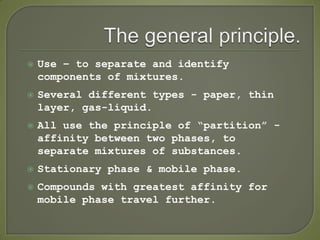
 Use – to separate and identify
components of mixtures.
 Several different types - paper, thin
layer, gas-liquid.
 All use the principle of “partition” -
affinity between two phases, to
separate mixtures of substances.
 Stationary phase & mobile phase.
 Compounds with greatest affinity for
mobile phase travel further.
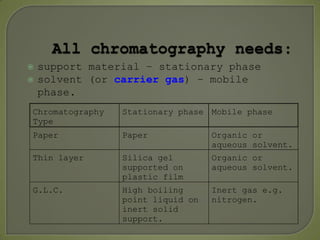
 support material – stationary phase
 solvent (or carrier gas) – mobile
phase.
Chromatography
Type
Stationary phase Mobile phase
Paper Paper Organic or
aqueous solvent.
Thin layer Silica gel
supported on
plastic film
Organic or
aqueous solvent.
G.L.C. High boiling
point liquid on
inert solid
support.
Inert gas e.g.
nitrogen.
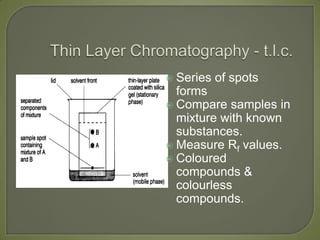
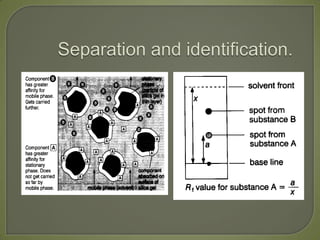
 Series of spots
forms
 Compare samples in
mixture with known
substances.
 Measure Rf values.
 Coloured
compounds &
colourless
compounds.
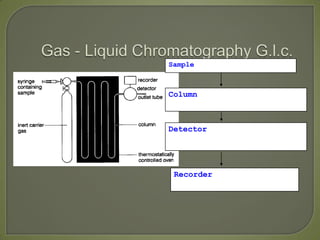
Sample introduced by syringe.
Column separates components.
(Heated in oven)
Detector monitors compounds
emerging from outlet.
Recorder plots signals as
a chromatogram.
 Compounds that have high affinity
for mobile phase emerge first,
(most volatile).
 Chromatogram charts recorder
response against time.
 Each component - separate peak.
 Retention time – characteristic of
the compound under given
conditions.
length of column
packing material
type of carrier gas
flow rate of carrier gas
temperature of column.
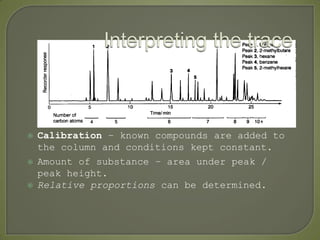
 Calibration – known compounds are added to
the column and conditions kept constant.
 Amount of substance – area under peak /
peak height.
 Relative proportions can be determined.
Very sensitive - small quantities of
substances detected, explosives, drugs
etc.
Separation of pure substances for
collection.
Can be connected to mass spectrometer
for direct identification of substances.
Chromatography

Chromatography

  • 1.
  • 2.
     Use –to separate and identify components of mixtures.  Several different types - paper, thin layer, gas-liquid.  All use the principle of “partition” - affinity between two phases, to separate mixtures of substances.  Stationary phase & mobile phase.  Compounds with greatest affinity for mobile phase travel further.
  • 3.
     support material– stationary phase  solvent (or carrier gas) – mobile phase. Chromatography Type Stationary phase Mobile phase Paper Paper Organic or aqueous solvent. Thin layer Silica gel supported on plastic film Organic or aqueous solvent. G.L.C. High boiling point liquid on inert solid support. Inert gas e.g. nitrogen.
  • 4.
     Series ofspots forms  Compare samples in mixture with known substances.  Measure Rf values.  Coloured compounds & colourless compounds.
  • 6.
    Sample introduced bysyringe. Column separates components. (Heated in oven) Detector monitors compounds emerging from outlet. Recorder plots signals as a chromatogram.
  • 7.
     Compounds thathave high affinity for mobile phase emerge first, (most volatile).  Chromatogram charts recorder response against time.  Each component - separate peak.  Retention time – characteristic of the compound under given conditions.
  • 8.
    length of column packingmaterial type of carrier gas flow rate of carrier gas temperature of column.
  • 9.
     Calibration –known compounds are added to the column and conditions kept constant.  Amount of substance – area under peak / peak height.  Relative proportions can be determined.
  • 10.
    Very sensitive -small quantities of substances detected, explosives, drugs etc. Separation of pure substances for collection. Can be connected to mass spectrometer for direct identification of substances.