Dr. N.R.Hazari
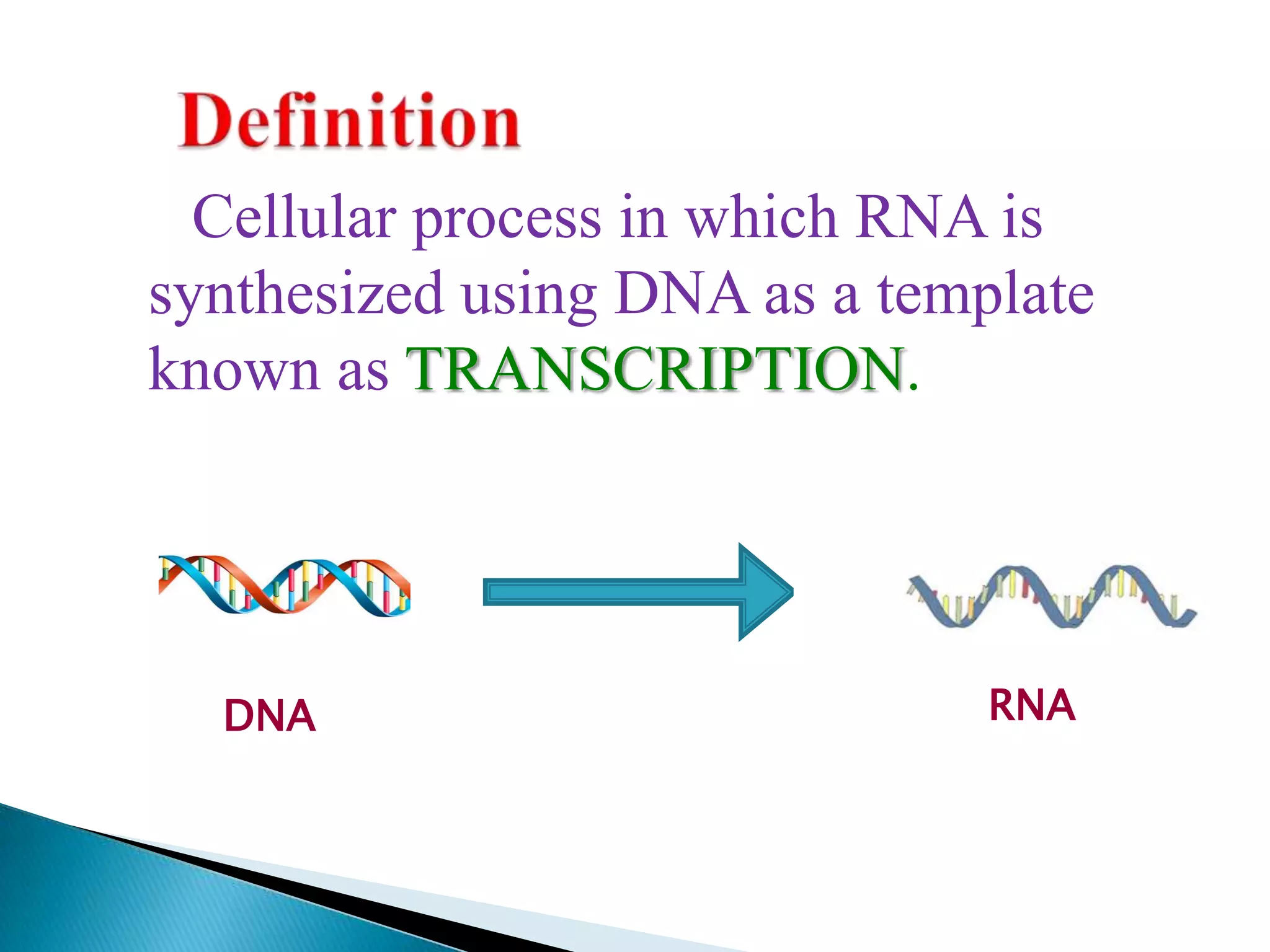
Cellular process in which RNA is
synthesized using DNA as a template
known as TRANSCRIPTION.


  DNA                          RNA
   Polymer of ribonucleotide held together by 3’ 5’
    phosphodiester bridge & are single stranded.

    Is the only molecule known to function both in the
    storage & transmission of genetic information & in
    catalysis.

   All RNAs except the RNA genomes of certain viruses
    derived from information which is stored permanently
    in DNA.
   Three major kinds of RNAs

     mRNA (5-10%) transfer information of gene to
    ribosome i.e. encodes the amino acids sequence .

   tRNA (10-20%)  reads codes on mRNA and
    transfers appropriate AA to mRNA.

   rRNA (60-80%)  constituents of ribosome.

    Many additional specialized RNAs which has catalytic
    activity or regulatory functions are present in the cell.
DNA


                                        U1RNA
rRNA   mRNA   tRNA   miRNA
                             ribozyme
   In replication entire DNA molecule is normally copied.

    In transcription a particular gene or group of genes are
    copied at any time, & some portions of DNA are never
    transcribed.

    Gene is a segment of DNA that codes for a type of
    Protein or for RNA & may present on any strand of
    DNA (contain many genes.)

                   Gene
                                                       Gene


         DNA


                   Gene                                 Gene
Differences between
                replication and transcription
                      Replication         Transcription
  Template            Both strand          single strand
                     whole genome    small portion of genome
   Primer                 yes                   no
  Enzyme            DNA polymerase      RNA polymerase
  Product              dsDNA                 ssRNA

  Base pair            A-T, G-C          A-U, T-A, G-C

Proof reading             yes                   no
   1)   It is highly selective.

    This selectivity is due to signals embedded in the nucleotide
    sequence of DNA.

   Specific sequences mark the beginning and end of the DNA
    segment which is to be transcribed.

   This signals instruct the enzyme

    where to start & stop the transcription
    when to start,
    how often to start .
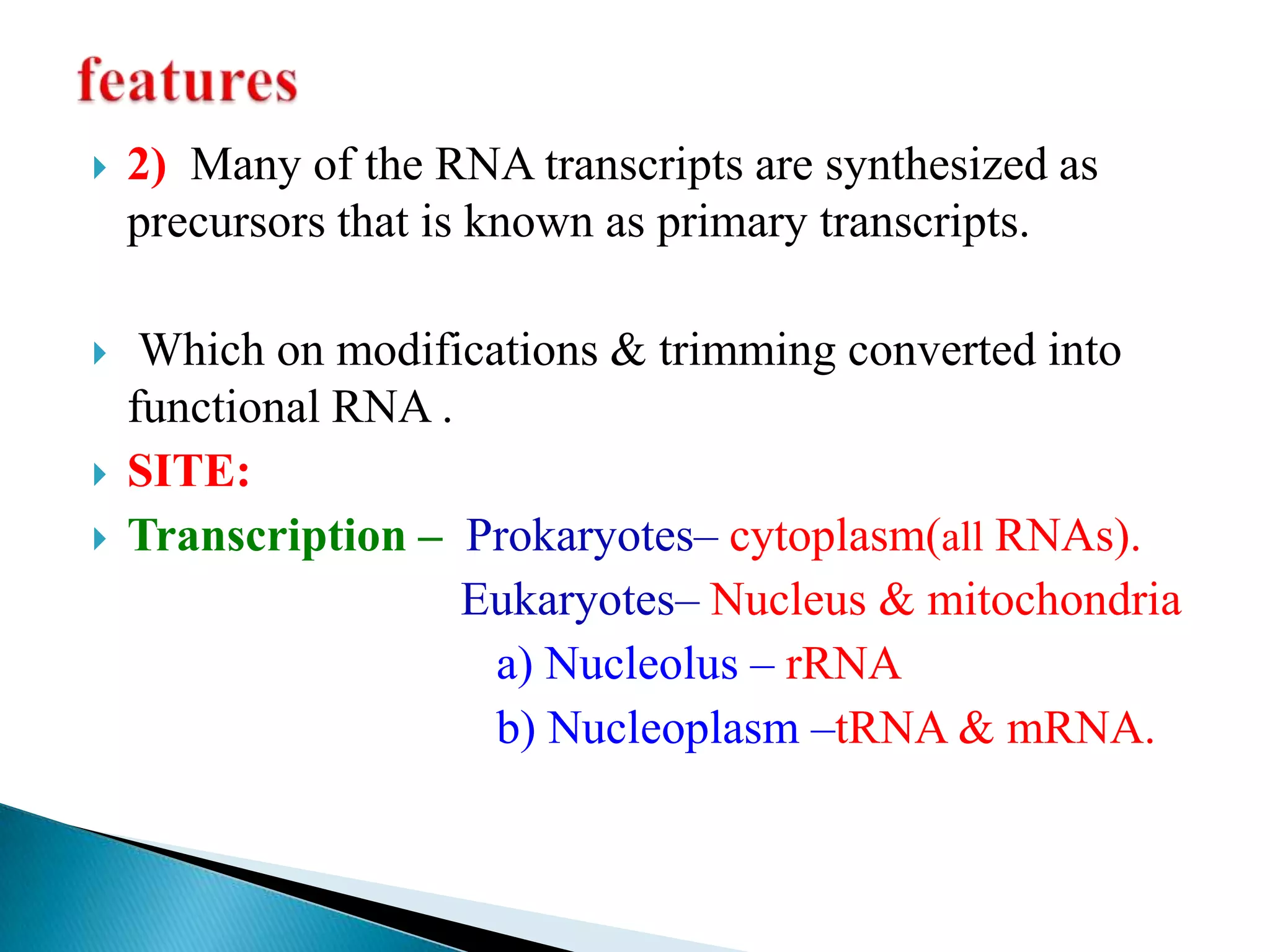
   2) Many of the RNA transcripts are synthesized as
    precursors that is known as primary transcripts.

    Which on modifications & trimming converted into
    functional RNA .
   SITE:
   Transcription – Prokaryotes– cytoplasm(all RNAs).
                     Eukaryotes– Nucleus & mitochondria
                      a) Nucleolus – rRNA
                      b) Nucleoplasm –tRNA & mRNA.
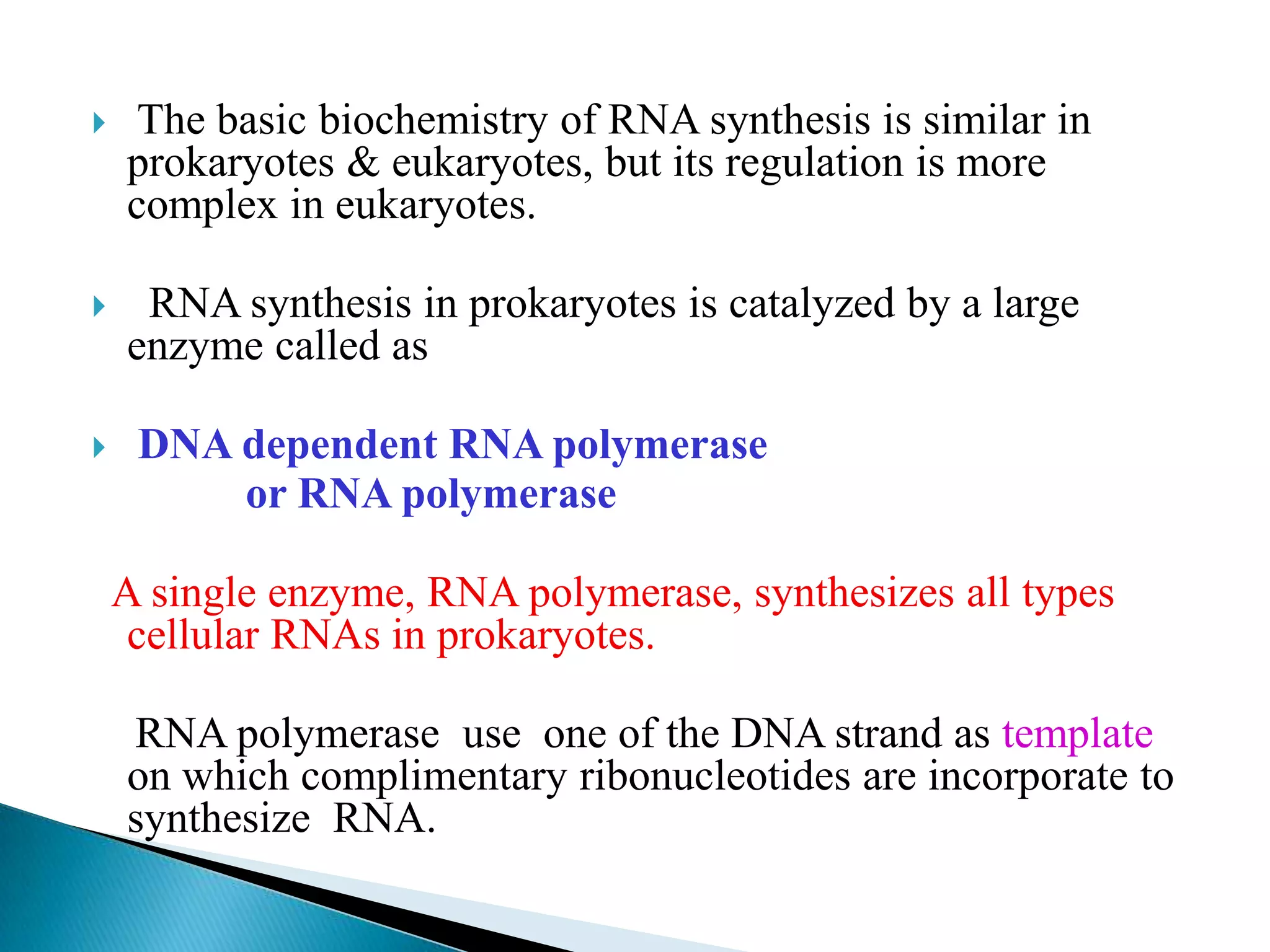
    The basic biochemistry of RNA synthesis is similar in
    prokaryotes & eukaryotes, but its regulation is more
    complex in eukaryotes.

    RNA synthesis in prokaryotes is catalyzed by a large
    enzyme called as

    DNA dependent RNA polymerase
         or RNA polymerase

    A single enzyme, RNA polymerase, synthesizes all types
     cellular RNAs in prokaryotes.

    RNA polymerase use one of the DNA strand as template
    on which complimentary ribonucleotides are incorporate to
    synthesize RNA.
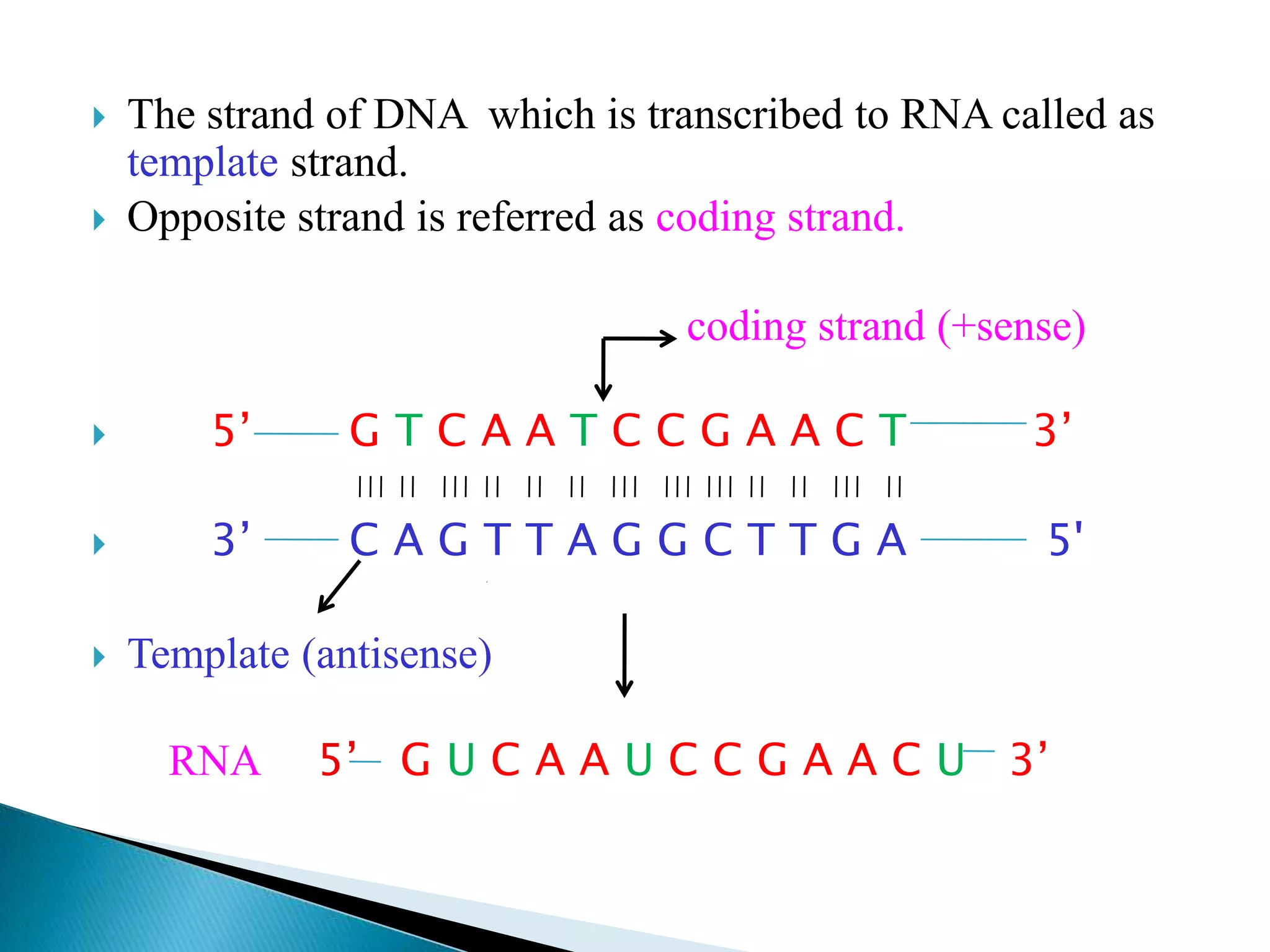
   The strand of DNA which is transcribed to RNA called as
    template strand.
   Opposite strand is referred as coding strand.

                                 coding strand (+sense)

       5’      GTCAATCCGAACT                       3’

       3’      CAGTTAGGCTTGA                        5'

   Template (antisense)

      RNA     5’ G U C A A U C C G A A C U 3’
   RNA polymerase synthesize RNA in the direction of
    5’-3’ that means DNA template is read in 3’-5’
    direction.
   Ribonucleotides required -- ATP, GTP, CTP & UTP.

   The prokaryotic RNA polymerase is a multimeric
    enzyme consisting of six subunits, two identical α-
    subunits, similar but not identical β and β’ and ω
    sixth is σ factor.
          2α,β,β’ω -- core enzyme
         2α,β,β’ω + σ --- Holoenzyme
RNA Polymerase of prokaryotes
Subunit                 Function
  ,α     Determine the DNA to be transcribed
         Catalyze polymerization
          Bind & open DNA
  
          template(unwinding)
  ω       Function is not known
          Recognize the initiation sites called
         promoter
    A single RNA polymerase performs multiple functions
    in transcription process.
   1- search & binds to promoter site
   2- unwinds a short stretch of double helical DNA.
   3- selects correct ribonucleotide & catalyze the
    formation of phosphodiester bond (polymerization
    according to base pair rule)
       (RNA)n + NTP                (RNA)n+1 + PPi
   4- detects termination signals
   5- interacts with activator & repressor proteins that
    regulate the rate of transcription.
Transcription in Prokaryotes
                   Three stages
   Initiation phase: RNA-polymerase recognizes the
    promoter and starts the transcription.
   Elongation phase: the RNA strand is continuously
    growing.
   Termination phase: the RNA-polymerase stops
    synthesis and the nascent RNA is separated from the
    DNA template.
    Involves the interaction of RNAP with DNA at a specific
    site or sequences of DNA.

   The sequence of DNA needed for RNA
    polymerase to bind to the template and accomplish the
    initiation reaction defines the promoter.


   Promoter are the characteristic sequences of DNA that
    direct the RNA polymerases to initiate the transcription.

   usually located on coding strand.

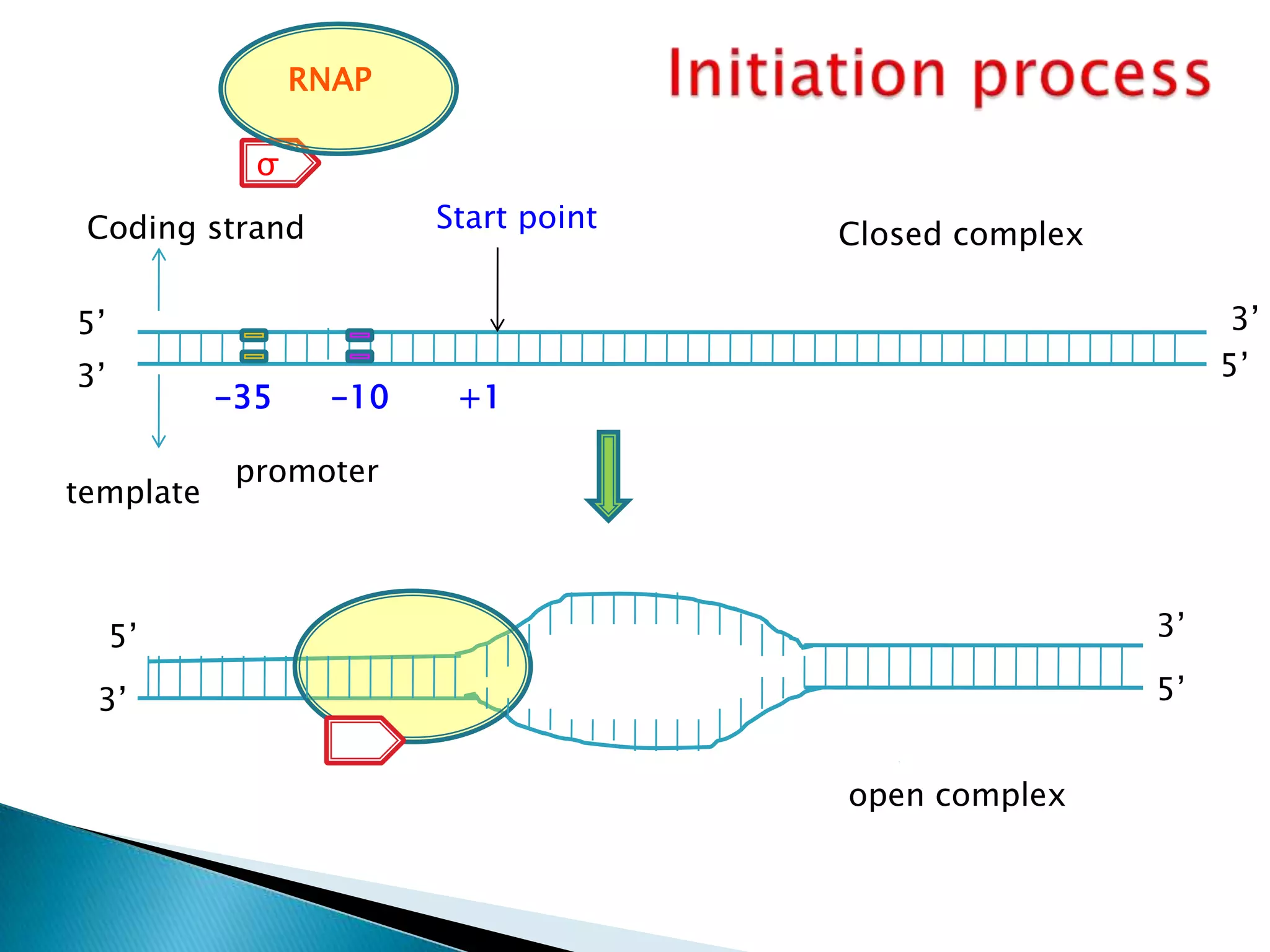
   Simplest type of promoters found in prokaryotes.
   Two general types of sequence elements are found.

   One sequence element is believed to promote initial binding of
    the enzyme RNAP.

   Other element usually has high content of adenine & thymine.
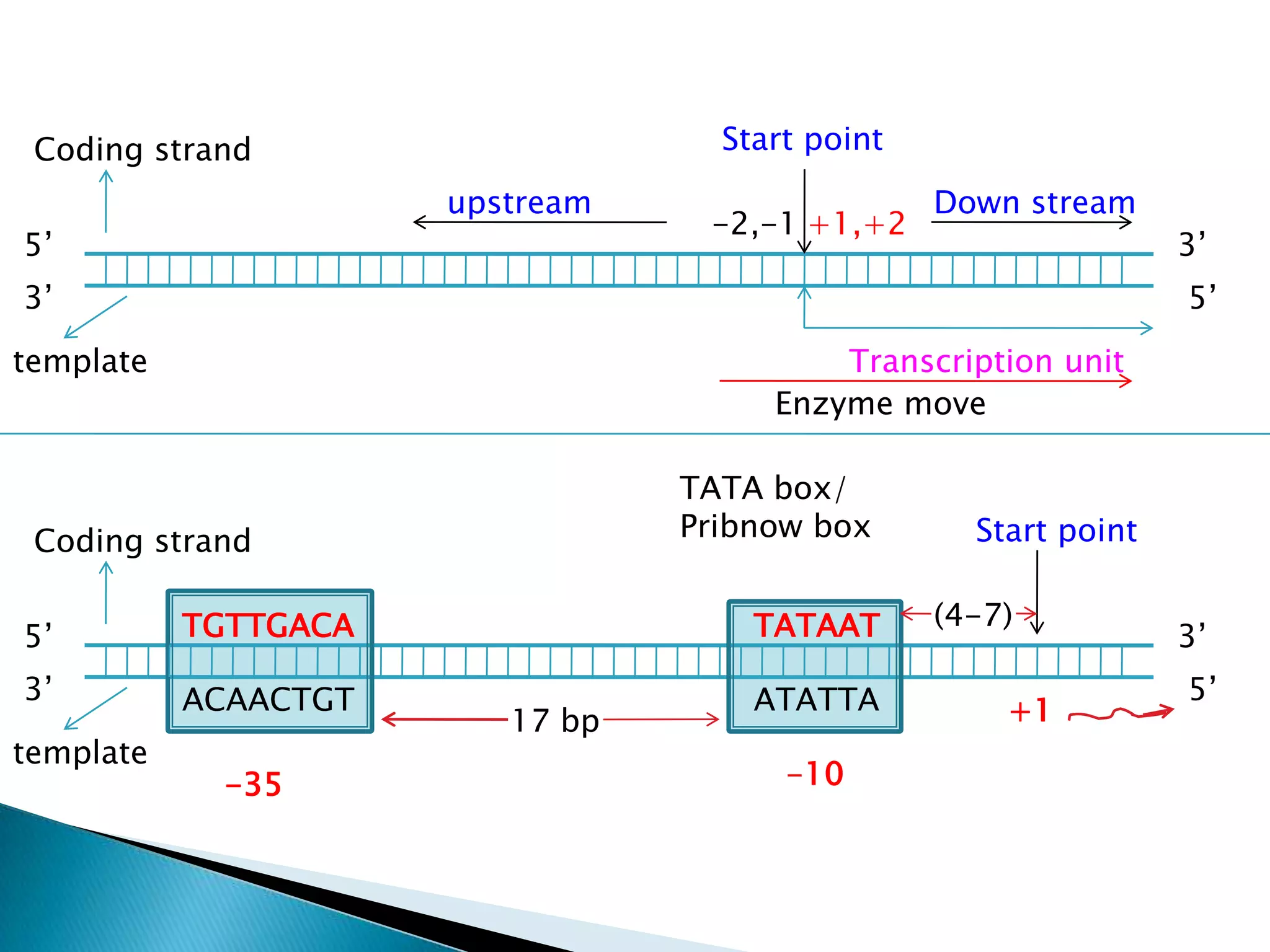
   These sequences are 6 to 8 nt in length and located about -35
    & -10 bp upstream of the start point of transcription.

   These are on coding strand indicates duplex DNA required for
    transcription.

   Change in only one base pair in promoter region decrease
    the rate of transcription
Coding strand                     Start point

                      upstream                   Down stream
                                  -2,-1 +1,+2
5’                                                               3’
3’                                                               5’

template                                  Transcription unit
                                      Enzyme move

                                 TATA box/
 Coding strand                   Pribnow box       Start point

           TGTTGACA                  TATAAT      (4-7)
5’                                                               3’
3’         ACAACTGT                  ATATTA                      5’
                         17 bp                       +1
template
            -35                        -10
RNAP

             σ

 Coding strand           Start point
                                       Closed complex

5’                                                            3’
3’                                                           5’
           -35     -10    +1

            promoter
template


     5’                                                 3’

 3’                                                     5’


                                       open complex
5’                                                                  3’

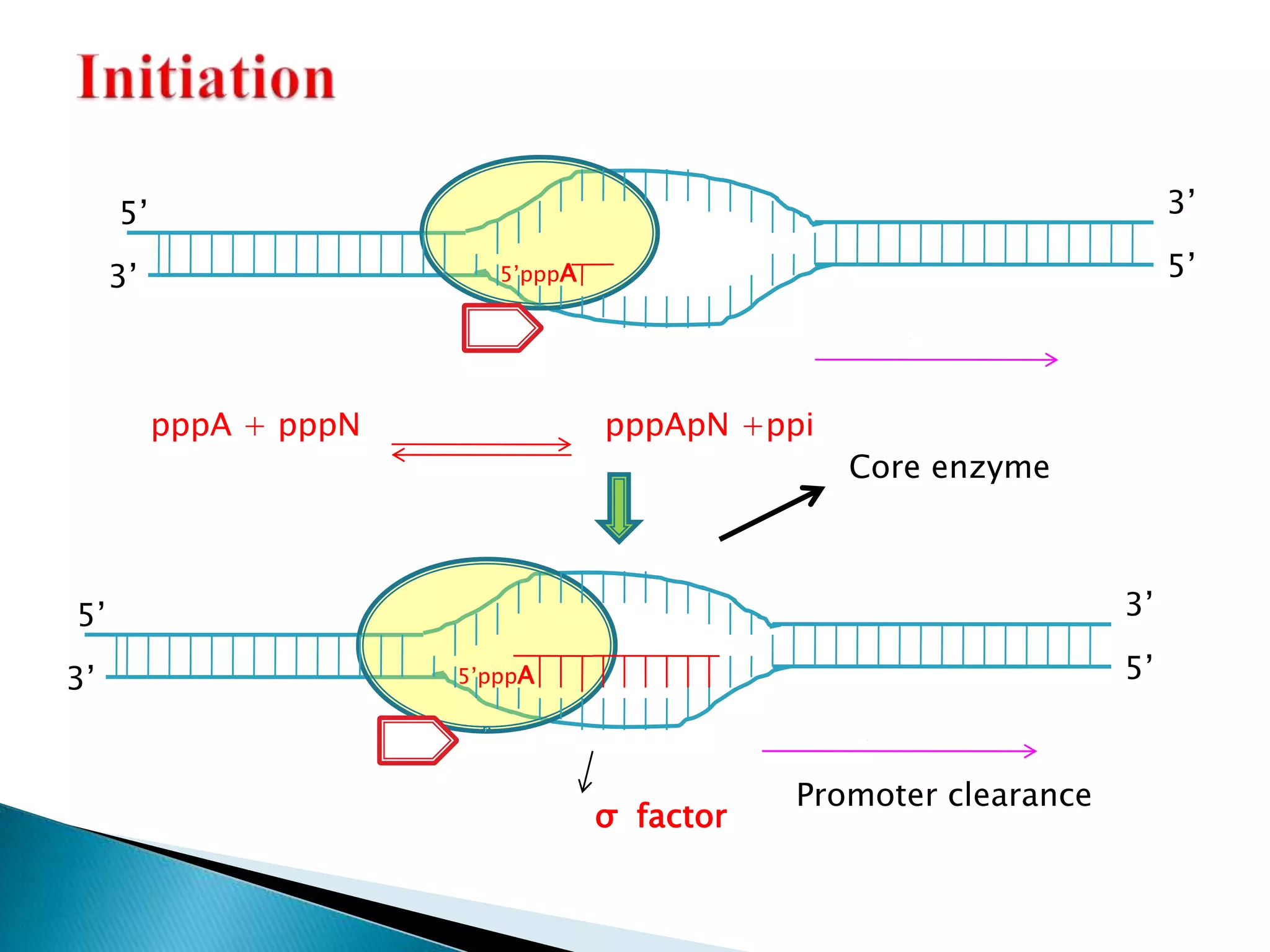
     3’                    5’pppA                                        5’


          pppA + pppN               pppApN +ppi
                                                  Core enzyme


5’                                                                  3’

3’                      5’pppA                                      5’


                                               Promoter clearance
                                    σ factor
5’                          3’

3’                           5’
                    5’pppA


 5’                               3’

3’
                                  5’
      Nascent RNA

              5’pppA
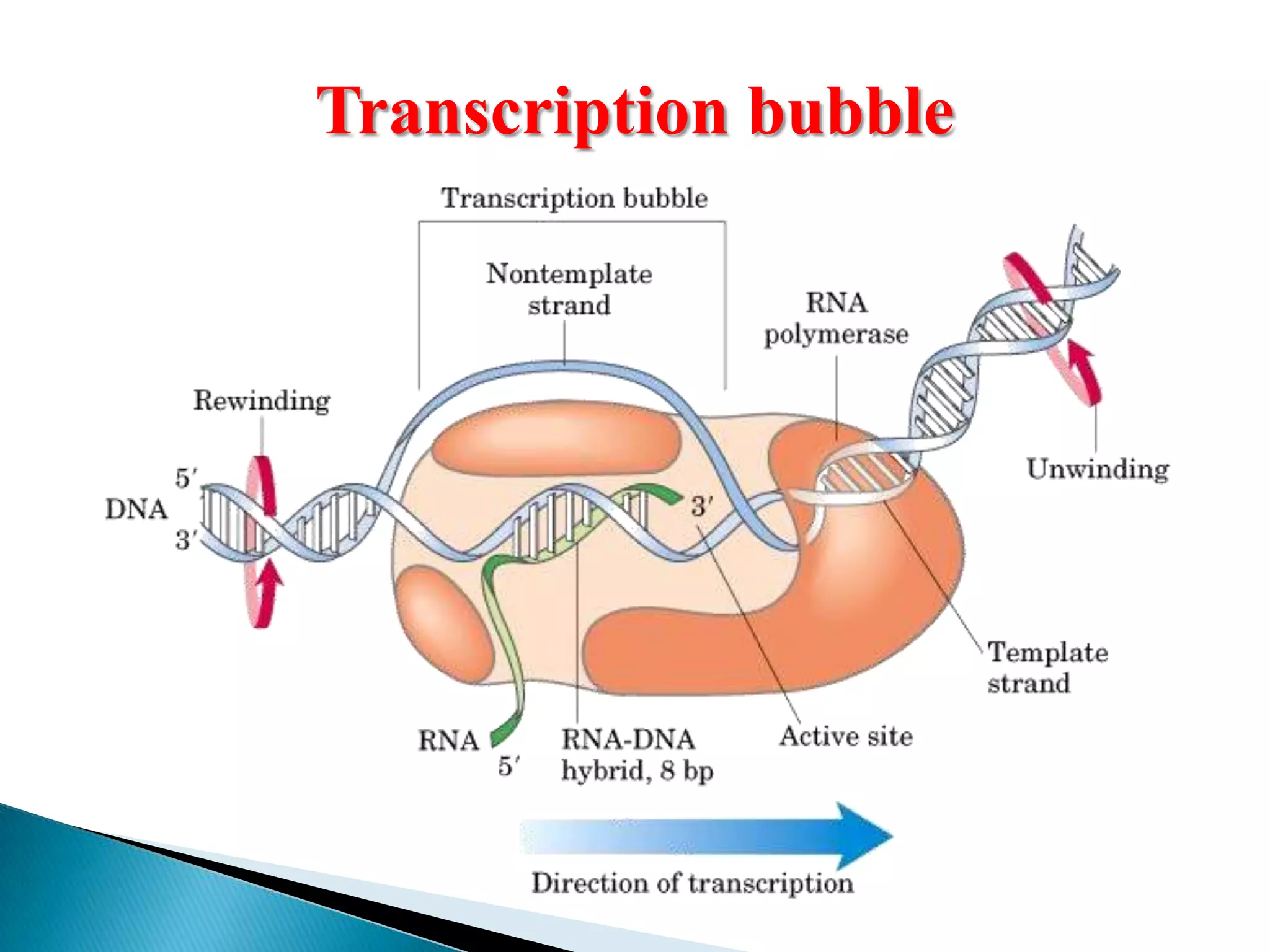
Transcription bubble
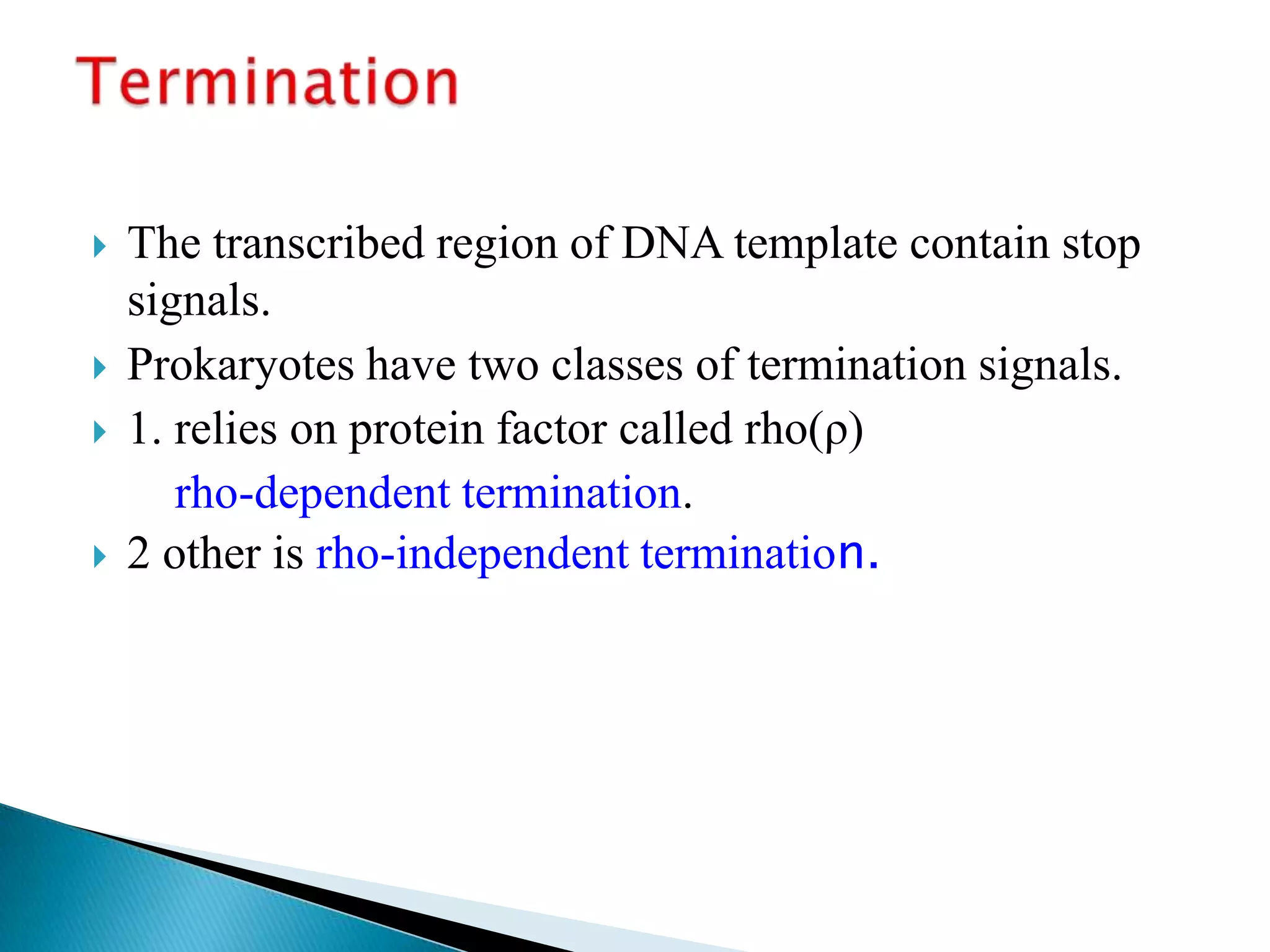
   The transcribed region of DNA template contain stop
    signals.
   Prokaryotes have two classes of termination signals.
   1. relies on protein factor called rho(ρ)
       rho-dependent termination.
   2 other is rho-independent termination.
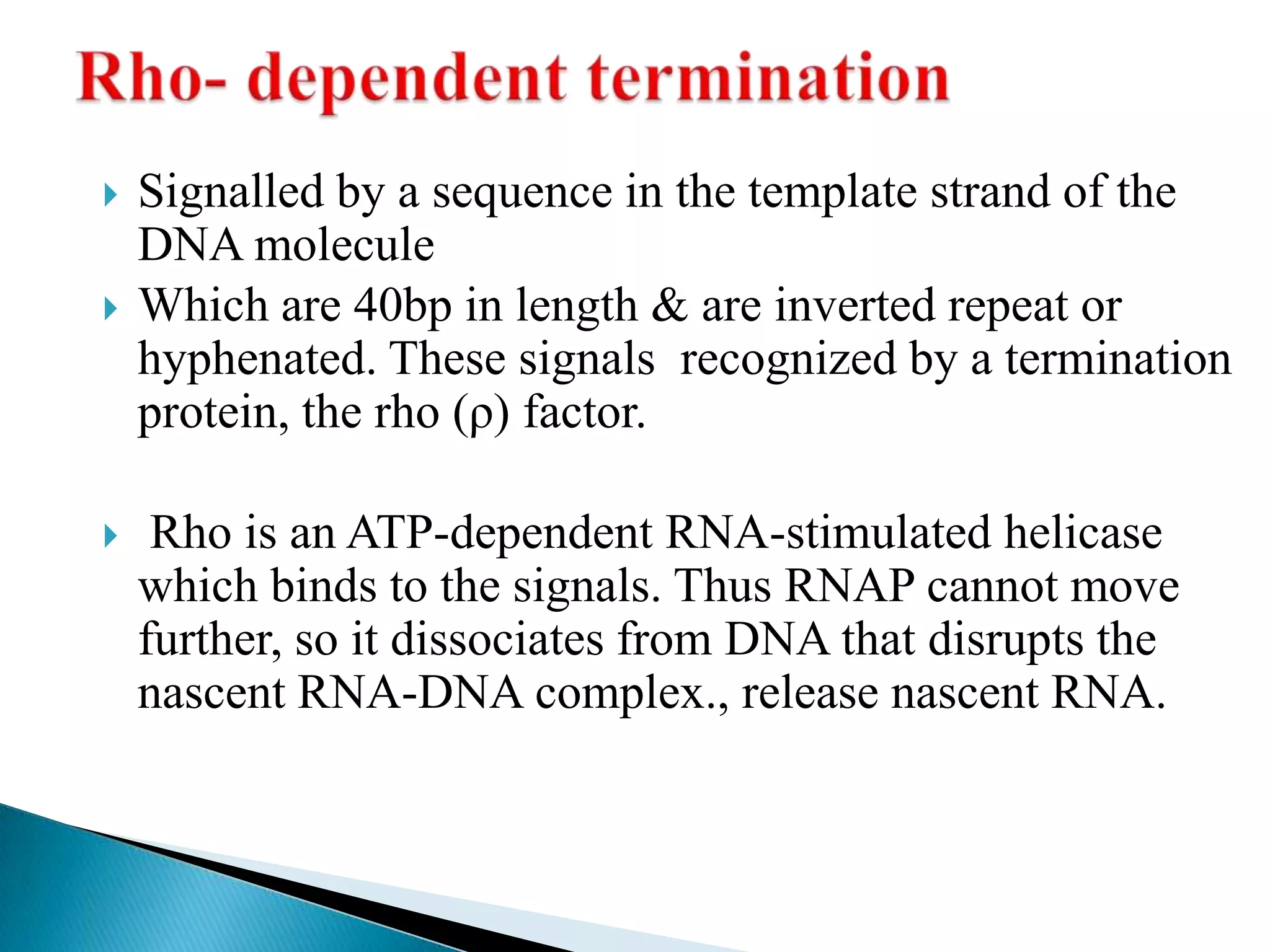
   Signalled by a sequence in the template strand of the
    DNA molecule
   Which are 40bp in length & are inverted repeat or
    hyphenated. These signals recognized by a termination
    protein, the rho (ρ) factor.

    Rho is an ATP-dependent RNA-stimulated helicase
    which binds to the signals. Thus RNAP cannot move
    further, so it dissociates from DNA that disrupts the
    nascent RNA-DNA complex., release nascent RNA.
Rho factor identifies
Nascent RNA   stop signal
                   Rho
Most -independent terminators have two
distinguishing features.
   1. One is palindromic G-C rich region which is
followed by an A-T rich region.
Thus RNA transcript of this palindrome is self
complementary sequences, permitting the formation of
a hairpin structure.
 2. The second feature is a highly conserved string of
A residues in the template strand that are transcribed
into U residues. The RNA transcript ends within or
just after them.
palindrome
Transcription in Eukaryotes
   1. Much more complicated.
   2. Three different RNA polymerases.
   3. Required many transcription factor protein.
   4. Transcription initiation needs promoter and
    upstream regulatory regions.
   5. Enhancers /silencers are DNA sequences that
    regulate the rate of initiation of transcription by
    RNA polymerase II
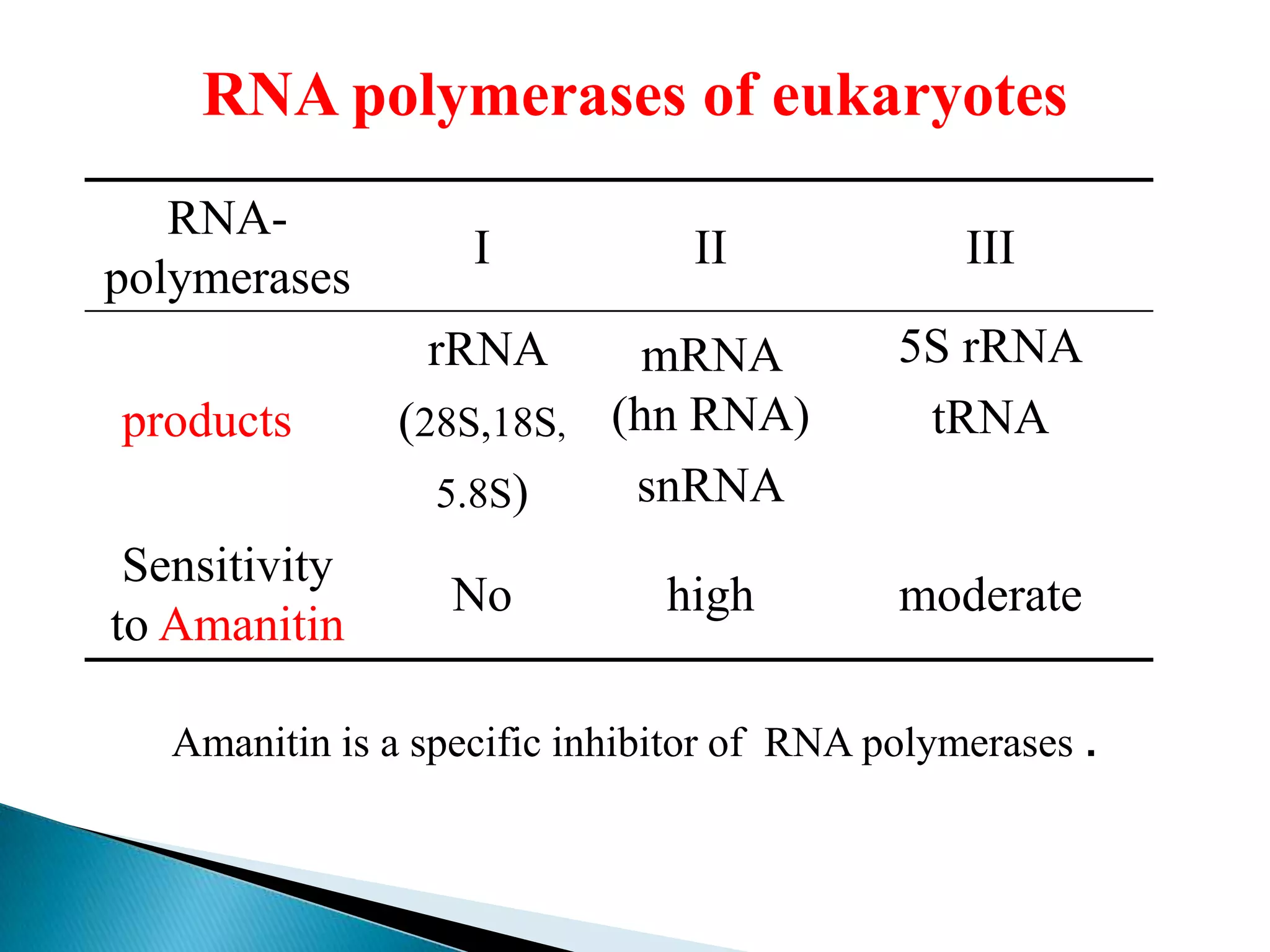
RNA polymerases of eukaryotes
   RNA-
                    I           II              III
polymerases
                 rRNA         mRNA          5S rRNA
products       (28S,18S,    (hn RNA)         tRNA
                 5.8S)       snRNA
 Sensitivity
                   No          high         moderate
to Amanitin

   Amanitin is a specific inhibitor of RNA polymerases .
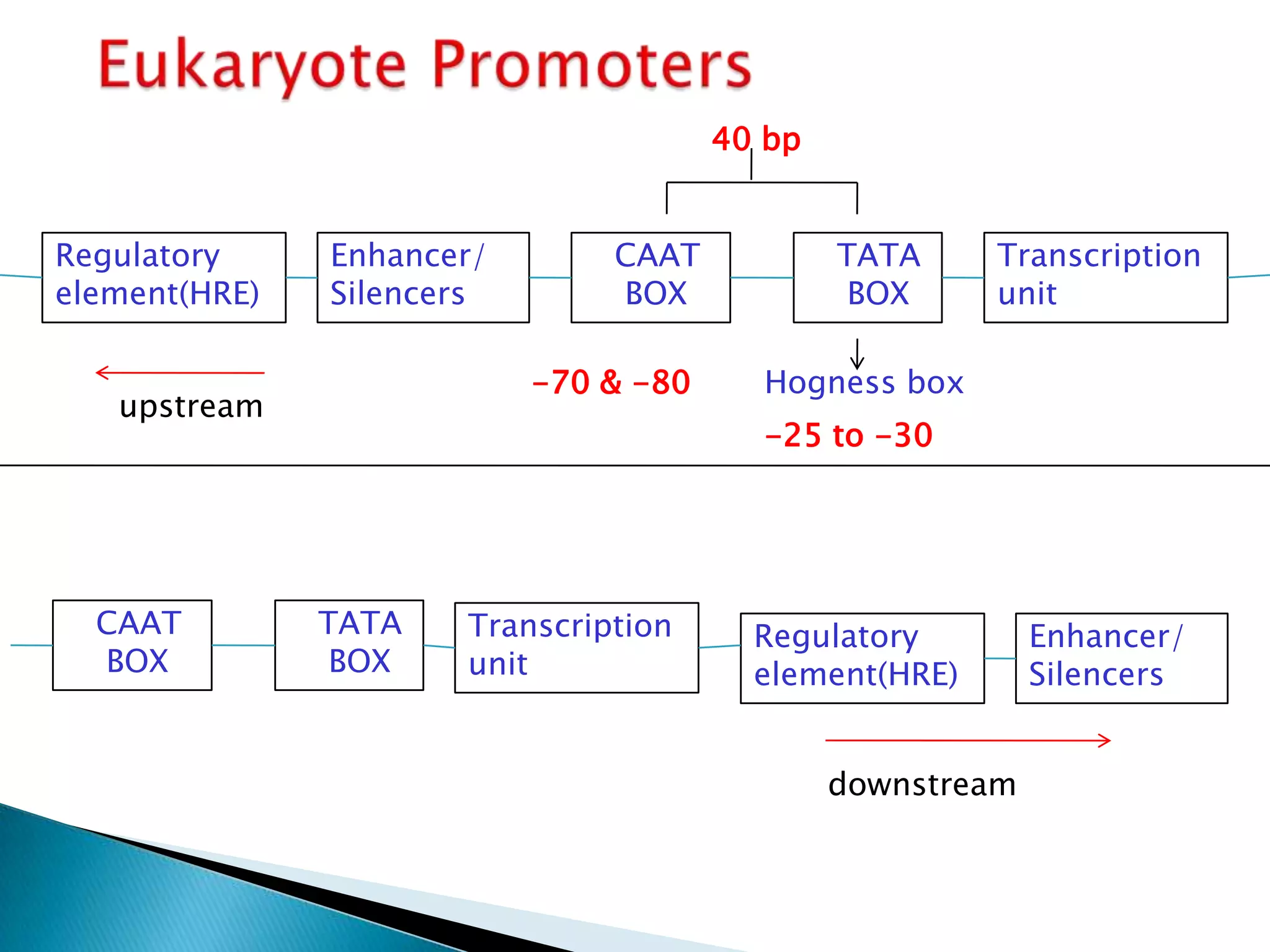
40 bp


Regulatory     Enhancer/       CAAT            TATA     Transcription
element(HRE)   Silencers       BOX              BOX     unit

                           -70 & -80     Hogness box
   upstream
                                         -25 to -30


  CAAT         TATA   Transcription      Regulatory         Enhancer/
  BOX           BOX   unit               element(HRE)       Silencers


                                               downstream
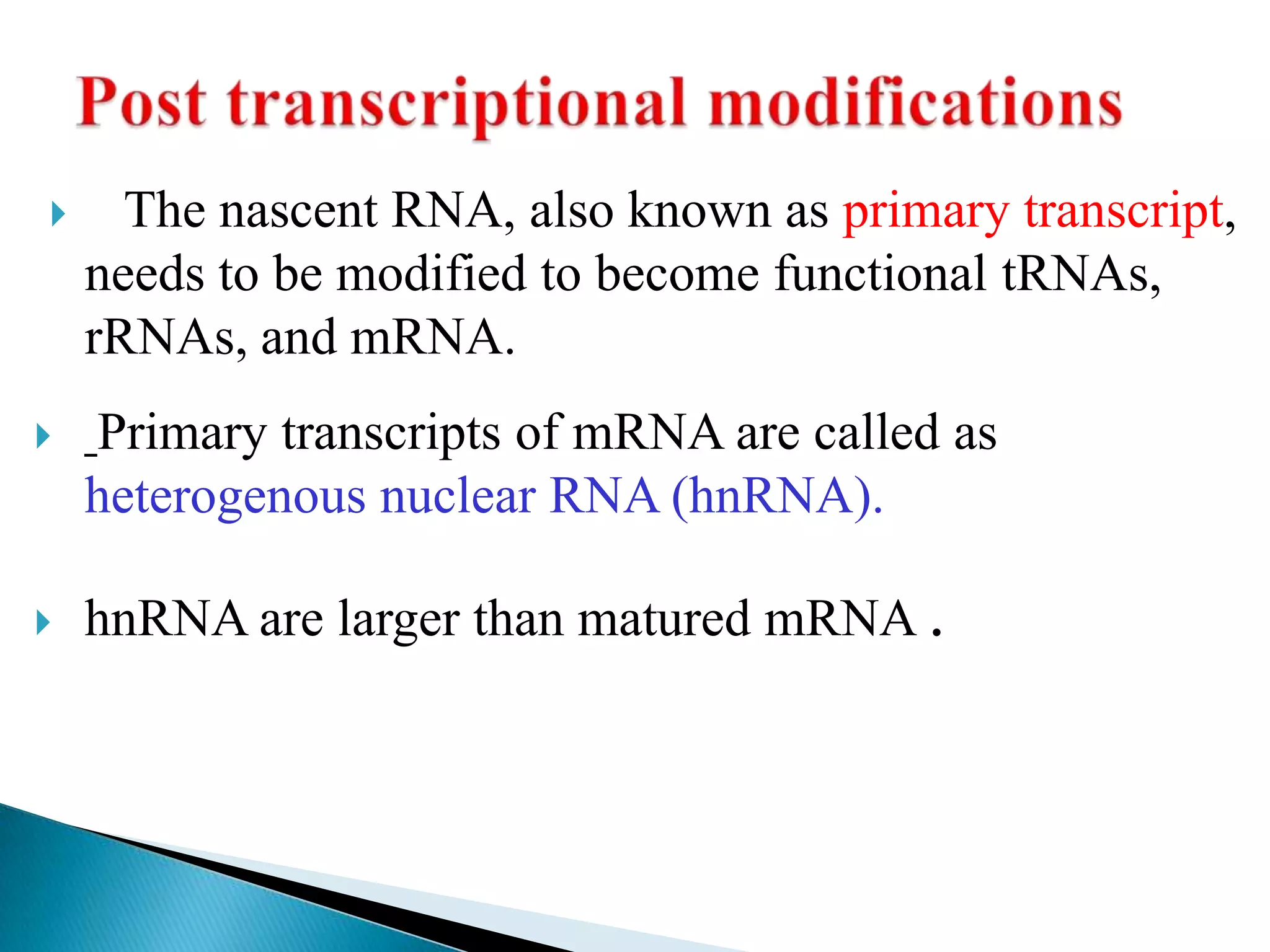
     The nascent RNA, also known as primary transcript,
    needs to be modified to become functional tRNAs,
    rRNAs, and mRNA.
   Primary transcripts of mRNA are called as
    heterogenous nuclear RNA (hnRNA).

   hnRNA are larger than matured mRNA .
   Splicing
   Addition of 5’ cap
   Creation of poly A tail
   RNA editing
Splicing

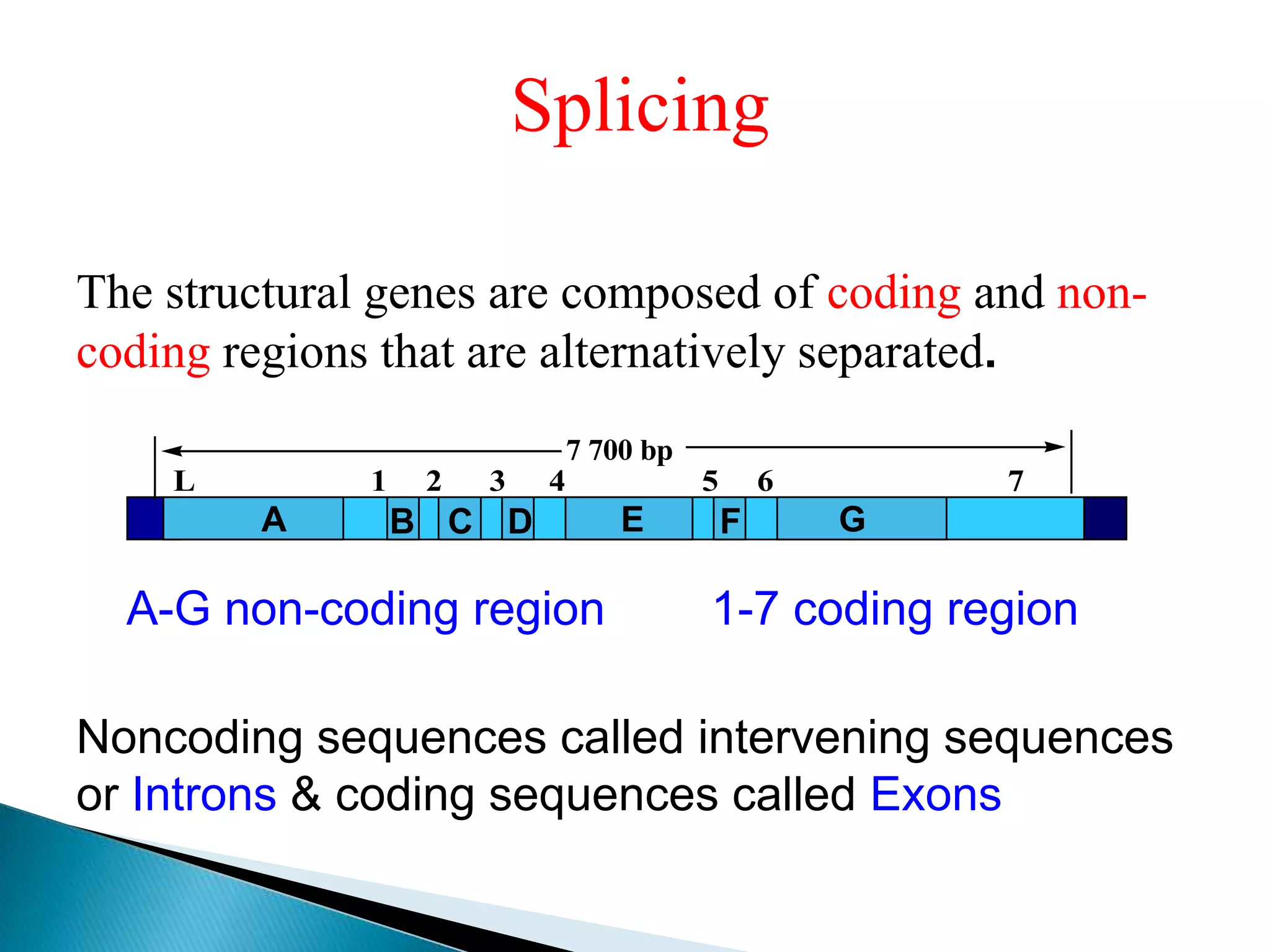
The structural genes are composed of coding and non-
coding regions that are alternatively separated.
                                7 700 bp
    L         1    2   3    4              5       6       7
        A         B C D             E          F       G

  A-G non-coding region                    1-7 coding region

Noncoding sequences called intervening sequences
or Introns & coding sequences called Exons
Nucleophilic A residue
         exposed


         ATP – dependent
         Protein mediated
         unwinding


lariat
Production of auto antibodies
against small nuclear
rionucleoprotein (SnRNPs) cause
systemic lupus erytromatosis.
Most eukaryotic mRNAs have a 5’ cap, a residue of 7-
 methyl guanosine linked to the 5’-terminal residue of the
 mRNA through an unusual 5’,5’-triphosphate linkage.

Formation of cap require three steps.
1 5’ terminal phosphate group removes by phosphatase
  enzyme leaving diphosphate.
2 GTP is added by releasing pyrophosphate.
3 7th N of guanine is methylated by methyl transferase
  enzyme. Methyl group donor is S-adenosyl methionine.
   At their 3’ end, most eukaryotic mRNAs have a
    string of 40 to 200 adenine residues, making up
    the poly(A) tail.

   Adenine nucleotides are added by enzyme
    adenylate transferase.
CAA


 mRNA


 Liver    Translation
                                               CAA
NH2                     COOH
         4536
         Apo B 100                             UAA

                 Intestine   Translation
                                    NH2               COOH

                                           2152
                                           Apo B 48
The primary transcripts of prokaryotic and eukaryotic
 tRNAs are processed by the removal of sequences from
 each end (cleavage) and in a few cases by the removal
 of introns (splicing).
Base modification

                      1. Methylation
(2)             (1)      A→mA, G→mG
      (1)
                      2. Reduction
                         U→DHU
                      3. Transversion
                         U→ψ
                (3)   4. Deamination
              (4)        A→I
Processing of eukaryotic rRNA
                                  45S

         18S                    5.8S               28S


                                METHYLATION

         18S                    5.8S                28S


Methyl groups
                                 CLEAVAGE (NUCLEASES)
   Actinomycin D- it binds with DNA template & blocks
    the movement of RNAP.
   Rifampicin- antibiotic used to treat tuberculosis. It
    binds with β subunit of prokaryotic RNAP.
   Α-Amanitin- Toxin produced by Amanita phalloides,
    mushroom. It tightly binds with eukaryotic RNA
    polymerase-II. Thus it inhibits mRNA synthesis.
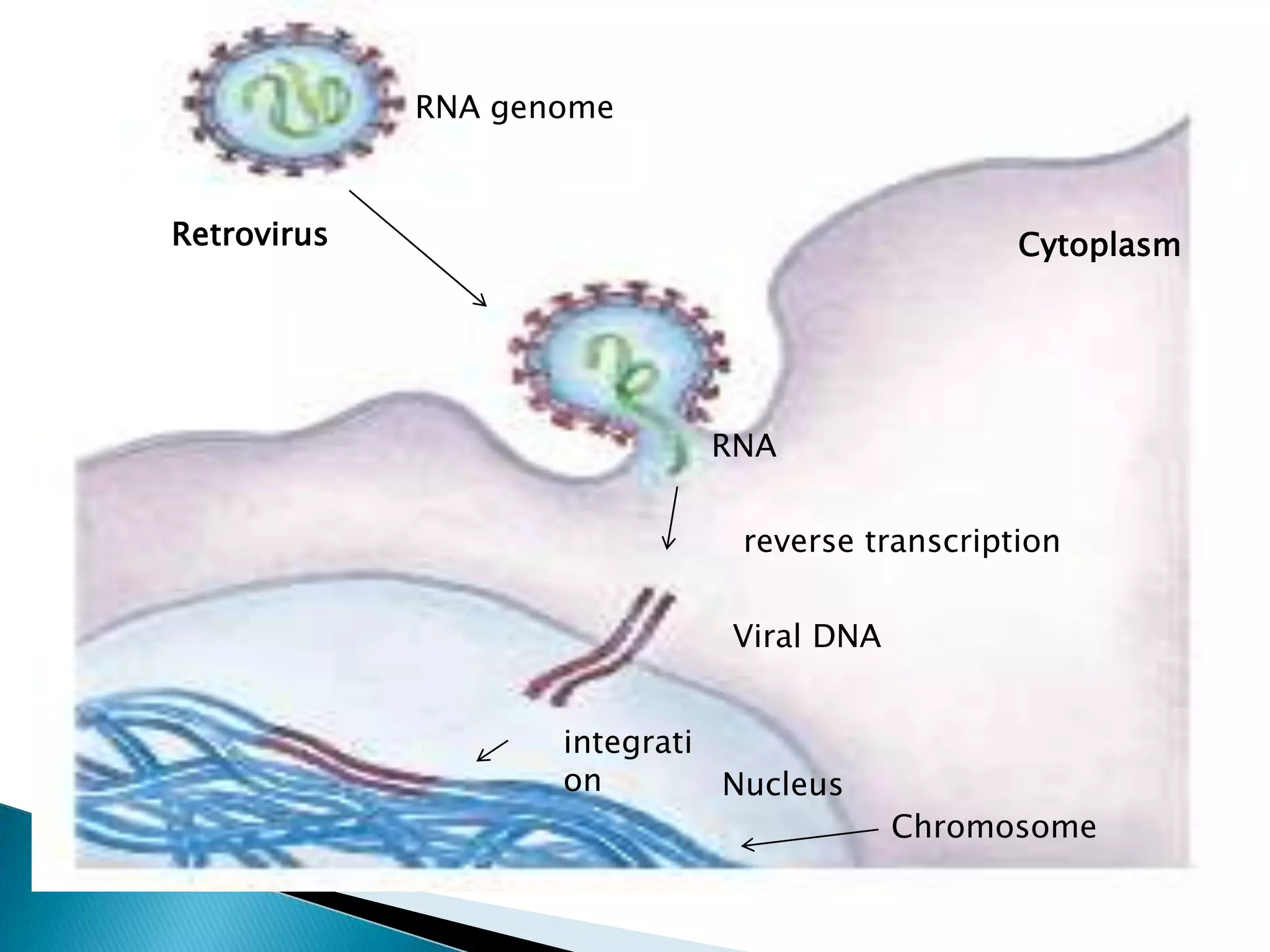
   Retrovirus possess RNA as genetic material
   Enzyme – RNA dependent DNA polymerase
   DNA complementary to viral RNA
   cDNA can be used as a probe to identify the sequence
    of DNA in genes
RNA genome


Retrovirus                                      Cytoplasm


                            RNA


                              reverse transcription

                              Viral DNA


                    integrati
                    on        Nucleus
                                          Chromosome
   The first nucleotide (the start site) of a transcribed
    DNA sequence is denoted as +1 and the second one
    as +2; the
   nucleotide preceding the start site is denoted as -1.
    These designations refer to the coding strand of
    DNA. Recall that the
   sequence of the template strand of DNA is the
    complement of that of the RNA transcript (see Figure
    5.26). In contrast,
   the coding strand of DNA has the same sequence as
    that of the RNA transcript except for thymine (T) in
    place of uracil
   (U). The coding strand is also known as the sense (+)
    strand, and the template strand as the antisense (-)
    strand.
Transcription
Transcription

Transcription

  • 1.
  • 2.
    Cellular process inwhich RNA is synthesized using DNA as a template known as TRANSCRIPTION. DNA RNA
  • 3.
    Polymer of ribonucleotide held together by 3’ 5’ phosphodiester bridge & are single stranded.  Is the only molecule known to function both in the storage & transmission of genetic information & in catalysis.  All RNAs except the RNA genomes of certain viruses derived from information which is stored permanently in DNA.
  • 4.
    Three major kinds of RNAs  mRNA (5-10%) transfer information of gene to ribosome i.e. encodes the amino acids sequence .  tRNA (10-20%)  reads codes on mRNA and transfers appropriate AA to mRNA.  rRNA (60-80%)  constituents of ribosome.  Many additional specialized RNAs which has catalytic activity or regulatory functions are present in the cell.
  • 5.
    DNA U1RNA rRNA mRNA tRNA miRNA ribozyme
  • 6.
    In replication entire DNA molecule is normally copied.  In transcription a particular gene or group of genes are copied at any time, & some portions of DNA are never transcribed.  Gene is a segment of DNA that codes for a type of Protein or for RNA & may present on any strand of DNA (contain many genes.) Gene Gene DNA Gene Gene
  • 7.
    Differences between replication and transcription Replication Transcription Template Both strand single strand whole genome small portion of genome Primer yes no Enzyme DNA polymerase RNA polymerase Product dsDNA ssRNA Base pair A-T, G-C A-U, T-A, G-C Proof reading yes no
  • 8.
    1) It is highly selective.  This selectivity is due to signals embedded in the nucleotide sequence of DNA.  Specific sequences mark the beginning and end of the DNA segment which is to be transcribed.  This signals instruct the enzyme where to start & stop the transcription when to start, how often to start .
  • 9.
    2) Many of the RNA transcripts are synthesized as precursors that is known as primary transcripts.  Which on modifications & trimming converted into functional RNA .  SITE:  Transcription – Prokaryotes– cytoplasm(all RNAs). Eukaryotes– Nucleus & mitochondria a) Nucleolus – rRNA b) Nucleoplasm –tRNA & mRNA.
  • 10.
    The basic biochemistry of RNA synthesis is similar in prokaryotes & eukaryotes, but its regulation is more complex in eukaryotes.  RNA synthesis in prokaryotes is catalyzed by a large enzyme called as  DNA dependent RNA polymerase or RNA polymerase A single enzyme, RNA polymerase, synthesizes all types cellular RNAs in prokaryotes. RNA polymerase use one of the DNA strand as template on which complimentary ribonucleotides are incorporate to synthesize RNA.
  • 11.
    The strand of DNA which is transcribed to RNA called as template strand.  Opposite strand is referred as coding strand. coding strand (+sense)  5’ GTCAATCCGAACT 3’  3’ CAGTTAGGCTTGA 5'  Template (antisense) RNA 5’ G U C A A U C C G A A C U 3’
  • 12.
    RNA polymerase synthesize RNA in the direction of 5’-3’ that means DNA template is read in 3’-5’ direction.  Ribonucleotides required -- ATP, GTP, CTP & UTP.  The prokaryotic RNA polymerase is a multimeric enzyme consisting of six subunits, two identical α- subunits, similar but not identical β and β’ and ω sixth is σ factor. 2α,β,β’ω -- core enzyme 2α,β,β’ω + σ --- Holoenzyme
  • 13.
    RNA Polymerase ofprokaryotes Subunit Function ,α Determine the DNA to be transcribed  Catalyze polymerization Bind & open DNA  template(unwinding) ω Function is not known Recognize the initiation sites called  promoter
  • 14.
    A single RNA polymerase performs multiple functions in transcription process.  1- search & binds to promoter site  2- unwinds a short stretch of double helical DNA.  3- selects correct ribonucleotide & catalyze the formation of phosphodiester bond (polymerization according to base pair rule)  (RNA)n + NTP (RNA)n+1 + PPi  4- detects termination signals  5- interacts with activator & repressor proteins that regulate the rate of transcription.
  • 15.
    Transcription in Prokaryotes Three stages  Initiation phase: RNA-polymerase recognizes the promoter and starts the transcription.  Elongation phase: the RNA strand is continuously growing.  Termination phase: the RNA-polymerase stops synthesis and the nascent RNA is separated from the DNA template.
  • 16.
    Involves the interaction of RNAP with DNA at a specific site or sequences of DNA.  The sequence of DNA needed for RNA polymerase to bind to the template and accomplish the initiation reaction defines the promoter.  Promoter are the characteristic sequences of DNA that direct the RNA polymerases to initiate the transcription.  usually located on coding strand.  Simplest type of promoters found in prokaryotes.
  • 17.
    Two general types of sequence elements are found.  One sequence element is believed to promote initial binding of the enzyme RNAP.  Other element usually has high content of adenine & thymine.  These sequences are 6 to 8 nt in length and located about -35 & -10 bp upstream of the start point of transcription.  These are on coding strand indicates duplex DNA required for transcription.  Change in only one base pair in promoter region decrease the rate of transcription
  • 18.
    Coding strand Start point upstream Down stream -2,-1 +1,+2 5’ 3’ 3’ 5’ template Transcription unit Enzyme move TATA box/ Coding strand Pribnow box Start point TGTTGACA TATAAT (4-7) 5’ 3’ 3’ ACAACTGT ATATTA 5’ 17 bp +1 template -35 -10
  • 19.
    RNAP σ Coding strand Start point Closed complex 5’ 3’ 3’ 5’ -35 -10 +1 promoter template 5’ 3’ 3’ 5’ open complex
  • 20.
    5’ 3’ 3’ 5’pppA 5’ pppA + pppN pppApN +ppi Core enzyme 5’ 3’ 3’ 5’pppA 5’ Promoter clearance σ factor
  • 21.
    5’ 3’ 3’ 5’ 5’pppA 5’ 3’ 3’ 5’ Nascent RNA 5’pppA
  • 22.
  • 23.
    The transcribed region of DNA template contain stop signals.  Prokaryotes have two classes of termination signals.  1. relies on protein factor called rho(ρ) rho-dependent termination.  2 other is rho-independent termination.
  • 24.
    Signalled by a sequence in the template strand of the DNA molecule  Which are 40bp in length & are inverted repeat or hyphenated. These signals recognized by a termination protein, the rho (ρ) factor.  Rho is an ATP-dependent RNA-stimulated helicase which binds to the signals. Thus RNAP cannot move further, so it dissociates from DNA that disrupts the nascent RNA-DNA complex., release nascent RNA.
  • 25.
    Rho factor identifies NascentRNA stop signal Rho
  • 26.
    Most -independent terminatorshave two distinguishing features. 1. One is palindromic G-C rich region which is followed by an A-T rich region. Thus RNA transcript of this palindrome is self complementary sequences, permitting the formation of a hairpin structure. 2. The second feature is a highly conserved string of A residues in the template strand that are transcribed into U residues. The RNA transcript ends within or just after them.
  • 27.
  • 28.
    Transcription in Eukaryotes  1. Much more complicated.  2. Three different RNA polymerases.  3. Required many transcription factor protein.  4. Transcription initiation needs promoter and upstream regulatory regions.  5. Enhancers /silencers are DNA sequences that regulate the rate of initiation of transcription by RNA polymerase II
  • 29.
    RNA polymerases ofeukaryotes RNA- I II III polymerases rRNA mRNA 5S rRNA products (28S,18S, (hn RNA) tRNA 5.8S) snRNA Sensitivity No high moderate to Amanitin Amanitin is a specific inhibitor of RNA polymerases .
  • 30.
    40 bp Regulatory Enhancer/ CAAT TATA Transcription element(HRE) Silencers BOX BOX unit -70 & -80 Hogness box upstream -25 to -30 CAAT TATA Transcription Regulatory Enhancer/ BOX BOX unit element(HRE) Silencers downstream
  • 31.
    The nascent RNA, also known as primary transcript, needs to be modified to become functional tRNAs, rRNAs, and mRNA.  Primary transcripts of mRNA are called as heterogenous nuclear RNA (hnRNA).  hnRNA are larger than matured mRNA .
  • 32.
    Splicing  Addition of 5’ cap  Creation of poly A tail  RNA editing
  • 33.
    Splicing The structural genesare composed of coding and non- coding regions that are alternatively separated. 7 700 bp L 1 2 3 4 5 6 7 A B C D E F G A-G non-coding region 1-7 coding region Noncoding sequences called intervening sequences or Introns & coding sequences called Exons
  • 34.
    Nucleophilic A residue exposed ATP – dependent Protein mediated unwinding lariat
  • 35.
    Production of autoantibodies against small nuclear rionucleoprotein (SnRNPs) cause systemic lupus erytromatosis.
  • 36.
    Most eukaryotic mRNAshave a 5’ cap, a residue of 7- methyl guanosine linked to the 5’-terminal residue of the mRNA through an unusual 5’,5’-triphosphate linkage. Formation of cap require three steps. 1 5’ terminal phosphate group removes by phosphatase enzyme leaving diphosphate. 2 GTP is added by releasing pyrophosphate. 3 7th N of guanine is methylated by methyl transferase enzyme. Methyl group donor is S-adenosyl methionine.
  • 37.
    At their 3’ end, most eukaryotic mRNAs have a string of 40 to 200 adenine residues, making up the poly(A) tail.  Adenine nucleotides are added by enzyme adenylate transferase.
  • 38.
    CAA mRNA Liver Translation CAA NH2 COOH 4536 Apo B 100 UAA Intestine Translation NH2 COOH 2152 Apo B 48
  • 39.
    The primary transcriptsof prokaryotic and eukaryotic tRNAs are processed by the removal of sequences from each end (cleavage) and in a few cases by the removal of introns (splicing).
  • 41.
    Base modification 1. Methylation (2) (1) A→mA, G→mG (1) 2. Reduction U→DHU 3. Transversion U→ψ (3) 4. Deamination (4) A→I
  • 42.
    Processing of eukaryoticrRNA 45S 18S 5.8S 28S METHYLATION 18S 5.8S 28S Methyl groups CLEAVAGE (NUCLEASES)
  • 43.
    Actinomycin D- it binds with DNA template & blocks the movement of RNAP.  Rifampicin- antibiotic used to treat tuberculosis. It binds with β subunit of prokaryotic RNAP.  Α-Amanitin- Toxin produced by Amanita phalloides, mushroom. It tightly binds with eukaryotic RNA polymerase-II. Thus it inhibits mRNA synthesis.
  • 44.
    Retrovirus possess RNA as genetic material  Enzyme – RNA dependent DNA polymerase  DNA complementary to viral RNA  cDNA can be used as a probe to identify the sequence of DNA in genes
  • 45.
    RNA genome Retrovirus Cytoplasm RNA reverse transcription Viral DNA integrati on Nucleus Chromosome
  • 47.
    The first nucleotide (the start site) of a transcribed DNA sequence is denoted as +1 and the second one as +2; the  nucleotide preceding the start site is denoted as -1. These designations refer to the coding strand of DNA. Recall that the  sequence of the template strand of DNA is the complement of that of the RNA transcript (see Figure 5.26). In contrast,  the coding strand of DNA has the same sequence as that of the RNA transcript except for thymine (T) in place of uracil  (U). The coding strand is also known as the sense (+) strand, and the template strand as the antisense (-) strand.