 In 1940s various researches showed that DNA was the
genetic material.
 In early 1950s structure of DNA was determined.
 James Watson and Francis Crick determined the structure
of DNA in 1953.
 DNA is a polynucleotide (nucleotide contains phosphate,
sugar and nitrogen base)
 Sugar in DNA is Deoxyribose
 Four Nitrogen bases in DNA (adenine, guanine, thymine,
cytosine)
 DNA is double helix A is paired with T and G with C.
(complementary base pairing)
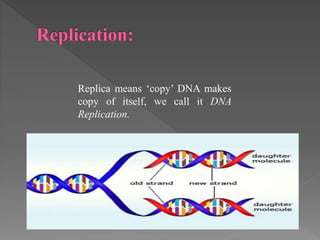
Replica means ‘copy’ DNA makes
copy of itself, we call it DNA
Replication.
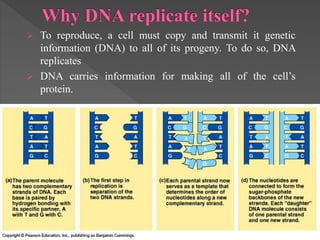
 To reproduce, a cell must copy and transmit it genetic
information (DNA) to all of its progeny. To do so, DNA
replicates
 DNA carries information for making all of the cell’s
protein.
Replication facts
Different type of cells replicated their DNA
at different rates
Hair cells, finger nails, bone marrow cells
constantly divide
Cells of brain, heart and muscles cell go
through several rounds of cell division and
stops.
Skin cells and liver cells stop dividing but
can be induced to divide to repair injury
Classical models For DNA
replication
 In this model the two parental DNA strands are back together after replication has
occurred. That is one daughter molecule contains both parental DNA strands and
other daughter molecule contains DNA strands of all newly synthesized material.
SEMICONSERVATIVE MODEL
 In this model two parental DNA strands separate and each of those strands then
serves as a template for the synthesis of a new DNA strand. The result is two DNA
double helices, both of which consist of one parental and one new strand.
DISPERSIVE MODEL
 In this model the parental double helix is broken into double stranded DNA
segments that, as for the conservative model, act as a template for the synthesis f
new double helix model. The segments then reassemble into complete DNA double
helices, each with parental and progeny DNA segment interspersed.
 DNA template
 Free 3’-OH group
 Proteins of DNA replication
I. DNA Template
Template strand that is to be copied
Each old strand act as a template
2. Free 3’-OH group
 DNA helicases
 DNA single stranded binding protein
 DNA gyrase
 DNA polymerase
 Primase
 DNA ligase
 Helicase: Separates the two strands.
 DNA single stranded binding proteins:
Bind to DNA as a tetramer and stabilize the
single stranded structure that is generated by
the action of helicases. Replication is 100
time faster when these proteins are attached
to the single stranded DNA.
 DNA gryase: This enzyme catalyzes the
formation of negative supercoils that is
thought to aid with the unwinding process.
 Primase: The requirement for a free 3’ hydroxyl
group is fulfilled by the RNA primers that are
synthesized at the initiation sites by these enzymes.
 DNA Ligase: forms a covalent phoshphodiester
linkage between 3’-hydroxyl and 5’-phosphate group.
 DNA polymerase: requires an RNA or DNA primer
(RNA primer in eukaryotes)
 Reads DNA template in a 3’5’ direction only.
 Synthesize new strand in 5’3’ direction only.
 Adds 5 phosphate to 3’ hydroxyl group
 It replicates from 3’ to 5’ of the template strand
 From 5’ to 3’ of the newly growing strand.
 Initiation
 Elongation
 Termination
 The first major step for the DNA replication is the breaking
of hydrogen bond between the bases of two antiparallel
strands
 Helicase is the enzyme that separate the two strands.
 One of the most important step of DNA is the binding of
RNA primase in the initiation point of the 3’ 5’ parent chain
 RNA nucleotides are the primers for the binding of DNA
nucleotides
 RNA primase lays down primers
 Replication starts at the primer and lay down nucleotide 5’ to 3’
 Leading strand goes continuously, lagging strands goes
discontinuously.
 The elongation process is different from the 5’3’ and 3’ 5’ template
 5’ 3’ template: the 3 5 preceding daughter strand that uses a 5 3
template is called leading strand because DNA polymerase a can ‘read’
the template and continuously adds nucleotides(complementary to the
nucleotides of the template, for example adenine opposite thymine etc.
 Leading strand synthesis is continuous
 From 3’ to 5’ of the template
 5’ 3’ template: the 5’ 3’ template cannot be read by DNA polymerase
 The replication of this template is complicated and the new strand is called
lagging strand in the lagging strand the RNA primase adds more RNA
primers. DNA polymerase a reads the template and lengthens the bursts the
gape between two RNA is called as Okazaki fragments
LAGGING STRANDS
Lagging strands synthesis is discontinuous
Okazaki fragments
Ligase joins discontinuous fragments.
 In the lagging strand the DNA pol 1 exonuclease reads the fragments
and remove the RNA primers. The gaps are closed with the action of
DNA polymerase (adds complementary nucleotides to the gap) and
DNA ligase (adds phosphate in the remaining gaps of the phosphate-
sugar backbone).
 The last step of DNA Replication is Termination.
 RNA primer is removed, replaced with DNA nucleotide.
 DNA ligase join okazaki fragments with phosphodiester bonds.
 Helicase rewinds DNA together.
 This process happen when the DNA polymerase reaches to an end of the
strands
 These ends of linear (chromosomal) DNA consists of noncoding DNA that
contains repeat sequences and are called telomeres.
 A part of the telomere is removed in every cycle of DNA replication.
 DNA replication is not completed before a mechanism of repair fixes possible
errors caused during the replication enzymes, like nuclease remove the wrong
nucleotide and the DNA polymerase fills the gaps.
 Proteins which binds to this sequence to physically stop DNA replication
proceeding.
DNA Replication
DNA Replication

DNA Replication

  • 2.
     In 1940svarious researches showed that DNA was the genetic material.  In early 1950s structure of DNA was determined.  James Watson and Francis Crick determined the structure of DNA in 1953.  DNA is a polynucleotide (nucleotide contains phosphate, sugar and nitrogen base)  Sugar in DNA is Deoxyribose  Four Nitrogen bases in DNA (adenine, guanine, thymine, cytosine)  DNA is double helix A is paired with T and G with C. (complementary base pairing)
  • 4.
    Replica means ‘copy’DNA makes copy of itself, we call it DNA Replication.
  • 5.
     To reproduce,a cell must copy and transmit it genetic information (DNA) to all of its progeny. To do so, DNA replicates  DNA carries information for making all of the cell’s protein.
  • 6.
  • 7.
    Different type ofcells replicated their DNA at different rates Hair cells, finger nails, bone marrow cells constantly divide Cells of brain, heart and muscles cell go through several rounds of cell division and stops. Skin cells and liver cells stop dividing but can be induced to divide to repair injury
  • 8.
    Classical models ForDNA replication
  • 9.
     In thismodel the two parental DNA strands are back together after replication has occurred. That is one daughter molecule contains both parental DNA strands and other daughter molecule contains DNA strands of all newly synthesized material. SEMICONSERVATIVE MODEL  In this model two parental DNA strands separate and each of those strands then serves as a template for the synthesis of a new DNA strand. The result is two DNA double helices, both of which consist of one parental and one new strand. DISPERSIVE MODEL  In this model the parental double helix is broken into double stranded DNA segments that, as for the conservative model, act as a template for the synthesis f new double helix model. The segments then reassemble into complete DNA double helices, each with parental and progeny DNA segment interspersed.
  • 10.
     DNA template Free 3’-OH group  Proteins of DNA replication I. DNA Template Template strand that is to be copied Each old strand act as a template 2. Free 3’-OH group
  • 12.
     DNA helicases DNA single stranded binding protein  DNA gyrase  DNA polymerase  Primase  DNA ligase
  • 13.
     Helicase: Separatesthe two strands.  DNA single stranded binding proteins: Bind to DNA as a tetramer and stabilize the single stranded structure that is generated by the action of helicases. Replication is 100 time faster when these proteins are attached to the single stranded DNA.  DNA gryase: This enzyme catalyzes the formation of negative supercoils that is thought to aid with the unwinding process.
  • 14.
     Primase: Therequirement for a free 3’ hydroxyl group is fulfilled by the RNA primers that are synthesized at the initiation sites by these enzymes.  DNA Ligase: forms a covalent phoshphodiester linkage between 3’-hydroxyl and 5’-phosphate group.  DNA polymerase: requires an RNA or DNA primer (RNA primer in eukaryotes)  Reads DNA template in a 3’5’ direction only.  Synthesize new strand in 5’3’ direction only.  Adds 5 phosphate to 3’ hydroxyl group
  • 15.
     It replicatesfrom 3’ to 5’ of the template strand  From 5’ to 3’ of the newly growing strand.
  • 16.
  • 17.
     The firstmajor step for the DNA replication is the breaking of hydrogen bond between the bases of two antiparallel strands  Helicase is the enzyme that separate the two strands.  One of the most important step of DNA is the binding of RNA primase in the initiation point of the 3’ 5’ parent chain  RNA nucleotides are the primers for the binding of DNA nucleotides
  • 18.
     RNA primaselays down primers  Replication starts at the primer and lay down nucleotide 5’ to 3’  Leading strand goes continuously, lagging strands goes discontinuously.  The elongation process is different from the 5’3’ and 3’ 5’ template  5’ 3’ template: the 3 5 preceding daughter strand that uses a 5 3 template is called leading strand because DNA polymerase a can ‘read’ the template and continuously adds nucleotides(complementary to the nucleotides of the template, for example adenine opposite thymine etc.
  • 19.
     Leading strandsynthesis is continuous  From 3’ to 5’ of the template
  • 20.
     5’ 3’template: the 5’ 3’ template cannot be read by DNA polymerase  The replication of this template is complicated and the new strand is called lagging strand in the lagging strand the RNA primase adds more RNA primers. DNA polymerase a reads the template and lengthens the bursts the gape between two RNA is called as Okazaki fragments LAGGING STRANDS Lagging strands synthesis is discontinuous Okazaki fragments Ligase joins discontinuous fragments.
  • 21.
     In thelagging strand the DNA pol 1 exonuclease reads the fragments and remove the RNA primers. The gaps are closed with the action of DNA polymerase (adds complementary nucleotides to the gap) and DNA ligase (adds phosphate in the remaining gaps of the phosphate- sugar backbone).
  • 22.
     The laststep of DNA Replication is Termination.  RNA primer is removed, replaced with DNA nucleotide.  DNA ligase join okazaki fragments with phosphodiester bonds.  Helicase rewinds DNA together.  This process happen when the DNA polymerase reaches to an end of the strands  These ends of linear (chromosomal) DNA consists of noncoding DNA that contains repeat sequences and are called telomeres.  A part of the telomere is removed in every cycle of DNA replication.  DNA replication is not completed before a mechanism of repair fixes possible errors caused during the replication enzymes, like nuclease remove the wrong nucleotide and the DNA polymerase fills the gaps.  Proteins which binds to this sequence to physically stop DNA replication proceeding.