Arvind Singh Heer
M.Sc -Analytical Chemistry
MITHIBAI COLLEGE
X-RAY DIFFRACTION
What is X-ray Diffraction?
 Diffraction occurs when each object in a periodic
array scatters radiation coherently, producing
concerted constructive interference at specific angles.
 Crystalline substances (e.g. minerals) consist of
parallel rows of atoms separated by a ‘unique’
distance, d.
 Diffraction occurs when radiation enters a crystalline
substance and is scattered
 Direction and intensity of diffraction depends on
orientation of crystal lattice with radiation
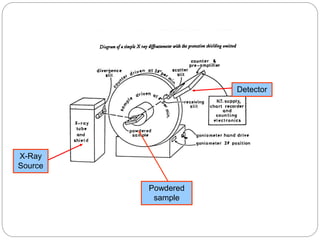
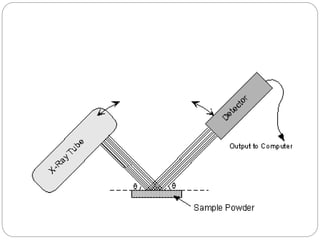
Schematic X-Ray Diffractometer
X-Ray
Source
Powdered
sample
Detector
Bragg Law
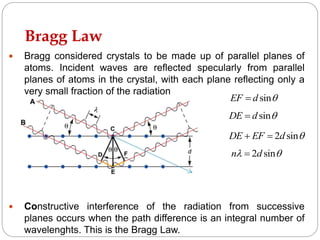
 Bragg considered crystals to be made up of parallel planes of
atoms. Incident waves are reflected specularly from parallel
planes of atoms in the crystal, with each plane reflecting only a
very small fraction of the radiation
 Constructive interference of the radiation from successive
planes occurs when the path difference is an integral number of
wavelenghts. This is the Bragg Law.
sinEF d 
sinDE d 
2 sinDE EF d  
2 sinn d 
Bragg Equation
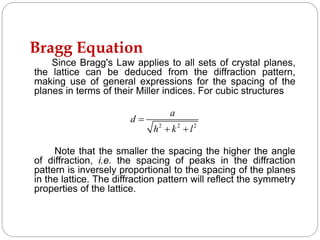
Since Bragg's Law applies to all sets of crystal planes,
the lattice can be deduced from the diffraction pattern,
making use of general expressions for the spacing of the
planes in terms of their Miller indices. For cubic structures
Note that the smaller the spacing the higher the angle
of diffraction, i.e. the spacing of peaks in the diffraction
pattern is inversely proportional to the spacing of the planes
in the lattice. The diffraction pattern will reflect the symmetry
properties of the lattice.
2 2 2
a
d
h k l

 
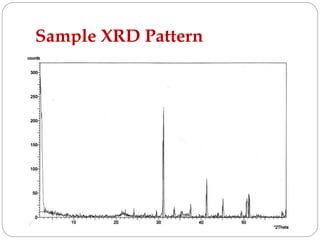
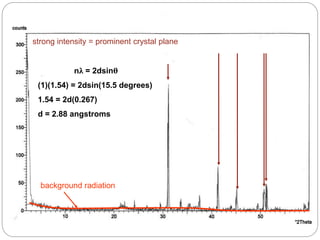
Sample XRD Pattern
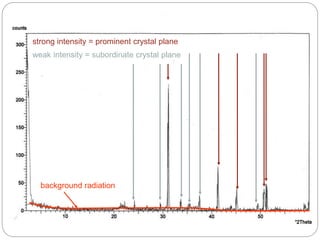
background radiation
strong intensity = prominent crystal plane
weak intensity = subordinate crystal plane
background radiation
strong intensity = prominent crystal plane
nλ = 2dsinθ
(1)(1.54) = 2dsin(15.5 degrees)
1.54 = 2d(0.267)
d = 2.88 angstroms
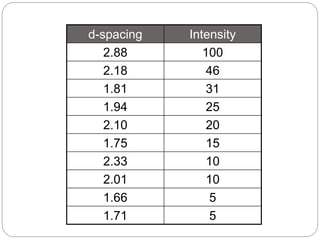
d-spacing Intensity
2.88 100
2.18 46
1.81 31
1.94 25
2.10 20
1.75 15
2.33 10
2.01 10
1.66 5
1.71 5
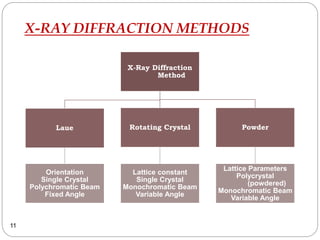
X-RAY DIFFRACTION METHODS
X-Ray Diffraction
Method
Laue
Orientation
Single Crystal
Polychromatic Beam
Fixed Angle
Rotating Crystal
Lattice constant
Single Crystal
Monochromatic Beam
Variable Angle
Powder
Lattice Parameters
Polycrystal
(powdered)
Monochromatic Beam
Variable Angle
11
Crystal structure determination by
Laue method
• The symmetry of the spot pattern reflects the
symmetry of the crystal when viewed along the
direction of the incident beam.
• Laue method is often used to determine the
orientation of single crystals by means of
illuminating the crystal with a continuos spectrum
of X-rays
• Although the Laue method can also be used to
determine the crystal structure, several wavelengths
can reflect in different orders from the same set of
planes, with the different order reflections
superimposed on the same spot in the film. This12
ROTATING CRYSTAL METHOD
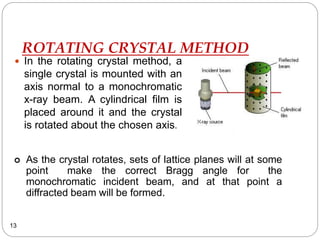
 In the rotating crystal method, a
single crystal is mounted with an
axis normal to a monochromatic
x-ray beam. A cylindrical film is
placed around it and the crystal
is rotated about the chosen axis.
13
 As the crystal rotates, sets of lattice planes will at some
point make the correct Bragg angle for the
monochromatic incident beam, and at that point a
diffracted beam will be formed.
ROTATING CRYSTAL METHOD
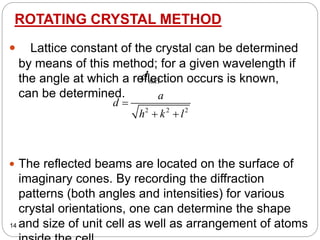
 Lattice constant of the crystal can be determined
by means of this method; for a given wavelength if
the angle at which a reflection occurs is known,
can be determined.
 The reflected beams are located on the surface of
imaginary cones. By recording the diffraction
patterns (both angles and intensities) for various
crystal orientations, one can determine the shape
and size of unit cell as well as arrangement of atoms
2 2 2
a
d
h k l

 
14
hkld
THE POWDER METHOD
 If a powdered specimen is used, instead of a
single crystal, then there is no need to rotate the
specimen, because there will always be some
crystals at an orientation for which diffraction is
permitted. Here a monochromatic X-ray beam is
incident on a powdered or polycrystalline sample.
 This method is useful for samples that are
difficult to obtain in single crystal form.
15
 The powder method is used to determine the value of
the lattice parameters accurately. Lattice parameters are
the magnitudes of the unit vectors a, b and c which
define the unit cell for the crystal.
 For every set of crystal planes, by chance, one or
more crystals will be in the correct orientation to give
the correct Bragg angle to satisfy Bragg's equation.
Every crystal plane is thus capable of diffraction. Each
diffraction line is made up of a large number of small
spots, each from a separate crystal. Each spot is so
small as to give the appearance of a continuous line.16
DEBYE SCHERRER METHOD
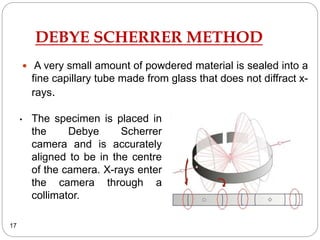
 A very small amount of powdered material is sealed into a
fine capillary tube made from glass that does not diffract x-
rays.
17
• The specimen is placed in
the Debye Scherrer
camera and is accurately
aligned to be in the centre
of the camera. X-rays enter
the camera through a
collimator.
Debye Scherrer Camera
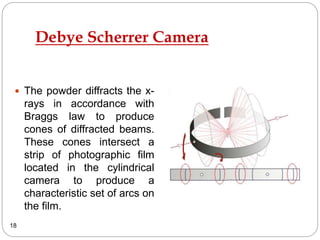
 The powder diffracts the x-
rays in accordance with
Braggs law to produce
cones of diffracted beams.
These cones intersect a
strip of photographic film
located in the cylindrical
camera to produce a
characteristic set of arcs on
the film.
18
Powder diffraction film
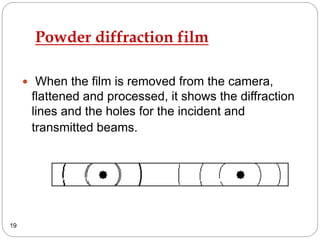
 When the film is removed from the camera,
flattened and processed, it shows the diffraction
lines and the holes for the incident and
transmitted beams.
19
XRD Technique
 Takes a sample of the material and places a powdered
sample which is then illuminated with x-rays of a fixed
wave-length.
 The intensity of the reflected radiation is recorded using
a goniometer.
 The data is analyzed for the reflection angle to calculate
the inter-atomic spacing.
 The intensity is measured to discriminate the various D
spacing and the results are compared to known data to
identify possible matches.
Powdering Samples
 The samples are powdered to give a random
sampling of ALL atomic planes (crystal faces)
 Statistically accurate given samples are
powdered finely AND randomly oriented on
sample holder
 Intensities are a reflection of d-spacing abundance
 Problems arise with minerals that may
preferentially orient on sample holder
 Micas and clays have special preparation
techniques
Factors that affect XRD data
 Sample not powdered fine enough
 May not give all d-spacing data (not random
enough)
 Analysis too fast (degrees/minute)
 May not give accurate peak data
 Mixture of minerals??
 Not crystalline – glass!!
Applications of XRD
1. Differentiation between crystalline and amorphous
materials;
2. Determination of the structure of crystalline materials;
3. Determination of electron distribution within the atoms, and
throughout the unit cell;
4. Determination of the orientation of single crystals;
5. Determination of the texture of polygrained materials;
6. Measurement of strain and small grain size…..etc
23
• XRD is a nondestructive technique. Some of the uses of x-ray
diffraction are;
Applications of XRD
 Unknown mineral ID
 Solid solution ID (e.g. feldspars, olivine)
 Mixtures of minerals
 Clay analyses
 Zeolites
 Crystallographic applications
 Material Science

X ray diffraction

  • 1.
    Arvind Singh Heer M.Sc-Analytical Chemistry MITHIBAI COLLEGE X-RAY DIFFRACTION
  • 2.
    What is X-rayDiffraction?  Diffraction occurs when each object in a periodic array scatters radiation coherently, producing concerted constructive interference at specific angles.  Crystalline substances (e.g. minerals) consist of parallel rows of atoms separated by a ‘unique’ distance, d.  Diffraction occurs when radiation enters a crystalline substance and is scattered  Direction and intensity of diffraction depends on orientation of crystal lattice with radiation
  • 3.
  • 5.
    Bragg Law  Braggconsidered crystals to be made up of parallel planes of atoms. Incident waves are reflected specularly from parallel planes of atoms in the crystal, with each plane reflecting only a very small fraction of the radiation  Constructive interference of the radiation from successive planes occurs when the path difference is an integral number of wavelenghts. This is the Bragg Law. sinEF d  sinDE d  2 sinDE EF d   2 sinn d 
  • 6.
    Bragg Equation Since Bragg'sLaw applies to all sets of crystal planes, the lattice can be deduced from the diffraction pattern, making use of general expressions for the spacing of the planes in terms of their Miller indices. For cubic structures Note that the smaller the spacing the higher the angle of diffraction, i.e. the spacing of peaks in the diffraction pattern is inversely proportional to the spacing of the planes in the lattice. The diffraction pattern will reflect the symmetry properties of the lattice. 2 2 2 a d h k l   
  • 7.
  • 8.
    background radiation strong intensity= prominent crystal plane weak intensity = subordinate crystal plane
  • 9.
    background radiation strong intensity= prominent crystal plane nλ = 2dsinθ (1)(1.54) = 2dsin(15.5 degrees) 1.54 = 2d(0.267) d = 2.88 angstroms
  • 10.
    d-spacing Intensity 2.88 100 2.1846 1.81 31 1.94 25 2.10 20 1.75 15 2.33 10 2.01 10 1.66 5 1.71 5
  • 11.
    X-RAY DIFFRACTION METHODS X-RayDiffraction Method Laue Orientation Single Crystal Polychromatic Beam Fixed Angle Rotating Crystal Lattice constant Single Crystal Monochromatic Beam Variable Angle Powder Lattice Parameters Polycrystal (powdered) Monochromatic Beam Variable Angle 11
  • 12.
    Crystal structure determinationby Laue method • The symmetry of the spot pattern reflects the symmetry of the crystal when viewed along the direction of the incident beam. • Laue method is often used to determine the orientation of single crystals by means of illuminating the crystal with a continuos spectrum of X-rays • Although the Laue method can also be used to determine the crystal structure, several wavelengths can reflect in different orders from the same set of planes, with the different order reflections superimposed on the same spot in the film. This12
  • 13.
    ROTATING CRYSTAL METHOD In the rotating crystal method, a single crystal is mounted with an axis normal to a monochromatic x-ray beam. A cylindrical film is placed around it and the crystal is rotated about the chosen axis. 13  As the crystal rotates, sets of lattice planes will at some point make the correct Bragg angle for the monochromatic incident beam, and at that point a diffracted beam will be formed.
  • 14.
    ROTATING CRYSTAL METHOD Lattice constant of the crystal can be determined by means of this method; for a given wavelength if the angle at which a reflection occurs is known, can be determined.  The reflected beams are located on the surface of imaginary cones. By recording the diffraction patterns (both angles and intensities) for various crystal orientations, one can determine the shape and size of unit cell as well as arrangement of atoms 2 2 2 a d h k l    14 hkld
  • 15.
    THE POWDER METHOD If a powdered specimen is used, instead of a single crystal, then there is no need to rotate the specimen, because there will always be some crystals at an orientation for which diffraction is permitted. Here a monochromatic X-ray beam is incident on a powdered or polycrystalline sample.  This method is useful for samples that are difficult to obtain in single crystal form. 15
  • 16.
     The powdermethod is used to determine the value of the lattice parameters accurately. Lattice parameters are the magnitudes of the unit vectors a, b and c which define the unit cell for the crystal.  For every set of crystal planes, by chance, one or more crystals will be in the correct orientation to give the correct Bragg angle to satisfy Bragg's equation. Every crystal plane is thus capable of diffraction. Each diffraction line is made up of a large number of small spots, each from a separate crystal. Each spot is so small as to give the appearance of a continuous line.16
  • 17.
    DEBYE SCHERRER METHOD A very small amount of powdered material is sealed into a fine capillary tube made from glass that does not diffract x- rays. 17 • The specimen is placed in the Debye Scherrer camera and is accurately aligned to be in the centre of the camera. X-rays enter the camera through a collimator.
  • 18.
    Debye Scherrer Camera The powder diffracts the x- rays in accordance with Braggs law to produce cones of diffracted beams. These cones intersect a strip of photographic film located in the cylindrical camera to produce a characteristic set of arcs on the film. 18
  • 19.
    Powder diffraction film When the film is removed from the camera, flattened and processed, it shows the diffraction lines and the holes for the incident and transmitted beams. 19
  • 20.
    XRD Technique  Takesa sample of the material and places a powdered sample which is then illuminated with x-rays of a fixed wave-length.  The intensity of the reflected radiation is recorded using a goniometer.  The data is analyzed for the reflection angle to calculate the inter-atomic spacing.  The intensity is measured to discriminate the various D spacing and the results are compared to known data to identify possible matches.
  • 21.
    Powdering Samples  Thesamples are powdered to give a random sampling of ALL atomic planes (crystal faces)  Statistically accurate given samples are powdered finely AND randomly oriented on sample holder  Intensities are a reflection of d-spacing abundance  Problems arise with minerals that may preferentially orient on sample holder  Micas and clays have special preparation techniques
  • 22.
    Factors that affectXRD data  Sample not powdered fine enough  May not give all d-spacing data (not random enough)  Analysis too fast (degrees/minute)  May not give accurate peak data  Mixture of minerals??  Not crystalline – glass!!
  • 23.
    Applications of XRD 1.Differentiation between crystalline and amorphous materials; 2. Determination of the structure of crystalline materials; 3. Determination of electron distribution within the atoms, and throughout the unit cell; 4. Determination of the orientation of single crystals; 5. Determination of the texture of polygrained materials; 6. Measurement of strain and small grain size…..etc 23 • XRD is a nondestructive technique. Some of the uses of x-ray diffraction are;
  • 24.
    Applications of XRD Unknown mineral ID  Solid solution ID (e.g. feldspars, olivine)  Mixtures of minerals  Clay analyses  Zeolites  Crystallographic applications  Material Science