Principle and application of
             DSC,DTA,FTIR and X-ray
                     diffraction
                                1

                   GUIDED BY:. VAISHALI THAKKAR
                    PREPARED BY:KARTIK DUDHAT
                     ANAND PHARMACY COLLEGE


ANAND PHARMACY COLLEGE, ANAND
ROLE OF THERMAL ANALYSIS IN
            PREFORMULATION
                                      2

 They are unique methods in the field of polymer analysis & of high
  value for a solid state analysis.

 They finds wide application in
     Detection of impurity
     Determination of moisture content in any drug substance or any
      excipient
     Study of polymorphism
     Characterization of hydrates & solvates
     Degree of Crystallinity
     Study of phase diagram
     Drug excipient compatibility study
     Study of complexation


ANAND PHARMACY COLLEGE, ANAND
2)Differential Thermal analysis (DTA)
                                         3

 PRINCIPLE: A Technique in which the temperature difference between a
  substance and reference material is measured as a function of temperature,
  while the substance and reference are subjected to a controlled temperature
  programme.

 the Difference in temperature is called as Differential temp(∆t) is plotted
  against temp. or a function of time.

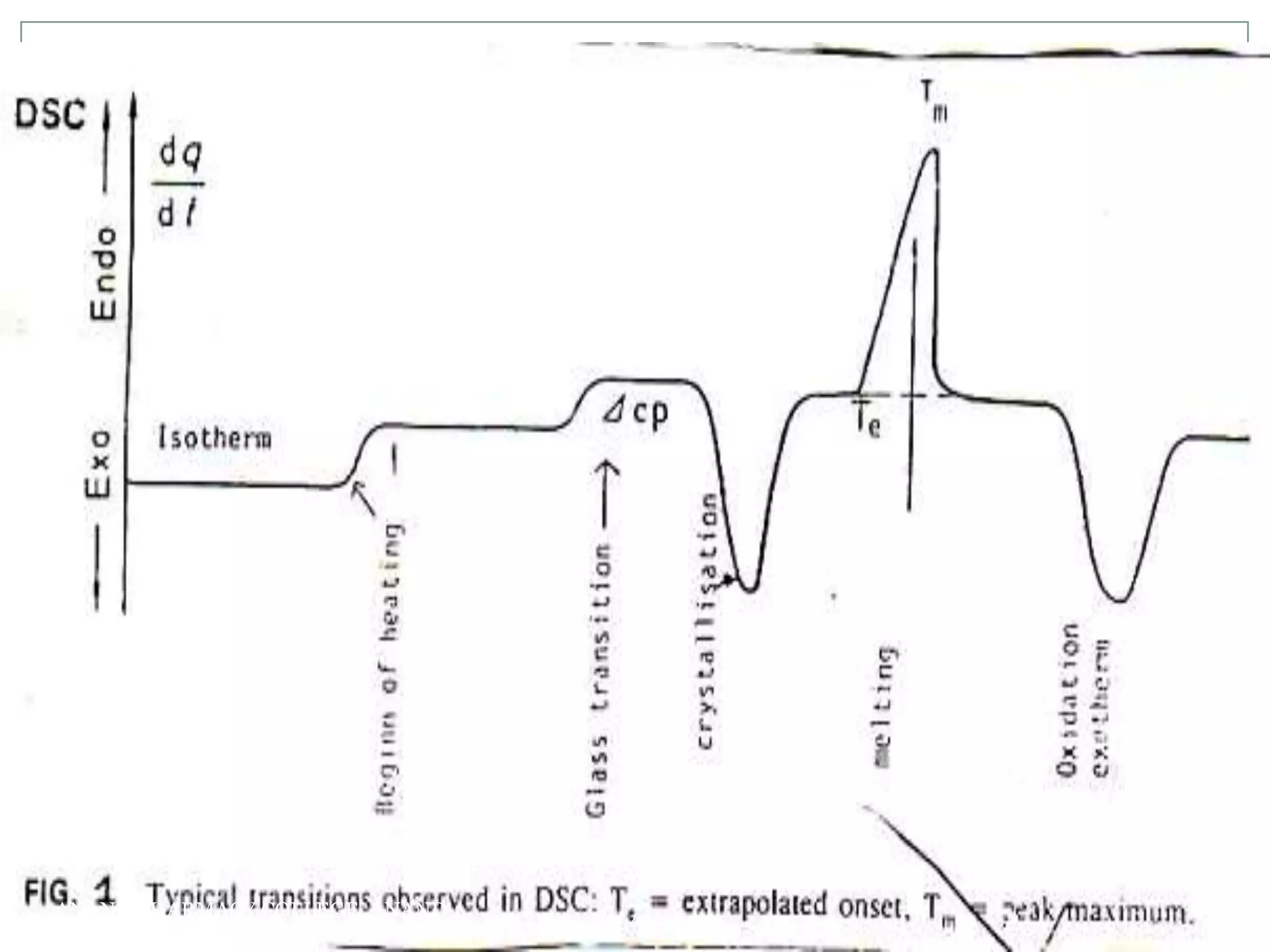
 Physical changes usually result in Endothermic peak ,whereas chemical
  reactions those of an oxidative nature are exothermic.

 Endothermic reaction (absorption of energy) includes vaporization,
  sublimation, and absorption & gives downward peak.
       Exothermic reaction (liberation of energy) includes oxidation,
  polymerization, and catalytic reaction & gives upward peak.


ANAND PHARMACY COLLEGE, ANAND
3) Differential scanning calorimetry
                                  4

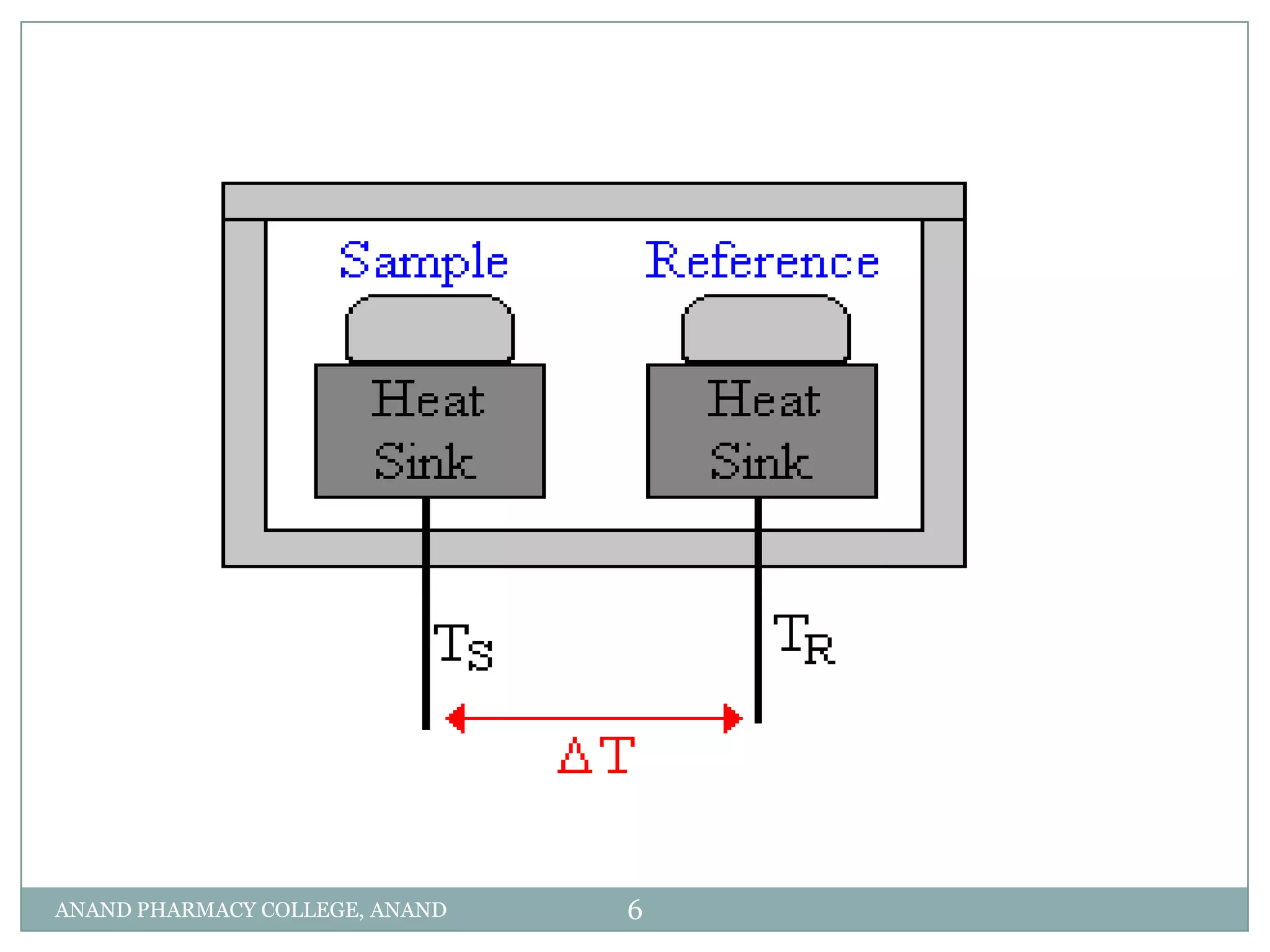
 PRINCIPLE: It is a technique in which the energy necessary to
    establish a zero temp. difference between the sample &
    reference material is measured as a function of temp.

 Here, sample & reference material are heated by separate
    heaters in such a way that their temp are kept equal while
    these temp. are increased or decreased linearly.

 Endothermic reaction: if sample absorbs some amount of
  heat during phase transition then reaction is said to be
  endothermic. In endothermic reaction more energy needed to
  maintain zero temp difference between sample & reference.
 E.g. Melting, boiling, sublimation, vaporization, desolvation.



ANAND PHARMACY COLLEGE, ANAND
5

 Exothermic reaction: if sample released some amount of
  heat during phase transition, then reaction is said to be
  exothermic. In exothermic reaction, less energy needed to
  maintain zero temp difference between sample & reference.
   E.g crystallization, degradation, polymerization.
 DSC Is widely used to measure glass transition temp &
  characterization of polymer.
 Glass Transition temp(Tg): Temp at which an
  amorphous polymer or an amorphous part of crystalline
  polymer goes from hard ,brittle state to soft,Rubbery state.


ANAND PHARMACY COLLEGE, ANAND
ANAND PHARMACY COLLEGE, ANAND   6
ANAND PHARMACY COLLEGE, ANAND   7
Application of DTA AND DSC in pre
                  formulation
                                8


 Thermal analytical system can be used for
  detection of impurities in pharmaceutical
  ingredient by recording Thermogram & DTA
  or DSC curves. This curves could be then be
  compared with the curve of reference standard .
  Any abnormal mass changes on TG curve &
  irregular endotherm or exotherm peaks on
  DTA or DSC curve would indicate the presence of
  impurity.


ANAND PHARMACY COLLEGE, ANAND
 The all thermodynamic parameter in the polymorphism
  substance is different like melting, sublimation temperature,
  kinetics, stability, solubility, heat capacity, crystal hardness &
  shape which are extremely important for the dosages form.

 During preformulation, it is important to identify the polymorph
  that are stable & also imp. to determine whether polymorphic
  transition are possible within the temp. range used for stability
  studies, processing (drying, milling, mixing. granulation etc.) &
  storage.

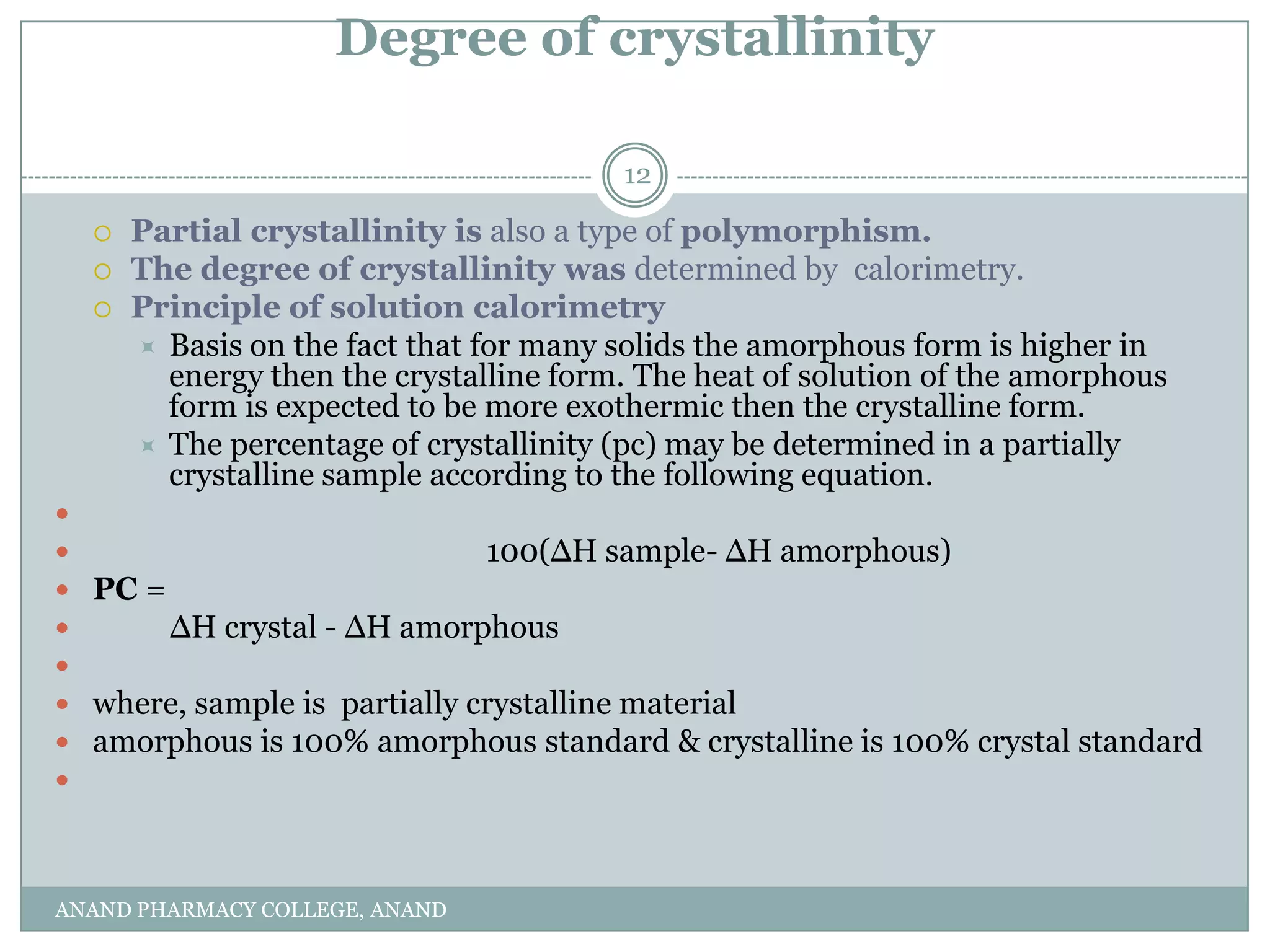
 Eg. Mannitol occurs in four forms, all melting at the same
  temp. & they are non hygroscopic, only form B shows a small
  endotherm exotherm process.


  ANAND PHARMACY COLLEGE, ANAND    9
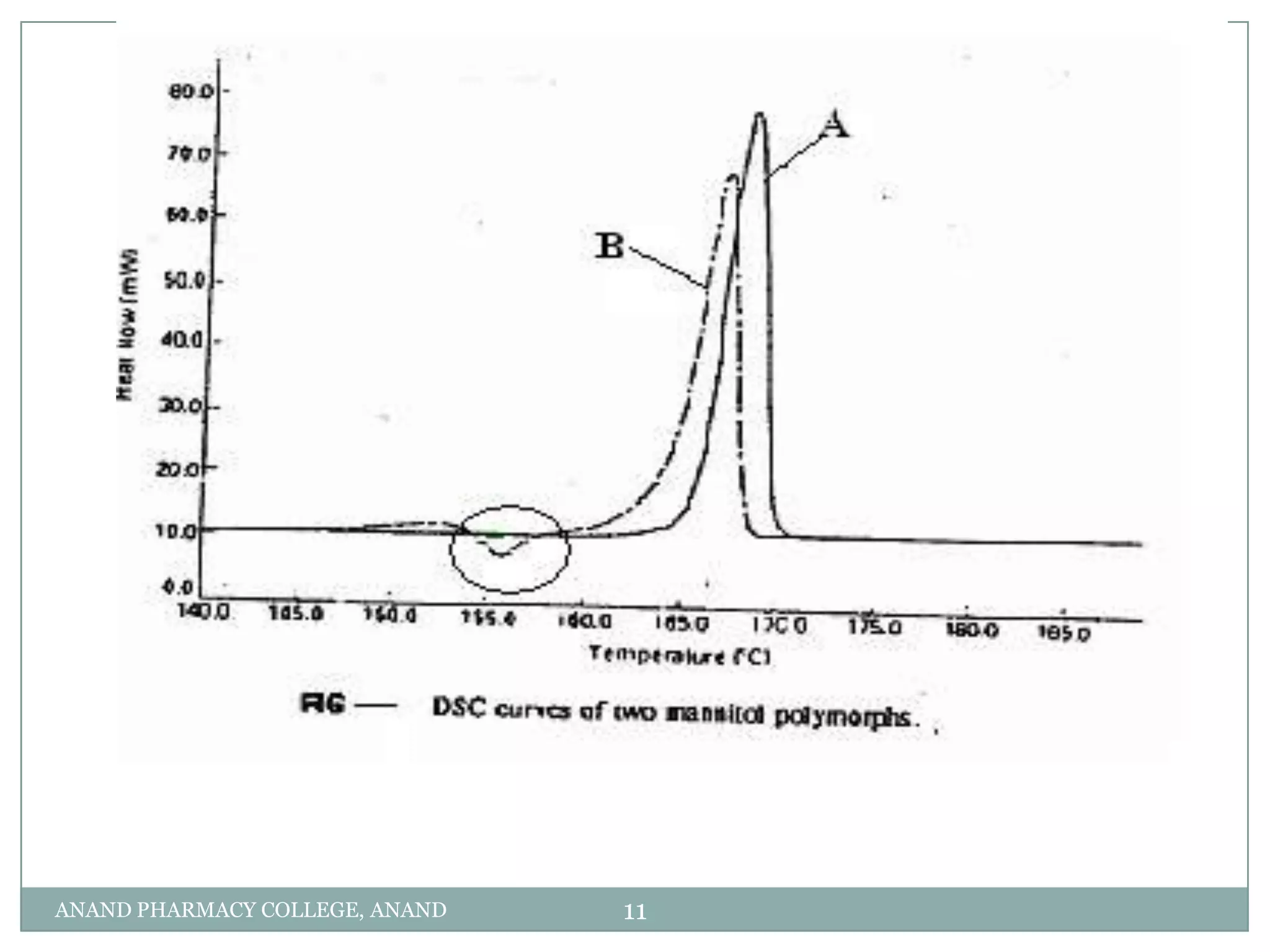
 A sharp melting endotherm indicates the relative purity
  where as broad asymmetric curve suggest impurity. The
  presence of minute amount of substance broadens its
  melting range & lowers its mp.

 Compare to other thermal methods, DSC is best method
  for detection of impurity.

 Eg. DSC of phenacetin.



  ANAND PHARMACY COLLEGE, ANAND   10
ANAND PHARMACY COLLEGE, ANAND   11
Degree of crystallinity

                                        12

     Partial crystallinity is also a type of polymorphism.
     The degree of crystallinity was determined by calorimetry.
     Principle of solution calorimetry
       Basis on the fact that for many solids the amorphous form is higher in
        energy then the crystalline form. The heat of solution of the amorphous
        form is expected to be more exothermic then the crystalline form.
       The percentage of crystallinity (pc) may be determined in a partially
        crystalline sample according to the following equation.

                             100(∆H sample- ∆H amorphous)
 PC =
      ∆H crystal - ∆H amorphous

 where, sample is partially crystalline material
 amorphous is 100% amorphous standard & crystalline is 100% crystal standard



ANAND PHARMACY COLLEGE, ANAND
COMPATIBILITY STUDY OF DRUG
            WITH EXCIPIENT.
                   13

     The early detection of Drug excipient
      Incompatibility is vital in pharmaceutical industry to
      avoid costly material wastage & time delays.

     DSC with the support of x-ray diffraction & infrared
      spectroscopy are used as screening technique for the
      compatibility testing of drug with excipient.


ANAND PHARMACY COLLEGE, ANAND
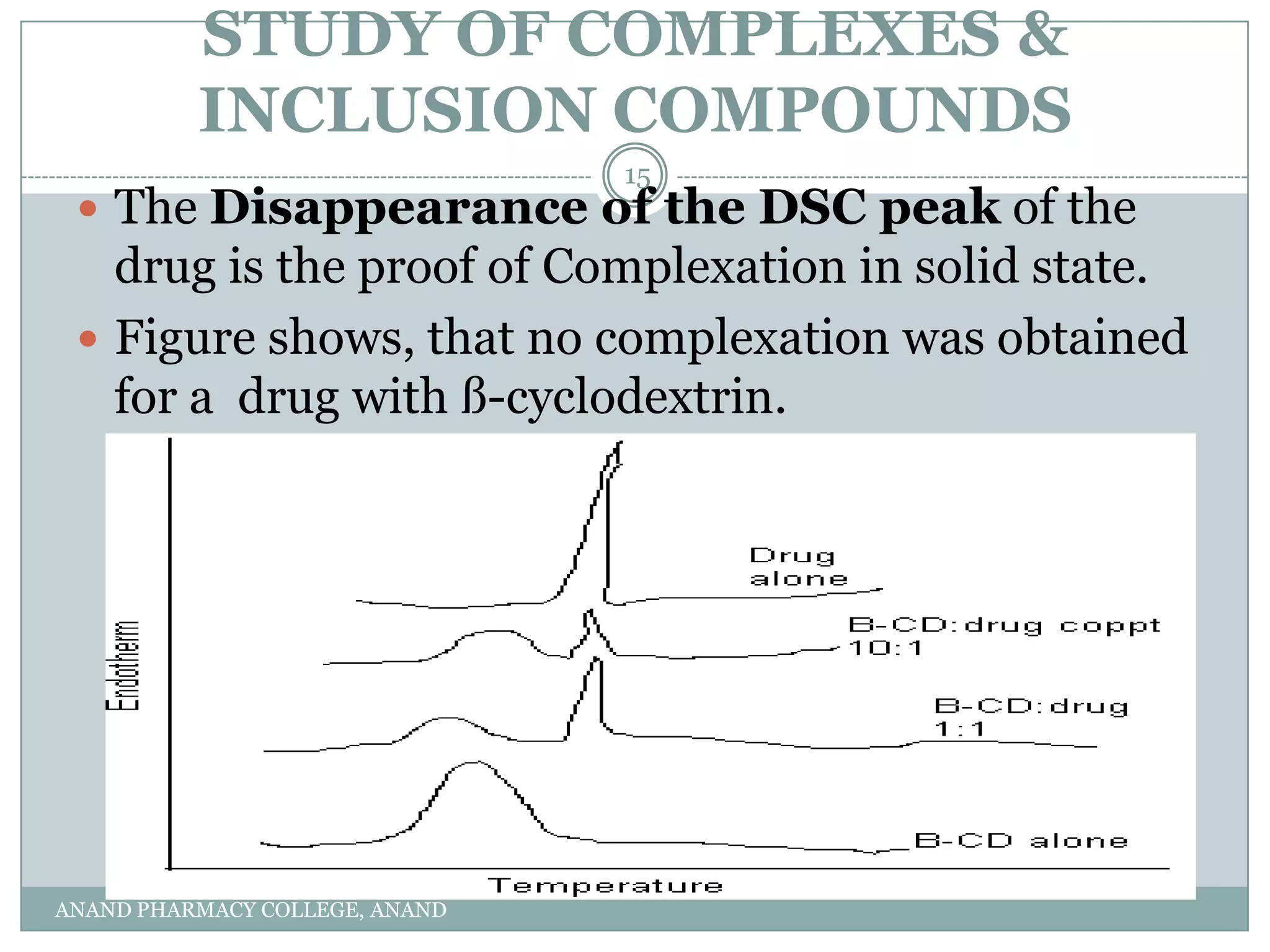
a) DSC of sparfloxacin
                               b) DSC of pvp
                 C) DSC of 1:1 physical mixture of Drug:pvp
                                 14
                 Conclusion– incompatibility
          Reason: Absence of melting endotherm & exotherm
                           isbroad.


ANAND PHARMACY COLLEGE, ANAND
STUDY OF COMPLEXES &
          INCLUSION COMPOUNDS
                                15
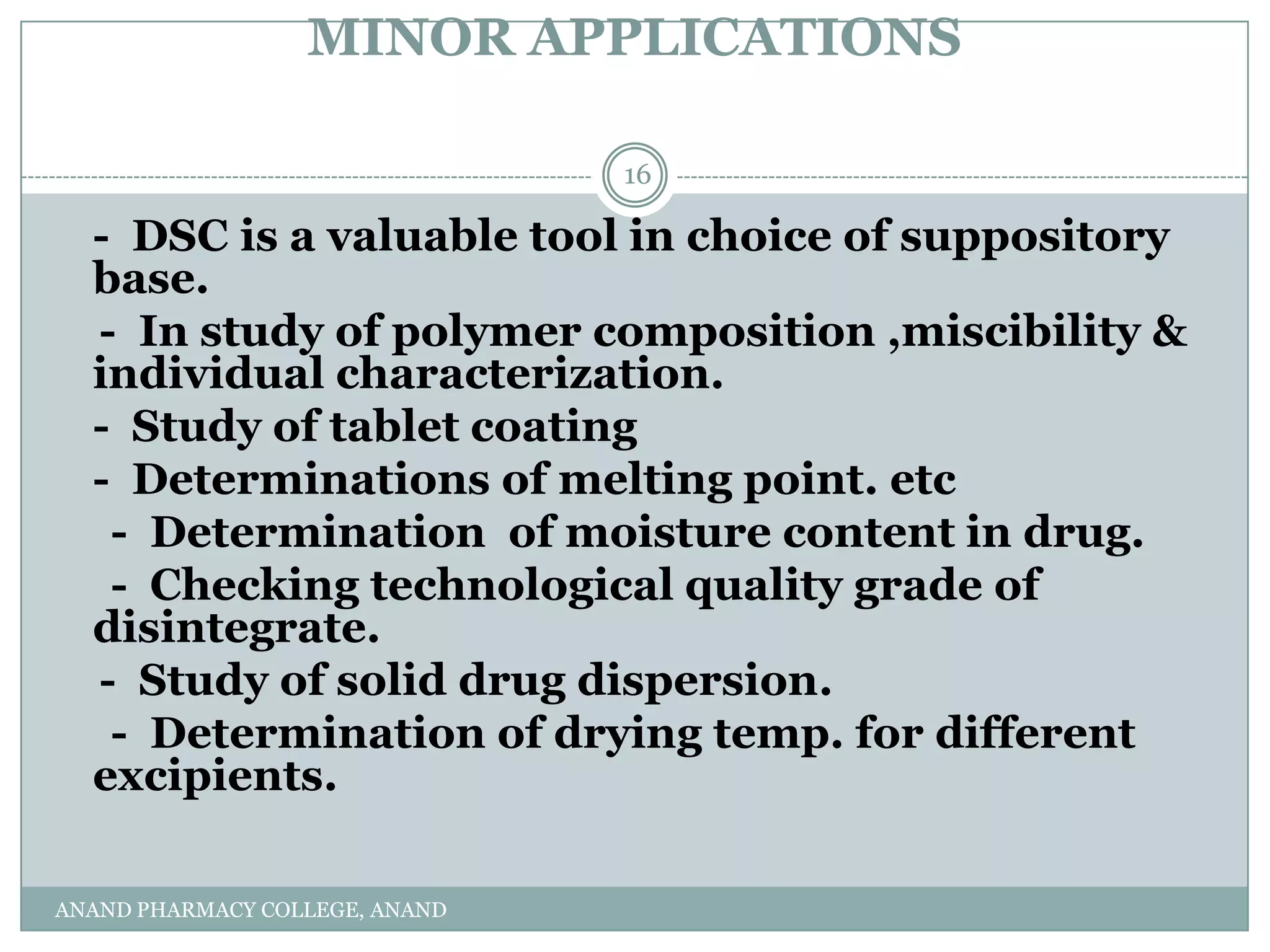
  The Disappearance of the DSC peak of the
   drug is the proof of Complexation in solid state.
  Figure shows, that no complexation was obtained
   for a drug with ß-cyclodextrin.


ANAND PHARMACY COLLEGE, ANAND
MINOR APPLICATIONS

                                16

  - DSC is a valuable tool in choice of suppository
  base.
  - In study of polymer composition ,miscibility &
  individual characterization.
  - Study of tablet coating
  - Determinations of melting point. etc
   - Determination of moisture content in drug.
   - Checking technological quality grade of
  disintegrate.
  - Study of solid drug dispersion.
   - Determination of drying temp. for different
  excipients.

ANAND PHARMACY COLLEGE, ANAND
GENERAL PRINCIPLE & APPLICATION OF
           FTIR SPECTRUM &
     X-RAY DIFFRACTION METHOD.
                   17

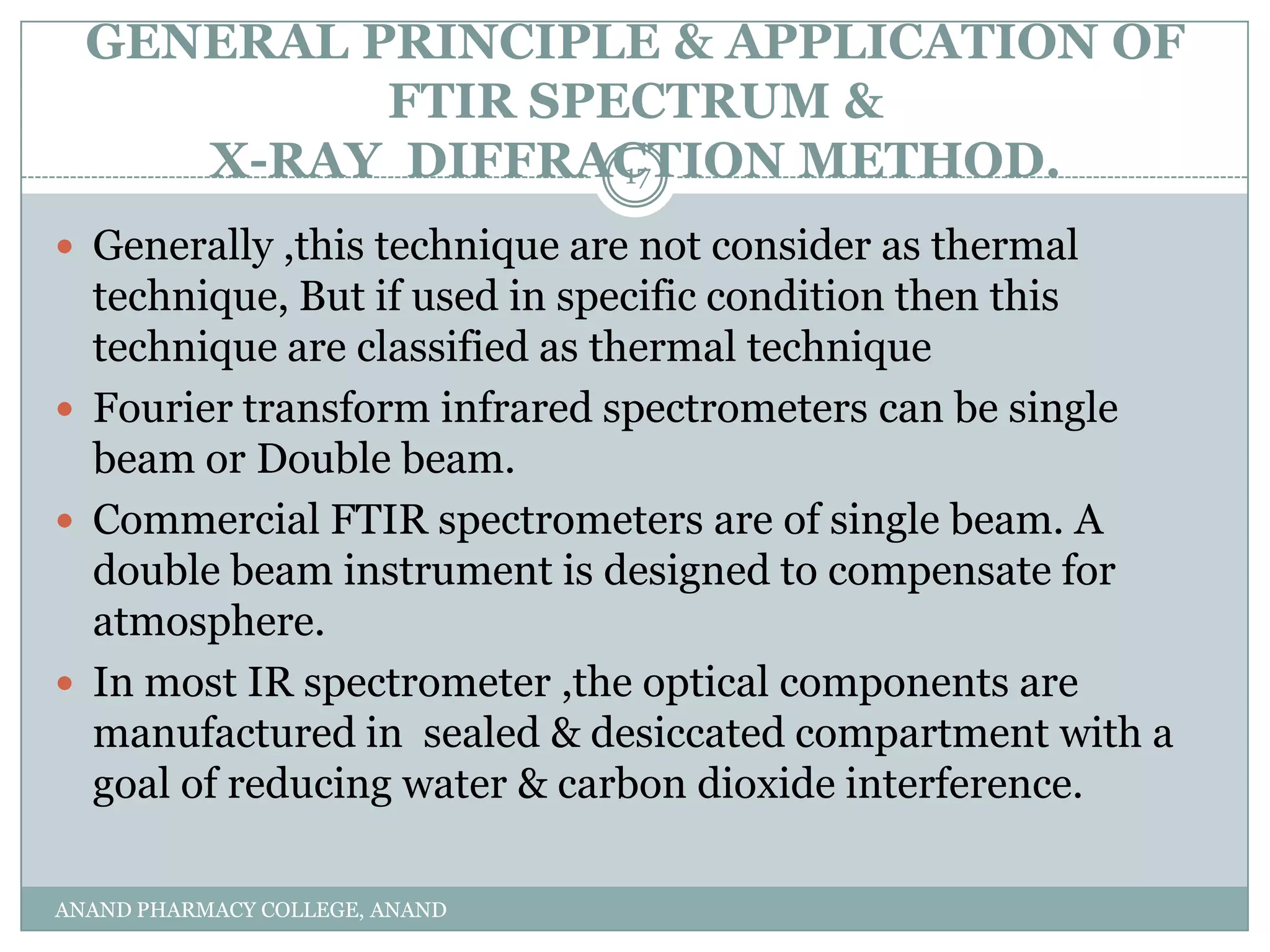
 Generally ,this technique are not consider as thermal
  technique, But if used in specific condition then this
  technique are classified as thermal technique
 Fourier transform infrared spectrometers can be single
  beam or Double beam.
 Commercial FTIR spectrometers are of single beam. A
  double beam instrument is designed to compensate for
  atmosphere.
 In most IR spectrometer ,the optical components are
  manufactured in sealed & desiccated compartment with a
  goal of reducing water & carbon dioxide interference.

ANAND PHARMACY COLLEGE, ANAND
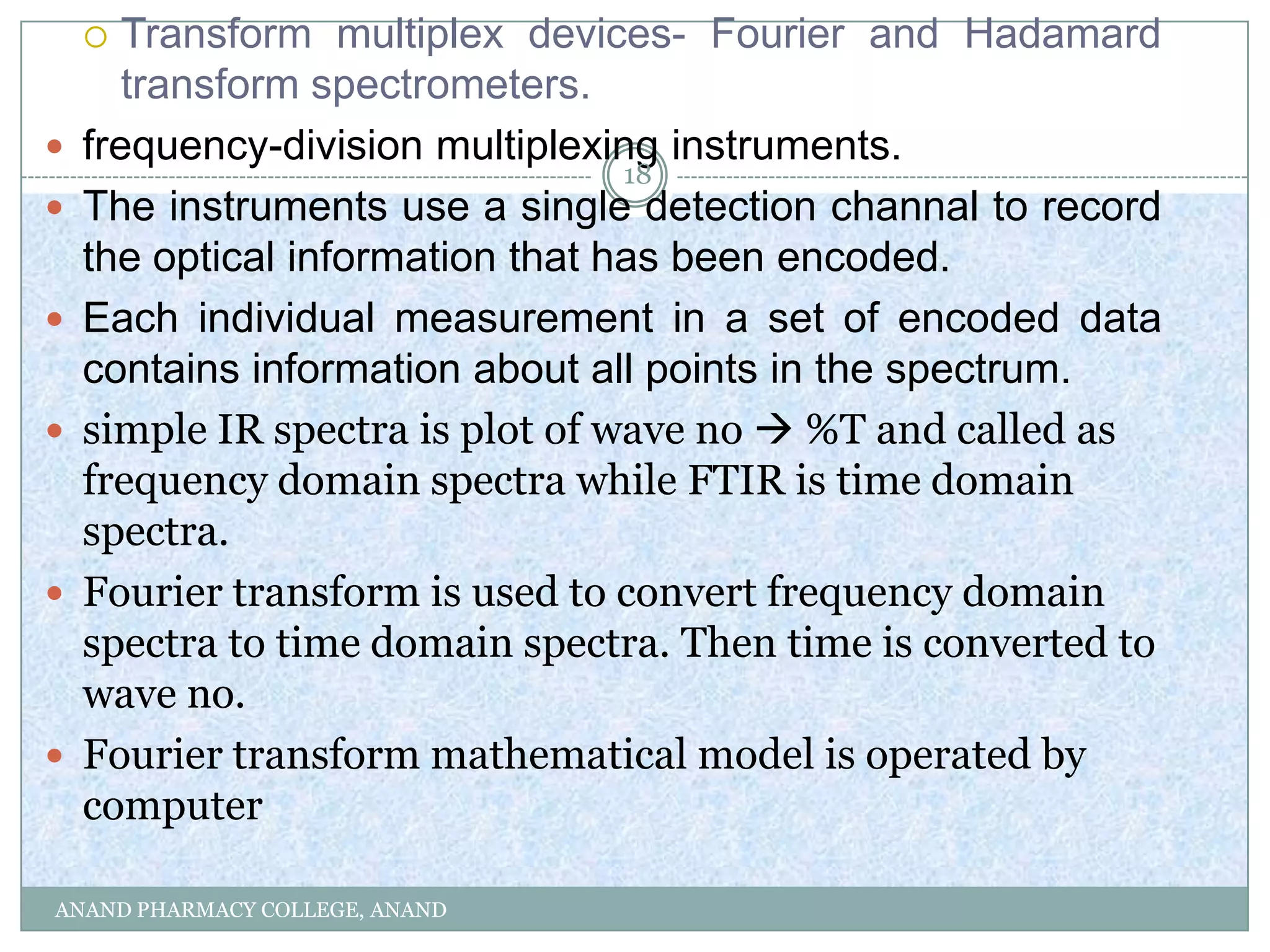
  Transform multiplex devices- Fourier and Hadamard
       transform spectrometers.
   frequency-division multiplexing instruments.
                                  18
   The instruments use a single detection channal to record
    the optical information that has been encoded.
   Each individual measurement in a set of encoded data
    contains information about all points in the spectrum.
   simple IR spectra is plot of wave no  %T and called as
    frequency domain spectra while FTIR is time domain
    spectra.
   Fourier transform is used to convert frequency domain
    spectra to time domain spectra. Then time is converted to
    wave no.
   Fourier transform mathematical model is operated by
    computer

ANAND PHARMACY COLLEGE, ANAND
application
                                     19

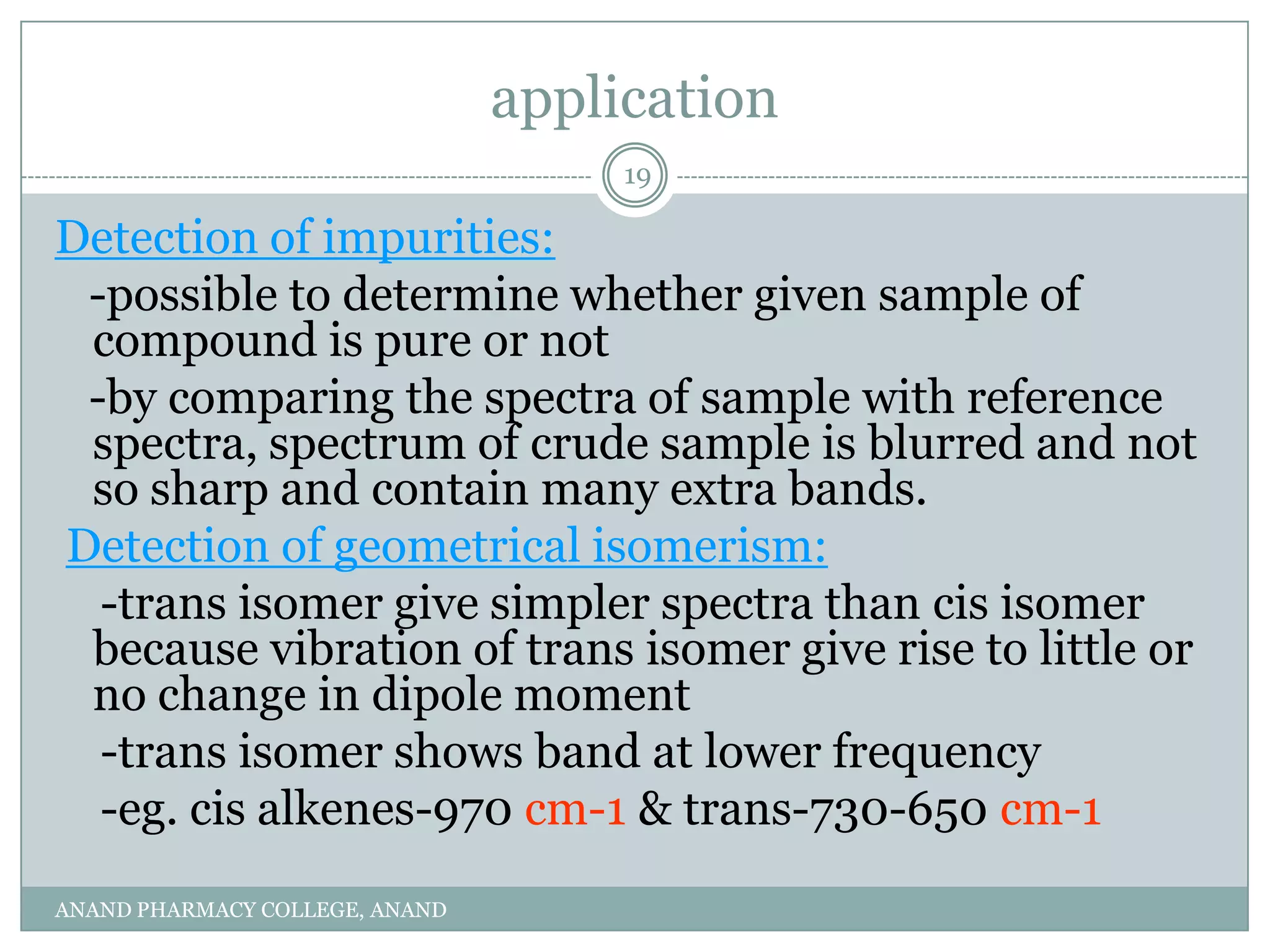
Detection of impurities:
 -possible to determine whether given sample of
 compound is pure or not
 -by comparing the spectra of sample with reference
 spectra, spectrum of crude sample is blurred and not
 so sharp and contain many extra bands.
Detection of geometrical isomerism:
  -trans isomer give simpler spectra than cis isomer
 because vibration of trans isomer give rise to little or
 no change in dipole moment
  -trans isomer shows band at lower frequency
  -eg. cis alkenes-970 cm-1 & trans-730-650 cm-1
ANAND PHARMACY COLLEGE, ANAND
B) X-RAY POWDER DIFFRACTION
                                 20

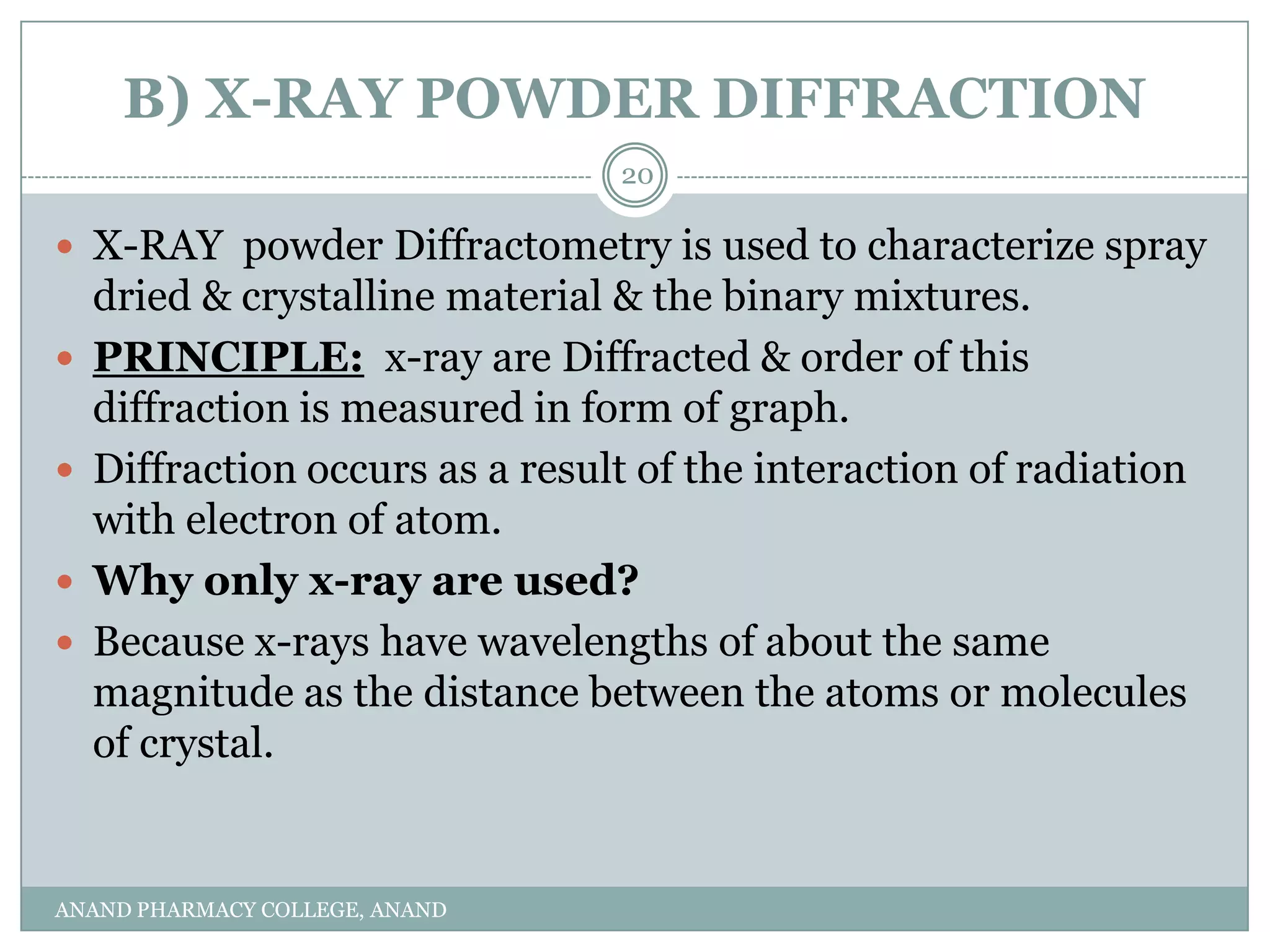
 X-RAY powder Diffractometry is used to characterize spray
    dried & crystalline material & the binary mixtures.
   PRINCIPLE: x-ray are Diffracted & order of this
    diffraction is measured in form of graph.
   Diffraction occurs as a result of the interaction of radiation
    with electron of atom.
   Why only x-ray are used?
   Because x-rays have wavelengths of about the same
    magnitude as the distance between the atoms or molecules
    of crystal.


ANAND PHARMACY COLLEGE, ANAND
21


        X-ray Diffraction Methods
        X-ray diffraction methods are generally used for
         investigating the internal structures. However,
         the following methods are used:
        (1) Laue photographic method
        (2) Bragg X-ray spectrometer method
        (3) Rotating crystal method
        (4) Power method


ANAND PHARMACY COLLEGE, ANAND
22

    Application of X-ray diffraction
    1. Structure of Crystals
     The analytical applications of X-ray diffraction are
     numerous. The method is nondestructive and gives
     information on the molecular structure of the sample.
     Perhaps its most important use has been no measure
     the size of crystal planes. The patterns obtained are
     characteristic of the particulars compounds from
     which the crystal was formed.
    2. Polymer Characterisation
     Powder method can be used to determine the degree of
     crystalline of the polymer. The non-crystalline portion
     simply scatters the X-ray beam to give a continuous
     background, while the crystalline portion causes
     diffraction lines that are not continuous.

ANAND PHARMACY COLLEGE, ANAND
23

 Identification Of Impurity:
     X-ray diffraction pattern of any specimens match with
      standard
     Presence of Additional lines on the photograph of
    specimen, indicate the presence of impurity.
       e.g In cosmetic talc, the contaminant tremolite (a
    potentially carcinogen ) can be detected by x-ray
    diffraction technique.
    Characterize spray dried & crystalline material.
   For particle size analysis.


ANAND PHARMACY COLLEGE, ANAND
24

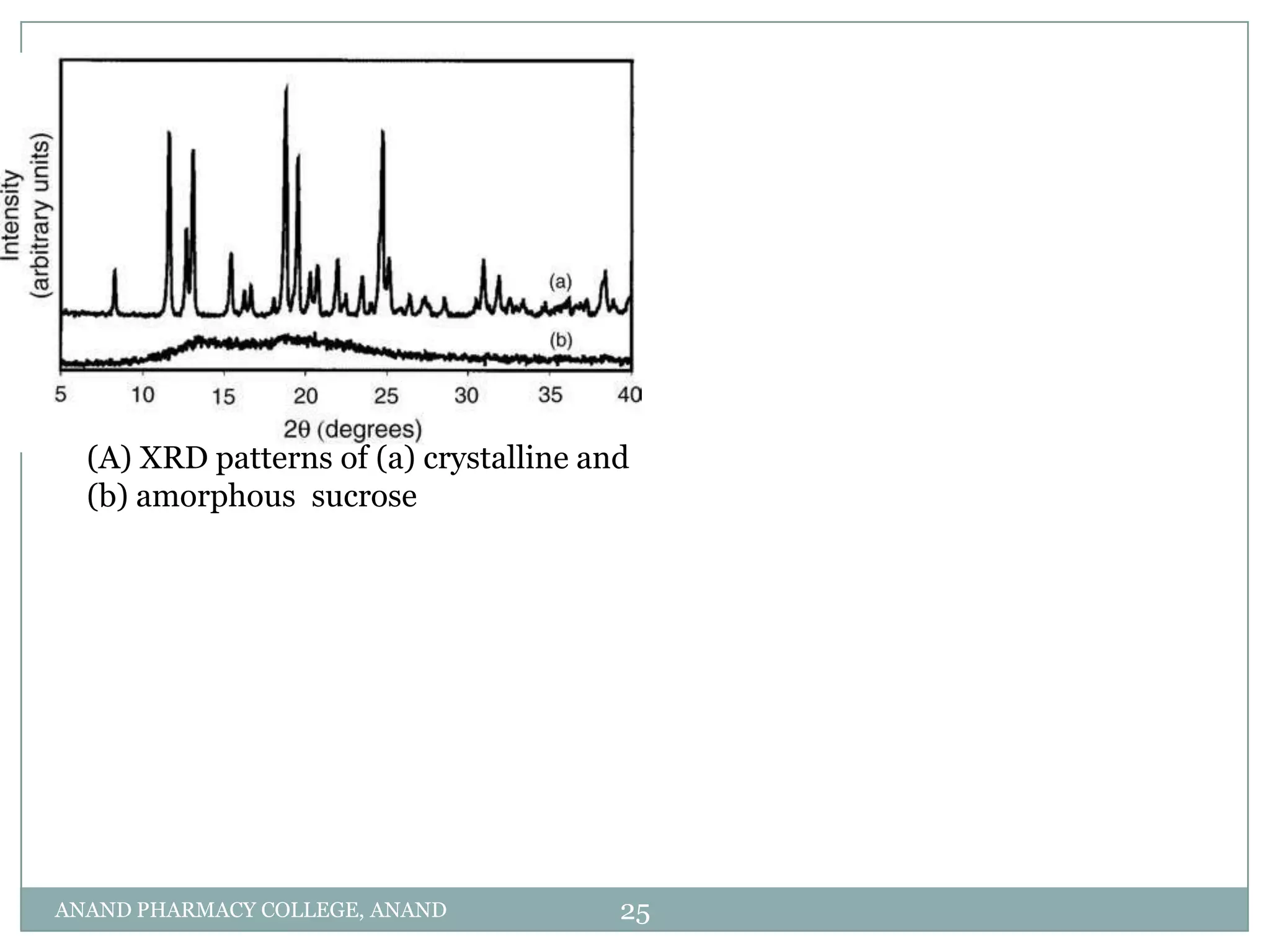
 XRD is the technique of choice to identify different
  polymorphic forms of a compound. It can also be
  used to identify the solvated and unsolvated
  (anhydrous) forms of a compound, provided their
  lattice structures are different.
 The technique can also reveal differences in the
  crystallinity of compounds.
 The XRD pattern of an amorphous (noncrystalline)
  compound will consist of one or more broad diffuse
  halos

ANAND PHARMACY COLLEGE, ANAND
(A) XRD patterns of (a) crystalline and
  (b) amorphous sucrose


ANAND PHARMACY COLLEGE, ANAND           25
Degree of crystallinity
                                      26

 XRD is widely used to determine the degree of crystallinity of
  pharmaceuticals. The procedure developed by Hermans and Weidinger
  is based on three assumptions.
 First, it must be possible to demarcate and measure the crystalline
  intensity (Ic) and amorphous intensity (Ia) from the powder pattern.
  Usually, the integrated line intensity (area under the curve), rather than
  the peak intensity (peak height), is measured.

 Second, there is a proportionality between the
experimentally measured crystalline intensity and the
crystalline fraction (xc) in the sample. Finally, a proportionality
exists between the experimentally measured
amorphous intensity and the amorphous
fraction (xa) in the sample. The degree of crystallinity is given below.
ANAND PHARMACY COLLEGE, ANAND
27


X=Ic +100
    Ic + qIa/p
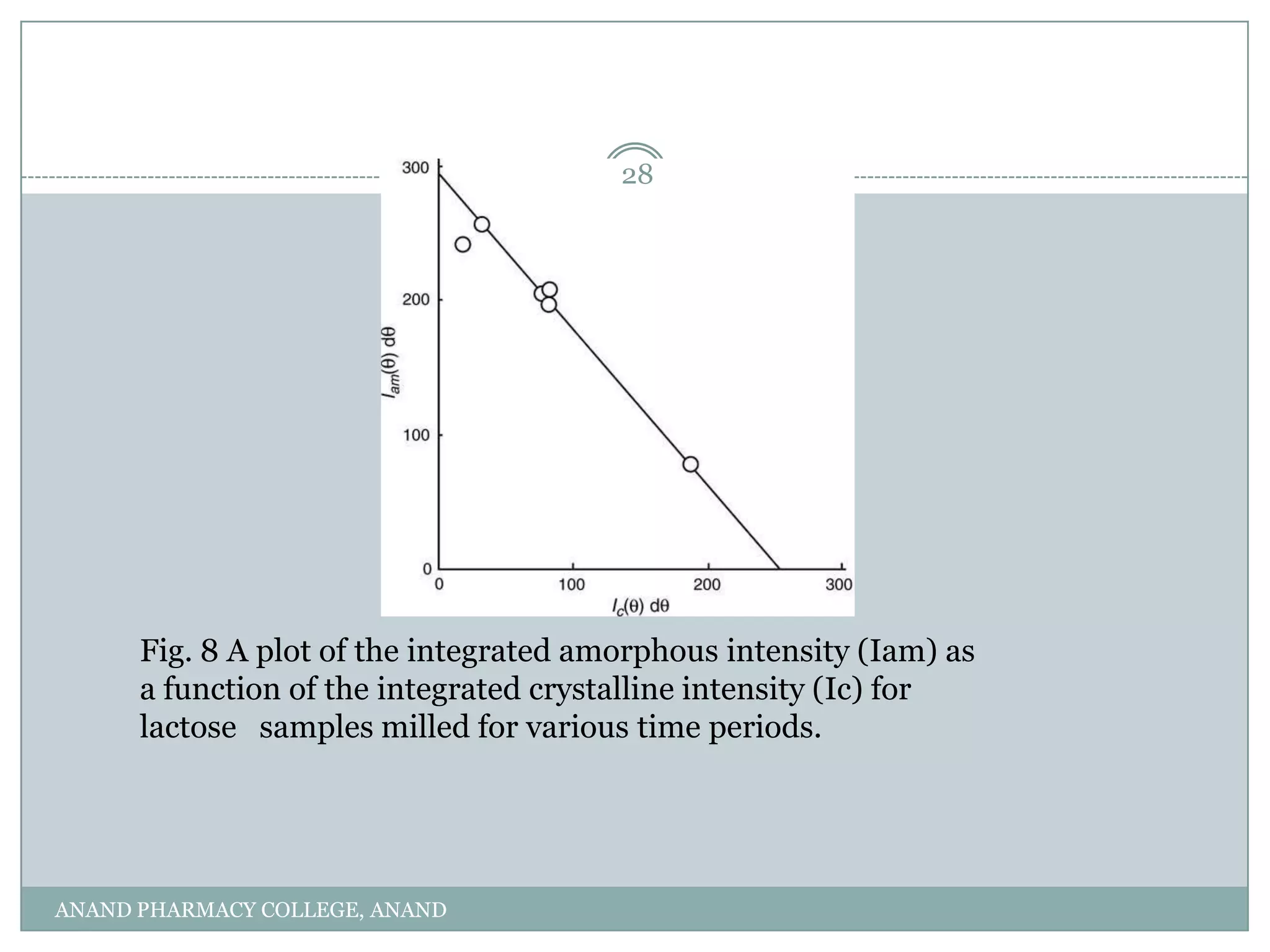
 where p and q are proportionality constants. The
values of Ia and Ic can be determined for samples of
varying degrees of crystallinity. A plot of the measured
values of Ia against those of Ic will result in a straight
line, and the intercepts on the y- and x-axes will provide
the intensity values of the 100% amorphous and
100% crystalline materials, respectively. This method
was used by Nakai et al.[17] to estimate the degree of
crystallinity of lactose that had been milled for various
time periods (Fig. 8). If the value of (q/p) is known, the
degree of crystallinity of an unknown sample can be
calculated from the experimentally determined values
of Ic and Ia.


ANAND PHARMACY COLLEGE, ANAND
28


      Fig. 8 A plot of the integrated amorphous intensity (Iam) as
      a function of the integrated crystalline intensity (Ic) for
      lactose samples milled for various time periods.


ANAND PHARMACY COLLEGE, ANAND
29


                                Thank you


ANAND PHARMACY COLLEGE, ANAND

Principle and application of dsc,dta,ftir and x ray diffraction

  • 1.
    Principle and applicationof DSC,DTA,FTIR and X-ray diffraction 1 GUIDED BY:. VAISHALI THAKKAR PREPARED BY:KARTIK DUDHAT ANAND PHARMACY COLLEGE ANAND PHARMACY COLLEGE, ANAND
  • 2.
    ROLE OF THERMALANALYSIS IN PREFORMULATION 2  They are unique methods in the field of polymer analysis & of high value for a solid state analysis.  They finds wide application in  Detection of impurity  Determination of moisture content in any drug substance or any excipient  Study of polymorphism  Characterization of hydrates & solvates  Degree of Crystallinity  Study of phase diagram  Drug excipient compatibility study  Study of complexation ANAND PHARMACY COLLEGE, ANAND
  • 3.
    2)Differential Thermal analysis(DTA) 3  PRINCIPLE: A Technique in which the temperature difference between a substance and reference material is measured as a function of temperature, while the substance and reference are subjected to a controlled temperature programme.  the Difference in temperature is called as Differential temp(∆t) is plotted against temp. or a function of time.  Physical changes usually result in Endothermic peak ,whereas chemical reactions those of an oxidative nature are exothermic.  Endothermic reaction (absorption of energy) includes vaporization, sublimation, and absorption & gives downward peak.  Exothermic reaction (liberation of energy) includes oxidation, polymerization, and catalytic reaction & gives upward peak. ANAND PHARMACY COLLEGE, ANAND
  • 4.
    3) Differential scanningcalorimetry 4  PRINCIPLE: It is a technique in which the energy necessary to establish a zero temp. difference between the sample & reference material is measured as a function of temp.  Here, sample & reference material are heated by separate heaters in such a way that their temp are kept equal while these temp. are increased or decreased linearly.   Endothermic reaction: if sample absorbs some amount of heat during phase transition then reaction is said to be endothermic. In endothermic reaction more energy needed to maintain zero temp difference between sample & reference.  E.g. Melting, boiling, sublimation, vaporization, desolvation.  ANAND PHARMACY COLLEGE, ANAND
  • 5.
    5  Exothermic reaction:if sample released some amount of heat during phase transition, then reaction is said to be exothermic. In exothermic reaction, less energy needed to maintain zero temp difference between sample & reference. E.g crystallization, degradation, polymerization.  DSC Is widely used to measure glass transition temp & characterization of polymer.  Glass Transition temp(Tg): Temp at which an amorphous polymer or an amorphous part of crystalline polymer goes from hard ,brittle state to soft,Rubbery state. ANAND PHARMACY COLLEGE, ANAND
  • 6.
  • 7.
  • 8.
    Application of DTAAND DSC in pre formulation 8  Thermal analytical system can be used for detection of impurities in pharmaceutical ingredient by recording Thermogram & DTA or DSC curves. This curves could be then be compared with the curve of reference standard . Any abnormal mass changes on TG curve & irregular endotherm or exotherm peaks on DTA or DSC curve would indicate the presence of impurity. ANAND PHARMACY COLLEGE, ANAND
  • 9.
     The allthermodynamic parameter in the polymorphism substance is different like melting, sublimation temperature, kinetics, stability, solubility, heat capacity, crystal hardness & shape which are extremely important for the dosages form.  During preformulation, it is important to identify the polymorph that are stable & also imp. to determine whether polymorphic transition are possible within the temp. range used for stability studies, processing (drying, milling, mixing. granulation etc.) & storage.  Eg. Mannitol occurs in four forms, all melting at the same temp. & they are non hygroscopic, only form B shows a small endotherm exotherm process. ANAND PHARMACY COLLEGE, ANAND 9
  • 10.
     A sharpmelting endotherm indicates the relative purity where as broad asymmetric curve suggest impurity. The presence of minute amount of substance broadens its melting range & lowers its mp.  Compare to other thermal methods, DSC is best method for detection of impurity.  Eg. DSC of phenacetin.  ANAND PHARMACY COLLEGE, ANAND 10
  • 11.
  • 12.
    Degree of crystallinity 12  Partial crystallinity is also a type of polymorphism.  The degree of crystallinity was determined by calorimetry.  Principle of solution calorimetry  Basis on the fact that for many solids the amorphous form is higher in energy then the crystalline form. The heat of solution of the amorphous form is expected to be more exothermic then the crystalline form.  The percentage of crystallinity (pc) may be determined in a partially crystalline sample according to the following equation.   100(∆H sample- ∆H amorphous)  PC =  ∆H crystal - ∆H amorphous   where, sample is partially crystalline material  amorphous is 100% amorphous standard & crystalline is 100% crystal standard  ANAND PHARMACY COLLEGE, ANAND
  • 13.
    COMPATIBILITY STUDY OFDRUG WITH EXCIPIENT. 13  The early detection of Drug excipient Incompatibility is vital in pharmaceutical industry to avoid costly material wastage & time delays.  DSC with the support of x-ray diffraction & infrared spectroscopy are used as screening technique for the compatibility testing of drug with excipient. ANAND PHARMACY COLLEGE, ANAND
  • 14.
    a) DSC ofsparfloxacin b) DSC of pvp C) DSC of 1:1 physical mixture of Drug:pvp 14 Conclusion– incompatibility Reason: Absence of melting endotherm & exotherm isbroad. ANAND PHARMACY COLLEGE, ANAND
  • 15.
    STUDY OF COMPLEXES& INCLUSION COMPOUNDS 15  The Disappearance of the DSC peak of the drug is the proof of Complexation in solid state.  Figure shows, that no complexation was obtained for a drug with ß-cyclodextrin. ANAND PHARMACY COLLEGE, ANAND
  • 16.
    MINOR APPLICATIONS 16 - DSC is a valuable tool in choice of suppository base. - In study of polymer composition ,miscibility & individual characterization. - Study of tablet coating - Determinations of melting point. etc - Determination of moisture content in drug. - Checking technological quality grade of disintegrate. - Study of solid drug dispersion. - Determination of drying temp. for different excipients. ANAND PHARMACY COLLEGE, ANAND
  • 17.
    GENERAL PRINCIPLE &APPLICATION OF FTIR SPECTRUM & X-RAY DIFFRACTION METHOD. 17  Generally ,this technique are not consider as thermal technique, But if used in specific condition then this technique are classified as thermal technique  Fourier transform infrared spectrometers can be single beam or Double beam.  Commercial FTIR spectrometers are of single beam. A double beam instrument is designed to compensate for atmosphere.  In most IR spectrometer ,the optical components are manufactured in sealed & desiccated compartment with a goal of reducing water & carbon dioxide interference. ANAND PHARMACY COLLEGE, ANAND
  • 18.
     Transformmultiplex devices- Fourier and Hadamard transform spectrometers.  frequency-division multiplexing instruments. 18  The instruments use a single detection channal to record the optical information that has been encoded.  Each individual measurement in a set of encoded data contains information about all points in the spectrum.  simple IR spectra is plot of wave no  %T and called as frequency domain spectra while FTIR is time domain spectra.  Fourier transform is used to convert frequency domain spectra to time domain spectra. Then time is converted to wave no.  Fourier transform mathematical model is operated by computer ANAND PHARMACY COLLEGE, ANAND
  • 19.
    application 19 Detection of impurities: -possible to determine whether given sample of compound is pure or not -by comparing the spectra of sample with reference spectra, spectrum of crude sample is blurred and not so sharp and contain many extra bands. Detection of geometrical isomerism: -trans isomer give simpler spectra than cis isomer because vibration of trans isomer give rise to little or no change in dipole moment -trans isomer shows band at lower frequency -eg. cis alkenes-970 cm-1 & trans-730-650 cm-1 ANAND PHARMACY COLLEGE, ANAND
  • 20.
    B) X-RAY POWDERDIFFRACTION 20  X-RAY powder Diffractometry is used to characterize spray dried & crystalline material & the binary mixtures.  PRINCIPLE: x-ray are Diffracted & order of this diffraction is measured in form of graph.  Diffraction occurs as a result of the interaction of radiation with electron of atom.  Why only x-ray are used?  Because x-rays have wavelengths of about the same magnitude as the distance between the atoms or molecules of crystal. ANAND PHARMACY COLLEGE, ANAND
  • 21.
    21  X-ray Diffraction Methods  X-ray diffraction methods are generally used for investigating the internal structures. However, the following methods are used:  (1) Laue photographic method  (2) Bragg X-ray spectrometer method  (3) Rotating crystal method  (4) Power method ANAND PHARMACY COLLEGE, ANAND
  • 22.
    22  Application of X-ray diffraction  1. Structure of Crystals The analytical applications of X-ray diffraction are numerous. The method is nondestructive and gives information on the molecular structure of the sample. Perhaps its most important use has been no measure the size of crystal planes. The patterns obtained are characteristic of the particulars compounds from which the crystal was formed.  2. Polymer Characterisation Powder method can be used to determine the degree of crystalline of the polymer. The non-crystalline portion simply scatters the X-ray beam to give a continuous background, while the crystalline portion causes diffraction lines that are not continuous. ANAND PHARMACY COLLEGE, ANAND
  • 23.
    23  Identification OfImpurity:  X-ray diffraction pattern of any specimens match with standard  Presence of Additional lines on the photograph of specimen, indicate the presence of impurity.  e.g In cosmetic talc, the contaminant tremolite (a potentially carcinogen ) can be detected by x-ray diffraction technique.  Characterize spray dried & crystalline material.  For particle size analysis. ANAND PHARMACY COLLEGE, ANAND
  • 24.
    24  XRD isthe technique of choice to identify different polymorphic forms of a compound. It can also be used to identify the solvated and unsolvated (anhydrous) forms of a compound, provided their lattice structures are different.  The technique can also reveal differences in the crystallinity of compounds.  The XRD pattern of an amorphous (noncrystalline) compound will consist of one or more broad diffuse halos ANAND PHARMACY COLLEGE, ANAND
  • 25.
    (A) XRD patternsof (a) crystalline and (b) amorphous sucrose ANAND PHARMACY COLLEGE, ANAND 25
  • 26.
    Degree of crystallinity 26  XRD is widely used to determine the degree of crystallinity of pharmaceuticals. The procedure developed by Hermans and Weidinger is based on three assumptions.  First, it must be possible to demarcate and measure the crystalline intensity (Ic) and amorphous intensity (Ia) from the powder pattern. Usually, the integrated line intensity (area under the curve), rather than the peak intensity (peak height), is measured.  Second, there is a proportionality between the experimentally measured crystalline intensity and the crystalline fraction (xc) in the sample. Finally, a proportionality exists between the experimentally measured amorphous intensity and the amorphous fraction (xa) in the sample. The degree of crystallinity is given below. ANAND PHARMACY COLLEGE, ANAND
  • 27.
    27 X=Ic +100 Ic + qIa/p  where p and q are proportionality constants. The values of Ia and Ic can be determined for samples of varying degrees of crystallinity. A plot of the measured values of Ia against those of Ic will result in a straight line, and the intercepts on the y- and x-axes will provide the intensity values of the 100% amorphous and 100% crystalline materials, respectively. This method was used by Nakai et al.[17] to estimate the degree of crystallinity of lactose that had been milled for various time periods (Fig. 8). If the value of (q/p) is known, the degree of crystallinity of an unknown sample can be calculated from the experimentally determined values of Ic and Ia. ANAND PHARMACY COLLEGE, ANAND
  • 28.
    28 Fig. 8 A plot of the integrated amorphous intensity (Iam) as a function of the integrated crystalline intensity (Ic) for lactose samples milled for various time periods. ANAND PHARMACY COLLEGE, ANAND
  • 29.
    29 Thank you ANAND PHARMACY COLLEGE, ANAND