CHEMICAL
SHIFT
ISOTOPIC NUCLEI
REFERENCE
STANDARDS
1
PRESENTED BY
ARANTHA J JOSEPH
Dep of pharmaceutics
St josephs college of
pharmacy cherthala.
CHEMICAL SHIFT
 The shift in the position of the NMR region resulting
from the shielding and deshielding by electrons is called
chemical shift.
 When a proton is present inside the magnetic field more
close to an electro positive atom more applied magnetic
field is required to cause excitation. This effect is called
shielding effect.
 When a proton is present outside the magnetic field
close to a electronegative atom less applied magnetic
field is required to cause excitation . This effect is called
deshielding effect 2
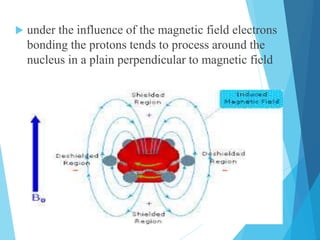
 Greater the electron density around the
proton greater will be the induced secondary
magnetic field.
 [ local diamagnetic effect]
 currents induced by fixed magnetic field
result in secondary fields which can either
enhance or decrease the field to given a
proton responds.
3
 under the influence of the magnetic field electrons
bonding the protons tends to process around the
nucleus in a plain perpendicular to magnetic field
4
5
 The position of the peaks in an NMR spectrum relative to the
reference peak is expressed in terms of the chemical shift
ᵟ= H0(reference)-H0(sample) X 106PPM
H0(reference)
 The value of H0 for the reference is usually greater than H0 for the
sample,so subtraction in the direction indicated gives a positive ᵟ.In
terms of frequency unit ᵟ takes the form
ᵟ = ѵ(sample)- ѵ(reference) X 106ppm
ѵ(reference)
 chemical shift is dimension less
 expressed in parts per million (ppm ) 10
 Alternative system used us tau scale
 τ=10-ᵟ
scale the position of TMS signal is taken as 0.0 ppm
 most chemical shifts value ranges from 0-10
6
 a small value if tau represents low field absorption.
 high value represents high field absorption.
7
greater the deshielding of protons larger the value of
delta
Reason for chemical shift
8
 Positive shielding :resonance position moves upfield.
 Negative shielding: resonance position moves
downfield.
Measurement of Chemical Shift
 In order to measure the magnitude of chemical shifts of
different kinds of protons,
 There must be some standard signal .
 0.5%Tetra methylsilane (TMS)(ch3)4si is used as
reference or standard compound.
 Chemical shift is represented by δ
 Δ scale: 0 to -10 scale
 TMS as zero markers.
 Dimensionless expression; negative for most protons.9
Chemical shift= shift in hz
Machine frequency in
mhz
10
Reason for TMS as reference std
TETRA METHYL SILANE(TMS)
 Accepted internal standard.
 TMS has 12 equivalent protons and gives an intense
single signal.
 Electro negativity of silicon is very low so the shielding
of equivalent protons in TMS is more than other
compound so all the signal arrives in a down field
direction.
11
 chemically inert
 low boiling point
 so it can be easily removed by evaporation after the
spectrum has been recorded
 so the sample can easily recovered.
 TMS is not suitable in aqueous solution so DSS ( 2,2-
dimethyl-2silapentane-5 sulphate) used as reference.
 protons in the methyl group of DSS gives a strong
line.
12
FACTORS AFFECTING CHEMICAL SHIFT
1. ELECTRONEGATIVITY AND INDUCTIVE EFFECT
 The proton is said to be deshielded if its attached with an
electronegative atom/group. Greater the electro negativity of
atom greater is the deshielding caused to proton. If the
deshielding is more, then δ value also more.
 Electronegative atoms like Halogens Oxygen and Nitrogen
deshield the protons
 There for the absorption occurs downfield.
 The deshielding is directly proportional to the halogens
oxygen or nitrogen
13
+ i effect
- i effect
 An electron withdrawing group is able to
reduce electron density around the proton
and Deshields the proton.
 An electron releasing group increase the
electron density around the proton and give
rise to its shielding.
14
15
Electronegativity
Deshielding
Delta value
Electrons around
proton induce
magnetic field
Induce magnetic field
oppose applied
magnetic field
Shielding
Neighboring
electronegative atom
decrease's electron
density
Deshielding
Smaller force is
required
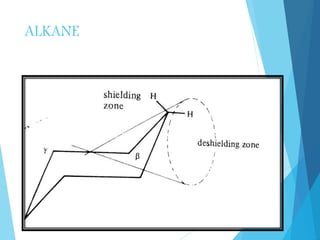
2. Anisotropic effect(space effect)
Shielding and deshielding can be
determined
By location of proton in space
Space effect
Downfield or paramagnetic shift of protons
attached to C = C, aldehydic, aromatic proton is
experienced by the molecular magnetic field
induced by an action of applied field Ho on pi
electrons, this magnetic field induced by pi
electrons are directional or unsymmetrical and
this directional measurement is called
ANISOTROPY 16
ALKANE
17
ALKYNE
18
Benzene
19
3. VANDERWAALS DESHIELDING
The electron cloud of a bulkier group will
tend to repel the electron cloud
surrounding the proton.
Thus such a proton will be deshielded
 will resonate at slightly higher value of δ
than expected in the absence of this effect.
20
4. HYDROGEN BONDING
if an atom exhibits hydrogen boding
in a compound .
it will deshielded due to the strongly
electronegative atom attached to it
so absorption in shifted downfield.
 Intra molecular hydrogen bonding
 Inter molecular hydrogen bonding 21
ISOTOPIC NUCLEI
 Many isotopes of chemical elements can be used for
NMR analysis
1h
 Most commonly used spin 1/2 nucleus in NMR
 Most sensitive nucleus.
 Produce narrow chemical shift with sharp signal
 Fast result is possible due to short relaxation time
22
2H
 A spin 1nucleus commonly utilize as signal free
medium
 Deuterium is used
 Commonly used in high resolution NMR.
 To monitor drifts in the magnetic field strength
 To improve the homogenicity of the external magnetic
field
3h
 Very sensitive to nmr 23
11B
-More sensitive than 10 B
-Yields sharper signals
-Quarts tubes are used(borosilicate glass interfere
with measurements)
13C
-Spin 1/2
-Widely used, stable to nuclear decay
-low sensitivity
-Wide chemical shift
-Yields sharp signals 24
14N
 Spin 1
 Medium sensitivity
 Wide chemical shift
 Limited use to small molecules and functional
group.
17 O
 Spin 5/2
 Low sensitivity
 Low natural abundance
 Wide chemical shift
25
19f
 Spin 1/2
 Yields sharp signal
-Wide chemical shifts
31P
 Spin 1/2
 Medium chemical shift
 Yield sharp line
26
43ca
 Used in biochemistry to study Calcium binding
to DNA protein
 Moderately sensitive
 Very low natural abundance
 195 P t
 eg:-6Li,7 Li
 9 Be,19F
 59Co,61Ni,77 Se etc.........
27
REFERENCE STANDARDS USED IN
NMR1. Tetra Methylsilane(tms)
2. DSS( 4,4-dimethyl-4-silapentane-1-sulfonic Acid)
 Used In Proton And Carbon Related Nmr
 High Water Solubility
 High Intensity Signals
 Almost All Peaks Found In Naturally Occurring Org
Molecule.
 Show Minor Peaks At 3.1ppm - Triplet
28
3. TRIMETHYLSILYL PROPIONIC ACID
 Used for aqueous solvents
 (3-(trimethylsilyl)-2,2',3,3'-tetradeutero propionic
acid ) Or tmsp-d4
4. DEUTERATED DMSO
 Show no peaks in 1+1
 H1 NMR signal is observed at 2.20 ppm
 13C chemical shift of DMSO - 39.52ppm
29
REFERENCE
 Instrumental Methods Of Chemical Analysis By
Gurdeep R. Chatwal ,Sham K Anand, Pg No:
2.192-2.196
 Www. Wikipedia.Org
30
 Spectroscopy of organic compounds by P.S. Kalsi,
page no.453-490.
 Spectroscopy of organic compound by Y.R.
Sharma.
 THANKUUUUUUUUU...........
31
PRESENTED BY:
ARANTHA J JOSEPH

Chemical shift

  • 1.
    CHEMICAL SHIFT ISOTOPIC NUCLEI REFERENCE STANDARDS 1 PRESENTED BY ARANTHAJ JOSEPH Dep of pharmaceutics St josephs college of pharmacy cherthala.
  • 2.
    CHEMICAL SHIFT  Theshift in the position of the NMR region resulting from the shielding and deshielding by electrons is called chemical shift.  When a proton is present inside the magnetic field more close to an electro positive atom more applied magnetic field is required to cause excitation. This effect is called shielding effect.  When a proton is present outside the magnetic field close to a electronegative atom less applied magnetic field is required to cause excitation . This effect is called deshielding effect 2
  • 3.
     Greater theelectron density around the proton greater will be the induced secondary magnetic field.  [ local diamagnetic effect]  currents induced by fixed magnetic field result in secondary fields which can either enhance or decrease the field to given a proton responds. 3
  • 4.
     under theinfluence of the magnetic field electrons bonding the protons tends to process around the nucleus in a plain perpendicular to magnetic field 4
  • 5.
    5  The positionof the peaks in an NMR spectrum relative to the reference peak is expressed in terms of the chemical shift ᵟ= H0(reference)-H0(sample) X 106PPM H0(reference)  The value of H0 for the reference is usually greater than H0 for the sample,so subtraction in the direction indicated gives a positive ᵟ.In terms of frequency unit ᵟ takes the form ᵟ = ѵ(sample)- ѵ(reference) X 106ppm ѵ(reference)
  • 6.
     chemical shiftis dimension less  expressed in parts per million (ppm ) 10  Alternative system used us tau scale  τ=10-ᵟ scale the position of TMS signal is taken as 0.0 ppm  most chemical shifts value ranges from 0-10 6
  • 7.
     a smallvalue if tau represents low field absorption.  high value represents high field absorption. 7 greater the deshielding of protons larger the value of delta
  • 8.
    Reason for chemicalshift 8  Positive shielding :resonance position moves upfield.  Negative shielding: resonance position moves downfield.
  • 9.
    Measurement of ChemicalShift  In order to measure the magnitude of chemical shifts of different kinds of protons,  There must be some standard signal .  0.5%Tetra methylsilane (TMS)(ch3)4si is used as reference or standard compound.  Chemical shift is represented by δ  Δ scale: 0 to -10 scale  TMS as zero markers.  Dimensionless expression; negative for most protons.9
  • 10.
    Chemical shift= shiftin hz Machine frequency in mhz 10
  • 11.
    Reason for TMSas reference std TETRA METHYL SILANE(TMS)  Accepted internal standard.  TMS has 12 equivalent protons and gives an intense single signal.  Electro negativity of silicon is very low so the shielding of equivalent protons in TMS is more than other compound so all the signal arrives in a down field direction. 11
  • 12.
     chemically inert low boiling point  so it can be easily removed by evaporation after the spectrum has been recorded  so the sample can easily recovered.  TMS is not suitable in aqueous solution so DSS ( 2,2- dimethyl-2silapentane-5 sulphate) used as reference.  protons in the methyl group of DSS gives a strong line. 12
  • 13.
    FACTORS AFFECTING CHEMICALSHIFT 1. ELECTRONEGATIVITY AND INDUCTIVE EFFECT  The proton is said to be deshielded if its attached with an electronegative atom/group. Greater the electro negativity of atom greater is the deshielding caused to proton. If the deshielding is more, then δ value also more.  Electronegative atoms like Halogens Oxygen and Nitrogen deshield the protons  There for the absorption occurs downfield.  The deshielding is directly proportional to the halogens oxygen or nitrogen 13
  • 14.
    + i effect -i effect  An electron withdrawing group is able to reduce electron density around the proton and Deshields the proton.  An electron releasing group increase the electron density around the proton and give rise to its shielding. 14
  • 15.
    15 Electronegativity Deshielding Delta value Electrons around protoninduce magnetic field Induce magnetic field oppose applied magnetic field Shielding Neighboring electronegative atom decrease's electron density Deshielding Smaller force is required
  • 16.
    2. Anisotropic effect(spaceeffect) Shielding and deshielding can be determined By location of proton in space Space effect Downfield or paramagnetic shift of protons attached to C = C, aldehydic, aromatic proton is experienced by the molecular magnetic field induced by an action of applied field Ho on pi electrons, this magnetic field induced by pi electrons are directional or unsymmetrical and this directional measurement is called ANISOTROPY 16
  • 17.
  • 18.
  • 19.
  • 20.
    3. VANDERWAALS DESHIELDING Theelectron cloud of a bulkier group will tend to repel the electron cloud surrounding the proton. Thus such a proton will be deshielded  will resonate at slightly higher value of δ than expected in the absence of this effect. 20
  • 21.
    4. HYDROGEN BONDING ifan atom exhibits hydrogen boding in a compound . it will deshielded due to the strongly electronegative atom attached to it so absorption in shifted downfield.  Intra molecular hydrogen bonding  Inter molecular hydrogen bonding 21
  • 22.
    ISOTOPIC NUCLEI  Manyisotopes of chemical elements can be used for NMR analysis 1h  Most commonly used spin 1/2 nucleus in NMR  Most sensitive nucleus.  Produce narrow chemical shift with sharp signal  Fast result is possible due to short relaxation time 22
  • 23.
    2H  A spin1nucleus commonly utilize as signal free medium  Deuterium is used  Commonly used in high resolution NMR.  To monitor drifts in the magnetic field strength  To improve the homogenicity of the external magnetic field 3h  Very sensitive to nmr 23
  • 24.
    11B -More sensitive than10 B -Yields sharper signals -Quarts tubes are used(borosilicate glass interfere with measurements) 13C -Spin 1/2 -Widely used, stable to nuclear decay -low sensitivity -Wide chemical shift -Yields sharp signals 24
  • 25.
    14N  Spin 1 Medium sensitivity  Wide chemical shift  Limited use to small molecules and functional group. 17 O  Spin 5/2  Low sensitivity  Low natural abundance  Wide chemical shift 25
  • 26.
    19f  Spin 1/2 Yields sharp signal -Wide chemical shifts 31P  Spin 1/2  Medium chemical shift  Yield sharp line 26
  • 27.
    43ca  Used inbiochemistry to study Calcium binding to DNA protein  Moderately sensitive  Very low natural abundance  195 P t  eg:-6Li,7 Li  9 Be,19F  59Co,61Ni,77 Se etc......... 27
  • 28.
    REFERENCE STANDARDS USEDIN NMR1. Tetra Methylsilane(tms) 2. DSS( 4,4-dimethyl-4-silapentane-1-sulfonic Acid)  Used In Proton And Carbon Related Nmr  High Water Solubility  High Intensity Signals  Almost All Peaks Found In Naturally Occurring Org Molecule.  Show Minor Peaks At 3.1ppm - Triplet 28
  • 29.
    3. TRIMETHYLSILYL PROPIONICACID  Used for aqueous solvents  (3-(trimethylsilyl)-2,2',3,3'-tetradeutero propionic acid ) Or tmsp-d4 4. DEUTERATED DMSO  Show no peaks in 1+1  H1 NMR signal is observed at 2.20 ppm  13C chemical shift of DMSO - 39.52ppm 29
  • 30.
    REFERENCE  Instrumental MethodsOf Chemical Analysis By Gurdeep R. Chatwal ,Sham K Anand, Pg No: 2.192-2.196  Www. Wikipedia.Org 30  Spectroscopy of organic compounds by P.S. Kalsi, page no.453-490.  Spectroscopy of organic compound by Y.R. Sharma.
  • 31.