X – RAY DIFFRACTION (XRD)
K V GOPINATH M Pharm PhD,CPhT
Tirumala Tirupati Devasthanams
TIRUPATI
e-mail:gopinath.karnam@gmail.com
Introduction
ï‚Ź It is a novel & non destructive method of chemical analysis
and a variety of x –ray techniques are available in practice.
ï‚Ź These are : X – Ray Absorption : X-ray diffraction
X-ray Fluorescence
ï‚Ź X – ray diffraction
“ Every crystalline substance gives a pattern; the same
substance always gives the same pattern; and in a mixture of
substances each produces its pattern independently of the others”
ï‚Ź The X-ray diffraction pattern of a pure substance is, therefore,
like a fingerprint of the substance. It is based on the scattering of
x-rays by crystals.
ï‚Ź Definition
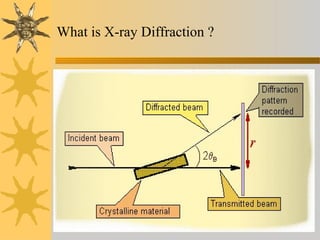
The atomic planes of a crystal cause an incident beam of X-
rays to interfere with one another as they leave the crystal. The
phenomenon is called X-ray diffraction.
What is X-ray Diffraction ?
Why XRD?
ï‚Ź Measure the average spacing's between layers or rows of atoms
ï‚Ź Determine the orientation of a single crystal or grain
ï‚Ź Find the crystal structure of an unknown material
ï‚Ź Measure the size, shape and internal stress of small crystalline
regions
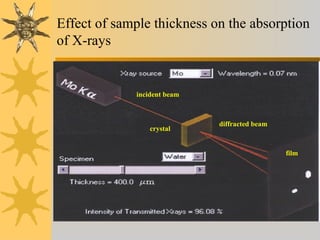
Effect of sample thickness on the absorption
of X-rays
diffracted beam
film
incident beam
crystal
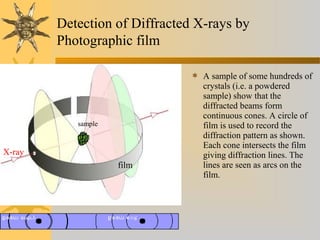
Detection of Diffracted X-rays by
Photographic film
ï‚Ź A sample of some hundreds of
crystals (i.e. a powdered
sample) show that the
diffracted beams form
continuous cones. A circle of
film is used to record the
diffraction pattern as shown.
Each cone intersects the film
giving diffraction lines. The
lines are seen as arcs on the
film.
sample
film
X-ray
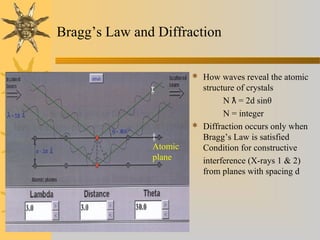
Bragg’s Law and Diffraction
ï‚Ź How waves reveal the atomic
structure of crystals
N = 2d sinƛ Ξ
N = integer
ï‚Ź Diffraction occurs only when
Bragg’s Law is satisfied
Condition for constructive
interference (X-rays 1 & 2)
from planes with spacing d
Atomic
plane
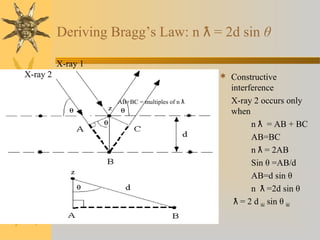
Deriving Bragg’s Law: n ƛ = 2d sin Ξ
ï‚Ź Constructive
interference
X-ray 2 occurs only
when
n = AB + BCƛ
AB=BC
n = 2ABƛ
Sin Ξ =AB/d
AB=d sin Ξ
n =2d sinƛ Ξ
= 2 dƛ hkl sin Ξ hkl
X-ray 2
X-ray 1
AB+BC = multiples of n ƛ
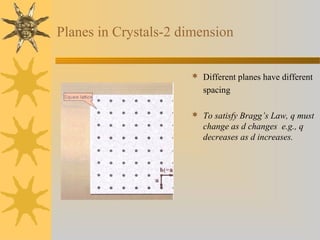
Planes in Crystals-2 dimension
ï‚Ź Different planes have different
spacing
ï‚Ź To satisfy Bragg’s Law, q must
change as d changes e.g., q
decreases as d increases.
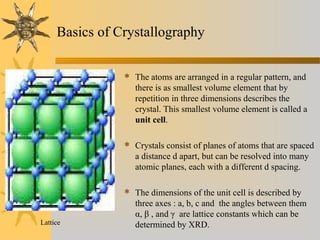
Basics of Crystallography
ï‚Ź The atoms are arranged in a regular pattern, and
there is as smallest volume element that by
repetition in three dimensions describes the
crystal. This smallest volume element is called a
unit cell.
ï‚Ź Crystals consist of planes of atoms that are spaced
a distance d apart, but can be resolved into many
atomic planes, each with a different d spacing.
ï‚Ź The dimensions of the unit cell is described by
three axes : a, b, c and the angles between them
α, ÎČ , and Îł are lattice constants which can be
determined by XRD.Lattice
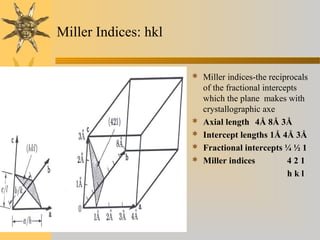
Miller Indices: hkl
ï‚Ź Miller indices-the reciprocals
of the fractional intercepts
which the plane makes with
crystallographic axe
ï‚Ź Axial length 4Å 8Å 3Å
ï‚Ź Intercept lengths 1Å 4Å 3Å
ï‚Ź Fractional intercepts ÂŒ œ 1
ï‚Ź Miller indices 4 2 1
h k l
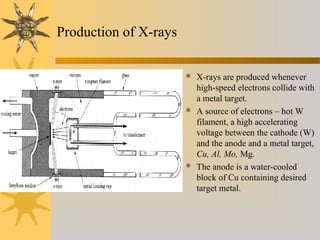
Production of X-rays
ï‚Ź X-rays are produced whenever
high-speed electrons collide with
a metal target.
ï‚Ź A source of electrons – hot W
filament, a high accelerating
voltage between the cathode (W)
and the anode and a metal target,
Cu, Al, Mo, Mg.
ï‚Ź The anode is a water-cooled
block of Cu containing desired
target metal.
Specimen Preparation
ï‚Ź Powders:
0.1ÎŒm < particle size < 40 ÎŒm
Peak broadening less diffraction occurring
ï‚Ź Bulks: smooth surface after polishing, specimens should be
thermal annealed to eliminate any surface deformation
induced during polishing.
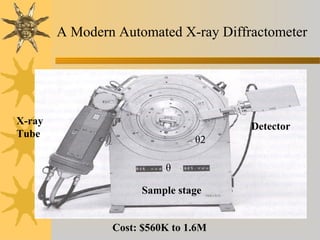
A Modern Automated X-ray Diffractometer
X-ray
Tube
Detector
Sample stage
Ξ
Ξ2
Cost: $560K to 1.6M
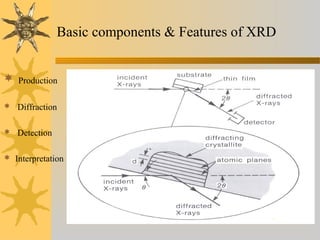
Basic components & Features of XRD
ï‚Ź Production
ï‚Ź Diffraction
ï‚Ź Detection
ï‚Ź Interpretation
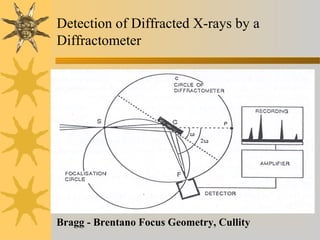
Detection of Diffracted X-rays by a
Diffractometer
Bragg - Brentano Focus Geometry, Cullity
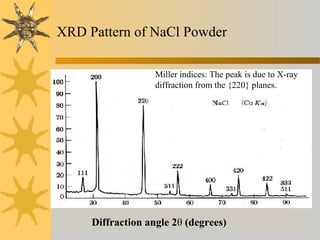
XRD Pattern of NaCl Powder
Diffraction angle 2Ξ (degrees)
Miller indices: The peak is due to X-ray
diffraction from the {220} planes.
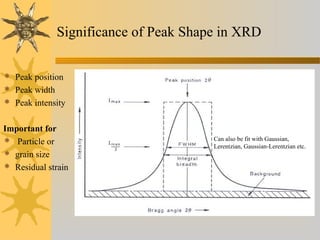
Significance of Peak Shape in XRD
ï‚Ź Peak position
ï‚Ź Peak width
ï‚Ź Peak intensity
Important for
ï‚Ź Particle or
ï‚Ź grain size
ï‚Ź Residual strain
Can also be fit with Gaussian,
Lerentzian, Gaussian-Lerentzian etc.
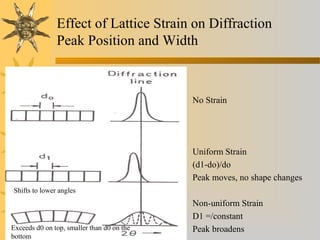
Effect of Lattice Strain on Diffraction
Peak Position and Width
No Strain
Uniform Strain
(d1-do)/do
Peak moves, no shape changes
Non-uniform Strain
D1 =/constant
Peak broadens
Shifts to lower angles
Exceeds d0 on top, smaller than d0 on the
bottom
Applications of XRD
ï‚Ź XRD is a non destructive technique to identify crystalline phases
and orientation
- Obtain XRD pattern ; Measure d-spacings ; Obtain
integrated intensities ;
- Compare data with known standards in the JCPDS file
ï‚Ź To determine structural properties:
- Lattice parameters (10-4Å),, grain size, expitaxy, phase
composition, prefer strained orientation (Laue) order-disorder
transformation, thermal expansion
ï‚Ź To measure thickness of thin films and multi-layers*
ï‚Ź To determine atomic arrangement
ï‚Ź Detection limits: ~3% in a two phase mixture; can be ~0.1% with
synchrotron radiation
Spatial resolution: normally none
Applications of XRD
ï‚Ź The electron density and accordingly, the position of the atoms in
complex structures, such as penicillin may be determined from a
comprehensive mathematical study of the x-ray diffraction pattern.
ï‚Ź The elucidation of structure of penicillin by xrd paved the way for
the later synthesis of penicillin.
ï‚Ź The powder xrd pattern may be thought of as finger print of the
single crystal structure, and it may be used conduct qualitative and
quantitative analysis.
ï‚Ź Xrd can also be used to determine whether the compound is solvated
or not
Applications of XRD
ï‚Ź Particle size determination by applying the relation.
v= V. ΎΞ. cos Ξ / 2n
Where v = the volume or size of an individual crystalline
V= the total volume of the specimen irradiated
n = the number of spots in a deffraction ring at a Bragg angle
ξ ήξ = the divergence of the X –ray beam
ï‚Ź Determination of Cis-Trans isomerism
ï‚Ź It is used to assess the weathering and degradation of natural and
synthetic , minerals.
ï‚Ź Tooth enamel and dentine have been examined by xrd.
ï‚Ź State of anneal in metals
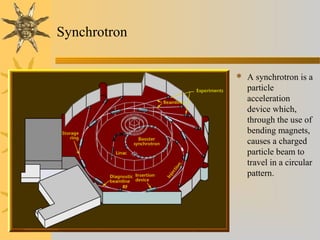
Synchrotron
ï‚Ź A synchrotron is a
particle
acceleration
device which,
through the use of
bending magnets,
causes a charged
particle beam to
travel in a circular
pattern.
Advantages of using synchrotron radiation
ï‚Ź Detecting the presence and quantity of trace elements
ï‚Ź Providing images that show the structure of materials
ï‚Ź Producing X-rays with 108 more brightness than those from
normal X-ray tube (tiny area of sample)
ï‚Ź Having the right energies to interact with elements in light
atoms such as carbon and oxygen
ï‚Ź Producing X-rays with wavelengths (tunable) about the size
of atom, molecule and chemical bonds
Instrumental Sources of Error
ï‚Ź Specimen displacement
ï‚Ź Instrument misalignment
ï‚Ź Error in zero 2 Ξ position
ï‚Ź Peak distortion due to K alfa 2 and K beta wavelengths
Conclusions
ï‚Ź Non-destructive, fast, easy sample preparation
ï‚Ź High-accuracy for d-spacing calculations
ï‚Ź Can be done in-situ
ï‚Ź Single crystal, poly, and amorphous materials
ï‚Ź Standards are available for thousands of material systems
X ray diffraction

X ray diffraction

  • 1.
    X – RAYDIFFRACTION (XRD) K V GOPINATH M Pharm PhD,CPhT Tirumala Tirupati Devasthanams TIRUPATI e-mail:gopinath.karnam@gmail.com
  • 2.
    Introduction ï‚Ź It isa novel & non destructive method of chemical analysis and a variety of x –ray techniques are available in practice. ï‚Ź These are : X – Ray Absorption : X-ray diffraction X-ray Fluorescence ï‚Ź X – ray diffraction “ Every crystalline substance gives a pattern; the same substance always gives the same pattern; and in a mixture of substances each produces its pattern independently of the others” ï‚Ź The X-ray diffraction pattern of a pure substance is, therefore, like a fingerprint of the substance. It is based on the scattering of x-rays by crystals. ï‚Ź Definition The atomic planes of a crystal cause an incident beam of X- rays to interfere with one another as they leave the crystal. The phenomenon is called X-ray diffraction.
  • 3.
    What is X-rayDiffraction ?
  • 4.
    Why XRD? ï‚Ź Measurethe average spacing's between layers or rows of atoms ï‚Ź Determine the orientation of a single crystal or grain ï‚Ź Find the crystal structure of an unknown material ï‚Ź Measure the size, shape and internal stress of small crystalline regions
  • 5.
    Effect of samplethickness on the absorption of X-rays diffracted beam film incident beam crystal
  • 6.
    Detection of DiffractedX-rays by Photographic film ï‚Ź A sample of some hundreds of crystals (i.e. a powdered sample) show that the diffracted beams form continuous cones. A circle of film is used to record the diffraction pattern as shown. Each cone intersects the film giving diffraction lines. The lines are seen as arcs on the film. sample film X-ray
  • 7.
    Bragg’s Law andDiffraction ï‚Ź How waves reveal the atomic structure of crystals N = 2d sinƛ Ξ N = integer ï‚Ź Diffraction occurs only when Bragg’s Law is satisfied Condition for constructive interference (X-rays 1 & 2) from planes with spacing d Atomic plane
  • 8.
    Deriving Bragg’s Law:n ƛ = 2d sin Ξ ï‚Ź Constructive interference X-ray 2 occurs only when n = AB + BCƛ AB=BC n = 2ABƛ Sin Ξ =AB/d AB=d sin Ξ n =2d sinƛ Ξ = 2 dƛ hkl sin Ξ hkl X-ray 2 X-ray 1 AB+BC = multiples of n ƛ
  • 9.
    Planes in Crystals-2dimension ï‚Ź Different planes have different spacing ï‚Ź To satisfy Bragg’s Law, q must change as d changes e.g., q decreases as d increases.
  • 10.
    Basics of Crystallography ï‚ŹThe atoms are arranged in a regular pattern, and there is as smallest volume element that by repetition in three dimensions describes the crystal. This smallest volume element is called a unit cell. ï‚Ź Crystals consist of planes of atoms that are spaced a distance d apart, but can be resolved into many atomic planes, each with a different d spacing. ï‚Ź The dimensions of the unit cell is described by three axes : a, b, c and the angles between them α, ÎČ , and Îł are lattice constants which can be determined by XRD.Lattice
  • 11.
    Miller Indices: hkl ï‚ŹMiller indices-the reciprocals of the fractional intercepts which the plane makes with crystallographic axe ï‚Ź Axial length 4Å 8Å 3Å ï‚Ź Intercept lengths 1Å 4Å 3Å ï‚Ź Fractional intercepts ÂŒ œ 1 ï‚Ź Miller indices 4 2 1 h k l
  • 12.
    Production of X-rays ï‚ŹX-rays are produced whenever high-speed electrons collide with a metal target. ï‚Ź A source of electrons – hot W filament, a high accelerating voltage between the cathode (W) and the anode and a metal target, Cu, Al, Mo, Mg. ï‚Ź The anode is a water-cooled block of Cu containing desired target metal.
  • 13.
    Specimen Preparation ï‚Ź Powders: 0.1ÎŒm< particle size < 40 ÎŒm Peak broadening less diffraction occurring ï‚Ź Bulks: smooth surface after polishing, specimens should be thermal annealed to eliminate any surface deformation induced during polishing.
  • 14.
    A Modern AutomatedX-ray Diffractometer X-ray Tube Detector Sample stage Ξ Ξ2 Cost: $560K to 1.6M
  • 15.
    Basic components &Features of XRD ï‚Ź Production ï‚Ź Diffraction ï‚Ź Detection ï‚Ź Interpretation
  • 16.
    Detection of DiffractedX-rays by a Diffractometer Bragg - Brentano Focus Geometry, Cullity
  • 17.
    XRD Pattern ofNaCl Powder Diffraction angle 2Ξ (degrees) Miller indices: The peak is due to X-ray diffraction from the {220} planes.
  • 18.
    Significance of PeakShape in XRD ï‚Ź Peak position ï‚Ź Peak width ï‚Ź Peak intensity Important for ï‚Ź Particle or ï‚Ź grain size ï‚Ź Residual strain Can also be fit with Gaussian, Lerentzian, Gaussian-Lerentzian etc.
  • 19.
    Effect of LatticeStrain on Diffraction Peak Position and Width No Strain Uniform Strain (d1-do)/do Peak moves, no shape changes Non-uniform Strain D1 =/constant Peak broadens Shifts to lower angles Exceeds d0 on top, smaller than d0 on the bottom
  • 20.
    Applications of XRD ï‚ŹXRD is a non destructive technique to identify crystalline phases and orientation - Obtain XRD pattern ; Measure d-spacings ; Obtain integrated intensities ; - Compare data with known standards in the JCPDS file ï‚Ź To determine structural properties: - Lattice parameters (10-4Å),, grain size, expitaxy, phase composition, prefer strained orientation (Laue) order-disorder transformation, thermal expansion ï‚Ź To measure thickness of thin films and multi-layers* ï‚Ź To determine atomic arrangement ï‚Ź Detection limits: ~3% in a two phase mixture; can be ~0.1% with synchrotron radiation Spatial resolution: normally none
  • 21.
    Applications of XRD ï‚ŹThe electron density and accordingly, the position of the atoms in complex structures, such as penicillin may be determined from a comprehensive mathematical study of the x-ray diffraction pattern. ï‚Ź The elucidation of structure of penicillin by xrd paved the way for the later synthesis of penicillin. ï‚Ź The powder xrd pattern may be thought of as finger print of the single crystal structure, and it may be used conduct qualitative and quantitative analysis. ï‚Ź Xrd can also be used to determine whether the compound is solvated or not
  • 22.
    Applications of XRD ï‚ŹParticle size determination by applying the relation. v= V. ΎΞ. cos Ξ / 2n Where v = the volume or size of an individual crystalline V= the total volume of the specimen irradiated n = the number of spots in a deffraction ring at a Bragg angle Ξ ΎΞ = the divergence of the X –ray beam ï‚Ź Determination of Cis-Trans isomerism ï‚Ź It is used to assess the weathering and degradation of natural and synthetic , minerals. ï‚Ź Tooth enamel and dentine have been examined by xrd. ï‚Ź State of anneal in metals
  • 23.
    Synchrotron ï‚Ź A synchrotronis a particle acceleration device which, through the use of bending magnets, causes a charged particle beam to travel in a circular pattern.
  • 24.
    Advantages of usingsynchrotron radiation ï‚Ź Detecting the presence and quantity of trace elements ï‚Ź Providing images that show the structure of materials ï‚Ź Producing X-rays with 108 more brightness than those from normal X-ray tube (tiny area of sample) ï‚Ź Having the right energies to interact with elements in light atoms such as carbon and oxygen ï‚Ź Producing X-rays with wavelengths (tunable) about the size of atom, molecule and chemical bonds
  • 25.
    Instrumental Sources ofError ï‚Ź Specimen displacement ï‚Ź Instrument misalignment ï‚Ź Error in zero 2 Ξ position ï‚Ź Peak distortion due to K alfa 2 and K beta wavelengths
  • 26.
    Conclusions ï‚Ź Non-destructive, fast,easy sample preparation ï‚Ź High-accuracy for d-spacing calculations ï‚Ź Can be done in-situ ï‚Ź Single crystal, poly, and amorphous materials ï‚Ź Standards are available for thousands of material systems