X-rays diffraction
Shyue Ping Ong
Department of NanoEngineering
University of California, San Diego
Intensities
¡Electrons, atoms and unit cells scatter X-rays
¡Expected knowledge
¡ Know how to compute intensities given the atomic
parameters and a unit cell
¡ Understand the concept of systematic extinctions, and
interpret the International Tables of Crystallography on
reflection and extinction conditions.
¡ Able to discuss in qualitative terms how measured
intensities differ from calculated intensities
NANO 106 - Crystallography ofMaterials by Shyue Ping Ong - Lecture 12
2
Scattering of X-rays by electrons
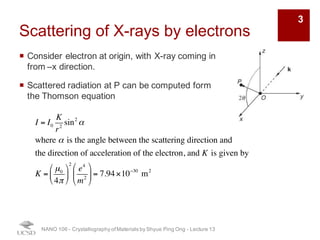
¡ Consider electron at origin, with X-ray coming in
from –x direction.
¡ Scattered radiation at P can be computed form
the Thomson equation
NANO 106 - Crystallography ofMaterials by Shyue Ping Ong - Lecture 12
I = I0
K
r2
sin2
α
where α is the angle between the scattering direction and
the direction of acceleration of the electron, and K is given by
K =
µ0
4π
!
"
#
$
%
&
2
e4
m2
!
"
#
$
%
& = 7.94×10⁻³⁰
m2
3
Scattering of X-rays by electrons,
contd.
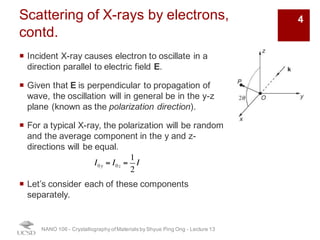
¡ Incident X-ray causes electron to oscillate in a
direction parallel to electric field E.
¡ Given that E is perpendicular to propagation of
wave, the oscillation will in general be in the y-z
plane (known as the polarization direction).
¡ For a typical X-ray, the polarization will be random
and the average component in the y and z-
directions will be equal.
¡ Let’s consider each of these components
separately.
NANO 106 - Crystallography ofMaterials by Shyue Ping Ong - Lecture 12
I0y = I0z =
1
2
I
4
Scattering of X-rays by electrons,
contd.
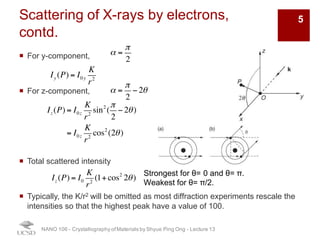
¡ For y-component,
¡ For z-component,
¡ Total scattered intensity
¡ Typically, the K/r2 will be omitted as most diffraction experiments rescale the
intensities so that the highest peak have a value of 100.
NANO 106 - Crystallography ofMaterials by Shyue Ping Ong - Lecture 12
α =
π
2
Iy (P) = I0y
K
r2
α =
π
2
− 2θ
Iz (P) = I0z
K
r2
sin2
(
π
2
− 2θ)
= I0z
K
r2
cos2
(2θ)
Iz (P) = I0
K
r2
(1+cos2
2θ)
Strongest for θ= 0 and θ= π.
Weakest for θ= π/2.
5
Compton Scattering
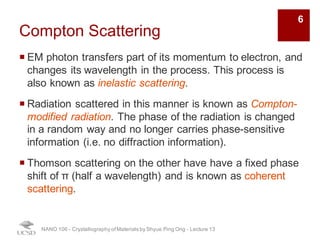
¡ EM photon transfers part of its momentum to electron, and
changes its wavelength in the process. This process is
also known as inelastic scattering.
¡ Radiation scattered in this manner is known as Compton-
modified radiation. The phase of the radiation is changed
in a random way and no longer carries phase-sensitive
information (i.e. no diffraction information).
¡ Thomson scattering on the other hand have a fixed phase
shift of π (half a wavelength) and is known as coherent
scattering.
NANO 106 - Crystallography ofMaterials by Shyue Ping Ong - Lecture 12
6
Scattering of X-rays by an atom
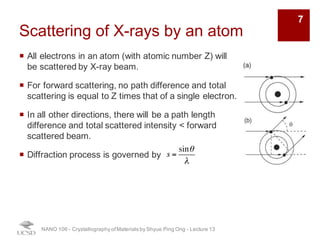
¡ All electrons in an atom (with atomic number Z) will
be scattered by X-ray beam.
¡ For forward scattering, no path difference and total
scattering is equal to Z times that of a single electron.
¡ In all other directions, there will be a path length
difference and total scattered intensity < forward
scattered beam.
¡ Diffraction process is governed by
NANO 106 - Crystallography ofMaterials by Shyue Ping Ong - Lecture 12
s =
sinθ
λ
7
Atomic scattering factor
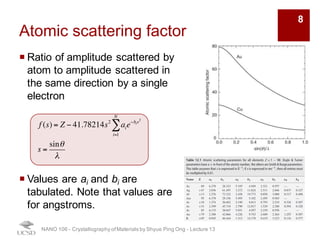
¡ Ratio of amplitude scattered by
atom to amplitude scattered in
the same direction by a single
electron
¡ Values are ai and bi are
tabulated. Note that values are
for angstroms.
NANO 106 - Crystallography ofMaterials by Shyue Ping Ong - Lecture 12
f (s) = Z − 41.78214s2
aie−bis2
i=1
N
∑
s =
sinθ
λ
8
Example: W
¡ Consider contribution of single W atom to Cu Kα radiation
from (222) plane of bcc crystal with lattice parameter a =
3.1653 A.
NANO 106 - Crystallography ofMaterials by Shyue Ping Ong - Lecture 12
Blackboard
9
Scattering of X-rays by a unit cell
¡ Extending the concept further, the scattering of X-rays by
a unit cell can be computed by taking into account the
relative positions of atoms.
¡ As seen previously, destructive interference can occur in
an atom because of the relative positions of electrons in
an atom. The same can happen in a unit cell.
NANO 106 - Crystallography ofMaterials by Shyue Ping Ong - Lecture 12
10
Scattering of X-rays by a unit cell,
contd.
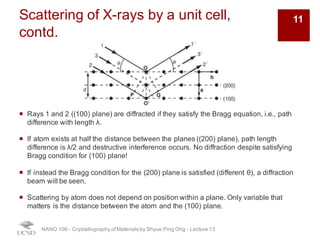
¡ Rays 1 and 2 ((100) plane) are diffracted if they satisfy the Bragg equation, i.e., path
difference with length λ.
¡ If atom exists at half the distance between the planes ((200) plane), path length
difference is λ/2 and destructive interference occurs. No diffraction despite satisfying
Bragg condition for (100) plane!
¡ If instead the Bragg condition for the (200) plane is satisfied (different θ), a diffraction
beam will be seen.
¡ Scattering by atom does not depend on position within a plane. Only variable that
matters is the distance between the atom and the (100) plane.
NANO 106 - Crystallography ofMaterials by Shyue Ping Ong - Lecture 12
11
Scattering of X-rays by a unit cell,
contd.
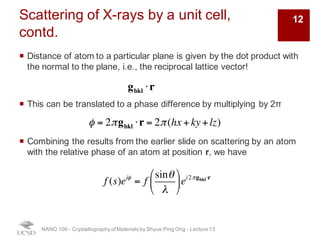
¡ Distance of atom to a particular plane is given by the dot product with
the normal to the plane, i.e., the reciprocal lattice vector!
¡ This can be translated to a phase difference by multiplying by 2π
¡ Combining the results from the earlier slide on scattering by an atom
with the relative phase of an atom at position r, we have
NANO 106 - Crystallography ofMaterials by Shyue Ping Ong - Lecture 12
ghkl ⋅r
φ = 2πghkl ⋅r = 2π(hx + ky+lz)
f (s)eiφ
= f
sinθ
λ
!
"
#
$
%
&ei2πghkl⋅r
12
Structure Factor
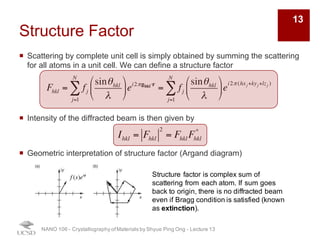
¡ Scattering by complete unit cell is simply obtained by summing the scattering
for all atoms in a unit cell. We can define a structure factor
¡ Intensity of the diffracted beam is then given by
¡ Geometric interpretation of structure factor (Argand diagram)
NANO 106 - Crystallography ofMaterials by Shyue Ping Ong - Lecture 12
Fhkl = fj
sinθhkl
λ
!
"
#
$
%
&ei2πghkl⋅r
j=1
N
∑ = fj
sinθhkl
λ
!
"
#
$
%
&e
i2π (hxj +kyj +lzj )
j=1
N
∑
Ihkl = Fhkl
2
= FhklFhkl
*
f (s)eiφ Structure factor is complex sum of
scattering from each atom. If sum goes
back to origin, there is no diffracted beam
even if Bragg condition is satisfied (known
as extinction).
13
Effect of lattice centering on F
¡ We will now consider the effect of the different kinds of
lattice centerings on the structure factor, F.
¡ Recall that for 3D Bravais lattices, there are four different
centerings:
¡ Primitive – no centering
¡ C-centering (A and B-centering are similar)
¡ I-centering (or body-centering)
¡ F-centering (or face-centering)
NANO 106 - Crystallography ofMaterials by Shyue Ping Ong - Lecture 12
14
Structure factor for primitive lattice
¡ For a primitive lattice, there are no other symmetrically
equivalent atoms in the unit cell.
¡ If we only have a single atom in the unit cell at r = (0, 0, 0)
[note we have dropped the functional dependence of f for
brevity]
¡ Note that f does depend on the lattice plane (hkl) through
the dependence on θ.
¡ No extinctions and all planes give rise to diffracted beam.
NANO 106 - Crystallography ofMaterials by Shyue Ping Ong - Lecture 12
Fhkl = f
I = f 2
15
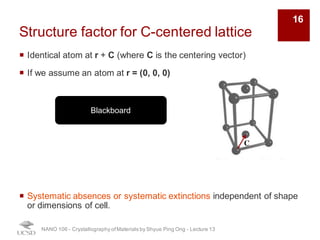
Structure factor for C-centered lattice
¡ Identical atom at r + C (where C is the centering vector)
¡ If we assume an atom at r = (0, 0, 0)
¡ Systematic absences or systematic extinctions independent of shape
or dimensions of cell.
NANO 106 - Crystallography ofMaterials by Shyue Ping Ong - Lecture 12
C
Blackboard
16
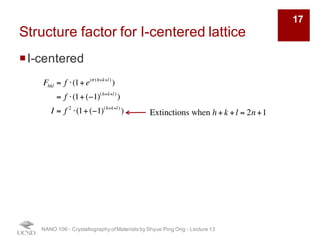
Structure factor for I-centered lattice
¡I-centered
NANO 106 - Crystallography ofMaterials by Shyue Ping Ong - Lecture 12
17
Fhkl = f ⋅ 1+ eiπ (h+k+l)
( )
= f ⋅ 1+ (−1)h+k+l
( )
I = f 2
⋅ 1+ (−1)h+k+l
( )
2
Extinction when h + k + l = 2n + 1
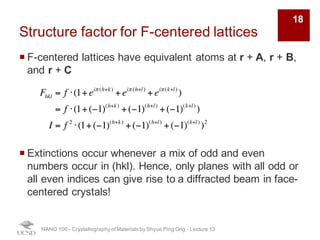
Structure factor for F-centered lattices
¡ F-centered lattices have equivalent atoms at r + A, r + B,
and r + C
¡ Extinctions occur whenever a mix of odd and even
numbers occur in (hkl). Hence, only planes with all odd or
all even indices can give rise to a diffracted beam in face-
centered crystals!
NANO 106 - Crystallography ofMaterials by Shyue Ping Ong - Lecture 12
18
Fhkl = f ⋅ 1+ eiπ (h+k)
+ eiπ (h+l)
+ eiπ (k+l)
( )
= f ⋅ 1+ (−1)h+k
+ (−1)h+l
+ (−1)k+l
( )
I = f 2
⋅ 1+ (−1)h+k
+ (−1)h+l
+ (−1)k+l
( )
2
Symmetry implications on the structure
factor
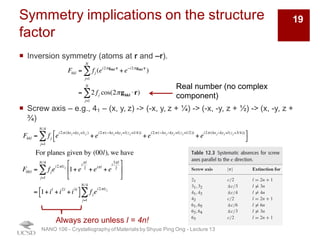
¡ Inversion symmetry (atoms at r and –r).
¡ Screw axis – e.g., 41 – (x, y, z) -> (-x, y, z + ¼) -> (-x, -y, z + ½) -> (x, -y, z +
¾)
NANO 106 - Crystallography ofMaterials by Shyue Ping Ong - Lecture 12
Fhkl = fj (ei2πghkl⋅r
+e−i2πghkl⋅r
)
j=1
N
∑
= 2 fj cos(2πghkl ⋅r)
j=1
N
∑
Real number (no complex
component)
Fhkl = fj e
i2π (hxj +kyj +lzj )
+ e
i2π (−hxj +kyj +l(zj +1/4))
+ e
i2π (−hxj −kyj +l(zj +1/2))
+ e
i2π (hxj −kyj +l(zj +3/4))"
#
$
%
j=1
N/4
∑
For planes given by (00l), we have
F00l = fje
i2πlzj
1+ e
i
πl
2
+ eiπl
+ e
i
3πl
2
"
#
'
$
%
(
j=1
N/4
∑
= 1+il
+i2l
+i3l"# $% fje
i2πlzj
j=1
N/4
∑
Always zero unless l = 4n!
19
Symmetry implications on the structure
factor, contd.
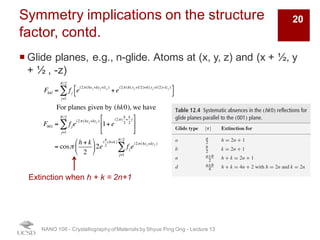
¡ Glide planes, e.g., n-glide. Atoms at (x, y, z) and (x + ½, y
+ ½ , -z)
NANO 106 - Crystallography ofMaterials by Shyue Ping Ong - Lecture 12
Extinction when h + k = 2n+1
20
Fhkl = fj e
i2π hxj +kyj +lzj( ) + e
i2π h(xj +0.5)+k(yj +0.5)−lzj( )
( )j=1
N/2
∑
For planes given by (hk0), we have
Fhk0 = fje
i2π hxj +kyj( ) 1+ ei2π 0.5h+0.5k( )
( )j=1
N/2
∑
= cos
π
2
(h + k)
⎛
⎝⎜
⎞
⎠⎟ 2e
i
π
2
hxj +kyj( )
fje
i2π hxj +kyj( )
j=1
N/2
∑
Friedel’s Law
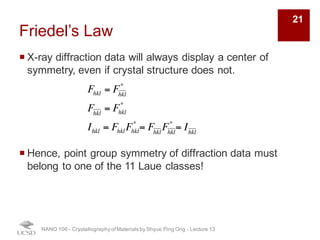
¡ X-ray diffraction data will always display a center of
symmetry, even if crystal structure does not.
¡ Hence, point group symmetry of diffraction data must
belong to one of the 11 Laue classes!
NANO 106 - Crystallography ofMaterials by Shyue Ping Ong - Lecture 12
Fhkl = Fhkl
*
Fhkl
= Fhkl
*
Ihkl = FhklFhkl
*
= Fhkl
Fhkl
*
= Ihkl
21
International tables and systematic
absences
NANO 106 - Crystallography ofMaterials by Shyue Ping Ong - Lecture 12
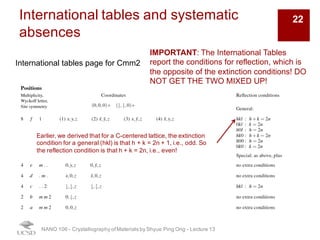
International tables page for Cmm2
IMPORTANT: The International Tables
report the conditions for reflection, which is
the opposite of the extinction conditions! DO
NOT GET THE TWO MIXED UP!
Earlier, we derived that for a C-centered lattice, the extinction
condition for a general (hkl) is that h + k = 2n + 1, i.e., odd. So
the reflection condition is that h + k = 2n, i.e., even!
22
International tables and systematic
absences
NANO 106 - Crystallography ofMaterials by Shyue Ping Ong - Lecture 12
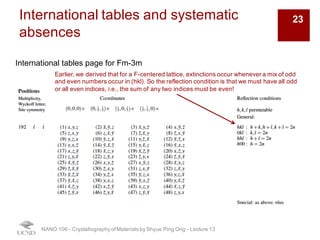
International tables page for Fm-3m
Earlier, we derived that for a F-centered lattice, extinctions occur whenever a mix of odd
and even numbers occur in (hkl). So the reflection condition is that we must have all odd
or all even indices, i.e., the sum of any two indices must be even!
23
Practical calculations of the Structure
Factor
¡We will now illustrate how you can compute the
structure factor for a given crystal structure, and
also discuss how missing reflections provide
information about the arrangement of atoms in
the structure.
NANO 106 - Crystallography ofMaterials by Shyue Ping Ong - Lecture 12
24
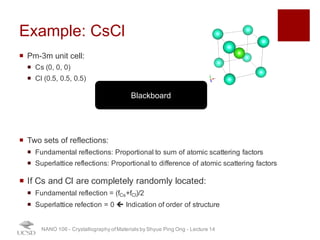
Example: CsCl
¡ Pm-3m unit cell:
¡ Cs (0, 0, 0)
¡ Cl (0.5, 0.5, 0.5)
¡ Two sets of reflections:
¡ Fundamental reflections: Proportional to sum of atomic scattering factors
¡ Superlattice reflections: Proportional to difference of atomic scattering factors
¡ If Cs and Cl are completely randomly located:
¡ Fundamental reflection = (fCs+fCl)/2
¡ Superlattice refection = 0 ç Indication of order of structure
NANO 106 - Crystallography ofMaterials by Shyue Ping Ong - Lecture 12
Blackboard
25
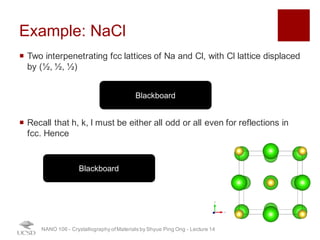
Example: NaCl
¡ Two interpenetrating fcc lattices of Na and Cl, with Cl lattice displaced
by (½, ½, ½)
¡ Recall that h, k, l must be either all odd or all even for reflections in
fcc. Hence
NANO 106 - Crystallography ofMaterials by Shyue Ping Ong - Lecture 12
Blackboard
Blackboard
26
Measured diffraction intensities
¡ XRD experiments are carried out for a certain period of
time with a detector with a certain aperture.
¡ Measured XRD patterns are time averages of the
scattered intensity and only a small fraction of total
scattered intensity is measured.
¡ To go from computed intensities to measured intensities,
we need to consider the effects of
¡ Temperature
¡ Absorption
¡ Multiplicity
¡ Geometry
NANO 106 - Crystallography ofMaterials by Shyue Ping Ong - Lecture 12
27
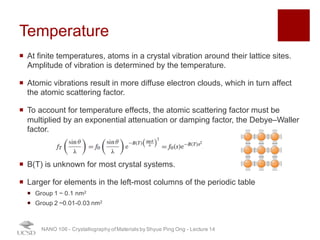
Temperature
¡ At finite temperatures, atoms in a crystal vibration around their lattice sites.
Amplitude of vibration is determined by the temperature.
¡ Atomic vibrations result in more diffuse electron clouds, which in turn affect
the atomic scattering factor.
¡ To account for temperature effects, the atomic scattering factor must be
multiplied by an exponential attenuation or damping factor, the Debye–Waller
factor.
¡ B(T) is unknown for most crystal systems.
¡ Larger for elements in the left-most columns of the periodic table
¡ Group 1 ~ 0.1 nm2
¡ Group 2 ~0.01-0.03 nm2
NANO 106 - Crystallography ofMaterials by Shyue Ping Ong - Lecture 12
28
Absorption factor
¡ X-rays travelling through a media is partially absorbed.
¡ Intensities must be scaled by absorption factor, A.
¡ For standard powder diffractometer, however, it can be
shown that this factor is a constant independent of
diffraction angle. Hence, this may be ignored since we are
usually interested only in relative intensities.
NANO 106 - Crystallography ofMaterials by Shyue Ping Ong - Lecture 12
29
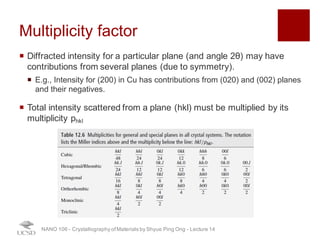
Multiplicity factor
¡ Diffracted intensity for a particular plane (and angle 2θ) may have
contributions from several planes (due to symmetry).
¡ E.g., Intensity for (200) in Cu has contributions from (020) and (002) planes
and their negatives.
¡ Total intensity scattered from a plane (hkl) must be multiplied by its
multiplicity phkl
NANO 106 - Crystallography ofMaterials by Shyue Ping Ong - Lecture 12
30
Lorentz Polarization Factor
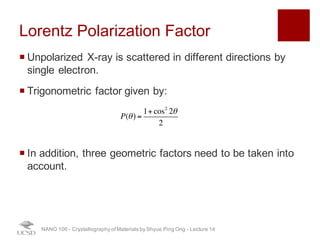
¡ Unpolarized X-ray is scattered in different directions by
single electron.
¡ Trigonometric factor given by:
¡ In addition, three geometric factors need to be taken into
account.
NANO 106 - Crystallography ofMaterials by Shyue Ping Ong - Lecture 12
P(θ) =
1+cos2
2θ
2
31
Lorentz Polarization Geometric Factor 1
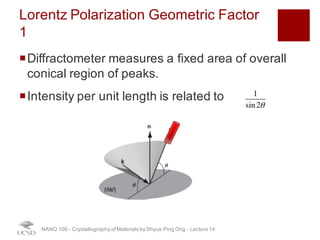
¡Diffractometer measures a fixed area of overall
conical region of peaks.
¡Intensity per unit length is related to
NANO 106 - Crystallography ofMaterials by Shyue Ping Ong - Lecture 12
1
sin2θ
32
Lorentz Polarization Geometric Factor 2
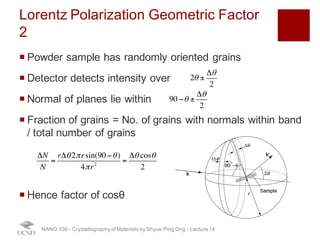
¡ Powder sample has randomly oriented grains
¡ Detector detects intensity over
¡ Normal of planes lie within
¡ Fraction of grains = No. of grains with normals within band
/ total number of grains
¡ Hence factor of cosθ
NANO 106 - Crystallography ofMaterials by Shyue Ping Ong - Lecture 12
2θ ±
Δθ
2
90 −θ ±
Δθ
2
ΔN
N
=
rΔθ2πrsin(90 −θ)
4πr2
=
Δθ cosθ
2
33
Lorentz Polarization Geometric Factor 3
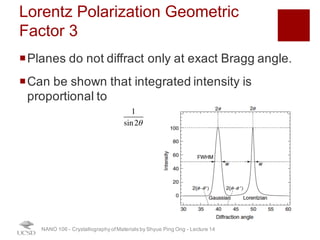
¡Planes do not diffract only at exact Bragg angle.
¡Can be shown that integrated intensity is
proportional to
NANO 106 - Crystallography ofMaterials by Shyue Ping Ong - Lecture 12
1
sin2θ
34
Overall correction
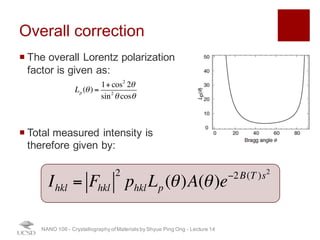
¡ The overall Lorentz polarization
factor is given as:
¡ Total measured intensity is
therefore given by:
NANO 106 - Crystallography ofMaterials by Shyue Ping Ong - Lecture 12
Lp (θ) =
1+cos2
2θ
sin2
θ cosθ
Ihkl = Fhkl
2
phklLp (θ)A(θ)e−2B(T )s2
35
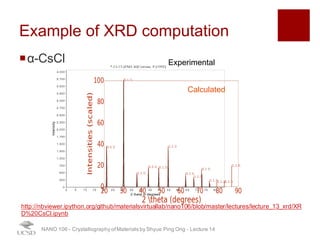
¡α-CsCl
Example of XRD computation
NANO 106 - Crystallography ofMaterials by Shyue Ping Ong - Lecture 12
Calculated
Experimental
http://nbviewer.ipython.org/github/materialsvirtuallab/nano106/blob/master/lectures/lecture_13_xrd/XR
D%20CsCl.ipynb
36
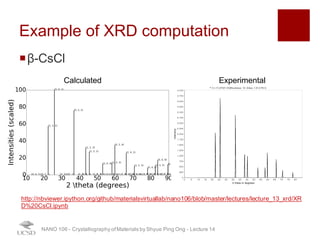
Example of XRD computation
¡β-CsCl
NANO 106 - Crystallography ofMaterials by Shyue Ping Ong - Lecture 12
Calculated Experimental
http://nbviewer.ipython.org/github/materialsvirtuallab/nano106/blob/master/lectures/lecture_13_xrd/XR
D%20CsCl.ipynb
37
Crystal structures and powder
diffraction patterns
¡We will use two examples – Ni and NaCl
¡For each structure, we will perform:
¡ Crystal structure è Diffraction pattern
¡ Diffraction pattern è Crystal structure
NANO 106 - Crystallography ofMaterials by Shyue Ping Ong - Lecture 12
38
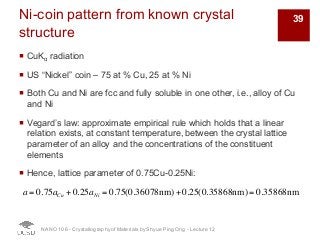
Ni-coin pattern from known crystal
structure
¡ CuKα radiation
¡ US “Nickel” coin – 75 at % Cu, 25 at % Ni
¡ Both Cu and Ni are fcc and fully soluble in one other, i.e., alloy of Cu
and Ni
¡ Vegard’s law: approximate empirical rule which holds that a linear
relation exists, at constant temperature, between the crystal lattice
parameter of an alloy and the concentrations of the constituent
elements
¡ Hence, lattice parameter of 0.75Cu-0.25Ni:
NANO 106 - Crystallography ofMaterials by Shyue Ping Ong - Lecture 12
a = 0.75aCu + 0.25aNi = 0.75(0.36078nm)+ 0.25(0.35868nm) = 0.35868nm
39
Ni-coin pattern from known crystal
structure
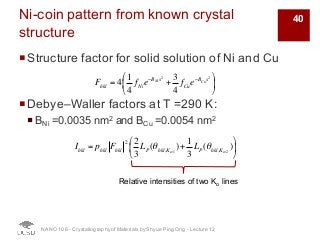
¡Structure factor for solid solution of Ni and Cu
¡Debye–Waller factors at T =290 K:
¡ BNi =0.0035 nm2 and BCu =0.0054 nm2
NANO 106 - Crystallography ofMaterials by Shyue Ping Ong - Lecture 12
Fhkl = 4
1
4
fNie−BNis2
+
3
4
fCue−BCus2"
#
$
%
&
'
Ihkl = phkl Fhkl
2 2
3
LP (θhkl,Kα1
)+
1
3
LP (θhkl,Kα 2
)
!
"
#
$
%
&
Relative intensities of two Kα lines
40
Computed vs experimental intensities
of nickel coin
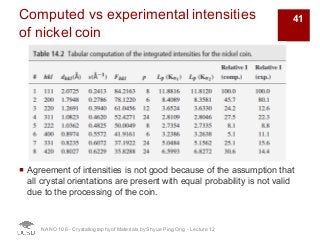
¡ Agreement of intensities is not good because of the assumption that
all crystal orientations are present with equal probability is not valid
due to the processing of the coin.
NANO 106 - Crystallography ofMaterials by Shyue Ping Ong - Lecture 12
41
NaCl diffraction pattern from known
crystal
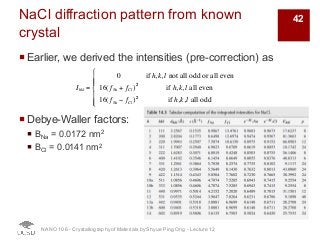
¡ Earlier, we derived the intensities (pre-correction) as
¡ Debye-Waller factors:
¡ BNa = 0.0172 nm2
¡ BCl = 0.0141 nm2
NANO 106 - Crystallography ofMaterials by Shyue Ping Ong - Lecture 12
Ihkl =
0 if h,k,l not all odd or all even
16( fNa + fCl )22
if h,k,l all even
16( fNa − fCl )22
if h,k,l all odd
"
#
$$
%
$
$
42
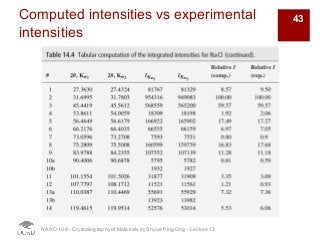
Computed intensities vs experimental
intensities
NANO 106 - Crystallography ofMaterials by Shyue Ping Ong - Lecture 12
43
Rietveld refinement
¡Previous examples show that good accuracy can be
obtained with relatively simple approaches, but more
sophisticated approaches exist
¡Rietveld refinement is a commonly used method that
uses a least squares approach to refine a theoretical
line profile until it matches the measured profile.
¡Able to deal reliably with strongly overlapping
reflections.
¡Accounts for the background intensity, the peak
shape, the atom positions and occupations in the unit
cell, the cell parameters, thermal Debye–Waller
factors, etc.
NANO 106 - Crystallography ofMaterials by Shyue Ping Ong - Lecture 12
44
Crystal structure from diffraction
pattern
¡Far more difficult task than computation of
diffraction patterns
¡Start from the measured diffraction pattern and a
few other pieces of information, e.g., density
NANO 106 - Crystallography ofMaterials by Shyue Ping Ong - Lecture 12
45
Example: Ni-coin structure from
diffraction pattern
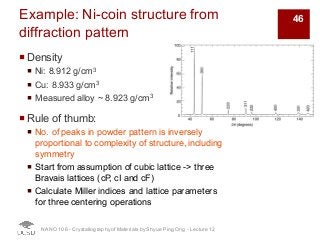
¡ Density
¡ Ni: 8.912 g/cm3
¡ Cu: 8.933 g/cm3
¡ Measured alloy ~ 8.923 g/cm3
¡ Rule of thumb:
¡ No. of peaks in powder pattern is inversely
proportional to complexity of structure, including
symmetry
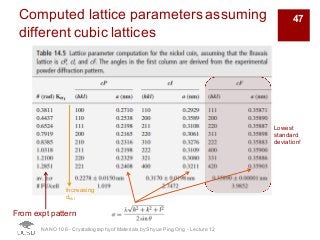
¡ Start from assumption of cubic lattice -> three
Bravais lattices (cP, cI and cF)
¡ Calculate Miller indices and lattice parameters
for three centering operations
NANO 106 - Crystallography ofMaterials by Shyue Ping Ong - Lecture 12
46
Computed lattice parameters assuming
different cubic lattices
NANO 106 - Crystallography ofMaterials by Shyue Ping Ong - Lecture 12
From expt pattern
Lowest
standard
deviation!
Increasing
dhkl
47
Caveats
¡Ni coin example seems simple, but in reality,
structure determination is difficult.
¡ Started from cubic assumption -> only 1 lattice
parameter (rather than 6)
¡Infinite number of choices for unit cell
¡Ideally, use the most symmetric unit cell, but even
if another unit cell had been chosen, should still
be able to assign Miller indices to all peaks
NANO 106 - Crystallography ofMaterials by Shyue Ping Ong - Lecture 12
48
Practical structure determination
¡ Nowadays unit cell determination is essentially a non-
linear least-squares problem that is readily solved by
means of standard numerical algorithms
¡ Determination of unit cell parameters is first step in
structure determination
¡ Once the lattice parameters are known, then the positions
of all diffracted beams are known, and one can focus on
the intensities of the individual peaks, i.e., on the
determination of the atom positions.
NANO 106 - Crystallography ofMaterials by Shyue Ping Ong - Lecture 12
49

UCSD NANO106 - 12 - X-ray diffraction

  • 1.
    X-rays diffraction Shyue PingOng Department of NanoEngineering University of California, San Diego
  • 2.
    Intensities ¡Electrons, atoms andunit cells scatter X-rays ¡Expected knowledge ¡ Know how to compute intensities given the atomic parameters and a unit cell ¡ Understand the concept of systematic extinctions, and interpret the International Tables of Crystallography on reflection and extinction conditions. ¡ Able to discuss in qualitative terms how measured intensities differ from calculated intensities NANO 106 - Crystallography ofMaterials by Shyue Ping Ong - Lecture 12 2
  • 3.
    Scattering of X-raysby electrons ¡ Consider electron at origin, with X-ray coming in from –x direction. ¡ Scattered radiation at P can be computed form the Thomson equation NANO 106 - Crystallography ofMaterials by Shyue Ping Ong - Lecture 12 I = I0 K r2 sin2 α where α is the angle between the scattering direction and the direction of acceleration of the electron, and K is given by K = µ0 4π ! " # $ % & 2 e4 m2 ! " # $ % & = 7.94×10⁻³⁰ m2 3
  • 4.
    Scattering of X-raysby electrons, contd. ¡ Incident X-ray causes electron to oscillate in a direction parallel to electric field E. ¡ Given that E is perpendicular to propagation of wave, the oscillation will in general be in the y-z plane (known as the polarization direction). ¡ For a typical X-ray, the polarization will be random and the average component in the y and z- directions will be equal. ¡ Let’s consider each of these components separately. NANO 106 - Crystallography ofMaterials by Shyue Ping Ong - Lecture 12 I0y = I0z = 1 2 I 4
  • 5.
    Scattering of X-raysby electrons, contd. ¡ For y-component, ¡ For z-component, ¡ Total scattered intensity ¡ Typically, the K/r2 will be omitted as most diffraction experiments rescale the intensities so that the highest peak have a value of 100. NANO 106 - Crystallography ofMaterials by Shyue Ping Ong - Lecture 12 α = π 2 Iy (P) = I0y K r2 α = π 2 − 2θ Iz (P) = I0z K r2 sin2 ( π 2 − 2θ) = I0z K r2 cos2 (2θ) Iz (P) = I0 K r2 (1+cos2 2θ) Strongest for θ= 0 and θ= π. Weakest for θ= π/2. 5
  • 6.
    Compton Scattering ¡ EMphoton transfers part of its momentum to electron, and changes its wavelength in the process. This process is also known as inelastic scattering. ¡ Radiation scattered in this manner is known as Compton- modified radiation. The phase of the radiation is changed in a random way and no longer carries phase-sensitive information (i.e. no diffraction information). ¡ Thomson scattering on the other hand have a fixed phase shift of π (half a wavelength) and is known as coherent scattering. NANO 106 - Crystallography ofMaterials by Shyue Ping Ong - Lecture 12 6
  • 7.
    Scattering of X-raysby an atom ¡ All electrons in an atom (with atomic number Z) will be scattered by X-ray beam. ¡ For forward scattering, no path difference and total scattering is equal to Z times that of a single electron. ¡ In all other directions, there will be a path length difference and total scattered intensity < forward scattered beam. ¡ Diffraction process is governed by NANO 106 - Crystallography ofMaterials by Shyue Ping Ong - Lecture 12 s = sinθ λ 7
  • 8.
    Atomic scattering factor ¡Ratio of amplitude scattered by atom to amplitude scattered in the same direction by a single electron ¡ Values are ai and bi are tabulated. Note that values are for angstroms. NANO 106 - Crystallography ofMaterials by Shyue Ping Ong - Lecture 12 f (s) = Z − 41.78214s2 aie−bis2 i=1 N ∑ s = sinθ λ 8
  • 9.
    Example: W ¡ Considercontribution of single W atom to Cu Kα radiation from (222) plane of bcc crystal with lattice parameter a = 3.1653 A. NANO 106 - Crystallography ofMaterials by Shyue Ping Ong - Lecture 12 Blackboard 9
  • 10.
    Scattering of X-raysby a unit cell ¡ Extending the concept further, the scattering of X-rays by a unit cell can be computed by taking into account the relative positions of atoms. ¡ As seen previously, destructive interference can occur in an atom because of the relative positions of electrons in an atom. The same can happen in a unit cell. NANO 106 - Crystallography ofMaterials by Shyue Ping Ong - Lecture 12 10
  • 11.
    Scattering of X-raysby a unit cell, contd. ¡ Rays 1 and 2 ((100) plane) are diffracted if they satisfy the Bragg equation, i.e., path difference with length λ. ¡ If atom exists at half the distance between the planes ((200) plane), path length difference is λ/2 and destructive interference occurs. No diffraction despite satisfying Bragg condition for (100) plane! ¡ If instead the Bragg condition for the (200) plane is satisfied (different θ), a diffraction beam will be seen. ¡ Scattering by atom does not depend on position within a plane. Only variable that matters is the distance between the atom and the (100) plane. NANO 106 - Crystallography ofMaterials by Shyue Ping Ong - Lecture 12 11
  • 12.
    Scattering of X-raysby a unit cell, contd. ¡ Distance of atom to a particular plane is given by the dot product with the normal to the plane, i.e., the reciprocal lattice vector! ¡ This can be translated to a phase difference by multiplying by 2π ¡ Combining the results from the earlier slide on scattering by an atom with the relative phase of an atom at position r, we have NANO 106 - Crystallography ofMaterials by Shyue Ping Ong - Lecture 12 ghkl ⋅r φ = 2πghkl ⋅r = 2π(hx + ky+lz) f (s)eiφ = f sinθ λ ! " # $ % &ei2πghkl⋅r 12
  • 13.
    Structure Factor ¡ Scatteringby complete unit cell is simply obtained by summing the scattering for all atoms in a unit cell. We can define a structure factor ¡ Intensity of the diffracted beam is then given by ¡ Geometric interpretation of structure factor (Argand diagram) NANO 106 - Crystallography ofMaterials by Shyue Ping Ong - Lecture 12 Fhkl = fj sinθhkl λ ! " # $ % &ei2πghkl⋅r j=1 N ∑ = fj sinθhkl λ ! " # $ % &e i2π (hxj +kyj +lzj ) j=1 N ∑ Ihkl = Fhkl 2 = FhklFhkl * f (s)eiφ Structure factor is complex sum of scattering from each atom. If sum goes back to origin, there is no diffracted beam even if Bragg condition is satisfied (known as extinction). 13
  • 14.
    Effect of latticecentering on F ¡ We will now consider the effect of the different kinds of lattice centerings on the structure factor, F. ¡ Recall that for 3D Bravais lattices, there are four different centerings: ¡ Primitive – no centering ¡ C-centering (A and B-centering are similar) ¡ I-centering (or body-centering) ¡ F-centering (or face-centering) NANO 106 - Crystallography ofMaterials by Shyue Ping Ong - Lecture 12 14
  • 15.
    Structure factor forprimitive lattice ¡ For a primitive lattice, there are no other symmetrically equivalent atoms in the unit cell. ¡ If we only have a single atom in the unit cell at r = (0, 0, 0) [note we have dropped the functional dependence of f for brevity] ¡ Note that f does depend on the lattice plane (hkl) through the dependence on θ. ¡ No extinctions and all planes give rise to diffracted beam. NANO 106 - Crystallography ofMaterials by Shyue Ping Ong - Lecture 12 Fhkl = f I = f 2 15
  • 16.
    Structure factor forC-centered lattice ¡ Identical atom at r + C (where C is the centering vector) ¡ If we assume an atom at r = (0, 0, 0) ¡ Systematic absences or systematic extinctions independent of shape or dimensions of cell. NANO 106 - Crystallography ofMaterials by Shyue Ping Ong - Lecture 12 C Blackboard 16
  • 17.
    Structure factor forI-centered lattice ¡I-centered NANO 106 - Crystallography ofMaterials by Shyue Ping Ong - Lecture 12 17 Fhkl = f ⋅ 1+ eiπ (h+k+l) ( ) = f ⋅ 1+ (−1)h+k+l ( ) I = f 2 ⋅ 1+ (−1)h+k+l ( ) 2 Extinction when h + k + l = 2n + 1
  • 18.
    Structure factor forF-centered lattices ¡ F-centered lattices have equivalent atoms at r + A, r + B, and r + C ¡ Extinctions occur whenever a mix of odd and even numbers occur in (hkl). Hence, only planes with all odd or all even indices can give rise to a diffracted beam in face- centered crystals! NANO 106 - Crystallography ofMaterials by Shyue Ping Ong - Lecture 12 18 Fhkl = f ⋅ 1+ eiπ (h+k) + eiπ (h+l) + eiπ (k+l) ( ) = f ⋅ 1+ (−1)h+k + (−1)h+l + (−1)k+l ( ) I = f 2 ⋅ 1+ (−1)h+k + (−1)h+l + (−1)k+l ( ) 2
  • 19.
    Symmetry implications onthe structure factor ¡ Inversion symmetry (atoms at r and –r). ¡ Screw axis – e.g., 41 – (x, y, z) -> (-x, y, z + ¼) -> (-x, -y, z + ½) -> (x, -y, z + ¾) NANO 106 - Crystallography ofMaterials by Shyue Ping Ong - Lecture 12 Fhkl = fj (ei2πghkl⋅r +e−i2πghkl⋅r ) j=1 N ∑ = 2 fj cos(2πghkl ⋅r) j=1 N ∑ Real number (no complex component) Fhkl = fj e i2π (hxj +kyj +lzj ) + e i2π (−hxj +kyj +l(zj +1/4)) + e i2π (−hxj −kyj +l(zj +1/2)) + e i2π (hxj −kyj +l(zj +3/4))" # $ % j=1 N/4 ∑ For planes given by (00l), we have F00l = fje i2πlzj 1+ e i πl 2 + eiπl + e i 3πl 2 " # ' $ % ( j=1 N/4 ∑ = 1+il +i2l +i3l"# $% fje i2πlzj j=1 N/4 ∑ Always zero unless l = 4n! 19
  • 20.
    Symmetry implications onthe structure factor, contd. ¡ Glide planes, e.g., n-glide. Atoms at (x, y, z) and (x + ½, y + ½ , -z) NANO 106 - Crystallography ofMaterials by Shyue Ping Ong - Lecture 12 Extinction when h + k = 2n+1 20 Fhkl = fj e i2π hxj +kyj +lzj( ) + e i2π h(xj +0.5)+k(yj +0.5)−lzj( ) ( )j=1 N/2 ∑ For planes given by (hk0), we have Fhk0 = fje i2π hxj +kyj( ) 1+ ei2π 0.5h+0.5k( ) ( )j=1 N/2 ∑ = cos π 2 (h + k) ⎛ ⎝⎜ ⎞ ⎠⎟ 2e i π 2 hxj +kyj( ) fje i2π hxj +kyj( ) j=1 N/2 ∑
  • 21.
    Friedel’s Law ¡ X-raydiffraction data will always display a center of symmetry, even if crystal structure does not. ¡ Hence, point group symmetry of diffraction data must belong to one of the 11 Laue classes! NANO 106 - Crystallography ofMaterials by Shyue Ping Ong - Lecture 12 Fhkl = Fhkl * Fhkl = Fhkl * Ihkl = FhklFhkl * = Fhkl Fhkl * = Ihkl 21
  • 22.
    International tables andsystematic absences NANO 106 - Crystallography ofMaterials by Shyue Ping Ong - Lecture 12 International tables page for Cmm2 IMPORTANT: The International Tables report the conditions for reflection, which is the opposite of the extinction conditions! DO NOT GET THE TWO MIXED UP! Earlier, we derived that for a C-centered lattice, the extinction condition for a general (hkl) is that h + k = 2n + 1, i.e., odd. So the reflection condition is that h + k = 2n, i.e., even! 22
  • 23.
    International tables andsystematic absences NANO 106 - Crystallography ofMaterials by Shyue Ping Ong - Lecture 12 International tables page for Fm-3m Earlier, we derived that for a F-centered lattice, extinctions occur whenever a mix of odd and even numbers occur in (hkl). So the reflection condition is that we must have all odd or all even indices, i.e., the sum of any two indices must be even! 23
  • 24.
    Practical calculations ofthe Structure Factor ¡We will now illustrate how you can compute the structure factor for a given crystal structure, and also discuss how missing reflections provide information about the arrangement of atoms in the structure. NANO 106 - Crystallography ofMaterials by Shyue Ping Ong - Lecture 12 24
  • 25.
    Example: CsCl ¡ Pm-3munit cell: ¡ Cs (0, 0, 0) ¡ Cl (0.5, 0.5, 0.5) ¡ Two sets of reflections: ¡ Fundamental reflections: Proportional to sum of atomic scattering factors ¡ Superlattice reflections: Proportional to difference of atomic scattering factors ¡ If Cs and Cl are completely randomly located: ¡ Fundamental reflection = (fCs+fCl)/2 ¡ Superlattice refection = 0 ç Indication of order of structure NANO 106 - Crystallography ofMaterials by Shyue Ping Ong - Lecture 12 Blackboard 25
  • 26.
    Example: NaCl ¡ Twointerpenetrating fcc lattices of Na and Cl, with Cl lattice displaced by (½, ½, ½) ¡ Recall that h, k, l must be either all odd or all even for reflections in fcc. Hence NANO 106 - Crystallography ofMaterials by Shyue Ping Ong - Lecture 12 Blackboard Blackboard 26
  • 27.
    Measured diffraction intensities ¡XRD experiments are carried out for a certain period of time with a detector with a certain aperture. ¡ Measured XRD patterns are time averages of the scattered intensity and only a small fraction of total scattered intensity is measured. ¡ To go from computed intensities to measured intensities, we need to consider the effects of ¡ Temperature ¡ Absorption ¡ Multiplicity ¡ Geometry NANO 106 - Crystallography ofMaterials by Shyue Ping Ong - Lecture 12 27
  • 28.
    Temperature ¡ At finitetemperatures, atoms in a crystal vibration around their lattice sites. Amplitude of vibration is determined by the temperature. ¡ Atomic vibrations result in more diffuse electron clouds, which in turn affect the atomic scattering factor. ¡ To account for temperature effects, the atomic scattering factor must be multiplied by an exponential attenuation or damping factor, the Debye–Waller factor. ¡ B(T) is unknown for most crystal systems. ¡ Larger for elements in the left-most columns of the periodic table ¡ Group 1 ~ 0.1 nm2 ¡ Group 2 ~0.01-0.03 nm2 NANO 106 - Crystallography ofMaterials by Shyue Ping Ong - Lecture 12 28
  • 29.
    Absorption factor ¡ X-raystravelling through a media is partially absorbed. ¡ Intensities must be scaled by absorption factor, A. ¡ For standard powder diffractometer, however, it can be shown that this factor is a constant independent of diffraction angle. Hence, this may be ignored since we are usually interested only in relative intensities. NANO 106 - Crystallography ofMaterials by Shyue Ping Ong - Lecture 12 29
  • 30.
    Multiplicity factor ¡ Diffractedintensity for a particular plane (and angle 2θ) may have contributions from several planes (due to symmetry). ¡ E.g., Intensity for (200) in Cu has contributions from (020) and (002) planes and their negatives. ¡ Total intensity scattered from a plane (hkl) must be multiplied by its multiplicity phkl NANO 106 - Crystallography ofMaterials by Shyue Ping Ong - Lecture 12 30
  • 31.
    Lorentz Polarization Factor ¡Unpolarized X-ray is scattered in different directions by single electron. ¡ Trigonometric factor given by: ¡ In addition, three geometric factors need to be taken into account. NANO 106 - Crystallography ofMaterials by Shyue Ping Ong - Lecture 12 P(θ) = 1+cos2 2θ 2 31
  • 32.
    Lorentz Polarization GeometricFactor 1 ¡Diffractometer measures a fixed area of overall conical region of peaks. ¡Intensity per unit length is related to NANO 106 - Crystallography ofMaterials by Shyue Ping Ong - Lecture 12 1 sin2θ 32
  • 33.
    Lorentz Polarization GeometricFactor 2 ¡ Powder sample has randomly oriented grains ¡ Detector detects intensity over ¡ Normal of planes lie within ¡ Fraction of grains = No. of grains with normals within band / total number of grains ¡ Hence factor of cosθ NANO 106 - Crystallography ofMaterials by Shyue Ping Ong - Lecture 12 2θ ± Δθ 2 90 −θ ± Δθ 2 ΔN N = rΔθ2πrsin(90 −θ) 4πr2 = Δθ cosθ 2 33
  • 34.
    Lorentz Polarization GeometricFactor 3 ¡Planes do not diffract only at exact Bragg angle. ¡Can be shown that integrated intensity is proportional to NANO 106 - Crystallography ofMaterials by Shyue Ping Ong - Lecture 12 1 sin2θ 34
  • 35.
    Overall correction ¡ Theoverall Lorentz polarization factor is given as: ¡ Total measured intensity is therefore given by: NANO 106 - Crystallography ofMaterials by Shyue Ping Ong - Lecture 12 Lp (θ) = 1+cos2 2θ sin2 θ cosθ Ihkl = Fhkl 2 phklLp (θ)A(θ)e−2B(T )s2 35
  • 36.
    ¡α-CsCl Example of XRDcomputation NANO 106 - Crystallography ofMaterials by Shyue Ping Ong - Lecture 12 Calculated Experimental http://nbviewer.ipython.org/github/materialsvirtuallab/nano106/blob/master/lectures/lecture_13_xrd/XR D%20CsCl.ipynb 36
  • 37.
    Example of XRDcomputation ¡β-CsCl NANO 106 - Crystallography ofMaterials by Shyue Ping Ong - Lecture 12 Calculated Experimental http://nbviewer.ipython.org/github/materialsvirtuallab/nano106/blob/master/lectures/lecture_13_xrd/XR D%20CsCl.ipynb 37
  • 38.
    Crystal structures andpowder diffraction patterns ¡We will use two examples – Ni and NaCl ¡For each structure, we will perform: ¡ Crystal structure è Diffraction pattern ¡ Diffraction pattern è Crystal structure NANO 106 - Crystallography ofMaterials by Shyue Ping Ong - Lecture 12 38
  • 39.
    Ni-coin pattern fromknown crystal structure ¡ CuKα radiation ¡ US “Nickel” coin – 75 at % Cu, 25 at % Ni ¡ Both Cu and Ni are fcc and fully soluble in one other, i.e., alloy of Cu and Ni ¡ Vegard’s law: approximate empirical rule which holds that a linear relation exists, at constant temperature, between the crystal lattice parameter of an alloy and the concentrations of the constituent elements ¡ Hence, lattice parameter of 0.75Cu-0.25Ni: NANO 106 - Crystallography ofMaterials by Shyue Ping Ong - Lecture 12 a = 0.75aCu + 0.25aNi = 0.75(0.36078nm)+ 0.25(0.35868nm) = 0.35868nm 39
  • 40.
    Ni-coin pattern fromknown crystal structure ¡Structure factor for solid solution of Ni and Cu ¡Debye–Waller factors at T =290 K: ¡ BNi =0.0035 nm2 and BCu =0.0054 nm2 NANO 106 - Crystallography ofMaterials by Shyue Ping Ong - Lecture 12 Fhkl = 4 1 4 fNie−BNis2 + 3 4 fCue−BCus2" # $ % & ' Ihkl = phkl Fhkl 2 2 3 LP (θhkl,Kα1 )+ 1 3 LP (θhkl,Kα 2 ) ! " # $ % & Relative intensities of two Kα lines 40
  • 41.
    Computed vs experimentalintensities of nickel coin ¡ Agreement of intensities is not good because of the assumption that all crystal orientations are present with equal probability is not valid due to the processing of the coin. NANO 106 - Crystallography ofMaterials by Shyue Ping Ong - Lecture 12 41
  • 42.
    NaCl diffraction patternfrom known crystal ¡ Earlier, we derived the intensities (pre-correction) as ¡ Debye-Waller factors: ¡ BNa = 0.0172 nm2 ¡ BCl = 0.0141 nm2 NANO 106 - Crystallography ofMaterials by Shyue Ping Ong - Lecture 12 Ihkl = 0 if h,k,l not all odd or all even 16( fNa + fCl )22 if h,k,l all even 16( fNa − fCl )22 if h,k,l all odd " # $$ % $ $ 42
  • 43.
    Computed intensities vsexperimental intensities NANO 106 - Crystallography ofMaterials by Shyue Ping Ong - Lecture 12 43
  • 44.
    Rietveld refinement ¡Previous examplesshow that good accuracy can be obtained with relatively simple approaches, but more sophisticated approaches exist ¡Rietveld refinement is a commonly used method that uses a least squares approach to refine a theoretical line profile until it matches the measured profile. ¡Able to deal reliably with strongly overlapping reflections. ¡Accounts for the background intensity, the peak shape, the atom positions and occupations in the unit cell, the cell parameters, thermal Debye–Waller factors, etc. NANO 106 - Crystallography ofMaterials by Shyue Ping Ong - Lecture 12 44
  • 45.
    Crystal structure fromdiffraction pattern ¡Far more difficult task than computation of diffraction patterns ¡Start from the measured diffraction pattern and a few other pieces of information, e.g., density NANO 106 - Crystallography ofMaterials by Shyue Ping Ong - Lecture 12 45
  • 46.
    Example: Ni-coin structurefrom diffraction pattern ¡ Density ¡ Ni: 8.912 g/cm3 ¡ Cu: 8.933 g/cm3 ¡ Measured alloy ~ 8.923 g/cm3 ¡ Rule of thumb: ¡ No. of peaks in powder pattern is inversely proportional to complexity of structure, including symmetry ¡ Start from assumption of cubic lattice -> three Bravais lattices (cP, cI and cF) ¡ Calculate Miller indices and lattice parameters for three centering operations NANO 106 - Crystallography ofMaterials by Shyue Ping Ong - Lecture 12 46
  • 47.
    Computed lattice parametersassuming different cubic lattices NANO 106 - Crystallography ofMaterials by Shyue Ping Ong - Lecture 12 From expt pattern Lowest standard deviation! Increasing dhkl 47
  • 48.
    Caveats ¡Ni coin exampleseems simple, but in reality, structure determination is difficult. ¡ Started from cubic assumption -> only 1 lattice parameter (rather than 6) ¡Infinite number of choices for unit cell ¡Ideally, use the most symmetric unit cell, but even if another unit cell had been chosen, should still be able to assign Miller indices to all peaks NANO 106 - Crystallography ofMaterials by Shyue Ping Ong - Lecture 12 48
  • 49.
    Practical structure determination ¡Nowadays unit cell determination is essentially a non- linear least-squares problem that is readily solved by means of standard numerical algorithms ¡ Determination of unit cell parameters is first step in structure determination ¡ Once the lattice parameters are known, then the positions of all diffracted beams are known, and one can focus on the intensities of the individual peaks, i.e., on the determination of the atom positions. NANO 106 - Crystallography ofMaterials by Shyue Ping Ong - Lecture 12 49