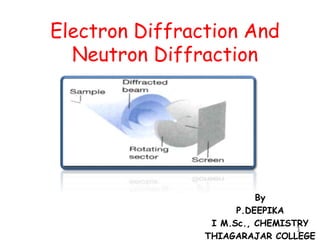
Electron Diffraction And
Neutron Diffraction
By
P.DEEPIKA
I M.Sc., CHEMISTRY
THIAGARAJAR COLLEGE
1
CONTENTS
• INTRODUCTION
• PRINCIPLE
• INSTRUMENTATION
• WORKING
• APPLICATION
• ADVANTAGES
2
When collimated beam of electron waves strikes pair of parallel
lattice planes in a crystal,each atom act as a scattering centre
and emits secondary waves All of the secondary waves
interfere with each other to produce diffracted beam
• An interaction between a wave of any kind
and an object of any kind
3
TYPES OF DIFFRACTION
 X-RAY DIFFRACTION
 ELECTRON DIFFRACTION
 NEUTRON DIFFRACTION
4
BASIC PRINCIPLE
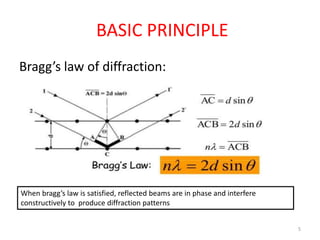
Bragg’s law of diffraction:
When bragg’s law is satisfied, reflected beams are in phase and interfere
constructively to produce diffraction patterns
5
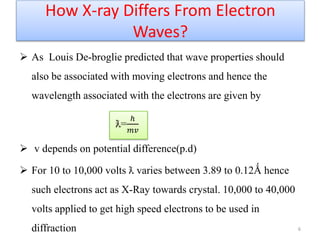
 As Louis De-broglie predicted that wave properties should
also be associated with moving electrons and hence the
wavelength associated with the electrons are given by
ƛ=
ℎ
𝑚𝑣
 v depends on potential difference(p.d)
 For 10 to 10,000 volts ƛ varies between 3.89 to 0.12Ǻ hence
such electrons act as X-Ray towards crystal. 10,000 to 40,000
volts applied to get high speed electrons to be used in
diffraction
How X-ray Differs From Electron
Waves?
6
INSTRUMENTATION
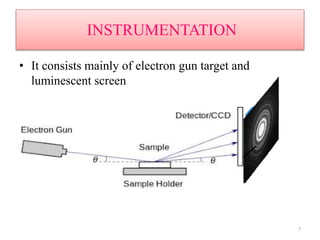
• It consists mainly of electron gun target and
luminescent screen
7
8
WORKING
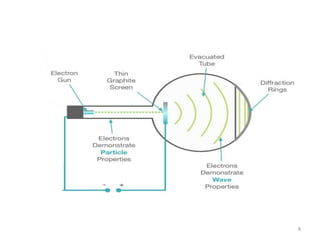
 It involves generation of electrons by a hot filament,
made accelerated by applying p.d of about 40,000
volts, passage of electrons passing through the sample
 As a result it get diffracted and the effect is seen on
the fluorescent screen in the form of concentric rings
9
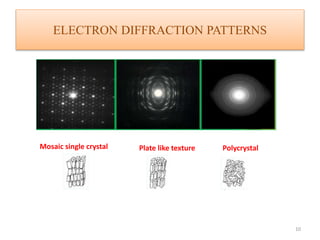
ELECTRON DIFFRACTION PATTERNS
Mosaic single crystal Plate like texture Polycrystal
10
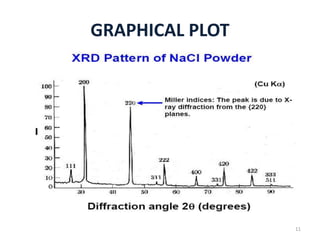
GRAPHICAL PLOT
11
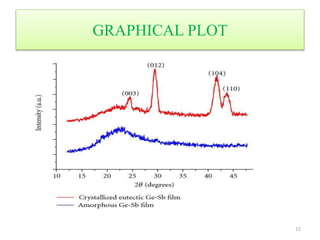
GRAPHICAL PLOT
12
APPLICATIONS
• It is used to investigate the nature of solid surfaces and surface films
• It has its own importance in studying the surface structures of thin
films
• Particularly this technique is more effective for gases and vapours for
measuring the bond distances and bond angles
• It also gives information about electron distribution in the given
sample
13
ADVANTAGES OVER X-RAY
• Being less penetrate than X-Rays , their interaction with the
surface level is more intimate.
• In electron diffraction the intensity of diffraction pattern is
high and so only very short exposure times are necessary when
compared to that of X-rays
14
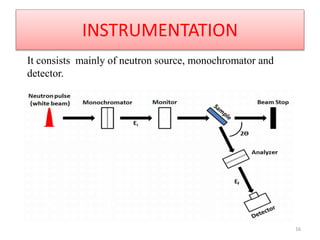
NEUTRON DIFFRACTION
• Neutron diffraction is the application of neutron scattering to
the determination of the atomic structure of the material
• When a beam of neutrons emanating from a reactor is slowed
down and selected properly by their speed, their wavelength
lies near one angstrom (0.1 nanometer), the typical separation
between atoms in a solid material. Such a beam can then be
used to perform a diffraction experiment.
15
INSTRUMENTATION
16
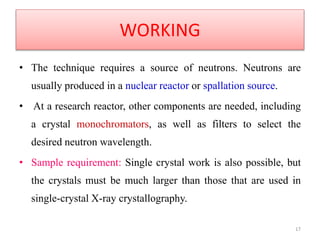
It consists mainly of neutron source, monochromator and
detector.
WORKING
• The technique requires a source of neutrons. Neutrons are
usually produced in a nuclear reactor or spallation source.
• At a research reactor, other components are needed, including
a crystal monochromators, as well as filters to select the
desired neutron wavelength.
• Sample requirement: Single crystal work is also possible, but
the crystals must be much larger than those that are used in
single-crystal X-ray crystallography.
17
TYPES OF SCATTERING
Nuclear scattering
Magnetic scattering
18
NUCLEAR SCATTERING
• Nuclear scattering is due to the interaction of neutrons with atomic
nuclei
• Neutrons interact directly with the nucleus of the atom, and the
contribution to the diffracted intensity depends on each isotope; for
example, regular hydrogen and deuterium contribute differently.
• It is also often the case that light (low Z) atoms contribute strongly
to the diffracted intensity, even in the presence of large Z atoms.
19
MAGNETIC SCATTERING
• Although neutrons are uncharged, they carry a magnetic moment,
and therefore interact with magnetic moments, including those
arising from the electron cloud around an atom.
• Neutron diffraction can therefore reveal the microscopic magnetic
structure of a material.
• Magnetic scattering requires an atomic form factor as it is caused
by the much larger electron cloud around the tiny nucleus.
20
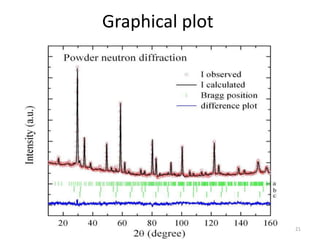
Graphical plot
21
APPLICATIONS
• Used for locating light atoms
• Used for detecting isotopes of same atomic number
• Neutron activation analysis (NAA) is a nuclear process used
for determining the concentrations of elements in a vast
amount of materials.
• Highly penetrating: Measure bulk properties can benefit
from large samples
• Main advantage is to study the magnetic properties of the
compounds comprised of transition metal series 22
`
23
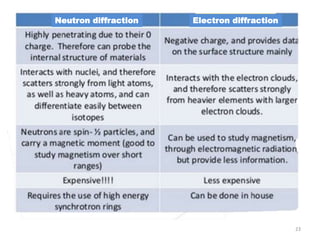
Electron diffractionNeutron diffraction
REFERENCES
• Introduction to advanced inorganic chemistry by
P.J.DURRANT and B.DURRANT
• Solid state chemistry by R.WEST and ANTHONY
• Wikipedia-diffraction techniques
24
Thank you..
25

Electron diffraction and Neutron diffraction

  • 1.
    Electron Diffraction And NeutronDiffraction By P.DEEPIKA I M.Sc., CHEMISTRY THIAGARAJAR COLLEGE 1
  • 2.
    CONTENTS • INTRODUCTION • PRINCIPLE •INSTRUMENTATION • WORKING • APPLICATION • ADVANTAGES 2
  • 3.
    When collimated beamof electron waves strikes pair of parallel lattice planes in a crystal,each atom act as a scattering centre and emits secondary waves All of the secondary waves interfere with each other to produce diffracted beam • An interaction between a wave of any kind and an object of any kind 3
  • 4.
    TYPES OF DIFFRACTION X-RAY DIFFRACTION  ELECTRON DIFFRACTION  NEUTRON DIFFRACTION 4
  • 5.
    BASIC PRINCIPLE Bragg’s lawof diffraction: When bragg’s law is satisfied, reflected beams are in phase and interfere constructively to produce diffraction patterns 5
  • 6.
     As LouisDe-broglie predicted that wave properties should also be associated with moving electrons and hence the wavelength associated with the electrons are given by ƛ= ℎ 𝑚𝑣  v depends on potential difference(p.d)  For 10 to 10,000 volts ƛ varies between 3.89 to 0.12Ǻ hence such electrons act as X-Ray towards crystal. 10,000 to 40,000 volts applied to get high speed electrons to be used in diffraction How X-ray Differs From Electron Waves? 6
  • 7.
    INSTRUMENTATION • It consistsmainly of electron gun target and luminescent screen 7
  • 8.
  • 9.
    WORKING  It involvesgeneration of electrons by a hot filament, made accelerated by applying p.d of about 40,000 volts, passage of electrons passing through the sample  As a result it get diffracted and the effect is seen on the fluorescent screen in the form of concentric rings 9
  • 10.
    ELECTRON DIFFRACTION PATTERNS Mosaicsingle crystal Plate like texture Polycrystal 10
  • 11.
  • 12.
  • 13.
    APPLICATIONS • It isused to investigate the nature of solid surfaces and surface films • It has its own importance in studying the surface structures of thin films • Particularly this technique is more effective for gases and vapours for measuring the bond distances and bond angles • It also gives information about electron distribution in the given sample 13
  • 14.
    ADVANTAGES OVER X-RAY •Being less penetrate than X-Rays , their interaction with the surface level is more intimate. • In electron diffraction the intensity of diffraction pattern is high and so only very short exposure times are necessary when compared to that of X-rays 14
  • 15.
    NEUTRON DIFFRACTION • Neutrondiffraction is the application of neutron scattering to the determination of the atomic structure of the material • When a beam of neutrons emanating from a reactor is slowed down and selected properly by their speed, their wavelength lies near one angstrom (0.1 nanometer), the typical separation between atoms in a solid material. Such a beam can then be used to perform a diffraction experiment. 15
  • 16.
    INSTRUMENTATION 16 It consists mainlyof neutron source, monochromator and detector.
  • 17.
    WORKING • The techniquerequires a source of neutrons. Neutrons are usually produced in a nuclear reactor or spallation source. • At a research reactor, other components are needed, including a crystal monochromators, as well as filters to select the desired neutron wavelength. • Sample requirement: Single crystal work is also possible, but the crystals must be much larger than those that are used in single-crystal X-ray crystallography. 17
  • 18.
    TYPES OF SCATTERING Nuclearscattering Magnetic scattering 18
  • 19.
    NUCLEAR SCATTERING • Nuclearscattering is due to the interaction of neutrons with atomic nuclei • Neutrons interact directly with the nucleus of the atom, and the contribution to the diffracted intensity depends on each isotope; for example, regular hydrogen and deuterium contribute differently. • It is also often the case that light (low Z) atoms contribute strongly to the diffracted intensity, even in the presence of large Z atoms. 19
  • 20.
    MAGNETIC SCATTERING • Althoughneutrons are uncharged, they carry a magnetic moment, and therefore interact with magnetic moments, including those arising from the electron cloud around an atom. • Neutron diffraction can therefore reveal the microscopic magnetic structure of a material. • Magnetic scattering requires an atomic form factor as it is caused by the much larger electron cloud around the tiny nucleus. 20
  • 21.
  • 22.
    APPLICATIONS • Used forlocating light atoms • Used for detecting isotopes of same atomic number • Neutron activation analysis (NAA) is a nuclear process used for determining the concentrations of elements in a vast amount of materials. • Highly penetrating: Measure bulk properties can benefit from large samples • Main advantage is to study the magnetic properties of the compounds comprised of transition metal series 22
  • 23.
  • 24.
    REFERENCES • Introduction toadvanced inorganic chemistry by P.J.DURRANT and B.DURRANT • Solid state chemistry by R.WEST and ANTHONY • Wikipedia-diffraction techniques 24
  • 25.