
NUCLEAR MAGNETIC
RESONANCE
By- Shivam Sharma , M.Pharm 1st Year
P.S.I.T
INSTRUMENTATION
OF
Presented to-
Mr. ASHISH
SRIVASTAVA
Associate Professor
Introduction to NMR
Spectroscopy
 Nuclear magnetic resonance spectroscopy is a
powerful analytical technique used to characterize
organic molecules by identifying carbon-hydrogen
frameworks within molecules.
 Two common types of NMR spectroscopy are
used to characterize organic structure: 1H NMR is
used to determine the type and number of H atoms
in a molecule; 13C NMR is used to determine the
type of carbon atoms in the molecule.
 The source of energy in NMR is radio waves which
have long wavelengths, and thus low energy and
frequency.
Instrumentation
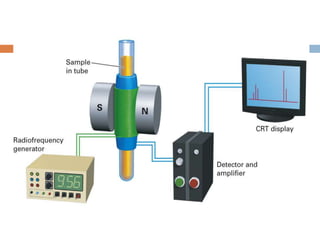
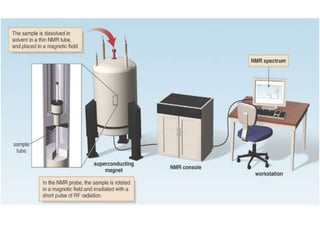
 The NMR spectrophotometer consists of
following components:-
1. Sample holder
2. Permanent Magnet
3. Magnetic coil
4. Radio frequency generator
5. Radio frequency receiver
6. Read out system
1.Sample holder
 The sample holder in NMR is normally tube-
shaped and is therefore called the sample
tube.
 The tube must be transparent to RF
radiation, durable, and chemically inert.
 Glass or Pyrex tubes are commonly used.
 These are sturdy, practical, and cheap.
 They are usually about 6-8cm long and 0.3-
0.5cm in diameter, with a plastic cap to
contain the
sample.
 This type of tube is used for obtaining
spectra of bulk samples and solutions.
2.Permanent Magnet
 Permanent Magnet or electromagnet can be
used in a NMR instrument.
 It should give stable and homogeneous
magnetic field i.e. the strength and direction
of magnetic field should not change point to
point.
 Strength field should very high i.e. 20,000
Gauss (G) . Because the chemical shifts are
proportional to the field strength.
 The magnet size is 15 inches in
diameter.
3. Magnetic coil
 There is a relationship between the resonance
frequency of nucleus and the strength of the
magnetic field in which the sample is placed .
 Relationship is-
 V = Constant × 
 For the nucleus to resonate , the precessional
frequency of the nucleus must equal to the
applied RF radiation.
 If the  is constant , the precessional
frequency is fixed.
4. Radio frequency generator
 In order to generate radio frequency radiation ,
radio frequency oscillator is used.
 To achieve the maximum interaction of the RF
radiation with the sample , the coil of oscillator
would be around the sample container.
 The oscillator irradiates the sample with a RF
radiation.
 The oscillator coil is perpendicular to the
applied magnetic field.
5. Radio frequency receiver
 It is installed perpendicular to both
magnetic field and the oscillator coil.
 It is tuned to the same frequency as
transmitter.
 When precession frequency is match with
RF radiation the nucleus induces (emf) in
detector coil and this signal is amplified
and sent to read out system.
6. Read out system
 The read out system gives a spectrum as
a plot of strength resonance signal on Y
axis & strength of magnetic field on X axis.
 The strength of resonance signal is
directly proportional to number of nuclei
resonating at that particular field strength.
Nmr  instrumentation

Nmr instrumentation

  • 1.
    NUCLEAR MAGNETIC RESONANCE By- ShivamSharma , M.Pharm 1st Year P.S.I.T INSTRUMENTATION OF Presented to- Mr. ASHISH SRIVASTAVA Associate Professor
  • 2.
    Introduction to NMR Spectroscopy Nuclear magnetic resonance spectroscopy is a powerful analytical technique used to characterize organic molecules by identifying carbon-hydrogen frameworks within molecules.  Two common types of NMR spectroscopy are used to characterize organic structure: 1H NMR is used to determine the type and number of H atoms in a molecule; 13C NMR is used to determine the type of carbon atoms in the molecule.  The source of energy in NMR is radio waves which have long wavelengths, and thus low energy and frequency.
  • 3.
    Instrumentation  The NMRspectrophotometer consists of following components:- 1. Sample holder 2. Permanent Magnet 3. Magnetic coil 4. Radio frequency generator 5. Radio frequency receiver 6. Read out system
  • 6.
    1.Sample holder  Thesample holder in NMR is normally tube- shaped and is therefore called the sample tube.  The tube must be transparent to RF radiation, durable, and chemically inert.  Glass or Pyrex tubes are commonly used.  These are sturdy, practical, and cheap.  They are usually about 6-8cm long and 0.3- 0.5cm in diameter, with a plastic cap to contain the sample.  This type of tube is used for obtaining spectra of bulk samples and solutions.
  • 7.
    2.Permanent Magnet  PermanentMagnet or electromagnet can be used in a NMR instrument.  It should give stable and homogeneous magnetic field i.e. the strength and direction of magnetic field should not change point to point.  Strength field should very high i.e. 20,000 Gauss (G) . Because the chemical shifts are proportional to the field strength.  The magnet size is 15 inches in diameter.
  • 8.
    3. Magnetic coil There is a relationship between the resonance frequency of nucleus and the strength of the magnetic field in which the sample is placed .  Relationship is-  V = Constant ×   For the nucleus to resonate , the precessional frequency of the nucleus must equal to the applied RF radiation.  If the  is constant , the precessional frequency is fixed.
  • 9.
    4. Radio frequencygenerator  In order to generate radio frequency radiation , radio frequency oscillator is used.  To achieve the maximum interaction of the RF radiation with the sample , the coil of oscillator would be around the sample container.  The oscillator irradiates the sample with a RF radiation.  The oscillator coil is perpendicular to the applied magnetic field.
  • 10.
    5. Radio frequencyreceiver  It is installed perpendicular to both magnetic field and the oscillator coil.  It is tuned to the same frequency as transmitter.  When precession frequency is match with RF radiation the nucleus induces (emf) in detector coil and this signal is amplified and sent to read out system.
  • 11.
    6. Read outsystem  The read out system gives a spectrum as a plot of strength resonance signal on Y axis & strength of magnetic field on X axis.  The strength of resonance signal is directly proportional to number of nuclei resonating at that particular field strength.