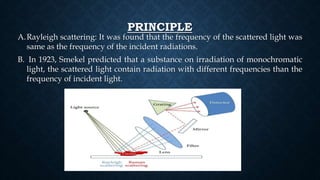
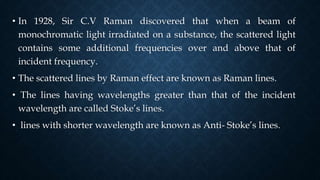
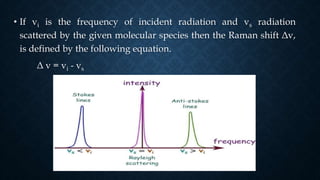
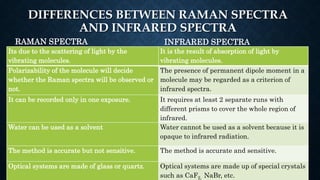
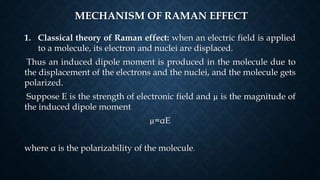
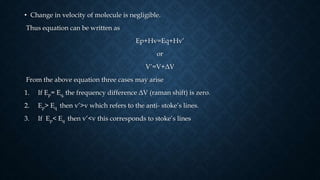
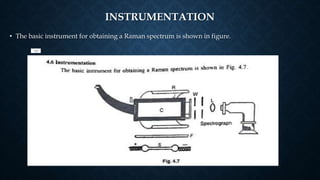
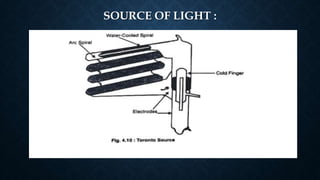
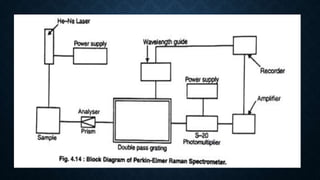
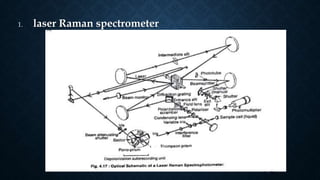
Raman spectroscopy involves scattering of monochromatic light, such as from a laser, when it interacts with molecular vibrations, phonons, or other excitations in the system being investigated. It relies on inelastic scattering, or Raman scattering, of monochromatic light, usually from a laser in the visible, near infrared, or near ultraviolet range. The laser light interacts with molecular vibrations, phonons or other excitations in the system, resulting in the energy of the laser photons being shifted up or down. The shift in energy gives information about the vibrational modes in the system. Raman spectroscopy is commonly used in chemistry to provide a fingerprint by which molecules can be identified. It can also be used to observe rotational